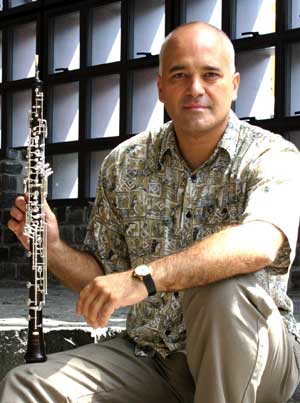
| Alex
Klein began his musical studies in his native Brazil at the age of nine,
and made his solo orchestral debut the following year. At the age of eleven,
he was invited to join the Camerata Antiqua, one of Brazil's foremost chamber
ensembles. During his teenage years, he toured and performed as a soloist,
recitalist, and as a member of several professional orchestras in Brazil.
He then studied at the Oberlin Conservatory with James Caldwell, earning
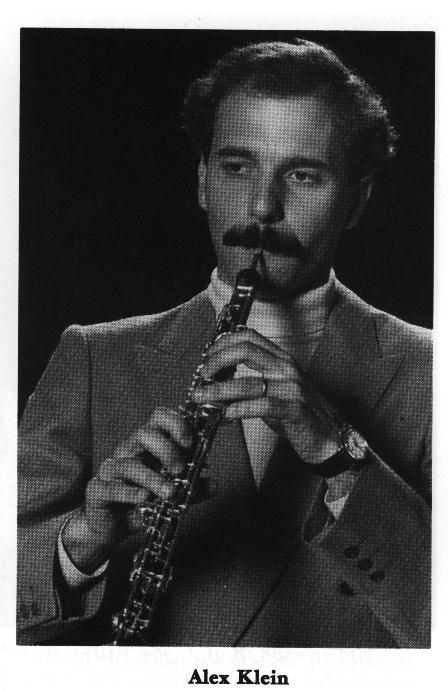
two degrees in music performance. After a year at Oberlin, Mr. Klein won first prize in the first Lucarelli International Competition for Solo Oboe Players, held at New York's Carnegie Hall. He has received many awards worldwide, including at the 1988 International Competition for Musical Performers in Geneva, Switzerland, in which he was the first oboist to be awarded first prize since Heinz Holliger, three decades earlier. Mr. Klein joined the Chicago Symphony as principal oboe in 1995. He has performed as soloist with the Chicago Symphony, Philadelphia Orchestra, Orchestre de la Suisse Romande, and Chicago Sinfonietta. He has recorded for Teldec, Boston Records, Newport Classics, Musical Heritage Society, and Cedille Records. Alex Klein won the 2002 Grammy Award for Best Instrumental Soloist with Orchestra for his recording of the Richard Strauss Oboe Concerto with Daniel Barenboim and the Chicago Symphony. Klein left the Chicago Symphony in July 2004 due to the onset of Musician's Focal Dystonia. He currently performs as a soloist and conductor, and also teaches. |
 AK: In Curitiba, Brazil. So I started on recorder
and ordered a good oboe from Germany that came through the Goethe Institute
there. Meanwhile, I would go to my oboe lessons only with a reed!
[Both laugh] Every week during my lesson, I would play on my teacher’s
oboe, and then go home and practice on the reed only. The poor dogs
in the neighborhoods! They just hated it!
AK: In Curitiba, Brazil. So I started on recorder
and ordered a good oboe from Germany that came through the Goethe Institute
there. Meanwhile, I would go to my oboe lessons only with a reed!
[Both laugh] Every week during my lesson, I would play on my teacher’s
oboe, and then go home and practice on the reed only. The poor dogs
in the neighborhoods! They just hated it!
 BD: What about the different sizes of instruments
— you play oboe d’amore and bass oboe...
BD: What about the different sizes of instruments
— you play oboe d’amore and bass oboe...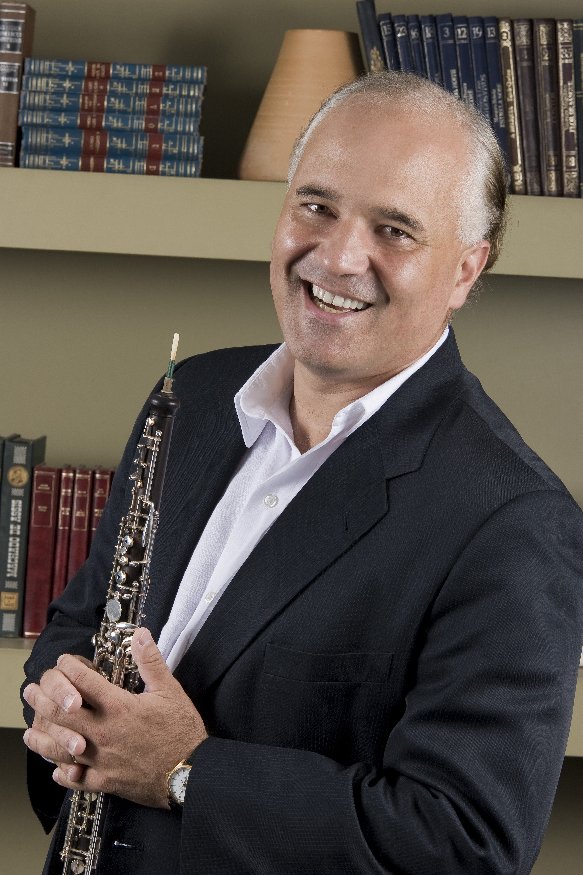 AK: Yeah, I’m very, very happy with my students.
I have very good students and they’re very dedicated. It is an interesting
process. As much as is necessary, I try to teach them the technical
aspects, then I try to concentrate on the art of music. It means digging
into people’s emotions and helping them find a channel to bring it out.
It’s very easy to play an instrument. You play it in tune and you play
the right notes. If you practice and repeat it long enough, anyone
off the street can play an instrument. That’s not hard! The hard
thing is to turn sound into emotion so that you hear three or four notes
and the word “sad” comes to your
mind, or the word “happy.”
AK: Yeah, I’m very, very happy with my students.
I have very good students and they’re very dedicated. It is an interesting
process. As much as is necessary, I try to teach them the technical
aspects, then I try to concentrate on the art of music. It means digging
into people’s emotions and helping them find a channel to bring it out.
It’s very easy to play an instrument. You play it in tune and you play
the right notes. If you practice and repeat it long enough, anyone
off the street can play an instrument. That’s not hard! The hard
thing is to turn sound into emotion so that you hear three or four notes
and the word “sad” comes to your
mind, or the word “happy.”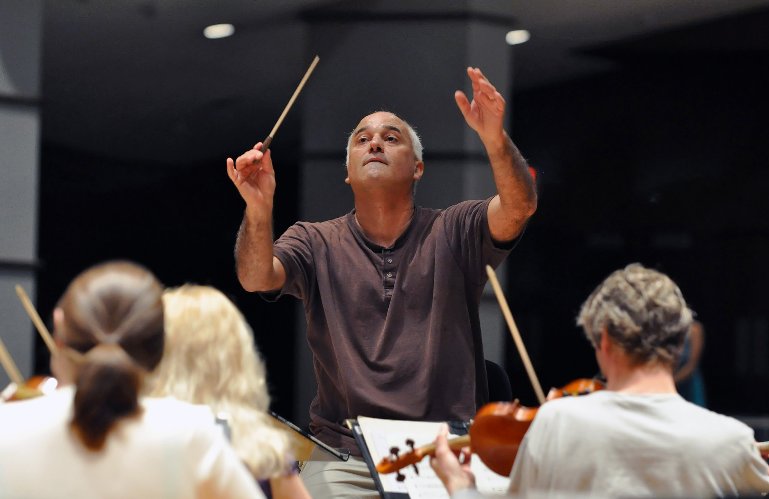
This interview was recorded in Chicago on June 11, 2002. Portions
(along with recordings) were used on WNUR two months later. This transcription
was made and posted on this website in 2009, and has been included in the
website Classical Connect.
To see a full list (with links) of interviews which have been transcribed and posted on this website, click here.
Award - winning broadcaster Bruce Duffie was with WNIB, Classical 97 in Chicago from 1975 until its final moment as a classical station in February of 2001. His interviews have also appeared in various magazines and journals since 1980, and he now continues his broadcast series on WNUR-FM, as well as on Contemporary Classical Internet Radio.
You are invited to visit his website for more information about his work, including selected transcripts of other interviews, plus a full list of his guests. He would also like to call your attention to the photos and information about his grandfather, who was a pioneer in the automotive field more than a century ago. You may also send him E-Mail with comments, questions and suggestions.