 BD: Does it get too
soggy in the
summertime?
BD: Does it get too
soggy in the
summertime?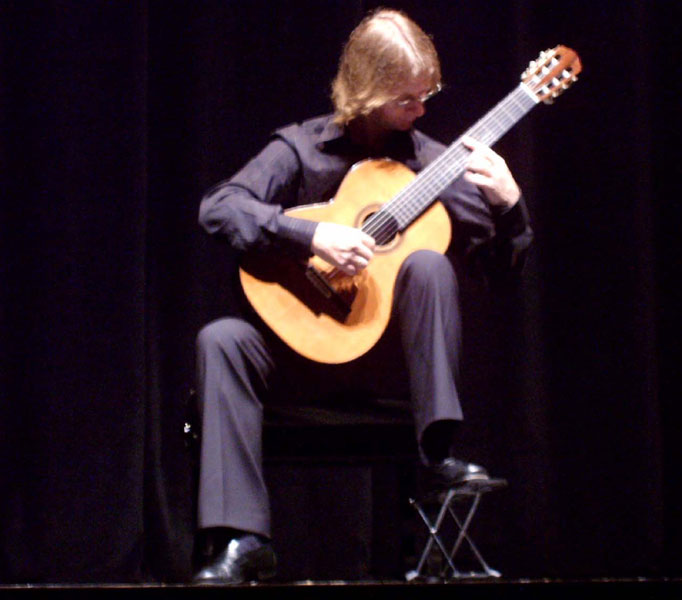 DR: Just as it
comes. Concerto performing for
guitar is always a small proportion of the concerts. I’ll
probably play five or six across the
summer, and maybe fifteen solo concerts. That’s about the
proportion, and this year it’s maybe a little more than some other
years. Basically it’s just as it fits in. I
don’t necessarily go out of my way to look for concertos. Playing
concertos is great fun for us because it’s different and we
don’t do it very often. Also, we get a chance to play for a
different audience. It’s not the same audience that goes to a
solo
concert, so it’s fun and I enjoy it. We do have a slight problem
because the classical guitar is a very quiet instrument, and we usually
have to amplify. Nowadays, the amplification is getting better
and better. The systems are better.
DR: Just as it
comes. Concerto performing for
guitar is always a small proportion of the concerts. I’ll
probably play five or six across the
summer, and maybe fifteen solo concerts. That’s about the
proportion, and this year it’s maybe a little more than some other
years. Basically it’s just as it fits in. I
don’t necessarily go out of my way to look for concertos. Playing
concertos is great fun for us because it’s different and we
don’t do it very often. Also, we get a chance to play for a
different audience. It’s not the same audience that goes to a
solo
concert, so it’s fun and I enjoy it. We do have a slight problem
because the classical guitar is a very quiet instrument, and we usually
have to amplify. Nowadays, the amplification is getting better
and better. The systems are better.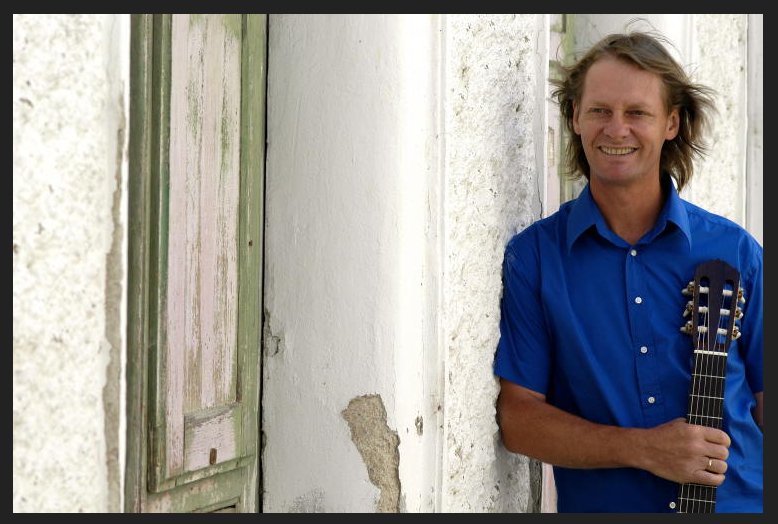 DR: No, there are
not, really. I would
love to have another 10 concerti that are really good and
worth playing. There are a few composers who have written some
very good concerti recently, and the one that comes to mind is by Leo
Brouwer, a Cuban composer who is now working as a conductor in
Cordoba, Spain. Brouwer has written three or four concerti.
There are two of them I really like and that I think are
excellent. They’ve made the guitar sound good; the orchestra
sounds good, and all around it’s exciting to play. There
are quite a few pretty contemporary pieces, but we only get a chance to
play a few; Stephen Dodgson wrote a few concerti, and Lennox Berkeley,
and a few of the English composers. I’m sure in America
there are many that I wouldn’t know of. The problem is that we
may only get one booking in a year, or one
booking in five years, for some of these concerti. They’re very
difficult and take a lot of time to learn, so
it’d be unusual for me to actually learn one simply on the off chance
that one day I might get booked. But when I’m offered, I
pick. Usually they say, “Can you play the Rodrigo
concerto for us?” I say okay, I’ll be there.
When they say to me, “Take your choice,” next time
I’ll probably try and play one of the other Brouwer ones that I
haven’t done, or one of the concerti that are lesser known. As
far as the solo repertoire, there’s more than I’m ever going to be able
to learn in my years
of life and playing.
DR: No, there are
not, really. I would
love to have another 10 concerti that are really good and
worth playing. There are a few composers who have written some
very good concerti recently, and the one that comes to mind is by Leo
Brouwer, a Cuban composer who is now working as a conductor in
Cordoba, Spain. Brouwer has written three or four concerti.
There are two of them I really like and that I think are
excellent. They’ve made the guitar sound good; the orchestra
sounds good, and all around it’s exciting to play. There
are quite a few pretty contemporary pieces, but we only get a chance to
play a few; Stephen Dodgson wrote a few concerti, and Lennox Berkeley,
and a few of the English composers. I’m sure in America
there are many that I wouldn’t know of. The problem is that we
may only get one booking in a year, or one
booking in five years, for some of these concerti. They’re very
difficult and take a lot of time to learn, so
it’d be unusual for me to actually learn one simply on the off chance
that one day I might get booked. But when I’m offered, I
pick. Usually they say, “Can you play the Rodrigo
concerto for us?” I say okay, I’ll be there.
When they say to me, “Take your choice,” next time
I’ll probably try and play one of the other Brouwer ones that I
haven’t done, or one of the concerti that are lesser known. As
far as the solo repertoire, there’s more than I’m ever going to be able
to learn in my years
of life and playing.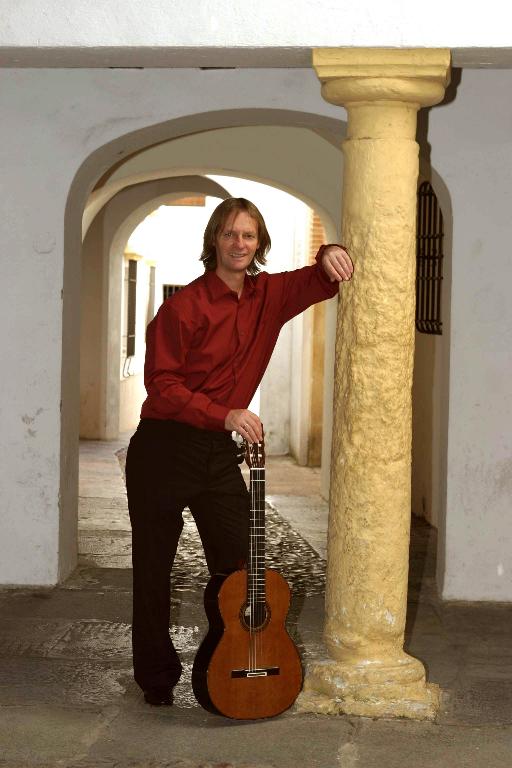 DR: Yeah there is,
in a sense that up until this
century, most of the guitar music was written by guitarists and most
of lute music was written by lutenists, with a few
exceptions, of course. Most people who play the
instrument are caught, in that they will only write what they can
play because
most of them are writing it for themselves. So unless they were
really agile players, I mean technically, they wouldn’t necessarily
demand enough out of their instrument. And a lot of them would
often get caught into a little thing of writing tricks. There are
certain little finger patterns that actually sound great, but
we all know it’s really easy. So these little idioms start to
creep
in. Of course that happens in all instruments, and it’s normal
that that’s going to happen. But most of that music is actually
designed to make the guitar sound good, and maybe to let the
guitarist show off a certain amount. A lot of it has more of the
virtuoso quality — like Paganini violin music. Well, Paganini
also wrote
guitar music — not to such a high level, because he wasn’t as good a
guitarist — but in the similar vein. Giuliani was another
composer of that period who wrote, basically, to show off what he could
do.
Sor was slightly different in that he was a more developed musician,
and maybe not quite such an agile player. So he got more out of
the instrument, musically, by use of harmony,
than just purely showing how fast his fingers would go. Perhaps
at the beginning of the century or end of
last century, it was easier to do a transcription because the
transcriber would take complete liberty of the
piece. He would actually rewrite bits and expand bits to make
them sound
more interesting, and just reduce other bits to give a
general view of this section of whatever. They usually called
it “Fantasies on,” rather than a transcription exactly.
Nowadays when we do transcriptions, because of the tradition or because
of whatever way it’s developed, we try to play as close as the original
would have been.
DR: Yeah there is,
in a sense that up until this
century, most of the guitar music was written by guitarists and most
of lute music was written by lutenists, with a few
exceptions, of course. Most people who play the
instrument are caught, in that they will only write what they can
play because
most of them are writing it for themselves. So unless they were
really agile players, I mean technically, they wouldn’t necessarily
demand enough out of their instrument. And a lot of them would
often get caught into a little thing of writing tricks. There are
certain little finger patterns that actually sound great, but
we all know it’s really easy. So these little idioms start to
creep
in. Of course that happens in all instruments, and it’s normal
that that’s going to happen. But most of that music is actually
designed to make the guitar sound good, and maybe to let the
guitarist show off a certain amount. A lot of it has more of the
virtuoso quality — like Paganini violin music. Well, Paganini
also wrote
guitar music — not to such a high level, because he wasn’t as good a
guitarist — but in the similar vein. Giuliani was another
composer of that period who wrote, basically, to show off what he could
do.
Sor was slightly different in that he was a more developed musician,
and maybe not quite such an agile player. So he got more out of
the instrument, musically, by use of harmony,
than just purely showing how fast his fingers would go. Perhaps
at the beginning of the century or end of
last century, it was easier to do a transcription because the
transcriber would take complete liberty of the
piece. He would actually rewrite bits and expand bits to make
them sound
more interesting, and just reduce other bits to give a
general view of this section of whatever. They usually called
it “Fantasies on,” rather than a transcription exactly.
Nowadays when we do transcriptions, because of the tradition or because
of whatever way it’s developed, we try to play as close as the original
would have been. 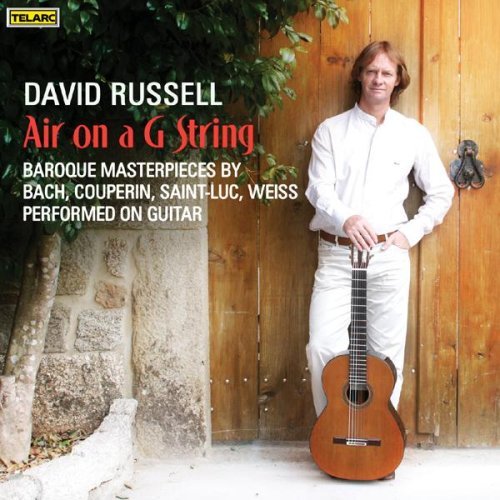 DR: There’s a
certain
difference. I try really hard to make the recording sound as
exciting as I hope it will in a concert. But certainly there are
certain
differences. The perfection now required in
recording has reached such a high level, and the guitar is a very noisy
instrument. We play at a low decibel level, so our
finger noise is pretty close to our music noise — little
string scratches and squeaks and fingernails
clacking means that we have to play extra carefully. We have to
play extra clean because the digital process picks up so much
nowadays! You can’t just filter it because if
you filter it, you lose everything. Usually there’s
a certain kind of reserve in the recording at first, and hopefully I’m
able to break away from it after I’ve got a few good takes. All
recordings are
stressful sort of situations, but without the excitement of a
audience. The only person you’re
going to try and excite is your engineer, and maybe your
producer.
DR: There’s a
certain
difference. I try really hard to make the recording sound as
exciting as I hope it will in a concert. But certainly there are
certain
differences. The perfection now required in
recording has reached such a high level, and the guitar is a very noisy
instrument. We play at a low decibel level, so our
finger noise is pretty close to our music noise — little
string scratches and squeaks and fingernails
clacking means that we have to play extra carefully. We have to
play extra clean because the digital process picks up so much
nowadays! You can’t just filter it because if
you filter it, you lose everything. Usually there’s
a certain kind of reserve in the recording at first, and hopefully I’m
able to break away from it after I’ve got a few good takes. All
recordings are
stressful sort of situations, but without the excitement of a
audience. The only person you’re
going to try and excite is your engineer, and maybe your
producer. 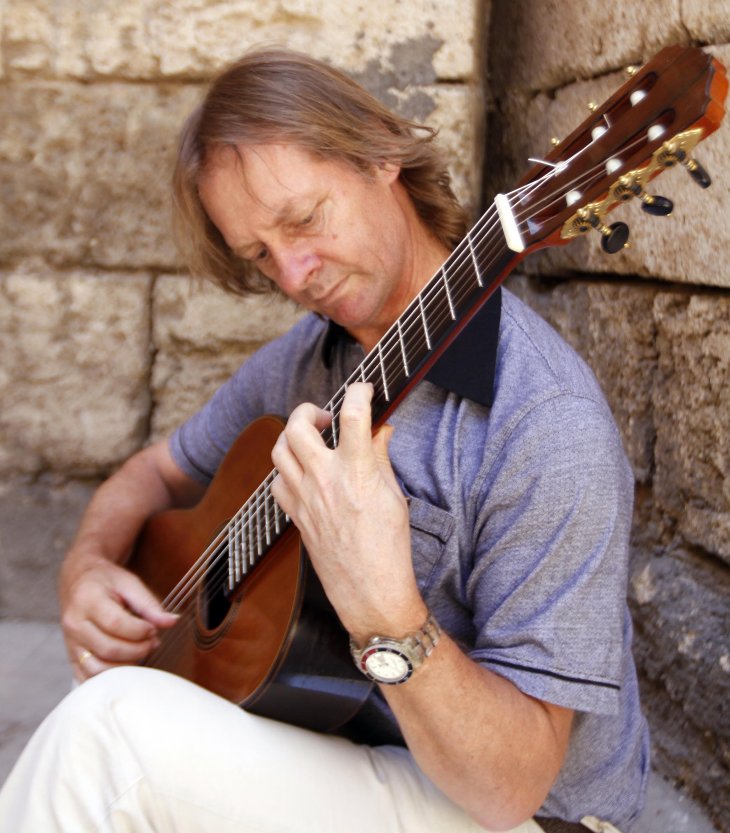 BD: Do you have any
advice for
younger guitarists coming along?
BD: Do you have any
advice for
younger guitarists coming along?|
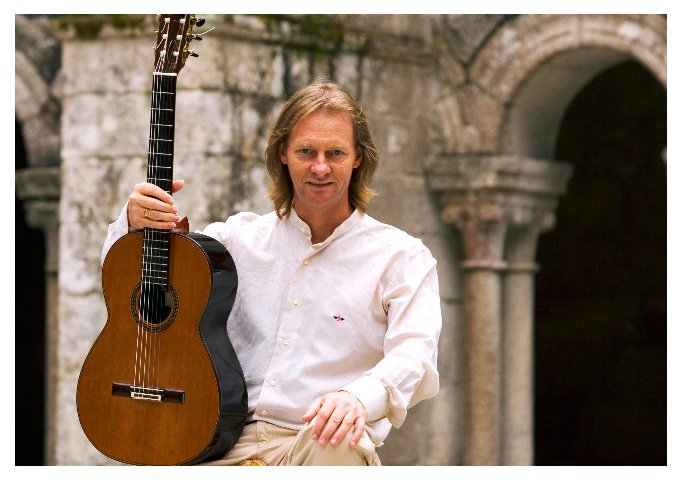
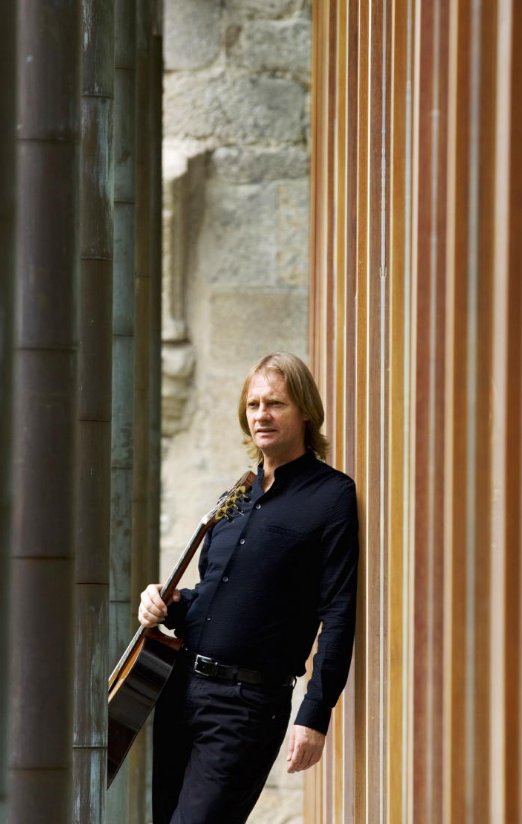
David Russell
Born: 1953 - Glasgow, Scotland, UK The Scottish guitarist, David Russell, was born in Glasgow, and while still very young (age 5), moved with his parents to Menorca, a Spanish island in the Mediterranean. His father, an artist, was an avid amateur guitarist. It became natural for David to pick up the instrument, and his father began to teach him to play it. He cannot remember when he did not play the guitar. Before he could read music, he could play the pieces by ear that he had learned from listening to Andrés Segovia recordings. When he got somewhat older he also learned to play violin and French horn. 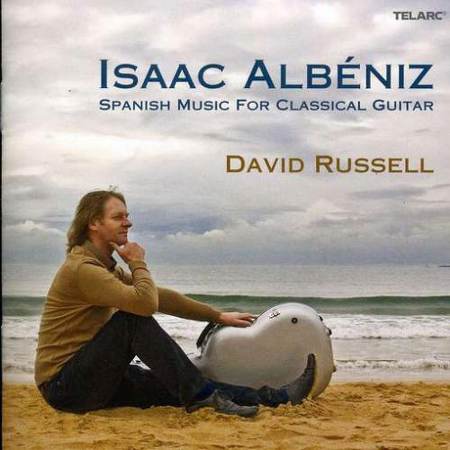 David Russell returned to Britain at the age of 16 to
attend the Royal Academy of Music in London. There his primary teacher
was Hector Quine. He also continued to study horn and violin. While
studying, he twice won the Julian Bream Prize in guitar. He graduated
in 1974 with a Ralph Vaughan Williams Trust Scholarship. In 1975, the
Spanish Government granted him a special grant to enable him to return
to Spain and continue his studies with José Tomás in
Santiago de Compostela. In the next few years, he won the major Spanish
guitar prizes - the José Ramírez Competition of Santiago
de Compostela in 1975, the Andrés Segovia Prize of Palma de
Mallorca in 1977, the Alicante Prize, and the most prestigious of all,
Spain's Francisco Tárrega Competition. David Russell returned to Britain at the age of 16 to
attend the Royal Academy of Music in London. There his primary teacher
was Hector Quine. He also continued to study horn and violin. While
studying, he twice won the Julian Bream Prize in guitar. He graduated
in 1974 with a Ralph Vaughan Williams Trust Scholarship. In 1975, the
Spanish Government granted him a special grant to enable him to return
to Spain and continue his studies with José Tomás in
Santiago de Compostela. In the next few years, he won the major Spanish
guitar prizes - the José Ramírez Competition of Santiago
de Compostela in 1975, the Andrés Segovia Prize of Palma de
Mallorca in 1977, the Alicante Prize, and the most prestigious of all,
Spain's Francisco Tárrega Competition.David Russell made his Wigmore Hall (London) and New York debuts in the same year, 1981, and has since performed and recorded widely in concerts, recitals and music festivals. He has performed in the major concert venues of the world in North (New York, Los Angeles, Toronto) and South America, Asia (Tokyo), Australia, and Europe (London, Madrid, Rome). David Russell is an exceptional classical guitarist, known for an attractive and outgoing stage presence. He is world renowned for his superb musicianship and inspired artistry, which have earned the highest praise from audiences and critics alike. He is noted for including new or unfamiliar music in most of his recitals. An often-mentioned attribute of his playing is his command over a wide variety of tone colour. His love of his craft resonates through his flawless and seemingly effortless performance. The attention to detail and provocative lyrical phrasing suggest an innate understanding of what each individual composer was working to achieve, bringing to each piece a sense of adventure. Composers who have written music for him include Jorge Morel, Francis Kleynijans, Carlo Domeniconi, Sergio Assad, and Guido Santorsola. His qualities carrie over into his frequent stints as a teacher of master-classes, for which he is much in demand. David Russell has recorded primarily for the GHA and Telarc Records labels, and on Opera Tres, he recorded the complete works of Francisco Tarrega. Since 1995 he has an exclusive recording contract with Telarc International, with whom he has recorded 12 CD's up to now, among them Aire Latino, which received a grammy in 2005. He has made recordings of several works of the Paraguayan composer Agustín Barrios Mangoré and Spanish composer Federico Moreno-Torroba and a release comprising the three solo guitar concerted works of Joaquín Rodrigo: Concierto de Aranjuéz, Fantasía para un Gentilhombre, and Concierto para una Fiesta. In recognition of his great talent and his international career, David Russell was named a Fellow of The Royal Academy of Music in London in 1997. In May 2003 he was bestowed the great honor of being made "adopted son" of Es Migjorn, the town in Minorca where he grew up. Later the town named a street after him, "Avinguda David Russell". In November 2003 he was given the Medal of Honor of the Conservatory of the Balearics. In 2005 he was GRAMMY award winner for his CD Aire Latino, in the category of best instrumental soloist in classical music. After winning the grammy award, the town of Nigrán in Spain where he resides, gave him the silver medal of the town in an emotional ceremony. In May 2005 he received an homage from the music conservatory of Vigo, culminating with the opening of the new Auditorium, to which they gave the name "Auditorio David Russell". |
This interview was recorded at his hotel on June
20, 1996. It
was used (along with recordings) on WNIB in 1998, and on WNUR in 2006.
It was transcribed and posted on this
website in 2012.
To see a full list (with links) of interviews which have been
transcribed and posted on this website, click here.
Award - winning broadcaster Bruce Duffie was with WNIB, Classical 97 in Chicago from 1975 until its final moment as a classical station in February of 2001. His interviews have also appeared in various magazines and journals since 1980, and he now continues his broadcast series on WNUR-FM, as well as on Contemporary Classical Internet Radio.
You are invited to visit his website for more information about his work, including selected transcripts of other interviews, plus a full list of his guests. He would also like to call your attention to the photos and information about his grandfather, who was a pioneer in the automotive field more than a century ago. You may also send him E-Mail with comments, questions and suggestions.