Conductor Christian Thielemann
A Conversation with Bruce Duffie
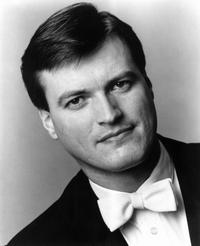 Christian Thielemann was born in Berlin, Germany, on April 1, 1959. He studied
piano, harpsichord, and viola in his youth and later enrolled in the Karajan
Academy. He played viola in the German Youth Orchestra and became an assistant
to Karajan at 19. Thielemann debuted with the Berlin Philharmonic as a harpsichordist
in 1980.
Christian Thielemann was born in Berlin, Germany, on April 1, 1959. He studied
piano, harpsichord, and viola in his youth and later enrolled in the Karajan
Academy. He played viola in the German Youth Orchestra and became an assistant
to Karajan at 19. Thielemann debuted with the Berlin Philharmonic as a harpsichordist
in 1980.
In 1985 Thielemann was appointed principal conductor of the Deutsche Oper
am Rhein in Dusseldorf. Three years later he became general music director
at the Nuremberg Opera. His U.S. debut came at the San Francisco Opera in
1991, conducting Strauss' Elektra.
Thielemann was appointed principal guest conductor of the Teatro Comunale
of Bologna in 1993. In 1997 Thielemann accepted the post of general music
director at the Deutsche Oper Berlin. He debuted at the 2000 Bayreuth Festival
in Wagner's Die Meistersinger. Meanwhile,
conflicts with management at the Deutsche Oper were brewing, and Thielemann
departed in 2004, three years sooner than expected.
From 2004 he began serving as music director of the Munich Philharmonic,
with a contract running through 2011. In 2008 Thielemann was named chief
musical advisor at Bayreuth, becoming in all but name the festival director.
With Thielemann's 2012 appointment as music director of the Saxon State Opera
and its sibling ensemble, the Dresden State Orchestra, he has clearly emerged
as one of the foremost German conductors of his generation.
|
In March of 1993, Christian Thielemann came to Chicago to conduct the Chicago
Symphony Orchestra. He was just 33 years old and had made only one
recording. The intervening years have seen his career take huge leaps
and arouse some controversy, but with all of that promise yet to come, it
is interesting to take note of his advice and his philosophy.
He was always earnest and spoke quickly at times, often punctuating his ideas
with fragments and half-thoughts. Usually those led to full ideas or
examples, and all of this has been tidied up so as to read comfortably.
His English was quite good and only a few times did he insert a German word
that was needed to precisely indicate his thought. As with many others
from Europe, the structure of his sentences would often reflect his native
tongue, and some of those quirks have been left in this text.
Sitting in the library of the Chicago Symphony Orchestra after his concert,
the spirits of many famous conductors were all around us, including Carlo
Maria Giulini, who made his American debut with the CSO, and whose association
here lasted for 23 seasons, including three years as Principal Guest Conductor.
Thielemann mentioned that he liked Giulini very much, so that is where we
started our interview . . . . .
Bruce Duffie: Obviously
there are many conductors in the world and you revere quite a number of them.
Do you learn from each of these conductors?
Christian Thielemann:
Always when you see a very good interpretation, you learn something.
You see a conductor and you hear him, and I think it is more important to
hear somebody than to see the movements a conductor makes. You have
to be talented in a certain way to do it. Don't look into a mirror,
like some people do, and say, "My God, the left hand, the right hand."
Just do it! The most interesting thing is the musical concept somebody
might have. A very good conductor has a very good concept. That's
something I'm always thinking about, to look where is really the climax of
the piece and so on. So you learn from everybody, and sometimes if a
concert is not that good, you try to find out what was missing.
BD: To learn what not
to do?
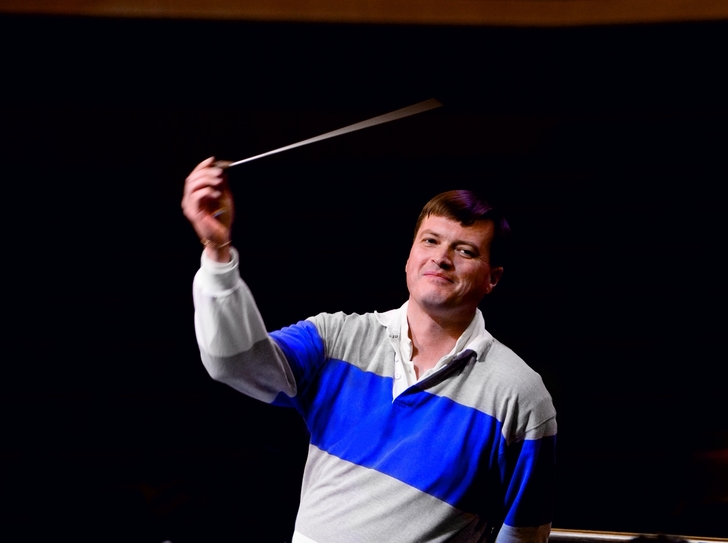 CT: Um, yeah, maybe to avoid something. I don't
want to say it's a kind of thing that you are very glad when you hear it.
That can happen to everybody. You are not in the same mood every concert,
especially if you do a series of four or five concerts. Recently at
the Met I had eight Rosenkavalier
performances. Fortunately, we were always very different because we
had cast changes, but if you have the same cast you have really to try to
be flexible. I like to be very flexible; I like to change every evening
the tempo and also the agogic accents. I just do it. It's better
to show it with your hands, better to express. There are thousands or
millions of ways to express with your hands what you want, but there is no
codex, nothing somebody could tell you, "Just do that and you get that sound,"
because every orchestra's different. Every orchestra offers you a different
sound, so you cannot say "I go to the Berlin Philharmonic or I'm going to
the Chicago Symphony, and I have to do this or that." It's complicated.
You need to just be yourself, and that's it.
CT: Um, yeah, maybe to avoid something. I don't
want to say it's a kind of thing that you are very glad when you hear it.
That can happen to everybody. You are not in the same mood every concert,
especially if you do a series of four or five concerts. Recently at
the Met I had eight Rosenkavalier
performances. Fortunately, we were always very different because we
had cast changes, but if you have the same cast you have really to try to
be flexible. I like to be very flexible; I like to change every evening
the tempo and also the agogic accents. I just do it. It's better
to show it with your hands, better to express. There are thousands or
millions of ways to express with your hands what you want, but there is no
codex, nothing somebody could tell you, "Just do that and you get that sound,"
because every orchestra's different. Every orchestra offers you a different
sound, so you cannot say "I go to the Berlin Philharmonic or I'm going to
the Chicago Symphony, and I have to do this or that." It's complicated.
You need to just be yourself, and that's it.
BD: But it doesn't keep
the singers or the instrumentalists off balance if you're trying new things
at the last moment?
CT: No, you have to
know. That is a kind of experience you have to have. You cannot
do silly things. No, I don't mean to try out a really shocking program.
That's not good, but you need to know how to keep the attention of a musician.
Every musician is different every evening. If you hear piano recitals
or violin recitals, you will never hear a very good pianist or very good violinist
give the same interpretation.
BD: But that is chamber
music. What do you do when you have a hundred people there in front
of you?
CT: You can do it.
That's a kind of experience that you have to feel. You know, "Aha,
I can go on to this point." It depends also how good they know you.
If an orchestra knows you very well, and if they know anything can really
happen, they will play in a different way. If you hear those old Furtwängler
recordings with Berlin Philharmonic or also with Vienna, my God, he did things
and they loved him. They did what they could, but this is if an orchestra
knows a conductor very well. They have to have worked together for
a long time. Sometimes you might get a piece an orchestra knows very
well, and they might play it without a conductor. [Chuckles]
Not so well, but they would play it. But if you try something, they
follow because they like it!
BD: Is it easier or
harder to do a piece that is so ingrained in the orchestra, rather than a
new piece which you are teaching them, or something they don't know very
well?
CT: It's different,
ja, but it's more of an adventure
for my taste. If you have a piece an orchestra doesn't know, it's another
kind of competition. You study with them... No, they study with
you, and you create it in a certain way. But if you do very known symphonies,
like Beethoven or Brahms, you have to offer something. Otherwise the
orchestra gets bored.
BD: Do you have to offer
something new and different?
CT: No, you have to
offer your own personal point of view, and that has to be convincing.
It's not "don't look for something new". What can you do? My
God! These symphonies have been conducted millions of times, so what
can you do? You can offer your own personal way, and that might be
so that the orchestra likes it.
BD: You say that you
try some new things. Does your basic concept of a work change from
season to season?
CT: No. I always
study if I have a new concert or a new opera engagement coming up.
I look to the score. I did many times Rosenkavalier before I did it at the
Met, but I had the whole month of December off. I didn't want to have
something to conduct, and I restudied the Rosenkavalier score. I had done
already two productions of Rosenkavalier,
and I know it so well I can do it without score, but I restudied it.
I changed my concept because I always felt that at certain points I wasn't
satisfied with myself.
BD: Do you get a clean
score and start fresh?
CT: I never write something
into my score. I never do that.
BD: [Surprised]
Never???
CT: Never. I think
your eye must be fresh. You don't need to mark every third horn or
the oboe entrance. You should know the piece so well that you know when
the oboe is playing. You don't need to write "Ob" or "Cl" or "Fg"...
BD: ...for the oboe
or the clarinet or the bassoon. But you wouldn't write something like
"meno mosso"?
CT: No... Then
you always have to look at the score. If a soloist is playing the Beethoven
Violin Concerto, he plays it, obviously,
without score. So a conductor very often conducts with score, but he
has to know the piece so well. It's a kind of security to have it there.
I did try it out for myself. I did Tristan without score, I did Tannhäuser without score, and I
did Lohengrin without score.
[Chuckles] It's a kind of sport. If something happens, and it
can always happen, even if you feel very secure and are enjoying yourself...
Maybe in the orchestra they feel very secure. "My God, we did that
piece so many times," and then something happens.
BD: It all falls apart!
CT: What are you doing?
What can you do? You don't know the rehearsal numbers of the score.
I think Mitropoulos could've written down an Elektra score page. Or Toscanini,
people say; I don't know if that is really true. I cannot imagine that
somebody can really write the whole Elektra
score from memory. You conduct it and you know the major things that
are coming up, but if somebody asked, "Is that the second bassoon or the
third bassoon?" or, "Is he mezzo forte
or piano?" you come very soon to
a certain point, and so why can't you have the score there?
BD: So most of the time,
then, you do use score?
CT: No, most of the
time I don't. But for very difficult things, now I have always the
scores right there. You never know. For the Rosenkavalier, I turn 40 pages or 50
pages together. But I have it in case something could happen and then
you have to shout, "Number one hundred!" It's so silly that you have
to prove to an orchestra like the Met Orchestra or the Chicago Symphony or
the Berlin Philharmonic, that you know the score. If you don't know
the score, you are conducting with your head buried in it, and they will
complain. You cannot just pretend to know it.
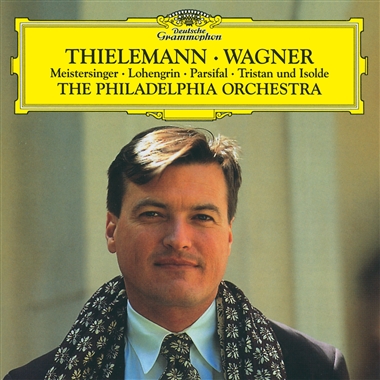 BD: Do you need the score more for the opera performances
than you do for the symphony?
BD: Do you need the score more for the opera performances
than you do for the symphony?
CT: No. I had
the normal German Kapellmeister career, which means that first you are a
coach, studying with more or less intelligent people, and you learn quite
well the repertoire. I was three years in Berlin at the Deutsche Oper,
and I did more than 70 operas. I did works from Palestrina to L'enfant et les sortilèges to
Figaro, and also Verdi. I
wouldn't say that I know all of them in the same way, but I had them under
my fingers, as we say. So if I have to do an opera now, I sometimes
remember that I studied it with her or with him. If you are a young
conductor and you want to be an opera conductor, you have to do that.
If you do the Ring or Meistersinger, and you never did it before
and you didn't play it on the piano, you have really to study it from the
beginning. Do you know what that means, studying Meistersinger if you don't really know
it??? My God!
BD: It's such an enormous
work!
CT: 600 pages!
And don't talk about the Ring! You need months and months and months.
If you studied that with singers, you know already when you are coming to
a difficult point. It's very, very important that you learn to breathe
with them. If you play it as coach, if you play a whole staging, a
whole production, then you find out. If you conduct it you might be
faster at some point, even if it maybe goes a little bit against your personal
point of view. But you have to help sometimes singers. You have
also to follow them, because what can you do? If you insist on being
slow in the first and second acts, the tenor later has no voice. You
want him to be able to sing the third act, so you have to compromise.
If you do symphony, you will not compromise so much, but that is something
you have to do. That's experience!
BD: In the orchestra,
though, if there's an incidental oboe solo, you have to make sure that he
has enough breath for that.
CT: Yeah, but that's
another kind of situation. Everybody is on stage, and it's not like
in opera where you have in the pit an orchestra. Sometimes the orchestra
in the pit cannot hear very well, and they have to know it. Some very
good orchestras know the pieces so well that they can follow. Sometimes
you cannot conduct everything, especially in Rosenkavalier. With those Walzer, sometimes you have only to do
something with your arms, and they'll do it. You need a very good Konzertmeister, and you need a very good
orchestra to do that. But then they have that kind of Schlamperei, we say be a little bit out
of the tempo. You are together, but that has to be a little bit free.
That is very, very difficult.
BD: Do you also make
sure that you have a good prompter to rely on?
CT: Mmmmm, it helps
quite a lot, yeah. But you don't worry, though, because most of the
singers are very secure. Opera conducting is more an adventure than
concert conducting. And don't forget a concert usually is from 8 to
10. An opera like Rosenkavalier
begins maybe at 6 and ends at 11. Tristan is longer, and Götterdämmerung is, my God,
six hours!
BD: But then you might
get La bohème, which is over
in a snap.
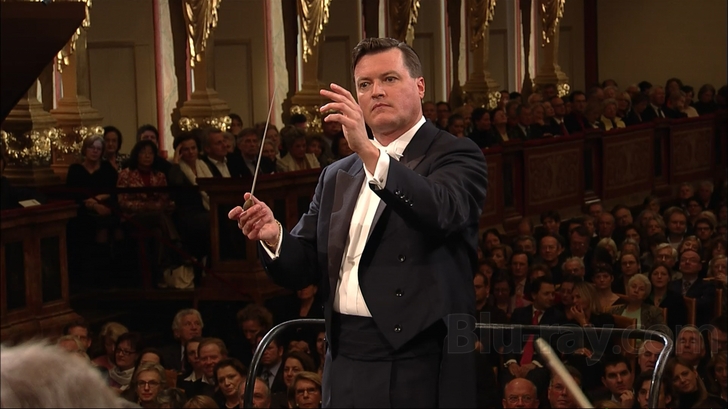 CT: Yeah, but my repertoire is the German, so that's
normal for us! I don't like to talk about money, but I get the same
for Rosenkavalier and a concert.
You don't make music to make money. That's not right, but an opera
like Rosenkavalier is so exhausting
that you cannot imagine. You as a conductor have to get them all together.
Sometimes they are not very exact, and you must be friendly since you have
to keep it together — which sometimes can be quite
hard.
CT: Yeah, but my repertoire is the German, so that's
normal for us! I don't like to talk about money, but I get the same
for Rosenkavalier and a concert.
You don't make music to make money. That's not right, but an opera
like Rosenkavalier is so exhausting
that you cannot imagine. You as a conductor have to get them all together.
Sometimes they are not very exact, and you must be friendly since you have
to keep it together — which sometimes can be quite
hard.
BD: It just happens
that we are meeting after a concert. How should a conductor feel after
a concert — elated, exhausted, what?
CT: [Chuckles]
Self-critical. [Hearty laughter] I enjoy very much the things
that were good and other things were very good. Then maybe I think,
"Hmm... you could've done better." So I am always looking forward to
tomorrow, and being always self-critical. If you are too secure, that's
the end. Never do so much that you cannot think about the pieces you
do. Sometimes, as is happening to me, you have this offer and this
offer, and you have to go, go, travel, and that's hard! You come maybe
to an orchestra rehearsal and you are jet-lagged. That is not good.
You have to learn to say "No." That's the most important thing you have
to learn in this profession, to say "No." Even if everybody says, "But
that is such an important engagement," everything will be important.
You have to make your own decisions because if you are not good, people will
be friendly, but they will not re-engage you again.
BD: With all the offers
that are coming in, how do you decide which concerts you'll accept and which
operas you'll accept?
CT: I always want to
have time off because for an artist, or for somebody who works hard to get
an inspiration, it is very important to have a life which has maybe nothing
to do with conducting and music. You need to have time to see friends
and to have a family, or to do whatever you want to do. You must have
a sentimental life with the private things you can do. Go to exhibitions,
see other things, read! If you're always with your scores, and you
are worrying about next week and the week after and being organized, you
don't even read the newspaper! You don't know what's going on!
That's sad for my taste.
BD: You need to come
back to the music refreshed.
CT: When I come back,
I'm really refreshed and really looking forward to it. I have more
energy. If I do a concert, I can really give everything I have.
Maybe people like it and they say, "Oh God, he's quite wild." But I
like to be wild. Sometimes I know that I have several things coming
up, but then I have two or three weeks off. Then I don't do anything
for one week. I sleep, see friends, come late home, go to wonderful
restaurants, and really have a life! It's very important that you can
have wild nights to do something wonderful.
* *
* * *
BD: East and West Germany
are coming back together, so this obviously affects your personal life.
Does this also affect your musical interpretation?
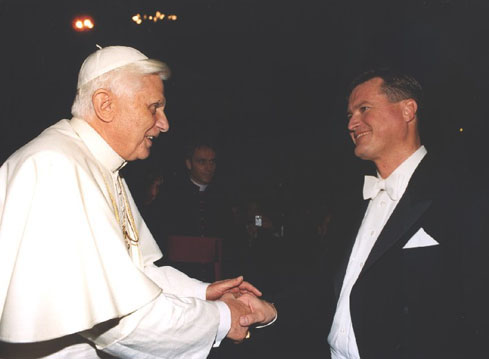 CT: Not so much. It has been a wonderful moment
because half of my family lives in ex-East Germany, in Leipzig, so my family
is part from Saxony and it's an influence. I grew up in West Berlin,
which doesn't exist anymore, and I'm very glad about it. When I was
a little child standing at the Wall, I saw that this is one city! It
is one country. I was always wondering about people who said, "Oh,
no, we have to accept that it's two countries, two nationalities."
I never understood that. East Germany tried making out that Bach was
the first socialist. That was so silly that you could laugh! You
didn't, though, because it was a tragedy! It was a tragedy! The
biggest part of my family, all the relatives of my father, remained in Leipzig
after the War. We had several discussions with them and they said,
"We didn't leave because first was the Kaiser, then Weimar, then Hitler,
then Americans, then Russians." Things became quite difficult.
They really had trouble, but that is something, that's an influence.
You are now so free to go to Dresden and to see those wonderful things.
It is a country, it is one country. There's one mentality, and nobody
can tell me that we West Germans are so different from the East Germans.
CT: Not so much. It has been a wonderful moment
because half of my family lives in ex-East Germany, in Leipzig, so my family
is part from Saxony and it's an influence. I grew up in West Berlin,
which doesn't exist anymore, and I'm very glad about it. When I was
a little child standing at the Wall, I saw that this is one city! It
is one country. I was always wondering about people who said, "Oh,
no, we have to accept that it's two countries, two nationalities."
I never understood that. East Germany tried making out that Bach was
the first socialist. That was so silly that you could laugh! You
didn't, though, because it was a tragedy! It was a tragedy! The
biggest part of my family, all the relatives of my father, remained in Leipzig
after the War. We had several discussions with them and they said,
"We didn't leave because first was the Kaiser, then Weimar, then Hitler,
then Americans, then Russians." Things became quite difficult.
They really had trouble, but that is something, that's an influence.
You are now so free to go to Dresden and to see those wonderful things.
It is a country, it is one country. There's one mentality, and nobody
can tell me that we West Germans are so different from the East Germans.
BD: How does that affect
your music making, if at all?
CT: [Pondering a moment]
Maybe you feel it's another color. You cannot describe it. You
are not faster or slower, but if you have a very nice moment in your life,
or an overwhelming moment in your life, you certainly do music in another
way. Maybe it's more intense. I don't know, but I couldn't say
that I changed an interpretation because of the reunification. Sometimes
you have certain imaginations you think about. I remember in my position
in Nürnberg, we did Beethoven 9
on Reunification Day, and that was wonderful. It was at midnight of
October 2 to October 3. I went for the celebration; I went to Berlin
because I wanted to be there. I had the general rehearsal in the morning
of October 2, and I went home. I was at the Brandenburg Gate, and you
never forget this moment. Then I went back the next morning and in
the evening I had the Beethoven 9.
That is something very special, because you conduct it in a kind of trance.
The reunification will never happen again, so it's such a... you cannot
describe that. So a piece like Beethoven 9 maybe becomes something... [snaps
fingers] I don't know.
BD: But now, if someone
is listening to a tape of that particular performance from the distance of
several months or a couple of years, or ten years or twenty years, would
it be as special for them, or would it be just another Beethoven 9?
CT: I don't know; they
have to decide it. Sometimes, if you are on stage conducting or playing,
you might have a very good feeling. Or you might have a bad feeling.
You might say, "My God, it's tonight," and people might say, "Ohh, it was
so wonderful!" In those moments, I feel always not well because I'm
very self-critical. But after the performance, a friend might ask,
"What happened in the third movement?" It was a lack of tension, but
you didn't feel it. So it is very different from that what you feel
and what the public feels. It is not the same.
BD: Should it be the
same?
CT: I think it cannot
be the same. It would be interesting to know, as a conductor or as
a performer, what the public really thinks, but you cannot because you are
involved, very involved; and if you become very involved, you have to do
with yourself. It's enough to do. You have to keep them together.
You do the accelerando you want;
that's interpretation. Coming back to what you asked me earlier, you
must have a frame for your interpretation. That's the idea you have
with the architecture of the piece. However, in the frame, like in
a kaleidoscope, you can change a little bit, but the whole idea should be
the same. A free interpretation doesn't mean that you're going to do
silly things without sense. That is something I wouldn't like.
BD: So you always start
at the same place. Do you end in the same place and get there different
ways, or do you end in different places?
CT: It could happen
that I end in different places. For example, in the last movement of
Beethoven 5, you have three times
this "Da, da, daaa, da da-da-da-da dum." So what are you going to do
with it? I do the first one rather slow, and I do every time a little
bit faster. It should not be a real accelerando, but it should lead right
to the end. You could do it differently. It's not that it is
the only way. You might have another idea on the evening. It
happens to me that sometimes I have just in this moment another idea.
Then I do it, and maybe later you find out it didn't lead where you wanted.
But that is the adventure of being a musician, of being a Musikant. That's not only Musiker, that is Musikant, to be a kind of free spirit.
Do it! If you work with an orchestra, don't talk about it. Do
it!
BD: Just do it.
CT: Yeah, just do it!
You cannot explain to the Chicago Symphony a Beethoven symphony. They
will look at you, and after five minutes they will say, "Why doesn't he really
do it?" They will say, "Do it! Don't talk!"
BD: But if you're working
with a considerably lesser orchestra, do you have to do more explanation?
CT: Yeah, it depends
on the level. If you are working really with a bad orchestra, that
means that you have to explain everything. Fortunately I don't have
to work really with bad orchestras. But you have to see what are they
offering. Every orchestra has a different music director, so they very
often have a different kind of staccato,
or they have a different kind of accelerando
sometimes... Little things, you know, and you cannot pretend, with
two or three rehearsals, that you can change the sound completely.
I grew up in Berlin listening to Berlin Philharmonic with Karajan.
So if somebody else came... I know somebody who jumped in for a Brahms
4. I don't say the name, but
it was the Karajan Brahms 4.
 BD: They didn't have time to re-rehearse the orchestra.
CT: No, because certainly,
if they have 20 years with Karajan and the kind of sound he liked, you cannot
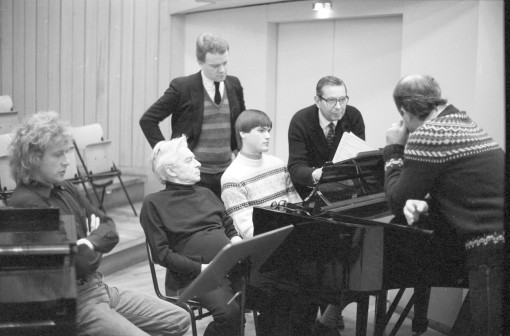
change it in two rehearsals. [Photo
at left - Thielemann seated at the piano with Karajan in 1982]
BD: What if someone
had come for a full week or even two weeks of rehearsals and performances?
CT: You have to choose,
and that is the kind of experience I was talking about. You learn that
if you work with singers, and if you work also with not-so-good orchestras.
If you have not so much time, you have to choose the right places.
With an intelligent orchestra, if you say in the first movement, "Give me
that legato, and do it this way, " and if you show that with your hands,
then maybe in the third movement, if something similar comes and you do the
same kind of gestures, they will think, "Aha! He wants that legato
in the first movement; let's try to do it again." You can get this
if you work with very intelligent people. Something I admired so much
with Karajan was that he sometimes conducted with just his little finger,
and out came the most beautiful things. But that is if an orchestra
knows a conductor for years and years and years and years, and did the repertoire
so many times together.
BD: So he's not really
conducting, he's just reminding them.
CT: In a certain way,
but that's wonderful! But that is only happening if there is a really
long collaboration, and I think an orchestra has also to like the interpretation.
They like doing that. Listen to the old Furtwängler recordings.
How much must the Berlin Philharmonic have loved Furtwängler to do those
accelerandi in the Brahms symphonies.
There are incredible things they did when they were together because they
knew what he wanted after so many years!
BD: Do you feel that
anything you are doing these days is incredible?
CT: No. Nothing's
incredible. I think always about the Brahms Requiem, and the phrase alles Fleisch es ist wie Gras.
"You are like grass," so don't think that you are terribly important.
BD: You don't feel you
are important?
CT: [Thinks a moment]
The music is the most important thing. We are all people who have to
do with music, and we have to be so grateful. You must have so much
respect. Poor Beethoven! What did he have for life? He
had a terrible life, and we are making our careers and our good life with
his music or with Wagner's music! We are in such a wonderful situation,
so we always need to be reminded and think about that. For a certain
period we have a life. Maybe we will be very old — 80
years or 90 or we might be hundred years, or it might be over after 50 years
or over after 40 years! Always be grateful for that what you can do.
It's so wonderful to conduct a Beethoven symphony; this wonderful music,
and you can command! That's wonderful! Isn't that enough?
[Laughter]
BD: I guess it should
be! Are you at the point of your career now where you think you
should be?
CT: Where should it
be? Mmmm. I don't think about that. I am grateful for the
things I get. I haven't got a plan. I want to make music as good
as I can.
BD: [With a gentle nudge]
So you'll just let it happen?
CT: Hmm... I let
it happen.
BD: [Genuinely surprised]
Really???
CT: I'm not terribly
jealous. I am not jealous at all. Sometimes I'm sad if I hear
that concerts are not nice, or are not good and are not filled. But
there is so much work to do and so many wonderful positions! You cannot
say, "Oh, I have to be there." Certainly I have very much time.
I'm 33 years old and I have really much time to think about having a very
important position. Let's see what happens!
BD: I wish you lots
of continued success!
* *
* * *
BD: So far, you've
made one recording with Kollo. Are there other recordings coming out?
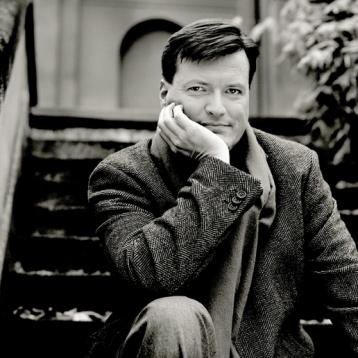 CT: No, not now. That's the very strange thing
— I haven't been contacted by recording companies. I don't
know why that didn't happen, but sometimes people say that I'm so difficult.
I had a wild period. In Berlin we say "Berliner Schnauzer," and that means the
"Berlin mouth" which can be quite open. Maybe you are not very psychological,
but that has nothing to do with a recording company. Sometimes you
have to be at the right moment at the right place, and somebody will meet
you. But there are so many recordings you can buy, and I think I would
really like to say something. I don't know, at 33 years aren't you
too young to say something to be recorded? I remember Karajan saying
his first recordings were done when he was my age. They did a Meistersinger Overture and he said later,
"My God! I think I was drunk when I did that." There are sometimes
a little bit too many recordings for my taste. Go to a record shop
and you see Beethoven symphonies with everybody. Maybe you have your
personal choice.
CT: No, not now. That's the very strange thing
— I haven't been contacted by recording companies. I don't
know why that didn't happen, but sometimes people say that I'm so difficult.
I had a wild period. In Berlin we say "Berliner Schnauzer," and that means the
"Berlin mouth" which can be quite open. Maybe you are not very psychological,
but that has nothing to do with a recording company. Sometimes you
have to be at the right moment at the right place, and somebody will meet
you. But there are so many recordings you can buy, and I think I would
really like to say something. I don't know, at 33 years aren't you
too young to say something to be recorded? I remember Karajan saying
his first recordings were done when he was my age. They did a Meistersinger Overture and he said later,
"My God! I think I was drunk when I did that." There are sometimes
a little bit too many recordings for my taste. Go to a record shop
and you see Beethoven symphonies with everybody. Maybe you have your
personal choice.
BD: You don't want to
be among those choices, then, at this point?
CT: I don't know if
I am really so mature to have much to say right now, that it is worth to
be recorded. I might be, but if I do something, I would really try
to say something so that people think, "That is not new, but that is very
special." I try always to find some tempi, so it might be controversial,
but that's good because I think people should choose between different interpretations!
I'm speaking now about the old masters like Klemperer or Furtwängler.
Furtwängler is certainly the conductor I admire the most, but if you
listen to Beethoven 5 with Toscanini,
with Furtwängler, with Klemperer, with Bruno Walter, and with Fritz
Busch, you have five really different interpretations! That is something
wonderful! I think it should be today in the same way. I don't
say that is, and certainly you have many different interpretations, but if
I add mine, it should be not different, but it should be something.
People shouldn't say after listening to it, "So we can buy also Solti, or
we can buy also..." I would like them to say, "My God, maybe we hate
it! He's so slow, or he's so fast," but that's something; people are
talking about that. I don't like to have an interpretation. No,
it has to be mature; you have to have lots of experience. Why did the
old masters do such great Beethoven symphonies? Because they have been
done so often! Look how many times Furtwängler conducted Beethoven
symphonies before he made the recordings. That was very late.
It was really the right time. The things we know now from the late
'30s and '40s, or the '50s before he died, really he was a mature conductor!
He was certainly wonderful when he was 30 or when he was 25, but maybe not
that mature to listen to a Beethoven 9th
like when they reopened the Bayreuth Festival. That is something.
He had conducted it 100 times! So you have that kind of Überblick. That can only to
happen from your heart; that's a miracle! Not everything should be
recorded, for my taste, a certainly there are things which are not recorded
right now, which should be recorded.
BD: Certain repertoire?
CT: Ja, certain repertoire. But who's
going to listen to all those records? We don't even know what all you
can have! If you look the catalog...
BD: It's enormous!
CT: My God! Sometimes
we don't even know the composers. Let's be honest — sometimes
there are Baroque composers we don't even know, and they have a complete edition
of all his violin concertos! Maybe they are very important, but have
we got the time to hear that? It's very important that they exist,
but you will never have, really, an overview so that you really know which
you prefer. We have only a certain time on Earth to live. We
cannot spend our whole time trying to read everything about Goethe, or everything
about Shakespeare, or everything about Wagner. That would be boring,
so we choose! Maybe we have the right choice, but maybe we don't.
Maybe we take this book, or maybe we should go three inches to the left and
we would find something else. Also your personal taste changes...
[pauses to ponder all of this]
BD: Thank you for coming
to Chicago, and thank you for speaking with me today. Danke schön.
CT: Thank you.
Danke schön.
Auf Wiedersehen.
===== ===== =====
===== =====
-- -- -- -- -- -- -- -- --
===== ===== ===== ===== =====
© 1993 Bruce Duffie
This interview was recorded in the library of the Chicago
Symphony Orchestra on March 12, 1993. Portions (along with recordings)
were used on WNIB in 1994, 1995, and 1999. This transcription was made
and posted on this website in 2012.
To see a full list (with links) of interviews which have been transcribed
and posted on this website, click here.
Award -
winning broadcaster Bruce Duffie was with
WNIB, Classical
97 in Chicago from 1975 until its final moment
as a classical station in February of 2001.
His interviews have also appeared in various magazines and
journals since 1980, and he now continues his broadcast series
on WNUR-FM, as
well as on Contemporary
Classical Internet Radio.
You
are invited to visit his website for more information
about his work, including selected transcripts
of other interviews, plus a full list of his guests.
He would also like to call your attention to the photos
and information about his grandfather,
who was a pioneer in the automotive field more than a century ago.
You may also send him E-Mail
with comments, questions and suggestions.