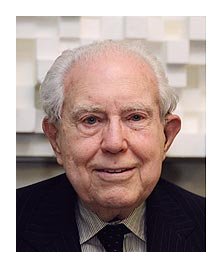
| "Elliott Carter is one of
America's most distinguished creative artists in any field." --
Aaron Copland nominating Elliott Carter for the Gold Medal of the
National Institute of Arts and Letters for Eminence in Music (1971). Twice winner of the Pulitzer Prize, first composer to receive the United States National Medal of Arts, one of the few composers ever awarded Germany's Ernst Von Siemens Music Prize, and in 1988 made "Commandeur dans l'Ordre des Arts et des Lettres" by the Government of France, Elliott Carter is internationally recognized as one of the leading American voices of the classical music tradition. He recently received the Prince Pierre Foundation Music Award, bestowed by the Principality of Monaco, and was one of a handful of living composers elected to the Classical Music Hall of Fame. December 11, 2008 will mark Carter’s 100th birthday with celebration plans in place worldwide. It will, no doubt, prove to be even more successful than his 95th birthday celebration season which brought salutes from performing organizations around the world. Concerts in Boston, London, Los Angeles, Minsk, New York, Washington DC, and other cities observed the milestone, as significant recordings were issued on the ECM, Naïve, and Mode labels. First encouraged toward a musical career by his friend and mentor Charles Ives, Carter was recognized by the Pulitzer Prize Committee for the first time in 1960 for his groundbreaking compositions for the string quartet medium, and was soon thereafter hailed by Stravinsky for his Double Concerto for harpsichord, piano and two chamber orchestras (1961) and Piano Concerto (1967), both of which Stravinsky dubbed "masterpieces". While he spent much of the 1960s working on just two works, the Piano Concerto and Concerto for Orchestra (1969), the breakthroughs he achieved in those pieces led to an artistic resurgence that gathered momentum in the decades that followed. Indeed, one of the extraordinary features of Carter’s career is his astonishing productivity and creative vitality as he reaches the midpoint of his tenth decade. Critics agree that his recent scores are among the most attractive, deeply-felt and compelling works he has ever written. This creative burst began in earnest during the 1980s, which brought major orchestral essays such as Oboe Concerto (1986-87), Three Occasions (completed 1989) and his enormously successful Violin Concerto (1990), which has been performed in more than a dozen countries. A recording of the latter work on Virgin Classics, featuring Oliver Knussen conducting the London Sinfonietta with soloist Ole Böhn, won Carter a Grammy for Best Contemporary Composition of 1994. New recordings of Carter’s music appear continually, making him one of the most frequently recorded contemporary composers. Carter’s crowning achievement as an orchestral composer may be his 50-minute triptych Symphonia: sum fluxae pretium spei ["I am the prize of flowing hope"], which received its first integral performance on April 25, 1998 with Oliver Knussen conducting the BBC Symphony Orchestra as part of the ISCM World Music Days in Manchester. A prize-winning recording of Symphonia by Knussen and the BBCSO has been released on Deutsche Grammophon. It is paired with Carter’s lively and playful Clarinet Concerto (1996), which has traveled widely in performances by the Ensemble InterContemporain, Orpheus, London Sinfonietta, Ensemble Modern, and several other distinguished ensembles. Those works were followed by a pair of works for the Chicago Symphony Orchestra: Cello Concerto (2000), premiered by Yo-Yo Ma with the orchestra, and Of Rewaking (2002), an orchestral cycle of three songs on texts by William Carlos Williams; Daniel Barenboim led the premieres of both works. Boston Concerto, commissioned by the Boston Symphony Orchestra and premiered by the ensemble under Ingo Metzmacher, also made its debut in 2003 and has recently been nominated for the 49th Annual Grammy Awards in the category “Best Contemporary Composition.” The composer's astonishing late-career creative burst has continued unabated: the first few weeks of 2004 brought a pair of acclaimed new scores: Micomicon, a witty concert-opener for the Boston Symphony Orchestra, and the incisive Dialogues for piano and large ensemble, commissioned by the London Sinfonietta. France enjoyed the world premiere of Réflexions at Cité de la Musique in February of 2005 and celebrated Carter’s work with multiple ovations. Back in the United States, the Boston Symphony Orchestra brought Carter’s Three Illusions for Orchestra to life in October 2005, a piece which the Boston Globe calls “surprising, inevitable, and vividly orchestrated,” while in the same month Daniel Barenboim assumed both the role of conductor and of pianist in the world premiere of Soundings with the Chicago Symphony Orchestra. Carter’s first opera, What Next?, commissioned by the Staatsoper Unter den Linden in Berlin, was introduced there in 1999 under Daniel Barenboim and made its staged premiere in July of 2006 at the Tanglewood Music Festival under James Levine. The 45-minute work, to a libretto by Paul Griffiths, comments wryly on the human condition as its six characters, unhurt but confused, confront the aftermath of an auto accident. What Next? has been hailed by critics from around the world for its wit, assured vocal writing, and refined orchestration and has been issued by ECM, paired with Asko Concerto. Carter continues to show his mastery in smaller forms as well. Along with a large number of brief solo and chamber works, his later years have brought major essays such as Triple Duo (1983), Quintet (piano and winds, 1991), and String Quartet No.5 (1995), composed for the Arditti Quartet. Another dedicated advocate of Carter’s music, Ursula Oppens, joined forces with the Arditti Quartet to give the premiere of Quintet for Piano and String Quartet in November 1998 at the Library of Congress’s Coolidge Auditorium in Washington, followed by tour performances throughout Europe and the U.S. Recent works include Asko Concerto, written for Holland’s ASKO ensemble, and Tempo e Tempi, a song cycle on Italian texts for soprano, oboe, clarinet, violin, and cello. Recent premieres of chamber works include the playfully humorous Mosaic, with the Nash Ensemble in 2005 as well as three premieres in 2006: Intermittences, a piano solo co-commissioned by Carnegie Hall Corporation and The Gilmore International Keyboard Festival and performed by Peter Serkin, In the Distances of Sleep, with Michelle DeYoung and the MET Chamber Ensemble under James Levine, and Caténaires, a solo piano piece performed by Pierre-Laurent Aimard. Looking ahead, a new horn concerto is set to premiere in the fall of 2007. Bridge Records recently released Vol. 7 of the extensive series of recordings entitled "The Music of Elliott Carter," which includes ASKO Concerto, and world premiere recordings of Grammy-nominated Boston Concerto, Cello Concerto, and 2005 Pulitzer finalist Dialogues. Volume 6, released in 2005, included Violin Concerto, Holiday Overture, and Four Lauds. A native of New York City, Carter has been compared as an artist to another New Yorker, Henry James, with whom he is seen to share multifaceted richness of vision and fastidiousness of craft based on intimate familiarity with Western (and in Carter's case, non-Western) artistic traditions. Like Henry James, Carter and his work reflect the impress of a lasting and deeply felt relationship with Europe, a relationship dating from adolescent travels with his father, nourished by study of the fruits of European artistic and intellectual culture, and cemented by a 3-year course of musical training in Paris with Nadia Boulanger during the period 1932-1935. Enriched through wide acquaintance with European artists, including many, such as Bartók and Stravinsky, who came to America during World War II, Carter has seen his work as widely appreciated and as actively encouraged overseas as in his own country. In 1987 the Paul Sacher Foundation moved to acquire all Carter's musical manuscripts, to be permanently maintained in a public archive in Basel alongside similarly comprehensive deposits of the manuscripts of Stravinsky, Boulez, Bartók, Hindemith, Strauss and other universally acknowledged 20th-century masters. Elliott Carter is published by Boosey & Hawkes. January 2007. Reprinted by kind permission of Boosey & Hawkes. (Links and slight corrections added later. All links on this webpage refer to Bruce Duffie's Interviews elsewhere on his website) |
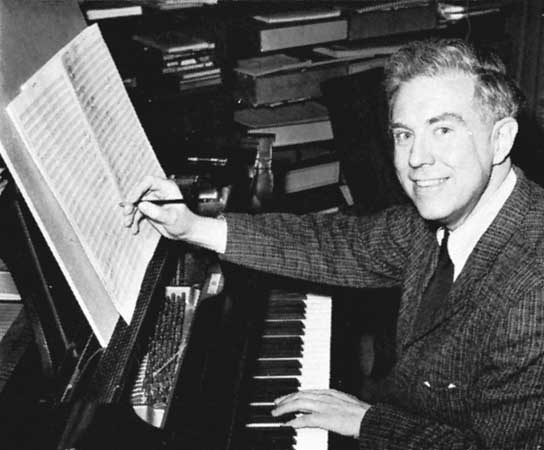 EC: It’s difficult to
reverse such a
trend because the whole field is very commercialized. The entire reason
why all this is happening in England is the government gives great
support to musical organizations. The BBC, for instance, and the people
who run it - certainly in the past, anyhow - have been very partial to
contemporary music, and developed a whole school of English composers
that didn’t exist before. Maxwell
Davies and Harrison Birtwhistle are
largely the result of a great deal of sponsorship on the part of rather
highly funded things by the government. We don’t have that kind of
thing in this country.
EC: It’s difficult to
reverse such a
trend because the whole field is very commercialized. The entire reason
why all this is happening in England is the government gives great
support to musical organizations. The BBC, for instance, and the people
who run it - certainly in the past, anyhow - have been very partial to
contemporary music, and developed a whole school of English composers
that didn’t exist before. Maxwell
Davies and Harrison Birtwhistle are
largely the result of a great deal of sponsorship on the part of rather
highly funded things by the government. We don’t have that kind of
thing in this country. EC: Ha! I like every one
of those.
[chuckles] I don’t think it makes any difference very much. One of the
problems of contemporary music concerts, at least here, is that it
tends to draw a very small and specialized public. That’s because, as I
see it, these concerts have not been highly enough publicized. When the
city of Milan decided to give Musica
nel Nostro Tempo, they give it a whole season long with
contemporary concerts almost every week. Gradually they've developed a
large public for them. These are highly publicized and they play all
kinds of things. Even La Scala presented the Stockhausen opera and the
radio orchestra plays concerts of modern music, so you gradually
develop a public. We’ve never done it, and we’ve never insisted on it.
Part of contemporary music is the way it’s been done in Milan or in
London, or as Boulez has done in Paris.
EC: Ha! I like every one
of those.
[chuckles] I don’t think it makes any difference very much. One of the
problems of contemporary music concerts, at least here, is that it
tends to draw a very small and specialized public. That’s because, as I
see it, these concerts have not been highly enough publicized. When the
city of Milan decided to give Musica
nel Nostro Tempo, they give it a whole season long with
contemporary concerts almost every week. Gradually they've developed a
large public for them. These are highly publicized and they play all
kinds of things. Even La Scala presented the Stockhausen opera and the
radio orchestra plays concerts of modern music, so you gradually
develop a public. We’ve never done it, and we’ve never insisted on it.
Part of contemporary music is the way it’s been done in Milan or in
London, or as Boulez has done in Paris.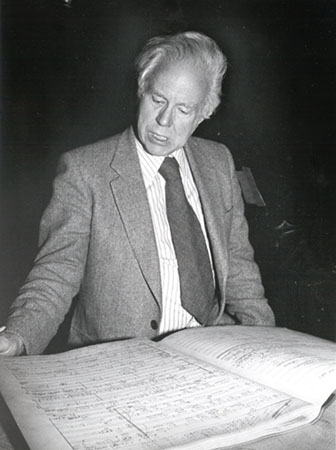 EC: I never accept a
commission that
I don’t want to do, of course. And although there are lots of those, I
generally turn down all orchestral commissions.
EC: I never accept a
commission that
I don’t want to do, of course. And although there are lots of those, I
generally turn down all orchestral commissions.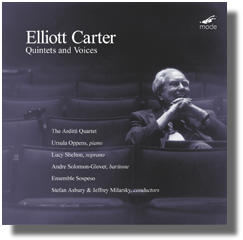 EC: It’s changed
enormously in a
very unpleasant way. When I first started to teach, contemporary music
was something that the teacher had to teach the student because
generally the students were not terribly interested in it, or, one
felt, didn’t know much about it. In truth, generally they were
interested in older music but were trained comparatively little in
harmony and counterpoint. There’s been lots of books that taught them
how to write contemporary music without knowing anything about harmony
and counterpoint, and at a certain point you have students that don’t
know anything at all, who can’t recognize the opening of Tristan und Isolde or who write
music like Stockhausen. I began to feel that they just had absolutely
no knowledge of the fundamental things that would be taught in a simple
manner by harmony and counterpoint, and it became harder and harder for
me to deal with this. The last straw was when the
composers decided that modern music was all finished and they wanted to
write old music, but they had no idea of harmony and counterpoint. So
they began to write this mess that they thought sounded like Brahms
because they couldn’t hear Brahms anymore in an intelligent way. I was
trying to write like Brahms and Mendelssohn when I began, and now I
find that students who want to write that way haven’t had the faintest
idea of what they’re trying to do. They do it the most inept and stupid
way. Finally I got sick of the whole thing, so I quit.
EC: It’s changed
enormously in a
very unpleasant way. When I first started to teach, contemporary music
was something that the teacher had to teach the student because
generally the students were not terribly interested in it, or, one
felt, didn’t know much about it. In truth, generally they were
interested in older music but were trained comparatively little in
harmony and counterpoint. There’s been lots of books that taught them
how to write contemporary music without knowing anything about harmony
and counterpoint, and at a certain point you have students that don’t
know anything at all, who can’t recognize the opening of Tristan und Isolde or who write
music like Stockhausen. I began to feel that they just had absolutely
no knowledge of the fundamental things that would be taught in a simple
manner by harmony and counterpoint, and it became harder and harder for
me to deal with this. The last straw was when the
composers decided that modern music was all finished and they wanted to
write old music, but they had no idea of harmony and counterpoint. So
they began to write this mess that they thought sounded like Brahms
because they couldn’t hear Brahms anymore in an intelligent way. I was
trying to write like Brahms and Mendelssohn when I began, and now I
find that students who want to write that way haven’t had the faintest
idea of what they’re trying to do. They do it the most inept and stupid
way. Finally I got sick of the whole thing, so I quit.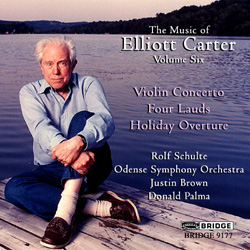 EC: I have no idea. One
of the things
I do feel is that my music is written for performers. If I were
performing it, I would lose track of what it is that goes on in the
performance that ought to have been put in the score. One of the things
that I find is very important in the early stages of the rehearsals of
the work is to hear how other people interpret what you’ve written. I
try to make the score as foolproof and as clear to the performers as
possible. When it doesn’t come out exactly the way I want it to, I
change to make a little bit louder, a little bit softer, or change the
articulation or something like that. I don’t think I would do that
if I were conducting because then, no matter how I do it, you’re too
much involved in too many other things, and I would not be able to get
the score in the shape that I would like to have it. I would lose track
of all this. Being apart from the performers, I can sit back and
check these things, and I can go to the next rehearsal, or whatever,
done by another group and find out whether what I put into that score
will be read by those people that way. I understand every time
Stravinsky conducted The Rite of
Spring, he changed the score. It is really not possible to find
out what the score is anymore, and he did this in every place he
went. In Minneapolis there are differences in the parts with the
New York Philharmonic because he changed something or other, and he
did this over and over again. We know that this practice is very
draining, and if he had been a bystander not involved in it, it might
have been better. It’s the same with the Mahler symphonies, where
Mahler continually changed everything.
EC: I have no idea. One
of the things
I do feel is that my music is written for performers. If I were
performing it, I would lose track of what it is that goes on in the
performance that ought to have been put in the score. One of the things
that I find is very important in the early stages of the rehearsals of
the work is to hear how other people interpret what you’ve written. I
try to make the score as foolproof and as clear to the performers as
possible. When it doesn’t come out exactly the way I want it to, I
change to make a little bit louder, a little bit softer, or change the
articulation or something like that. I don’t think I would do that
if I were conducting because then, no matter how I do it, you’re too
much involved in too many other things, and I would not be able to get
the score in the shape that I would like to have it. I would lose track
of all this. Being apart from the performers, I can sit back and
check these things, and I can go to the next rehearsal, or whatever,
done by another group and find out whether what I put into that score
will be read by those people that way. I understand every time
Stravinsky conducted The Rite of
Spring, he changed the score. It is really not possible to find
out what the score is anymore, and he did this in every place he
went. In Minneapolis there are differences in the parts with the
New York Philharmonic because he changed something or other, and he
did this over and over again. We know that this practice is very
draining, and if he had been a bystander not involved in it, it might
have been better. It’s the same with the Mahler symphonies, where
Mahler continually changed everything.  EC: On winning the
Pulitzer Prize, I
can’t tell you that exactly. You write something and it’s among the
list of things that you’ve got and the actual effect of the Pulitzer is
very odd. They just give it to you. The first one was won by my Second String Quartet which the
Juilliard were playing at that time, and they got a lot of engagements
to play it around the United States. After the first two or three
performances, the audiences were so angry that I had ever received the
prize because the piece was so peculiar as far as they were concerned.
The Juilliard Quartet finally made a recording and sent it around to
the people who had asked for it, and asked them whether they really
wanted to hear this piece or not. Many of them canceled it. The
Pulitzer Prize in music is a very different thing from that in
literature or journalism.
EC: On winning the
Pulitzer Prize, I
can’t tell you that exactly. You write something and it’s among the
list of things that you’ve got and the actual effect of the Pulitzer is
very odd. They just give it to you. The first one was won by my Second String Quartet which the
Juilliard were playing at that time, and they got a lot of engagements
to play it around the United States. After the first two or three
performances, the audiences were so angry that I had ever received the
prize because the piece was so peculiar as far as they were concerned.
The Juilliard Quartet finally made a recording and sent it around to
the people who had asked for it, and asked them whether they really
wanted to hear this piece or not. Many of them canceled it. The
Pulitzer Prize in music is a very different thing from that in
literature or journalism.  EC: Well of course it’s
fun. I
wouldn’t do it if it wasn’t. It's not like a funny toy, it’s
infuriating like everything, like all fun. This particular aspect of
copying drives me a little crazy because I would rather write the piece
than copy it, but when it’s written this way, it’s in such a mess that
nobody could make it out. It’s not clear enough, so it has to have
copies made.
EC: Well of course it’s
fun. I
wouldn’t do it if it wasn’t. It's not like a funny toy, it’s
infuriating like everything, like all fun. This particular aspect of
copying drives me a little crazy because I would rather write the piece
than copy it, but when it’s written this way, it’s in such a mess that
nobody could make it out. It’s not clear enough, so it has to have
copies made.|
|
This interview was recorded on the telephone on June 10,
1986. Portions were used (along with recordings) on WNIB in 1988,
1993, 1998 and 2000; and aboard Delta Airlines In-Flight Entertainment
Package in September, 1989. Audio copies of the interview have
been given to the Archive of Contemporary Music at Northwestern
University, and the Oral History American Music archive at Yale
University. This transcription was made and posted on this
website in 2008.
To see a full list (with links) of interviews which have been transcribed and posted on this website, click here.
Award - winning broadcaster Bruce Duffie was with WNIB, Classical 97 in Chicago from 1975 until its final moment as a classical station in February of 2001. His interviews have also appeared in various magazines and journals since 1980, and he now continues his broadcast series on WNUR-FM, as well as on Contemporary Classical Internet Radio.
You are invited to visit his website for more information about his work, including selected transcripts of other interviews, plus a full list of his guests. He would also like to call your attention to the photos and information about his grandfather, who was a pioneer in the automotive field more than a century ago. You may also send him E-Mail with comments, questions and suggestions.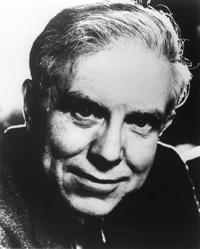 With
the explorations of tempo relationships and texture that characterize
his music, Carter is recognized as one of the prime innovators of
20th-century music. The challenges of works such as the Variations
for Orchestra, Symphony of Three Orchestras,
and the concertos and string quartets are richly rewarding. In 1960,
Carter was awarded his first Pulitzer Prize for his visionary
contributions to the string quartet tradition. Stravinsky considered
the orchestral works that soon followed, Double Concerto for
harpsichord, piano and two chamber orchestras (1961) and Piano
Concerto (1967), to be "masterpieces".
With
the explorations of tempo relationships and texture that characterize
his music, Carter is recognized as one of the prime innovators of
20th-century music. The challenges of works such as the Variations
for Orchestra, Symphony of Three Orchestras,
and the concertos and string quartets are richly rewarding. In 1960,
Carter was awarded his first Pulitzer Prize for his visionary
contributions to the string quartet tradition. Stravinsky considered
the orchestral works that soon followed, Double Concerto for
harpsichord, piano and two chamber orchestras (1961) and Piano
Concerto (1967), to be "masterpieces".