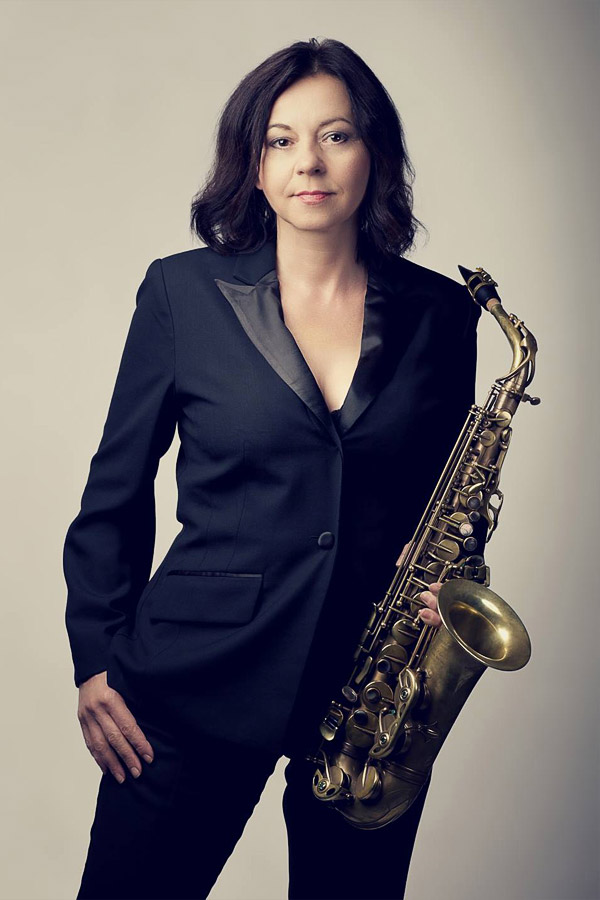
Saxophonist  Alina  Mleczko

A Conversation with Bruce Duffie


mleczko


Alina Mleczko made her debut as a soloist at the Warsaw Philharmonic in 1995. One year later, the American professional magazine Saxophone Journal dedicated a monographic article to her in the issue dedicated to the world's most outstanding saxophonists.

She has released 8 albums featuring  saxophone concert recordings and original programs. Her solo performances are featured on albums dedicated to composers such as Grazyna Pstrokońska- Nawratil, Jacek Grudzień, and Edward Sielicki. She has participated in the recordings of several dozen publications as a chamber musician.

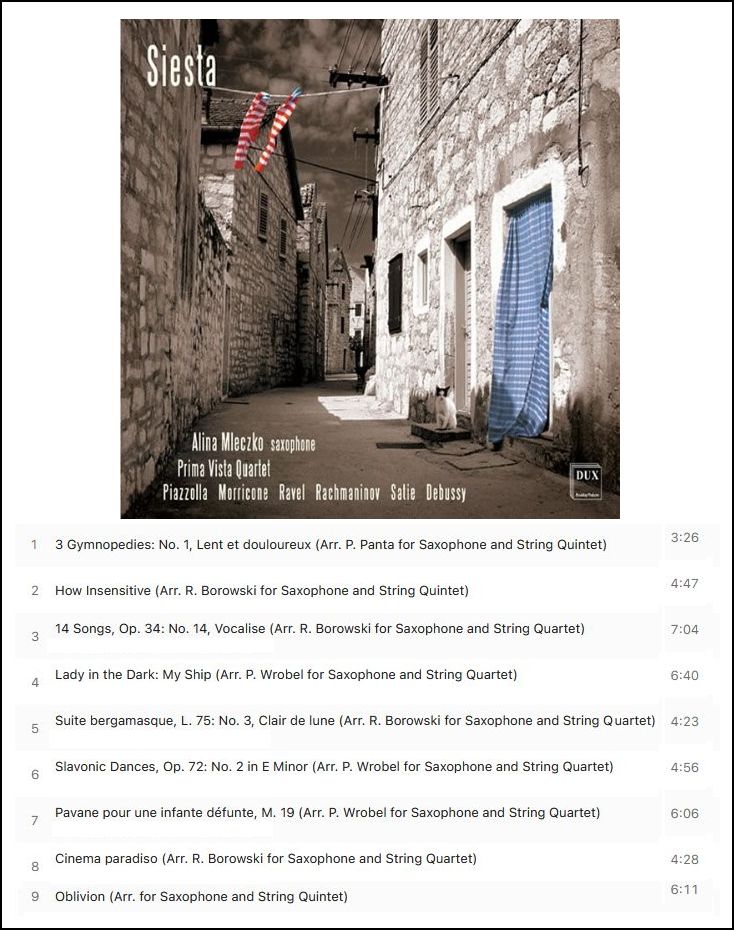
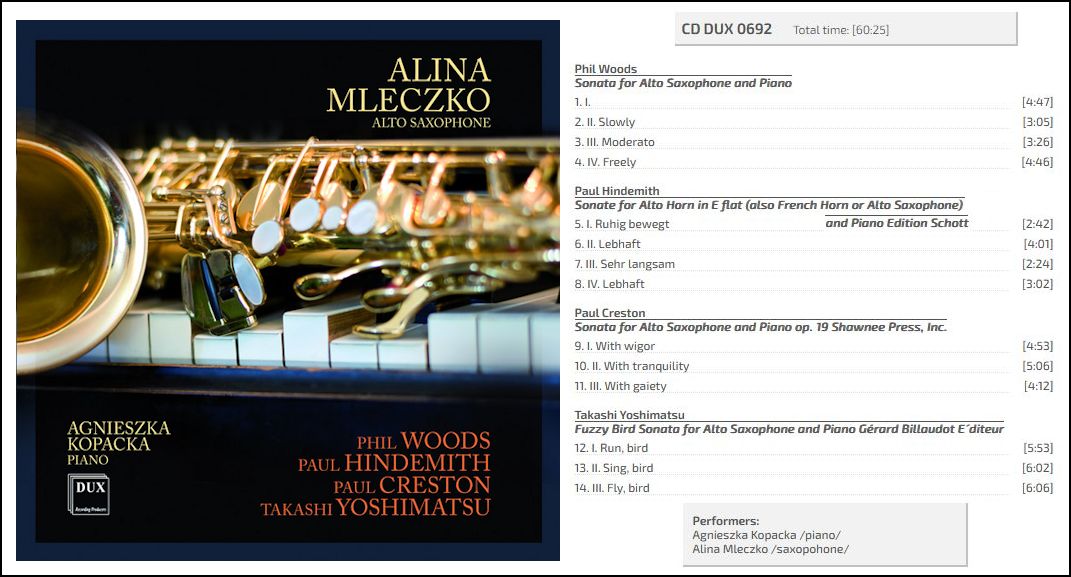
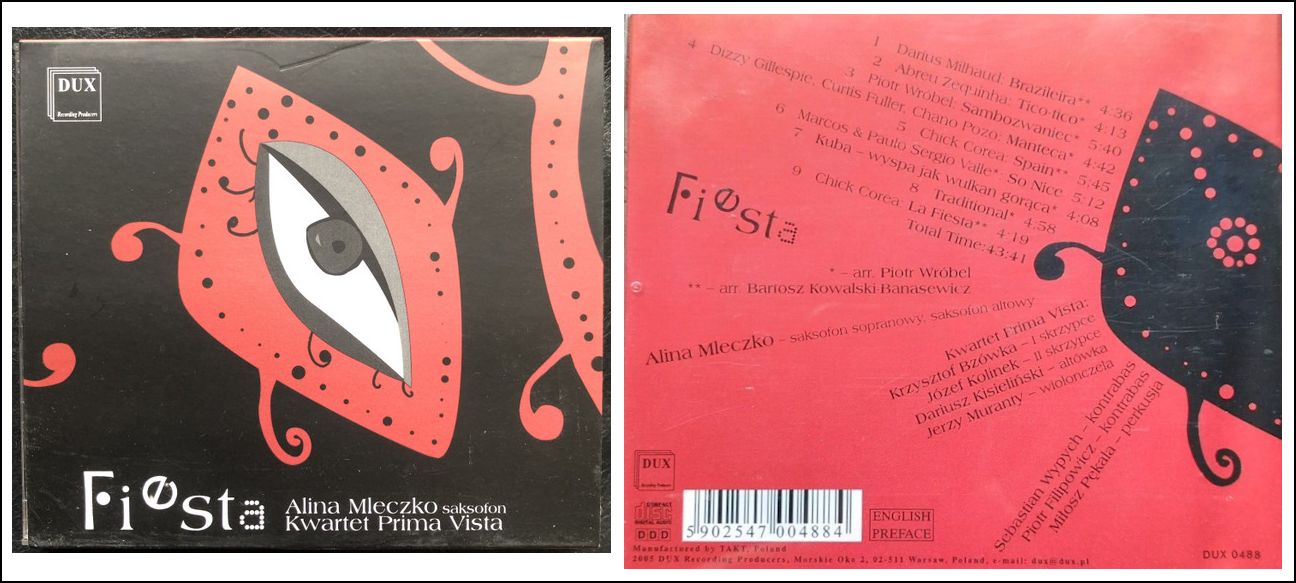
Alina’s first solo album entitled Wiatr od Morza (Sea Breeze) featured works written for her by Jacek Grudzien, Pawel Mykietyn, Maciej Zielinski, Waldemar Miksa and Michal Kulenty. In 2003, DUX Recording Producers released her album Siesta that received a nomination for the Fryderyk Award for Best Album-Chamber Music. Siesta was also awarded by the French Classica, and became number one on this periodical’s bestseller list. Mleczko’s next album, Fiesta, has also received a nomination for the Fryderyk Award. Her CD, Saxophone, consists of sonatas for saxophone written by Paul Creston, Paul Hindemith, Phil Woods and Takashi Yoshimatsu. This album has received excellent reviews from world-renowned press like British Gramophone and French Classica, among others.

mleczko

Alina Mleczko is a saxophone lecturer at Fryderyk Chopin School of Music in Warsaw, and holds a degree from there, as well as from the Instrumental-Pedagogical Faculty in Bialystok. She was a lecturer at the International Course for Young Composers in Radziejowice. Her students succeed in various competitions, and are often awarded with scholarships by the Polish Ministry of Culture and National Heritage, and the Polish Children’s Fund.

As a soloist, she performs with the finest Polish orchestras, including Symfonia Varsovia, with whom she toured Germany in 2010 performing Aleksandr Glazunov's Concerto for Saxophone and String Orchestra. She has also performed with the orchestras of the Kiev Philharmonic, Danish Radio, Capella Istropolitana from Bratislava in various countries across Europe, as well as in the USA. She has premiered numerous compositions, many of which were dedicated to her. In April 2016, she performed again at the National Philharmonic with Hanna Kulenty's-Majoor concerto. In addition, Alina Mleczko is involved in projects featuring improvised music, jazz, and ethno.

Alina Mleczko received the Gloria Artis Medal of Cultural Merit in November 2023, awarded by the Polish Minister of Culture and National Heritage to individuals or institutions for outstanding achievements, cultural activities or the preservation of national culture and heritage.

==  Text of biography slightly edited from the Selmer website  
==  Photo from a different source  


Alina Mleczko (born February 1, 1969 in Lubliniec ) – Polish saxophonist.

She has released several solo albums, two of which were nominated for the Fryderyk phonographic award . She received an award from the French music magazine Classica for her album Siesta. She also received the Rewelacja Audio Video distinction for her album Fiesta

In 1995 she made her debut at the National Philharmonic in Warsaw at the Latin American Culture Festival, performing Fantazja by Heitor Villa-Lobos.

In 2010, she was the first Polish saxophonist to tour Germany with the prestigious Sinfonia Varsovia orchestra, performing Aleksander Glazunov's Concerto for Saxophone and String Orchestra, Op. 109.

She teaches saxophone at the Fryderyk Chopin State Music School Complex in Warsaw.

In 2011, she received a doctorate in musical arts, and assumed the position of assistant professor at the Fryderyk Chopin University of Music in Warsaw. She is also on the faculty of Instrumental and Pedagogical Studies in Białystok, where she teaches saxophone.

She was the first woman to graduate from the saxophone class of David Pituch and Krzysztof Herder at the Academy of Music in Warsaw.

She recorded her first solo album, "Wind from the Sea," during her fifth year of studies. Subsequent albums, "Siesta" (2003) and "Fiesta" (2005), were nominated for the Polish phonographic award "Fryderyk" and received excellent reviews and awards. Siesta won the award from the French music magazine "Classique." It also topped the magazine's bestseller list. "Fiesta" was hailed as an audio-video revelation.

mleczko


As a soloist, she has performed with orchestras including Capella Istropolitana from Bratislava, the National Orchestra of Ukraine, Sinfonia Varsovia , the Danish Radio Symphony Orchestra and many philharmonic orchestras in Poland.

She has performed in numerous European countries and the United States, including at festivals such as Warsaw Autumn , Lutosławski Forum, Two Days & Two Nights in Odessa, Musica Polonica Nova, Vratislavia Cantans, the Prague Electronic Music Festival, and the Latin American Culture Festival.

Alina Mleczko's artistic experience also includes joint concerts with Grammy Award winner Włodek Pawlik entitled The Other Side of the Medal - Jazz and Classical Music.

The artist has collaborated extensively with the Dramatyczny Theatre and the Studio Theatre in Warsaw. She has participated in numerous performances directed by, among others, Krzysztof Warlikowski with music by Paweł Mykietyn .

She co-creates theatre performances, performing her own music, including with actors Wojciech Siemion in a play by Tomasz Walczak "Laments to My Mother", as well as "Saxophone"  based on the novel by Wiesław Myśliwski " Treaty on Shelling Beans " with actor Mariusz Bonaszewski of the National Theatrer, The Taming of the Shrew – Dramatyczny Theatre – directed by Krzysztof Warlikowski , "The Hour When We Knew Nothing About Each Other" – directed by Krzysztof Warlikowski – music by Paweł Mykietyn. Studio Theatre.

Discography

  • Wind from the Sea (1997), publisher: Polskie Nagrania Edition
  • Contemporary Music for Classical Saxophone - USA (March 2000), recorded live at Regenstein Hall, Northwestern University, Chicago
  • Siesta (2003), released by DUX Recording Producers 
  • Fiesta (2005), released by DUX Recording Producers
  • Saxophone (2010), DUX Recording Producers
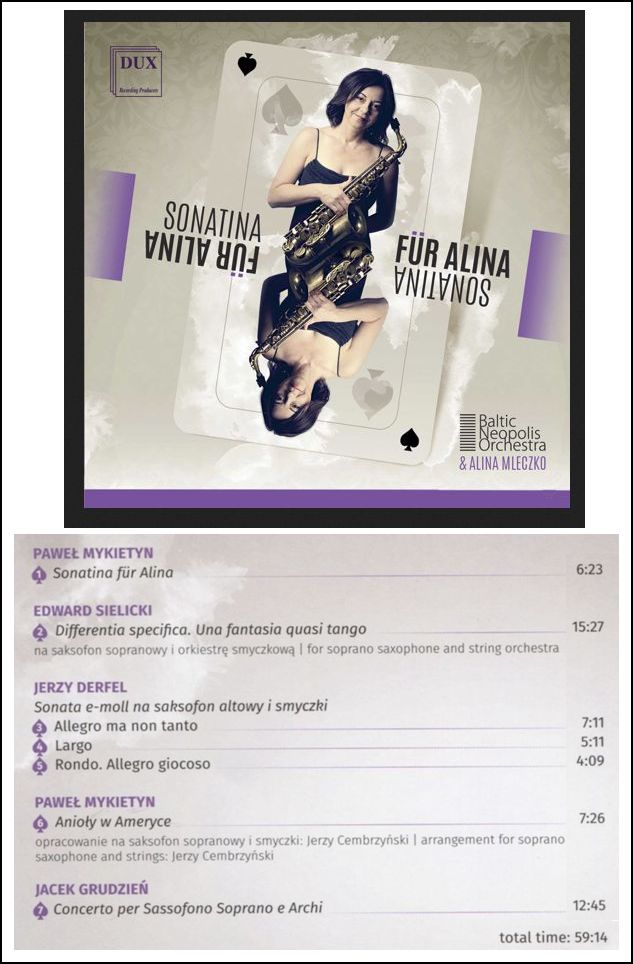
  • Sonatina für Alina (2010), DUX Recording Producers . Recorded with the Baltic Neopolis Orchestra .
  • Christmas Carol (2011), released by EMI Classics

Awards and distinctions

  • The album was nominated for the Fryderyk 2003 award
  • Award from the French music magazine "Classica." Mleczko also topped the magazine's bestseller list.
  • The album "Fiesta" was nominated for the Fryderyk phonographic award (2005) . "Fiesta" was hailed as the Audio-Video Revelation of 2005.


==  Text slightly edited from the Google translation of the Polish edition of Wikipedia.  
  Photo from a different source.  


In March of 2000, the concert tour of saxophonist Alina Mleczko brought her to Chicago, and through the kindness of composer Robert Kritz, whose music was included in her programs, she came to the studios of WNIB for an interview.  Her English was quite good, and we spent about a half-hour discussing her work, as well as her ideas of music in general.

A couple of days later I was able to air portions of the conversation to promote her appearances, and now, exactly twenty-six years later, I am pleased to present the entire chat.
 

Bruce Duffie:   You were telling me that your husband works at a classical radio station, and does the same kind of job that I do, but in Warsaw.

Alina Mleczko:   Yes, this is Radio Classic in Warsaw which started three years ago, and actually my husband created this idea.

BD:   Has he put you on the air?

Mleczko:   Yes, of course.
mleczko
BD:   Did you influence him to go into classical radio, rather than into pop or rock?

Mleczko:   He’s also a musician, and he also plays the saxophone.  He also plays classical music on the saxophone, so he loves classical music!  That is why he created the classical station, not a rock outlet for our work.

BD:   Have you always played the saxophone, or did you start on some other instrument?

Mleczko:   When I was a child I played the violin for six years, and when I was in high school I met the very good saxophone teacher.  He asked me if I wanted to play the saxophone because he liked the way I played the violin.  So, I tried it, and that was my beginning.

BD:   Did it take much coaxing to get you into the saxophone and away from the violin, because it’s a completely different technique?

Mleczko:   Yes, but playing the violin helped me musically with the playing of the saxophone.  When I was a child, I practiced the violin a few hours a day, and this is very good for fingers and for exercise.  But also, this good for my musicianship, because I knew different styles of pieces.  I played Wieniawski, and Paganini, and many of the greatest composers.  Then I started to play the saxophone, and I met music by composers like Glazunov, Ibert, Villa Lobos and other wonderful composers.

BD:   Do you keep up the violin at all?

Mleczko:   No.  [Laughs]  I can’t play the violin now other than just for myself.

BD:   Perhaps someone should write a double concerto for you as the soloist on both violin and saxophone!

Mleczko:   No, no, I don’t think so!  [Both laugh]  I play the saxophone, and this is my job and my pleasure.  As I said, the violin is only for me, not to play professionally.

BD:   The violin can play jazz and rock, but it’s basically classical.  The saxophone is somewhat the other way round.  It’s mostly a jazz and rock instrument, and a little bit classical.  You’ve brought the saxophone more into the classical world.

Mleczko:   Yes, I play classical music on the saxophone, but I also like jazz music very much.  Actually, my favorite saxophone players are jazz players.  John Coltrane is my favorite saxophone player, but my way on the instrument is through classical music.

BD:   Is it hard to get people to understand that the saxophone can play classical music and not just jazz?

Mleczko:   It’s hard.  It depends on what I can do, what I want to tell the audience, how I play, what is really musically my way, and what I want to play.  People love music, so if this is good classical music, then this is good.  If it is jazz, they also listen so this is also good.

*     *     *     *     *

BD:   You play solo recitals and also concertos.  Do you prefer one to the other, or do you play mostly one or the other?

Mleczko:   Actually, in the last few weeks, I performed many concerts with orchestras in Poland and in Ukraine, and now I’m here in Chicago where I will play a few recitals.  I already performed a recital in Valparaíso, and next week I will perform at Northwestern University, the Chicago Cultural Center, and The University of Chicago.

BD:   These are all solo recitals?

Mleczko:   Solo recitals, yes.  Then I will go to Germany where I will perform the concerto by Glazunov with the Ukrainian National Symphony Orchestra.  So, I’m involved with both orchestral concerts and solo recitals.

BD:   Do you change your technique or your sound at all if you’re accompanied by a piano rather than by a full orchestra?

Mleczko:   No, I don’t change my technique, but when I play with a pianist, this is different situation.  Here in Chicago I am playing with Yoko Yamada-Selvaggio, who is a very good pianist.  We will play in mostly smaller places.  I know what I want to play, what I want to suggest to her, and this is more private and more intimate.  When I play with orchestra, this situation would be with a conductor.  I actually like working with the conductor.  I talk with him, and he matches the orchestral sound to my sound and way of performing.

BD:   Do you find that conductors are sympathetic to the sound of the saxophone?

Mleczko:   Yes.  I have met conductors who want to play with me, and who love saxophones!  I have never had any problems with them.

BD:   That’s good.  Do you find that audiences receive you well?

Mleczko:   Yes, especially I’m very happy that I can be here in Chicago.  The audiences here are very, very nice.  For the two recitals which I had, there were many people there, and they were really wonderful audiences.

BD:   Are the audiences here different from the audiences in Poland and elsewhere?

Mleczko:   I don’t know if they are different, but in Poland I know my audiences.  Here, this is a new place for me.  It’s my first time in Chicago, and the first time to give concerts both in Chicago and in America.  So this is good experience for me, but I have to see what it is.  I don’t know these audiences yet, but as I say, so far they are really fantastic.

*     *     *     *     *

BD:   There are several different sizes of saxophone.  Do you play the various sizes?

Mleczko:   Yes, I play the soprano, the alto, and the tenor saxophones.  I haven’t got a baritone one, but I will try to learn to play all saxophones.
mleczko
BD:   You could multi-track yourself as a quartet!
 
Mleczko:   Oh!  [Much laughter]  I don’t think so, but a saxophone performer should play all saxophones, not only alto or only soprano.  I’m also a teacher.   I teach in the Warsaw Conservatory of Music, and I have eleven students, and all of them play alto.  Some of them also play soprano and tenor saxophones.

BD:   Have you played in a saxophone quartet?

Mleczko:   Yes, sometimes, but now when I’m here and when I have many concerts, I haven’t got the time for quartets!  [Both laugh]  Actually I played a lot in saxophone quartets when I was in the Chopin Academy of Music.  There I met my teacher, a very good teacher and a very good saxophone player, David Pituch, who was in Warsaw for ten years.  He was teaching in Warsaw at the Chopin Academy, and it was probably the first time I really thought I’d be a professional saxophone player.

BD:   Does it surprise you that you are now touring the world as a virtuoso?

Mleczko:   Yes, but I always wanted to be a professional saxophone player.  I want to play as a soloist in saxophone concertos.

BD:   There’s not a lot of repertoire for the saxophone, so you are commissioning a number of works?

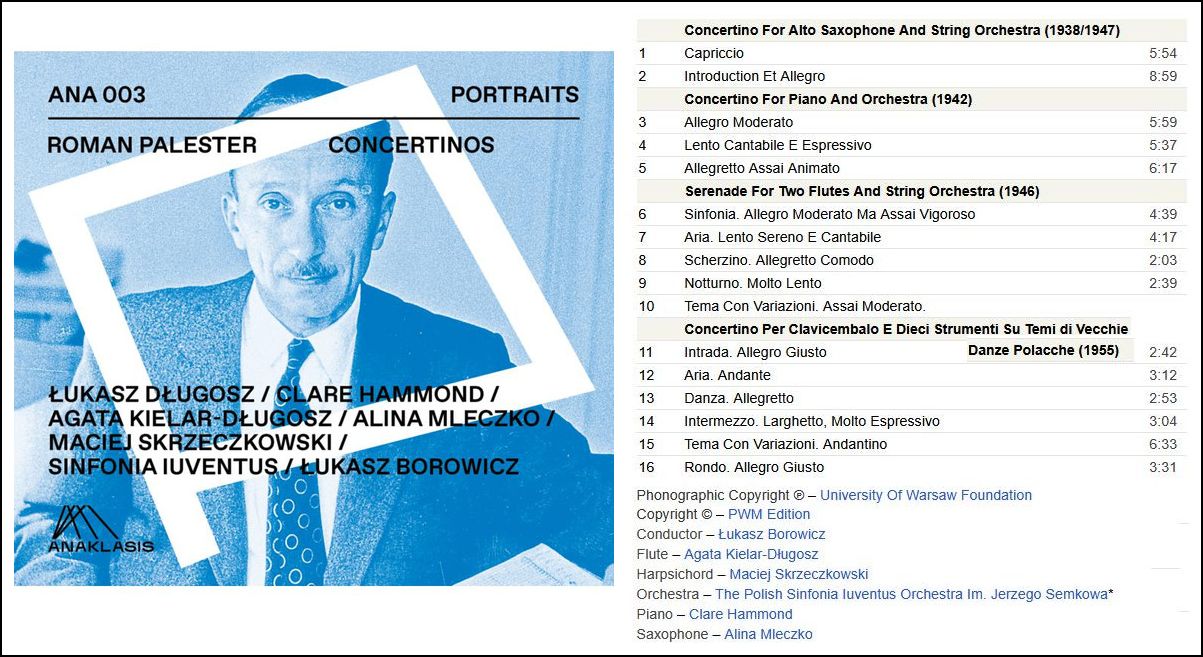
Mleczko:   There are not a lot of very good compositions for saxophone, but we have a few like the concerto by Glazunov, Fantasie by Villa Lobos, and the concerto by Jacques Ibert.  There is also a concerto by the Polish composer Roman Palester.  David Pituch recorded it.  What I like to play very much are pieces by Polish contemporary composers.  A few years ago, I met a Chicago composer Robert Kritz, who wrote a wonderful concerto for saxophone and orchestra.  I played this concerto in Poland a few times with Polish orchestras, and I hope I will perform this concerto next summer and next autumn with a Ukrainian orchestra in Ukraine and in Germany.  In my recitals next week, I also have Two Studies from Blue by Kritz, along with Polish composers.

BD:   Is it satisfying to know that composers will write music for you and your instrument?

Mleczko:   Of course, absolutely!  On my first CD, which is called The Sea Breeze, most of the pieces were written especially for the CD, and especially for me.  So I’m very glad that I can perform these pieces here in America.  They are being heard here for the first time.

BD:   Do you have any advice for those who want to wrote for the saxophone?

Mleczko:   Advice?  Hmmm... I don’t know.  It depends.  Actually, I haven’t any real advice.  If I met somebody who listened to how I play, and they like it, then they can write something for me and it will be enjoyed.  I always want to play very good pieces as best as I can, so maybe this is my advice... not for composers but for performers.  I’m interested in what composers can suggest, and what they want to write.  I see, I hear, and I can play it as best as I can.  That’s all.

BD:   You’re happy playing the saxophone?

Mleczko:   Yes.

BD:   When you’re playing a piece of music, are you playing what’s in your head or what’s in your heart?

Mleczko:   [Laughs]  Of course, both!  It has to be in my head because I have to know the piece really well.  I have to know every note, but when I am on the stage and when I see the audience, yes, I play from my heart.

*     *     *     *     *

BD:   Let me ask an easy question.  What’s the purpose of music?

Mleczko:   You mean why music?  I don’t know.  I always wanted to play music when I was a child.  I wanted to play the piano, because in Poland there is the very famous competition, The Chopin Competition.  All my family listen to this competition, and everyone likes this music.  So, when I was five and six years old, I wanted to play the piano, but my mother said she could not buy a piano.  But we had an accordion at home, so if I wanted, I could learn the accordion.  I said I would, and I took this accordion and went to a music school.  But when I was there, I met teachers who said I was so small and so thin that I can’t play this hard instrument.  They said I could try the violin!

BD:   [Pursuing my original thought just a bit deeper]  That’s why you’re into music, but what is the reason for music to exist?

Mleczko:   Hmmm... I don’t know!  People need some music.  It’s simple.  People need art, and they need music, and they need poetry.  A good life without all these things is impossible.

BD:   Is the music that you play, for all people?

Mleczko:   For some, no.  It is only for those people who want to listen to this music.  I’m sure it is not for all.

BD:   Should we try to get more people to listen to your music?

Mleczko:   Yes, but I don’t want to do it.  If I want to get big audiences, I will play pop music.  I play music which I want to play, and if somebody wants to hear it, I would be happy.

BD:   Are you pleased with where you are at this point in your career?

Mleczko:   Yes, of course.  I’m very lucky because I have met very good people, and very interesting people as my teachers and composers whose pieces I play.  I’m really lucky, and they have helped me to do what I do well.

BD:   Will you be coming back to Chicago?

Mleczko:   I hope so!  I would love to come back!

BD:   I’m glad you’ve brought your enthusiasm to the saxophone.  Thank you for speaking with me today.

Mleczko:   Thank you very much.


mleczko


© 2000 Bruce Duffie

This conversation was recorded in Chicago on March 25, 2000.  Portions were broadcast on WNIB three days later.  This transcription was made in 2026, and posted on this website at that time.  My thanks to British soprano Una Barry for her help in preparing this website presentation.

To see a full list (with links) of interviews which have been transcribed and posted on this website, click here.  To read my thoughts on editing these interviews for print, as well as a few other interesting observations, click here.

*     *     *     *     *

Award - winning broadcaster Bruce Duffie was with WNIB, Classical 97 in Chicago from 1975 until its final moment as a classical station in February of 2001.  His interviews have also appeared in various magazines and journals since 1980, and he now continues his broadcast series on WNUR-FM, as well as on Contemporary Classical Internet Radio.

You are invited to visit his website for more information about his work, including selected transcripts of other interviews, plus a full list of his guests.  He would also like to call your attention to the photos and information about his grandfather, who was a pioneer in the automotive field more than a century ago.  You may also send him E-Mail with comments, questions and suggestions.