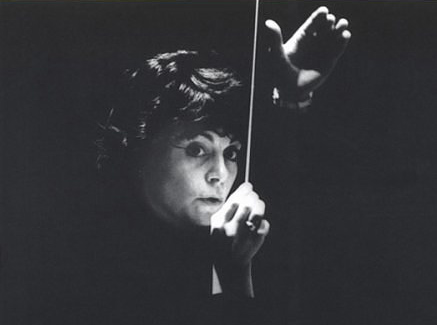
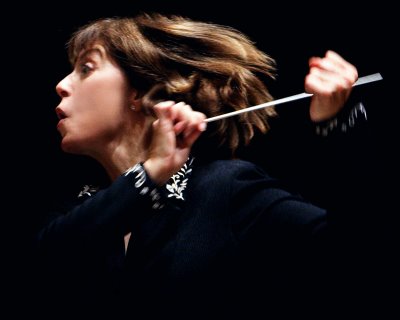
Conductor JoAnn Falletta
A Conversation with Bruce Duffie
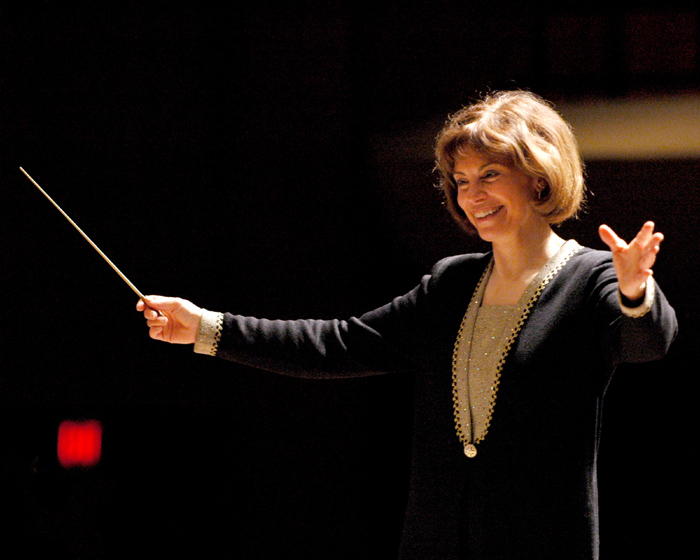
Though not really a pioneer, JoAnn Falletta is one of a small
– but steadily growing – group of orchestral conductors who happen
to belong to the female gender.
She started out playing guitar, went to Juilliard and studied with Jorge
Mester, and also worked with Leonard Bernstein. All of these credentials
are somewhat typical of those who aspire to lead virtuoso ensembles and imprint
their ideas on recordings.
For more photos and details of her career, visit her website. And harking back
to her earliest musical experiences, a guitar competition has been established
in her name. [For the remainder of
this webpabe, links refer to my interviews elsewhere on my website.]
In the fall of 1996, Falletta was in suburban Chicago to conduct the Lake
Forest Symphony, and we arranged to meet for an interview. She was enthusiastic
about the upcoming concerts as well as the other aspects of her career.
Here is that conversation . . . . .
Bruce Duffie:
We’re talking a bit about contemporary music. Is it really as difficult as
we all think to get contemporary music performed on concerts these days?
 JoAnn Falletta:
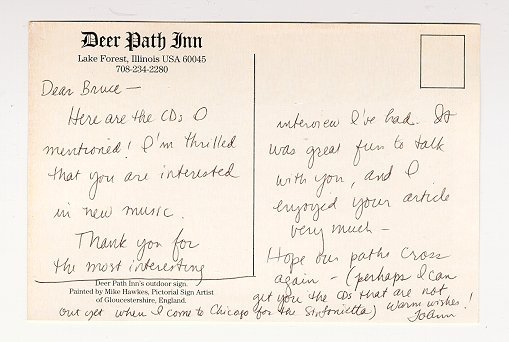
Well, I’ve made it for myself kind of a mission to try and expand the orchestral
repertoire a little bit because, as you know, most conductors are faced with
audiences that want pieces composed before the year 1900 and nothing after
that. So I’ve tried very hard to begin to introduce 20th century music
and contemporary music from the later part of the 20th century into concert
programs.
JoAnn Falletta:
Well, I’ve made it for myself kind of a mission to try and expand the orchestral
repertoire a little bit because, as you know, most conductors are faced with
audiences that want pieces composed before the year 1900 and nothing after
that. So I’ve tried very hard to begin to introduce 20th century music
and contemporary music from the later part of the 20th century into concert
programs.
BD: Twentieth
century music could be Debussy or Stravinsky.
JF: For some
people, and that’s risky in some places. But I want to include even
later music of the living American composers now. I’ve found that if
one is very careful about length and position in the program, that audiences
are intrigued and interested. You can build up a certain trust among
your audience base, which is what it’s all about. They may not know
the name Christopher Rouse
or John Luther Adams
but they know that you are choosing carefully and interested in good music,
so they’ll take a chance and come.
BD: So they’ll
take a chance on maybe 15 or 20 minutes but not a chance on two hours?
JF: Well, that’s
right. I sometimes ask composers, “Would you prefer if we could get
a 15 minute piece of yours on a program with Beethoven and Rachmaninoff, or
would it be better if we have evenings with two hours of contemporary music?”
Most of them prefer being on a mixed concert because it somehow indicates
to the audience that the orchestra is going forward. The orchestra
continues to develop. We’re enriching the repertoire; we’re not ghettoizing
a certain type of repertoire that only those hardcore new-music fans will
come to. I think there’s certainly ways to do both, but I’ve found
it most interesting for myself to mix in contemporary music on programs with
very standard repertoire as well.
BD: When you
get a score that is either very new or brand new and never been played, how
do you decide if you’re going to spend the time learning it and preparing
it and presenting it to the audience?
JF: Once the
word sort of gets out that you are a person who’s interested in new music,
you are deluged with scores from everywhere. Weekly I get two or three
scores from composers, and the sad thing is that there are so many incredibly
gifted American composers who are really worth hearing that I would never
have enough concerts to program all this music. So, it’s hard…
BD: Well, this
is my question – what makes it worth hearing?
 JF:
It is worth hearing if I can get a sense that the music will communicate something
to the audience. Of course it is not going to communicate in the language
of Tchaikovsky; it’s not going to be something that is going to be beautiful
to listen to in the 19th century sense of ideal of beauty. But if I can sense
that there is an integrity and there is a desire to communicate with the
public, that is interesting to me. In the last five years especially,
I’ve noticed that composers seem to be also more interested in communicating
with the public. There was a period of time when composers didn’t seem
to find that a necessity. They wrote music that made sense for them,
whether it was mathematically or esoteric, whatever it was, and if the audience
liked it that was an extra. But I think composers today are vitally
interested in whether the audience likes it. Maybe “likes”
is too strong a word because it’s hard to like something on first hearing;
it depends whether the audience is interested in it, intrigued by it, and
would appreciate hearing it again, and that makes a big difference.
I find that audiences are responding to the composer’s desire to reach them.
JF:
It is worth hearing if I can get a sense that the music will communicate something
to the audience. Of course it is not going to communicate in the language
of Tchaikovsky; it’s not going to be something that is going to be beautiful
to listen to in the 19th century sense of ideal of beauty. But if I can sense
that there is an integrity and there is a desire to communicate with the
public, that is interesting to me. In the last five years especially,
I’ve noticed that composers seem to be also more interested in communicating
with the public. There was a period of time when composers didn’t seem
to find that a necessity. They wrote music that made sense for them,
whether it was mathematically or esoteric, whatever it was, and if the audience
liked it that was an extra. But I think composers today are vitally
interested in whether the audience likes it. Maybe “likes”
is too strong a word because it’s hard to like something on first hearing;
it depends whether the audience is interested in it, intrigued by it, and
would appreciate hearing it again, and that makes a big difference.
I find that audiences are responding to the composer’s desire to reach them.
BD: Perhaps a
dangerous question – are there some composers who are
just pandering to this new taste?
JF: Yes, I think
that happens, too.
BD: So how do
you weed them out?
JF: There are
composers who get a little bit gimmicky, I think, because in being gimmicky
– or having a cute idea or a cute title or some sort of interesting
premise – there’s not much substance there, so it’s
hard. And I’ll be honest with you, I can’t say I’ve always been successful
in my own mind in choosing the best pieces. But I really try very hard
to do some research into the composer’s background, what he’s written before
and where he is now. With the Long Beach Symphony, we do a great deal
of commissioning in California, and that’s always very risky –
as you can imagine – because you may look
at a composer’s work and like what he’s done, commission him and then find
that he’s just radically changed styles into something else that you were
not interested in. That happens sometimes.
BD: But even
if he hasn’t really changed styles, is it right to expect the composer to
hit a home run each time?
 JF:
That’s it too. I try and tell the audiences what we are doing is enabling
this composer to become a better composer. We’re enabling our culture,
the music of our country to become strengthened. Could Beethoven have
really written his Ninth Symphony
if he could never get performances for the other eight? I don’t think
so. Composers tell me that when they are actually in a situation where
an orchestra is rehearsing and performing their piece, they learned so much
more about what they want, about their own language, their own voice and what
was not how they calculated it to be. It’s a tremendous step forward
for them, and if we don’t perform American music, eventually we’re not going
to have a valid music at all in this country because we’re not allowing composers
to develop. It’s like any other art form – it
has to develop. No one is born a great composer and writes masterpieces
at age 20 – except Mozart perhaps! They get better and better, and as
an American conductor, I feel that’s part of my responsibility. It’s
actually a privilege, too, because to work with living American composers,
as an American you understand that language somehow. And I think audiences
do, too. It may be very modern language, very dissonant, very atonal,
whatever, but if it’s written by someone who’s grown up in the United States
and has had basically the same experiences that many of us have had, there
is something in that we have in common with the language we hear. There
is something that makes sense to us at the core, and that’s why I think it’s
become easier to interest American audiences in American music. They’re
able to somehow respond to an aspect of that music that touches them.
JF:
That’s it too. I try and tell the audiences what we are doing is enabling
this composer to become a better composer. We’re enabling our culture,
the music of our country to become strengthened. Could Beethoven have
really written his Ninth Symphony
if he could never get performances for the other eight? I don’t think
so. Composers tell me that when they are actually in a situation where
an orchestra is rehearsing and performing their piece, they learned so much
more about what they want, about their own language, their own voice and what
was not how they calculated it to be. It’s a tremendous step forward
for them, and if we don’t perform American music, eventually we’re not going
to have a valid music at all in this country because we’re not allowing composers
to develop. It’s like any other art form – it
has to develop. No one is born a great composer and writes masterpieces
at age 20 – except Mozart perhaps! They get better and better, and as
an American conductor, I feel that’s part of my responsibility. It’s
actually a privilege, too, because to work with living American composers,
as an American you understand that language somehow. And I think audiences
do, too. It may be very modern language, very dissonant, very atonal,
whatever, but if it’s written by someone who’s grown up in the United States
and has had basically the same experiences that many of us have had, there
is something in that we have in common with the language we hear. There
is something that makes sense to us at the core, and that’s why I think it’s
become easier to interest American audiences in American music. They’re
able to somehow respond to an aspect of that music that touches them.
BD: You also
conduct in Europe. Do you try to take some of the best of the American
music to Europe with you?
JF: I do
try, and I have to tell you this is very frustrating in Europe because they
almost always ask for an American piece, but their idea of an American piece
is almost always An American in Paris.
This year alone I’m doing that piece in Europe three or four times.
They love Copland and Gershwin. That to them is the American sound,
and the delightful thing about doing it in Europe is that they take it tremendously
seriously. When I do An American in
Paris with my orchestras in United States, it’s like, “Oh, we’re doing
this again,” and we hardly rehearse it. In Europe, they take it with
the same seriousness they would play a Brahms symphony. This is music
that is very worthwhile and very exciting to them. So it’s interesting
to see them responding such a serious way to it.
BD: Do you think
Gershwin would have been happy that they took it so seriously?
JF: I don’t think
so. Part of the problem is that they’re taking it so seriously it doesn’t
have the natural sound that an American orchestra can give it with even no
rehearsal. But it’s very heartwarming to see the European orchestras
enjoying this music, and they do try to imitate an American inflection...
but it does sound a little bit unnatural. Sometimes I try and convince
them to try something different. Earlier this year, I promised to do
An American in Paris with an orchestra
in Spain if they would let me do the Barber First Symphony as well. They gave
into that. I don’t think they had a particular interest in the Barber,
but I felt they should understand that American music also has this aspect
to it and have a chance to experience that. It was a big success.
With another orchestra in Europe I brought John Adams’
The Chairman Dances with a lot
of trepidation not knowing how they’d feel about it, and they loved it. They
absolutely adored it.
BD: Of course
that’s music that really hits people.
JF: Yes, it did,
but I didn’t know how Europeans would react to it. But, they loved it.
The orchestra enjoyed it and the audience was completely intrigued by it.
So there’s certainly a lot of room to bring American music to Europe, but
if we’re really going to help our country’s culture, we have to do it here.
We cannot expect Europeans to be looking for American music.
* *
* * *
BD: You also
conduct the standard repertoire. From this huge array of pieces, how
do you decide which ones you will learn and present to the public and which
ones you’ll put aside for a year or two or six or twelve?
JF: It’s an interesting
process that you go through to decide what pieces you would like to add to
your repertoire or bring back to your repertoire. This year, for instance,
I’m adding to my repertoire with a number of performances. Here in Lake
Forest I’m adding the Rachmaninoff Symphonic
Dances. It’s a piece that I have known but I’ve never conducted
before this season. It’s very exciting to make that decision to add
a piece and then to have the chance to do it several times, because for me
that really crystallizes the essence of the piece. Then this
same season I’m bringing back Dvořák’s Symphony Number Eight which I did years
and years ago, but now maybe have a different viewpoint about.
BD: Did you approach
it with a clean score?
 JF: No, no. I always use my old scores,
but I don’t always observe my markings. It’s funny. My scores
sort of look like a history of my conducting training because I’ve got marks
in them back from when I was a student at Julliard. My teacher, Jorge Mester, said, “Never
do this, and always do this.” And there are marks from the various performances
that I’ve done. So it’s kind of a record for me of how the piece has
developed, so I keep everything in there and just decide what is right for
me now. But it is hard to know what pieces of the repertoire to do, what
to let go for a couple of years and what to bring back. Sometimes I
feel my colleagues tend to do the same pieces over and over again, and there
is just so much repertoire. I have done a lot of new music. I
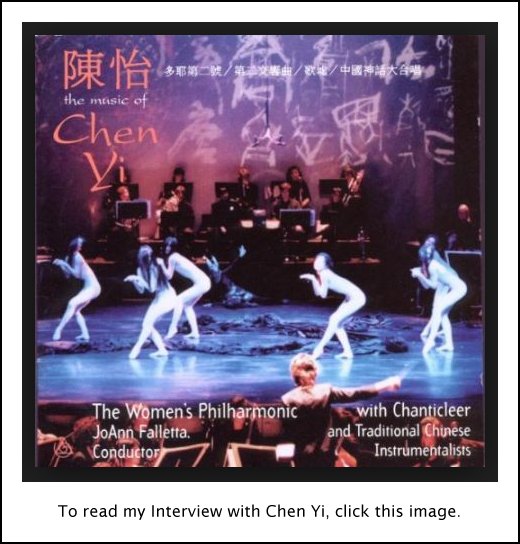
worked for a number of years with the Women’s Philharmonic in San Francisco
which was almost all new music at every concert, and that gives you kind of
a fresh perspective on the old music, too, because I got so used to approaching
scores that had no recordings and no performance tradition.
JF: No, no. I always use my old scores,
but I don’t always observe my markings. It’s funny. My scores
sort of look like a history of my conducting training because I’ve got marks
in them back from when I was a student at Julliard. My teacher, Jorge Mester, said, “Never
do this, and always do this.” And there are marks from the various performances
that I’ve done. So it’s kind of a record for me of how the piece has
developed, so I keep everything in there and just decide what is right for
me now. But it is hard to know what pieces of the repertoire to do, what
to let go for a couple of years and what to bring back. Sometimes I
feel my colleagues tend to do the same pieces over and over again, and there
is just so much repertoire. I have done a lot of new music. I
worked for a number of years with the Women’s Philharmonic in San Francisco
which was almost all new music at every concert, and that gives you kind of
a fresh perspective on the old music, too, because I got so used to approaching
scores that had no recordings and no performance tradition.
BD: Is it easier
or harder to teach an orchestra a piece they have not heard as opposed to
a piece they have heard many times?
JF: Actually,
it’s harder to teach a piece that they’ve heard many times. Ideally
you’d like to do is approach it with a clean slate, without the kind of traditions
that get tacked on over the years or the way that we always hear it on the
recordings. But, for me, having had the experience of coming up with
a first-time interpretation for a new piece of music where there is no set
interpretation, it’s been helpful to approach older pieces that way, too.
Not to just do it the way it’s always done is actually a big challenge, I
think. You might notice when you listen to recordings today, more and
more recordings are starting to sound alike. It’s very hard to have
a fresh perspective on a piece because everyone seems to be doing it the same
way. I don’t know whether that’s because people now have more access
to recordings so there is the one way to do it. I’ve been told that
80 years ago or 100 years ago, to hear a Beethoven Fifth in New York and then a Beethoven
Fifth in Boston was a completely
different experience because there was no set way. They didn’t have the standard
CD that everyone thought was the best one. You really had conductors,
and sometimes there were abuses of the score, too. There were conductors
who would cut out certain bars and other conductors who would rescore them
and put trombones in when there were no trombones. But at least there
was a responsibility on the part of the conductor to create something, to
have an individual interpretation.
BD: Does it take
even more guts on your part if you discover something in the score that you
know is radically different from the standard interpretation?
JF: It does,
and I think that sometimes it is a risk. Sometimes people are not ready
to hear something a different way. They’ve got their favorite CD at
home. Sometimes it is the same thing for critics. They’ve heard
it so many times, that to hear it played a different way is sometimes shocking.
But I think that is part of the responsibility of being a conductor. We have
to walk a fine line, hopefully honoring the score as the ultimate resource
as what the composer wanted. But you know that the musical notational
language is very vague, so there is a great deal of room for personal interpretation.
That’s the whole extra layer of the concert. In honoring what the composer
wants, you still inject a great deal of your own personality. But it
should be your own personality; it shouldn’t be a carbon copy of Leonard Bernstein’s
performance. So it’s a challenge, it’s a challenge. As we hear more
and more, progress sort of robs us of individuality sometimes because we
don’t have to be individuals, we can hear everybody else’s ideas.
* *
* * *
BD: When you go from
one orchestra to another, are you able to infuse all of your ideas into each
performance or do you find that you can just go so far and just let it go
at that?
JF: Every performance
with a different orchestra is different. I basically have an interpretation
of a piece that I’ve worked out and makes sense. But you learn a great
deal from orchestras. You might work with an orchestra that has a particularly
brilliant brass section or a very poetic principal clarinet or a wonderful
solo cello, and all of a sudden the piece changes for you because their playing
gives you ideas. They may not even be aware of it, but their interpretation
and their personality comes through their playing and it affects everyone
in the orchestra. So every performance is quite different; not that
one is better than another, but that’s the flexibility of the notational system
that it can happen that way. Sometimes even one performance to another
of the same orchestra is different, or the dress rehearsal and the performance
is different because of a different environment.
BD: Is all your
work done in rehearsal or do you leave something for that spark of the performance?
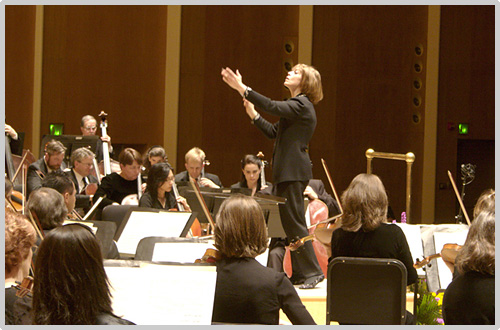 JF: There always is something in the performance that’s different,
and that’s risky, too, because if you rehearse everything to the nth degree
so that there’s no room for spontaneity, you rob the performance of a little
bit. The performance is the time when inspiration enters into it.
The rehearsals are hard work, with drilling and making sure everything is
well in tune or with good ensemble and correct articulation. But then
in the performance something else has to happen. A performance where
everything was correct could be deadly. It has to have a kind of spontaneity
and risk taking. Sometimes audiences don’t understand that. They’re
so used to CDs which are now all controlled by electronics. They’ll
hear that harp run in their CD that is never possible in an orchestra.
They’ll hear a perfect performance with never a little glitch here and there,
and they’ll come to a live performance and it’s different. You don’t
hear everything quite the same way, and things happen sometimes. But
the true music lover, I think, relishes that; he relishes the idea that anything
could happen in the performance. It will be different on Friday night
than it will be on Saturday night, and this performance will be different
from the one we heard three years ago. It will definitely be different
from the CD. We don’t know what’s going to happen; we really don’t
know, and I think that is what makes it so incredibly special.
JF: There always is something in the performance that’s different,
and that’s risky, too, because if you rehearse everything to the nth degree
so that there’s no room for spontaneity, you rob the performance of a little
bit. The performance is the time when inspiration enters into it.
The rehearsals are hard work, with drilling and making sure everything is
well in tune or with good ensemble and correct articulation. But then
in the performance something else has to happen. A performance where
everything was correct could be deadly. It has to have a kind of spontaneity
and risk taking. Sometimes audiences don’t understand that. They’re
so used to CDs which are now all controlled by electronics. They’ll
hear that harp run in their CD that is never possible in an orchestra.
They’ll hear a perfect performance with never a little glitch here and there,
and they’ll come to a live performance and it’s different. You don’t
hear everything quite the same way, and things happen sometimes. But
the true music lover, I think, relishes that; he relishes the idea that anything
could happen in the performance. It will be different on Friday night
than it will be on Saturday night, and this performance will be different
from the one we heard three years ago. It will definitely be different
from the CD. We don’t know what’s going to happen; we really don’t
know, and I think that is what makes it so incredibly special.
BD: What is your
advice for audiences who come to live performances?
JF: Try and be
as open-minded as possible. I give people this advice, “When you come
to a live performance, don’t listen to music that day.” Maybe that’s
sort of a silly thing, but I find that sometimes people have had the radio
on all day long and they put the car radio on and then they run into the concert
two minutes before it begins, and they don’t have time to read the program
notes and they wonder why they can’t listen, or why the music doesn’t have
an impact on them. It’s because they’re tired out. They’ve been
listening all day long, and they don’t even allow themselves time to rest
to prepare to listen.
BD: Rest themselves
and their ears!
JF: Absolutely.
Rest themselves and their
ears. In the past, when music was not so accessible, concerts were
much more valued experiences because that was the only way you heard music.
You really looked forward to it. You concentrated intently while you
were there, and then you remembered it because you didn’t have any other opportunity
to hear music for awhile. So in a way, music is so accessible now that
we don’t value it as being special. We very often relegate it to a
background, which it shouldn’t be. Sadly, we may be losing our ability
to listen without doing something else. Listening by itself is really
an art form that is dying.
BD: Virgil Thomson once told me
all this creates a sort of lack of attention.
JF: Yes, it does,
it does. Musicians rely on the audience’s attention because music it
is an art form where you can’t go back and say, “Wait! What was that?
Can I hear that again?” or, “I missed two minutes because I was daydreaming
and I really don’t know why, so what’s happening?” We can’t go back.
It’s not like a painting on the wall where you look at it and look back again
and think about it at your own time and your own pace. If you don’t
follow a thread of a piece of music, it’s hard to really get a feeling that
it makes sense, that it builds up to something and then comes away and ends
in a spot that feels right. You need to have the attention to follow
that all the way through.
BD: I asked about
advice for audiences. What advice do you have for younger conductors
coming along?
JF: For younger
conductors I think that the only way one can really consider being a conductor
is if this is really all you want in life. Like any career in music,
it’s the kind of thing where you don’t choose to be a musician; it chooses
you and you know you have no other option. Conducting is something that
for me is an unbelievable privilege to be on the podium. I feel that
every time in a rehearsal or in a performance. Sometimes I can’t believe that
I’m lucky enough to be standing on the podium in the middle of an orchestra
like the Lake Forest Symphony and working with them because it’s an extraordinary
pleasure to be involved with art on that level. But it also requires
tremendous dedication. That’s the only way you can get the most out
of it. You have to be willing to think of it as a lifelong study.
It really is. It’s not something that you say, “Well, now I’m a conductor.”
No. You never really know the piece well enough. I think most
conductors feel this way; I would hope so. You never know it well enough.
As much as you study it, there’s always more that you see in it. Sometimes
I’ll do a piece again three or four years later and say, “Why didn’t realize
that?” or “How could I have missed that?” Yet at the time I wasn’t
ready to see it, I suppose. André Previn said
a thing that I thought was particularly beautiful. He said, “Every time
we conduct a piece we get a little closer to what it means, but we never find
the center of it. We just get closer.” So the idea that all of
your life you’re changing and developing and reassessing yourself, reevaluating
what you’re doing, constantly studying, is something that you have to love.
You have to love that idea of constantly developing and working. I
can’t imagine doing anything else, because for me it is the most tremendous
source of joy to be able to work with an orchestra and to hear things develop
and get better and come out with an interpretation that hopefully communicates
this unbelievable music to the audience.
* *
* * *
BD: Are you getting
tired of occasionally being the first woman to conduct this orchestra or the
first woman to do this or that?
JF: When I decided
to become a conductor I was only about 11, and I was very naïve.
I never realized that women weren’t conductors. I’d never seen a woman
do it, but it just never dawned on me that it might be anything other than
chance.
BD: So your philosophy
is, “Why not?”
 JF: Well, yes. I never set out to prove
that women could conduct because I didn’t realize that they weren’t conducting.
I’m glad about that because I never think of myself as a woman conductor;
I just think of myself as a conductor. In many situations I am the
first woman to conduct, especially in Europe where it’s still relatively
rare. I try not to get too involved in it really, because to work as
a conductor you really can’t be aware of potential prejudices or how people
feel about it, and that’s been very helpful for me. If the idea that
I as a woman am the first woman conducting that orchestra helps people to
think, “Well, this is fine, and there’s no reason why a woman can’t compose
or can’t play a violin or can’t conduct an orchestra,” then I’m very happy
about it. And I think that in a way that’s happened. The classical
music world is very conservative, but it’s changing slowly and we’re seeing
more and more incredible women composers who are being performed all over.
And now there are more than just a handful of women conductors and women
concertmasters, which 50 years ago would have been unheard of. So things
are changing and they’re changing from inside, I think.
JF: Well, yes. I never set out to prove
that women could conduct because I didn’t realize that they weren’t conducting.
I’m glad about that because I never think of myself as a woman conductor;
I just think of myself as a conductor. In many situations I am the
first woman to conduct, especially in Europe where it’s still relatively
rare. I try not to get too involved in it really, because to work as
a conductor you really can’t be aware of potential prejudices or how people
feel about it, and that’s been very helpful for me. If the idea that
I as a woman am the first woman conducting that orchestra helps people to
think, “Well, this is fine, and there’s no reason why a woman can’t compose
or can’t play a violin or can’t conduct an orchestra,” then I’m very happy
about it. And I think that in a way that’s happened. The classical
music world is very conservative, but it’s changing slowly and we’re seeing
more and more incredible women composers who are being performed all over.
And now there are more than just a handful of women conductors and women
concertmasters, which 50 years ago would have been unheard of. So things
are changing and they’re changing from inside, I think.
BD: At the beginning,
did you perhaps stay away from the woman composer because you didn’t want
to be thought of as the woman conductor who brings the woman composer along?
JF: No, actually
I didn’t, and maybe it was a big mistake. I was actually working with
the Milwaukee Symphony as Associate Conductor when I got a call from the Women’s
Philharmonic in San Francisco asking if I would like to come out and conduct
a concert and see what I thought about them. They were looking for
a music director.
BD: Are they a full-size
orchestra or a chamber group?
JF: It is a full-size
orchestra. I’m embarrassed to say that I asked what sort of repertoire
they were doing, and they said, “We only do music by women composers,” and
I said, “What women composers?” Can you imagine how ignorant I sounded?
Because my music training had been absolutely traditional, I had just worked
on Brahms, Beethoven, Stravinsky, etc. I’m so embarrassed about it now,
but then I truly didn’t know any women composers. But I went out there,
saw their library and the kind of dedication they had to bringing new pieces
by women to the public. I learned a tremendous amount. In the
nine years I worked with them, I learned so much about new music and about
women composers. I shouldn’t say “women composers”
because to me there really is no difference. I have to be honest about
that. People often ask me, “If you look at a score, can you tell?”
And I have to be honest, if the name were covered up I would not be able
tell. Shulamit Ran is a woman who wrote this incredible cello concerto
that I performed. There’s nothing gender-related about music.
BD: [In jest]
They don’t make their notes in the shape of little hearts?
JF: [Smiling]
No. Perhaps the public expects a harp cadenza, or a lot of flute.
I don’t know what people would think, but sometimes I’m surprised by their
reaction. I remember the first time I performed the Amy Beach Symphony, some people came back and said,
“But how could have this been written by a woman? It was so strong.
It was so masculine.” It was just in the style of time. It was
very Schumann-like, Dvořák-like, but they were surprised at the strength
of the piece. It’s been wonderful for me to bring some this music around
and to bring it to other situations. And while I’m not really a fan
of the all-woman composers program, just like I’m not really a fan of the
all-contemporary composers program, I’m very happy to be able to introduce
a new composer to an audience.
BD: Would it
be fair to do an all-Schumann program and put some Clara in there as well
as Robert?
JF: Why not?
I haven’t actually had a chance to this on the same program, but I often thought
it would be interesting to do both piano concertos – the
Clara Schumann Piano Concerto and
the Robert Schumann Piano Concerto
– and let audiences just hear the difference, the relationship
of these two incredible pieces.
* *
* * *
BD: Let me ask
the big question – what’s the purpose of music?
 JF: [Pondering a moment] The purpose
of music... No one has ever asked the question quite that way.
It’s hard to express, but for me it simply is one of greatest expressions
of what a human being can do. We read about the terrible things that
human beings are capable of and how depressing sometimes life can be.
On the other hand, we have this legacy of the best of what people are capable
of. For me, the best thing that music can do is make me proud, in a
way, to be a human being, because if human beings can create something so
extraordinary, with all their flaws and all their problems and all their
difficulties and vices, if they can create something so extraordinarily moving
and powerful and emotional, that says a great deal about what the human spirit
is capable of. So I feel lucky because as a conductor, as a musician,
I’m involved always with the very best that humans have to offer. We
can just revel in it.
JF: [Pondering a moment] The purpose
of music... No one has ever asked the question quite that way.
It’s hard to express, but for me it simply is one of greatest expressions
of what a human being can do. We read about the terrible things that
human beings are capable of and how depressing sometimes life can be.
On the other hand, we have this legacy of the best of what people are capable
of. For me, the best thing that music can do is make me proud, in a
way, to be a human being, because if human beings can create something so
extraordinary, with all their flaws and all their problems and all their
difficulties and vices, if they can create something so extraordinarily moving
and powerful and emotional, that says a great deal about what the human spirit
is capable of. So I feel lucky because as a conductor, as a musician,
I’m involved always with the very best that humans have to offer. We
can just revel in it.
BD: Even if it’s
a depiction of a terrible subject?
JF: Oh yes.
Sometimes it’s the most powerful, such as the music composed at the beginning
of the Second World War, or at the beginning of the First World War particularly.
At the beginning of the twentieth century, when Europe was undergoing this
tremendous upheaval, to the Europeans life seemed to be falling apart.
This was the end of the world; crime and terror was gripping Europe.
Composers who were writing at that time – Bartók,
Schoenberg, even Ravel – are so eloquent about what
can be better. In their protest of man’s inhumanity, they are making
a statement that is so strong and so wonderful that it has to cause us to
take a look at it and say, “What are we doing? Look at what we are capable
of doing in the best sense and never forget that.” So at the core,
that is what music means to me. It represents the almost God-like side
of what people can do. Not being a composer myself, it makes me have
incredible respect for the composer. Many times the composer himself
probably is not even aware that what he is doing is so great. He’s
working through something that is going to become a classic and communicate
so much to people. He’s not even aware of that many times. But
I feel such respect for the people who create. Then, as a recreative
musician, a musician who interprets, it’s a great privilege to be able to
work with these masterpieces and potential masterpieces. Sometimes
in new works, we don’t know. Very often people will say to me, “Who
is the great composer of the 1990s? Who’s going to last? Who
is going to be the next Beethoven?” And I always say, “We don’t know.”
We really don’t know because we don’t have the distance to know. Fifty
years from now we’ll have a better sense of who is important, just as now
we have a strong sense of who was important in the early twentieth century.
We know who has emerged.
BD: But should
we not still play music of some of the minor figures from the early part of
the century?
JF: Absolutely,
absolutely. In a sense I think it’s very sad that we don’t do that for
all of music history. There were so many more composers in Mozart’s
time that deserve to be played, but 50 years from now, probably we will know
who were the most important voices of the late 20th century. Now we
don’t know, and it’s kind of an adventure for us, as musicians and as music
lovers, to listen to lots of different things and wonder will Christopher
Rouse be the next Beethoven? Will Shulamit Ran be a very significant
voice? Right now they’re interesting, they’re vibrant, and potentially
classic composers.
* *
* * *
BD: The music
that you deal with all the time is concert music, serious music, classical
music, whatever label we want to hang on it. How can we get more
audiences who are either not familiar with this music or who just go to
rock concerts or listen to MTV?
JF: This is a
big question for symphony orchestras, especially now that we’re dealing
with very financially troubled times in the symphony world. I think
the important thing that we should realize is that we don’t have to apologize
for what we do. This is so important to me because I find that many
orchestras tend to take the kind of hysterical approach. “We’ll try
and make our concerts like rock concerts and then they’ll come.” Or,
“We’ll only do Beatles tunes arranged for orchestra and then we’ll get the
Beatles fans.” It doesn’t work. The orchestra has an integrity
for what it does. On the other hand, we can probably break down some
of the barriers that have nothing to do with music. For instance, can
someone come casually dressed to a concert? Why not? Or should
concerts always be at 8:00 at night? Why can’t they be the 6:00; rush
hour concerts or whatever? Or can they be shorter in length?
Yes, that’s fine. The thing to preserve is the fact that the orchestra
is playing great repertoire and nobody need apologize for that. There
was an essay in Civilization that
said the worst thing an orchestra can ever do is to talk down to its audience,
and I think that’s true. Sometimes we don’t give the American public
enough credit for their intelligence. Granted, not all of them are
musically trained or have much music background, and that’s the fault of
our educational system that they’re not given that. But that doesn’t
mean that they’re not intelligent, well-educated, insightful people.
There’s no reason why we have to talk down to them. We can present
to them a great work of art and help them understand it. “Help
them” and even “understand it”
is maybe too strong an idea. Let us help them have a human reaction
to it, which will happen.
BD: Can we try
and convince them that it’s accessible on a certain level but then there’s
more depth behind it?
 JF:
Yes. I think a lot of orchestras are doing this. I know I do
it in Long Beach and Virginia. The audience comes an hour before and
I talk about the music. It’s not so much from a scholarly point of view;
it’s more from a point of view of what did this piece mean to the composer?
What was life like when he wrote it? What can you get out of it?
What should you listen for? We did Ein Heldenleben in Long Beach, and if
you come in cold and listen for 40 minutes, you may not know what’s going
on. You leave saying, “That was really long.” If you come
in an hour before and hear about the six sections, and this theme is Strauss
himself, and these are his enemies, the critics, and at this point this is
his wife who he loved for his entire life, all of a sudden these people who
know nothing about Richard Strauss are intrigued by this idea of this man
telling us a little about his life. They leave that concert hall feeling
that they understood Ein Heldenleben,
and that’s the whole clue. If an audience feels successful, that they
had an experience that meant something to them, they’ll be back. They
don’t have to have an easy Pops experience, but they have to have the door
opened for them. That’s all. Then it can be accessible to them.
That’s our only hope, I think, because we really are battling the result of
a lack of music education in the schools for many, many years. Also,
there is the lack of amateur music making in this country, which I think is
so sad. In the past, there were lots of people who made music on an
amateur level. They played string quartets in their houses, or they
played piano in their churches or at home. We’ve become a culture that
frowns on amateurism. If someone doesn’t do something on a completely
professional level, they’re discouraged from doing it. I think that
is one of the most tragic things – that we don’t encourage
and celebrate the avocational musician on any level, from the person who sings
in the church choir to the person who plays violin in a string quartet of
friends in his house.
JF:
Yes. I think a lot of orchestras are doing this. I know I do
it in Long Beach and Virginia. The audience comes an hour before and
I talk about the music. It’s not so much from a scholarly point of view;
it’s more from a point of view of what did this piece mean to the composer?
What was life like when he wrote it? What can you get out of it?
What should you listen for? We did Ein Heldenleben in Long Beach, and if
you come in cold and listen for 40 minutes, you may not know what’s going
on. You leave saying, “That was really long.” If you come
in an hour before and hear about the six sections, and this theme is Strauss
himself, and these are his enemies, the critics, and at this point this is
his wife who he loved for his entire life, all of a sudden these people who
know nothing about Richard Strauss are intrigued by this idea of this man
telling us a little about his life. They leave that concert hall feeling
that they understood Ein Heldenleben,
and that’s the whole clue. If an audience feels successful, that they
had an experience that meant something to them, they’ll be back. They
don’t have to have an easy Pops experience, but they have to have the door
opened for them. That’s all. Then it can be accessible to them.
That’s our only hope, I think, because we really are battling the result of
a lack of music education in the schools for many, many years. Also,
there is the lack of amateur music making in this country, which I think is
so sad. In the past, there were lots of people who made music on an
amateur level. They played string quartets in their houses, or they
played piano in their churches or at home. We’ve become a culture that
frowns on amateurism. If someone doesn’t do something on a completely
professional level, they’re discouraged from doing it. I think that
is one of the most tragic things – that we don’t encourage
and celebrate the avocational musician on any level, from the person who sings
in the church choir to the person who plays violin in a string quartet of
friends in his house.
BD: Should we
try to re-establish orchestral Little Leagues?
JF: Yes.
I would, and I think this is also a good point. As orchestras find themselves
in trouble, there is a theory that’s been put forth that maybe we don’t need
so many orchestras. Maybe we should have 30 mega orchestras in the
country and they would serve everyone. The state of California could
use two orchestras with one that would play in all the cities in the northern
part of the state. This would be a big orchestra of 200 people or so,
and they would travel around and be at a very high level, and that’s what
we need. There’s a very important man in the industry who really is
a proponent of this.
BD: That sounds
like Merger Mania.
JF: Yes, it’s
just crazy. He’s ignoring the fact that every city should celebrate
it’s own orchestra. Certainly a little town in
California is not going to have an orchestra like the L.A. Philharmonic, but
it doesn’t matter. Sometimes the most interesting things in the orchestral
world happen on the grassroots level with the smaller orchestras because
they’re the ones who are taking chances. They’re the ones who don’t
have to bring in the $50,000-a-night Itzhak Perlman every weekend. They’re
the ones who can be more creative. That’s where change is happening,
in the smaller orchestras. It would be a shame to think that we only
need the really big institutions and we don’t need the smaller institutions.
BD: Do a lot
of people who go to the smaller orchestras also go to the Los Angeles Philharmonic...
and vice versa?
JF: I think they
do. If you travel and you’re proud of your hometown orchestra, you go
to another city and want to hear their orchestra too. It engenders
a kind of national interest in orchestras, but I can’t imagine not having
those metropolitan and urban orchestras.
BD: Then if you’re
living in suburban Los Angeles, do you go to both?
JF: In some cases,
yes. Why not? Another question that comes up is whether we have
too many arts organizations. Is there too much competition and that’s
why we can’t survive? Actually, I think the more arts we have available,
the more people will avail themselves of it. The more concerts there
are, the more people go to concerts. It creates an interest, it stimulates
an interest rather than saying we should only have one concert a month so
that we can be sure that people will come. I don’t think they come
then. But if they’re used to going, if they’re used to being involved
in the arts and having an active participation in the arts, then they will
come.
* *
* * *
BD: You’ve made
a number of recordings. Do you conduct the same for the microphone as
you do for a live audience?
JF: It’s very
different making a recording. It’s a very odd experience because in
some cases you are recording after a performance, and that’s very nice because
you’ve rehearsed it, you’ve given a performance and you go into the recording
studio with basically the same intensity level. But often you are recording
without the benefit of any rehearsal at all, and this is particularly true
in London. You step in front of the London Symphony, which is an incredible
orchestra in terms of sight reading; they can really read anything.
But the tape starts rolling from the beginning, and everything that orchestra
plays is on that tape. The final result is kind of a hodgepodge of the
editor’s view of what’s the best take of this and that. Of course the
conductor approves it, but…
 BD: You don’t have any input in the final product?
JF: You have
some input, but it’s a very, very different experience than actually conducting
a performance with the intensity and the excitement and drama of that.
BD: Are you pleased
with the recordings that you’ve made so far?
JF: I am.
I’m especially pleased because a lot of them are unusual repertoire.
The two discs we did with the Women’s Philharmonic really were the first time
any of this music had been recorded. There were names people recognize,
such as Clara Schumann and Fannie Mendelssohn, and a couple of recordings
have been with American composers, again, whose works have never been recorded.
So that’s been a great deal of fun.
BD: Are you going
to be nervous when they start asking you for your Beethoven cycle and your
Dvořák material?
JF: Probably.
The most recent one is actually disc of music with the Ravel Mother Goose, which is a piece that’s
often recorded. I spent a great deal of time on thinking what would
be, for me, an interpretation that would sum up the essence of the piece,
not listening to anyone else’s interpretation but to come up with something
that hopefully is fresh. And that’s very hard. As you say, approaching
the Beethoven symphonies and the Dvořák symphonies will be very, very
difficult.
BD: It’s got
to be fresh, but not fresh just to be different.
JF: Absolutely.
It can’t be quirky. Sometimes people say, “I’ve decided this is the
right tempo,” and it doesn’t make any sense. It was done just for the
sake of being different. Being truly fresh is a very, very hard thing
to come up with. Sometimes I think that some of the early music groups
or the original instrument groups have degenerated into the “different
just to be different” syndrome. And I always say
that with a little bit of fear because some of them have done fabulous work.
For conductors who don’t always work in that genre, we learn a lot from them,
frankly. We really learn a lot from kind of the stripping away of years
of tradition and a fresh approach. But, as you say, there’s a difference
between a fresh approach and an approach that is different just to make an
impact of being different. It’s hard to always find an approach with
integrity that’s different.
BD: Are you pleased
to be at the point in your career to where you’ve arrived now?
JF: I feel very lucky.
Mostly yes, I’m pleased. I think that what’s most fortunate for
me is that since I left school, or since I was actually in school, I’ve had
the opportunity to conduct all the time. I see that many of my colleagues
who are incredibly talented don’t have that opportunity, and frankly you cannot
learn how to conduct unless you’re conducting. In school you learn
how to approach a score. You learn the basics about conducting.
But when you have your degree and you graduate, you don’t know very much about
conducting. The only way you learn is by standing in front of musicians,
making mistakes, choosing the wrong tempo, saying the wrong things, hearing
things for the first time. It’s amazing how much you can learn and
how fast you learn on the podium. That’s where you really learn quickly
and is the only way you can learn. So, I feel I’ve been very fortunate
in that I have been able to conduct since I was 19 or 20 and just keep conducting.
The orchestras that I worked with were good for me at the time. When
I was a young conductor, I worked with an orchestra that wasn’t very good,
but I learned from them and they learned from me; it was appropriate.
And as I became more confident and developed as a conductor, I was challenged
by orchestras that were stronger and needed more from me. So I think
that I’ve been especially lucky in that the progress has been well-timed.
Now I’m working with orchestras that challenge me, not in correcting rhythms
and correcting notes, but really in getting to the essence of what the piece
is and how are we going to say something special about it. So I feel
very, very fortunate and very lucky. I am also very lucky to have started
out at a time when it was possible for women because I know there are some
of my older colleagues that were very, very gifted but it was just not the
right time. I remember a conversation I had many years ago with Margaret Hillis.
She was wonderful to me and she said, “I always wanted to be an orchestral
conductor and I couldn’t because of the time. I never really set out
to be a choral conductor, but that was all the option I had at that time.”
I realized how lucky I was that at least at the time I was studying, although
it was a little odd, it wasn’t impossible.
* *
* * *
BD: Do you like
all the travel?
JF: I don’t like
actually the traveling itself. When I was very young, I thought, “Oh
how glamorous. You go and stay in a hotel for a week and then get on
a plane.”
BD: It gets real
old real fast.
 JF: Oh it does; it’s not glamorous at all.
It’s really very, very tiring. But what I do like is the opportunity
to work with different musicians. That I find very stimulating.
There have been times when I’ve gotten off the plane and had to go right to
rehearsal because of the timing. I’ve gotten off the plane feeling dreadful,
feeling depressed, feeling tired and thinking, “How am I ever going to conduct
for two and a half hours? I’ll never get through this.” Then
ten or fifteen minutes into the rehearsal, I feel fantastic. Now that’s
a tribute to what music does and what the energy of 90 musicians around you
can do for you. At the end of the rehearsal, I am completely reenergized,
reinvigorated and I’m feeling thrilled to be there.
JF: Oh it does; it’s not glamorous at all.
It’s really very, very tiring. But what I do like is the opportunity
to work with different musicians. That I find very stimulating.
There have been times when I’ve gotten off the plane and had to go right to
rehearsal because of the timing. I’ve gotten off the plane feeling dreadful,
feeling depressed, feeling tired and thinking, “How am I ever going to conduct
for two and a half hours? I’ll never get through this.” Then
ten or fifteen minutes into the rehearsal, I feel fantastic. Now that’s
a tribute to what music does and what the energy of 90 musicians around you
can do for you. At the end of the rehearsal, I am completely reenergized,
reinvigorated and I’m feeling thrilled to be there.
BD: [With
a gentle nudge] You’re just an old firehorse – you
hear the bell and you’re off!
JF: Yes, you’re
off. But working is wonderful. The other things that come along
with it – having to travel – is
not always the best part of it.
BD:
Speaking of travel, tell me about conducting in Beijing.
JF: That was
a very interesting experience to conduct in a city where I had to use an
interpreter. Usually I don’t have to do that. The musicians were
not particularly used to Western music because many of them had grown up
during the Cultural Revolution. So for ten years they heard nothing
of Western music. We were doing Brahms, and the way that I could
get them to play was just to sing it to them and then they would imitate
the phrasing back. But it was very interesting. We take that
phrasing for granted in the United States. Our tradition is so Western
European that we know how to play Brahms because we’ve always heard it played
this way. For Chinese people, they were discovering how to play Brahms
and they wanted so much to have the Western cadence. I had to sing
it to them to help them do that, but they were very talented.
BD: Did you learn
any Chinese music when you were there?
JF: I did one
Chinese piece on the program and I loved it. The piece was extraordinarily
difficult rhythmically. Any American orchestra would have had trouble
with it at the beginning, but this Chinese orchestra had no problem with it
at all. Through an interpreter I asked the concertmaster why and he
said, “But this is folk music.” That’s the whole thing. They understood
those rhythms intrinsically, while Brahms for them was a foreign language.
BD: You’re getting
lots of engagements and you’re working steadily. Are you keeping enough
time for yourself?
JF: I have to
be careful about that. Sometimes I find that in the excitement of doing
concerts and learning repertoire, I have to be careful to allow enough space
for myself, to have time just to relax. It may seem silly that you have
to program that in, but one year I worked through the whole summer, and when
September came around it was very, very hard to even think about starting
a new season. So I have to be careful about that. I have to make
sure that I allow time in my life for little things – even
like going for a bike ride or a walk. When I’m in different cities,
I try to make sure I go to their museums, or get out and just walk around
and meet people. I find that can that be very relaxing, too, to get
a little bit away from music. For musicians, sometimes it’s just very
hard to forget about music because it’s never a nine-to-five occupation.
It’s something that really consumes you. You need to just make sure
that you’re broadening yourself enough and not becoming too narrowly focused
on what you’re doing.
BD: One last
question. Is conducting fun?
JF: It is fun.
It’s a tremendous thrill. That’s not to say there are not times on the
podium that are very stressful. There are very stressful times when
rehearsals are not going well or musicians may not be responding as you hoped.
Sometimes in concert things go badly and you’re under tremendous stress.
But regardless of that, regardless of the things that go wrong, the idea
of being surrounded by the sound that the conductor hears standing on that
podium, and the incredible repertoire with which you work, it is a tremendous
thrill. I can’t imagine anything more satisfying than conducting.
BD: I hope you
continue it for a long time.
JF: Thank you.
===== =====
===== =====
--- --- --- --- ---
===== ===== ===== =====
© 1996 Bruce Duffie
This interview was recorded in Lake Forest, IL, on September 23, 1996.
Portions (along with recordings) were used on WNIB later that year and
in 1999, and on WNUR in 2005. This transcription was made and posted
on this website in 2009.
To see a full list (with links) of interviews which have been transcribed
and posted on this website,
click here.
Award -
winning broadcaster Bruce Duffie
was with WNIB,
Classical 97 in Chicago from 1975
until its final moment as a classical station in
February of 2001. His interviews have also appeared
in various magazines and journals since 1980, and he
now continues his broadcast series on WNUR-FM, as
well as on Contemporary
Classical Internet Radio.
You are invited to visit his website for more information
about his work, including selected
transcripts of other interviews, plus a full
list of his guests. He would also like to call
your attention to the photos and information about his grandfather,
who was a pioneer in the automotive field more than a century ago.
You may also send him E-Mail with comments,
questions and suggestions.