 BD: Am I correct that he would use a different
piano for touring and yet another one for recording?
BD: Am I correct that he would use a different
piano for touring and yet another one for recording?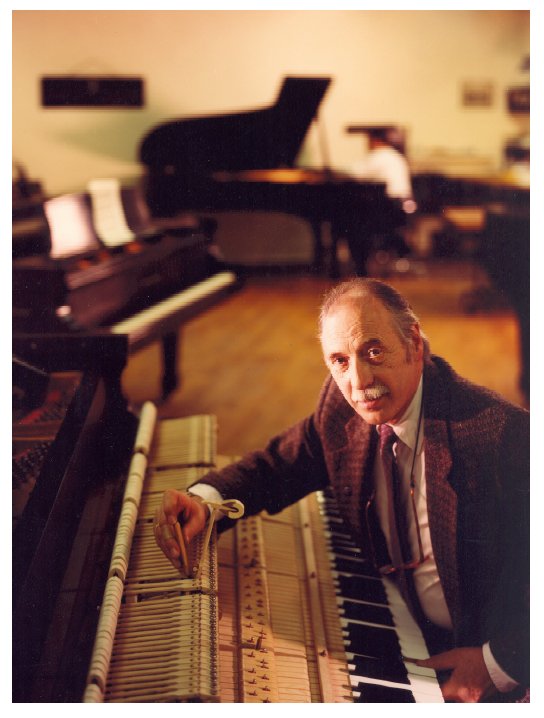 BD: What should it be?
 FM: Right, exactly. You see this immediately.
Then you have other pianos which are very lovely if you keep them on a smaller
scale, more chamber music. If you would take a piano like this, which
is not such a big, bombastic orchestra piano and force the tone into a piano
which is not really a big piano, then you get a very ugly horrible sound.
A piano can’t give it; it’s not there and it’s a lot of fun to see this.
Most of the time the piano is not immediately ready for the concert stage.
It happens very rarely that a piano comes under my hands which is brand new,
and wow, we say, “Boy, we can use this immediately on the stage!” No,
it doesn’t work like that. It has to develop; it has to be broken in.
I might put it in a corner. I’m very fortunate. In my concert
department, artists come in the evening and practice, I let them use that
one I put it in a corner. Then maybe after a couple of months I take
it in and work with it, and I say, “It’s ready,” or “It’s not ready yet,”
and put it back in the corner.
FM: Right, exactly. You see this immediately.
Then you have other pianos which are very lovely if you keep them on a smaller
scale, more chamber music. If you would take a piano like this, which
is not such a big, bombastic orchestra piano and force the tone into a piano
which is not really a big piano, then you get a very ugly horrible sound.
A piano can’t give it; it’s not there and it’s a lot of fun to see this.
Most of the time the piano is not immediately ready for the concert stage.
It happens very rarely that a piano comes under my hands which is brand new,
and wow, we say, “Boy, we can use this immediately on the stage!” No,
it doesn’t work like that. It has to develop; it has to be broken in.
I might put it in a corner. I’m very fortunate. In my concert
department, artists come in the evening and practice, I let them use that
one I put it in a corner. Then maybe after a couple of months I take
it in and work with it, and I say, “It’s ready,” or “It’s not ready yet,”
and put it back in the corner. BD: What advice do you have for someone who wants
to be a piano technician?
BD: What advice do you have for someone who wants
to be a piano technician?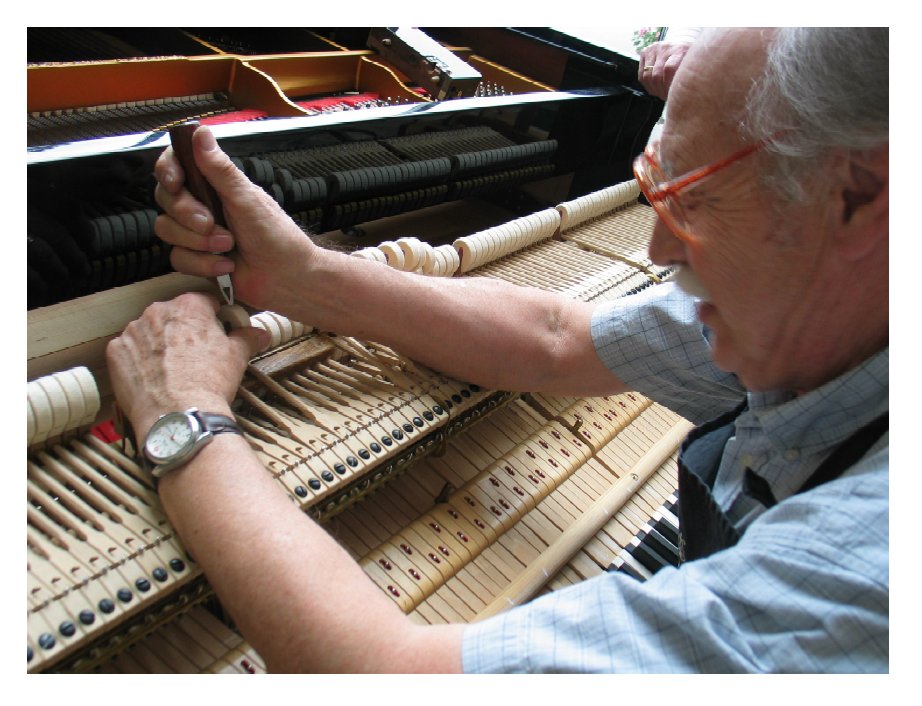 FM: Oh, there’s no piano like the Steinway!
To me, the Steinway is the greatest piano ever conceived in the human mind!
At Ibach, the old, decent, wonderful company in Germany where I learned piano
technology, I learned all the phases of piano building and worked my way up
to become a travel technician. I thought I can’t learn anything anymore!
Then I applied for a job as a concert tuner for a concert management, and
they took me. That’s way back, forty years ago. But they took
me as a concert tuner, and like everywhere else, the concert piano is a Steinway.
So I first started to work with Steinways, and immediately as a technician
and as a concert tuner I fell in love with the Steinways that were out there.
FM: Oh, there’s no piano like the Steinway!
To me, the Steinway is the greatest piano ever conceived in the human mind!
At Ibach, the old, decent, wonderful company in Germany where I learned piano
technology, I learned all the phases of piano building and worked my way up
to become a travel technician. I thought I can’t learn anything anymore!
Then I applied for a job as a concert tuner for a concert management, and
they took me. That’s way back, forty years ago. But they took
me as a concert tuner, and like everywhere else, the concert piano is a Steinway.
So I first started to work with Steinways, and immediately as a technician
and as a concert tuner I fell in love with the Steinways that were out there. FM: Yes, sixty-five! Officially I will retire
as of October 1st, but I already promised Steinway that I will do a lot of
P.R. work and still some important concerts, and take care of recording sessions
and teach.
FM: Yes, sixty-five! Officially I will retire
as of October 1st, but I already promised Steinway that I will do a lot of
P.R. work and still some important concerts, and take care of recording sessions
and teach.To many
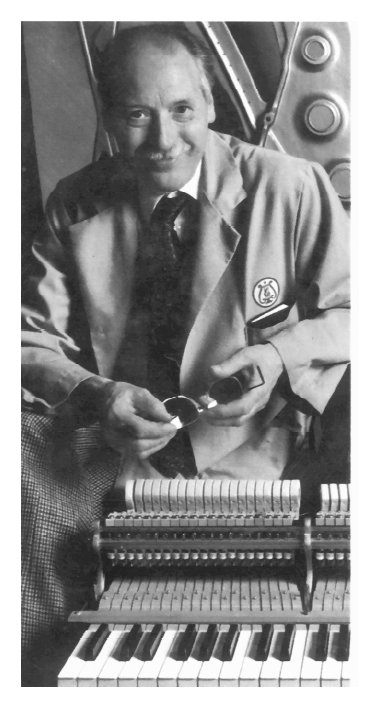
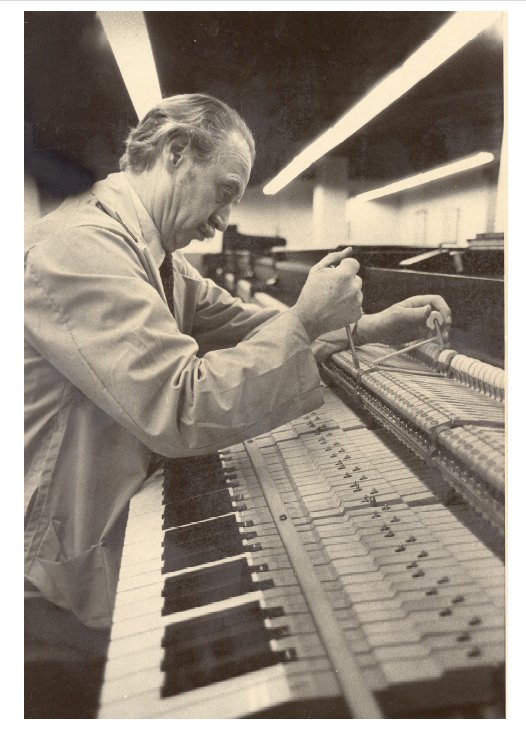
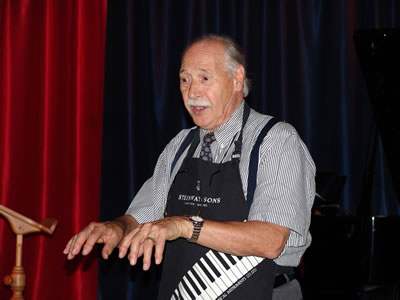
of the greatest pianists of our time, one man was critically important: Franz
Mohr, former Chief Concert Technician of Steinway & Sons for more than
a quarter of a century. 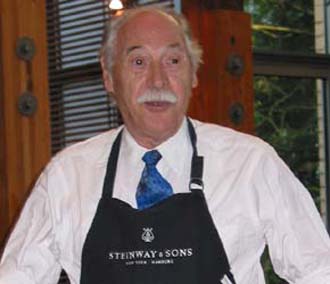 As the close colleague of legendary musicians such as Vladimir Horowitz,
Arthur Rubinstein, Glenn Gould, Rudolf Serkin and many others, Franz Mohr
attended to their Steinway instruments, making delicate adjustments that
affect tone, balance, and other characteristics of sound. It was Mohr who
enabled these virtuosos to fully realize their own, individual interpretative
styles, and to fully realize their concept of tonal color. Franz Mohr directed
the preparation and maintenance of all Steinway pianos provided for concert
and artists' service throughout the world and was the technical advisor
to technicians at 100 dealer locations where hundreds of Steinway pianos
stand ready for concert use.
As the close colleague of legendary musicians such as Vladimir Horowitz,
Arthur Rubinstein, Glenn Gould, Rudolf Serkin and many others, Franz Mohr
attended to their Steinway instruments, making delicate adjustments that
affect tone, balance, and other characteristics of sound. It was Mohr who
enabled these virtuosos to fully realize their own, individual interpretative
styles, and to fully realize their concept of tonal color. Franz Mohr directed
the preparation and maintenance of all Steinway pianos provided for concert
and artists' service throughout the world and was the technical advisor
to technicians at 100 dealer locations where hundreds of Steinway pianos
stand ready for concert use. A master piano technician, Franz Mohr joined Steinway & Sons in New York City in 1962 as assistant to William Hupfer, then chief concert technician, whom he succeeded in 1968. Mr. Mohr learned piano building in Europe beginning in 1950 in Cologne, Germany. In 1956 he became a concert technician for a Steinway dealer in Dusseldorf, Germany, which maintains a large concert service. Six years later he and his family moved to New York. Born in Duren, Germany, on September 27, 1927, he studied music at the Musikhochschule in Cologne and the Academy of Music in Detmold, Germany. He and his wife, Elizabeth, live in Lynbrook, New York. They have three children: a daughter, Ellen, and two sons, one of whom continues the family tradition by working at the Steinway factory in Long Island City as manager of Customer Service. Mr. Mohr retired as chief concert technician of Steinway & Sons in 1992. Presently he is an active advisor and consultant to Steinway & Sons. He is also a well-known book author ("My Life with the Great Pianists" and "Backstage with Great Pianists" - German) and a brilliant speaker. |
This interview was recorded in Chicago in May, 1992. Portions
(along with recordings) were used on WNIB in 1993, 1997 and 1998. This
transcription was made in 2009 and posted on this website early in 2010.
To see a full list (with links) of interviews which have been transcribed and posted on this website, click here. To read my thoughts on editing these interviews for print, as well as a few other interesting observations, click here.
Award - winning broadcaster Bruce Duffie was with WNIB, Classical 97 in Chicago from 1975 until its final moment as a classical station in February of 2001. His interviews have also appeared in various magazines and journals since 1980, and he now continues his broadcast series on WNUR-FM, as well as on Contemporary Classical Internet Radio.
You are invited to visit his website for more information about his work, including selected transcripts of other interviews, plus a full list of his guests. He would also like to call your attention to the photos and information about his grandfather, who was a pioneer in the automotive field more than a century ago. You may also send him E-Mail with comments, questions and suggestions.