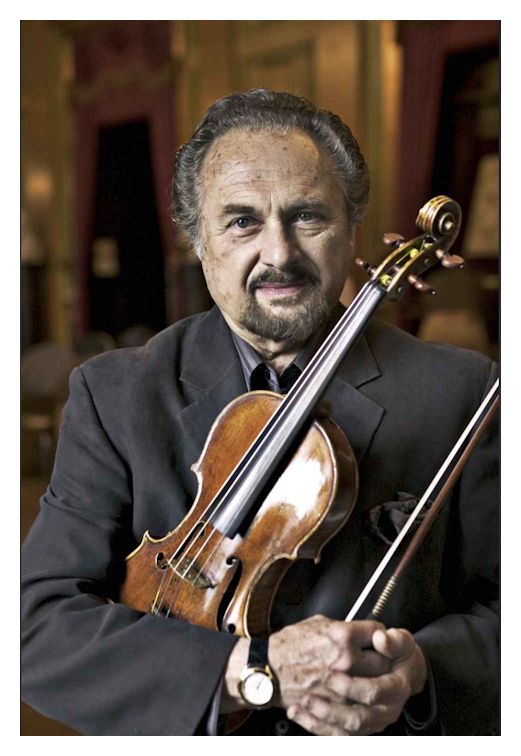
Violinist  Aaron  Rosand

A Conversation with Bruce Duffie


rosand


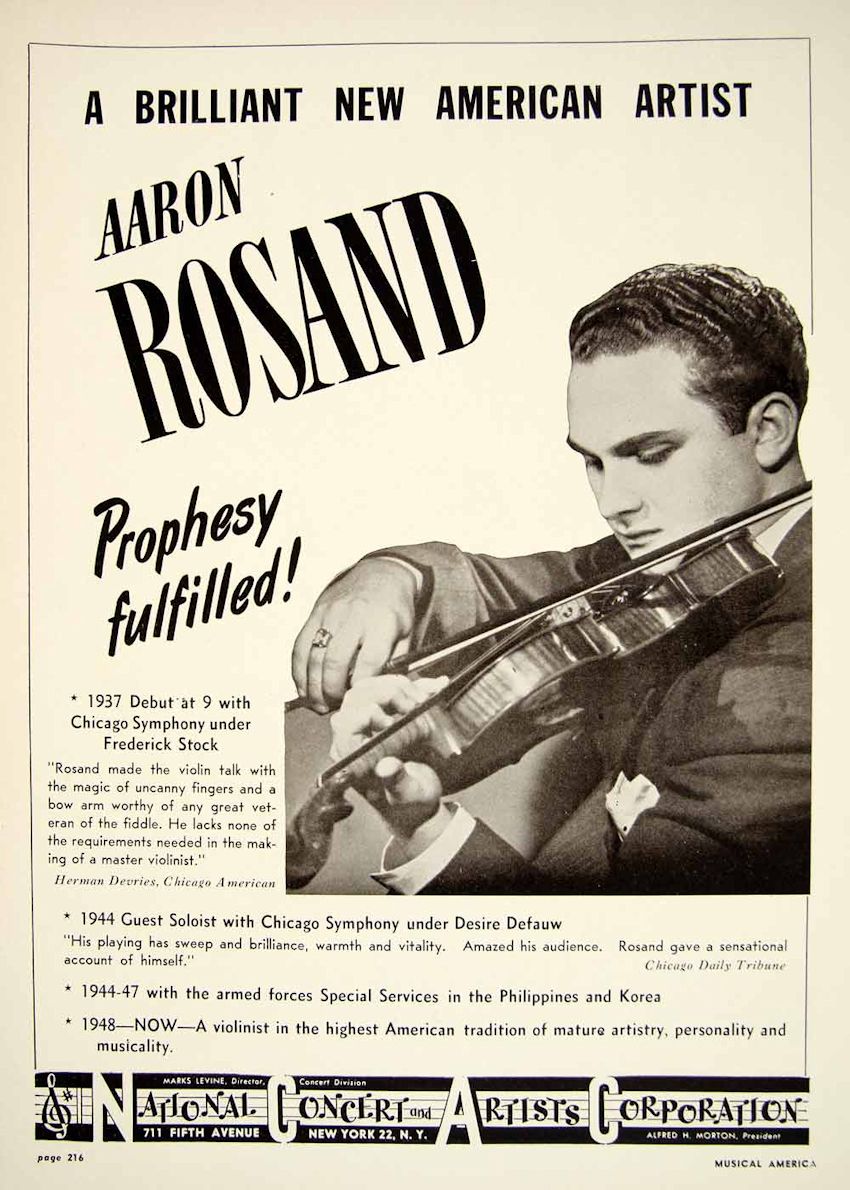
Aaron Rosand (born Aaron Rosen; March 15, 1927 – July 9, 2019) was an American classical violinist and violin pedagogue.

Born in Hammond, Indiana, he studied with Leon Sametini at the Chicago Musical College, and with Efrem Zimbalist at the Curtis Institute of Music, where he taught from 1981 until his death. Particularly noted for his insightful and passionate performances of the romantic repertoire and his beautiful tone, Rosand recorded prolifically and appeared all over the world with many major orchestras and concert organizations.

rosand


In the 1960s he performed often at Butler University's Festival of Neglected Romantic Music, resurrecting works that had not been heard in decades and helping spearhead the Romantic Revival in music. In an April 1970 review in The New York Times, critic Harold C. Schonberg wrote of Rosand that "Romanticism on the violin had a rebirth last night in Carnegie Hall." In the 1970s he also completed three acclaimed tours of Southern Africa.

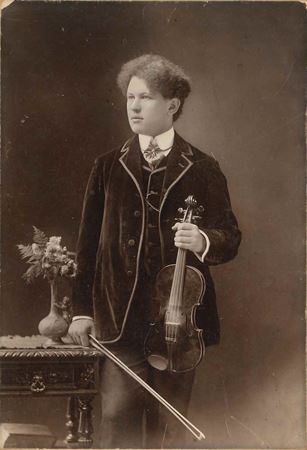
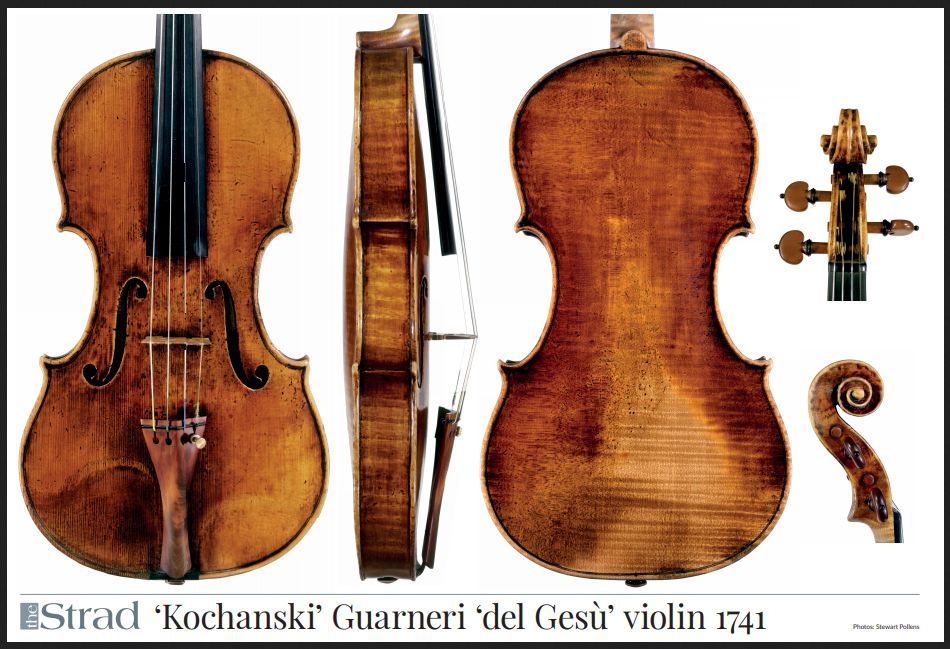
In October 2009, he sold his 1741 Guarneri del Gesù violin (previously owned by Paul Kochanski), which he had purchased in 1957 from the widow of Kochanski, to a Russian businessman for around US$10 million. This was believed to be the highest price ever paid for a violin, and Rosand donated $1.5 million to the Curtis Institute of Music.

rosand


In December of 1997, composer Dan Tucker, was having a belated 70th birthday party at his home for his friend Aaron Rosand.  Tucker arranged for me to attend the gathering, and interview the violinist in a quiet upstairs room.  Rosand was very cordial, and enjoyed speaking about the topics I raised.

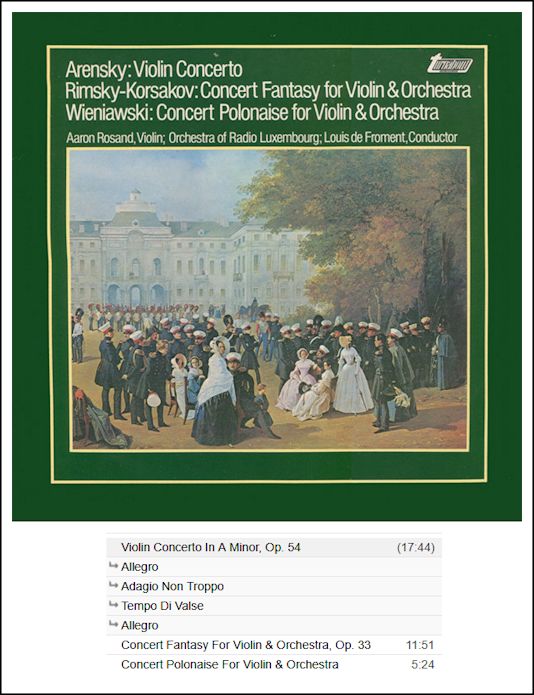
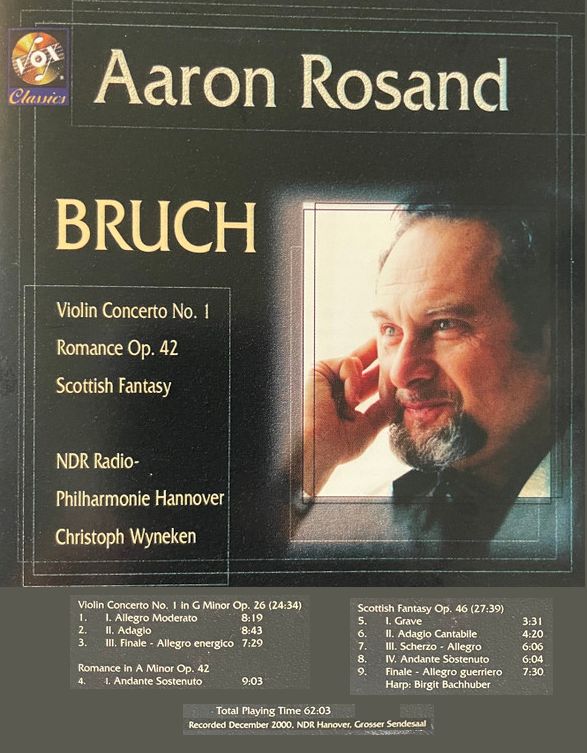
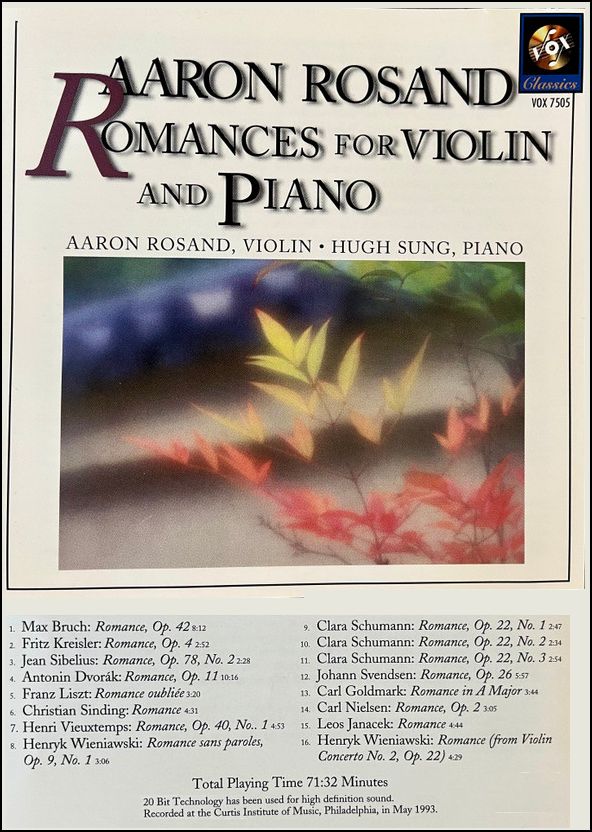
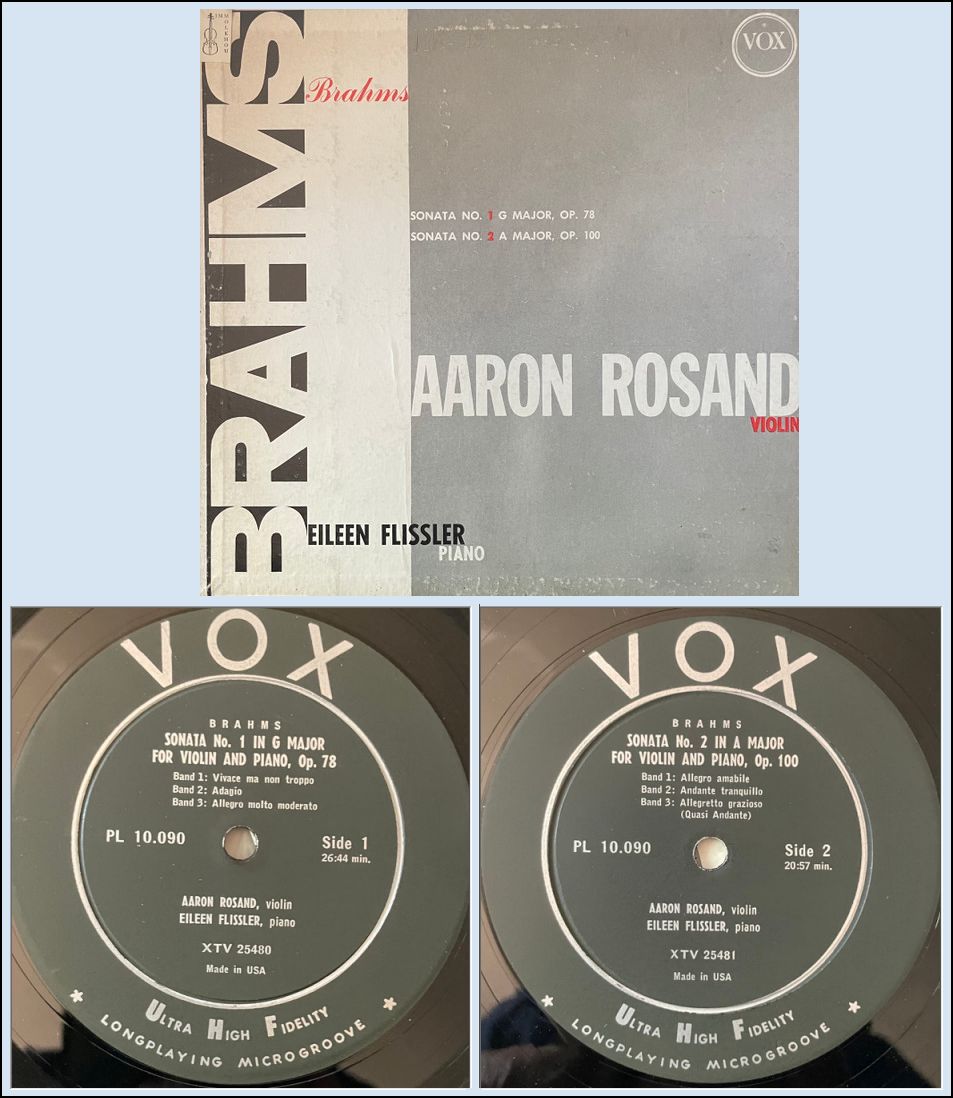
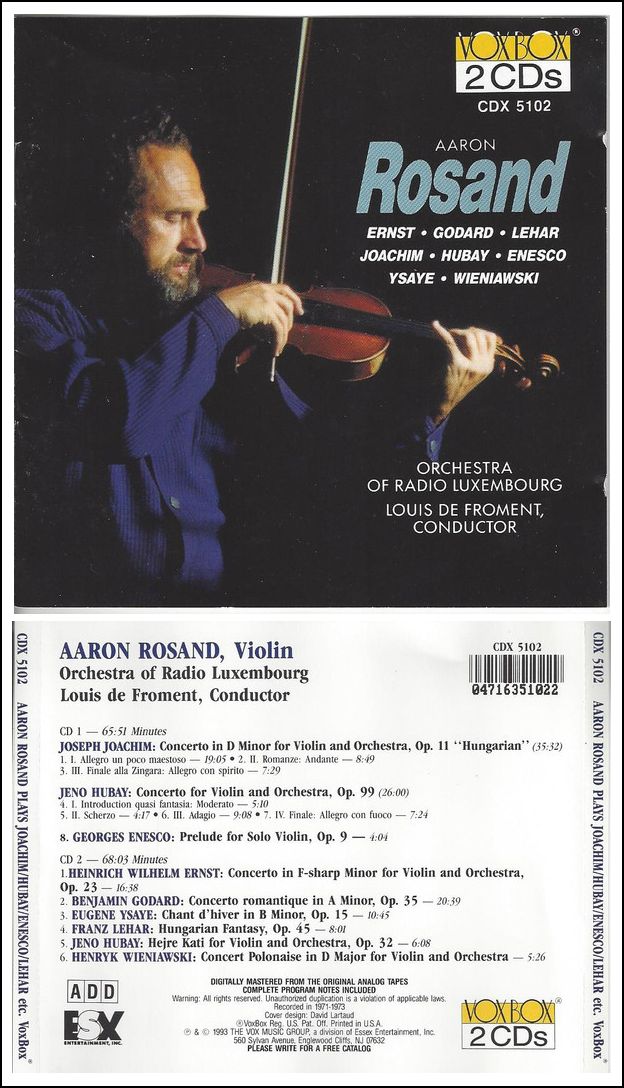
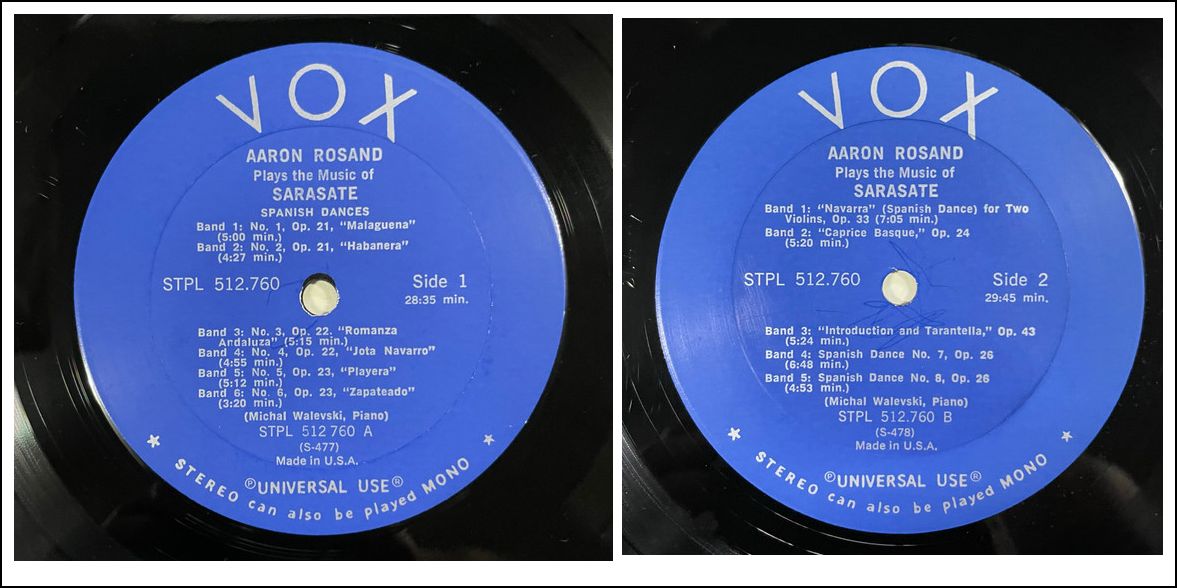
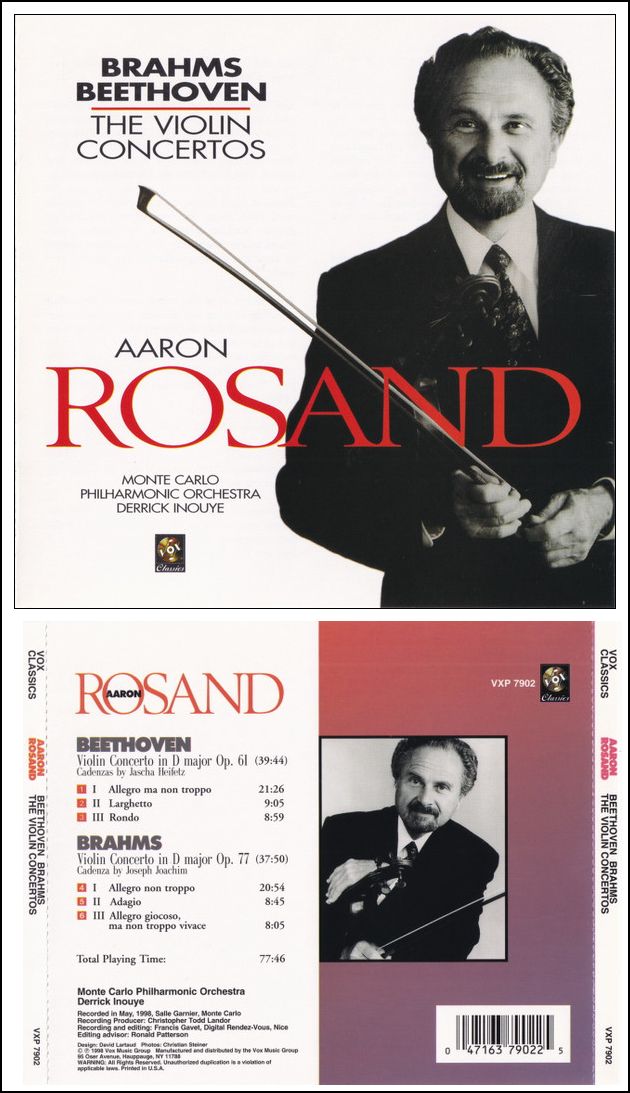
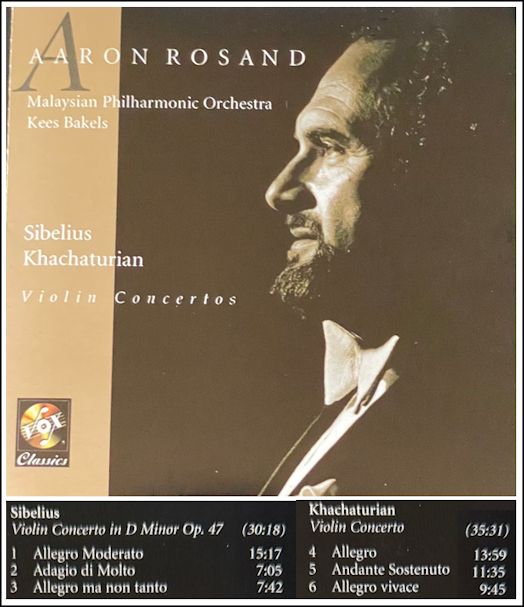
Note that throughout this page, names which are links refer to my interviews elsewhere on my website.  The illustrations show just a few of his many recordings.

Portions of the chat were aired on WNIB, Classical 97 a few months later, and now, in 2026, I am pleased to present the entire encounter.


Bruce Duffie:   We’ve just spent a greater part of two hours enjoying a meal and libation, and talking about other violinists.  Does it distress you or make you feel happy that other violinists do the same to you?

Aaron Rosand:   [Laughs]  I’m not in any way unhappy about it.  If they do the same to me, it means that you are worthwhile being discussed!  [Both laugh]

BD:   Are you a worthwhile violinist?

Rosand:   That’s a very leading question!  If I didn’t think I were a worthwhile violinist, I wouldn’t have come this far.  Without a certain amount of ego and security, you really can’t continue in this very difficult profession.  Performing requires the self-confidence and knowledge that you are worthwhile.  Any insecurity immediately shows in performance.

BD:   There is quite a wide range of repertoire to choose from, and you’ve played quite a bit of it.  How do you decide if you are going to play a piece or not?

Rosand:   Most of the time, repertoire is mutually agreed upon long in advance by conductors and the orchestral season that may demand certain works.

BD:   But even before that...  How do you decide which pieces you are going to learn and put into your repertoire?

Rosand:   The early influence is the responsibility of the professor.  I’m thinking now about the years from twelve to sixteen, which are very important in establishing taste, and the definite direction in music-making.  I was fortunate enough to study with a very great professor here in Chicago.  His name was Leon Sametini [see box below], who taught at the Chicago Musical College.  He was a remarkable violinist himself, and was a student of Eugène Ysaÿe (1858-1931).  Sametini performed with Ysaÿe several times during Ysaÿe’s tenure as the conductor with the Cincinnati Orchestra (1918-22).  Sametini definitely turned my direction and repertoire in forming a stylistic manner of approaching French music in particular, and for virtuoso music, for what has been called a ‘romantic approach’.  Sometimes I don’t like to use that term ‘romantic’, although I have been called the romantic virtuoso violinist.  The connotation ‘romantic’ is a misnomer in making music.  You might have called the style
traditional, because it was Ysaÿe who turned violin playing around.  He became the poet of the violin.  Before Ysaÿe, most of the recordings that still exist to this day show this.  When you hear Pablo de Sarasate (1844-1908), or the few existing recordings of Joseph Joachim (1831-1907) and other players such as Jan Kubelík (1880-1940), you realize that it was an approach which was more mechanical than emotional.  There wasn’t the poetic approach.  Ysaÿe suddenly turned things around with his intense vibrato.


sametini

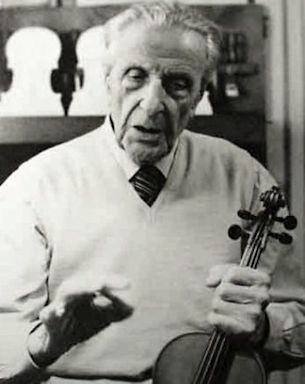
Leon Sametini
(March 16, 1886 – August 20, 1944) was an American virtuoso violinist and music pedagogue. He was born in Rotterdam, Holland, where his father was principal flute in the Royal Opera Orchestra. Leon studied violin with his uncle, M. De Groot, and from 1892 until he was 10 years of age with Dutch violinist Felice Togni and Bram Eldering at the Amsterdam Conservatoire. In 1902, Sametini went to Prague to study violin for one year with Otakar Ševčík. He also studied with notable teacher Eugène Ysaÿe.

As a violin virtuoso, Sametini gave concert tours from which he became well known in Europe, particularly in the Netherlands, Belgium, England and Austria. He was a protégé of Queen Wilhelmina of the Netherlands who enabled him to continue his studies in Prague under Otakar Ševčík. She gave him a violin made in 1730 by the Venetian luthier Sancto Seraphin.

In 1905, he appeared with the renowned soprano Nellie Melba, one of the first Australian classical musicians to win international recognition. Sametini later gave recitals throughout 1907 and 1908 with Australian contralto Ada Crossley and her eponymous Concert Company. Also supporting Crossley in her tour of England was composer and pianist Percy Grainger. With Crossley’s company, Sametini went on to tour Australia and New Zealand, as well as India and Indonesia, in 1908.

Sametini was a notable violin teacher. In 1912 he settled in Chicago, where he was head of the violin department at the Chicago Musical College.


rosand
BD:   In recent years we talk about the fact that students are technically better at the violin than they were.  Can we go back almost a century and maybe have the idea that they were still even struggling with technique just a little bit?

Rosand
:   No.  I don’t believe that at all.  The same was true for piano as well as violin.  When you hear extraordinary pianists of yesteryear and talk about Simon Barere (1896-1951) and Rachmaninoff (1873-1943) and Joseph Hofmann (1876-1957), the technique was fabulous, and those were days where one didn’t edit recordings.  The recordings were made in one piece.

BD:   Four and half minutes, and that’s it!  [That was the length of a 12-inch 78 rpm disc, the standard for commercial recordings in the first half of the twentieth century.]

Rosand:   Four and half minutes on each side, and it was great.  Now, one doesn’t even know if a recording has been doctored a hundred times within four and half minutes or not!  You can put a note in and then another note.  But in the case of great performers, even the violinists of yesteryear, the emphasis was always on technique.  It would have been interesting to have a recording of Paganini (1782-1840) playing.  To this day, no one has written anything as comprehensively difficult for violin as Paganini, so he certainly must have had the technique to achieve what he had written.

BD:   [With a wink]  Do we really know that he got around it?

Rosand:   Well, he may not have gotten around it!  [Both laugh]  However, I think he did because in those years, they didn’t have radio and television.  They held their instruments in their hands most of the day.  The stories that were told of Franz Liszt, and eyewitness accounts of the way he could read a very difficult piece of music at sight, and then perform it from memory the next day.  I don’t think these were words or stories invented in thin air.  Those players were technically very, very proficient.  Yes, it’s true there has been a lot of emphasis on technique in this particular generation, but I don’t see that the technique today is any better than it was years ago.  Do you think there will ever be a violinist that was more technically accurate than Jascha Heifetz (1901-87)?

BD:   I don’t know... I would assume that he would have probably said yes.

Rosand:   I don’t think so.  I’m sure that records are always going to be surpassed, but whatever you’re hearing today is still not on the same level as what already has been established.

*     *     *     *     *

BD:   After you decide you’re going to learn something, when you come back to it again after having put it aside for a number of years, is it like an old friend that you haven’t seen for a while?

Rosand:   It’s always an old friend.  But when I go back to doing any work, and even if we’re speaking of a time frame of two months, I’ll look at it with different eyes.  I always start or approach a work differently than the last performance.

BD:   Do you get a clean score and start completely over?

Rosand:   Yes, yes, yes!  I’m doing that now with the Beethoven Concerto, which I’ve played since I was ten years old.  I’m going to record it for the first time this coming May (1998), and yes, I’m starting with a clean score, and going back to whatever supposedly is the original.  Of course, that leads to an entirely different way of thinking.  One is always under the impression that if you’re playing from the original score, and you play exactly what is written, then you’re playing the composer’s intention.  To me, literal accuracy, of course, is just the first step of really learning a piece.

BD:   Then how much is the composer, and how much is the performer?

Rosand:   The performer is an equal part, and not enough credit is given that.  If there was just one way of approaching a piece of music, and we’re talking about literal accuracy, then we might just as well feed it to a computer.  Then you’re going to get the accurate performance.  But without the personality, or the individuality, or the interpretive skill of the artist, the music will not come to life.  Each artist approaches the same score quite differently, and that’s the beauty of making music.  The interpretation has to reflect not only how you view the music, or what you see in the composer or his life and everything that he has written, but it has to reflect every day of the life of the artist that’s playing it.

BD:   Then it will change every time you come to it?

Rosand:   Every time!

BD:   Is there such a thing as a perfect performance?

Rosand:   Not in my book.

BD:   But do you keep striving for it?
rosand
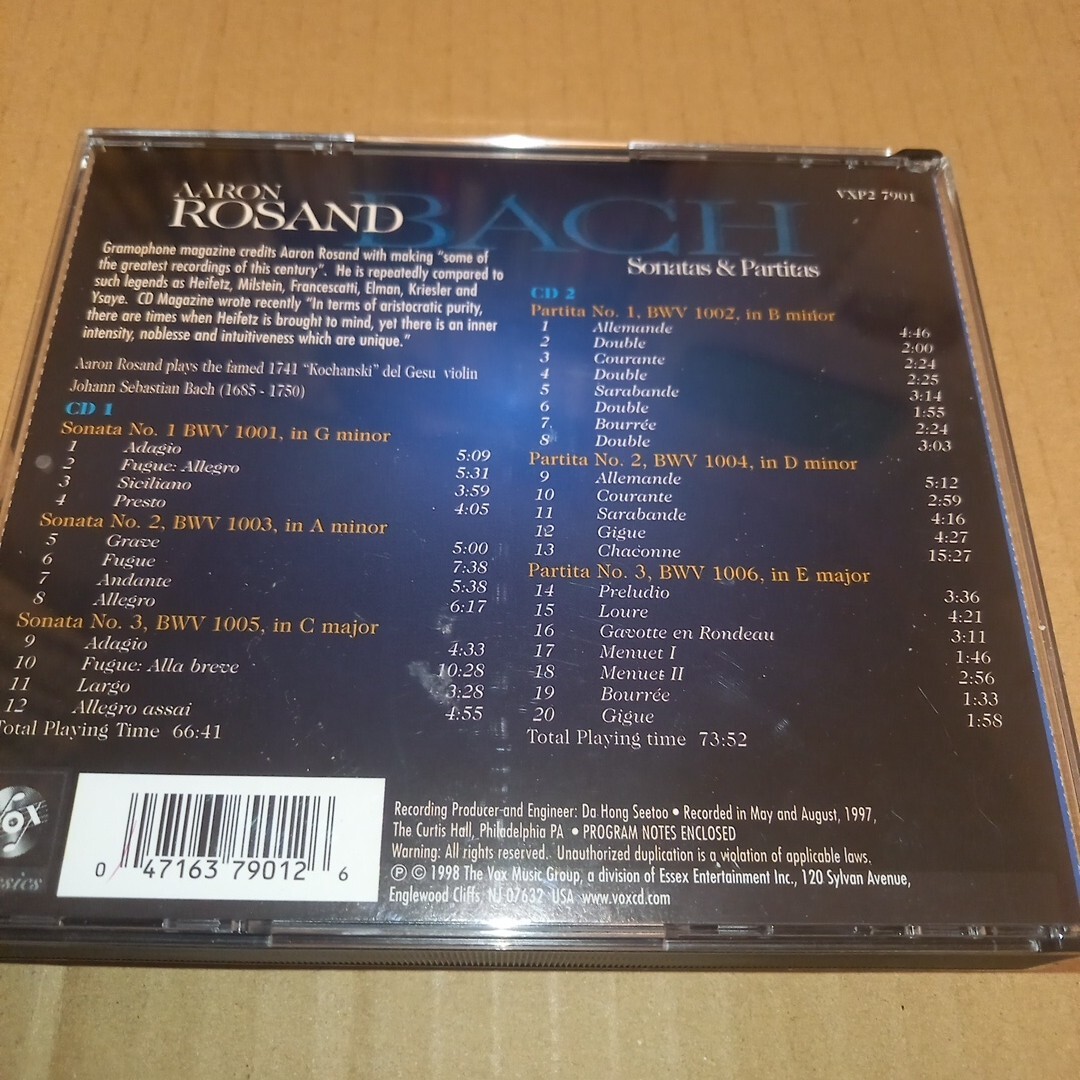
Rosand:   Oh, I am trying, and trying, and trying.  I work harder as the years go on, and I’m always regretting things that I have done.  Recently, I recorded the Bach solo sonatas for the first time.  [Track listings for the 2-CD set are shown at the bottom of this webpage.]  In fact, I played three performances recently doing all six in one day!

BD:   That sounds like a marathon!

Rosand:   It’s a marathon.  I didn’t think it could be done.  It was a challenge and I just wanted to do it.  But the reason for bringing up the subject of Bach is that every day when I approach the same piece that I have been working on all of my life, I see things that I feel I have overlooked, and perhaps I should have done differently.  It’s never ever the same, not day to day, not the tempos, and even the way I might finger, or bow, or feel it in the given moment, because I believe in spontaneity.  I do not believe in just using automatic reflex.

BD:   I hope that doesn’t mean you’ve only got fifty years of regrets.

Rosand:   Not at all!  [Both laugh]  On very rare occasions I’m happy with what I do, but it’s very rare I can assure you.  I always feel like I could have done better.  I shall never forget about a time I was with Nathan Milstein (1904-92).  It was late in his life and in his career, and he performed the Tchaikovsky Concerto with orchestra in Monaco.  It wasn’t one of Milstein’s great performances.  There were a few errors, and he was unhappy about the performance.  I saw him the very next day, and he was still angry with himself.  He told me that Princess Grace and Prince Ranier had thrown a party for him after the concert, but he didn’t attend.  He said he sent his wife to the party.  He said he stayed in the hotel room and practiced!  He was in his eighties, and he was there practicing rather than going to the party.  He was so unhappy with himself for not playing up to his standard.

BD:   You mentioned recordings.  Do you play the same for the microphone as you do for a live audience?

Rosand:   That’s a very good question, and it’s a hard one to answer.  Playing for a microphone requires a different technique than playing for an audience.  You’re trying so hard to be the best that you can possibly be, and you’re not projecting to an audience.  You’re projecting for a microphone, and you become terribly self-conscious when you record.  That shouldn’t happen, but sometimes it does.  Sometimes you’re capable of completely losing yourself and not being aware of the microphone, and that is perhaps the skill of recording when you’ve had a lot of recording experience.  But it doesn’t always happen, and for that reason I find many times that recordings don’t have the same power of projection, or emotional content that you might have from a live performance.

BD:   Can we assume that you’re pleased with at least some of your recordings?

Rosand:   Some of them, yes.  On the other hand, I always feel that I should have done it better.  There have been many situations where you’re given a day in which to make that recording, and perhaps you’re not feeling very well, or you had a bad night and didn’t sleep well...

BD:   [With mock officiousness]  Too bad!  Go out there and play!

Rosand:   [Laughs]  That’s it!  The time is set.  That’s the time we have to face the bull and get as close to the horn as possible.  That makes it difficult.  In fact, I’m reminded of the time when I recorded the Mendelssohn Violin Concerto.  I recorded the Tchaikovsky and the Mendelssohn at the same time, and I became terribly ill with flu.  I had a 103º temperature, and the day I had to record the Mendelssohn I was so ill and dizzy, I couldn’t even stand.  Yet the orchestra was there, and this was their only time.  Otherwise, we wouldn’t have been able to record it.  They put out a chair, and I sat and recorded the Mendelssohn.  I’m so uncomfortable when I try to listen to it... it’s been years since I actually have listened to it.  I remember the first time I heard it I was a little bit alarmed because it was faster than I had ever imagined playing.  It was much faster I suppose because of the temperature or the body heat.  Whatever it was, it really is not representative of the way I might normally do it.

BD:   What do you say when someone says it’s wonderful?

Rosand:   Well, that’s fine, but I can’t listen to it.  You asked me if I’m comfortable listening to my own records, and there’s one example of it.

*     *     *     *     *

BD:   When you go out on stage to play, and you put the violin under your chin, are you playing an instrument, or does that instrument become part of you?

Rosand:   In my case, that violin is very much part of me.  My violin has been my partner for forty years, and the instrument is my voice.  I know what to expect from the instrument, and I’m always trying to do my best to caress and draw the beautiful voice from it.

BD:   Tell me about the instrument.


violin


Rosand:   My violin a very famous Guarneri del Gesù [known as the Ex-Kochanski].  It was made in 1741, and it’s one of his outstanding examples.  I fell in love with it in the early 1950s.  I knew that this was the voice I was looking for.  Singers are born with their voices, but a violinist has to buy his voice.

BD:   [Gently protesting]  But violinists can find just the one they want.  You’re not stuck with whatever’s in the throat!

Rosand:   [Both have a huge laugh]  That’s a good point!  Some never quite find the right voice, and they’re never quite happy with it.  They keep turning it in for a different model, but I’ve been happy with my voice for all of these years.

BD:   Do you have just the one, or do you have a couple of others that you practice on, or tour with?

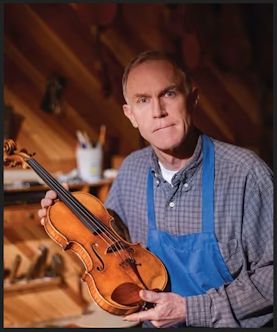
Rosand:   I have two other violins.  One is a Kurt Widenhouse [see box below], a contemporary maker whose work I respect very much.  I practice on that instrument most of the time.  I don’t like to abuse my great violin.  It is getting old, and there’s no necessity to pound it in practice all day long.  I certainly know what it sounds like, and what it’s going to do, and it’s better to practice on a lesser instrument.  It makes you work a little bit harder, so it’s that much easier when you pick up your great one.  It’s like a baseball player swinging a lead bat before picking up his hickory stick!  [Both laugh]  I do have another instrument which is also from this century which I’m very fond of, by Ansaldo Poggi [also see box below].  His violins are quite respected nowadays, and it’s a lovely fiddle.  I alternate between the Poggi and the Widenhouse to practice, but for concerts I’ll only play on my Guarnerius.


widenhouse


Kurt Widenhouse (February 6, 1958 - ) is one of America’s most respected contemporary violin makers, with over 275 instruments crafted since opening his workshop in 1989. A graduate of the Violin Making School of America, Kurt began his career in restoration before dedicating himself fully to building new instruments. This approach has earned him multiple Gold Medals at the Violin Society of America competitions.

His violins have reached the hands of some of today’s most recognizable performers, including Ray Chen and TwoSet Violin, helping bring his work to a global audience. Featured on the cover of Strings magazine, Widenhouse instruments are celebrated for their power, clarity, and modern craftsmanship rooted in classic tradition.

Kurt holds a B.A. in Music Education from Appalachian State University in Boone, NC and the Degree of Luthier from The Violin Making School of America in Salt Lake City, UT. After working for five years as a maker and restorer at violin shops in Portland, OR, suburban Washington, DC and Charlotte, NC, he established his own business in 1989 and turned full attention to making new instruments.

Numerous honors awarded to his instruments include the coveted Gold Medals from the Violin Society of America’s International Competitions in 1988 and 1994.


*     *     *     *     *


poggi


Ansaldo Poggi
was born in Villafontana di Medicina (Bologna), 9 June 1893 and died in Bologna, 4 September 1984. He demonstrated his talent for the making of stringed instruments at a young age. His father, also an artisan, musician and amateur violin maker, encouraged his son, steering him toward the arts. After the end of World War I he dedicated himself to the profession, taking up the craft again alongside his father while at the same time graduating from the Philharmonic Academy of Bologna. In 1921 he met up with the famous luthier Giuseppe Fiorini, of whom he was an adored disciple. In 1923 he won his first silver medal with a viola at the National Competition in Rome.

In 1925, 1927 and 1929 he was awarded many gold medals, which resulted in his no longer being permitted to compete. With the passing of the years Poggi became stylistically independent of Fiorini, and was soon producing instruments of a shape and reflecting a taste all his own. He became an enormous success on both a national and international level.

Most of his instruments are based on Stradivari model, sometimes on Guarneri and a personal model. During his lifetime, he made instruments for important musicians such as Mstislav Rostropovich, David Oistrakh, Nathan Milstein, Yehudi Menuhin, Isaac Stern, Aaron Rosand, and Uto Ughi, to name just a few. Poggi made a total of 322 violins in his lifetime.


BD:   If you had to play some other violin, could you not bring almost the same sound because you are you?

Rosand:   You are right about that.  One often attributes the sound of the artist to the violin.  The violin is a good part of it, but any violin that I’ll play will still sound like me.  One of the compliments that I resent after concerts is when a person will come backstage and say, 
Your violin has the most beautiful tone.  I’m always tempted to hold out the violin and tell him to play on it!  There’s a wonderful Heifetz story where he’s holding the violin up to his ear and he says, I don’t hear anything!  [Both laugh]  A fine artist can make any instrument sound beautiful... within reason.

BD:   Up to the capacity of the instrument?

Rosand:   Yes, to the capacity of the instrument, precisely.

BD:   Do we ever get up to the capacity of the artist?

Rosand:   I’m still trying!  I’m working at it.  We were discussing earlier the fact that I have always been known as the romantic virtuoso, and in fact I have always thought of myself more of a traditional classicist in playing the works of Bach and Beethoven and Brahms.  The first recording that I ever made [in 1956] was the three sonatas of Brahms, but we never issued all three.  The idea was to put them all on one LP recording, but in those days there was a maximum amount of time on the LP [approximately 28 minutes per side].


rosand


rosand Then early in my career, I was the first violinist to record all of the works for piano and violin of Beethoven, including the short works.  Now it has been re-released, and it’s doing tremendously, which is interesting and exciting for me.  I began to make a reputation and a career because I realized that every artist has to find a certain... I’m not going to say
gimmick, but you have to be type-cast in a certain role.  Otherwise you’re Jack of All Trades.  In this particular case, the occasion came around to participate in The Romantic Music Festival, which was taking place in Minneapolis in the 1960s.  For ten years I was unearthing nineteenth century concertos that had been neglected... works of Joseph Joachim, Jenő Hubay (1858-1937), Anton Arensky (1861-1906), Ferdinand Ries (1784-1838), and Benjamin Godard (1849-95), with his Concerto Romantique.  There were many, many works that we performed with major orchestras.  It was either the Cincinnati, or the Indianapolis, or the St. Louis that used to come around and do the Festival, and during that particular period the newspapers from all over the country were covering that particular event, and I just became known as the Romantic Virtuoso Supreme (or some such title [laughs]).  As a result, I was type-cast into the romantic role, and continued to do a lot of the romantic concertos.  I didn’t mind this because it requires a lot of technique and style to play the nineteenth century repertoire.  Style and technique were part and parcel of that period of writing, and I was delighted to do that.  But at the same time, it did some harm because I suddenly wasn’t thought of as being the Beethoven, Brahms and Bach player.  I’m so happy nowadays to come back to where I started.  In many ways I feel as if I’m reborn now as an artist, because in doing the Bach, and having this extraordinary reception, and reviews, and everything else for my Bach, and Beethoven, and Brahms, I’m finding it’s a new career all over again.
BD:   Do you play any new works?

Rosand:   I have never been a contemporary music player, but there have been some works.  I have been involved in Klaus Egge’s (1906-79) work in Norway, and Claus Ogermann (1930-2016), and a few others.  I have performed contemporary works, but it has never been my bag.

BD:   Having stood apart from the contemporary idiom as much as you have, do you have any advice for someone who wants to write for the violin these days?

Rosand:   Yes!  Write lyrically!  That is my advice, and that’s why I’ve stayed away from it because most of the contemporary compositions are violinistically off the wall.  You’re jumping from one end of the fiddle to the other, and just trying to achieve effects that I don’t think are violinistic.

BD:   How much of this is writing for the violin, and how much of this is just the way they want to write the music, and it would come out that way if it was a trumpet concerto or an orchestral piece?

Rosand:   I really can’t answer that, because it upsets me in learning something to jump [illustrates by singing up and down], and then making tremolos and pizzicatos.  Everything is so disjointed, and that’s what bothers me.  If something isn’t lyrical, then I have no interest.  It’s not that I want to hum the tune.  It’s just the manner in which most of the music is being written.  I know there are some wonderful composers out there, and one of these days I’ll come across something that I really want to play.

BD:   Are you optimistic about the future of musical composition?

Rosand:   Oh, yes!  We have gone through various periods in the last thirty years or so, and I would doubt very much that a lot of this music will survive.  There are a few outstanding composers, but the writing that isn’t logical I don’t think will survive whatever the effects.

*     *     *     *     *

BD:   You say the new writing isn’t logical.  When you play a romantic piece, is there a logic to the music, or is it a unique logic to that piece?

Rosand:   It’s a logic in the writing.  You know it when you’re working, you know it when you see, and you know it when you’re working on something.  You know when a piece is logically written for the instrument.  If one is going to write a violin concerto, you have to have a feeling for writing for the instrument.

BD:   Should they take a few lessons to learn how to get around it?

Rosand:   I think they should.  It’s necessary to know what is possible and what isn’t possible... intervals, and so on, and what your jumps are going to be.  It’s very important.  I’m not going to say that the music written by great violinists is great music.  When George Bernard Shaw heard Pablo de Sarasate play his own music, he said it’s great violin music, not to be misunderstood with great music, but it’s great violin music.  [Both laugh]  Most of the new small works and concertos that I have looked at are what I call
off-the-wall, and they certainly haven’t made a lasting impression on me.  Now, I’m currently doing five performances this season of the Korngold Violin Concerto.  It’s an outstanding piece of writing, and it’s a brilliant violin piece but, at the same time, it has some worthwhile music, even if it is romantic music!

BD:   [With a gentle nudge]  You say that so condescendingly!  [Both laugh]

Rosand:   I’m saying it that way because for so many years, there was a condescending attitude when you said you were a romantic player.  It didn’t mean that you were a classic player, and that meant you couldn’t play Beethoven.  It’s really not the case.  One often speaks of Jascha Heifetz.  He was a great violinist, but he wasn’t thought of as a musician because he did everything so personally.  I think that this is a big, big mistake, because the man was a very astute musician.  He certainly knew his music inside and out, and his tempos, considered too fast by many contemporaries, were tempos that Heifetz looked at with the composers
intentions, not his own.  As an example, when you listen to the Beethoven Violin Concerto with Toscanini, he was closer to Beethoven’s time then most of the performers and conductors today, and their tempos are not too fast.  There are several performances which were recorded in the 1920s, and the tempos are twice as fast as what we’re accustomed to hearing nowadays.  So, in actual fact, we have slowed things down.  Beethoven didn’t put metronome markings in everything.  He was given one of the first metronomes by Maelzel, and if one looks at the tempo indication in the Hammerklavier Sonata as an example, one would say it’s impossible because it’s too fast.  But there was nothing wrong with his metronome.  They always say his metronome must have been broken, but that’s not the case.  They played faster in the nineteenth century.  That’s my honest theory, and you hear it with a few existing recorded performances by nineteenth century artists.  You might say the performances today are too slow.

BD:   You say that Heifetz knew these pieces inside out.  Do you know them inside out?
rosand
Rosand:   I certainly hope so!  I’m studying them inside out every time I look at them, and every time I review these works, I review metronome markings.  This is not to say that a metronome marking is the right way to do something, but it shows a composer’s intentions.  The Brahms Violin Concerto is a good example.  It’s indicated by the composer, who worked closely with Joachim, at a speed of 120.  I don’t know of a recorded performance today, other than one done in 1920 by Huberman (1882-1947), that approaches 120.  [In 1896, Huberman performed the concerto in the presence of Brahms, who, it is written, was stunned by the quality of his playing.]  So, there’s a good example of what we’ve done to tempos.  I’m always striving to be honest to the composer, as well as being honest to myself.  But once I have achieved the tempo that I feel is right, it becomes instinctive.  I put on a metronome as a reference, but I certainly don’t keep playing with a metronome banging away.  You have to impart your own feelings about it.  Each person has a different pulse rate, and that’s what tempos are all about.

BD:   Let me ask a real easy question.  What’s the purpose of music?

Rosand:   [Laughs]  Gee, you’re getting heavy!  I’m not sure of the purpose, but I don’t think there’s anything more beautiful than music.  It’s food for the soul.  I’ve spent my life in music, and I love it more each day.  I’ll never get enough music.  I suppose there ought to be a purpose...  For one thing, it’s considered therapeutic by many medical people today.  They say if you listen to classical music it relieves a lot of stress from daily lives.  I know that when I spend my days in music, I’m not over-stressed.  I feel wonderful, and, as I say, I love it more dearly.  It’s an aural gratification, and something that can fill you with such emotion.  Beautiful music transcends.  I’m not talking about rock
n’ roll now, but we’re speaking of beautiful music that can do so much for your life.  The appreciation of music is something that can enrich one’s life.

BD:   Is the concert music that you play, for everyone?

Rosand:   I certainly hope so!

BD:   How can we get more of the rock
n’ roll audience into the concert hall?

Rosand:   With more exposure.  I have my thoughts about this...  Performing beautiful classical music does not get the right exposure, and I do feel that there has been too much of a snob effect where classical is concerned.  Appreciation doesn’t take learning, and it doesn’t take studying.  It just takes listening, and an awareness of what it is that creates this beautiful sound.  It would be helpful if we had more television and radio exposure, because we have so few classical music channels.  When you go out of the major cities, and you’re driving along the country roads, if you turn on your radio there is only a continuous banging of rock ‘n’ roll.  There is not even good jazz!  I love jazz!  I love good popular music.  It used to be very beautiful.  The American theater has a lot to offer, but we only hear what is being perpetrated on the youth today, with the electric guitars, and sounds which are loud and louder, and always with a very poor drummer just banging away in primitive rhythms, and the repetition of four or five words which make up a song.  It’s just going back to basics.  It’s not doing the young generation any good.  In fact, I think it’s doing a lot of harm because it’s bad and it doesn’t stimulate them at all.

BD:   Is there any hope?

Rosand:   There would be hope if we just had more classical music spread around.  When I was a youth, I grew up in a period where there were WPA Orchestras.  It was at a time when there were so many people out of work that Franklin Roosevelt decided that musicians were workers too, and orchestras were formed.  I was going to school right here on the southwest side of Chicago at the Lawson public school, and every couple of weeks one of the WPA Orchestras came into our assembly hall and we heard concerts!  We heard one-hour concerts given by a very good orchestra and conductor.  Young people don’t see that anymore, so they don’t have an opportunity to grow up listening to a concert in their assembly while going to public school.  Many of my friends and colleagues that graduated from Lawson are now the supporters of the Chicago Symphony Orchestra.  The only way we’re going to get more interest and more support for classical music is to have more exposure to it, and also to market it a little.  Everything today is marketing.  My wife is a famous marketer in this country, and we talk about this.  She says that classical music isn’t being marketed.  It’s not palatable to the general public, and it’s unfortunate that you have to think of marketing it.  I never even thought that I was in a business.  I’ve lived in my own ivory tower for years and years, but she’s right.  It’s the way we position it, the way we try to sell classical music.  I’m not going to say it
s a game, but it’s something that needs to be supported.  Without wealthy people supporting good music, we wouldn’t even have good music.  There’s only limited government support, and they’re always threatening to drop whatever support there is.

BD:   Should we write to money men like Ted Turner and Bill Gates?

Rosand:   We certainly should, but I’m afraid you’re not going to get anywhere, because they’ve never had a musical education, and they have no interest in that sort of thing.  This is unfortunate because they are the kind of people that could do so much to promote classical music.

*     *     *     *     *

BD:   [Noting that he is 70]  Are you at the point in your career that you want to be at this age?
rosand
Rosand:   It’s hard to believe I’m at this age because I really don’t feel as old as I actually am.  At the same time, it’s very exciting because I’m so active, and probably doing more now than I did ten or fifteen years ago.  There has been tremendous renewed interest in my career, with people wondering where I’ve been.  I’ve spent many, many years playing more abroad than here in this country.

BD:   Are you also doing some teaching?

Rosand:   I teach at the Curtis Institute in Philadelphia, where I‘ve been since 1980.  I love that very much.  Teaching is a learning experience.  At the same time, the Curtis Institute is unique in that it’s an all-scholarship school, and the finest talent is chosen through audition every year.  So teaching becomes a joy, and certainly not a chore.  I look forward to the visits that I make to Philadelphia.

BD:   One last question.  Is playing the violin fun?

Rosand:   For me it is!  I began when I was three and a half or four years old, and in the early days my mother had to threaten to cut off something or other if I didn’t practice.  But it didn’t take long until I loved what I was doing, and now if I don’t practice one day, I become a little bit frustrated.  If I don’t get enough work done in a day, I also become a little bit frustrated.  It’s not a habit, but it’s just something that I feel fulfills my life.  It’s as important as eating.  Practicing is a joy for me.  I can practice six or seven hours a day and not realize that six or seven hours have passed.  When I become engrossed in something, the time passes so quickly.  If you’ve ever painted, it’s like that, too.  If you’ve ever dabbled in oils or watercolors, and try to put something on a canvas, the sun is shining and suddenly you don’t realize it, but night has fallen and you’re long passed your dinner hour!  That’s the way it becomes with my practice.  When I’m involved in something that I’m working on, the hours just disappear like minutes.

BD:   Do you get the same feeling when you’re performing, or is it just in the practice room?

Rosand:   It’s the practice room.  Performing is not quite the same because there you are putting on the line all that you have practiced.  That’s the challenge.  You’re always trying to surpass that which you have already done, and it doesn’t get easier because you always want to do better than your last performance.  That’s what makes it so very interesting.

BD:   I wish you lots of continued success!

Rosand:   Thanks, Bruce!  A pleasure to speak to you.

:     


rosand


rosand


© 1997 Bruce Duffie

This conversation was recorded in suburban Chicago on December 19, 1997.  Portions were broadcast on WNIB the following year.  This transcription was made in 2026, and posted on this website at that time.  My thanks to British soprano Una Barry for her help in preparing this website presentation.

To see a full list (with links) of interviews which have been transcribed and posted on this website, click here.  To read my thoughts on editing these interviews for print, as well as a few other interesting observations, click here.

*     *     *     *     *

Award - winning broadcaster Bruce Duffie was with WNIB, Classical 97 in Chicago from 1975 until its final moment as a classical station in February of 2001.  His interviews have also appeared in various magazines and journals since 1980, and he continued his broadcast series on WNUR-FM, as well as on Contemporary Classical Internet Radio.

You are invited to visit his website for more information about his work, including selected transcripts of other interviews, plus a full list of his guests.  He would also like to call your attention to the photos and information about his grandfather, who was a pioneer in the automotive field more than a century ago.  You may also send him E-Mail with comments, questions and suggestions.