Composer  Kaija  Saariaho

A Conversation with Bruce Duffie


saariaho


Finnish composer Kaija Saariaho, considered to be an innovator in classical music, has died aged 70.

Kaija Saariaho (October 14, 1952 - June 2, 2023)

Her family said she had been diagnosed in 2021 with an aggressive form of brain cancer and had kept her illness private to focus on her work.

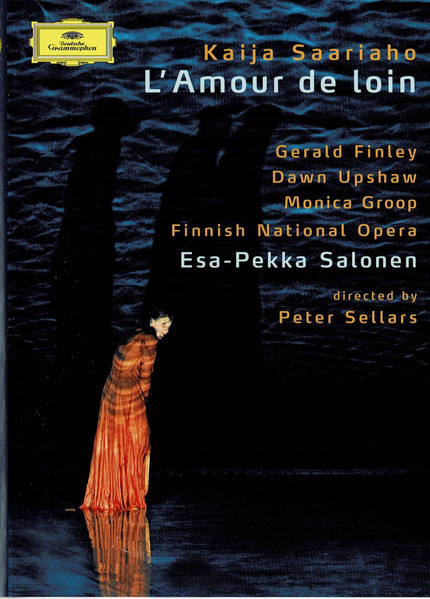
Her early work included an acclaimed violin concerto but her international breakthrough came with her debut opera L'Amour de loin in 2000. Peter Sellars, who directed it, spoke of the "secret beauty" of her music. [The DVD of that production is shown below-left. Vis-à-vis that recording, see my interview with Dawn Upshaw.]

saariaho It was not until April 2023 that her most recent opera Innocence made its UK debut at the Royal Opera House. Set at an international school in Helsinki, it deals with a mass shooting and is sung in nine languages.

Her final work, a trumpet concerto called Hush, was only completed at the end of March and will have its premiere in Helsinki, where she was born in 1952.

Last year she told the BBC about how the natural world had inspired her: "I was a very solitary child and I spent all the summers in my mother's home village surrounded by big forests on a lake that I loved the sound." She has spoken of how she was fascinated by the sound of the wind, footsteps in the snow or the sound of waves and learned to play the violin, piano and guitar and then the organ in local churches.

Peter Sellars, who directed many of her operatic works, said her music had an inexhaustible life force. "There's no other music in the world like it. Every performance is freshly amazing," he told BBC Radio 3.

She was listed in a BBC Music Magazine survey by the world's leading composers as 17th out of the 50 greatest of all time, in between Brahms and Haydn.

Saariaho studied with conductor Esa-Pekka Salonen and composer Magnus Lindberg at the Sibelius Academy in Helsinki in the 1970s. They had all benefited from Finland's national network of music schools and went on to form a Finnish society called Korvat auki (Ears Open) dedicated to contemporary music.

Eventually she tired of being identified as Finland's only female composer and moved first to Germany and then to Paris, where in 1982 she took a course in computer music at the renowned avant‑garde IRCAM institute.

In Finland she has remained a role model for composers, both men and women. Earlier this year, in an interview with BBC Music Matters, Saariaho said she still felt very Finnish. "I don't think I ever moved away from Finland really. I tend to be very straight and sincere. I don't enjoy speaking publicly, I don't enjoy arguing, and I think that's what French people do a lot."

In Paris she met Jean-Baptiste Barrière, who she later married and collaborated with. When the Covid pandemic struck in 2020, she was visiting Helsinki while he was still in Paris. "I will be separated from my husband longer than ever before," she said at the time.

In her family's statement on Friday, they said her case should help highlight the plight of immuno-compromised individual. "Twice Kaija has contracted Covid in public events where insufficient measures were taken, if at all, to protect the most fragile among us."

In a tribute, the Orchestre de Paris said it was with immense sadness that it had learned of the death of Kaija Saariaho, "with whom we shared so many wonderful musical moments".

The Royal Opera House said she was one of the most significant composers of her day and had an immense impact on its audiences.


==  (Text only) by Paul Kirby, BBC News (with addition of her birth/death dates)  
==  Names which are links in this box and below refer to my interviews elsewhere on my website.  BD  


saariaho
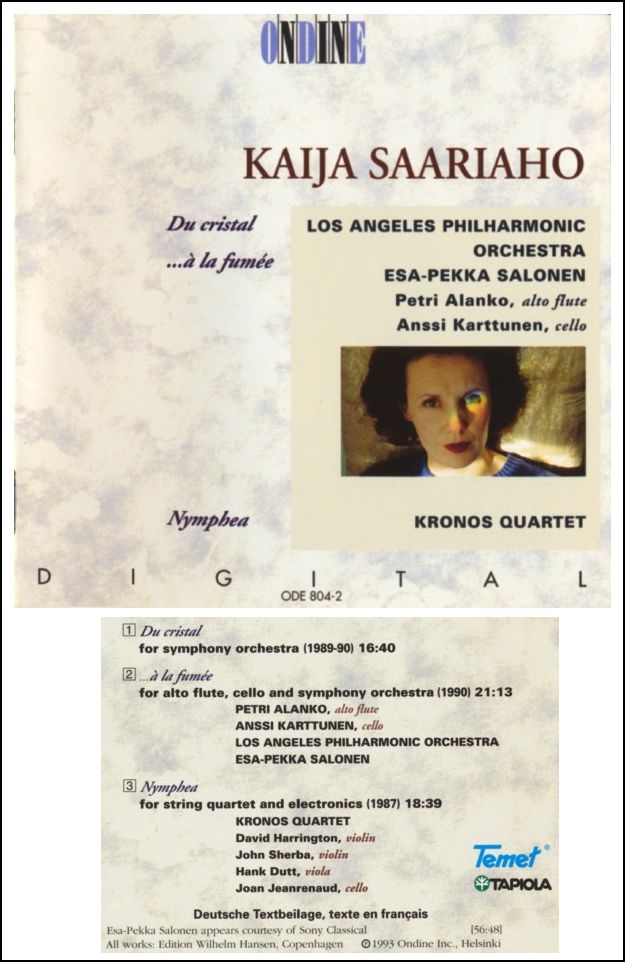
In May of 1988, composer Kaija Saariaho was on tour with the Kronos Quartet for Nymphén, which had been commissioned for them.  A recording was made at that time, and is shown at left.

During her stop in Chicago, she graciously took time to speak with me.  Some of her comments were used a couple of times on WNIB, Classical 97, and now, almost forty years later, near the end of 2026, I am pleased to present the entire conversation.


Bruce Duffie:   Tell me about the joys and sorrows of being a composer as we come to the end of this century.

Kaija Saariaho:   Well, that’s quite a large order!  [Both laugh]  For me, this particular time is very interesting, because during this century there were many things which had to happen in musical development and musical history.  At the moment, we are living in a time where we can synthesize the knowledge we have, and really make music diverse.  Serialism had to happen, but in this period right now we are really free, even much more free.  There are several different things going on everywhere in the world.  We hear music which comes from everywhere in the world, and it’s really less nationalistic, even if I see a very big difference between works from the United States and Europe.  Another thing which is really interesting to me is the technology.  Computer technology really inspires me a lot.

BD:   Do you ever work exclusively with electronics, or is it always electronics in conjunction with live people?

Saariaho:   I make them both.  Sometimes, if you have a very interesting idea about special tunings, or something which is easy to realize with the computer but very difficult for musicians, then I prefer to realize it with a computer.

BD:   If the musicians could realize these ideas easily, would you rather they do them?

Saariaho:   I don’t know, because there are things and ideas which are very suitable for tech media.  There are things which happen in space, for example, and all kind of special articulation that involve very refined work with musical timbre.  So, there are things which are very suitable for the machines.  On the other hand, I really enjoy the work with musicians.  I write for musicians, and when you get a good interpretation, it’s something you cannot get otherwise.

BD:   When you give the score to the musicians, are there times that they find things there which you didn’t know you had included?

Saariaho:   Surely.

BD:   Is this a good thing?

Saariaho:   I don’t know!  [Both laugh]  I cannot tell.

BD:   Have you basically been pleased with the performances you’ve heard of your music?

Saariaho:   Very often.  I’ve had good luck, but I don’t believe it’s only good luck.  There must be something in my music which reaches the interpreters, because when writing my music I’m working on a perception.  I’m not working on hidden constructions.

BD:   For whom do you write?

Saariaho:   This is a question which people ask here in the United States.  In Europe, they don’t ask that!  [Both laugh]

BD:   It seems that we in the United States are looking for direction, and if we know for whom you are writing, then it gives us a more of an idea.

Saariaho:   Yes, but in fact I cannot say that I’m writing for the public.  If I say that I’m writing for myself, I don’t know what it means, except for a bad and selfish attitude!  [Both laugh]  When I get musical ideas for any piece I want to realize them.  I write them for the musicians, or certain musicians who like my music and like to play it.  Then if the audiences like my music, of course I’m very pleased.

BD:   What do you expect of the audience that comes to hear your music?

Saariaho:   I wish that they could be quite open.  For example, it’s very difficult to come to a concert where there is only contemporary music, because each of the composers has their own language and their own rules.  So it’s difficult to be a listener then.  But I wish they wouldn’t compare my music to anything else, and that they are ready to try to listen.  Then they can choose if they get something from it or not.

BD:   Have you had mostly good reactions?

Saariaho:   Very often very good reactions, but not always.

BD:   It doesn’t bother you if people don’t like it?

Saariaho:   Yes, it bothers me, but what can I do?  I’m sure that when they don’t like it, it’s possibly that the concert was not very good.  I’m completely sure that when music is well played and well interpreted, then it gives something.

BD:   Let me ask a big philosophical question.  What is the purpose of music in society?

Saariaho:   [Thinks a moment]  There might be several purposes.  Today it’s very different than before, but on the other hand it’s the same.  One of my favorite composers is J.S. Bach.  He wrote his music for the church, and in a way he wrote his music to praise God.  From his music we get a vision of a larger life than our world, which maybe we cannot perceive otherwise.  I think that is true, even if I’m not really a religious person in this way.  I cannot say that I’m writing my music to praise God, though I feel that through my music people can perceive things which they cannot perceive anywhere else.  This might make their lives richer, and give experiences which they cannot have otherwise, and it might make life nicer.  Perhaps their perspectives might become wider, and you can see things in this way.  So it may be able to have some effect on their lives.
saariaho
BD:   Does your music make your life richer?

Saariaho:   My music is my life.

*     *     *     *     *

BD:   You’re a composer.  Do you also teach?

Saariaho:   At the moment, no, because I don’t have to.  I’m living in Paris for the time being, but in Finland we have a very special system for an artist’s salary.  At this moment I’m happy to receive this salary, so I’m only composing music.

BD:   Does that make your time freer to do just what you like?

Saariaho:   Yes.  It gives me the possibility to concentrate only on composition, which is what I want.  At some time later I would be interested in teaching.

BD:   Is composition something that can be taught?

Saariaho:   Yes, it can be taught, but not directly.  I was taught.  My first teacher was Paavo Heininen in Finland.  Teaching playing or teaching all the arts is a vast thing.  First of all there is the analysis of other works.  Teaching shows the way of perceiving things, and enables you to find your own personality, your musical weak points and your strong points.  All the more experienced composers who have already lived and realized many works can teach these to a younger person.

BD:   Did you have other teachers beside Paavo Heininen?

Saariaho:   Yes, I studied also in Freiburg with Brian Ferneyhough and Klaus Huber.

BD:   What did you get from them besides just inspiration?

Saariaho:   Because of my situation in Finland, where I studied for five years, it was very intensive work.  After going from Finland to Freiburg, it was most important to get away from Finland and become independent from this teacher who was so important to me.  I got different things from Brian and Klaus, and I cannot say that it was so important.  Freiburg is famous for being a place where people work very much on constructing structures.  It boasts the use of a serialistic approach, and while I was there I understood that this is not really what interested me.  Even if you must have certain methods to master your material, to master form and to master all the musical elements, I want to work with things which are audible.

BD:   Do you feel that music is art, or is music entertainment?

Saariaho:   [Thinks again]  What is the difference between art and entertainment?  I don’t always know what the difference is.  If I must choose between these two things, then it’s art, but art can also be entertaining.

BD:   Where is the balance between the two?

Saariaho:   In today’s society, there is no balance.  Most of the rock music and the video-clips we see on television very often are not art.  That’s entertainment and that’s sometimes destroying the ground from art.

BD:   Are there some recordings of your music?  [Remember, this conversation was held in 1988, and since that time there have been quite a few pieces which have been released on CD.]

Saariaho:   Yes.

BD:   Are you pleased with those recordings, because they can be distributed all over the world?

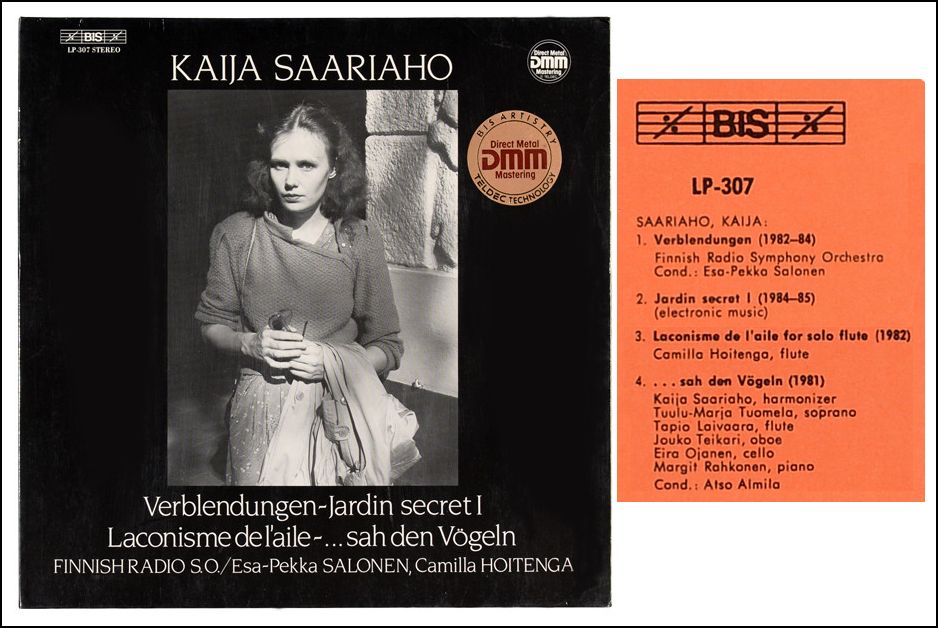
Saariaho:   Yes, I’m pleased.  There is one record from a few years back on the Swedish label, BIS [shown at the top of this webpage], and it’s got just my works.  The main one is Verblendungen [1984], which is a piece for orchestra and tape.  Then there are some other individual pieces on several records, but they are mostly Scandinavian discs.

BD:   Do you find that making records is different from doing live performances?

Saariaho:   Yes, it’s different, and in some ways it interests me more and more.  For example, working in this country with Kronos, we have a string quartet and live electronics.  To get them exactly as I would like them to be, in all the conditions in all the different halls, with different microphones and different loudspeakers, is really extremely difficult.  I wish that we can make a recording very soon where we can really control all the circumstances.  I like it because it’s interesting, but it’s not the same thing as a live concert.  In a concert, many things can happen, and it doesn’t matter.  On the other hand, because the musicians are there with other people, there’s a very special atmosphere.  It’s really important, but they are two different things.  On the recording situation, you can really work on achieving perfection, and that’s very interesting.

BD:   Do you ever achieve perfection?

Saariaho:   No!  [Both laugh]  I don’t think that has happened yet.  In fact I was working on a radiophonic piece in Finland just before starting this tour with Kronos.  I worked for two months in the studio where we had made many recordings.  This was something very nice, and there I became very close to getting everything just as I wanted.

BD:   Are most of your pieces on commission?

Saariaho:   Yes.

BD:   When you’re given a commission, how do you decide if you will accept it, or postpone it, or decline it?

Saariaho:   It depends on what I have in my mind.  Normally I have something in my mind, and then from the commissions which are proposed, I choose something which is suitable.  Often it goes quite well.  It must have been three years ago that Kronos asked me for two quartets.  If they would have asked it four years ago, I don’t think I would have accepted, because I didn’t really have anything to say with a string quartet.  For me it was something completely foreign.  But then in a different context, I started to work more and more with strings, and that was just when I got a letter from Kronos.  I started to think that it would actually be very nice.  It often happens this way.

BD:   The right piece at the right time!

Saariaho:   Yes, yes.

BD:   Will this piece be played by other quartets after the Kronos?


Saariaho:   Yes, surely, but this commission is for them, and in the concert program it says that they have the exclusive rights for two years.  I know already many quartets who would like to play it, but they must wait.
saariaho
*     *     *     *     *

BD:   When you’re working, do you concentrate on one piece at a time, or do you have more going at the same time?

Saariaho:   Normally I work on just one piece.  Sometimes if it’s a big work, I can go for a period and then move on to something else, especially if they are very different works.  But normally I cannot mix pieces.  Especially in the last phase of working I cannot think of anything other than that one thing.

BD:   Do you know when you start how long it will take to write?

Saariaho:   Yes, often I know.  It’s very strange... I sometimes feel a little bit bad about it.  I’m like a machine.  [Both laugh]  I don’t know, but it works.  Often there is a deadline.  It’s never finished before the deadline, but it’s never really late either.  There can be all kinds of minor catastrophes, but it’s not late.  It’s like an inner clock somehow, but I need the deadline.  It’s gives me a nice tension when I have this limited time.  Of course it can’t be too limited, but if it’s nicely limited then it’s a very secure feeling.

BD:   [With mock horror]  You mean I can’t have that three-movement orchestral work next week???

Saariaho:   No!  [Both laugh]  Not quite!  I work very slowly in fact.

BD:   Deliberately?

Saariaho:   I want to have time to think about things.  I always write a piece twice.  I write it first to make sure the things are generally in their place, but I leave quite many details open.  It’s like a sketch, and then I feel good when everything is in place.  I know how it will be, and then when I have the totality, I start rewriting and I fix the details.

BD:   Do you ever go back and revise it?

Saariaho:   Yes, sometimes.

BD:   Do you ever revise a work after it’s been published?

Saariaho:   This I never did.  [Both laugh]  I’m not Boulez!  [Even more laughter]

BD:   When you set out to write the piece, how do you know when you’ve come to the end?

Saariaho:   It comes very naturally.  Somehow, it’s finished.  It becomes more and more finished.  It goes naturally, and when I understand all of the nuances, then I must write my name to end it.  It’s a mental process, but even as I go farther away from it, then it’s there all along.  [Laughs]

BD:   When you’re writing, do you control that pencil or does the pencil control you?

Saariaho:   [Thinks a moment]  It depends.  Often it controls me.  Sometimes when I listen to a nice recording of my music, if there is some special passage which is nicely worked out, I am really surprised.  I wonder if it was me who wrote this.  Sometimes there are many secrets that we don’t know about.  The things which come from the unconscious to the paper are often more interesting than what we can find out by thinking.  On the other hand, it speeds up the process.  It’s good to think about the things, and try to work them out by thinking, but then the final solutions might come completely from somewhere else.
 
BD:   When you listen to a piece that’s maybe ten or fifteen years old, are you still pleased?

Saariaho:   I cannot say if I’m pleased or not.  I have changed much, of course.  I see what I was after, and I think it was me, but it was me ten years ago.  But I couldn’t touch it.  It was then, and it was the right thing to do.

BD:   Have you written any vocal music?

Saariaho:   I wrote a lot of vocal music earlier, but then I stopped for a while.  Now in this radio work I have used voice and choir, and it’s all coming back to me now.  I really like the voice a lot, but I somehow came to the point that I was not very happy with the western classical singing.

BD:   [Genuinely surprised]  Why not?

Saariaho:   I don’t know.  I felt that it’s so far from reality somehow.  The voice is something we use every day, and we hear it everywhere.  I found that it’s somehow too abstract.  On the other hand, so-called extended vocal techniques are so often like a cliché.  There are all these quasi-Berios, and I felt that it was very difficult to find a good and natural solution.  I like so much other singers than classical singers.  I really like somebody like Billie Holiday.  I would like to have this kind of quality in my music.

BD:   Can you write that quality into your music?

Saariaho:   Yes, I try to, but it’s difficult.

BD:   Will you ever write an opera?

Saariaho:   I don’t think that I will call it
‘opera’.  In fact, I’m working on something which should be performed for the first time around Christmas of 1989 in New York.  It’s called Christmas for Vincent van Gogh, and they call it a ‘satellite opera’ because part of it will be sent by satellite from the last little village in France where van Gogh was living.  But I would like to find another name for it.  I don’t like to speak about ‘opera’ or about ‘symphony’.  I would not like to use these names which are historical and plauded.  But if one speaks about opera and means something where different arts come together, where there is interesting work with light and dance, maybe all the possible vocal uses, maybe video, then it interests me.

BD:   Is your music for everyone?

Saariaho:   I don’t think there is any music which is for everyone.  I would like it to give something to everybody, but I don’t think it’s possible.

*     *     *     *     *
 
BD:   Is composing fun?
saariaho
Saariaho:   Sometimes it’s really fun [laughs], but not always.  Often it’s very hard work because it demands such enormous concentration.  It’s tiring.  If you’re working on a long piece, it’s really arduous work, but sometimes it’s wonderful and things work out.  When all of a sudden something wonderful comes onto the page, or comes to mind, then I really love it.

BD:   I hope this performance goes well!

Saariaho:   Yes, I hope so, too.

BD:   Has it been running well?

Saariaho:   Yes, really well.  It’s quite dry in this theater.

BD:   Is that good or bad?

Saariaho:   I would like theaters to be a bit more resonant, so we’ll see.

BD:   How many times has this been performed so far?

Saariaho:   Six or seven times.

BD:   How many more will be coming?

Saariaho:   On this tour, this is the last time I join Kronas.  They will do it a few more times with the technician.

BD:   [With a wink]  Have they learned it?

Saariaho:   Yes, now they have learned it!  [Both laugh]  It has been a very interesting experience, really nice.  It doesn’t happen so often to composers that you can work out things again, and I’ve really enjoyed it.

BD:   How far ahead are your commissions?  Do you have dates for the next year or two or three?

Saariaho:   I have commissions until 1992.  I would have had more, but it doesn’t make great sense.  I cannot know what I want to do after three years.  Some possibilities must be left until later.  There are some composers who are filled up until 2000, but I think it’s quite a terrible idea that they are slaving to finish one piece and immediately start another.

BD:   You’re not a slave?

Saariaho:   I am, but I really don’t like the idea of all that pressure.  If you want to be a really big name in this society, you must produce many pieces, because the first performance is always so important.  I don’t like the idea of using my recipes and then repeating my things.  I really want all my pieces to be different, so it takes a lot of time.
 
BD:   All the pieces are different, and yet they’re all you.

Saariaho:   Yes, they’re really different.  It’s a difficult question about what are the mannerisms of my style.  It’s difficult to know.

BD:   Is your style always evolving?

Saariaho:   I don’t know.  You should ask somebody else about this.  [Laughs]  I think it is, but there’s something which is very much me.

BD:   Are you at the point today where you thought you would be ten or even fifteen years ago?

Saariaho:   No.  In fact, ten years ago I didn’t know that I would not be living in Finland.  I am also really surprised how well my music is received.

BD:   I hope you’re pleased!

Saariaho:   Yes, I’m pleased, but I didn’t have to wait so long.  [Both laugh]

BD:   Where do you want to be twenty years from now?

Saariaho:   I cannot know.  I’ve learned to realize that you never know what will happen in your life!  [Both laugh]

BD:   I hope good things continue to happen for you.

Saariaho:   Yes, me too!

BD:   Thank you for being a composer, and thank you for spending some time with me this afternoon.

Saariaho:   Thank you.


= = = = = = = =                = = = = = = = =                = = = = = = = =
-----              -----              -----
= = = = = = = =                = = = = = = = =                = = = = = = = =


© 1988 Bruce Duffie

This conversation was recorded in Chicago on May 23, 1988.  Portions were broadcast on WNIB in 1992 and 1997.  This transcription was made in 2026, and posted on this website at that time.  My thanks to British soprano Una Barry for her help in preparing this website presentation.

To see a full list (with links) of interviews which have been transcribed and posted on this website, click here.  To read my thoughts on editing these interviews for print, as well as a few other interesting observations, click here.

*     *     *     *     *

Award - winning broadcaster Bruce Duffie was with WNIB, Classical 97 in Chicago from 1975 until its final moment as a classical station in February of 2001.  His interviews have also appeared in various magazines and journals since 1980, and he continued his broadcast series on WNUR-FM, as well as on Contemporary Classical Internet Radio.

You are invited to visit his website for more information about his work, including selected transcripts of other interviews, plus a full list of his guests.  He would also like to call your attention to the photos and information about his grandfather, who was a pioneer in the automotive field more than a century ago.  You may also send him E-Mail with comments, questions and suggestions.