Pianist Byron Janis
A Conversation with Bruce Duffie
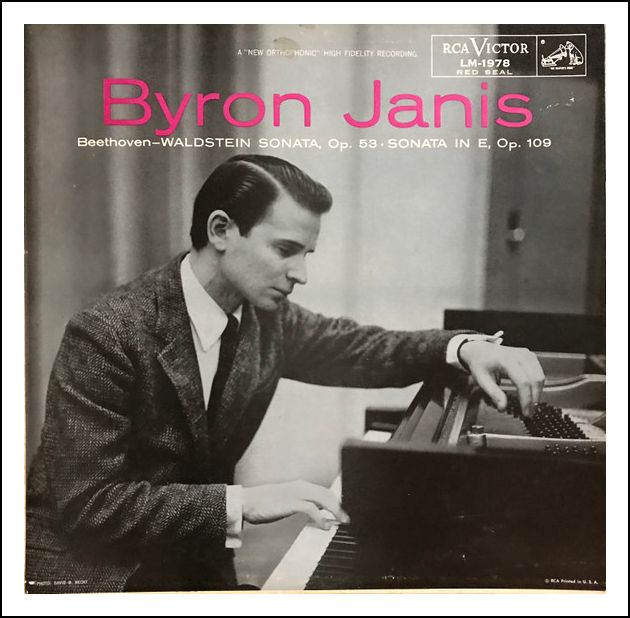
Byron Janis (né Yanks, father having shortened
it from Yankilevich, March 24, 1928 – March 14, 2024) was an American classical
pianist. He made numerous recordings for RCA Victor and Mercury Records,
and occupies two volumes of the Philips series Great Pianists of the 20th
Century. His discography covered repertoire from Bach to David W. Guion
and included major piano concertos from Mozart to Rachmaninoff and Liszt to
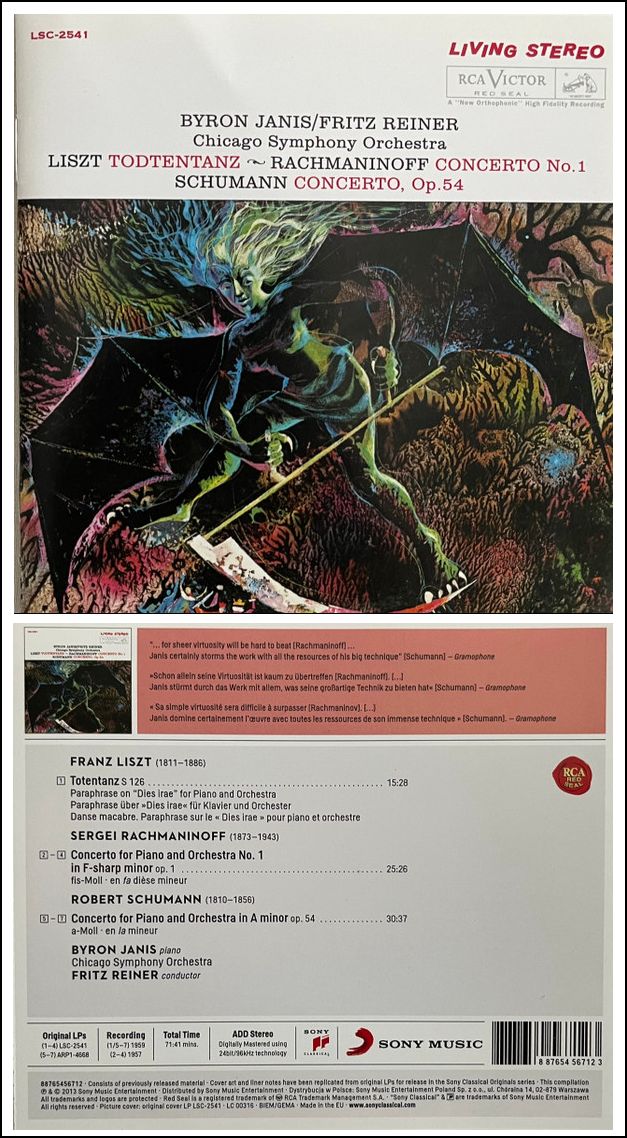
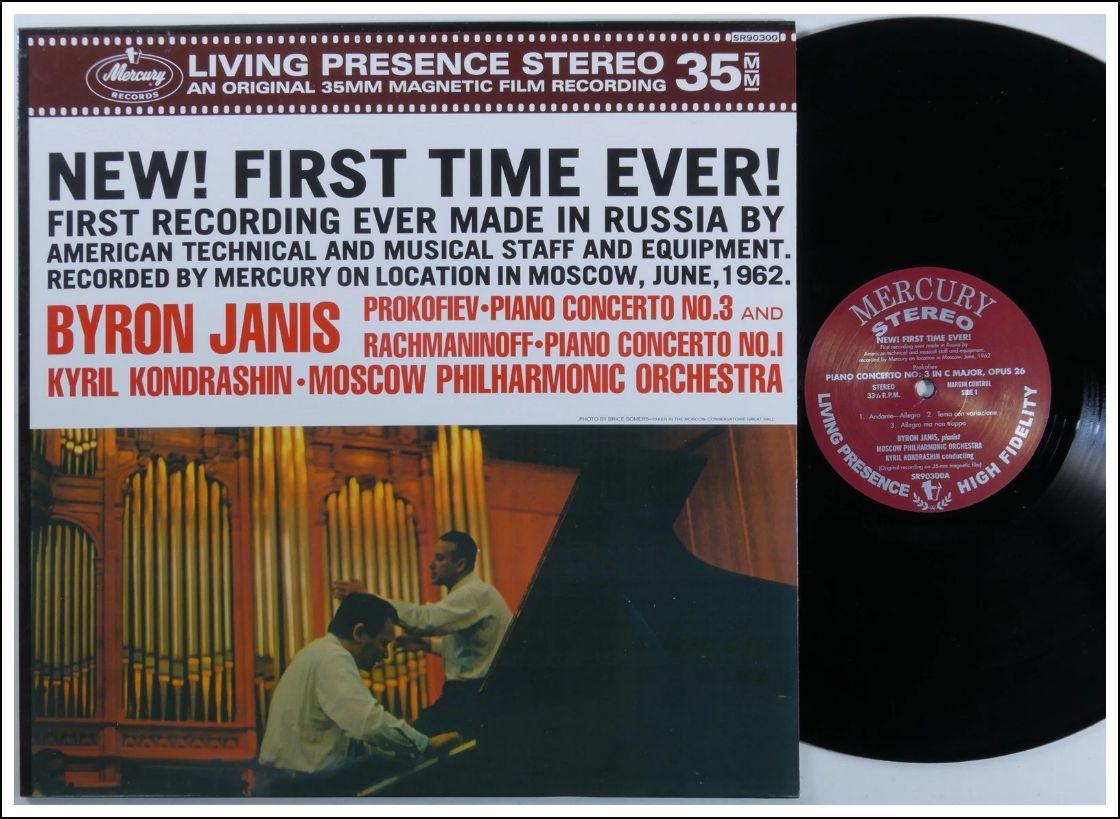
Prokofiev. [A few of these recordings are used as illustrations on
this webpage.]
After demonstrating perfect pitch on a toy xylophone in kindergarten,
Janis studied with Abraham Litow until he was 8 years old. Byron moved to
New York with his mother and sister in 1936 to study with Josef and Rosina
Lhévinne, and a year later, he began studying with their associate,
Adele Marcus, who would remain his teacher for six years. When Marcus moved
to Dallas in 1941, Yanks followed her there to continue his piano studies.
He remained in Texas for three years, attending Woodrow Wilson High School.
Byron Yanks made his recital debut in 1937 at the Carnegie Music Hall in
Pittsburgh, and a year later, his musical sponsor, Samuel Chotzinoff, persuaded
him to change his name to Byron Jannes; he would later change the spelling
to Janis.
After attending one of Janis' concerts in Pittsburgh in 1944, at which
he played Rachmaninoff's Concerto No. 2, Vladimir Horowitz offered
to take the fifteen-year-old on as his pupil. Janis studied with Horowitz
from 1944 until 1948. Horowitz had advised Janis to concertize to build self-confidence
and stage presence, so he postponed his successful Carnegie Hall debut until
1948.
In 1973, Janis developed severe arthritis in both hands and wrists. In
1985, he talked about his difficulties in public for the first time and became
the First Ambassador for the Arthritis Foundation. In June 2012, he was presented
with a Lifetime Achievement Award for his work in Arthritis Advocacy.
Janis was also a composer. He wrote music for musical theater, including
the score for a 1993 Off-Broadway adaptation of The Hunchback of Notre-Dame,
for television shows, and in collaboration on several pieces with Cy Coleman.
|
In July of 1994, pianist Byron Janis was back in Chicago to speak about
the Arthritis Foundation. During his brief visit, he graciously agreed
to speak with me at his hotel. His thoughts on both subjects permeated
the conversation, and I was pleased to present portions on WNIB, Classical
97 when playing some of his recordings. Now, in 2026, it is my pleasure
to share the entire encounter on this webpage.
Bruce Duffie: You were a fine pianist, and now
your priority is being a spokesman for the Arthritis Foundation.
Byron Janis: I was struck with this thing in
1973. I played with it for many years without speaking about it,
and finally decided to talk about it. In 1985 it was announced at
the White House that I had been playing with psoriatic arthritis for all
these years, and that I was joining the Foundation because I felt I had
proven my point that I could challenge the disease, fight it, play with
it, and not let anybody realize that I had it.
BD: How much pain were you in during an ordinary
concert?
Janis: It varied because I took a lot of medication,
and, most importantly, I used an awful lot of will power. I’m a
very strong believer in ‘mind over matter’.
That’s so important in everything, and I was really determined not to
let this stop my life, which was music performance. It didn’t stop
me. I kept playing. When I did announce it, I didn’t know
exactly how long I was going to continue, or what would happen. Because
of some of the side effects of some of the medication, and some other things
that I was given, it was getting to be a little too much to handle. So
this is one reason that I decided. The stress of playing all those
years with that condition meant relearning and refingering things.
You can imagine what effort that took.
BD: Did the condition alter your selection
of repertoire? Did you play more chordal pieces rather than
running pieces?
Janis: Certain pieces I deleted, but it was amazing
how I kept a lot of the big repertoire. I kept the Rachmaninoff
for a long, long time after this had started. A few things which
were uncomfortable I just deleted, but I kept most of the repertoire going.
BD: Did you find that it was harder to play
with as much power? Did you maybe play more delicately?
Janis: At times I may have cut back at bit on some
power on things. Also I used pianos that were compensated, which
is a good thing to do. Liszt used to play on two pianos in one recital.
He used one for the more classical repertoire, and one for the more virtuoso
repertoire, which had a much lighter action and was much easier to play.
That makes a great deal of sense.
BD: Did you have your technician ease off the
action a bit?
Janis: Yes. I played on the easiest actions
I could find, without question, and that was a big help. You can
find pianos that have more power than others. Quite honestly, if
I thought that the standard of playing had dropped, I would have stopped
immediately. But I thought my playing was solid enough to me that
I said no, no, I will not stop. There were times when I was not
at the top of my form, but nobody is always at the top of their form, even
when you’re without a medical problem. But this, of course, was such
a shock to me. You never think this is going to happen to you.
BD: Would have been better if you had blown
out a knee?
Janis: A knee, or a foot, or whatever [laughs],
but hands and wrists both I needed.
BD: Do you still play occasionally?
Janis: I do play, yes, because I do a lot of benefits
for the Foundation. I’m in a moment where it goes into remission.
It gets a little better, and I may start playing more again. But
at the moment what I’ve done is another part of my life, which is my creative
ability, to open up, and I’ve started to write. It’s taken the form
of writing musicals. I’ve written my second one just now.
The first one was The Hunchback of Notre-Dame, and the second one
I can’t talk a lot about because it’s Public Domain. But what a wonderful
thrill this is for me to write. I’ve always wanted to write.
Musicals have always excited me because I think they are really the backbone
of American opera. That’s why they’re all coming back now. Think
of works like My Fair Lady. They will keep coming back just
like operas keep coming back, with new sets and new versions.
BD: The obvious question then is to ask why
you are not writing piano music.
Janis: Yes, that’s a good question! There’s
a sympathy that I share with a man whom I admire probably more than
anybody, not only as a composer but as a man, and that was Chopin. The
voice interested me more than anything, and to write melodically, to write
vocal music for that instrument I find very exciting. I have written
a few things for piano, but nothing important. That may happen one
day, but I wanted to start with something like this, and it was what I
was drawn to. I wanted to see if it was still possible to write
melodically in an age where I felt melody was nonexistent.
BD: You seem to be coming into it at a time
when melody is making a comeback.
Janis: It’s making a comeback, isn’t it? I
think it’s wonderful, because it’s also about the hardest thing in the
world to write.
BD: To write a good tune?
Janis: To write a good tune is very hard. It
doesn’t sound like other things, and so that’s been a challenge. The
pleasure it’s given me is enormous, and I must tell you that creating,
writing, is very different from performing, although I find I’m using exactly
the same creative feelings that I use in performing somebody else’s music
as going into my own. I feel the same emotions, yes, the same feelings
that I do when playing Schumann or Chopin. Yet it’s your own, and that’s
quite thrilling. [Laughs] We’re coming out of an age of specialization,
where for so many years pianists were just pianists. In the nineteenth
century, pianists were composers, and conductors.
BD: Have you ever thought about going into
conducting?
Janis: Yes, I have. I did it once on a dare
to myself, without ever having lifted a baton. I played a three-concerto
evening in Paris. I think it was the First Rachmaninoff,
the Schumann, and Prokofiev’s Third.
BD: You conducted them from the piano?
Janis: I conducted the Prokofiev from the piano,
which is not the easiest piece in the world. Even Prokofiev himself
always wanted to, and didn’t have the nerve to do it. He asked his
good friend Dmitri Mitropoulos, who was a great conductor, and a marvelous
pianist by the way. He was the first man to conduct it from the
piano [a concert in Berlin in 1930 when the soloist was ill]. It
was very tricky, but I felt that if it didn’t go well in rehearsal, I’d just
forget it. It was a fascinating experience, because I’d really never
lifted a baton. This was what fifteen or twenty years ago. They
started helping me because it was a game to see if I could, in fact, conduct
and transmit my technical aspects. I’d been watching these people for
many, many years over my shoulder...
BD: ...and of course, you are a musician.
Janis: Exactly! A lot of the great orchestras
can play by themselves, so it took quite a bit of doing. But I must
say that the performance came out well. I was quite a nervous
wreck because it was difficult. They were really helping, and
it turned out to be one of the best performances of the evening.
I found it marvelous. There are many older conductors, so I thought
to myself maybe I might do that yet. It’s not impossible.
BD: We have that to look forward to! [Both
laugh]
Janis: Perhaps! Perhaps I have that, and,
as they say, music is music. You can write, you can conduct, you
can play, so why not? It’s quite natural to be able to do all those
things.
BD: Since we’re talking about music as music as music,
what is the purpose of music?
Janis: Music is here to take you away, to transcend
things that are restricting our imaginations and our dreams here on Earth.
Music is to make us dream. It’s to make us feel many different things,
and perhaps the strongest of all is the spiritual side. It is to
me, and always has been.
BD: It must be so strong in you to overcome
the pain and difficulty that you’ve endured.
Janis: Yes, exactly. I have said it was life,
and it truly was my life. Since the age of four it was everything
to me. It was spiritual, it was love, it embodied every emotion
that a man or woman can feel. That’s what was so difficult about thinking
if I had to stop playing, I would have to do it another way, because for
me it is the closest thing to something beyond birth. I can say to
God it should bring out the best in me. It caters to the best part
of man, and takes them to that place. That’s why I think a concert
should be not just a transference of notes and thoughts and feelings that
somebody wrote. It should be an experience! You should leave
that concert with a lot of feelings that you can’t get anywhere else.
It should be strong. It might be faster or louder than so and
so played it, but that for me is not interesting. I want to go to
a concert where I have an experience. The artist himself has got
to feel that this is an experience, and the audience is going through
what he’s conducting or playing, or singing. I want to make them really
feel, and just forget everything else, and come with me on this voyage.
* * *
* *
BD: Let us talk a little bit about your
career before the arthritis hit, and just the technique of playing. From
the repertoire of the piano that is so huge, how did you decide which
pieces you were going to tackle and which pieces you’d set aside?
Janis: The things I tried interested me as an artist.
I did not like to be categorized in any one particular area of
the repertoire, because all of the areas interested me, just like all
of life interests me. When I go to Spain I go to the bull fight.
That’s fascinating. When I go to France, I explore the French
countryside, the food, the color, and particularly the essence of France.
All this interests me. You feel what that country has to offer.
It is like Laurence Olivier, who switched roles and played every
kind of part because they all fascinated him. He felt what it
would be like to be in all kinds of different people’s shoes.
BD: You wanted to present all of these different
styles?
Janis: Yes. All these different styles fascinated
me, because that’s my outlook towards life. When people ask what’s
my favorite, it’s an impossible question. Who’s the most beautiful
woman? How can you compare beauty? How can you compare great
pieces of music? You cannot... or at least I cannot!
BD: Right. I never ask which are a guest’s
favorite pieces, just for that reason. Now you’ve led me to an
idea that I’ve never asked a pianist before. I ask opera singers
if they become their characters or portray them. As a pianist, do
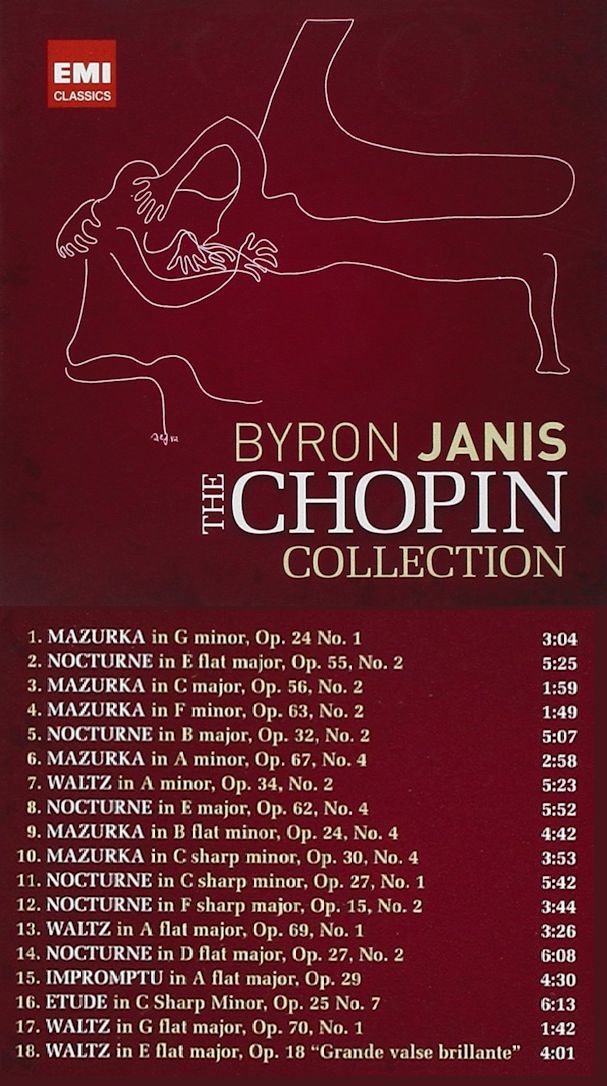
you become the music, or are you projecting the music? [The cover
illustration of the CD shown at left seems to embody this idea!]
Janis: [Laughs] Ha, ha! Probably you’re
doing both if you’re successful. In a sense you are becoming it.
It’s a rather Stanislavsky-type approach. You definitely are
what you are playing at that moment. It’s hard to separate yourself
from the music. I know that I’m totally involved with whatever
the piece is saying to me. I’m listening, and I’m hearing what this
is saying to me. I’m hopeful by then that whatever talent of the
artist will be projected, because you can feel a lot of things. You
have to communicate it strongly. You do become the music, or at least
I do anyway. I become so involved, however there is still this
distance that you must keep in order to project it. I was very close
to Boris Chaliapin, the son of the great singer, Feodor. He told
me this wonderful story about asking his father what he was feeling in
the death scene in Boris Godunov. The son thought the father
must be feeling all kinds of incredible things, and the father said,
“No, not at all. If I felt too much, I would
never be able to communicate to you what Boris was feeling.”
It’s this odd thing of being very much involved, and yet removed
enough to be able to project it. I had one experience like that,
which was very strange. I had a close friend who died on an evening
I was playing the Funeral March sonata of Chopin. I was dedicating
it to him in my own mind and heart, and when I played it I thought I was
so terribly sad. My first wife came backstage and said to me, “I
have never heard you play the Funeral March so unemotionally. It
was not moving.” I suddenly realized that
there is this strange thing of feeling so much and being so involved that
you’re not communicating anything because you’re too involved.
BD: You still have to be a technician?
Janis: If you want to use that word, yes.
I would say you have to be the artist who knows that in order to communicate.
You’ve got to listen to it, and you have to be slightly removed
from it. You cannot just be totally involved with it.
BD: You can’t cry, but the audience must cry.
Janis: Exactly. I know what you mean when
you say ‘technician’. It is the art or a technique of communicating,
which is the most important. That is the artist, and that’s what you
must do.
BD: It’s the technique that allows the artistry
to flow?
Janis: Yes, and to come through. In teaching
you find so many young people feel a great deal, and you see them feeling
this tremendously, but it’s not coming out because they don’t know how.
It’s not communicated. It’s all kept inside them.
BD: Is there any way of teaching a young person
to let it come out?
Janis: Oh yes, sure there is. You have to just
undo this kind of emotion. There are so many reasons for it not communicating,
and that’s one of the jobs of a good teacher. The student may feel
it, but they’ve got to make me feel this, and they’re not doing it. Why
aren’t they doing it? What’s going on? Not everybody can
learn, but you can teach some how to improve their communication, and
how to make them feel something which is them. That’s really what
we have to do.
BD: In a more general sense, what advice do
you have for young pianists coming along?
Janis: [Sighs] There are so many young pianists
coming along!
BD: Are there too many?
Janis: I think so, yes. There are too many
who are wanting big careers who simply don’t deserve big careers because
they just aren’t extraordinary enough. There will always be a handful
of great artists, and there’s perhaps a group of very great artists, and
there’s a group just under those who are very great and who are extraordinary,
wonderful and beautiful. Then there’s many, many under those. Today
the standard of technical expertise has increased, but the artistry hasn’t
changed at all.
BD: They are better technicians but not better
artists?
Janis: No. Artistry is what it’s about. Anybody
can develop a technique.
BD: Without naming names, are we getting artists
today of the level of the artists of yesterday and the day before?
Janis: I have a feeling that we’re breaking out of a
long period of time where that kind of personal artistry comes from an
artist who puts himself on an equal par with the music he interprets. In
all honesty, what he or she must understand is that the music is more
important than you are. It just doesn’t have any validity, because
without you the music doesn’t live. Each one of us has something
different to say. You are important, and the great artists of the
past were very strong personalities. Suddenly maybe they overdid
it a bit, so the pendulum swung, and now will swing in the other direction.
We had all these people who were rather playing notes and doing
exactly what was written in the score. That is nonsense.
BD: Now you say the pendulum is swinging back?
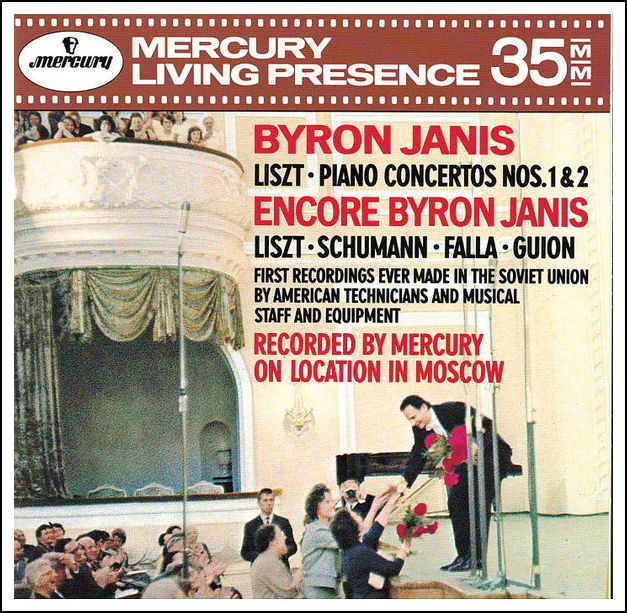
Janis: I think it is. We’ve had that
period of being ‘in church’, if you will, in front of that music, and
having to do what’s there. There’s not very much there. You
have to bring out what you think is there. One of my great stories
I always told people was when I opened the exchange between this country
and the Soviet Union in 1960. [Recordings of subsequent concerts
in Moscow shown above and at right.] I took the Aaron Copland
Piano Sonata with me. I’d never played it before, so I took it
to Mr. Copland in New York. I played it for him, and I wanted to hear
what he had to say. He asked me if I had heard it before, and I said
no. He said, “I like it very much.”
I was delighted, and he sat down and started playing some things from
it. I asked him if he was going to play a certain part forte,
because he’d written piano in the score. He said, “That
was ten years ago!” [Both laugh] So
therein is a very important lesson in where the artist has got to exert
his own feeling. That comes from a very strong conviction that he
must do it the way he feels it, because he feels it so strongly. If
he feels it so strongly, it’s going to make the listeners feel it so strongly,
and they will leave that concert saying it was fantastic! The next
day you might feel that it was not at all Beethoven, or was not really Beethoven.
Then this spell will have been broken, but at the time he’s held
you in his conviction.
* * *
* *
BD: When you played in small halls and big halls,
did you adjust your technique at all?
Janis: Yes. Small halls are a problem, and a lot
depends on the instrument there. If you have too big a piano in
a small hall, you’re in big trouble, and the reverse is also true.
Having too small a piano in a big hall can mean you’re in trouble.
That’s why dealing with pianos was such an important factor
in a pianist’s career. I came to major cities very often, and it
is important to have a man who knows how to voice a piano up or down.
Rachmaninoff used to tune the bass of his pianos himself. He wouldn’t
let anybody tune it because he wanted a certain sound in the bass. So
he would tune it himself. Vladimir Horowitz traveled with two
pianos all of his life, one for orchestra and one for recitals. A big
one, and a less big one. If you play in a smaller hall, it certainly
helps to have a piano that is not a big smashing orchestral piano, because
you’re going to have to spend all your time trying to keep the sound down.
But small halls are really wonderful for many things. Intimate
things in a smaller hall become even more beautiful than in a big hall.
They just lend themselves to that kind of ambiance. That smaller
environment just suits the works so much better.
BD: Do you try to make it more like chamber music
then?
Janis: Yes. That is the feeling. Halls
do influence you not only acoustically but visually. What they look
like changes what they feel like. They do have a part in how you
play.
BD: Does the temperament of the audience play
a part in how you play?
Janis: It does in a sense of their reactions.
If they react to something strongly, it’s good, and you just give more.
If they don’t, or if something you feel is played well and the public
doesn’t react, it’s raining on my parade a little bit. You think they’re
not getting this, so you begin to feel a little bit disappointed, and you
don’t quite give as much somehow. So an audience reaction is very,
very important, yes. Once you feel they’re with you, you’re going to
go and give them everything you have, which is what you should do anyway!
[Laughs]
BD: At the height of your career, how did you
divide your time between concertos and solo recitals?
Janis: I don’t know the percentage exactly, but it was
three quarters recitals to half and half. It’s hard to say which
was more fun. With the right conductor, it was marvelous to play
concertos because you’re playing with ninety or a hundred men. You’re
making music together with a lot of people, and that’s exciting. If
the conductor’s not right, or you don’t agree, there’s hostility. Many
conductors just didn’t like to accompany.
BD: They thought they were wasting their time?
Janis: It’s more than wasting time. There’s
a lot of ego involved, and some of them didn’t particularly enjoy having
soloists. They think they had them because they had to have them.
BD: They didn’t want to take a back seat to
you?
Janis: Yes, they didn’t want to, surely. Some people
just don’t enjoy accompanying somebody else. They want to always
be the soloist, and that’s a tragic deficiency in the character of a human
being, and hence in the artist. For instance, I was talking the other
day with someone about how the pianissimo sound today in an orchestra
is practically gone. It’s a generalization, but that double-piano
[marked pp] where the orchestra is playing really, really softly
behind a solo instrument, and even on its own but behind it, they’re almost
completely with the sound of the piano. It’s such a shame because
you lose that tremendous balance. I can remember when I was younger,
playing with conductors who, when they looked at the orchestral score,
took all the dynamic marks and cut them in half. They’re felt that
when playing with a soloist he’s got to be heard. You’re not going
to experience that very often today.
BD: So, forte would be mezzo-forte,
and piano would be pianissimo?
Janis: Yes, exactly, because you’ve got ninety orchestral
players versus one pianist.
BD: [With a wink] But of course, you’re
out in front, and you’ve got a lid which will force
your sound out into the audience. [Both laugh]
Janis: Yes, but it’s still balance. You’ve
got many strings playing against you...
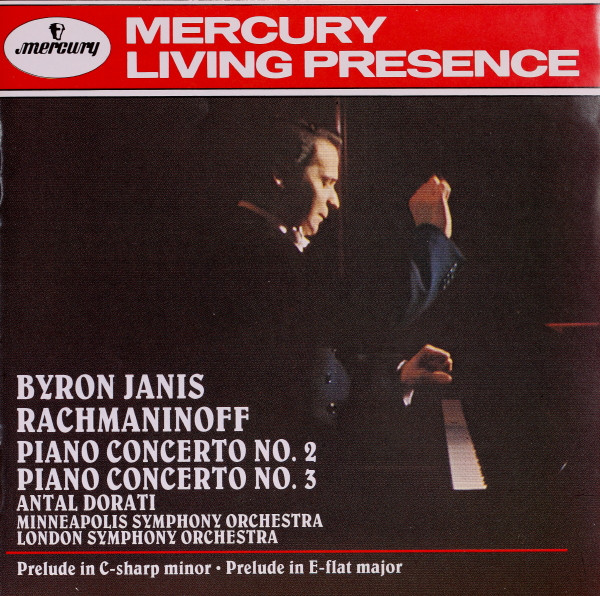
BD: Does it really become piano versus orchestra?
[Vis-à-vis the recording shown at left, see my interview
with Antal Dorati.]
Janis: It did at times, yes. Sure it did!
It became a battle sometimes because in the old days with the Boston Symphony
Orchestra, Serge Koussevitzky brought his pitch with him. International
concert pitch was 440, which means an A was 440 vibrations per second,
and because the Russians tune much higher, at 444, the Boston Symphony
Orchestra was always very, very highly tuned. So to take a piano
to play with the Boston Symphony, you had to tune that piano. Steinway
at the time was having terrible trouble because the strings would break
with that kind of pressure on them being so high. So they refused,
and you’d have to fight with that higher pitch as well.
BD: I would think that Steinway would have
a piano built to 444, and that would be the instrument for Symphony
Hall. [See my interview with Franz Mohr, chief concert
technician for Steinway 1968-92.]
Janis: Yes, but of course many guys were saying that even
when it’s the right pitch, it doesn’t feel right to them. That’s
the trouble, because when you don’t bring your own piano, you’re calling
up saying this piano needs to be voiced. What do you mean? This
is what you run into. [Janis pauses a moment, and then says wistfully...]
Individuality is to be encouraged everywhere as much as you can.
BD: Is it coming back now?
Janis: I sense it’s coming back. I sense a
return to being a little more romantic, if you want to call it that.
That word is overused, but I just mean more freedom.
BD: It may be coming back a little bit because
there are so many recordings that each pianist wants to stand out. So
they have to do something, and that becomes a bit of personality. [Both
laugh]
Janis: They have to be different, yes.
* * *
* *
BD: Let’s talk about recordings. I asked if
you changed your technique for small halls to big halls. Do you
play the same for the microphone as you do for a live audience?
Janis: [Thinks a moment] No. That’s a good
question, and it’s one that’s often discussed. You do have to change
somewhat in playing for a recording because the visual aspect of a concert,
which you do not have in a recording, allows for certain interpretive
things to take place, such as, for instance, a rest, a brief moment of
silence. In an auditorium, that brief silence can be longer, because
there’s a visual element which makes it seem as not being very long.
But if you do that in a recording, it seems much too elongated, so you have
to cut it in half because there’s no visual. You will just have the
ear at work. It’s quite fascinating how you run into a rest like that.
I cannot hold it for that long a time. It’s too long for a record,
but in a hall it works well. So, there are elements that have to
be sorted out for the recording. I always found the most difficult
thing was recording solo repertoire versus orchestral, because you’re alone
in the room with a microphone. For me, that has always been very
difficult because with an orchestra you have at lease a few men there,
and it’s just like a performance. But with a microphone alone, where’s
your audience? That’s also one of the difficulties in practicing.
I remember Eugene Ormandy saying to me that you always have to practice
as if you feel there’s somebody else in the room, and that you’re not
alone, because when you are alone, you tend to go over and over, and you
just waste time on a lot of things that you don’t have to. But when
you’re rehearsing with an orchestra, you’ve got limited time and you’re always
looking for improvements and changes quickly. We talked about auditoriums
being important. You walk out and when you see this beautiful hall,
it gives you something which is a tremendously important part of a performance.
You’re so aware of it, and it creates a bond. It’s another entity,
and you’re playing for that. You’re not just alone.
BD: One last question. What advice do you have
for composers who want to write music for the piano?
Janis: Write music for that piano is the advice.
It’s a rare thing, because the piano has been treated as a percussive
instrument, which it originally was, and is. But the great pianists
and great composers treated it not as a percussive instrument, but as a
singing instrument. They wrote horizontally and not vertically. This
means that the line goes along, not just the chords that bang down. The
piano is very boring if it’s played as a percussive instrument. That’s
why you had some of the greatest music written by great pianists, because
they knew the instrument. It’s interesting that the pianists of
the middle of the twentieth century were not writing, and that’s a tragedy.
Horowitz and Rubinstein didn’t write, and it’s interesting because those
and others probably didn’t have the time to write. In the nineteenth
century, they didn’t play that many concerts. Liszt, for instance,
mostly stopped playing at thirty-eight, so he could spend all his time writing.
While he was playing very little, he wrote.
BD: Of course, and if someone was going from
London to New York, they had six days on a boat, not six hours on a
Concorde.
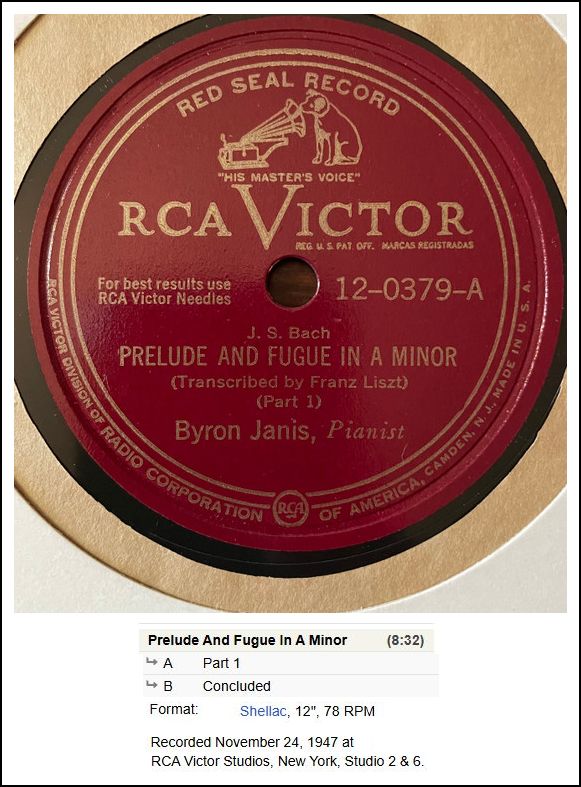
Janis: Exactly! That’s right, so that’s
a factor in it. [Note that the recording shown at right is a 78
rpm disc, recorded in 1947, a year before the first LPs were issued!]
BD: You’re writing for the musical
theater, but are you writing for the piano?
Janis: [Smiles] You bring up a very good point.
Having been, and still am, a pianist, I should write for it because
I know the instrument, and we should keep it alive as an instrument, even
though we’re not sure how long that will happen to be. Time marches
on, and if you lived at the time of the harpsichord, you would have thought
that it would be around forever, but it wasn’t, and I don’t think the piano
will be around forever, particularly if we don’t write for it.
BD: Is the next thing that’s coming perhaps
electronics, such as the Clavinova?
Janis: It’ll be a mixture of something with more and
different sounds, perhaps with quarter tones, but not only with electronics.
They’ll find a way of having more tones in with which to make melodic
music. That’s my feeling. But as long as we have this wonderful,
beautiful instrument, which for me is the greatest instrument, it’s the only
instrument that can accompany itself.
BD: It is music complete?
Janis: Complete. It can do anything.
BD: But you have to do it.
Janis: Yes, exactly! You have to treat it as
that kind of an instrument, as the accompanist and a singer with the
same instrument.
BD: Thank you for all the music that you have
given, and for inspiring people with difficulties to continue playing.
Janis: Oh, thank you very much. I enjoyed
talking with you. It was a great pleasure. Thank you!
= = = = = = = =
= = = = = = = =
= = = = = = = =
-----
----- -----
= = = = = = = =
= = = = = = = =
= = = = = = = =
© 1994 Bruce Duffie
This conversation was recorded at his hotel in Evanston, Illinois,
on July 28, 1994. Portions were broadcast on WNIB the following year,
and again
in 1997 and 1998. This transcription
was made in 2026, and
posted on this website at that time.
My thanks to
British soprano Una Barry for
her help in preparing this
website presentation.
To see a full list (with links) of interviews which have been transcribed
and posted
on this website, click here.
To read my thoughts
on editing these interviews for print,
as well as a few other interesting observations,
click here.
* * * *
*
Award -
winning
broadcaster Bruce Duffie was
with WNIB,
Classical 97
in Chicago
from 1975 until its final moment
as a classical station in
February of 2001. His interviews
have also appeared in various
magazines and journals since 1980,
and he continued his broadcast series
on WNUR-FM,
as well as on Contemporary
Classical Internet Radio.
You
are invited to visit his
website for
more information
about his work, including selected
transcripts of other interviews,
plus a full
list of his guests.
He would also like to call your attention
to the photos and information
about his grandfather,
who was
a pioneer in the automotive field more than
a century ago.
You may also send him E-Mail with
comments,
questions and suggestions.