 GB: Oh sure, as we also compete with the recordings!
We compete with ourselves in many cases. Often there is a recording
of an opera in which the same artist is singing on stage, and most times
it's not quite the same.
GB: Oh sure, as we also compete with the recordings!
We compete with ourselves in many cases. Often there is a recording
of an opera in which the same artist is singing on stage, and most times
it's not quite the same.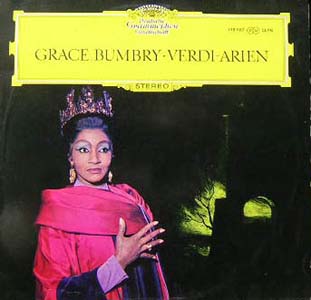 BD: Are you happy with the recordings you made 15 or 20
years ago?
BD: Are you happy with the recordings you made 15 or 20
years ago?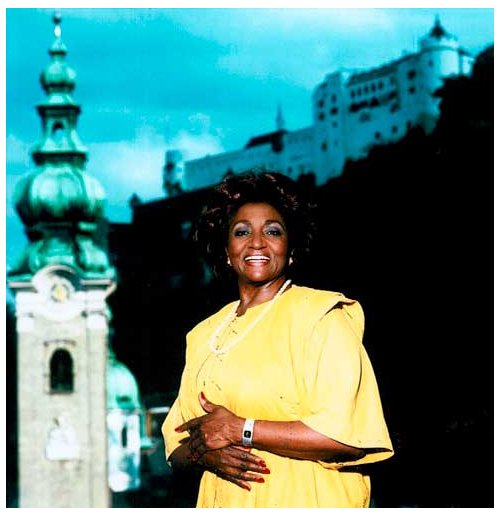 GB: Yes. It's a very, very interesting part.
It's too bad that you don't get as much of the play as one would like to
get; mind you, the same thing is true with Macbeth, but I find it to be an extremely
interesting opera, very close-knit in its structure and its action and its
music. Everything seems to go hand in hand. I saw the play of
Medea with Zoe Caldwell and Judith
Anderson this spring in New York. I tell you, I've never been so riveted
as when I went three evenings to see those ladies. I was speechless,
and when I say speechless, I mean I couldn't talk! That's never, ever
happened to me. I went backstage to see Dame Judith because I know
her; I worked Lady Macbeth with her years ago out in Santa Barbara.
She was playing the nurse, and I must say I was so very impressed with her
professionalism. For a person to have come from the glorified, wonderful
role of Medea, to all of a sudden now playing the role of the nurse with
such beauty, was wonderful. So I went backstage to see her and my voice
was gone! I couldn't talk. She took me to meet Zoe and introduced
me as a Medea, but I found my voice and said, "No, no. There are two
Medeas here, you and Dame Judith. I'm just beginning to learn what
it's all about." It was wonderful, the most incredible experience I've
had in I can't tell you how many years.
GB: Yes. It's a very, very interesting part.
It's too bad that you don't get as much of the play as one would like to
get; mind you, the same thing is true with Macbeth, but I find it to be an extremely
interesting opera, very close-knit in its structure and its action and its
music. Everything seems to go hand in hand. I saw the play of
Medea with Zoe Caldwell and Judith
Anderson this spring in New York. I tell you, I've never been so riveted
as when I went three evenings to see those ladies. I was speechless,
and when I say speechless, I mean I couldn't talk! That's never, ever
happened to me. I went backstage to see Dame Judith because I know
her; I worked Lady Macbeth with her years ago out in Santa Barbara.
She was playing the nurse, and I must say I was so very impressed with her
professionalism. For a person to have come from the glorified, wonderful
role of Medea, to all of a sudden now playing the role of the nurse with
such beauty, was wonderful. So I went backstage to see her and my voice
was gone! I couldn't talk. She took me to meet Zoe and introduced
me as a Medea, but I found my voice and said, "No, no. There are two
Medeas here, you and Dame Judith. I'm just beginning to learn what
it's all about." It was wonderful, the most incredible experience I've
had in I can't tell you how many years.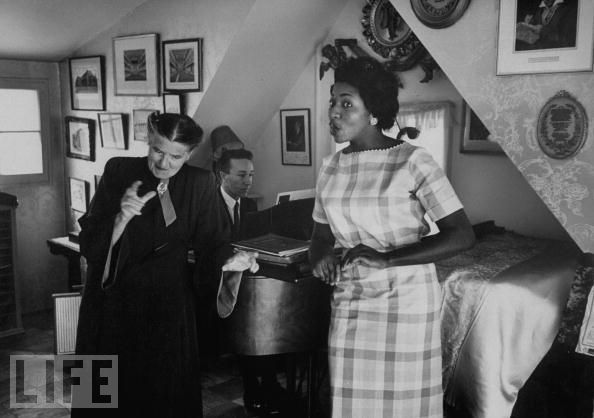 GB: The importance of the word. The importance of
the word and the importance of the musical line. Usually the word and
the music tells you what movement to make. She was really very, very
strong on that point, that the word is most important. Then the word
and the music together, because a musical line should give you a certain
feeling. With that sort of feeling and those words, it tells you what
you have to do! If you're at all a little bit intelligent, there are
markings in the score that tell you what you're supposed to do. It
might say, "She takes the fan, and she goes with the fan to the lamp."
But what happens in that musical line, from the moment she takes the fan
until she gets to that lamp, tells you how she got there and which way she
got there. Another thing that Lehmann and I very often discussed was
wearing apparel for the stage, for the opera.
GB: The importance of the word. The importance of
the word and the importance of the musical line. Usually the word and
the music tells you what movement to make. She was really very, very
strong on that point, that the word is most important. Then the word
and the music together, because a musical line should give you a certain
feeling. With that sort of feeling and those words, it tells you what
you have to do! If you're at all a little bit intelligent, there are
markings in the score that tell you what you're supposed to do. It
might say, "She takes the fan, and she goes with the fan to the lamp."
But what happens in that musical line, from the moment she takes the fan
until she gets to that lamp, tells you how she got there and which way she
got there. Another thing that Lehmann and I very often discussed was
wearing apparel for the stage, for the opera. 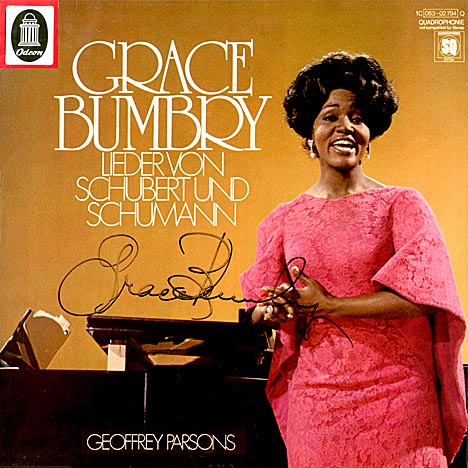 BD: So what got you into opera?
 GB: Yes. I really like Aïda very much.
But I also love Amneris.
GB: Yes. I really like Aïda very much.
But I also love Amneris.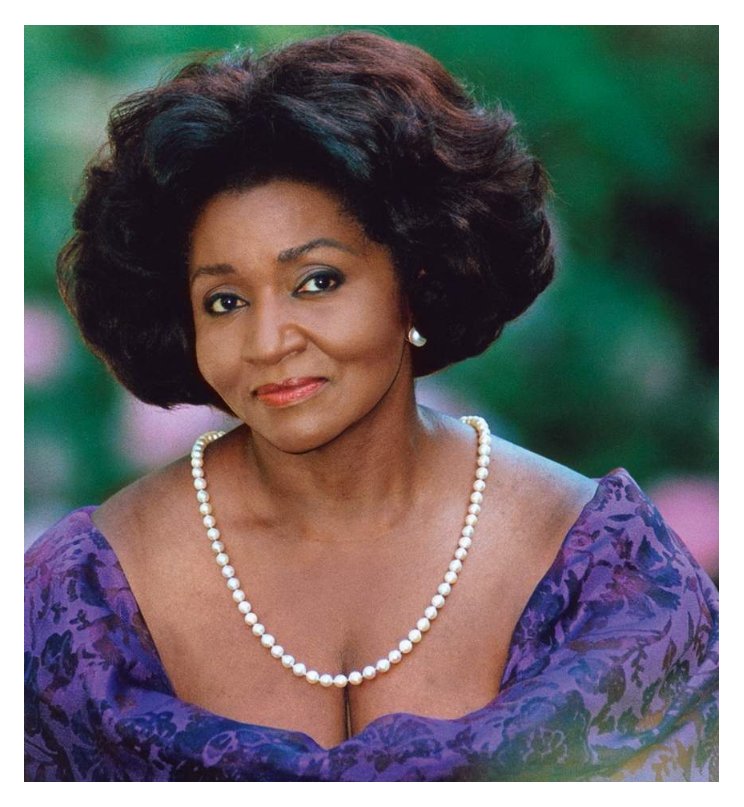 GB: I don't find her complicated at all. She is
very straightforward and self-sacrificing.
GB: I don't find her complicated at all. She is
very straightforward and self-sacrificing.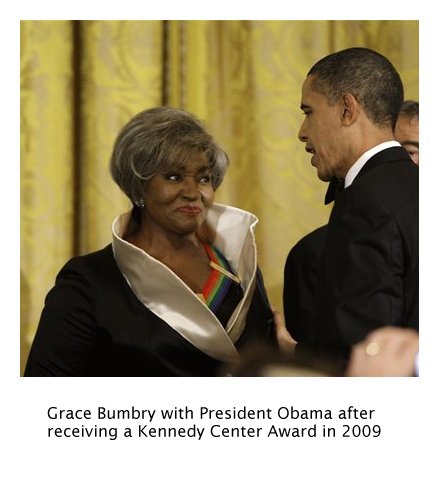 GB: We can hope! I don't think in the next four
years, unless we squeeze something in. My problem is that I divide
my time with Europe and also with my recitals. So I've got a triad that
I have to work out. I don't believe in doing too much in one place
because people begin to get tired of you. So I try not to do too much
in one city.
GB: We can hope! I don't think in the next four
years, unless we squeeze something in. My problem is that I divide
my time with Europe and also with my recitals. So I've got a triad that
I have to work out. I don't believe in doing too much in one place
because people begin to get tired of you. So I try not to do too much
in one city.Grace Melzia Bumbry
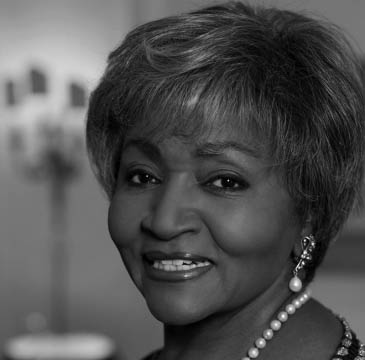
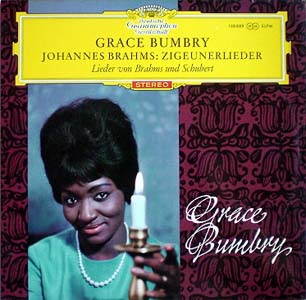
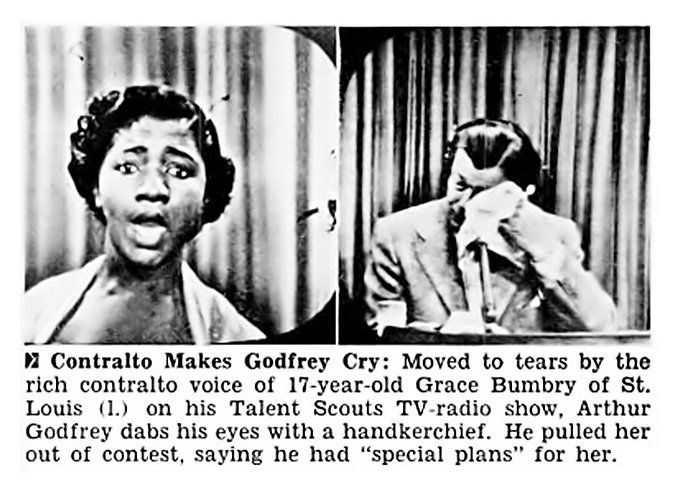
Born in St. Louis, Missouri, she became interested in music when, as a little girl, she was taken to concerts of Marian Anderson. Her life was altered forever after this experience and she absorbed every recording of classical music that she could find. Encouraged by all who knew her singing, at age 16, she won first prize in a local radio contest which awarded her the opportunity to appear on the then famous “Arthur Godfrey Talent Scout Program” where she sang “O Don Fatale” from Verdi’s Don Carlo. She then began her studies at Boston University and later at Northern University where she met the woman who would change her life forever -- Lotte Lehmann. The renowned diva heard Ms. Bumbry while giving master classes and invited her to Santa Barbara, California, to the “Music Academy of the West”. Through the influence of Jacqueline Kennedy and the American Embassy in Paris, Bumbry was granted an audition at the Paris Opera where she was immediately engaged and made her operatic debut as Amneris in Aïda at the Paris Opera, the first person of color to sing at the house. The extraordinary success of these performances by the 23-year old Bumbry created such a stir in the opera world that she was immediately invited to audition in Bayreuth for Wieland Wagner, grandson of the composer Richard Wagner. He immediately cast her as Venus in a new production of Tannhäuser. When the press discovered that the new Venus would be a (Schwarze) black singer, there began protests in several publications. However, Wagner remained steadfast in his decision stating that his grandfather would want the best voice for the part and Ms. Bumbry certainly had that voice. Ms. Bumbry, unmoved by the negative press, went on stage and changed history by becoming the first person of color to be cast in a major role at the prestigious opera in Bayreuth. The next day she was hailed as “The Black Venus” (“Die Schwarze Venus”) propelling her into international stardom. She sang in 1962, one year later, a recital at the White House under the Kennedy administration. It was another “first.” In December 2009 Ms. Bumbry received the most prestigious and coveted award in America for one’s contributions to the arts, The Kennedy Center Honors. Grace Bumbry, unlike the many singers that came before her, coped with international success and stardom very well. Because of Bumbry´s singing gifts, Lotte Lehmann was able to develop her innate musical abilities and transform her into a singing actress. Her roles, amongst others, included Amneris in Aïda, Eboli in Don Carlo, Azucena in Il Trovatore, Ulrica in Un Ballo in Maschera, Lady Macbeth in Macbeth, Carmen, Dalila, Gluck’s Orfeo, Adalgisa in Norma, Selika in L’Africaine, and Didon in Les Troyens. Accustomed to making headlines wherever her travels took her she demanded world attention by changing to the soprano repertory. In her new fach she sang the title role of Richard Strauss’s Salome, Santuzza in Cavalleria Rusticana, Abigaille in Nabucco, Cherubini’s Medea in Medea, Spontini’s La Vestale, Jenůfa in Jenůfa, the title role of La Gioconda, Ariane in Ariane et Barbe-bleu, Leonora in both Il Trovatore and La Forza del Destino, Tosca and Turnadot. She gave another “tour de force” performance at Covent Garden when she sang Norma and Adalgisa in the same production of Norma within a period of two weeks. From the beginning Grace Bumbry was an acclaimed recitalist, and her recitals merited the exclamation “authentic and keeping with tradition” a standard and style of singing she learned from her famous teacher Lotte Lehmann, a great lieder exponent. Ms. Bumbry is especially proud of being named Goodwill Ambassador to “UNESCO”, receiving The American Guild of Musical Artists´ (the dance and opera union in America) first “Lawrence Tibbett Award” awarded, France’s “L’Officier des Arts et Lettres”, as well as the “Commandeur des Arts et Lettres”, Italy’s Giacomo Puccini award for her interpretation of Tosca and the “Premio Giuseppe Verdi” award. Ms. Bumbry was a favourite collaborator of the world’s greatest conductors -- Claudio Abbado, Leonard Berstein, Kurt Böhm, Christoph von Dohnanyi, Herbert von Karajan, James Levine, Loren Maazel, Seiji Ozawa, Giuseppe Patanè, Wolfgang Sawallisch, and Sir Georg Solti, among others. Not every artist gives back to the music community, but Bumbry believes that it is necessary to pass on tradition, style and the insatiable love for opera and music to all who want to obtain it. She teaches all over the world in universities and colleges giving master classes, and in 2009 she founded The Grace Bumbry Vocal and Opera Academy in Berlin. At this age, she is still elegant in her delivery, poignant in her intent – a true icon of the world of opera. -- Biography from IMG Artists Website
(with slight corrections)
|
This interview was recorded in Chicago on October 14, 1982.
Portions (along with recordings) were used on WNIB in 1987, 1989, and again
in 1997. A brief segment was used by Lyric Opera of Chicago as part
of their Celebration of Jubilarians, part of their 50th Anniversary Season
in 2004-2005. Portions of the interview were transcribed and published
in Opera Scene in May, 1983.
This full transcription was made and posted on this website in 2012.
To see a full list (with links) of interviews which have been transcribed and posted on this website, click here. To read my thoughts on editing these interviews for print, as well as a few other interesting observations, click here.
Award - winning broadcaster Bruce Duffie was with WNIB, Classical 97 in Chicago from 1975 until its final moment as a classical station in February of 2001. His interviews have also appeared in various magazines and journals since 1980, and he now continues his broadcast series on WNUR-FM, as well as on Contemporary Classical Internet Radio.
You are invited to visit his website for more information about his work, including selected transcripts of other interviews, plus a full list of his guests. He would also like to call your attention to the photos and information about his grandfather, who was a pioneer in the automotive field more than a century ago. You may also send him E-Mail with comments, questions and suggestions.