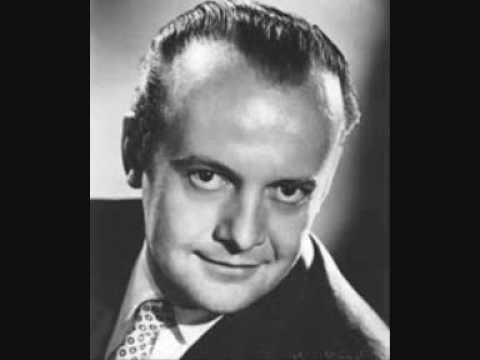
| Tito Gobbi was an admired
operatic baritone. He originally studied at Padua University for a career
in law, but he eventually gave that up in favor of pursuing voice lessons
in Rome with Giulio Crimi. He made his operatic debut in the town of Gubbio
in 1935, as Count Rodolfo in Bellini's "La sonnambula." He was hired at Milan's
La Scala for the 1935-1936 season as an understudy; his first appearance there
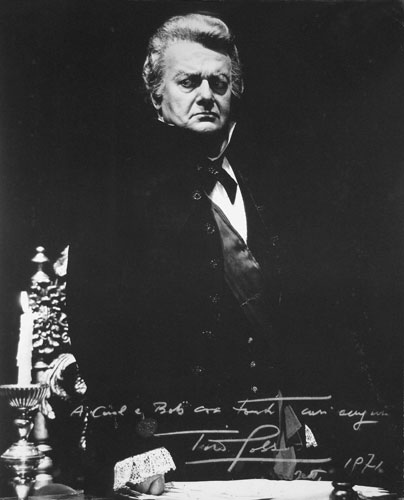
was as the Herald in Ildebrando Pizzetti's "Oreseolo." He won the international singing competition in Vienna in 1936. As a result he began getting improved billing; he sang the role of Germont in "La traviata" at the Teatro Reale in Rome in 1937. In the same year he sang Lelio in Ermanno Wolf-Ferrari's "Le donne curiose," and continued singing secondary roles through 1939 there. He was promoted to primary roles and in 1941 sang Ford in Verdi's "Falstaff" during a visit by the company to Berlin in 1941. Meanwhile, in a guest appearance at Rieti he first sang the role of Scarpia in Puccini's "Tosca" in 1940. This was to become his best-known part. Gobbi made his La Scala debut in a major role in 1942 as Belcore in "L'Elisir d'Amore." However, the performance that made him famous was as Wozzeck in the first Italian performance of Alban Berg's opera in Rome in November, 1942. Fighting raged throughout Italy following the Allied invasions there in 1943, interrupting his career. After the war he began to include international appearances. He first appeared in Stockholm in 1947 as Rigoletto; in 1948 he went to Covent Garden in concerts and to San Francisco to debut as Figaro in Rossini's "Barber of Seville." His London operatic debut was at Covent Garden as Belcore when the La Scala Company toured there. He appeared in Chicago in 1954 as Rossini's Figaro, and debuted at the Metropolitan Opera Company as Scarpia, January 13, 1956. He sang Don Giovanni in Salzburg in 1952 under von Karajan's direction. He took up producing as well, often at Chicago, where he made regular appearances, and producing opera became an ever more important part of his career after 1965, which is when he produced a performance starring himself in the title role of Verdi's "Simon Boccanegra" in London. Although he was particularly well known for his portrayal of Verdi's baritone roles (including Posa in "Don Carlos"), and of Puccini's (Scarpia, Jack Rance, Gianni Schicchi), he had a very large repertory of well over 100 roles, including such rare operas as Malipiero's "Ecuba" (as Ulysses), Teprulov in Rocca's "Monte Ivnor," the Count of Albaforita in Persico's "La locandiera," and operas by Lualdi, Napoli, and Ghedini. He was an excellent actor, had a high degree of musicianship and intelligence, had a flexible, rich, but not large baritone voice, and was at home in a wide variety of parts. He also appeared in 26 movies. He was the brother-in-law of another eminent singer, Boris Christoff. Gobbi retired from the operatic stage in 1979. He published an autobiography (Tito Gobbi: My Life, 1979) and Tito Gobbi and His World of Italian Opera (1984). He left a significant legacy of recorded performances, mainly made in the 1950s and 1960s. ~ Joseph Stevenson, Rovi |
 BD: Could some of these operas stand without the music, just
as straight plays?
BD: Could some of these operas stand without the music, just
as straight plays?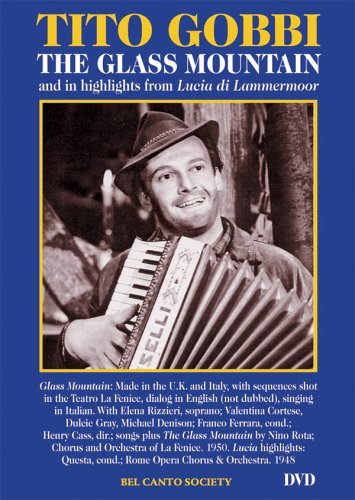 Gobbi: Yes! [Both laugh] Maybe that's a good idea!
But when the decor is too imposing, too much capturing the attention, it
is against the music. First of all we have to serve the music.
Gobbi: Yes! [Both laugh] Maybe that's a good idea!
But when the decor is too imposing, too much capturing the attention, it
is against the music. First of all we have to serve the music.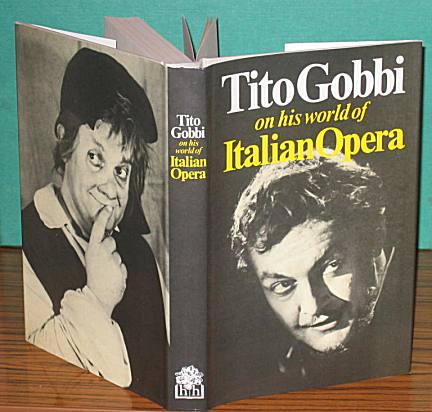 BD: Wasn't there a connection with Rosary College in suburban
Chicago?
BD: Wasn't there a connection with Rosary College in suburban
Chicago? 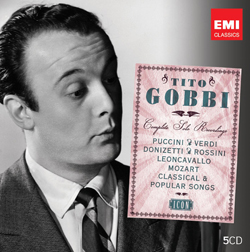 Gobbi: [Pausing to muse a moment] Yes. Making a
record sometimes is a joy when you are transported by a certain impulse...
But some other times, the preoccupation of the microphones, or the switches
up and down... The volume-meters are terrifying. They are like
spying on you, to tell you if you are doing well or not. It's like
eyes pointed on you. You think you can do much better when you listen
to your records; you will never be really satisfied. I have done some
good records, and I like some very much. Some are good enough, but if
I could go back and do it again, I would do it better.
Gobbi: [Pausing to muse a moment] Yes. Making a
record sometimes is a joy when you are transported by a certain impulse...
But some other times, the preoccupation of the microphones, or the switches
up and down... The volume-meters are terrifying. They are like
spying on you, to tell you if you are doing well or not. It's like
eyes pointed on you. You think you can do much better when you listen
to your records; you will never be really satisfied. I have done some
good records, and I like some very much. Some are good enough, but if
I could go back and do it again, I would do it better. BD: What about composers you have sung; for instance, the
lesser works of Giordano or Boito, or people like that. Why do we not
know those so well today? Are they worth producing, or should they
stay on the library shelf?
BD: What about composers you have sung; for instance, the
lesser works of Giordano or Boito, or people like that. Why do we not
know those so well today? Are they worth producing, or should they
stay on the library shelf?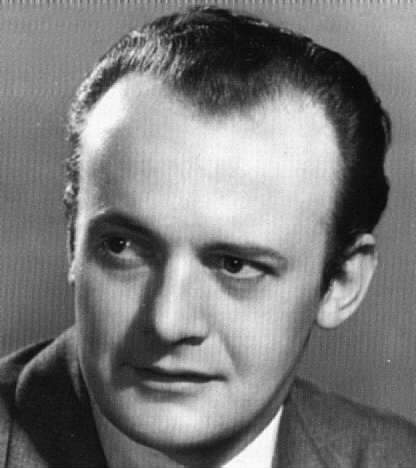 Gobbi: Yes, I would like to, but it will be depending on the
opera house. Here you have seven operas this year. If you have
a theater where they perform every night for one year or ten months, then
it will be really a duty for them to do more works. But I hope also
here that they can find, every season, one less-known opera of good quality
with a good cast. You can't kill Rigoletto
even with a bad singer; it's such a great masterpiece that it will be good.
It can be also much better if you have a good cast or an excellent cast,
but small operas which are out of the repertory need a good personality.
For instance, when I was starting out, we did L'arlesiana and we had Tito Schipa and
Gianna Pederzini! Two big names was a guarantee for the success!
Then maestro Serafin added Tito Gobbi, Gino Bechi, Giulio Neri in this
cast, so we had the chance to start our careers with two big stars, and
the opera was a success.
Gobbi: Yes, I would like to, but it will be depending on the
opera house. Here you have seven operas this year. If you have
a theater where they perform every night for one year or ten months, then
it will be really a duty for them to do more works. But I hope also
here that they can find, every season, one less-known opera of good quality
with a good cast. You can't kill Rigoletto
even with a bad singer; it's such a great masterpiece that it will be good.
It can be also much better if you have a good cast or an excellent cast,
but small operas which are out of the repertory need a good personality.
For instance, when I was starting out, we did L'arlesiana and we had Tito Schipa and
Gianna Pederzini! Two big names was a guarantee for the success!
Then maestro Serafin added Tito Gobbi, Gino Bechi, Giulio Neri in this
cast, so we had the chance to start our careers with two big stars, and
the opera was a success.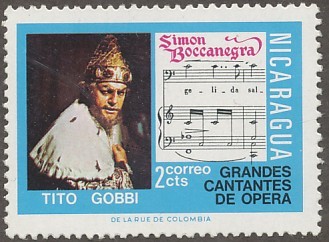 Gobbi: [With flat disapproval] Terrible.
|
Tito Gobbi at Lyric Opera of Chicago 1954 - Barber of Seville (Figaro) with Simionato, Simoneau, Badioli, Rossi-Lemeni; Rescigno Traviata (Germont) with Callas, Simoneau, Lind, Foldi; Rescigno Tosca (Scarpia) with Steber, di Stefano, Badioli, Foldi, Stewart (Angelotti), William Mason (Shepherd Boy); Rescigno 1955 - Aïda (Amonasro) with Tebaldi, Antonioli, Varnay, Wildermann; Serafin Bohème (Marcello) with Tebaldi, di Stefano, Lind, Rossi-Lemeni, Foldi; Serafin Rigoletto (Rigoletto) with Stich-Randall, Björling, Wildermann, Dunn, Krainik (Giovanna); Rescigno Tabarro (Michele) with Ribla, Bergonzi, Wildermann, Turner, Krainik (Lover); Rescigno Ballo in Maschera (Renato) with Cerquetti, Björling, Turner, Foldi, Wildermann; Rescigno 1956 - (Opening Night) Fanciulla del West (Jack Rance) with Steber, Del Monaco; Mitropoulos Andrea Chénier (Carlo Gérard) with Steber, Del Monaco, Lind; Buckley Tosca (Scarpia) with Tebaldi, Björling, Badioli, William Mason (Shepherd Boy); Bartoletti/Kopp 1957 - (Opening Night) Otello (Iago) with Del Monaco, Tebaldi/Koehn, Chabay, Kramarich, Wildermann; Serafin Pagliacci (Tonio, but not the Prologue) with Likova, Del Monaco, MacNeil, Caruso; Bartoletti; Rosing Andrea Chénier (Carlo Gérard) with Tebaldi, Del Monaco, Krainik (Countess); Gavazzeni Marriage of Figaro (Count) with Steber, Berry, Moffo, Simionato, Badioli; Solti Adriana Lecourveur (Michonnet) with Tebaldi, di Stefano, Simionato, Badioli, Krainik (Mlle. Dangeville); Serafin Tosca (Scarpia) with Steber, di Stefano/Björling, Badioli, William Mason (Shepherd Boy); Bartoletti Don Carlo (Rodrigo) with Cerquetti, Sullivan/Björling, Christoff, Rankin, Wildermann; Solti 1958 - (Opening Night) Falstaff (Falstaff) with Tebaldi, Simionato, Canali, Moffo, MacNeil; Serafin Gianni Schicchi (Schicchi) with Moffo, Misciano, Wildermann, Canali; Serafin Pagliacci (Tonio) with Likova, di Stefano, MacNeil, Caruso; Serafin Barber of Seville (Figaro) with Simionato, Misciano, Corena, Montarsolo, Canali; Schaenen Rigoletto (Rigoletto) with Moffo, Björling, Wildermann, Steffan, Krainik (Giovanna); Sebastian Aïda (Amonasro) with Rysanek, Björling, Simionato, Wildermann; Sebastian 1959 - Simon Boccanegro (Boccanegra) with Roberti, Tucker, Mazzoli, Maero, Krainik (Servant); Gavazzeni Ballo in Maschera (Renato) with Nilsson, di Stefano, Kramarich, Stahlman; Bartoletti 1960 - (Opening NIght) Don Carlo (Rodrigo) with Roberti, Tucker, Christoff, Simionato, Mazzoli; Votto Tosca (Scarpia) with Tebaldi, di Stefano, Pechner; Gavazzeni Fedora (De Siriex) with Tebaldi, de Stefano, Scovotti; Matačič Simon Boccanegra (Boccanegra) with Tebaldi, Tucker, Mazzoli, Cesari; Gavazzeni 1962 - Tosca (Scarpia) with Crespin, Zampieri, Corena; Cillario Marriage of Figaro (Count) with Della Casa, Capecchi, Streich, Berganza, Corena; Maag 1963 - (Opening Night) Nabucco (Nabucco) with Mastilovic, Lo Morena, Christoff, Wildermann, Cossutta (Abdallo); Bartoletti Otello (Iago) with Jurinac, Vickers/Uzunov, Vozza, Cossutta (Cassio), Wildermann; Bartoletti 1964 - Don Carlo (Rogrigo) with Gencer, Tucker, Ghiaurov, Cossotto/Bumbry, Marangoni; Bartoletti Tosca (Scarpia) with Crespin, Tucker, Tadeo; Bartoletti 1965 - Simon Boccanegra (Boccanegra and Director) with Ligabue, Cioni, Ariè, Cesari; Bartoletti 1966 - Otello (Iago and Director) with Kabaivanska, Vickers/Craig, Roggero/Cvejic, Lorenzi, Wildermann; Sanzogno 1968 - Falstaff (Falstaff and Director) with Kabaivansak, Malagù, Dominguez, Mittelmann, Garaventa, Andreolli; Sanzogno, Zeffirelli (Production) 1969 - Don Giovanni (Giovanni and Director) with Watson, Ligabue, Evans, Kraus/Garaventa, Raskin; Leitner Barber of Seville (Director) with Horne, Bruscantini, Garaventa, Evans, Vinco; Pritchard 1970 - Gianni Schicchi (Schicchi and Director) with Marimpietri, Garaventa, Washington, Andreolli; Bartoletti 1971 - Tosca (Scarpia and Director) with Martin/Kubiak, Bergonzi, Tajo, Giorgetti; Sanzogno Barber of Seville (Director) with Horne, Prey, Garaventa, Malas, Ferrin, Zilio; Bartoletti 1972 - Ballo in Maschera (Director) with Arroyo, Tagliavini, Milnes, Baldani, Kozut, Ferrin, Voketaitis; Dohnányi 1973 - Tosca (Scarpia and Director) with Kubiak, Tagliavini, Tajo, Giorgetti; Bartoletti 1976 - Ballo in Maschera (Director) with Ricciarelli, Carreras, Bruson, Wolff, Wise, Casarini, Voketaitis; López-Cobos Tosca (Director) with Neblett, Pavarotti, MacNeil, Tajo, Giorgetti; López-Cobos 1977 - Maria Callas Tribute (Speaker) with Neblett, Kuhlmann, Vickers, Little, Stilwell; Fox, Ross; Bartoletti, Fournet Barber of Seville (Director) with Ewing, Stilwell, Alva, Desderi, Montarsolo, Hines; Bellugi 1979 - Andrea Chénier (Director) with Marton, Domingo, Bruson, Kuhlmann, Voketaitis, Gordon; Bartoletti 1982 - Tosca (Director) with Bumbry/Marton, Luchetti/Domingo, Wixell/Nimsgern, Tajo, Kavrakos, Cook; Rudel -- Names which are links refer
to my interviews elsewhere on this website.
|
This interview was held in a dressing room backstage in the Civic
Opera House in Chicago, on October 7, 1982. A small portion was included
in an article I wrote for the WNIB Program Guide one year later.
Portions were used (along with recordings) on WNIB the following year, and
again in 1987, 1988, 1993, 1997, 1998 and 2000. The transcription was
made and posted on this website in 2011.
To see a full list (with links) of interviews which have been transcribed and posted on this website, click here. To read my thoughts on editing these interviews for print, as well as a few other interesting observations, click here.
Award - winning broadcaster Bruce Duffie was with WNIB, Classical 97 in Chicago from 1975 until its final moment as a classical station in February of 2001. His interviews have also appeared in various magazines and journals since 1980, and he continued his broadcast series on WNUR-FM, as well as on Contemporary Classical Internet Radio.
You are invited to visit his website for more information about his work, including selected transcripts of other interviews, plus a full list of his guests. He would also like to call your attention to the photos and information about his grandfather, who was a pioneer in the automotive field more than a century ago. You may also send him E-Mail with comments, questions and suggestions.