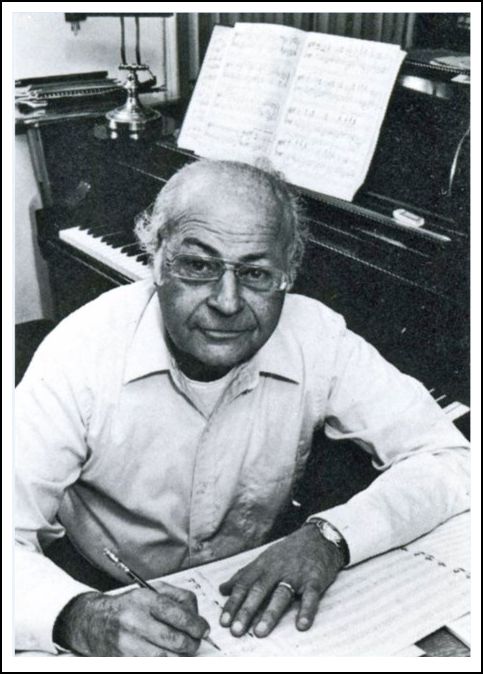
Composer / Piano Technician Leon
Levitch
A Conversation with Bruce Duffie
Leon Levitch was born August 29, 1927,
in Belgrade, Serbia. His parents both played piano, and he began composing
music at an early age.
During World War II, he and his family were sent by Italian authorities
to a concentration camp north of Milan. Levitch found a piano in the
camp, and began taking lessons from a fellow prisoner named Vera Levenson.
In 1943 his family was sent to the Ferramonti camp, where in 1944 they
were among a group of nearly 1,000 refugees chosen to go the Fort Ontario
Emergency Rescue Shelter in Oswego, NY,
After the war Levitch pursued a career in music, briefly attending Los
Angeles City College before earning a master of arts degree in composition
from the University of California Los Angeles. He became a well-known
composer. He died November 26, 2014 in California.
|
Each of us is a product of our heritage and upbringing. No
matter how we turn out, there is a starting point, and we must use our
talents and resources to make the most of our lives. Sometimes, this
history is full and rich and encouraging. Other times, it is filled
with pain and terror at every turn. Despite that, some manage to survive
and eventually thrive. What you are about to read is one such story.
Leon Levitch is a Holocaust Survivor. Being a teenager during
the war, he and his immediate family were among the lucky ones to get to
America and continue their lives. Leon was a pianist and a composer
from early on. Of necessity, he also learned how to tune and repair
pianos, and eventually rose to the top of that unsung profession.
In June of 1988, Levitch was coming to
Chicago, and since the radio station I worked for, WNIB, Classical 97, was
promoting the appearance of Elie Wiesel, I gave Leon the contact information
so he could attend, and also meet with the Nobel Prize winner. During
that trip, Leon also visited my home studio, and we had a long and wonderful
conversation.
Portions of that chat aired several times
on WNIB, and I also produced and narrated a special program which ran
for two months as part of the entertainment package aboard United Airlines,
and Air Force One, the Presidential jetliner. Now, in 2026, I am
pleased to present the entire interview.
Needless to say, the focus of our topics was music, but he also gave
many personal details about his early life and experiences. It was
fascinating to hear all about them, and we are all very lucky that he
was able to live a full and rich life.
Bruce Duffie: You are both a composer and a
keyboard technician?
Leon Levitch: That is correct.
BD: Do you get enough time to compose?
Levitch: That is the sixty-four-dollar question!
[Both laugh] One just has to make time. One of my
big heroes, at least in lifestyle though not always in music, but I am
quite a fan of Charles Ives because he too could not or did not make a
living from writing music. I understand he was an insurance agent,
or owner of an insurance company, so he was, for practical purposes, an
‘amateur’. So I have had to consider myself on those terms, at least
when it came to official designations. Very few composers in our century
really make a living from writing music. We’ve had examples in the
past, like Borodin, and Mussorgsky. Rimsky-Korsakov was an officer
in the army. So the term bothers me.
BD: Should society make it so that a composer
can make a living just by writing music?
Levitch: People have differing opinions on that.
I often wonder what kind of a composer I might have been if I had had
the chance to go through the normal procedures from early childhood.
I have always felt cheated because of the Holocaust, and because of what
it has done to my education, let alone to what it has done to some more
important than to worry about one’s education. But when Hitler arrived
in Belgrade, I was about 13 years old, and I had just restarted my musical
education. My father was very opposed to it in my earliest days,
and so I became very fiercely involved with my musical education. Then
it had to be stopped again, and again, and again, until I finally landed
in Los Angeles. There was an intermediary stop in Oswego, New York
when we arrived there in August of 1944. But my serious pursuit of
music as a profession did not really materialize, or was not even possible
to be thought about, until we were finally resettled in the United States,
in California. This was when I decided that music is what I wanted
to do, come hell or high water. Hell having already arrived, and fortunately
was behind me! So I was at the high water [laughs], which was the
Pacific Ocean. I was fortunate enough to be recognized by a fellow
refugee, who was more fortunate than myself, having been able to come earlier.
This was Jakob Gimpel. He was the first musical personality
in the twentieth century. He was a very, very great pianist, and he
offered me a scholarship when we arrived. So I started studying, and
continued to study the piano with him. He also referred me to another
fellow refugee, Gerhard Albersheim, who now lives in Switzerland. He
began to teach me theory and harmony, but that did not last very long because
I was summarily drafted into the army. That was an interruption that
set me back, not so much educationally but emotionally. I was just
devastated by having to interrupt again my musical activities. Fortunately,
that turned out to be a mistake somewhere in the department of the army.
Right after basic training, both my brother and I were drafted simultaneously
and placed in the same company, which we later found out was a practice that
was strictly forbidden during the War. But in 1947 we were about to
be shipped off to Korea, when the telegram arrived from the War Department
in Washington, stating that the Levitch boys were summarily to be moved to
a separation center, and be given an honorable discharge. This had
a side benefit, in that we were granted the G. I. Bill of Rights. So
it helped with the first years and three months of my college education,
for which I was very grateful. We were not yet citizens when
we were drafted, but that sped up our naturalization. So we didn’t
have to wait the customary five years. We became citizens in 1950 or
1951. The year and a half that we spent in the War Relocation Center
in Oswego, New York did not count. But once that was over, I came back
and continued studying. Later on, I was given a scholarship to go to
Brandeis-Bardin Institute, which at the time had also an Arts Institute,
which was headed by Max Helfman. He was quite a figure in Jewish music,
and he had encouraged me greatly. He started this Arts Institute, which
did not last very long. I understand that maybe it lasted two summers,
and that was the end of it. But he was a composer, and quite an authority
on liturgical music and was very encouraging. Unfortunately, he
died not too long after that [1963]. Other encouragement came by
and by. I met Louis Gruenberg, the composer of the opera The Emperor
Jones. He was quite an imposing figure. He had worked in
Hollywood, and was invited to be one of our teachers. I also met
Ernst Toch there, and Mario Castelnuovo-Tedesco, as well as Erich Zeisl,
who became my first teacher. He was a former composition teacher,
and after about a year and a half or two years, I won a scholarship to
study with Castelnuovo-Tedesco, which was sponsored by the Los Angeles
Conservatory. That relationship lasted till the end of his life.
BD: When you did you make the decision to go
from playing the piano to composing music?
Levitch: This was a decision that I did not make,
because from my earliest childhood I wanted to be a composer. But
I considered composing to be such a lofty, unattainable profession or
activity that I was determined that I had to at least become a master of
an instrument before I could even dream of such a thing as becoming a composer.
This notion I acquired from reading. My father was a very musical
man. He played the piano and the violin, and he loved to read. He
was self-taught on both instruments. He was a pharmacist and a poet,
and he would play the piano or sometimes the violin in the evening. He
loved to read through Beethoven Sonatas and Chopin Waltzes, and on the
piano was a thick volume of Beethoven Sonatas. There was a lot written
about Beethoven in the Preface, and that is where I first discovered what
a virtuoso he was on the piano. So that is where I got the notion that
if I ever wanted to be a composer, I would first have to really master an
instrument. I always improvised at the piano, and played things by
ear that I heard. I’ll never forget the first time when my father took
me to see a ballet, which was Swan Lake. When I came home, I
played it on the piano. I must have been about six or seven at that
time, and they were all startled. My mother was the one who was very
intent in getting me started. She had a great love of music.
She never could pursue it, and so it was one of those vicarious things that
often parents do to their children, or for their children, or against their
children [Laughs]. In my case, it was very positive, and she then encouraged
me to have piano lessons. So did my younger brother who was three.
My older brother took violin lessons, and my sister, who is the youngest,
also started on the piano. But I was the only one who really stuck
to it, so much so that my father threw out the piano teachers. It’s
a very peculiar and paradoxical thing that sometimes parents do. He
was concerned. He didn’t want me to be a sissy. He wanted me
to go out and be like all other
‘normal’
kids. He was very concerned when he saw that I was involved with
the piano, and so he discontinued the piano lessons, and I was very miserable.
BD: This was when you were still in Belgrade?
Levitch: Yes, quite a few years before the
whole world came tumbling down. Hitler came in 1941, and in 1939
or 1940, my mother restarted both of us on the piano with a wonderful
teacher. I visited her in 1970, and it was some reunion! She
had remained in Yugoslavia throughout the War, and became quite prominent
under Tito. She became a children’s opera composer, and was given
many awards for this during the time of Tito. We did correspond
a little bit after I returned home, but we lost touch. But I was
very grateful to have had the opportunity to see her at least once after
the Holocaust.
BD: [Coming back to the narrative] We
have gotten to where you were studying with Mario Castelnuovo-Tedesco.
Levitch: Yes. By the time I had started
working with Erich Zeisl and Mario Castelnuovo-Tedesco, I had already
given up the idea of being a pianist, because I was convinced that it
was not absolutely necessary in order to be a composer. I was still
studying with Jakob Gimpel at the time, and it was hard for me to make the
time to practice. I was going to school, and tuning pianos, and time
was at a premium. I decided that I would have to give up something.
I couldn’t give up school, so I stopped being a pianist per se, although
I still love to play the piano. It was one of my first loves in music,
because that was the instrument I was able to control. It was something
I could extract music from. I then concentrated strictly on the music.
After coming back from the army, I went to the Los Angeles City College,
and got my A.A. in Music, and I then decided I would go into the teaching
profession. I was hoping this would still allow me time to continue
with my music, so I continued at what is now called Cal State Los Angeles
University, which was then called the Los Angeles State College. It
was on the same campus as the City College. The University had just
started, and I got my B.A. in Elementary Education. All along I was
studying with Zeisl, and between 1952 and 1953, I started studying with
Castelnuovo-Tedesco.
BD: What did you learn from him?
Levitch: From him I learned mostly to not concern
myself with being somebody else. I learned from him to just stop
torturing myself with the fact that I did not fit into the contemporary
mold. [Laughs] He didn’t either, but when he encouraged
me not to worry about it, that was the most valuable thing I learned,
besides a whole world of form, and harmony, and orchestration, and counterpoint.
He really took me forward. I had already done all these pieces of
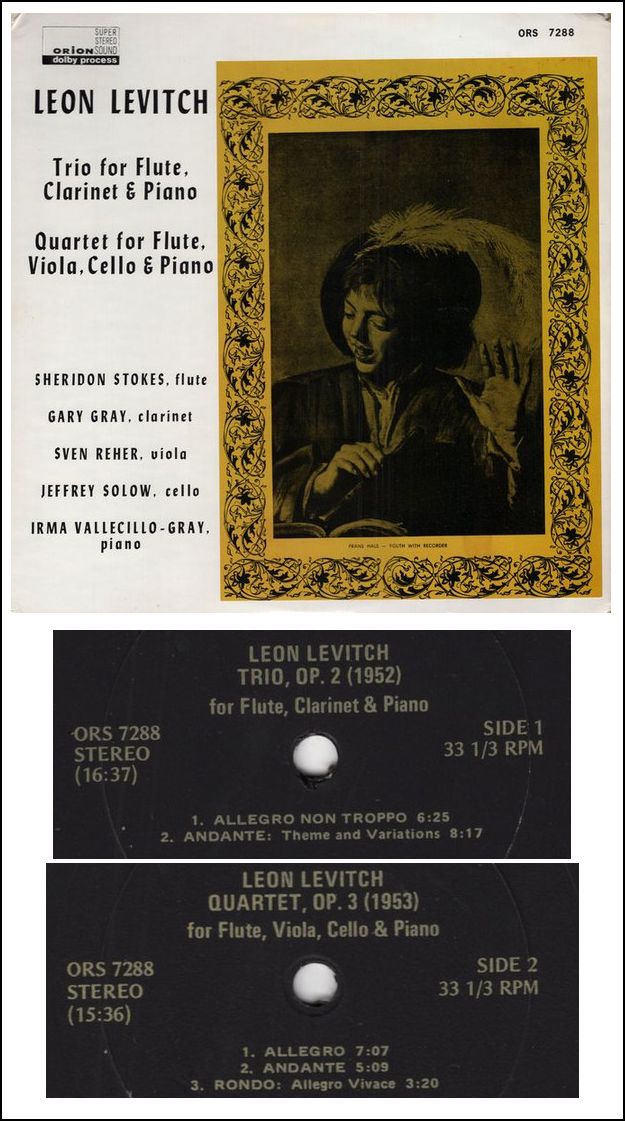
counterpoint with Zeisl, and with him I did my Opus 1, which is the Flute
Sonata. This was the first really public recognition of a struggling
young composer.
BD: I’m surprised that Opus 1 isn’t a piano
piece.
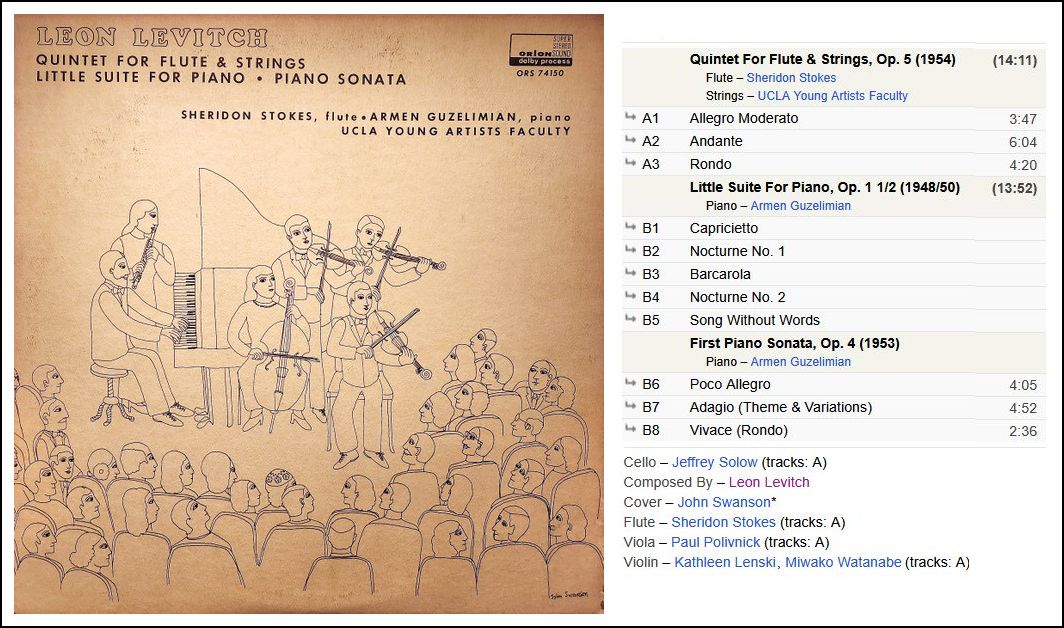
Levitch: Well, there were some piano pieces before
that, which I did with Zeisl, and which I didn’t dare call a full opus.
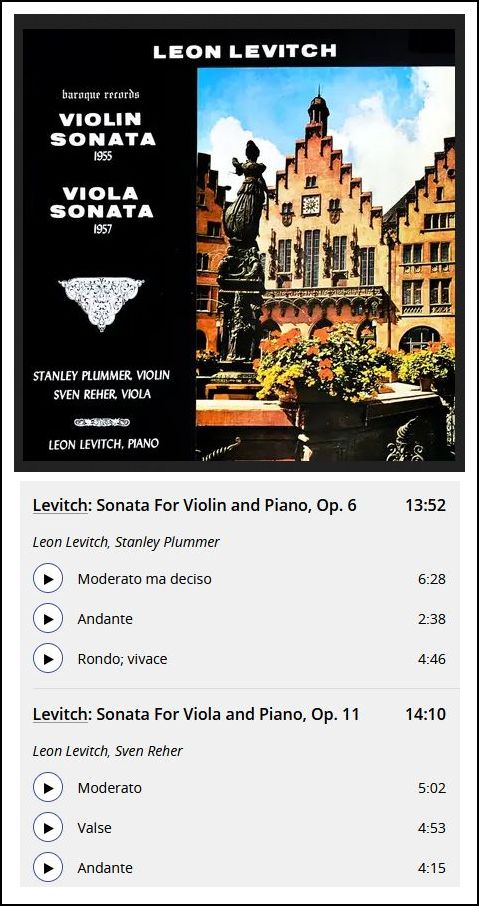
That became the Little Suite for Piano, which has five piano
pieces, but that was long before the Five Easy Pieces existed. I
called that Opus 1-and-a-half. [That disc is shown above.]
After that, I felt that the Flute Sonata deserved a full
opus number, and it was the piece that I submitted to the LA Conservatory,
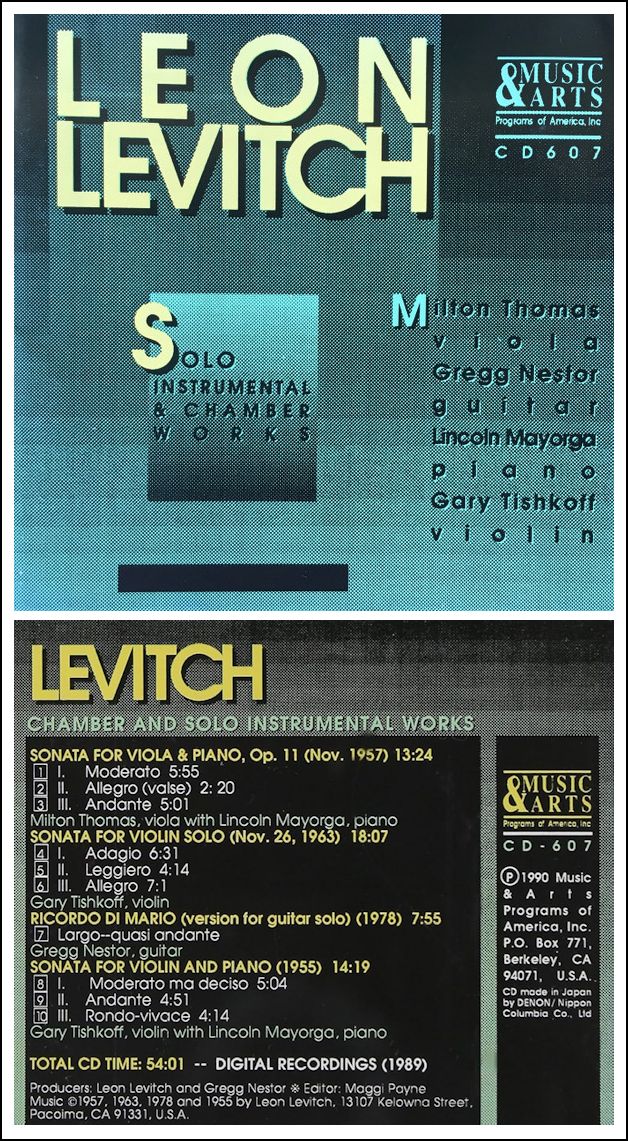
which brought me to Castelnuovo-Tedesco. By the way, the design
of that cover is my own. I did that in my teacher-training. This
was a finger painting. [That recording is shown at right.]
BD: At that point you were teaching school?
Levitch: No, I never got that far. I
had a very short elementary teaching career, which was in a private school
for emotionally disturbed children. For some reason, the school was
closed and that was the end of it. When I wanted a public school
teaching job after I graduated in 1952, I couldn’t get one, and that was
because I had too much of a foreign accent. [Laughs] This was
the reason given to me why I was not employable as an elementary school teacher,
and that created real havoc with me. I was desperate. I wanted
to be self-supporting in a better way. I started piano tuning very
early in my life. As a matter of fact, my first contact with that
art or craft was in the concentration camp of Ferramonti in Italy.
Certainly, it was no picnic to be in a concentration camp. Italians,
fascism and all might take your life, liberty and property from you, but
it will never take music away from you. We were about 2,000 concentration
camp prisoners of Mussolini, and we did have a piano. It was a broken
down, straight-strung grand piano that one of our inmates, who was a technician
by profession and was also a Yugoslav, kept going for us. He had
had his training in Vienna, and in the midst of the darkness that enveloped
Europe and all of us, this music room was the one light that provided hope
and a real desire to live and to survive. Tools were very scarce.
I had to mute the strings with my fingers so that he could tune the unisons.
Later, after the Liberation, we were all dispersed, and the allied
military government was shuffling us back and forth from one camp to the
other, which were now administered by the allies. When we were
settled, we didn’t know how long we were going to be there. Weeks
passed and I had no piano. I was desperate, and so went through
the town looking to find a piano somewhere. I entered a saloon, like
a tavern, an osteria, and in a corner covered with all kinds of junk
I saw something that looked like a keyboard. I started digging it
out, and after I had dug enough, I saw that it was indeed a full-sized
keyboard. The keys seemed to work, but the sounds emanating from it
were horrible. I immediately went to see Il Patrone [the patron
or owner], and I begged him to let me have it. He said, “Wonderful!
We were just going to use it for firewood. You are welcome
to have it.” So, I went and hired the mule and brought this monstrosity,
this wreck of an instrument to our camp, and put it in the dining hall.
Everybody was flabbergasted, especially my father who said I was
crazy! I had no tools, so I took off a door knob, and saw that it
would fit over those old oval tuning pins. There were a lot of strings
missing, especially in the bass. I don’t know how I was able to fix
it, but I did it. I moved up a few of the bass strings, so it had not
such a big range, but it didn’t have a hole in the middle. I managed
to create a reasonable range, and I tuned it. A distant relative of
ours, who was in the same camp with us, played on it. She was a wonderful
pianist, and she now lives in South America. Her name was Gena, and
she played Chopin on this piano. Everybody was just floored. They
couldn’t believe it. But alas, this didn’t last. We were there
for maybe a month, and they came for us to go to America.
BD: Why did you choose to come to America rather
than go back to Belgrade?
Levitch: I didn’t choose to come to America.
My father chose to come to America. Anyway, the war was still raging,
and Yugoslavia was not liberated. This was in July of 1944, and the
War didn’t end until 1945. We didn’t know what was going to happen.
Some people were being smuggled into the Exodus already, and my
father didn’t want to take more risks. There appeared an announcement
that people could put in their names and hopefully be selected to come
to America. My mother had a brother who lived in America before
Hitler came, and we desperately tried to get an entry visa, or any kind
of a visa. In part, we owe our survival to the uncanny clairvoyance
that my father had. He read Mein Kampf cover to cover in the
original German, and he kept translating it to us, because there was no
translation of it. From then on, he was seized with Germanophobia.
He did not have a greater Germanophobia than Hitler had Judeophobia,
but otherwise our family would not have survived. Most of his immediate
brothers and sisters did not survive. My father comes from a large
family. There were ten of them. We would have meetings at
our house just before Hitler came. The Jewish community was very
scared, however they never dreamt that Hitler would come, and that he was
to do the things that he said he would do. My father would tell them
to get out by whatever means possible. We tried desperately, but
in spite of the fact that my mother had her own brother living in the United
States, her visa was not granted. So when we saw that the end was
near, my father took us away to a little resort camp next to Belgrade.
This is where we awaited the Nazis. After that, our flight never
ended. We did return to Belgrade after the Occupation, but only for
a brief period until we could get the false papers that we needed in order
to exit Belgrade and get into an Italian occupied zone of Yugoslavia. Finally
we ended up in Albania, and that is where we gave ourselves up to the Italians,
to Mussolini’s forces, who promptly interned us. But, thank God, they
did not deliver us back to the Nazis.
* * *
* *
BD: When did you start piano-tuning for a living?
Levitch: I did that immediately when we came to
Los Angeles. Actually, I started really practicing tuning while we
were in the Oswego Camp. This was an ideal basic training for me
in tuning as well as in music... not so much in music because I had to go
to the high school, and I had to reactivate my formal education. I
had to learn the language, although I did have a few English lessons while
we were in the camp for a month. Oswego was an abandoned army camp,
and it had loads of old broken-down upright pianos. I managed to acquire
an antiquated square-tipped tuning hammer that was for older style pins.
So I had to send it out to some blacksmith in Oswego. I took
off a tuning pin, and asked them to hammer it into that shape so I could
use it for the more modern uprights. Ironically, after word spread
in Oswego that there was a young chap among the refugees who could tune
pianos, I had destroyed the most appropriate tool that I would have had
to use when I was tuning a piano in town, because most of those pianos were
square grabs! [Both laugh] So, I made do with what I had, and
this is where I really continued to teach myself how to tune pianos. I
did pretty well, because we had a lively musical life in the camp. Then,
when we came to Los Angeles, I immediately acquired a normal star-tipped
tuning hammer, and I spread the word that I was able to tune pianos. I
started tuning grand pianos. I never saw a modern grand piano in
Oswego in the camp. There was no such thing. We had these old
uprights, but thank God for them because I really got my feet wet.
BD: It affected your craft?
Levitch: Yes. I was tuning pianos for a
living throughout my college career, and also while I was still in high
school. I later applied to join the Piano Technicians of the USA.
It was just beginning to get organized. The parent organization
of the current Piano Technicians Guild was The American Society of Piano
Technicians [ASPT], and I joined that organization in 1953.
BD: How many members were there then?
Levitch: There were very few members in Los Angeles,
maybe twenty-five or thirty. But we are a national organization.
As a matter of fact, we are an international organization. There
is an international body which is called the International Association of
Piano Builders and Technicians, the IAPBT. Other organizations belong
to the international organization, and we already have had two international
conventions. The next one is going to be next year [1989].
The last one was last year in Toronto. The international ones are
bi-annual, and the national ones are every year. This year it’s in
St. Louis, and I’ll be there. I’m actually a Charter Member of the
Piano Technicians Guild, and I’m very proud of it!
BD: In all of this time, were you still doing
a little composing?
Levitch: Yes. All this time I was going to
school, and I was studying with Zeisl and with Castelnuovo-Tedesco. Later,
in 1960, I won a scholarship in Aspen to study with Darius Milhaud.
BD: You’re composing and you’re working as
a piano technician. Is there really much difference between that
and composing and working as a teacher of music?
Levitch: A teacher of music, I would say, might
have been more within the scope.
BD: But, as opposed to Charles Ives, who was
composing but working as a business man.
Levitch: Yes, there is some difference. For
instance, only later was I able to really integrate the two arts.
In the beginning, I loathed every moment that I was away from the piano
as a pianist or a composer. I looked at it as a necessary evil, and
while this was going on, my piano playing completely stopped. My
composing wasn’t really going that well, and my tuning wasn’t very hot
because I had the wrong attitude. Only after I changed my attitude,
which took some doing, did everything fall into place. Then, everything
began to be complimentary rather than working at cross purposes.
I was able to integrate all these activities, so that when I finally became
an instructor of piano technology at UCLA
— which is something that
I started myself in 1971
— I began to look at piano tuning as a
para-musical art, and that is what I try to impart to all my students.
I was very fortunate to have a number of students that have done
very well.
BD: Are the students who get into piano tuning
and technology, musicians?
Levitch: Some are and some are not.
BD: Does it matter?
Levitch: It certainly helps. If they have
a love of music, and if they have a good ear, it all helps. This
is another thing that I tried to bring about at UCLA, but did not succeed.
However, I am very happy to know that my very dear colleague, Owen Jorgensen
succeeded in creating a department of piano technology at East Lansing,
Michigan. It is now possible to get a B.A. in Piano Technology. We
consulted for a long time before he was able to succeed, and I was delighted
that he did because it has now elevated piano tuning to the level of para-musical
art, which was my idea in the first place.
BD: Are you the Godfather of piano technology?
Levitch: [Smiles] Well, I would say
that we both had very similar ideas. He liked the idea of para-musical
art, and he treats his students the way I did mine. It’s lucky
that this is now an established chair in a university, and I hope that
in the near future many other universities will acquire this as a legitimate
curriculum.
BD: What advice do you have for a young person
who wants to be a piano technician?
Levitch: First of all, they must love
music. That’s the first prerequisite. They must have a good
musical background. The curriculum at East Lansing will tell you
everything, because it’s really embodying all these ideas that I have about
it. They should also have a good mechanical aptitude, and they should
have a lot of patience. Naturally, a good ear is certainly a requirement
in spite of the fact that we have developed electronics that are mind boggling.
We had a long struggle in the Guild integrating these electronic devices
with the aural tuning techniques. This was one of the major accomplishments
of the Piano Technicians Guild, to be able to integrate these two ideas.
There was a great deal of resistance in the Guild itself about the
electronic devices, but we had a very fine electronics engineer by the name
of Al Sanderson, who has invented the Accu-Tuner. He’s constantly
improving it and refining it, but how does one create these gadgets?
It all comes from the human ear to begin with. So we were able to
stem the public’s distrust of technicians who use these devices, and also
their distrust of those who don’t use them. Now we have a standardized
test which is done before anyone can become a member of the Piano Technicians
Guild. Their skills have to be tested, so we test them electronically.
But any applicant can take the exam. He can tune a piano either completely
aurally, or with the aid of an electronic device, but in the end whatever
he has done is calibrated electronically. During the exam he is allowed
to challenge the machine, and through very ingenious devices, we can come
to an agreeable decision as to whether he was correct or the machine was
correct.
BD: [With mock horror] You mean, the machine
can be wrong???
Levitch: [Laughs] Yes, sometimes. They
have to be properly calibrated. There’s a lot of things that can
go wrong in the actual printout or readout of the machine. Therefore,
each applicant has the opportunity to question the machine. Then
there are various tests or checkpoints which are brought into play. To
my knowledge, there’s never been a test that was totally disqualified.
In other words, there was always an agreement between the applicant
and the grade that he received. So, that was a big breakthrough in
our profession, because now we are able to control the quality of craftsmanship
that our members have.
BD: Is a career in piano technology a satisfying
one, and a rewarding one?
Levitch: Very rewarding. For me especially
it was, because I was later able to really integrate it into my total
musical life, so that after a certain period of time, by the late 1950s
or early 1960s, it was all one piece. The only problem is time, but
if you can transfer your creativity, it can work out. After a certain
time, I never thought that I was not making music when I was tuning or
working on an instrument in whatever capacity. That was a great comfort
to me, and also a source of nourishment both physical and spiritual, because
to be able to tune a piano, especially if you are doing it aurally as I did
most of my life, you must be in a state of complete relaxation. It
is impossible to tune a piano and get away with it if you’re tense.
It’s just like it’s impossible to play a piano if you’re tense, or write
music if you’re tense, or to do anything productively and creatively if you
are not in this mode of relaxation.
BD: Is that the secret of life, to relax?
Levitch: Definitely. They have recently come
out with statistics, naming the piano tuning profession as one with the
least tension. The delicate balance between tension and relaxation
is really the most universal and the primeval. It is at the very base
of all meaningful existence, because if we have too much of one and too
little of the other, we become a sloth. Or, if we have too much of
the other and not of the tension, or too much tension, then we become maybe
rock stars. [Both laugh] Another thing that I have often wondered
about myself, is that I was reproached by many contemporary composers of
my generation. For some reason, I regretted that I have been unable
to assimilate what is normally understood as being the ‘American idiom’.
I don’t know why this happens, or how it happens, but my ‘style’
was probably formed very early in my creative life, and I must say that
it has never changed.
BD: This is the style of writing tonal music?
Levitch: Yes, but just writing tonally doesn’t
per se make a ‘style’. I
have never consciously striven for a ‘style’.
* * *
* *
BD: When you’re writing a piece of music, are you
in control of the pencil, or is that pencil really in control of you?
Levitch: Again, that is a very important question.
Many people write music, and for every person who writes music, the moving
force is different.
BD: What is the moving force for Leon Levitch?
Levitch: The moving force for Leon Levitch is
the gut. My catalogue is very sparse. My opus numbers are
hardly out of the teens. In the past, I could not and did not put
pencil to paper unless I absolutely had to. It was always primarily
an emotional necessity, and lately these necessities have become fewer.
Whether that is a sign of decline or a temporary period, I don’t
know, and I’m not going to wrack my brains trying to find out. All
I know is that I only write music when I need to, and I must.
BD: Then let me ask a big philosophical question.
What do you feel is the purpose of music in society?
Levitch: In my view, the purpose of music in society
is to communicate with other human beings in a nonverbal fashion, and
to share emotional states of one’s spiritual and existential being. Music
will communicate things and emotions and feelings or ideas that cannot
be communicated in any other way, at least for that person. There
are tremendous phenomena such as André Previn and
Leonard Bernstein, and all these incredible geniuses who are so facile
in so many ways, which is very enviable. But not everyone is endowed
with these multifaceted capacities and talents, and so one must try to
do best what one is capable of doing. I am often green with envy
when I see youngsters who have incredible techniques in simply handling
the orchestra, and simply being virtuosos as far as I’m concerned.
There are virtuoso pianists, violinists, and singers, but there are also
virtuoso composers. I know I’m not one, but that is not the point.
Virtuoso or not, the point is to ascertain whether what one person creates
really makes an impact on the general music-loving public, or does it make
them bored and run out of the hall. It can do all kinds of things.
The important thing for me is to see, in a small way at least, a mirror
of the emotional impact that was the emotional state that impacted me when
I was writing. To see a little of that coming back from the public
would then tell me that yes, I am justified in doing this, because when
I was doing this, I was moved, and therefore I had at least a chance to
move other human beings, and therefore communicate with them on a higher
plane, not verbally, not materialistically but maybe in a kind of spiritual
way.
BD: What do you expect of the public that
comes to hear one of your pieces?
Levitch: I expect them to be honest. I expect
them to tell me if they are bored, if they are angered, if they like
it, if they don’t like it, and if they are moved. I expect them to
be honest in the same way I was convinced when I was sitting down and putting
notes on paper.
BD: Have you basically been pleased with
the performances you’ve heard of your music?
Levitch: Most of the time, yes. I would say maybe
I might have had one performance, the latest, which I wasn’t very pleased
with myself. Something is lacking, and maybe if I had had a better
performance, I would be more favorable to myself and to the audience. But
I have never yet had an experience where my work has left people indifferent.
BD: Will you go back and tinker with this
latest piece a little bit?
Levitch: I may. It was suggested that I rewrite
it for a different instrument. It’s a short piece. It’s called
Song for Bass Clarinet and Piano. It was a commissioned
piece, and it had one performance, which was bad. But I have
been blessed with hearing all of my music for the first time by crass
amateur orchestras and groups of musicians [laughs], but I would much rather
have those than none at all. I feel that I was blessed because there
are so many composers. A couple of years ago when I was in Florida
at the Atlantic Institute for the Arts, I found out from none other than
Gunther Schuller,
who is master artist, that in the United States there are at least 35,000
legitimate well-trained people who call themselves composers!
My mind was boggled, and then he asked how many of these 35,000 do you
expect to even get a small public’s ear, let alone the large public’s
ear? When he said that, I really considered myself extremely
fortunate, because in spite of the fact that I had no so-called career
as a composer, and I did not make my living as a composer, I did manage
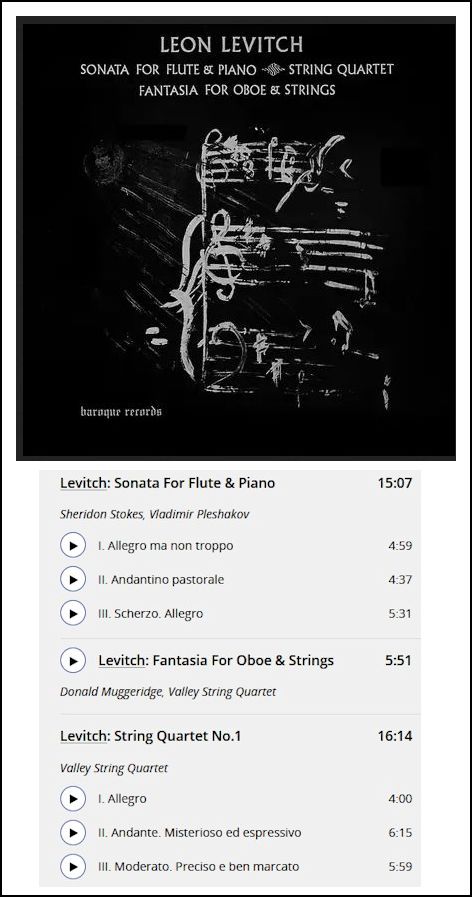
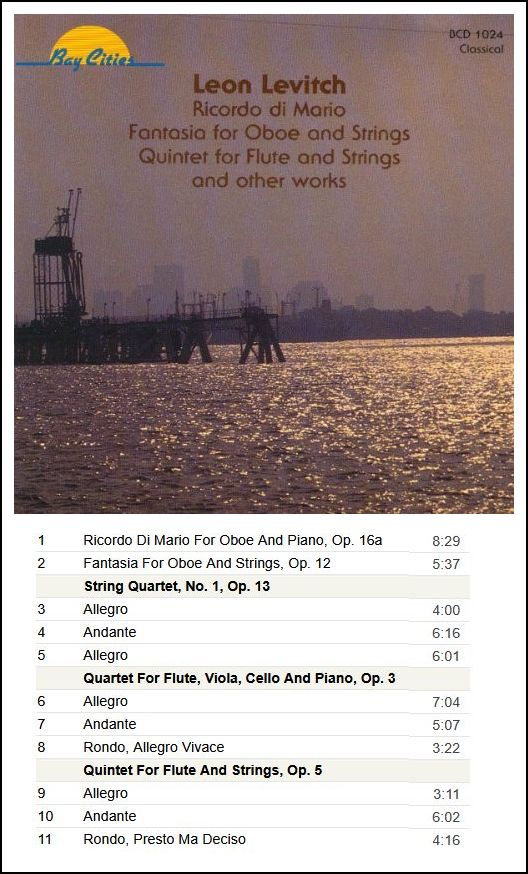
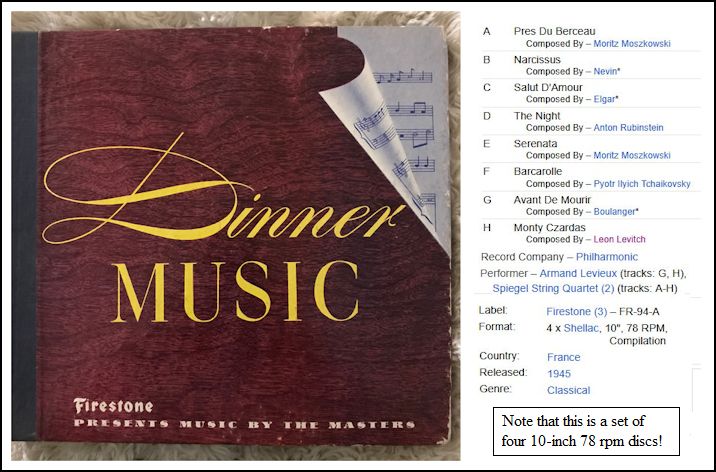
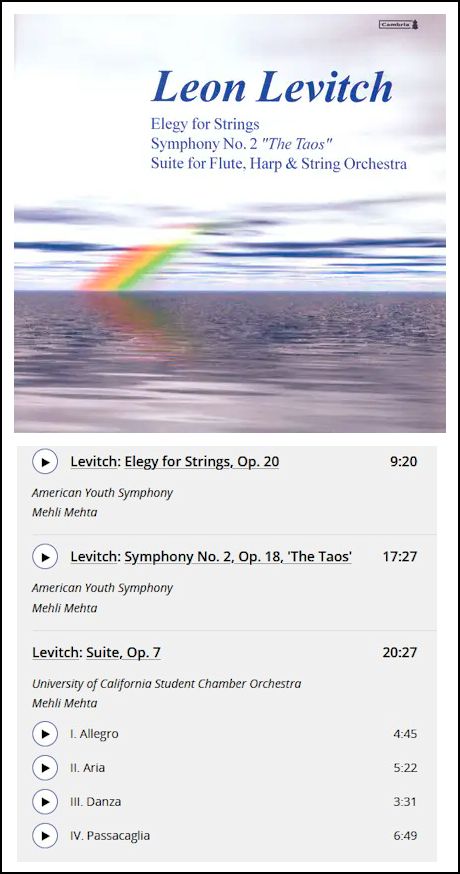
to have five record albums out, and another CD is coming. The two symphonies
which I managed to compose in my lifetime so far, have both been accepted
by Carl Fischer into their symphonic library catalogue. So I think
that I have done pretty well for a piano tuner at least! [Both laugh]
BD: Are you a piano tuner, or are you a composer?
Levitch: I’m both. I am a piano tuner-technician,
I am a composer, and sometimes even a bad pianist, but I still have
hopes that maybe the time will come when I could devote more of my time
to the composing aspect of music-making.
* * * *
*
BD: Let me ask a question about balance. In your
music, or music in general, where is the balance between the artistic
achievement and an entertainment value?
Levitch: That is a very delicate balance. All
art also entertains us. The only difference between art and entertainment
is the level of it. There’s cheap entertainment, there’s vulgar entertainment,
and there is more graceful entertainment. There’s entertainment
that borders on spirituality. I could hardly consider myself listening
to Mahler as being entertained. Yes, I’m engaged with my mind, as
well as my emotions and my spiritual being. Yes, there is an entertainment
element in all music and in all hearts, but that is only in the service
of the higher values.
BD: Where does your music fit into that?
Levitch: Who am I to judge my music? [Laughs]
The final judgment on one’s creative life belongs to endless time and
countless people. If I have written something, I could have an idea
as to whether I am satisfied with it or not. I can say that I think
it’s a good work, but for the rest it has to have a life of its own.
If it survives, then it is valid. If it doesn’t survive, probably
it doesn’t deserve to. But we don’t know. Once we have created
a work, it has to stand on its own feet, and history is pitiless. It’s
merciless. It only allows very few survivors. Hopefully my music
will survive, but I will never know. I’m glad that I survived the
Holocaust. That is already a big gift. Everything else will be pure
gravy. That’s all extra.
BD: Is composing fun?
Levitch: It depends. That is a very good question.
I have never thought of composing as being fun. I’m sure that it
must be for those who are extremely facile, but I am not. I would say
the most important aspect for me would be called something deeper than fun.
Maybe it is the joy. If something comes out of you, and you can
see it on the paper, and you can hear it... I really have difficulty
verbalizing my feelings about when I am alone with the keyboard and the paper.
It’s a very intimate relationship, and a very intimate experience. Making
love is more than fun. It’s a spiritual experience. I would say
composing is a joy and is a sorrow. It is a fulfillment unlike any
other that I have experienced in my life, and this is probably why I continue
to do it. The other problem is that many of my followers, my close
friends, my relatives, and my children are complaining that I have not written
enough. I have complained about that to myself, and berated myself
for not being more productive. In my youth, I used to take piano tuning
and all those other extramusical activities as an excuse for not being more
productive. I don’t do that anymore because I know there is no excuse
for not writing, other than not being compelled to. My most productive
years were earlier, when I had far more to do that was extramusical and extracurricular.
For instance, I have not written two works in one year since 1955.
Maybe I’m wrong... I hope I’m wrong! [Both laugh] I don’t
know. My writing is not facile. It doesn’t go fast. It
takes time. It simmers, and the gestation period sometimes seems
interminable. Yet eventually there comes a conclusion, and when
this happens, then I feel a sense of relief, and a sense of joy, and sense
of peace.
BD: When you’re writing a work, how do you know
when you have come to the end, when you should finish tinkering with
it?
Levitch: It tells me. The way I look at my
work is basically as a bystander. In a way I cannot arbitrarily
force something into anything. The process for me is that I am a
witness in that something inside of me wants to come out, and wants to be
communicated, and the only way I can make it communicable is to make it
make sense to me. Then there’s the brain, which is the intellect,
and the gut which is the creative source. I could never approach
a work from the brain. It always starts in the gut and then it goes
up, where it gets refined. Then it goes on the paper. It is
a continuous process, and I have had difficulty writing things to order,
or meeting a deadline. This is why I never entered the movie industry.
The score for [the documentary] Safe Haven is made up of my
works that I had written over a period of time, and which I considered the
most appropriate for that particular story, because it is my story as well
as 890 others who came with me on the same ship. If somebody would
commission me to make a compilation, to make into a Suite or something
of that nature, that would be very nice, but that offer has not arrived
yet. [Both laugh]
BD: What advice do you for young composers
coming along?
Levitch: They must be true to themselves,
though that is a cliché. You cannot impose your values on
anybody else. Composing has to do with the system of values.
BD: Do you feel that composers have had other
people’s values imposed upon in this last two decades?
Levitch: Nobody can impose somebody else’s values on
you unless you have none of your own, and unless you want to mimic them.
This would mean you have accepted something from outside without
really looking inside first. In the 1950s and early 1960s, the music
establishment usually made fun of my creative endeavors, and gave me little
encouragement. This was especially true of the followers of various
Schools. It did affect me in those impressionable years, and fortunately
I was able to liberate myself from that attitude. If you are always
made to feel as though you are not part of your time or your generation,
and that you are an old stick-in-the-mud, or somebody who really isn’t
‘with it’, it can have adverse
effects on you. But you have to have an endurance, and you have to
really look inside and accept what you genuinely feel yourself to be, and
then proceed to be the best of whatever you are. If my musical needs
for expression require that use the tonal language, then I will try to use
it to the best of my ability, since this is my language. But that does
not preclude others who choose a different language as being valid.
Everybody is valid no matter what language they speak, so long as they speak
the truth. Every person has their own truth to speak.
BD: But not everyone can understand all these languages.
Levitch: No, not everybody can understand.
If for a prolonged period of time you are not communicating, then you
are talking to yourself. That is a problem that each person who
is trying to communicate something has to face. Fortunately, I
never had that problem, because whenever I was talking in the musical language,
I was always able to communicate. So that is something which gave
me a sense of validity. I felt that I was not talking to the walls,
and I was not talking to myself, and I was not in a vacuum, because whatever
I said evoked a response, and almost always there was a positive response.
People will say the rock people are getting a positive response, and everybody
in Tin Pan Alley gets a positive response, and that makes it valid for
what it is.
BD: Is the future of American concert music
valid?
Levitch: I think so. I must also
mention my latest teacher, Roy Harris. I think that his music
is amply valid.
BD: Again, he is another tonal composer.
Levitch: Yes, another tonal composer. While
I was still a very young student at City College, I did have occasion briefly
to meet and study with Ernst Krenek. He’s
in his 80s, and he’s still writing his music. He’s honest.
He’s remained what he was from the beginning. This was his language,
and he still speaks it very eloquently for those who can understand it.
But I do not claim that I can. This is probably a limitation
of my own, and we must learn that we all have limitations. I have
a limitation with the atonal composers, or with the serial composers.
When I was at the Atlantic Center, I was very well treated and very
much helped by Gunther Schuller. He really helped me at least to
understand what this system is all about. I’ve written some exercises
in the twelve-tone technique, but when I sit down to the piano, this all
goes out the window because I cannot intellectually force it on my unconscious.
Whatever is there that wants to be expressed, does not speak twelve-tone
to me. If I am moved to write music, this is always an emotional
experience. I don’t think I have ever written a piece of music where
I did not have to, because something happened inside of me that made it
unbearable not to write. This is why I have written so little.
But it isn’t question of quantity. It’s the quality that counts.
BD: Are you optimistic about the whole
future of music?
Levitch: I am, because I think music is to me a mirror
of mankind. We are living in very troubled times. It is only
understandable that the music which is produced today for the most part,
mirrors the times we live in. But that is not the only valid music
that can exist in a period of time. What makes a work of art, and
what makes it valid is if it is imbued with mastery of the medium, and
with an emotional content and a spiritual content. This is how I
view the function of the work of art in the context of homo sapiens.
It is very difficult to judge a work of art in the time it is written, because
it always looks ahead, or it looks behind, or it looks elsewhere somehow.
It points in a direction, and, as I said before, it is endless time and
countless people. I will quote Roy Harris. What he said made
a very deep impression on me. “A work of art
has to be cross-cultural, and transcentury.”
BD: Do you write that into your music?
Levitch: I don’t know if my music possesses
this. I know certain pieces that I have written in the 1950s are
still valid, so at least they’ve lasted thirty years. Whether they
will outlive me or not, I will never be able to tell, and I will never know.
We can speculate...
BD: You want your music to last, don’t you?
Levitch: It would be nice but, more than anything I
would like it to be meaningful now, so that I can enjoy the experience
of having shared something with my fellow human beings here and now.
Whether this will transcend me and those with whom I share it now, I will
never know. It is kind of egomaniacal to suppose that one’s music
will really continue. I’m sure that the great masters of the past,
especially Bach, never gave it a second thought. He wrote his music
for ‘now’. He was a highly
spiritual man, and he was a very Earthy man. He was full of life,
and what he was doing was for ‘now’.
Look how many centuries he has survived!
BD: His ‘now’
has extended to our own era.
Levitch: Yes. I’ve been thinking about this
for a long time. We human beings have a speck of immortality, which
is the soul. The soul is the consciousness, that part of us which
is divine. It is the gift of consciousness that was given to us, and
it only exists in instances, in moments. It exists now, and the ‘now’
contains the past, the present, and the future, because it is only now
that we can contemplate what may be tomorrow. Tomorrow may never be,
but it exists in our contemplation. It only exists now, and so if
we do not live ‘now’ in the moment,
we’re not alive at all. Yesterday has gone, tomorrow may never be,
and what we have is now, and the ‘now’
for me is my capacity to have consciousness, to be aware, to contemplate,
to meditate, to feel, to see, to think, to respond, to relate to, to share.
These are all ‘now’ experiences
for me, and this is the source from which the music comes. The source
of creativity is in our consciousness of our existence, and in our relatedness
to that experience and to other human beings. I have never been placed
in solitary confinement, but if I were, I often wonder how long I would
survive, because to isolate a human being from other human beings is very
unnatural. But again, many people have survived such experiences,
and it depends on their inner resources. If they can internalize the
world out there, they can still communicate with it somehow.
BD: Thank you for persevering with this over
many adversities throughout your life.
Levitch: I consider myself to be really very fortunate,
because I have been able to reach a certain age and a certain state of
consciousness, which was inconceivable to me in my younger days. With
everything that transpired in my youth, it is a miracle that I was able
first to reach this age, and second to have the serenity that I appear
to have at this time.
BD: Thank you for sharing all of this with me. I
really appreciate it.
Levitch: It was a privilege and a pleasure.
= = = = = = = =
= = = = = = = =
= = = = = = = =
----- -----
-----
= = = = = = = =
= = = = = = = =
= = = = = = = =
© 1988 Bruce Duffie
This conversation was recorded in Chicago on June 4, 1988. A
portion was used in the Entertainment Package aboard United Airlines and Air
Force One, the Presidential Jetliner, in May and June, 1989. Portions
were also broadcast on WNIB in 1990, 1992, and 1997. This
transcription was made in
2026, and posted on this website at
that time. My
thanks to British soprano Una Barry for
her help in preparing this
website presentation.
To see a full list (with links) of interviews which have been transcribed
and posted
on this website, click here.
To read my thoughts
on editing these interviews for print,
as well as a few other interesting observations,
click here.
* * * *
*
Award -
winning
broadcaster Bruce Duffie was
with WNIB,
Classical 97
in Chicago from
1975 until its final moment
as a classical station in February
of 2001. His interviews
have also appeared in various magazines
and journals since 1980, and he continued
his broadcast series on WNUR-FM,
as well as on Contemporary
Classical Internet Radio.
You
are invited to visit his website for
more information
about his work, including selected
transcripts of other interviews,
plus a full
list of his guests.
He would also like to call your attention
to the photos and information about
his grandfather,
who was a
pioneer in the automotive field more than
a century ago.
You may also send him E-Mail with
comments,
questions and suggestions.