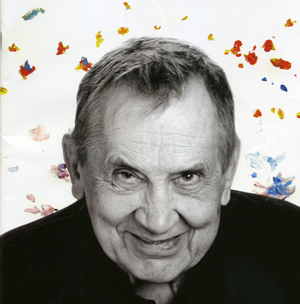
| Einojuhani Rautavaara was born
in Helsinki in 1928 and studied with Merikanto at the Helsinki Academy (1948-52),
with Persichetti
at the Juilliard School in New York (1955-56), and with Sessions and Copland
at Tanglewood (1955). He first came to international attention in 1955 when
the neo-classical A Requiem in Our Time for brass and percussion won
the Thor Johnson Composer’s Competition in Cincinnati. He studied serialism
and soon integrated twelve note techniques, without displacing his essential
Romanticism. For instance, Symphony No.3 (1961) may be the first
totally serial Finnish work, yet it is also a tribute to the symphonies of
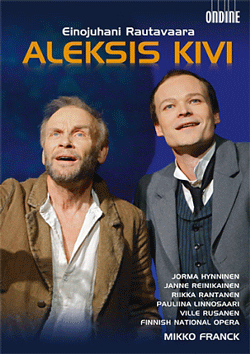
Bruckner, complete with Wagner tubas. In the late 1960s Rautavaara distanced himself from serialism and his mystical character came more to the fore in music of rich colour and sweeping melodic profile, at once accessible and evocative. His operas have often explored issues of creativity and madness, such as Vincent (1986-87), Aleksis Kivi (1995-96) and Rasputin (2001-03), and his symphonies and concerti have increasingly been commissioned by orchestras outside his native Finland, including Symphony No.8 ‘The Journey’ (1999) for the Philadelphia Orchestra, a Harp Concerto (1999-2000) for the Minnesota Orchestra and a Clarinet Concerto (2001-02) for Richard Stoltzman and the National Symphony in Washington. Recent works by Rautavaara include the orchestral work Tapestry of Life (2007), the concertos Incantations for percussionist Colin Currie (2008) and Towards the Horizon for cellist Truls Mork (2008-09), and Summer Thoughts (2008) toured by violinist Midori. His new Missa a cappella (2010-11) has performances scheduled in the Netherlands, Australia, the UK and Sweden. Rautavaara's music has been recorded on the Ondine, Finlandia and Naxos labels and DVDs have been released of his operas The Gift of the Magi, Alexis Kivi and Rasputin. Einojuhani Rautavaara is published by Boosey & Hawkes. == June 2011
- Reprinted by kind permission of Boosey & Hawkes
== Names on this page which are links refer to my interviews elsewheere on my website. BD |
 BD: Is it easier for you to write something when
you have a specific performer in mind?
BD: Is it easier for you to write something when
you have a specific performer in mind? BD: When you're writing and you have the page in
front of you, are you controlling the pencil, or does your pencil lead your
hand to various places?
BD: When you're writing and you have the page in
front of you, are you controlling the pencil, or does your pencil lead your
hand to various places? ER: I don't think so; I have always been very interested
and happy if a performer finds a new way in a work I have written.
It's not a question of that. When it comes out of my hands, it's not
mine anymore. It belongs to the performers, and if they find new aspects,
I'm only glad. I never want to push my ideas. Of course, if the
performance is bad, technically not sufficient, then I protest, but I have
seven concertos for various instruments, and there you have to leave it to
the performer; otherwise there's no idea. So far it's been happy.
When I was young, I studied with Wladimir Vogel in Switzerland. He
was a fierce modernist, and I studied 12-tone with him. He played two
recordings for me of the Lyrische Suite
by Alban Berg. One recording was from beginning of '30s, and the second
recording was from the current time, about '57, I suppose. What a difference!
He said, "Listen what a difference there is; they are like different works."
In the old recording, the music was extremely modern and the performers hardly
understood the language. You can feel that it's good technically, a
wonderful performance, but it doesn't speak the language. Then the later
performance is like the mother tongue of the performers; they feel it.
Both were acceptable; both were good performances, but they were entirely
different because they were played in different times. The same probably
is true with Beethoven.
ER: I don't think so; I have always been very interested
and happy if a performer finds a new way in a work I have written.
It's not a question of that. When it comes out of my hands, it's not
mine anymore. It belongs to the performers, and if they find new aspects,
I'm only glad. I never want to push my ideas. Of course, if the
performance is bad, technically not sufficient, then I protest, but I have
seven concertos for various instruments, and there you have to leave it to
the performer; otherwise there's no idea. So far it's been happy.
When I was young, I studied with Wladimir Vogel in Switzerland. He
was a fierce modernist, and I studied 12-tone with him. He played two
recordings for me of the Lyrische Suite
by Alban Berg. One recording was from beginning of '30s, and the second
recording was from the current time, about '57, I suppose. What a difference!
He said, "Listen what a difference there is; they are like different works."
In the old recording, the music was extremely modern and the performers hardly
understood the language. You can feel that it's good technically, a
wonderful performance, but it doesn't speak the language. Then the later
performance is like the mother tongue of the performers; they feel it.
Both were acceptable; both were good performances, but they were entirely
different because they were played in different times. The same probably
is true with Beethoven. 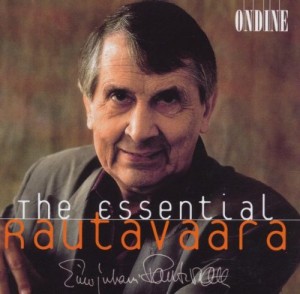 BD: You find the commission that fits what you wanted
to do anyway?
BD: You find the commission that fits what you wanted
to do anyway?
This interview was recorded on the telephone on June 5, 1996. Portions (along with recordings) were used on WNIB ten days later, and again in 1998. This transcription was made and posted on this website in 2012.
To see a full list (with links) of interviews which have been transcribed and posted on this website, click here. To read my thoughts on editing these interviews for print, as well as a few other interesting observations, click here.
Award - winning broadcaster Bruce Duffie was with WNIB, Classical 97 in Chicago from 1975 until its final moment as a classical station in February of 2001. His interviews have also appeared in various magazines and journals since 1980, and he now continues his broadcast series on WNUR-FM, as well as on Contemporary Classical Internet Radio.
You are invited to visit his website for more information about his work, including selected transcripts of other interviews, plus a full list of his guests. He would also like to call your attention to the photos and information about his grandfather, who was a pioneer in the automotive field more than a century ago. You may also send him E-Mail with comments, questions and suggestions.