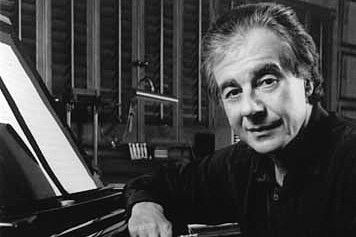
| Best known for his "Mission: Impossible"
theme song, Lalo Schifrin is an Argentinean-born composer, arranger, pianist,
and conductor, whose jazz and classical training earned him tremendous success
as a soundtrack composer. Born Boris Claudio Schifrin in Buenos Aires on
June 21, 1932, his father was a symphonic violinist, and he began playing
piano at age six. He enrolled in the Paris Conservatoire in 1952, hitting
the jazz scene by night. After returning to Buenos Aires, Schifrin formed
a 16-piece jazz orchestra, which helped him meet Dizzy Gillespie in 1956.
Schifrin offered to write Gillespie an extended suite, completing the five-movement
Gillespiana in 1958; the same year, he became an arranger for Xavier Cugat.
In 1960, he moved to New York City and joined Gillespie's quintet, which recorded
"Gillespiana" to much general acclaim. Schifrin became Gillespie's musical
director until 1962, contributing another suite in "The New Continent"; he
subsequently departed to concentrate on his writing. He also recorded as
a leader, most often in Latin jazz and bossa nova settings, and accepted his
first film-scoring assignment in 1963 (for Rhino!). Schifrin moved to Hollywood
late that year, scoring major successes with his indelible themes to Mission:
Impossible and Mannix. Over the next decade, Schifrin would score films like
The Cincinnati Kid, Bullitt, Cool Hand Luke, Dirty Harry, and Enter the Dragon.
As a jazzer, he wrote the well-received "Jazz Mass" suite in 1965, and delved
into stylish jazz-funk with 1975's CTI album Black Widow. Schifrin continued
his film work all the way through the '90s; during that decade, he recorded
a series of orchestral jazz albums called Jazz Meets the Symphony, and became
the principal arranger for the Three Tenors, which complemented his now-dominant
interest in composing classical music. ~ Steve Huey, All Music Guide |
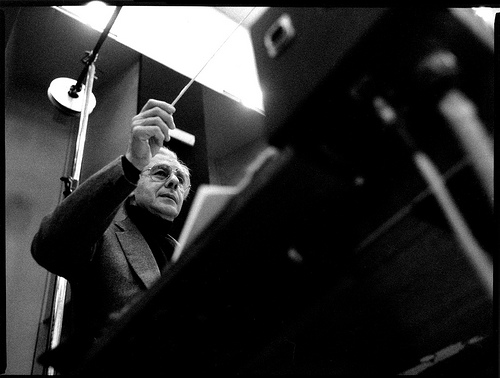 LS: Yes, I get a lot of commissions, but I have a dual career,
or maybe several careers going parallel. One of the aspects of my musical
personality which developed relatively late was my talent to conduct.
I must say that I've always been a conductor, and conducted only my own music
in self-defense because I felt that nobody could conduct my music better
than I did. From there I started to expand, and found that it was very
interesting for me to study the scores of other composers — masters
of today or the past — and look at them not from a
compositional (analytical) point of view only, but also from a performing
point of view. Once I became a conductor and I started to be in touch
with that aspect, I discovered that one of the secrets of being a good conductor
is to know how to use the time. For instance, today's symphony orchestras
all over the world have unions with limitations in rehearsal time, so you
have to know how to use your time in order to achieve the maximum possibilities.
The same thing I apply in life — how to use my time
in the best way. So I divide it. Sometimes I turn down things
because I know that it's going to take away from other things. I divide
the year in two halves. I say, "These two months I'm not going to
write anything; I'm just going to learn this and this and this repertoire
for concerts I have later on. I have two agents — one
for composition and one for conducting — so I tell
the conducting agent I won't be able to take any assignments for this month
to this month because I'll be writing. So that's the way. I more
or less play it by ear.
LS: Yes, I get a lot of commissions, but I have a dual career,
or maybe several careers going parallel. One of the aspects of my musical
personality which developed relatively late was my talent to conduct.
I must say that I've always been a conductor, and conducted only my own music
in self-defense because I felt that nobody could conduct my music better
than I did. From there I started to expand, and found that it was very
interesting for me to study the scores of other composers — masters
of today or the past — and look at them not from a
compositional (analytical) point of view only, but also from a performing
point of view. Once I became a conductor and I started to be in touch
with that aspect, I discovered that one of the secrets of being a good conductor
is to know how to use the time. For instance, today's symphony orchestras
all over the world have unions with limitations in rehearsal time, so you
have to know how to use your time in order to achieve the maximum possibilities.
The same thing I apply in life — how to use my time
in the best way. So I divide it. Sometimes I turn down things
because I know that it's going to take away from other things. I divide
the year in two halves. I say, "These two months I'm not going to
write anything; I'm just going to learn this and this and this repertoire
for concerts I have later on. I have two agents — one
for composition and one for conducting — so I tell
the conducting agent I won't be able to take any assignments for this month
to this month because I'll be writing. So that's the way. I more
or less play it by ear.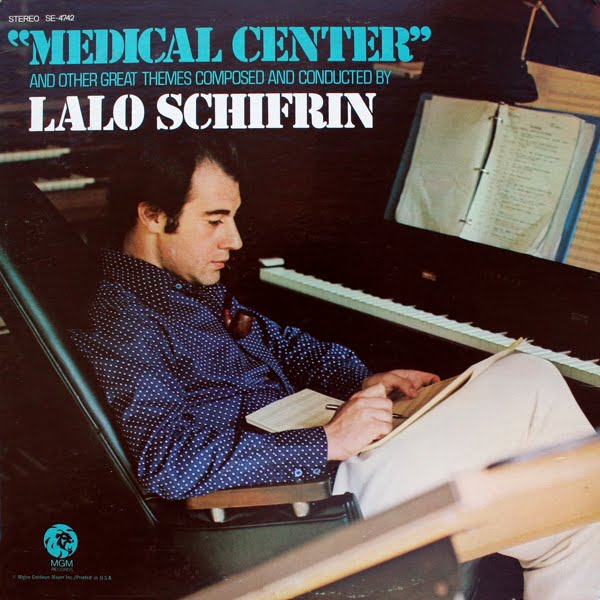 LS: No. Again, it is like driving; I know exactly how
it should be. No, I don't have that problem with myself. I did
performances myself of the Guitar Concerto,
including some with Romero, and I think I did it very close to the record.
LS: No. Again, it is like driving; I know exactly how
it should be. No, I don't have that problem with myself. I did
performances myself of the Guitar Concerto,
including some with Romero, and I think I did it very close to the record.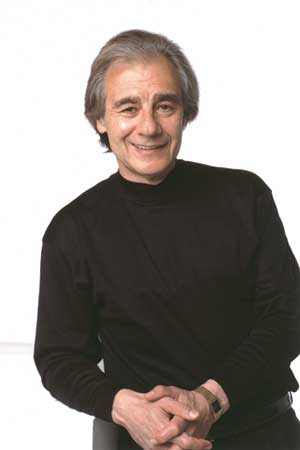 LS: Right! They have one way of synchronizing electronic
instruments playing automatically to acoustic instruments; it does it without
the need of a click track, but it's very, very different. The acoustic
instruments dictate the rhythm to the electronics by themselves, like almost
artificial intelligence. But this would be very difficult to use commercially;
in the movie studios it would be almost prohibitive, because it's almost
in the realm of science fiction. But it happens. I know it happens.
I am about to write a piece for the IRCAM with the Ensemble InterContemporain,
and I'm right now studying that technology.
LS: Right! They have one way of synchronizing electronic
instruments playing automatically to acoustic instruments; it does it without
the need of a click track, but it's very, very different. The acoustic
instruments dictate the rhythm to the electronics by themselves, like almost
artificial intelligence. But this would be very difficult to use commercially;
in the movie studios it would be almost prohibitive, because it's almost
in the realm of science fiction. But it happens. I know it happens.
I am about to write a piece for the IRCAM with the Ensemble InterContemporain,
and I'm right now studying that technology. 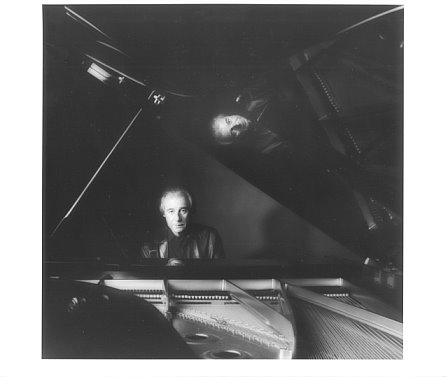 LS: I never wrote for bandoneon. I conducted, recently,
a concert and a recording with Astor Piazzolla, who is a great master of
the bandoneon. As a matter of fact, he wanted to explain me how to write
for the bandoneon, but I gave up after the first lesson. [Both laugh]
It's very difficult. But I had the pleasure of conducting for him his
Concerto for Bandoneon and Orchestra;
on the other side we did the Three Tangos
for bandoneon, harp, piano, and strings, and percussion. I think
that it was a very rewarding experience. He's a great master; I think
that he plays with great, great intensity. That's why I'm talking about
musicians of today who are alive and have so many different things to say.
On one hand you have the minimalists; you have the neo-Webern and the post-Webern
school including Berio, Stockhausen, Boulez; and then you have
the neo-romantic Penderecki,
who became a kind of neo-Mahler. And the aleatoric composers...
A musician like Piazzolla is difficult to put a label on, but he's very
much today and very much alive and very much interesting. And it's
good music.
LS: I never wrote for bandoneon. I conducted, recently,
a concert and a recording with Astor Piazzolla, who is a great master of
the bandoneon. As a matter of fact, he wanted to explain me how to write
for the bandoneon, but I gave up after the first lesson. [Both laugh]
It's very difficult. But I had the pleasure of conducting for him his
Concerto for Bandoneon and Orchestra;
on the other side we did the Three Tangos
for bandoneon, harp, piano, and strings, and percussion. I think
that it was a very rewarding experience. He's a great master; I think
that he plays with great, great intensity. That's why I'm talking about
musicians of today who are alive and have so many different things to say.
On one hand you have the minimalists; you have the neo-Webern and the post-Webern
school including Berio, Stockhausen, Boulez; and then you have
the neo-romantic Penderecki,
who became a kind of neo-Mahler. And the aleatoric composers...
A musician like Piazzolla is difficult to put a label on, but he's very
much today and very much alive and very much interesting. And it's
good music.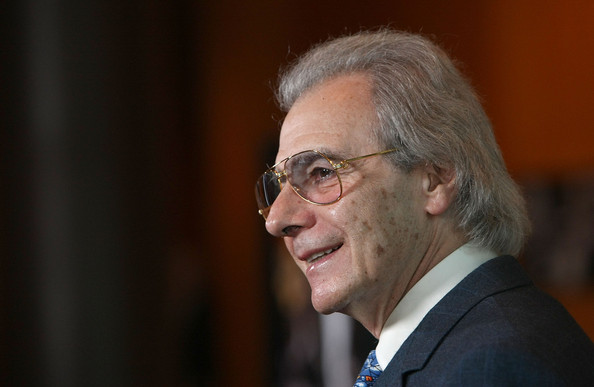 LS: Yes! There are many things that we would have to
talk about; specific pieces. There was a conductor, Igor Markevitch,
who I think was and is underestimated and underrated. I think he was
a great, great conductor and a great teacher. He came with new insight
to music and analysis that would help the musical interpretation. For
instance, he has a complete study of the nine symphonies of Beethoven, which
is mind-boggling; it's the most incredible study of analysis of those works.
All the elements are there. He doesn't tell you how to conduct them,
but once you have gotten through his analysis, you know how to put it all
together. He came with a new insight, a new approach, which is a little
bit different from the traditional approach.
LS: Yes! There are many things that we would have to
talk about; specific pieces. There was a conductor, Igor Markevitch,
who I think was and is underestimated and underrated. I think he was
a great, great conductor and a great teacher. He came with new insight
to music and analysis that would help the musical interpretation. For
instance, he has a complete study of the nine symphonies of Beethoven, which
is mind-boggling; it's the most incredible study of analysis of those works.
All the elements are there. He doesn't tell you how to conduct them,
but once you have gotten through his analysis, you know how to put it all
together. He came with a new insight, a new approach, which is a little
bit different from the traditional approach.Fifteen years later, Lalo Schifrin was in Chicago for performances of a brand-new piece with the Chicago Symphony, and we arranged to meet briefly (in person this time) in a dressing room before the first of the concerts. Even though a few of the questions are the same as in the previous conversation, his responses differ somewhat, and/or amplify other aspects of his ideas and experience.
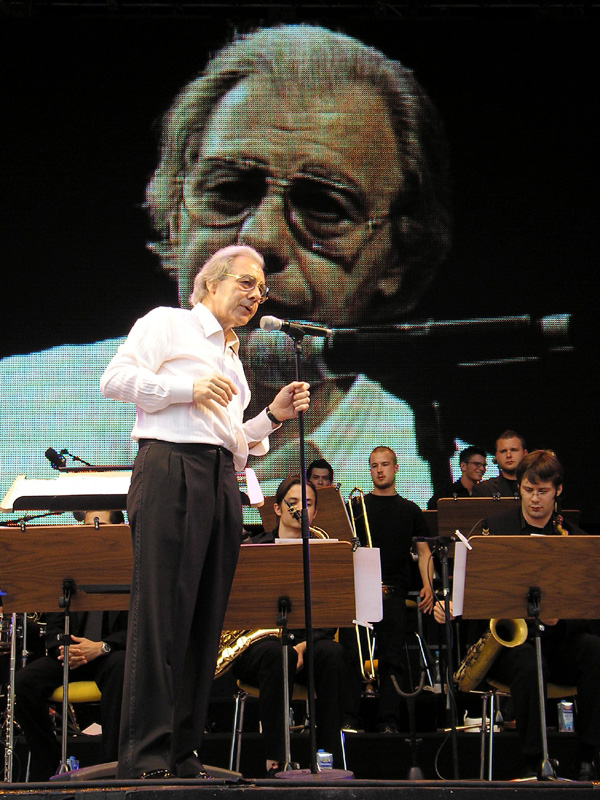 BD: Have you ever gone back and reused some of your own music;
taken a theme yourself and made it into something new?
BD: Have you ever gone back and reused some of your own music;
taken a theme yourself and made it into something new?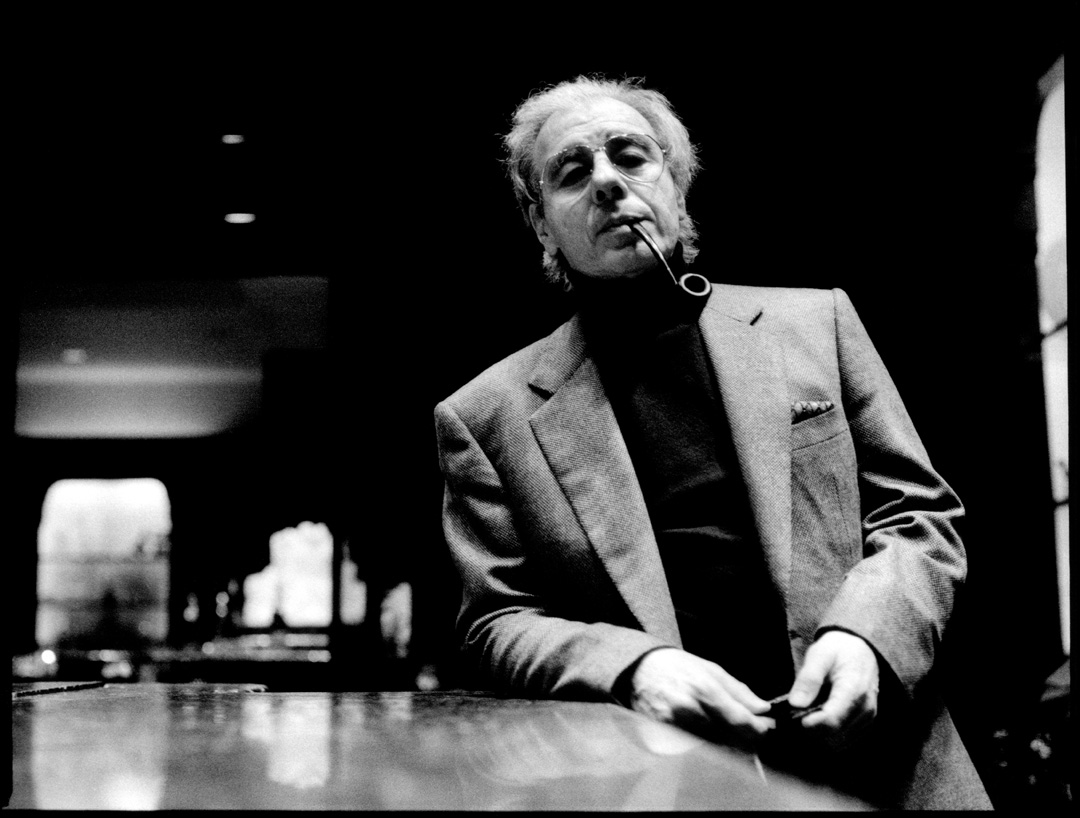
| Lalo Schifrin is one of the most
versatile composers on the scene today. As a pianist, composer and conductor,
he is equally at home conducting a symphony orchestra, performing at an
international jazz festival, scoring a film or television show, or creating
works for the Los Angeles Chamber Orchestra or the London Philharmonic. Born in Argentina, Lalo was classically trained from an early age by his father, Luis Schifrin, concertmaster of the Orchestra of the Teatro Colon in Buenos Aires. While attending the Conservatory in Paris, Lalo led a double life: he would study classical music during the week and jam with Europe's hottest jazz players on the weekend. When Schifrin returned to Buenos Aires in the mid 1950's, he formed his own big band. When the legendary trumpeter Dizzy Gillespie heard Lalo play, Dizzy brought Lalo to New York to be his pianist and arranger. As a jazz musician he has performed with such great personalities as Sarah Vaughan, Ella Fitzgerald, Stan Getz, and Count Basie. A prolific composer, Schifrin has written more than 100 scores for film and television, garnering four Grammy awards out of 21 Grammy nominations, one ACE, and six Oscar nominations. Among Schifrin's well known scores are: Mission: Impossible, Cool Hand Luke, The Competition, Dirty Harry, The Fox, Bullitt, Rush Hour, and Tango. Schifrin has performed in the world's greatest concert halls: Carnegie Hall, Lincoln Center, the Los Angeles Music Center, the Concertgebouw, Royal Festival Hall, Teatro Colon, Salle Pleyel, and the Champs Elysee Theatre, as well as at all the major jazz festivals in the United States and Europe. Schifrin's classical works include "Cantos Aztecas" recorded by Placido Domingo with orchestra and choir; "Piano Concerto No. 2" commissioned by the Steinway Foundation, performed by Mstislav Rostopovich and Cristina Ortiz; "Guitar Concerto" recorded by Angel Romero with the London Philharmonic; "Dances Concertantes" for clarinet and orchestra performed by David Shifrin; and "Concerto for Double Bass and Orchestra" recorded by Gary Karr and the Paris Philharmonic. The Three Tenors, Jose Carreras, Placido Domingo, and Luciano Pavarotti, commissioned Schifrin to write all three of the Grand Finale concerts celebrating the World Soccer Championships: Italy in 1990; Los Angeles in 1994; and Paris in 1998. Schifrin's contribution was to arrange the medleys featuring all three of the Tenors singing together. This highly successful series of recordings have enticed many new fans into the world of classical music. Schifrin has arranged the music for two highly acclaimed Christmas programs: "Christmas in Vienna" in 1992 with Diana Ross, Jose Carreras and Placido Domingo, and also "A Celebration of Christmas" in 1995 with Jose Carreras, Placido Domingo and Natalie Cole. Beginning in 1993, Schifrin has been featured as composer, pianist and conductor for his ongoing series of "Jazz Meets the Symphony" recordings. These works have featured the London Philharmonic Orchestra, the London Symphony Orchestra and such jazz stars as Ray Brown, Grady Tate, Jon Faddis, Paquito D'Rivera, James Morrison, and Jeff Hamilton. The "Jazz Meets the Symphony Collection" contains the first four releases and has garnered three Grammy nominations. The fifth CD in this series will be recorded in the autumn of 2000. Schifrin's most recently acclaimed CD, for which he received a Grammy nomination, is his "Latin Jazz Suite" with soloists Jon Faddis, David Sanchez, Ignacio Berroa, Alex Acuna and the WDR Big Band of Cologne, Germany. Among the many honors awarded Schifrin: BMI Lifetime Achievement Award (1988); an award from the Israeli government for "Contributions to World Understanding through Music"; a star on the Hollywood Walk of Fame from the Hollywood Chamber of Commerce; the Chevalier de l'Ordre des Arts et Lettres from the French minister of Culture; the Distinguished Artist Award in 1998 from the Los Angeles Music Center; advisor to the President of Argentina in Cultural Affairs in 1998; and appointed Music Director of the Los Angeles Latin Jazz Institute/Festival in 1999. It is Schifrin's ability to switch musical gears which makes him unique in the music world and also continues to spark his own interest in new creations. His time continues to be divided amongst composing both jazz and classical commissions, performing on tour with orchestras and big bands, and working on film scores. (March 2000)
Partial Credits List Feature Films: * Rush Hour 2 * Rush Hour * Something to Believe In * Tango * Money Talks * Mission: Impossible * Sudden Impact * The Competition * The Amityville Horror * Voyage of the Damned * Enter the Dragon * Dirty Harry * Bullitt * Coogan's Bluff * The Fox * Cool Hand Luke * The Cincinnati Kid Television Themes * Mission: Impossible * Mannix * Medical Center * Dr. Kildare * The Rise and Fall of the Third Reich Classical and Jazz * Gillespiana Suite for Trumpet and Bass * Canons for String Quartet * The Cat for Jazz Band and Percussion * The Jazz Mass * Symphonic Sketches of Cool Hand Luke * Concerto for Double Bass and Orchestra * Pan American Games Overture * La Nouvelle Orleans (For Woodwind and Orchestra) * Dances Concertantes (For Clarinet and Orchestra) * Cantos Aztecas (Opera) * Lili'Uokalani Symphony (Symphony No. 1) For Classical Music, Score and Parts Rentals for Lalo's work, please contact: MMB Music Attn: Marcia Goldberg - mlg@mmbmusic.com (800) 543-3771 (314) 531-9635 (314) 531-8384 FAX |
The first of these two interviews was recorded on the telephone on
June 23, 1988. Portions (along with recordings) were used as part of
the in-flight programming aboard United Airlines in September and October
of that year. Other portions (also along with recordings) were used
on WNIB in 1992 and 1997. The second interview was held at Orchestra
Hall in Chicago on October 9, 2003. The transcription of both conversations
was made and posted on this website in 2011.
To see a full list (with links) of interviews which have been transcribed and posted on this website, click here.
Award - winning broadcaster Bruce Duffie was with WNIB, Classical 97 in Chicago from 1975 until its final moment as a classical station in February of 2001. His interviews have also appeared in various magazines and journals since 1980, and he now continues his broadcast series on WNUR-FM, as well as on Contemporary Classical Internet Radio.
You are invited to visit his website for more information about his work, including selected transcripts of other interviews, plus a full list of his guests. He would also like to call your attention to the photos and information about his grandfather, who was a pioneer in the automotive field more than a century ago. You may also send him E-Mail with comments, questions and suggestions.