Baritone Olaf Bär
A Conversation with Bruce Duffie
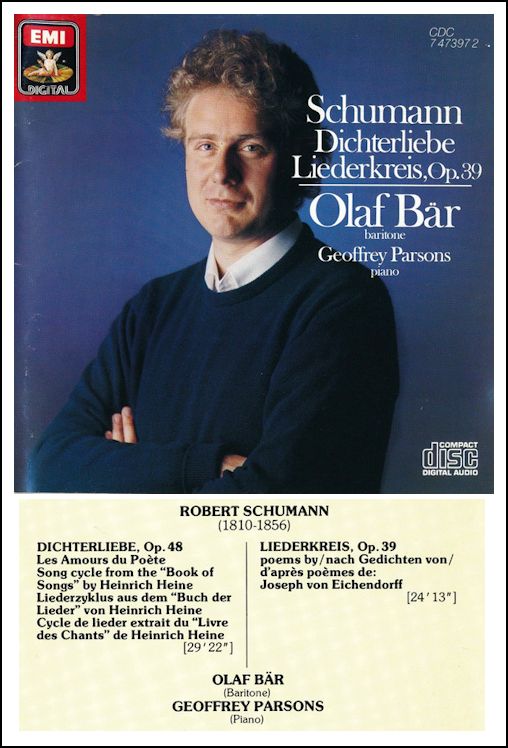
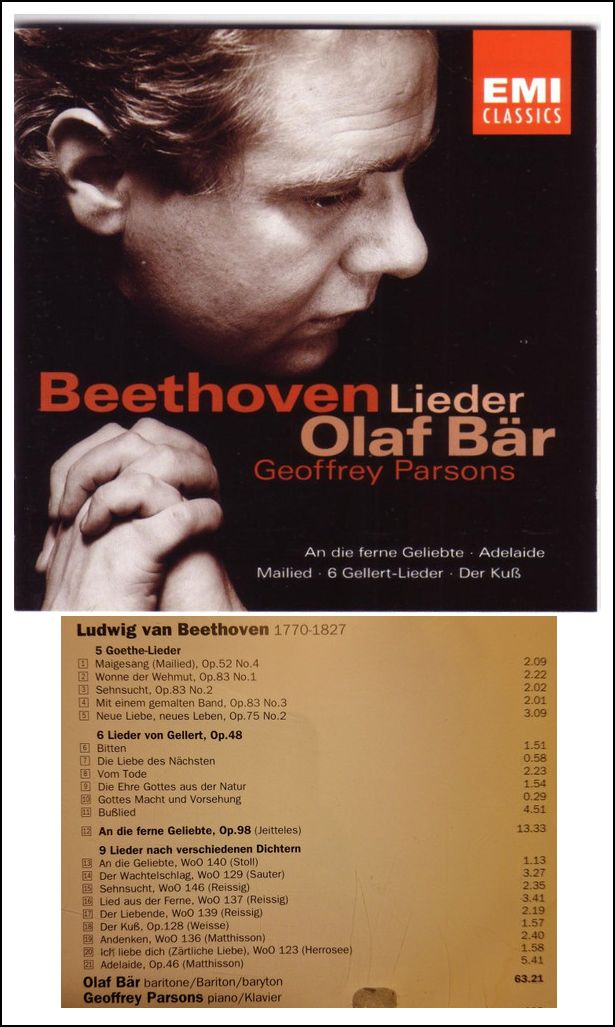
Olaf Bär, prominent German baritone; b. Dresden, Dec 19, 1957.
He sang in the Kreuzchor (1966–75) and studied at the Hochschule für
Musik in Dresden. In 1982 he won first prize in the Dvořák vocal
competition in Karlovy Vary, and, in 1983, first prize in the vocal competition
sponsored by the East German opera houses and the Walter Grimer lieder competition
in London.
In 1981 he made his operatic debut in Dresden, and from 1985 to 1991
he was a principal member of the State Opera there. He made his British
debut in a recital at London’s Wigmore Hall in 1983, returning to London
in 1985 to make his British operatic debut as Strauss’s Harlekin at Covent
Garden. In 1986 he appeared in Ariadne at the Aix-en-Provence Festival,
and as Papageno at the Vienna State Opera and at La Scala in Milan.
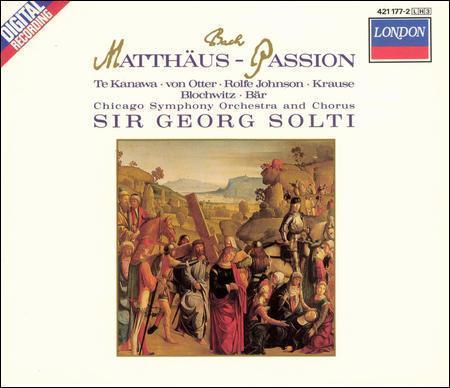
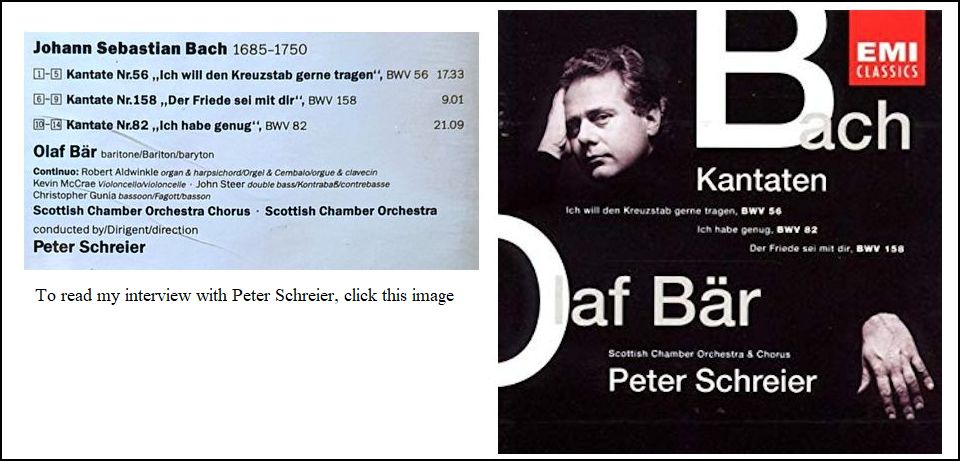
On March 19, 1987, he made his U.S. debut as Christ in Bach’s St.
Matthew Passion with Sir Georg Solti and
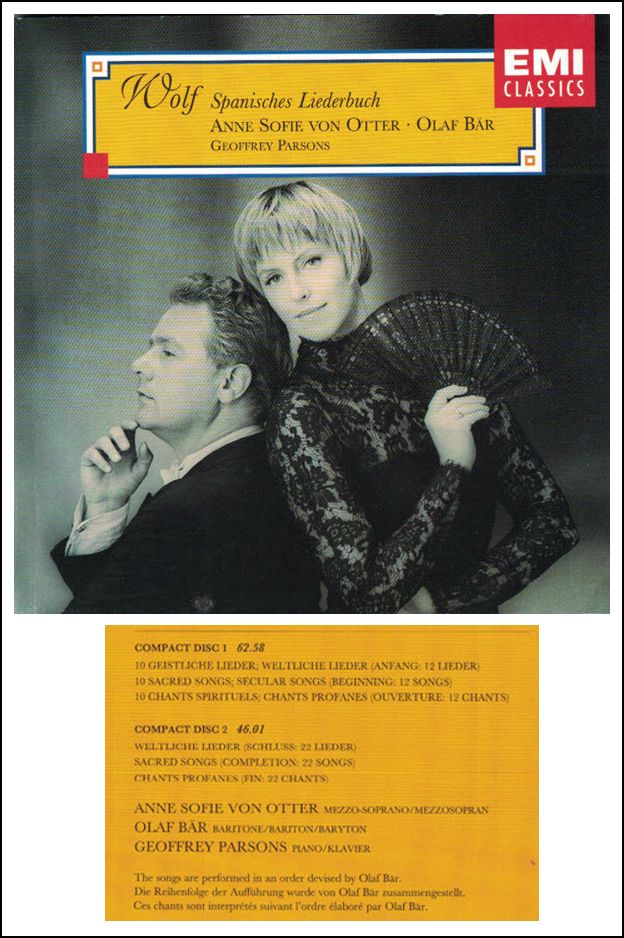
the Chicago Symphony Orchestra [performances and recording shown at left;
see my interviews with Kiri
te Kanawa, Anne
Sofie von Otter, Anthony Rolfe Johnson,
and Tom Krause],
and that same year sang the role of the Count in Capriccio at
the Glyndebourne Festival. On April 18, 1991, he made his N.Y. recital
debut at Alice Tully Hall. He portrayed Mozart’s Count at the Netherlands
Opera in Amsterdam in 1993. He made his U.S. operatic debut as that composer’s
Papageno in Chicago in 1996.
In addition to his roles in operas by Mozart and Strauss, he has
won distinction as a concert and lieder artist.
== Names which are links in this box and below
refer to my interviews elsewhere on my website. BD
|
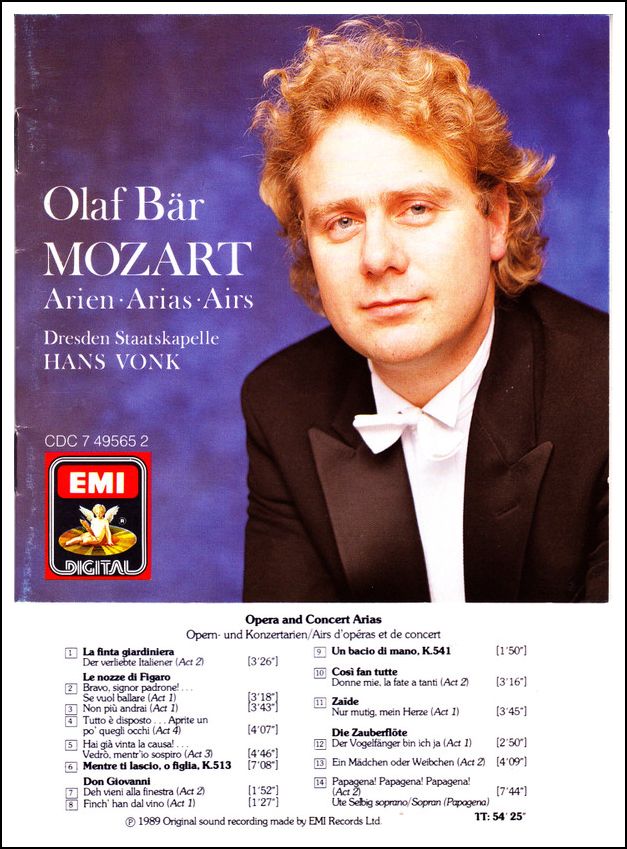
During the period December of 1996 through January of 1997,
baritone Olaf Bär was singing Papageno in
The Magic Flute with Lyric Opera of Chicago. Also in the
cast were Elizabeth Norberg-Schulz as Pamina, Frank Lopardo as Tamino,
Yelda Kodalli as the Queen of the Night, and Franz-Joseph Selig (December)
and Kurt Moll (January)
as Sarastro. Marek Janowski conducted
the August Everding production.
Early in the new year, Bär graciously took time for
an interview. Besides opera, Bär also spoke about
Lieder, of which he was a distinguished performer. In all, it was
a most enjoyable and enlightening hour. Portions were used twice on
WNIB, Classical 97 in Chicago, and now [2026] I am pleased to present the
entire conversation.
Bruce Duffie: To start, tell me the secret
of singing Mozart!
Olaf Bär: Oh, my God, the secret
of singing Mozart??? There is no secret. Unfortunately
for a lot of people, there’s a secret, but it should not be for us.
We are the singers, so it’s our profession, and it’s our passion as
well. The secret that you have to find out relates to how to translate
the music by Mozart into our time.
BD: Does it still work after two hundred
years?
Bär: I think so, yes. I’m
pretty sure about that. It’s the same with Schubert. I
just did a masterclass this afternoon with the Opera Center, and we
were talking about German Lieder, because that’s my specialty, and I
thought to myself how I could explain why we are doing it in our times.
In German Lieder the poetry and also the music is not the music of
our times, but the themes and the problems are the same. The themes
and the problems are the problems and situations we are talking about. It’s
about our lives, and that’s the same as operas by Mozart. If you look
at Così Fan Tutte, it’s about life. It’s about jealousy
and about faith, and all of these things as in The Magic Flute.
It’s like a Märchen [fairy tale], but it’s not a fairy
tale. If one is doing it as a fairy tale, I think it’s wrong. It’s
a mixture of different things.
BD: Is it more like a fable? [According
to a website about words and sorcery, a fairy tale can be dark, but
will entertain with reflections on a romanticized past, while a fable
is lighter and can use animals to teach virtue and moral lessons.]
Bär: Yes, it’s
a symbol. There are a lot of symbols, some of which even I don’t
understand in our times, to be honest. Maybe scientists will understand
and will find out, but there are still a lot of arguments. For
instance, is the text better than the music, or is the music better than
the text? We have that discussion very often in opera, but especially
in this one. We could discuss it for hours. What is the idea
of the three boys? What are they doing in that opera? Actually,
I think there are a lot of secrets and a lot of things which remain as
secrets. Mozart took them with him to the other world. But
it’s wonderful to think about all this, to think about this kind of secret
that we have to try to figure out. That’s the fun about our profession.
We have to try every day to find out about secrets.
BD: You mentioned that singers are supposed
to know and understand this, or at least make a stab at it.
Should the public understand just how difficult real singing is?
Bär: If we’re talking about it,
one can explain what singing means. But the ideal is that the
public goes to the performance or to the recital, and listens to what
we are doing. They listen to the music and the text, and maybe
to a good voice. Otherwise you would not have success.
BD: [Somewhat shocked] You really
put the voice at number three???
Bär: No, it’s not number one or
number two or number three. It has to all go together, even if
someone doesn’t have a good voice, or has a boring voice. Perhaps
if he is a great artist who understands the text and the music, you still
have to have this gift of an interesting voice. There are some
people who like voice A and hate voice B, and there are other people who
love voice B and hate voce A! This is a matter of taste, but there
still has to be a quality of voice if we want to do opera or Lieder or
oratorio.
BD: Should we not like voice A and voice
B and also voice C?
Bär: Maybe... This is also
a possibility. I shouldn’t say anything, and I won’t
mention names, but there are some colleagues who are very, very successful,
and a lot of people love them, but to be very honest I don’t understand
why. [Laughs] I’m sure there are other colleagues or other
people who don’t understand why I am successful, because they just can’t
cope with my kind of interpretation. This is quite possible, and
it’s the variety of voices which make our profession so interesting.
A special singer might be perfect in a certain part, but still
another singer puts something different in the role, and the different
experience is the wonderful thing about it. Maybe if you put A,
B, and C together, then you could have the ideal singer, but that’s not
possible. We are human beings, and that’s the good thing about it.
It makes every day special.
BD: Is there a competition amongst lyric
baritones?
Bär: I’m sure there is always
a competition. Our world is full of competition, and that’s
normal. On the other hand, this is also helpful. You have
to be very careful, and you have to really do your best to be on the
top. I always say it’s good to have a kind of a competition. It’s
not a fight, but you always want to be good. That’s the main thing.
There is enough space for all of us... well, for most of us. [Both
laugh]
* * *
* *
BD: I mentioned that you are a lyric
baritone. Is this the correct label?
Bär: Yes, I would say so. I
cannot find another one. [More laughter]
BD: The range and style of your voice
dictates what kind of roles you will sing. Do you like the characters
that are imposed upon you?
Bär: I like all the characters
I can sing. I did like Harlequin more than I do now because
maybe Harlequin in Strauss’s Ariadne auf Naxos I have done
too often. But I especially love Papageno because he’s a wonderful
guy, as you would say here in America.
BD: [With a wink] Would you
rather be a tenor in order to play the lover?
Bär: [With a big smile] Papageno
is a lover! All these characters are full of love. For
instance, you can say Don Giovanni is an evil character, but he’s not.
He’s a lover in a different way, but he still is a very, very interesting
character. Maybe there is something of a Don Giovanni in our
fantasy, so it’s not so far from everyone’s experience. Another
part in the Mozart repertoire is Guglielmo in Così Fan Tutte,
who is also a very interesting character. He really is very strong
and has a great temper. On the other hand, he is a little bit like
Don Giovanni, and the problems he and the other people have in Così
Fan Tutte are problems every one of us has in a lifetime. If
you are falling in love and suddenly you decide you want to live together
with that person, on the other hand there’s a possibility that someone
crosses your life and you’re falling in love again. What should you
do then? It’s a very, very thought provoking opera.
BD: Who should wind up with whom at
the end?
Bär: I don’t know! [Both
have a huge laugh] It’s an open end, I would say. It’s
very difficult to answer. Maybe all the questions stay unanswered.
In The Marriage of Figaro there are a lot of unanswered questions.
BD: They’re not happy in the third opera?
[Both laugh]
Bär: I don’t know. The Countess,
for instance has a relationship with Cherubino in the next part.
BD: Yes. It’s
even called The Guilty Mother! I’ve shocked lots of little
old ladies when I tell them that the Countess has a child by Cherubino
in the third play by Beaumarchais.
Bär: I can imagine! It’s
all these things. It’s about life.
I heard about a production in London where the Countess was an alcoholic
because of all the problems she had with the Count. He’s a man
who loves young girls, and one also has to understand he’s in the position
to have them. He can’t understand why he should not have all these
girls. He’s used to that, and he wonders why that privilege suddenly
should stop. It’s not only the problem of the relationship between
man and woman. It’s also the problem of society, and that’s part
of what the piece is about.
BD: Are you glad that we are no longer
bringing up our sons that way?
Bär: To be honest, yes! One
of the main things we learn in opera, which is so important in music,
is about tolerance. In the pieces themselves, we learn about tolerance,
because otherwise the world doesn’t work. It’s going to be a big
disaster. As a singer, when you’re going on stage, you have to
tolerate a lot of things which are going on. You have to be flexible,
and that’s one of the things I love about being on stage.
BD: Are there any of the characters
in your repertoire that are perhaps a little too close to the real
you?
Bär: That’s an interesting question.
It’s not so much in opera, to be honest, but it’s more in Lieder singing.
I’m not doing so much opera. I do one or two productions a year,
so my operatic repertoire is not as big as it may be for other singers.
I would not say that any of my parts are too close, but some of them
are very close, and that has something to do with my own experiences
in life. You have put your experience into the interpretation without
telling people it is my personal experience. The main and most
important thing is not what I put in the interpretation, but more important
is that I have the music and I have the poetry, and when I try to read
it, the most important thing is to do that right. Then I put it
together and combine it with my experience in life, and with my singing
technique. This combination is what makes it. This month we
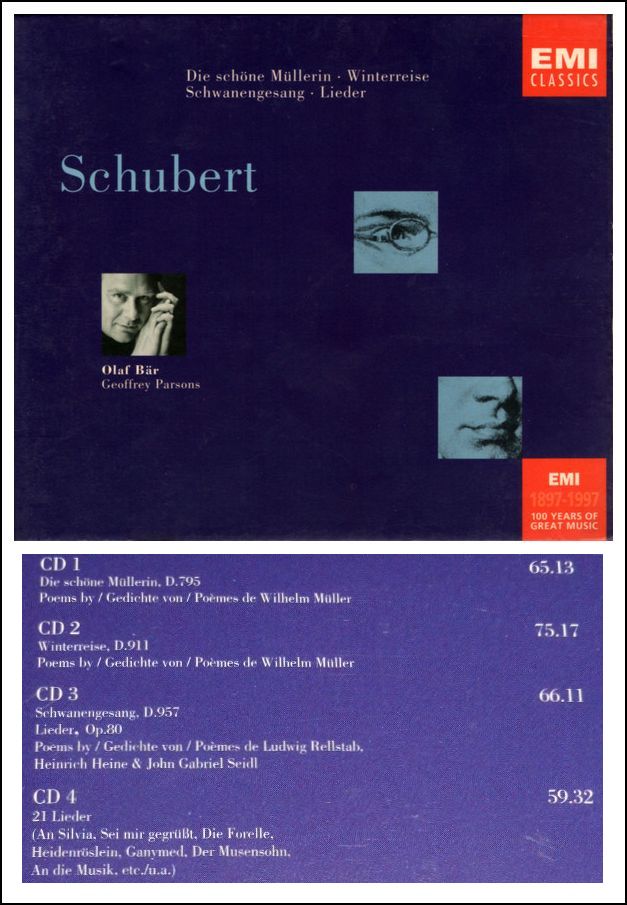
have the 200th birthday of Franz Schubert, and so for all this time we
are listening to Winterreise, and Die Schöne Müllerin,
and it’s all still very touching and very moving. A lot of singers
have sung it in the past, and everyone has a different experience and
a different voice. Every singer puts his own ideas in each cycle,
and the best interpretations are still the ones who stay as close as
possible with what Schubert said about the dynamics and all these musical
things. Of course, the text and your experience make it your personal
interpretation, and that makes it so interesting.
BD: Can we assume that each composer
wants you to put something into it, so he left it slightly incomplete?
Bär: I’m sure, yes. With Schubert,
it starts with the very, very special way he wrote things down.
If you think about what he did, he had a blank piece of paper.
He then had to take his time to line the paper for the staves, because
he couldn’t afford to buy real printed music paper. So he had
to do all that first of all, and by candlelight! Then in some
pieces, especially in Winterreise, he put pauses in the parts.
It was quite clear. Everyone knew how to play the piano, but he
wrote down every single pause just to make sure that they really played
them. It’s not that no one used the pedal yet, but he wanted to
make sure it was done his way. Later we get Hugo Wolf who really
writes every single detail.
BD: Are we losing the style and the
tradition of Lieder singing these days?
Bär: This is a very difficult question
to answer, to be honest, because I just don’t know. In some
places there are a lot of people who want to listen to it, and in other
places we’re losing totally the Lieder singing tradition for whatever
reason. Maybe it’s that people think it’s an
old-fashioned repertoire. I don’t believe that because, as I
said before, it’s about life, it’s about death, it’s about jealousy,
it’s about faith, it’s about relationships, it’s about our lives, just
with a different type of poetry. They are using old-fashioned
words which we don’t use today, but they are much more interesting and
much more colorful sometimes, and they say much more about the feelings
than we are able to express in our modern words. Forgive me to say
this, but I’m getting very angry when I’m in Germany and we are using more
and more of the English and American languages instead of finding the German
words. It’s just modern thinking, and anything that comes from
America is modern. It’s more or less ‘in’, and therefore it’s absolutely
perfect. But we should not forget that there is still a language
in our soul and in our feelings. This is our Mother Language, as
we say, and it would be a pity if we are losing this language. When
students or younger signers ask me why we’re doing that, I say that one
of the reasons is that it’s about us, and the other reason is to keep
the language!
BD: As I understand it, the French
have gone so far as to outlaw the use of English words being incorporated
into the French language.
Bär: Yes, it’s really true.
* * *
* *
BD: Is there a parallel between singing
Lieder and the arias of Mozart?
Bär: I’m not sure about this.
I had a discussion with another singer two or three years ago, and
we don’t talk about this anymore because we are not sure. For instance,
is Così Fan Tutte an Italian or a German opera? For
the style of the music, it’s a German opera, but we are singing it in
the Italian language. It’s a different thing. Anyway, opera
is different from Lieder. Lieder singing is much more intimate
than singing opera. In opera you are a character, and therefore
you are not so much yourself, but you can be yourself as a Lieder singer.
You can put much more of your own life experience into Lieder singing
than you can in opera. It depends on the part, of course. Here
in Chicago I’m singing Papageno, and some of the time I can take my life
experience. One shouldn’t believe that Papageno is a clown. He’s
not one of these funny guys. He is a real human being, and sometimes
it’s provocative when I say he’s the only normal person in the opera.
He doesn’t understand what they’re talking about with and all this
examination about wisdom and light. For him it’s blah, blah, blah!
He wants to find a woman!
BD: We would call him a ‘regular’ guy!
Bär: A regular guy, yes, but he
also thinks about life. He’s not just a funny man. So you
can bring a lot of your personal experience in it to make him a human
being, a normal regular guy! Coming back to the difference between
Mozart opera and Lieder singing, a lot of people think that Lieder singing
and also Mozart opera singing is good for young singers. We had
a discussion about all this during the rehearsals, and I think it would
be much better for a young baritone, or for a young tenor,
and especially for young sopranos, to sing La Bohème because
the orchestra really supports you in these parts. It’s really
lyrical singing, instead of having a young singer singing the Countess
in The Marriage of Figaro, which is a dramatic part. It’s
not so much that you can’t sing it because you have a big voice or a small
voice, it’s the experience you need to sing these arias. It’s
also the experience you need to sing Don Giovanni, or the Count in The
Marriage of Figaro, or all the ensembles in Così Fan Tutte.
For all of this you need experience of life, and experience in
how to work with your voice. Mozart is not for every singer. A
part like Fiordiligi is not for inexperienced young singers as a first
debut on the opera stage! There are lighter parts to sing. People
stare at me when I say this, and I’m not saying La Bohème
is light Italian opera, but it’s better to start with this kind of repertoire
than starting with the Countess, Fiordiligi, the Count, or some other part
in Mozart operas.
BD: You’re finding a nobility in the Mozart,
and a special kind of relationship that you want to keep for the
experienced singer?
Bär: Yes, absolutely!
BD: [Gently protesting] Then how
do they get experience unless they sing it from early on?
Bär: They can practice. At one
stage, you have to go on for the first time for Winterreise,
and that’s the same problem. I was first singing Winterreise
when I was twenty-six, and a lot of people told me I was much too young,
and that I didn’t have the experience! I said that the tragedy
of Winterreise is that it is a young man, and I must be able to
show that. I’m sure I can do it now much better than I was when I was
twenty-six, but still you’re absolutely right. You have to have the
experience. But it always depends on where you sing it, which is
also true of singing these parts especially in opera. What I
wanted to say is not that you should start singing it quite early on,
but you should not start as a singing beginner. Your first parts
should not be the Countess or Don Giovanni because they need much more
experience in life, as well as much more experience on stage. Mozart
opera is not light opera. It’s very difficult to bring it to life.
If the audience thinks it’s light, then it’s very well done! [Both
laugh] That’s the beauty of art. The audience should not realize
how hard it is. We can talk about it, and we can explain that it
is a very difficult profession, but we only can explain about singing
technique, and this is hard to explain if you don’t have experience, or
if you never tried to sing. You can tell the people about breathing
technique, and support, and all these things that have a lot to do with
imagination. You can talk about discipline, which is necessary in
our lives, yet if people leaving the concert hall are only talking about
the quality of the singers in terms of interpretation, and about the piece,
they are not thinking that it was hard work for them. That would be
terrible. Then something was wrong.
BD: You camouflage that effort?
Bär: Yes!
BD: Do you change your technique at all
for the size of the house, if you’re in a big house like here in Chicago,
or a small house like Glyndebourne?
Bär: [Thinks a moment] One shouldn’t
change the technique too much. If you are singing in a big
house like this one and you start to push, then it doesn’t help at all.
The main thing is always that the whole system must work. There
is, or should be, a basic singing technique for everyone, and you have
to work on that every day, because every human being is different every
day. Sometimes you’re feeling good in the morning but then feel
bad in the evening. Therefore, you need the basic singing technique,
which has a lot to do with working with your muscles, and breathing technique.
On this basis you can work with your voice, and with the consonants.
Maybe you have to pronounce more in a big house so that everyone
understands you, but for the vocal cords there shouldn’t be a difference.
I don’t hear myself in the theater, so I don’t know if I’m not loud
enough. But then maybe my voice is not big enough for a big house.
That’s also possible, and it has a lot to do with how loud the orchestra
plays.
BD: Isn’t it the responsibility of the
conductor to balance it all?
Bär: Oh yes, absolutely. The
main thing the conductor has to do is control things. We are
the ones making the noise, but he has to control things and to organize
things.
BD: When you’re deciding to accept
or turn down a contract, do you look at who is conducting?
Bär: I’m not in the position to look
at who is conducting because, as I said before, I’m doing one or
two operas a year. I ask who will be the conductor, but in our
times it’s more that I’m looking at who will be the producer [stage director],
especially in Europe. I don’t like productions and stage directors
who want to bring their personal problems via the plot of the opera.
There is a meaning in the context of the opera, in the libretto and
the music, and the composers and librettists thought about it. So
it’s not necessary that a producer comes and tries to find out what he
could put in additionally. Of course in the theater we need fantasy,
we need good costumes, and we need to find out about relationships between
the characters. Sometimes there are very interesting timeless costumes
which seem to me to act as a bridge from the time when it was composed
to our modern times. Sometimes it is good that we really can see
what it is and is not about, and we find that it is not about a time 300
years ago, but it is about us.
BD: Then are you more in control when
you give a Lieder recital because it’s just you and the piano?
Bär: Oh yes, of course! You are
much more in control. You can choose the program, but on the
other hand, it’s more dangerous because you have no costumes. You
have just your tails. [Laughs] A female singer can change the
costume in the interval, which can make it more interesting, but a baritone
or a tenor must have the tails and that’s it.
BD: Could you come out in a frock coat
or something like that for the first half?
Bär: [Laughs] No, you can’t!
You have the music, and you have your colleague at the piano, and
then you have the audience. They listen to you, or rather you
have to make them listen to you, and it’s tough!
BD: Is that your responsibility, or
is it Schubert’s responsibility?
Bär: [Thinks again] Ha! In
that special moment it’s my responsibility to make them listen to
Schubert. If I’m singing Winterreise, it’s a mixture.
I shouldn’t say this, but maybe some people are coming to listen
to me. But what I want is that they listen to Winterreise
or Die Schöne Müllerin. I’m not saying I don’t
want them to listen to me, because I’m trying to do these pieces. But
when I’m on stage, the main thing is that I make the music work with my
voice. It’s in my body. It’s not just an instrument, it’s
me. What I really want is that they listen to Schubert or to Mozart
with my voice and with my experience. That’s the mixture.
* * *
* *
BD: When you’re thinking about recitals,
how do you decide from this huge array of song literature which songs
you will put on a mixed program, or which cycles you will sing here
and there?
Bär: Very often in our times they are
asking for Winterreise, or Die Schöne Müllerin,
or Dichterliebe by Schumann, or a special program by Hugo Wolf,
or whoever. So, I have a few standard programs I can offer. In
very small places they may ask me for a recital, but not to make it too
complicated. Then you can find a mixture between very well-known
songs and some not-well-known songs. What I’m trying to do is
find a theme where I’m talking about love, or songs about God and the
world, meaning religious songs in the first half, and in the second half
we might have just one composer. So there are a lot of ideas of
what you can do with a recital. Sometimes the ideas come from someone
else. Three or four years ago in Brussels, they had a festival
which was going on for half a year with a theme about Saxony. That’s
where I come from in Germany, and they invited me to sing a recital. They
asked if I could sing Richard Strauss and Mendelssohn and Schumann because
they all spent some time in Saxony, but I suggested that since there was
the special theme, why not find something else? So, the first half
of the concert consisted of compositions by music directors of the Dresden
Opera. There was Heinrich Marschner [1795-1861], Carl Maria von
Weber [1786-1826], and Carl Gottlieb Reissiger [1798-1859]. They
all wrote interesting songs. There was an idea that I might do a
recording of German operatic arias, but Thomas Hampson had done
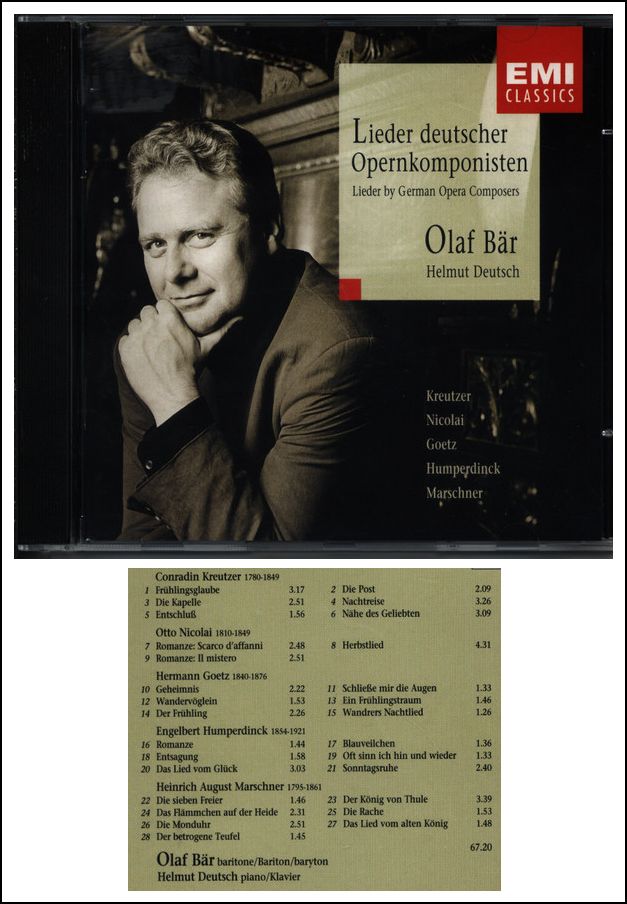
a disc of very big arias where you need a big voice. So we found
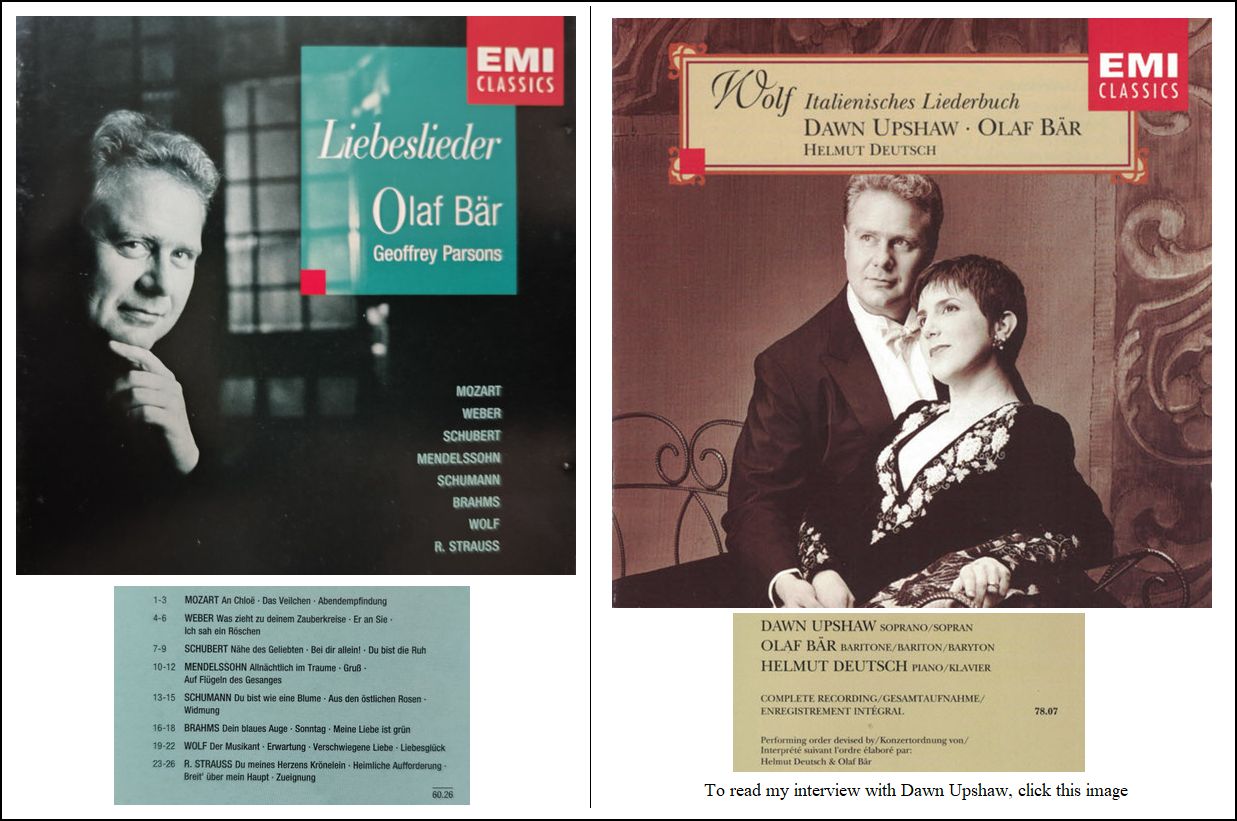
a lot of fine songs by composers like Conradin Kreutzer, Hermann Goetz,
and Engelbert Humperdinck, and we put together a program of Lieder by German
Operatic Composers [shown below-right]. Now we are trying
to find something about the different styles of Vienna Lieder composers
at the turn of the century. These include Alexander von Zemlinsky
[1871-1942], and Erich Wolfgang Korngold [1897-1957].
BD: Mahler’s era but not Mahler?
Bär: No, not Mahler, but a
lot of other things. We call it Jugendstil Lieder. It’s
not Jugendstil as in architecture, but it’s just an idea that we
are working on.
BD: If you only do a couple of operatic productions
a year, how do you decide which operas you will sing and which operas
you will decline?
Bär: Since I am not getting
too many offers, there’s not much of a problem. This year I
am doing The Magic Flute in Chicago, which is great because
it is my American (opera) debut. It’s a great cast with a good conductor
and an interesting production with Everding. I never had the chance
to work with him before, so it’s ideal. The next opera production
I’m doing is Alfonso und Estrella, an opera by Franz Schubert
which is very, very rarely done, especially on stage. There are
some concert performances, especially this year because it is the Schubert
year.
BD: Is there any relationship
between the Schubert style on stage and the Schubert songs with piano?
Bär: Yes, there is a relationship.
You really can hear that it’s Schubert. They always blame
Schubert, saying he is not good enough for the opera stage. We
will see how it works. I have seen Fierrabras, which is
another opera of his, and that was very good and very exciting. Alfonso
und Estrella has a very interesting cast because there are two baritones,
Thomas Hampson and me! [Laughs]
BD: The two of you would very rarely
get to work together.
Bär: Right. When he’s singing
a recital, I can’t sing a recital, and when I’m singing a recital, he
can’t sing a recital. Also, there are not many operas where two
baritones are on stage together. So that’s going to be very interesting,
and I hope it’s not going to be too much competition, which you mentioned
before. [Both laugh] I don’t think so because we know each
other quite well, and we are quite different. Nikolaus Harnoncourt
will conduct, and the producer will be Jürgen Flimm from the Thalia
Theater in Hamburg. I worked with him before in Amsterdam, and it
was fantastic. So, that’s something to look forward to. If I
get two of these offers a year, that’s great, and you don’t have to look
for other things. It’s a pity that I can’t do Tannhäuser
in Dresden because of that production. That was really where I had
to choose, and since I’m living in Dresden, hopefully I can do another production
there. I decided to go to Vienna instead of staying in Dresden, which
is a pity because we just built a new house in Dresden.
BD: You’ve also sung some new operas.
Is it especially exciting to create a role where there’s no precedent?
Bär: It depends. It’s different.
I’m not as good especially in modern contemporary opera. I
like to see a score that is going to be worthwhile music, because this
is quite difficult. You’ve never heard this music before, and
sometimes you can’t imagine how it’s going to sound because you have
these big scores now in our days. I have had different experiences.
One opera was very, very good. It was called Die Weise von
Liebe und Tod des Cornets Christoph Rilke (Cornet Christoph Rilke’s
Song of Love and Death). It was after a piece by Reiner Maria
Rilke who was a German poet, and it was composed by Siegried Matthus
[1934-2021], an East German composer. The production was by Ruth
Berghaus, which was a very, very interesting work. On the other
hand, I had another experience where they told me at the beginning
it would be a main part, and be very, very important, but then I was
hanging around on stage for three hours and singing for two minutes!
[Laughs] But I love to create contemporary music, and
it wasn’t that he composed something especially for me.
BD: If someone comes to you saying they
would like to write either Lieder or an opera for your voice, what
advice do you have for that composer?
Bär: [Sighs] I still should
be able to sing it, not like knocking at the door and only using consonants
instead of vowels. I really want to use my voice as I learned
to use it as a classical singer. Record companies sometimes come
and say I should do a crossover disc. When I was younger, I tried
to sing Blues, and since we are in Chicago, I have to say that I was
very, very bad because I can’t do it. I didn’t learn it. I
love that music, but I told myself to keep my fingers away from this
music because I can’t do it! Leave it to people who can really do
it. If a composer asks me, I would say to listen to my voice either
live or on recordings. I would give him two or three recordings,
and tell him to use that talent I have, but don’t ask me to do things
I can’t do. I’m open to experimentation, no question about that,
but there is a base that even in our times one can use a classical voice
for modern music. It shouldn’t be a problem.
BD: Does it please you that we seem
to be coming back to more tonal music?
Bär: Yes, we seem to be coming back, and
as long as it means something, it’s fine. It’s very hard... the
music of our time is not opera, and it’s not classical music. It’s
more about improvisation. It’s more jazz. That’s the music
of our time, and that’s what I would say is contemporary modern music.
I can’t imagine that an opera’s been done before with jazz-style.
BD: The only one I know is Jonny
Spielt Auf of Ernst Krenek.
Bär: You are right!
BD: Since you’re here in Chicago for a few
weeks, will you take advantage by going to a Blues club to learn
the Blues style?
Bär: Nooooooooo, I shouldn’t
do that. I should go to a Blues club to listen to it, but I don’t
have time enough now. The other thing is you don’t want to go
on your own to a Blues club. You have to have some company, some
good friends, and not every opera singer in Chicago wants to go to
a Blues club! You have to find the right people to go with you.
I thought I should go once to the Chicago Bulls to watch one of these
[basketball] games because it’s fun, but I don’t want to go on my own.
Bryn Terfel [who was singing Jochanaan in Salome during this period]
went two or three times, but always when I had a performance or rehearsal.
Otherwise we would have gone together.
* * *
* *
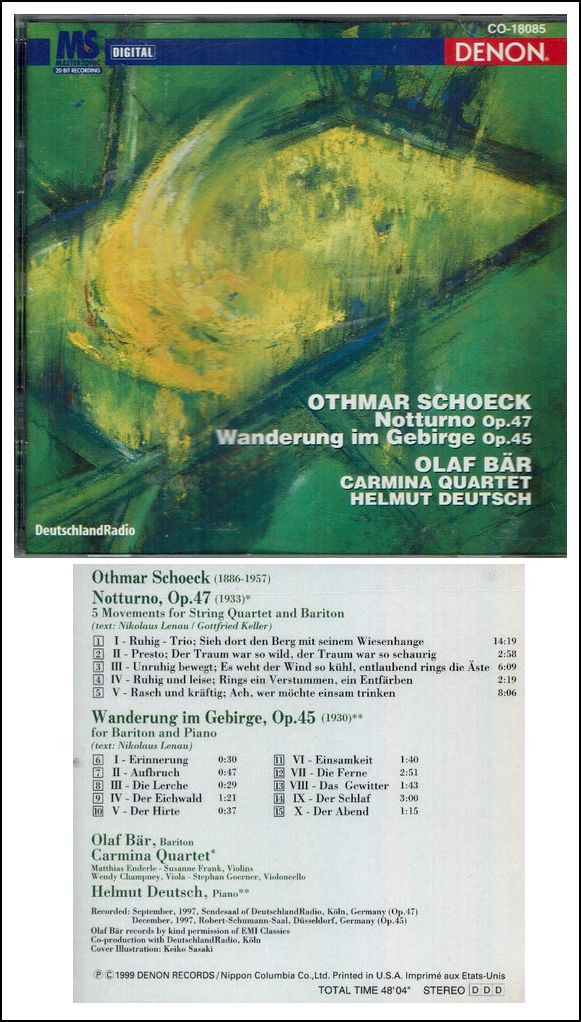
BD: Do you sing the same for the microphone
as you do in the concert hall?
Bär: I think there is a difference
because you have no audience. I don’t mind the microphone if it
is in a live performance. I just ignore it because I’m doing
it for the people who are there, and if it doesn’t work, everyone knows
it’s a live performance. In the studio it’s different, because you
really want to make it as good as possible. What we try to do in
a studio is to have a basic take or two, and then we listen to them and
decide which one we’ll use. Then we listen again, and if you think
it’s a little bit flat
— which you don’t hear in
a concert because it’s gone
— or if there’s one single
note which is not exactly where it should be, maybe some experts will hear
it but it’s not so important in that moment, you don’t want to have that
on a CD where you can listen to it a hundred times. You know he is
always singing this one note flat. Therefore we do make these little
corrections.
BD: Are records too perfect?
Bär: It depends! Sometimes
if there is a little noise on the voice, but it was an good interpretation,
I say you should excuse me, because we are human beings. So
we should leave it like that because it’s what happened at that moment.
What we are looking for in our team is for the most interesting
interpretation, and it should be as right as possible, but it should
not be a sterile interpretation because that’s boring. People want
to listen to it more than once, and if you have heard it and you get
bored, it makes no sense, and no one wants to hear the record again.
We are making it that people hear it, and that they may experience new
things they have never heard before. When they have finished listening
to the recording, we hope they would love to listen to it again because
it was interesting, and it was fun, and it was enjoyable. That’s
what we’re looking for. It’s difficult to do that in a studio, but
some things you have to do more in a studio because people don’t see your
movements or your face. It’s a bit strange, and you can do things
on stage which you can’t do in a studio.
BD: So it’s a trade-off?
Bär: Yes, absolutely.
BD: Is there such a thing as a perfect
performance?
Bär: No, there’s no perfect performance,
but maybe there are performances of recitals and operas where there
is a special atmosphere. That’s what I call it, but it really
depends on what you call ‘perfect’. Even in a performance
where you had a big success, there might be three or four people who
didn’t like it at all. What is ‘perfect’? It’s not possible.
BD: Even so, can we assume you strive
for it?
Bär: Yes, yes, but it’s not possible
because there’s something that always happens. A perfect performance
for me is an exciting performance even if something is going wrong.
It’s a performance with a special atmosphere, with a special
power where people in the audience really are touched.
BD: Are you at the point in your career that
you want to be now?
Bär: Yes, yes, I am! I had
some trouble a few years ago. There was a crisis, and that
was just at the right time. I learned a lot, especially that
there is no point in the career where you should stop working on your
voice, on your lifestyle, everything. Every day it’s interesting,
and every day is a challenge especially in the lives we lead. We
are so lucky in our profession. We get paid, which is fine, but
still we have such a good profession. It’s great. We are
able to work with some really great art. To be able to sing Schubert
songs, that’s a gift. It’s fantastic. Singing is much Spaß
[fun], as we say in Germany, but it’s also work, and if it works well,
I enjoy it. Preparing a production with the everyday routine is not
really fun, but it helps that singing is fun, and can be fun in performance.
Actually it’s great!
BD: Do you like the life of a wandering
minstrel?
Bär: [Thinks a moment] Sometimes I
do, sometimes I don’t. It depends on my mood and where I am.
It also depends on people I’m with at the time when I’m away.
I would rather prefer that my wife would come with me, but she can’t come
all the time because she’s a ballet dancer and has to do her work. Sometimes
it’s great because you are learning a lot about this world, and other
times you are very sad because you’re hanging around in your apartment
waiting for the next day to start. But that also means that you
know more about yourself. You learn about longing, really longing.
A lot of people don’t know that, but you really have to think about it,
and you should not throw away those feelings. You should be able
to sit in your room and cry. That’s just the way you have to accept
when you are feeling lonely. If you accept that, then it’s possible
to cope with it, and you wake up the next morning and think it’s a wonderful
day, and you’re in Chicago! You go to the Fine Arts Museum, or
you have a wonderful rehearsal, or you have a good masterclass. Then
the same day you’re coming home and you’re very sad, but even if you are
at home and you are in your normal surroundings, you can also be very sad.
So, you just have to cope with that. When I’m away for a long time,
then I get bored, and I just want to go home, which is quite normal.
But if I’m at home for a long time, I want to go away again! [Both
laugh] So this is kind of lifestyle.
BD: You have a wanderlust?
Bär: Yes, it is wanderlust, that’s
right.
BD: I’m glad that you’ve come to Chicago again
for The Magic Flute.
Bär: Thank you, thank you.
BD: I appreciate that you took time
for the conversation.
Bär: Oh good. Great. Me
too!
© 1997 Bruce Duffie
This conversation was recorded in Chicago on January 9, 1997.
Portions were broadcast on WNIB later that year, and again
in 1998.
This transcription
was made in 2026, and posted
on this website at that time.
My thanks to
British soprano Una Barry
for her help in preparing
this website presentation.
To see a full list (with links) of interviews which have been transcribed
and posted on this website,
click here.
To read my thoughts
on editing these interviews for print,
as well as a few other interesting observations,
click here.
* * * *
*
Award -
winning broadcaster Bruce
Duffie was with WNIB,
Classical 97
in Chicago from
1975 until its final moment
as a classical station in February
of 2001. His interviews
have also appeared in various
magazines and journals since 1980,
and he continued his broadcast series
on WNUR-FM,
as well as on Contemporary
Classical Internet Radio.
You are invited
to visit his website for
more information
about his work, including selected
transcripts of other interviews,
plus a full
list of his guests.
He would also like to call your attention
to the photos and information
about his grandfather,
who was a pioneer in the automotive
field more than a century ago.
You may also send
him E-Mail
with comments,
questions and suggestions.