Composer  Irwin  Swack

A Conversation with Bruce Duffie


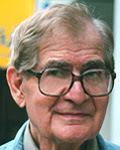
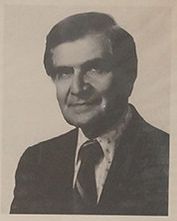
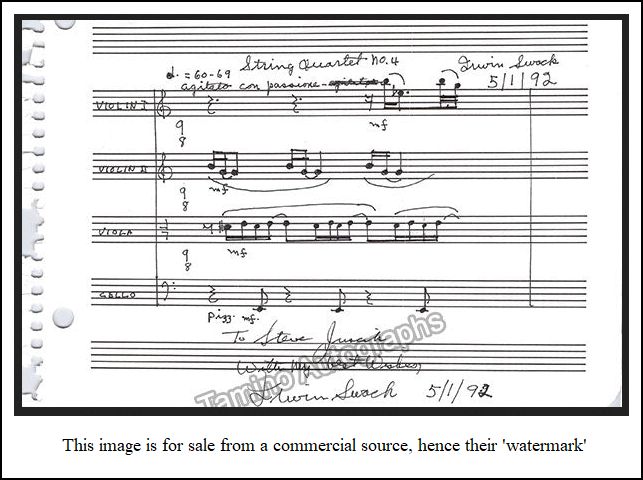
swack swack Irwin Swack (November 8, 1916 – January 2, 2006) was an American composer of contemporary classical music from West Salem, Ohio.

He held degrees from the Cleveland Institute of Music, where he studied violin, graduating with a B.M. in 1939, the Juilliard School, Northwestern University (master's degree), and Columbia University (doctorate). He studied with Henry Cowell and Paul Creston at Columbia University, Gunther Schuller at Tanglewood, Vittorio Giannini at Juilliard, and Normand Lockwood.

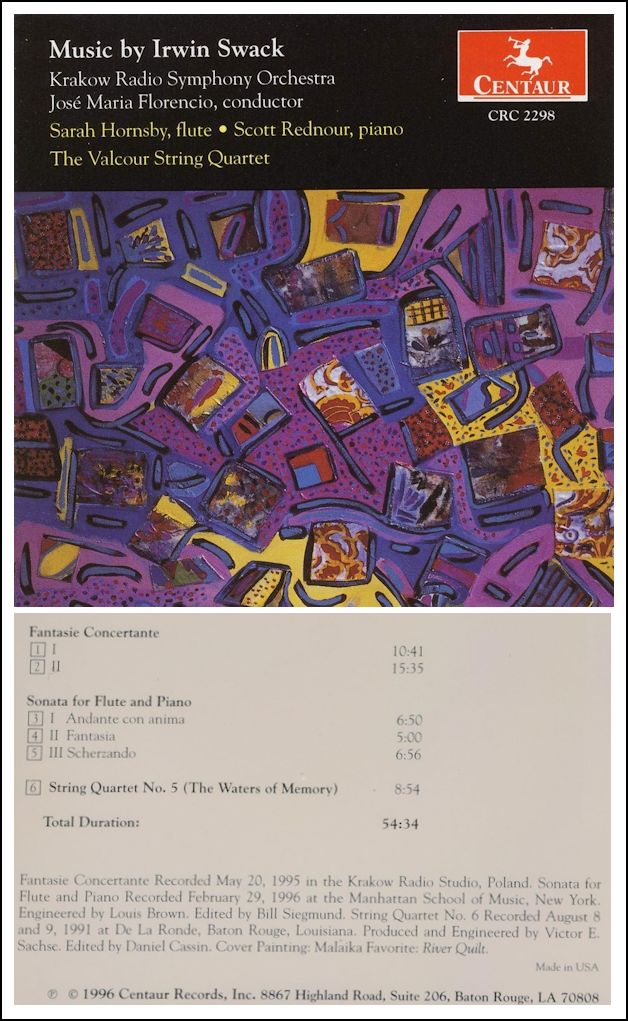
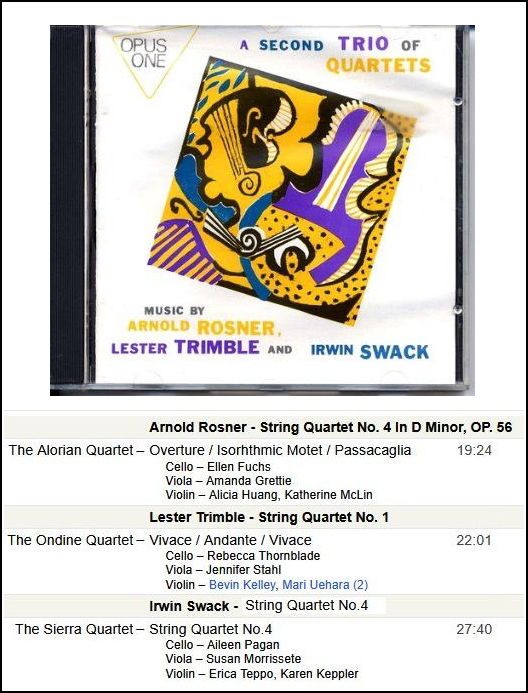
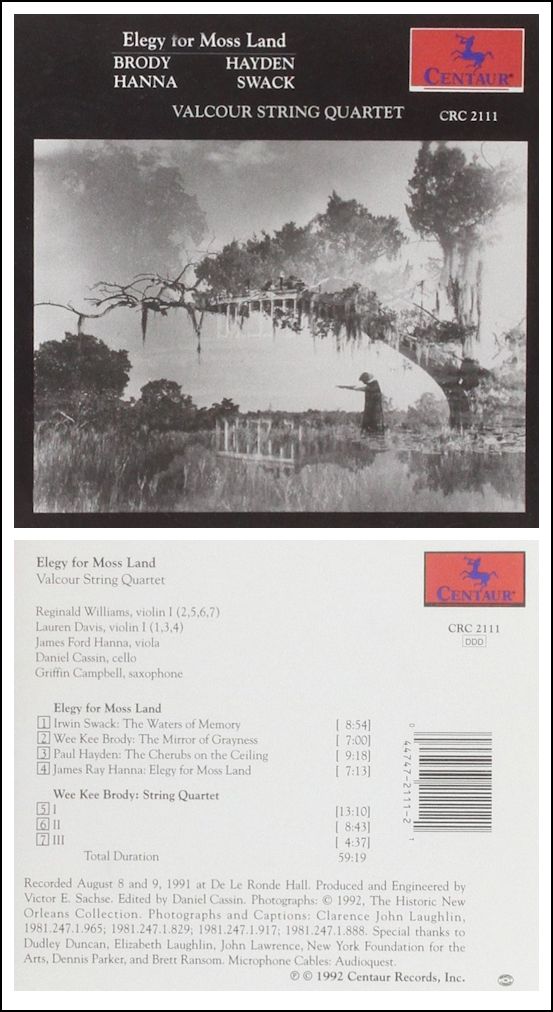
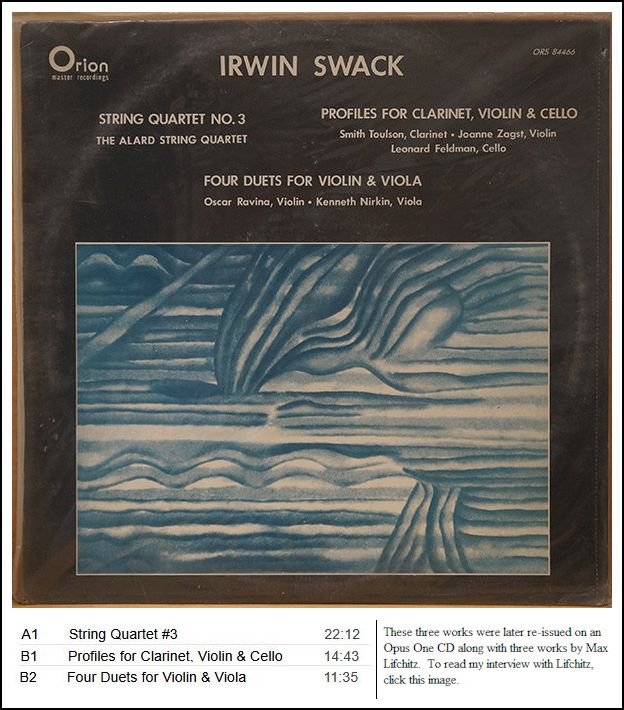
Swack worked as an assistant professor of music at Jacksonville State College. His music was recorded on the Centaur, CRS, Opus One, and Living Artist Recordings labels.

His music is published by Carl Fischer, Shawnee Press, Theodore Presser, and Galaxy Music.

==  Names which are links in this box and below refer to my interviews elsewhere on my website.  BD  


swack


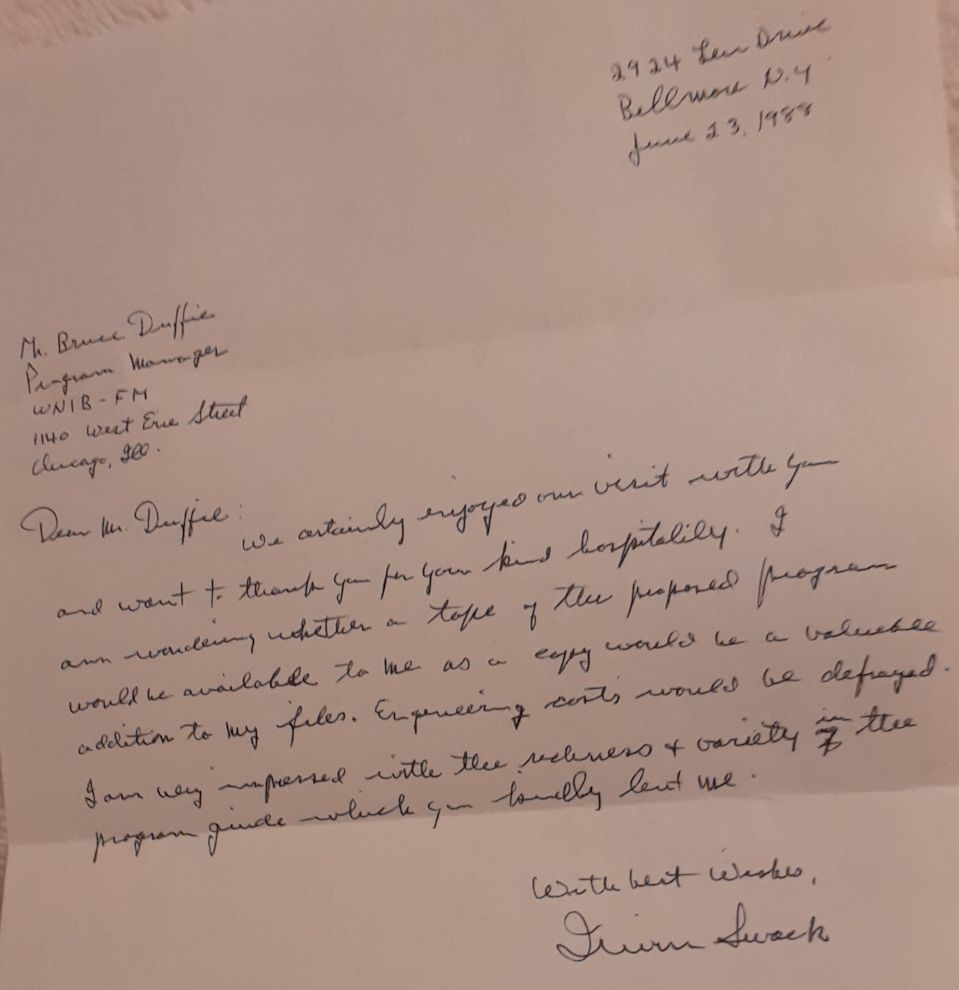
In May of 1988, Irwin Swack returned to Chicago, and graciously agreed to meet at my home studio for a conversation.  He was in very good spirits, and spoke of many musical topics.  Portions of the interview were aired on WNIB, Classical 97, and now, as we begin 2026, I am pleased to present the entire chat on this webpage.
swack
Knowing that he had begun as a violinist before devoting his time to composing and teaching, this is where we began . . . . .


Bruce Duffie:   When did you decide to go from performing to creating?

Irwin Swack:   I have always written, and I decided that perhaps composition was a way for me to go, because I could perhaps carry it further along than as a violinist.  There were so many very fine young violinists when I was growing up, and I found it very difficult.

BD:   Are there too many violinists?

Swack:   It’s possible that there are!  Living in New York, I hear these kids who are twelve, thirteen, fourteen years old who have fabulous technique.

BD:   Is there any chance that there are too many composers these days?

Swack:   It’s possible, but who’s to say who should not be a composer?  [Both laugh]

BD:   Who decides who is a composer?  Is it the composer himself?  Is it the public?  Is it the students?

Swack:   I think it’s the composer himself.  Composers, like artists, writers, and poets seem to be self-driven.  We have a motor that goes no matter what the actual climate happens to be.  We go in our own time and in our own rhythm whether the music is good or bad.  That’s my observation.  I could be wrong, but if there’s a proliferation of composers, perhaps there’s a bigger calling than we need.  [Both laugh]

BD:   Do you ever feel it’s a burden being a composer?

Swack:   Yes.  Composition, or any of the arts, is by nature of its difficulty a burden, because it is an electoral pursuit done in private.  Then there are all kinds of elements that come into play.  We have the critics, we have the public, and we also have the composer himself or herself who is in competition with whoever else is writing.  So composition becomes a difficult profession because there are so many elements that are involved in the success of any one piece.  It’s a difficult situation, and nobody is guaranteeing success, or even appreciation.  That’s the worst of it, but we just go on.

BD:   You do it and hope for the best?

Swack:   I think so.  Maybe other composers can give you other points of view, which they may tell you is more realistic.  I’m trying to be very realistic about this.  Any of the arts is extremely difficult in the truest sense of the word.

BD:   You’re very realistic in you outlook, and you also seem to be more realistic in your view of music, because you write works which can be more accessible than some other composers.

Swack:   Right.  The reason is that the style I use is very natural for me.  I felt for many years that communication is very important for the composer.  He must say something that is of value, and that other people can relate to.  The famous composers produced music that had appeal to the public, and I don’t think that the great music survived just because they were intellectuals.  They had a message in addition to a very artistic expression, and it appeals to the experience of the listener in some way.

*     *     *     *     *

BD:   We’ll come back to your music in just a moment, but you’re also a teacher, and I want to find out where we lost all of the appeal?

Swack:   I think because of the various trends that music took.  Composers started off writing tonally, including the music of Copland and Bernstein...

BD:   ...Roy Harris?

Swack:   Yes, Roy Harris, and Virgil Thomson.  Then it seemed to pass into another kind of situation with the coming of Arnold Schoenberg and the late Viennese composers.  Also there were people such as Milton Babbitt and Charles Wuorinen, and the thing to do in music became to write in the atonal style.  Styles have changed, and with that they lost a good share of the audience, simply because the audience cannot relate to this type of style.

BD:   You did not succumb to this?

Swack:   No, I didn’t.  I realized at that time that this was not the way for me to go.  In the first place, it was not comfortable for me to write in this situation.  It would have been an acquired style, and that would be sacrificing something of myself to acquire a medium which wasn’t natural for me.  So I stuck to my guns, which meant that I write tonally, but try to write interesting music with good clear and concise ideas.  Then I develop them very well.  When you develop a strong technique, hopefully you’ll have a work of art that has some value.

BD:   This is the style you wanted to use.  Were you using the style, or was that style really using you?

Swack:   I felt that I have always been interested in tonal music.  I’ve always been interested in melody, and quite a long while ago, even as a student, I felt that without melody, composition wasn’t worth the effort.  This is the best way I could communicate my music to others, so I stuck to this style, and will probably always write in a tonal, melodic orientation.
swack
BD:   What do you expect of the audience that comes to hear your music?
 
Swack:   The audience has a great appreciation for my style of music.  I never had a problem of audiences being alienated to my type of sound.  They seem to appreciate and understand what I’m doing.  I can’t speak for its artistic worth, but in the manner of communication, it is successful on that level.

BD:   Who is the ultimate judge of whether it’s successful?  Is it you, or is the performers, or is it the public?

Swack:   I think it’s the public.  If the public will inquire and require the hearing of a composer like myself.  Then it becomes more and more into the repertoire of the general music source.  Does the audience want to hear it?  The ultimate test of a composition is whether you want to hear it again, and how many times.  Is it just another time, or do they find this interesting enough that they’d like to hear it more than once.  [Laughs] This is a legitimate test, and I think it’s worthwhile.

BD:   As a contemporary composer, do you find yourself stained with the brush of Milton Babbitt, and Elliott Carter, and Arnold Schoenberg, and not getting the hearings you might if people knew that you wrote in an accessible style?

Swack:   No, I really don’t.  The atonalists are having quite a problem today.  There was an article in The New York Times last Sunday written by Charles Wuorinen.  He was complaining about the fact that the audiences are not relating to atonal music, and wondering why.  Are we losing audiences, or are audiences educated to the fact that this is more difficult music, and they have to look at it in a different way?  Personally I think that the twelve-toners, the atonalism, is on the way out, and minimalists are now coming back to a semblance of melodic line.  However, this is another style, and I don’t see a great future for minimalism.  I think it’s passing like other styles have passed, and I have had a strong feeling for some time that music will eventually get back to the melodic line, and to sounds that are more or less listenable.  It may take more time, but eventually it has to, because if you don’t have an audience, who are you going to play for?

BD:   Let me play Devil’s Advocate just for one moment.   What’s going to happen to the audience that Wuorinen, and Babbitt, and Carter have built up over the last few years?  Small as it may be, what’s going to happen to those people?

Swack:   I’m sure there’s always going to be an audience for any aspect of music, though the audiences are relatively small.  There are audiences perhaps of students, and perhaps other composers who write in the same vein, but I’m talking about the general audience of the lawyers, the doctors, the candle makers, the butchers who would go to Carnegie Hall for an afternoon.  These people are very, very smart when it comes to judging art.  You don’t have to have an education to understand if the music is communicating or not.

BD:   Are they going to start coming back to Carnegie Hall, or are they going to go to rock concerts?

Swack:   They may go to rock concerts.  There are many kinds of music.  There’s no one kind of music that’s going to solve any problem, and the rock audiences are different than for what we call serious music.

BD:   Let’s cut through to the heart of the matter.  What is the purpose of music in society?

Swack:   There seems to be a need for it.  If there wasn’t a need for it, we probably wouldn’t have it.  Perhaps it tells us something about ourselves, and maybe we are looking for something, such as an answer to our own problems, or a philosophical reason for being.  Like any art, audiences find a certain appeal in a message a composer or an artist has to give, and it’s something of a universal message.  Exactly what it is, I’m afraid I can’t tell you.  It’s very subtle, but it certainly is a need that the audiences have.  They’re going to the concert looking for a certain kind of self-fulfilment, which the atonalists have not provided.

BD:   Do you feel your music provides this?

Swack:   I think it does in a limited way.  I remember the audience’s reaction to my music, and I’ve experienced the fact that many people from different walks of life have responded to it.  My music is very accessible, so perhaps that is one reason for it.

*     *     *     *     *

BD:   What are you currently working on?

Swack:   I’m working on a piece I’m calling a symphony.  It’s a reworking of the Third String Quartet for string orchestra.  I find it very adaptable for the string orchestra because it’s a dramatic work, and I think it will lend itself for the addition of more strings.  I have that pretty well completed now.

BD:   Is this on commission, or is it something you just had to write?

Swack:   It’s something I’m doing on my own simply because I thought of the idea and the possibilities.  I think it will work out very well.  That should be interesting, and after that I probably will work on a trio for piano, violin and either clarinet or cello.

BD:   Are some of the pieces you write on commission?
swack
Swack:   Some of them are on commission.  For instance, I’ve just finished a duet for Stanley and Naomi Drucker.  He is the principal clarinet in the New York Philharmonic, and his wife is also very fine clarinetist.  They asked me to write a duo for them, which I’ve finished and they have it now.  Before that, I wrote a Divertimento for the American Chamber Ensemble, which Naomi Drucker heads, and that was performed at Hofstra University last November.

BD:   When you get a commission, how do you decide whether you’ll accept it, or postpone it, or decline it?

Swack:   Generally we decide before it’s even offered as to the feasibility of writing for this combination of instruments.  Then, if it is, I try to accommodate the group so that they’re able to finance it.  The music of the Divertimento is much different from the very serious music that has been recorded.  I have a rag-time, a waltz, and a piece I call celebration, as well as Summer Moon, which is an atmospheric piece.  So it’s in an entirely different direction that I went.

BD:   In your music, or music in general, where is the balance between the artistic achievement and the entertainment value?

Swack:   There always should be an artistic achievement in anything you write.  Simply because a piece is entertaining, doesn’t necessarily mean that it is less intellectual, or less effective as an artistic piece of music.  It’s just another medium, so I feel strongly that it can be achieved.

BD:   You’ve also been teaching music for many years.  Do you get enough time to compose?

Swack:   I manage to savor my time.  I have it arranged now so that I can write in the morning and in the evening, and I teach in the afternoon.  So I can get in around four hours of writing time per day if I choose.

BD:   Do you write every day?

Swack:   Yes, I write about every day.

BD:   Do you have more than one thing going on at once, or do you work just on one piece at a time?

Swack:   I have never tried to write more than one piece.  I remember the stories of Beethoven who was able to juggle three or four pieces at one time, and I understand that it has to do with the mechanism in the brain that will allow a person to do this type of work and still keep them separate.  Mozart could do that as well, but for my simple brain, I have to keep things separate, and work on those separate entities.

BD:   In a way, are you not juggling several things?  You are composing one piece of music, evaluating a student’s piece of music, and deciding what you’re going to talk about in a lecture?

Swack:   I can separate my school from my work, which I do very well.  As far as my own music is concerned, juggling various sections is just about that, and I realize it more and more when you have to make corrections in a piece of music.  Once the music is finished, then you feel you can improve it, so you try that, and you have to go all the way down the line to justify your change.  This is most difficult.

BD:   Do you ever go back and make revisions in a score?

Swack:   I certainly do, even after the first performance.  I have no compunction about changing anything at any time that will improve the piece.

BD:   Are historians ever going to go back and decide which version to play between the Urtext and the revisions?

Swack:   I’m careful to write all the revisions down in the master-copy, so it will show I have everything down that I choose to have down.

BD:   Do you make revisions after it’s been published?

Swack:   No, I really don’t, because it does lay a burden onto the publisher to go through all the copies.  I try to be sure that everything I plan to change is changed before it goes into publication.

BD:   When you’re working on a score, how do you know when you’ve finished?

Swack:   A very good question!  I’m not sure that I know the answer, but through experience I have begun to realize that generally the composer writes too much.  So that makes me very alert about how a piece should end, or how long a piece should continue.  I’m not sure how other composers feel about this, but I will be very conscious of the form, and if something has been on too long, or if it should end sooner and I should take out this measure because it doesn’t add anything to what I said before, and where it’s going.  So I will perhaps eliminate it.  I have eliminated bushels of what I thought was good material of music, simply because I felt it didn’t fit.  It was just too much.

BD:   Does that material then show up in other pieces?

Swack:   [Laughs]  No, generally it won’t fit, and so I just throw it away.  I’m satisfied if it’s a better piece.

BD:   When you’re writing a piece, are you always in control of that pencil, or are there times when that pencil is really controlling you?

Swack:   That’s also a good question!  Music will take you even into areas where you really don’t want to go, because it does create certain difficulty.  After a while, music does have a life of its own, because the logic of the situation says that this music should move in a certain way, and a certain way may be outside of the orbit of where you had intended to go.  There’s a problem of controlling the direction of that, but I will generally let it go and see where it leads.  Perhaps one can come up with a better idea because of the evolution of that motif, so that has some value.

BD:   You say that music has a certain logic.  Is music always logical?

Swack:   Food music should always be logical.  Music should be written as clearly as possible, and that doesn’t negate any of its intellectual value.  It should be clearly stated, have a logical presentation and a logical development.  Logic is not equated with ordinary or simple values.  Logic means that you have a clear idea as to how this music should be developed.  When the public can relate to it, it becomes a better piece.

*     *     *     *     *
swack
BD:   You spoke about music having good material.  What makes a piece of music good, or even great?

Swack:   You certainly have a knack for hard questions!  [Both laugh]  I don’t know if I’m the one to answer it, but I’ll make a stab at it.  I think good music has artistic values that will stand up under intellectual and emotional view.  A certain amount of logic in it will heighten the value of that piece of music.  Also, music should have an emotional appeal to the audience.  It should say something in an artistic way, and perhaps, if we’re lucky, it will have some kind of a message, whatever that happens to be.

BD:   Do you try to write this into your music?

Swack:   Yes, I do try.  I can’t say how successful I am, or if I’m ever successful, but I do have these ideas in mind.

BD:   Is it not a foregone conclusion that you’ve had at least some success with repeated performances, and the recordings?

Swack:   Yes, I’ve had some success in that manner.  Perhaps that’s what keeps a person like me going and writing more music.

BD:   What advice do you have for your students, or younger composers, coming along?

Swack:   My advice is to gather all the technique that you can, study as many different styles as you can, listen to what is contemporary and what had been done, have a good strong knowledge of the classics, meaning the Baroque and the other periods of music, and study the early forms.  Have a good technique so that you can know how to develop a piece of music.  Study orchestration, and try and have your music performed as much as possible.  The last thing I would tell them is to be true to yourself.  Don’t use an acquired system, but use a system of writing that is natural for you.

BD:   You bring up the idea of learning technique.  Where is the balance between the technique and the inspiration?

Swack:   The inspiration, or what we call musicianship, or a divine spark is a little bit misunderstood.  A fine composer who has a great ability to communicate his ideas should be able to sit down and write a decent melody and a decent accompaniment.  In other words, he should be so well schooled that he should be able to write something that is of artistic value at just about any time.  If one is lucky enough to have this spark of imagination in which he can create a beautiful melody and a great harmonic progression, this is an added bonus.  Occasionally it is possible to achieve these heights while improvising.  I can get ideas sometimes that I think are unusually good.  I know I should hold onto it, and then work it out in another way.  The great composers were writing all the time.  I think Dvořák mentioned that he wrote thirty or forty measures every single day, so just as a fine craftsman, a fine composer should be able to write good music at any particular time.

BD:   Is composing fun?

Swack:   Sometimes!  It’s kind of satisfying.  I have a need to do this, but fun?  I’m not sure if that’s the right word.  Compulsion is a better word.  It can be satisfying after you have heard something you’ve written, and you begin to think it wasn’t too bad.  Maybe that’s the reward we get.

BD:   Is there anything that stands out in your mind as being surprising, or upsetting, or enlightening that you’ve noticed in music during your life thus far?

Swack:   I’ve noticed that the various schools are constantly changing, and perhaps there’s a reason for that.  Maybe they’ve always changed.  During the Baroque period, we had Bach writing in his contrapuntal style, and in his day he was at times considered old-fashioned.  His sons wrote differently from their father.  Bach was primarily a contrapuntal composer, and his sons, particularly Johann Christian Bach, was a homophonic composer.  In other words, he utilized melody and harmony.  So music does go through a process of change, and music is changing now.  As far as what will live and what won’t live, posterity will sort everything out.  It’s not up to me to judge what is going to stay and what isn’t, but I’m rather sure of one thing, and that is that music must relate to audiences if a certain style is going to be here to stay and prevail.

BD:   Are you optimistic about the future of music?

Swack:   Yes, I think the audiences will win out.

BD:   I’m glad that it all worked out that you were able to visit me this afternoon.  Thank you for this conversation.

Swack:   Yes, I enjoyed meeting you.  It was such a pleasure being here.


========                ========                ========
-----        -----        -----
========                ========                ========


© 1988 Bruce Duffie

This conversation was recorded in my home studio in Chicago on May 11, 1988.  Portions were broadcast on WNIB the following year, and again in 1994 and 1999.  This transcription was made at the end of 2025, and posted on this website at that time.  My thanks to British soprano Una Barry for her help in preparing this website presentation.

To see a full list (with links) of interviews which have been transcribed and posted on this website, click here.  To read my thoughts on editing these interviews for print, as well as a few other interesting observations, click here.

*     *     *     *     *

Award - winning broadcaster Bruce Duffie was with WNIB, Classical 97 in Chicago from 1975 until its final moment as a classical station in February of 2001.  His interviews have also appeared in various magazines and journals since 1980, and he continued his broadcast series on WNUR-FM, as well as on Contemporary Classical Internet Radio.

You are invited to visit his website for more information about his work, including selected transcripts of other interviews, plus a full list of his guests.  He would also like to call your attention to the photos and information about his grandfather, who was a pioneer in the automotive field more than a century ago.  You may also send him E-Mail with comments, questions and suggestions.