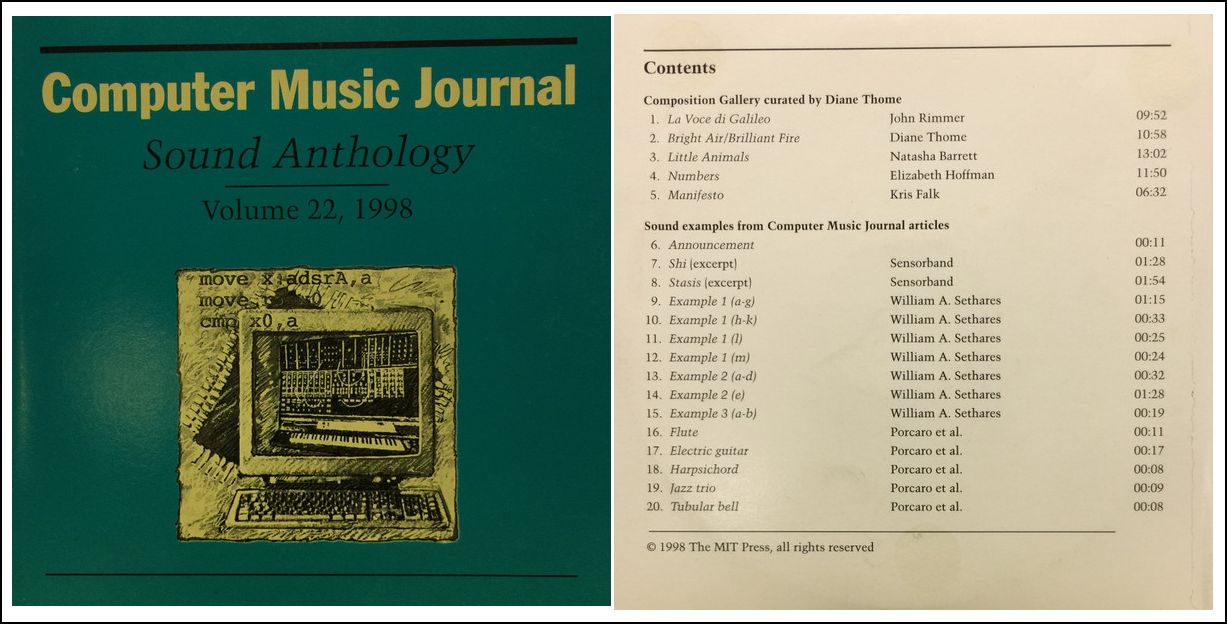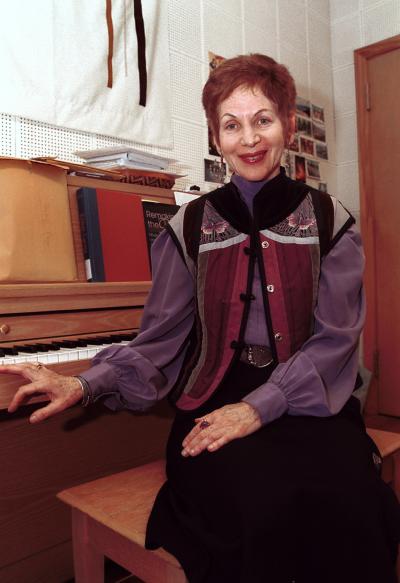
Composer / Pianist  Diane  Thome

A Conversation with Bruce Duffie


thome


Diane Thome (January 25, 1942 - January 12, 2025) was an American composer. She studied piano with Dorothy Taubman and Orazio Frugoni and composition with Robert Strassburg, Roy Harris, Darius Milhaud, A.U. Boscovich, and Milton Babbitt.

Thome graduated with two undergraduate degrees from Eastman School of Music with distinction in piano and composition, a Master of Arts in theory and composition from the University of Pennsylvania, and a Master of Fine Arts and Ph.D in composition from Princeton University. She was the first woman to receive a Ph.D. in music from Princeton University.

After completing her studies, Thome became a professor and then chair of the Composition Program at the University of Washington School of Music. Thome's compositions have been performed in Europe, China, Australia, Canada, Israel and the United States. She has been composer-in-residence at the University of Sussex and the Chamber Music Conference and Composers' Forum of the East (Bennington, Vermont). Her compositions have been featured on French radio.

Thome has received commissions from organizations including the Bremerton Symphony Association, Seattle Symphony, New Jersey Symphony Orchestra, The Eleusis Consortium, The Esoterics, and Trimpin.

==  Names which are links in this box and below refer to my interviews elsewhere on my website.  BD  


thome


In July of 1987, on the second of my two visits to Seattle for performances of their Wagner Festival (and delightful trips to Alaska!), I had the opportunity to interview a few members of the cast, as well as other musicians who resided in the Pacific Northwest.  One such encounter was with composer/pianist Diane Thome.  She graciously drove to the apartment where I was staying, and we spent more than an hour discussing her views, as well as her specific works.
thome
A couple of years later, and twice subsequently, I was able to present portions of the conversation, along with some of her recordings on WNIB, Classical 97 in Chicago.  Now, nearly forty years later, I am pleased to be able to share a transcript of the entire meeting.

As we were setting up to record, our conversation centered on her two latest works . . . . .


Bruce Duffie:   How do the two new pieces compare?  Are they the same or different from the older pieces?

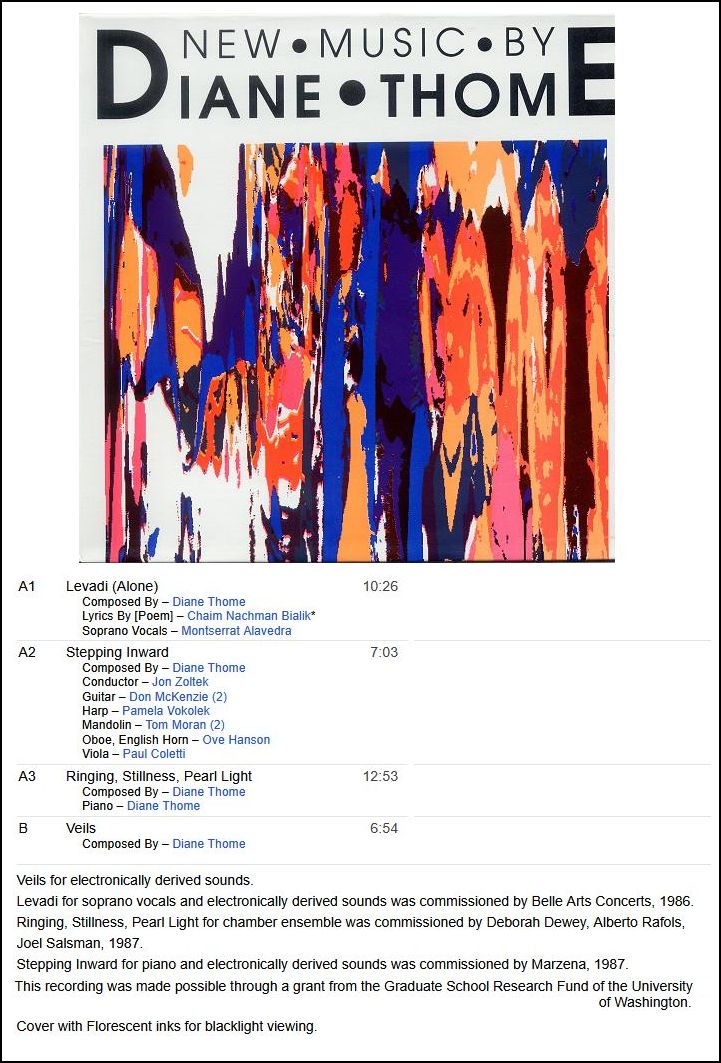
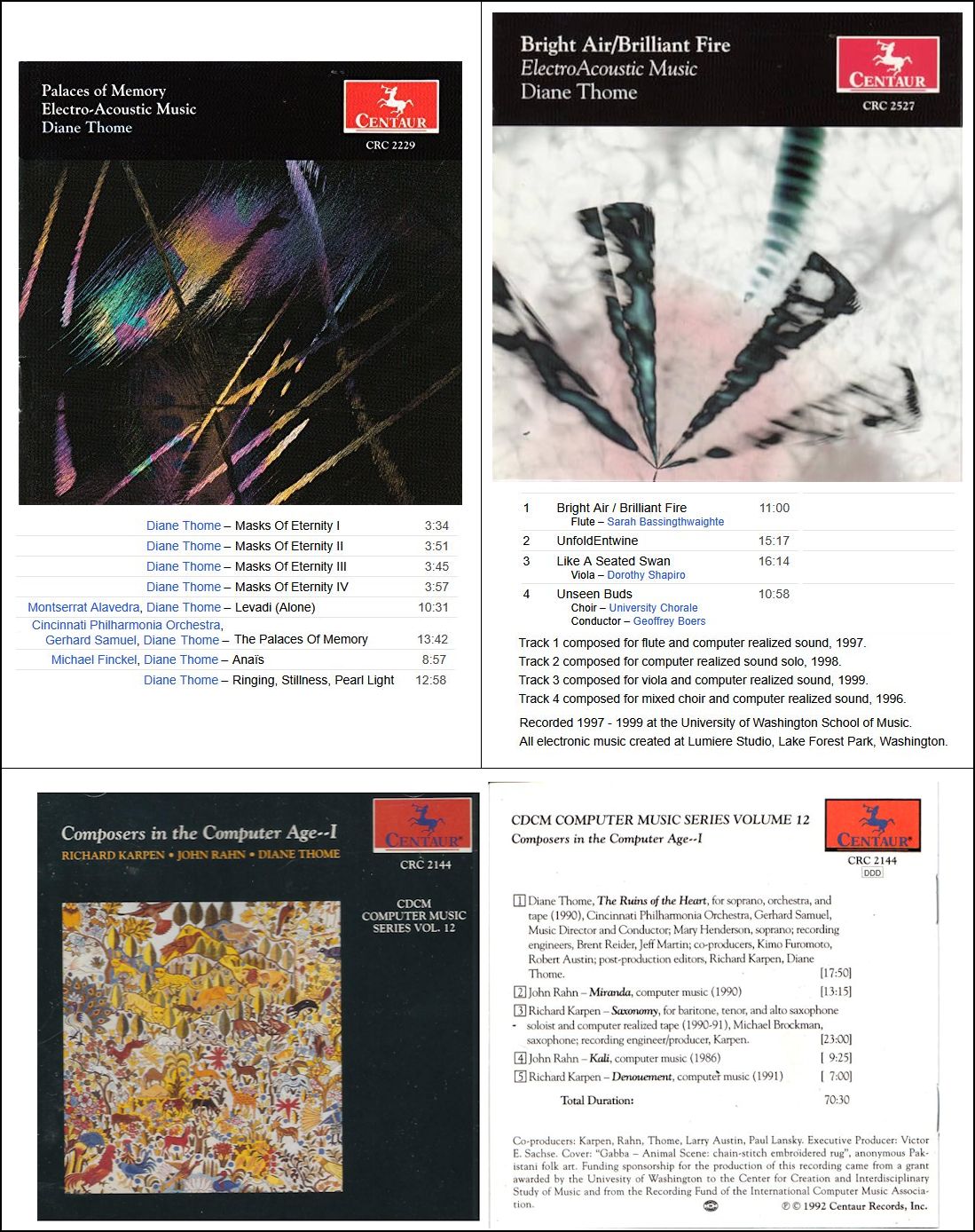
Diane Thome:   The two new pieces are also somewhat different from each other.  One of them [Levadi] is for soprano and electronic tape, and that represents a continuation of my interest in the electronic medium, along with using some different electronic instruments.  The other piece [Stepping Inward] was commissioned for the Marzena ensemble here in Seattle, and just premiered about two months ago.  It was recorded for Opus One about three weeks ago.  That’s for oboe doubling English horn, viola, harp, guitar, and mandolin.  [Recording shown at left.]

BD:   Why that particular instrumentation?

Thome:   They had a trio of harp, guitar, and mandolin, which they originally commissioned a piece for.  Then I found out they occasionally use a marvelous oboist and a marvelous violist.  The trio was wonderful, but I decided to amplify and extend the instrumentation.  I would say that in some respects these two new pieces reflect my ongoing interest in both live instrumental music and combinations of tape.

BD:   What fascinates you about electronic music?

Thome:   Many things fascinate me.  First, there is the enormous degree of control of the timbral domain, and also the rhythmic domain, and the frequency domain.  Then, there are the possibilities of multi-layerings, and also the different sound sources.  The whole conception of a performance is that you have a lot of control.  I hesitate to say this, but any composer who’s ever dealt with large groups of musicians in live performance situations, finds they’re very much at the mercy of that live situation.

BD:   So you like more control?

Thome:   I like a lot of control.  It’s not only control over the performance, but also the control over the exact proportion of sound and the types of sounds.  When I was working with a computer as a graduate student in Princeton, I structured every sound in a very precise way.  I was also experimenting, because at that time computer synthesis was pretty new.

BD:   You don’t lose the human element by having the electronics and not a human performer?

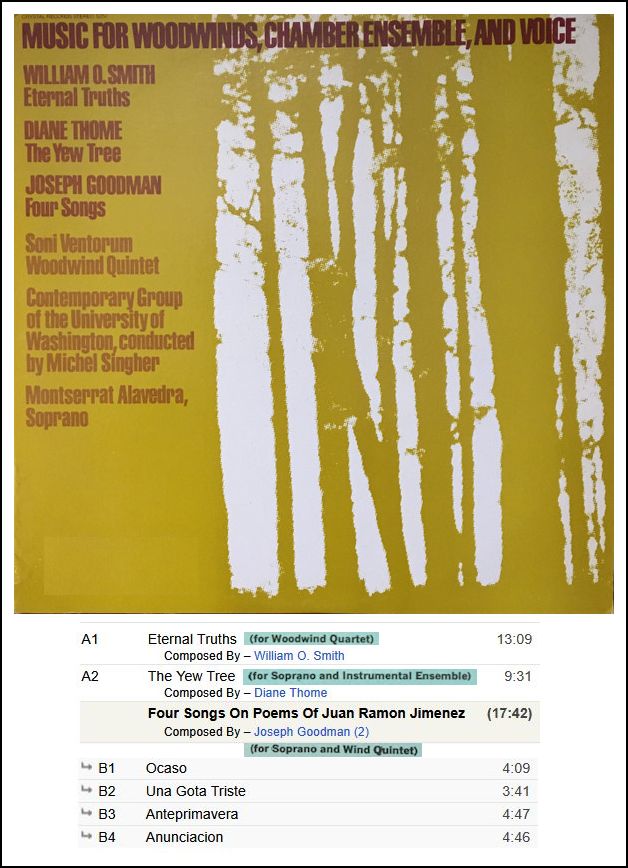
Thome:   The human element is present as long as human beings are involved in a creative act.  After all, when you turn on a record and you’re only listening, everything is on tape or on disc.  You could ask where’s the human element?  You don’t have any people you can see.  This is a false argument.  It’s very important and very legitimate to ask why go to a concert and look at speakers, or listen to speakers, or listen to electronic music in a concert situation?  The whole act of listening can be done in many different environments.  I happen to have a classical performance background, and I am certainly all in favor and support of the performer.  I usually come to my chamber pieces which involve tape and instruments, with a performer outlook.  Once the tape is done, then I sit down as if I were a performer, not as if I’m a composer anymore.  That’s very interesting to me.  As a matter of fact, I just had a nice long talk with Montserrat Alavedra, who is the soloist for the soprano and tape piece.  [Recording of this work is shown below-right.  Also see my interviews with William O. [Bill] Smith, and Joseph Goodman.]  With a group of people, we talked about this whole matter of composers working with performers.  If the composer has a certain view of a performer, and a certain view of music, it’s a totally different relationship.  I’m a performer myself, so once it’s finished I come to the piece as a performer, and then I think about the interpretation of it.

BD:   Are you a better composer because you are also a performer?

Thome:   That’s a hard thing for me to say.  I might be a different composer because I’m a performer, and I’m always interested, especially in a live performance situation, in various modifications or perspectives that a performer
s intelligence would bring to such a piece.  Then I put on another hat, and I feel another part of myself coming into play.  That’s true even if I write a live performance piece.  I wrote a solo piano piece for the first time in my life about six years ago.  I’m a pianist, and I had never written a piano piece!  Once I finished it, I noticed that to learn it as a performer was a completely different experience for me, and I was really confronted with what I’m telling you in a very concrete way.

BD:   Did you ever want to ask the composer,
Why did you do this???”

Thome:   [Laughs]  No, but it was interesting to look at my own music as a performer, and basically feel very detached from it.  I was suddenly shocked at how distant I was from that composer, and how I was really looking at that piece as a pianist.  At times I was really very pleased, the way a performer who was just looking at a new piece would be pleased to discover something about a piece.  I have great confidence in good performers.  They see things about the piece in terms of interpreting it that you don’t particularly focus on while you’re writing it.  So to answer your original question, I don’t see the electronic medium as unhuman.  It offers enormous opportunities for extending the range of possibilities for composers in these various domains.  On a practical level, it’s part of our time.  It’s part of the use of technology, and it’s part of another perspective about space and time.  For example, if you’re interested in opening up very new fields of timbre, that’s one way to go.  A flute is a flute, and a clarinet is a clarinet, and an oboe is an oboe...

BD:   ...but an oscillator can be many things?

Thome:   Yes.  You can do many things when you combine oscillators.  You perform various kinds of modifications and various kinds of electronic manipulations.  Also there’s a huge range of synthesizers and digital control of these operations.  Since I was a graduate student at Princeton, which is when I first began to write electronic music, there has just been a revolution, even though the medium had been around for many decades.  Computer synthesis really began in the early ’60s, and it’s a very exciting addition to the possibilities for writing music.
thome
BD:   Are you always looking for new sounds to put into the music?

Thome:   Yes, but I’m also looking for something else.  It’s not just a matter of finding a new sound.  In a sense, it’s a matter of reconceptualizing possibilities for relationships within the structure of a piece.  It’s not just the sounds.  It’s the fact that you can have very many different temporal and frequency and timbral and registral and spatial relationships.  You have them all much more available to you much more quickly.  Let’s say you want to write very large pieces which would take four or five orchestras.  Most of us, as composers, don’t have access to four or five orchestras or five conductors.  With a really large system, theoretically it’s absolutely reasonable.  You could try all of these things out and really start to extend and inspire.

BD:   By combining and recombining everything?

Thome:   Right.  You could really open your thinking and your hearing.

BD:   Is this what you expect from the public, that they open their ears, open their thinking, and open their minds?

Thome:   With the new music public, certainly.  There are many musical publics, and I don’t think everyone wants to have his or her eyes and ears expanded.  A lot of people like what they like, but there is a public that wants to see music advance.  They think of music and other arts as having possibilities for opening their consciousness by thinking, and hearing, and seeing.  That’s the public I’m interested in, and I’m part of that public.  That’s why I like to go to new music concerts, and exhibits of art, and certain types of poetry readings.  It’s not that I’m not also interested in the tradition.  I have a great love and respect for the tradition.  I have a classical background, and I teach many, many courses which concentrate on the traditions of 1,000 years.  But I’m a composer, so it’s not enough for me to stay and rest in that bygone era.  The audience I’m interested in, in a sense, starts first with me.  That’s true for all composers.

BD:   I trust you don’t want to limit your compositions to just this new music audience.

Thome:   Oh, I’m very happy with whatever audience.  I’m not saying this is the only audience, but for people who have no experience with contemporary music, there has to be a certain kind of outside work done just to get them to walk into the theater or the hall where it’s going to be programmed.  I’ve lived in a number of American cities, and I’ve lived abroad, and I’ve had a number of outstanding 20th century composers as my teachers.  So, my experience has been that if there’s a contemporary music series on, there’s a certain audience that has been developed for that, and they come for that.  It’s not the audience that goes to the orchestra concerts, or the opera, or the ballet.  Maybe there are small numbers of people who are exceptions to that, but there are a number of new music audiences.  For example, I went to the Philip Glass concert here a few years ago, and that was a particular audience.  I noticed that Bill Smith and I both went, and it was a very different audience than you’d see for even a contemporary music concert.

BD:   Can you give a reason for that, or is it just the way it is?

Thome:   There are reasons for that.  Clearly there’s a very big rock audience, and there’s also an audience that I recognize as having, at least in Seattle, some connections with dance.  A lot of it has to do with the type of music, and also the type of performers, and also the decibel level!  A rock audience is used to a very loud, repetitious, reiterative, strong, forceful, and also a fairly theatrical kind of presentation.  Those are some of my observations.

BD:   Are we blurring the lines between the rock audience and the concert music audience?

Thome:   Some musics are already doing that.

BD:   Is that a good thing?

Thome:   It’s fine.  It’s inevitable.  We have a very open culture in a way.  We have many audiences, and many musics, and many repertoires, and it’s inevitable that people are going to have combinations sometimes.  There are also artists and composers who will very consciously seek out ways to amalgamate these things in their own work.  After all, when you also think about pop art, and artists and painters that support musicians, it’s not an unprecedented situation.  When you think about Stravinsky and the early ballets, those weren’t music audiences.  Those were dance audiences.  So these various art forms try to make themselves heard.  They make a present statement, and however they do it, it is usually singular, and individual, and particular to a situation and a locale and a geography and the people that you collaborate with.  If you collaborate with filmmakers and painters, there’s going to be an audience that will be impacted by that.  If you work with dancers and choreographers, that’s another audience.  Then if you work with a lot of rock musicians, that’s another audience, and then you can do some kind of combination of these things.  So the possibilities are really very large. There is also a very strict kind of concert repertoire outlook, too.

BD:   Is there ever a case where we get too many kinds of things trying to make their way in the society?

Thome:   You’re talking about a splintering syndrome, a compartmentalization.  There are people who would say maybe we suffer from that in this country.  There are so many little pockets of this and that, that it’s almost a choked situation, or it’s an overload.  Is it bad?  Is it good?  It’s inevitable.  We have a large democratic culture, and it’s a decentralized one.  It’s a market culture.

BD:   At what point does the market become saturated?

Thome:   It’s been saturated for some time, and I don’t even think that what it’s saturated with is particularly good for the most part, even commercially.  It’s just part of the energy in this country to get there and get the piece on.

BD:   Who makes the decision whether a piece will stay?  Is it the composer?  Is it the public?

Thome:   It’s not the composer.  It’s a combination of fickle circumstances.  You know the stories about one of the Ives symphonies which Mahler had intended to program with the New York Philharmonic.  It would have been premiered or heard for the first time, but Mahler died the year before he was to present it.  It wasn’t heard for 30 or 40 years, so who’s responsible for whether the piece comes around?  Performers have a lot to do with it, in the sense that a piece has no chance if it’s not put out there.  If it’s not performed, and if it’s not presented, then it’s not heard.  There’s not a cadre of people who read musical scores and will say that they have to hear the piece.  Also, the public needs to hear the piece more than once.
thome  
BD:   [With a sigh]  The era of hausmusik is dead.  [Hausmusik is music that is played in the home by amateurs.]

Thome:   Right.  Music needs to be disseminated.  It needs to be recorded.  So I don’t think that’s up to the composer, unless the composer happens to be an entrepreneur.  Richard Strauss was very good at that.  He had something to do with that kind of success.  But there are a number of composers who either become conductors of their own music, or they form their own groups.  This is all a matter of artistic survival.  It’s up to any number of factors.  It can be up to the performance, up to conductors, up to recordings, up to reviewers, up to critics.

BD:   With all of this going against it, does the great music always filter itself up to the top?

Thome:   We only know what has filtered up to the top.  We don’t know really what hasn’t.

BD:   Are there, perhaps, some great scores lurking around which haven’t been heard?

Thome:   You could talk to a scholar who really has researched this.  Every so often people come up with unheard great scores.  I don’t know that I’m a good person to answer that, because we know what we know, and the people who dig into the history and look through scores that have never been heard, and who are really scholarly about it, and who are in a position to advance on performances who could say so-and-so has been overlooked, and this is someone 40 years ago who wrote four or five fabulous works.  I can’t tell you that I know any great composers whose works you haven’t heard, because I haven’t done that kind of research.  For me to give a statistical guess about how many greats we’re missing is a very good question.  I’ve thought about it, and there’s no doubt there are probably very fine pieces that have gone unheard and unnoticed and unacknowledged.  That’s one of the great sad things about doing works.  There’s that old question about Mendelssohn and Bach... if Mendelssohn hadn’t done the St. Matthew Passion, would Bach still be a great composer even if you’d never heard those works?

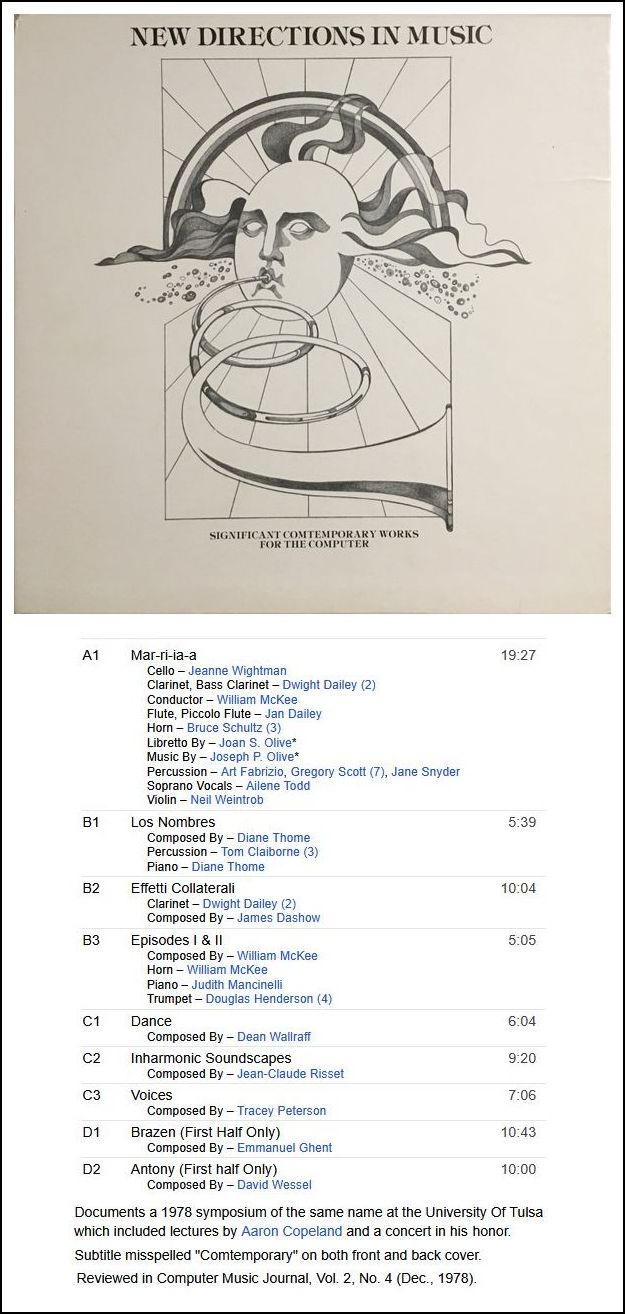
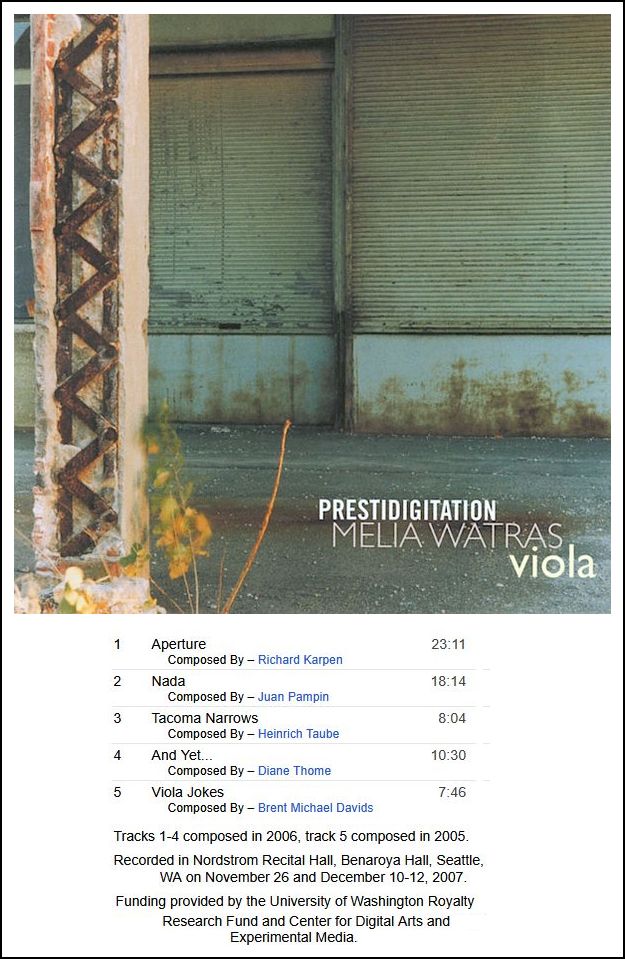
BD:   I see the dilemma.  Well, what constitutes a great piece of music?  [Vis-à-vis the recording shown at left, see my interview with James Dashow.]

Thome:   [Laughs]  You’re asking all the difficult questions!

BD:   Then let me change it a little bit.  What are some of the things to look for that are the ingredients to help make a piece of music great?

Thome:   There are fundamental baseline things that will just get it up to a level.  These include its coherence, its integrity, its intelligibility, its comprehensibility, and its clarity.  That does not make for greatness, but greatness cannot exist without those things.  Great pieces are informed by a number of qualities that really go way beyond those fundamental foundation points, and that has to do with having something to say, something to communicate, something that’s inspiring, and perhaps something that can affect the consciousness.  When I think of the works that I feel are great, it’s because they succeed in a compositional way as very fine works in terms of their own materials, and the technique, and the craft, and the inevitability with which the composers have somehow completed them and have fashioned them.  They speak to me on some very special, unique, individual and often very high level.  These include the late Beethoven quartets, the Bach B Minor Mass, and Chopin Mazurkas.  It’s a communication on some meaningful, symbolic level.

BD:   Do you strive to put all of these things into your pieces of music?

Thome:   I don’t know if you can.  The best answer is yes.  I would like to make the pieces good as possible in a technical way, but there’s not any point in doing that if I don’t have something to say.  There are a lot of works in literature and painting and any art where people have a fantastic technique.  You say it’s wonderfully done, but it’s just that it wasn’t anything that is really meaningful.

BD:   In thinking about all this, where is the balance between the creative inspiration and the technical ability?

Thome:   I don’t think it’s so much a balance.  I see one as the foundation.  There’s no point in attempting to do anything, to communicate anything if you don’t have the technique and craft with which to do it.  On the other hand, if there’s only technique and craft, then the pieces are not very interesting as far as I’m concerned.  Maybe this is a little bit of an unfair judgment, because there’s a great deal of work that has to be done, especially in new media, to establish some kind of minimum level of expertise.  There’s a long, hard push that one has to go through, and that the profession has to go through.  The great composers do not exist or come out of some kind of vacuum.  That there’s tremendous elaboration and development of language that carries them.  For example, tonality comes to a certain stage, and that stage is also advanced by and pushed and stretched by composers.  But they also grow from that.  It’s a little bit of that question which is central of the soil in which you are growing, and what it is that you have to add to enrich that soil.  That’s very hard for people to answer about themselves.  They can say that they attempt this or that, or that they try to see what they would like.  So about myself, I would like to come out of a 20th century pluralist type of musical compositional situation, which has been expanded enormously with many, many possibilities in terms of what’s happened internally to music.  This utilizes tonality and serialism and aleatoric and stochastic and many other ways of dealing with the pitch domain.  Then it also has the possibilities for the application of technology to the arts, and very, very refined types of structurings of different dimensions of works, such as timbre and rhythm and so forth.  So my interest has to do with both dealing with the tradition, in the sense of what is happening, what the meaning of tonality is for a 20th century composer, and how tonality and atonality and serialism can perhaps be incorporated in combination.  This is all because I’m not really a person with just one way of using the pitch domain of one approach.  That’s one aspect.  Then I deal with how I can do that in an intelligible and consistent and convincing way.  We’re talking about something technical right now.  How can I do that?  How can I also use the technology that I have available to me in ways that I find musical?  Oftentimes there are pieces which use the technology in very daring ways, but they’re not particularly attractive as music.  These are the technical questions.  Then there’s the question of what it is that I want to say as a composer.  Am I interested only in pattern-making?  Am I interested in formalism?  Am I interested in some kind of enlargement of a single technique?  Many composers and many artists have this as an interest.  They have a certain way of using rhythms in very complicated presentations, and writing many pieces which continue to elaborate and extend this interest and articulate this interest.  In a way, what I’m interested in is that pieces speak from different levels of consciousness.  That’s one aspect of art which interests me very much, and also interests me in the other arts.  If I cannot get beyond the technique of the piece, then it has somehow failed for me.  As much as I’m interested in the craft and technique, as any artist is, and how something is done and whether it’s done well, above and beyond that, art has to give me something more than that, and if it doesn’t give me that, then I’m disappointed.  I would also be disappointed in my own pieces if they fail in those levels.

*     *     *     *     *

BD:   With all of these questions in mind when you’re writing a new work, are you in control of the piece or is the piece in control of you?
 
Thome:   It changes sometimes.  A piece is like a relationship with a living organism.  There’s a reciprocity.  As you’re listening of yourself do that work, that work has to also listen to you.  I’m reminded of something Federico Fellini said.  He was asked about making his films, and how they happened and how he did them.  He said that he had images which haunted him, and he had to come to terms with these images.  So I sometimes think that it’s many, many dialogues, and many, many types of confrontations.  That is all part of the compositional process.  There’s a critical faculty involved, an editing faculty, and a constant listening faculty, as well as a faculty of concentration.  There are also endless decisions of many, many, many kinds, but sometimes you have the feeling that there’s been a certain pounding out of a work, where the piece has been fabricated.  It takes off, and either you think the composer has fabricated it, or the piece has written itself in a very mechanical way.  That kind of creative relationship with a composition is anathema for me.  That would not be my way to work.

BD:   But I assume you have to have the give and take, back and forth.
thome
Thome:   At a certain point, there’s something that becomes living about the piece.  I’m the initiator, but then, at a certain point, the piece has its own vitality, and it has its own suggestibilities.  There’s an ongoing process of listening to whether one makes a decision that somehow violates the material.  I’ve got a large number of composition students, both undergraduate and graduate, and this process particularly appears when they get to a problematical place, and find something is not quite working.  If you’re lucky, it could be just a nice, simple technical reason, but other times it’s something much more rarefied, and more esoteric.

BD:   You make many decisions.  At what point do you say all of the decisions have been made, and this piece is ready to be launched on the world?

Thome:   You just know.  Either that, or you’re so tired that you can say no more... or you have a deadline, and you say it has to be at this point.  At some time later, you may go back with a somewhat different view, and you look at it a little bit more freely.

BD:   I was going to ask if you ever revised your works.
 
Thome:   After a couple of performances, sometimes I see certain details that I want to refine.  Of course, that would not be true of an electronic piece.

BD:   That’s done and finished?

Thome:   That’s done, yes.  But this is so individual.  There are composers who, if given the chance, would never stop working on a piece.  But I usually am already thinking about the next piece.  If I can finish it with some reasonable degree of satisfaction, then it’s really finished.  I’m not going to go back two years later and take ten pieces and fix them because they didn’t meet my expectations.  If I do some final editing, it usually comes very soon, and very, very quickly.

BD:   Have you basically been pleased with the performances you’ve heard of your works?

Thome:   That really depends.  It’s very individual.  I’m rather pleased with these two recent recordings.  One of the works is being premiered right now in Israel, and another is being done in England.  Also, I recently heard another few pieces of mine when I was composer-in-residence at the University of Wisconsin in Milwaukee.  I was very pleased with those performances, but it certainly would not be true to say that I have been pleased with performances across the board for 20 years.

BD:   Recordings are a little different, because those stay, and people can hear them any time.  Are you pleased with the recordings?

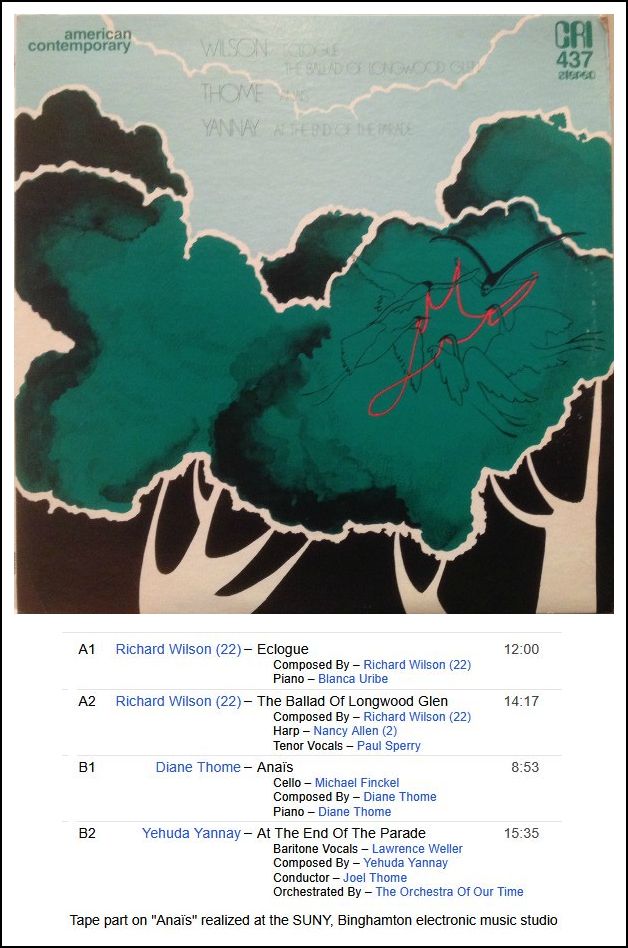
Thome:   What I’m the most pleased with is the first one, Anaïs [for cello, tape, and piano] on CRI.  [That LP is shown at right.  See my interviews with Richard Wilson, and Paul Sperry.]  We had the most control over that, and there had been the most wonderful performance of it in advance of the recording.

BD:   How much leeway do the performers get, or is that all bound up with the tape, which is unalterable?

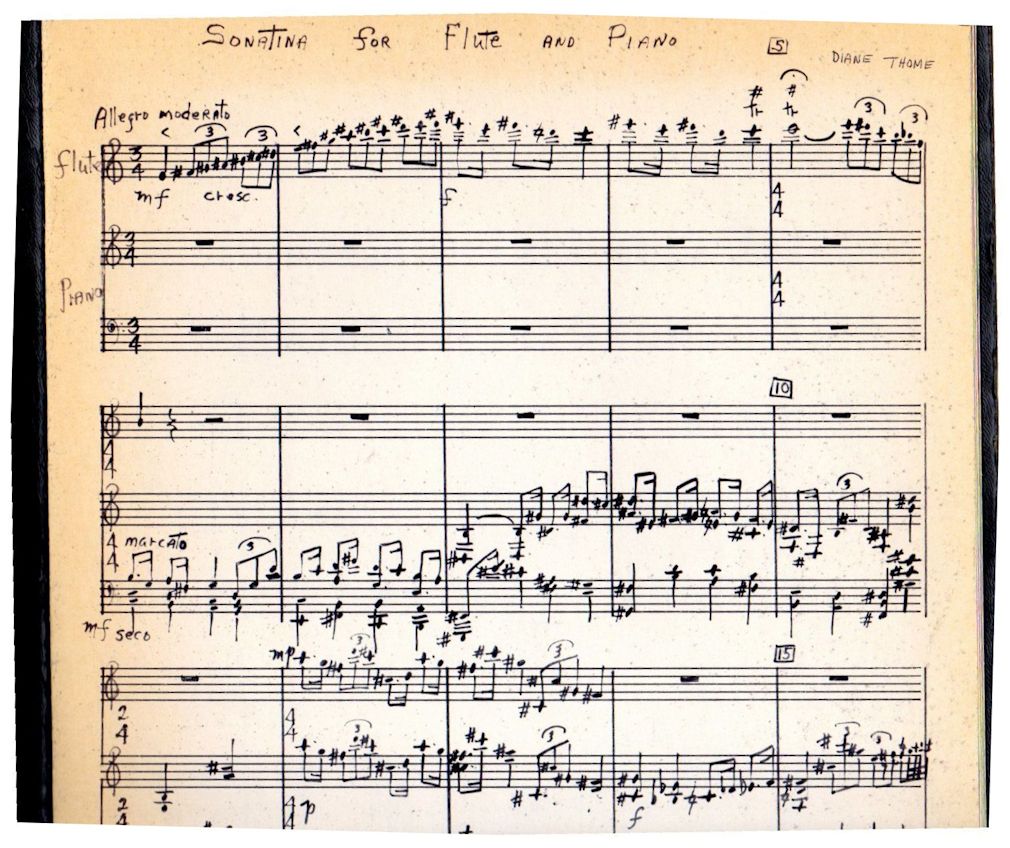
Thome:   With a piece like that, where it’s a fixed tape, this is not live electronic music.  So the performers in this piece don’t have a lot of leeway, but they have more leeway than they have, for example, in the most recent piece.  If you look at the score, you’ll see that the electronic part is not metered.  It’s not a metrical part whatsoever.  It’s a much freer, more spatially and graphically notated part.  Once the cellist got used to certain cues, he became very secure with it.  But it wasn’t as if he was counting a four-four measure, then a five-four measure, and then a six-four measure.  Whereas in Levadi, which Montserrat Alavedra has just recorded for Opus One, she has a score which looks absolutely traditional, and the tape part is written out as if it were a piano part.  It’s strictly metered, so she absolutely has to be on the button down to an eighth note, or a 16th note.  These are two different types of tapes, by the way.  They’re both finished tapes, and the performer has to follow them.  You can’t get away from the tape, but there’s still two different types of rhythmic relationships.

BD:   On the piece where the tape has been notated, did you compose the music first and then record it, or did you record the music and then transcribe it?

Thome:   I wrote out the score in the traditional notation, and then I proceeded to synthesize the entire electronic part of it.

BD:   It’s almost as though you were a conductor!

Thome:   Yes, I’m the conductor and the performer, too.  It was a lot of detail work.

BD:   Is composing fun?

Thome:   Just the other day I was thinking about how very difficult it was.  It can be fun.  It’s very interesting.

BD:   Is it satisfying?

Thome:   It’s satisfying when it goes well, but it’s very challenging and occasionally very troubling when it’s not going well.  But that’s just part of the creative process.

*     *     *     *     *

BD:   You’re also doing a lot of teaching.  What advice do you have for young composers coming along?

Thome:   In terms of their individual work, or in terms of their careers or their lives?

BD:   Is there any bit of general advice that you have, rather than getting into each specific individual case?

Thome:   I have many different types of students.  Some want to lead alternative lives.  They’re not interested in teaching in a conservatory, and they’re not necessarily interested in even using their music as a way to make a living.  There would be different advice for those people.  Then there are those who really love the academic situation, and feel very comfortable with it, so if they are preparing for that I encourage them to go on to advanced degree work.  There are also composers who have no interest whatsoever in anything but a commercial life.  They want to write for film, so they need to go to Los Angeles and write for the studios.  Or they might want to write commercials, and that’s a whole other world.  So the general advice I give them is to know what it is they want to do, and to be sure that they have investigated all the possibilities that would enable them to achieve those goals.
thome
BD:   Is that advice you have followed yourself?

Thome:   To tell you the truth, I decided when I was a little girl that I wanted to be a composer, and I thought to teach in a university would be a good profession for me, because I felt it would also give me time for my creative and professional life.  That’s turned out to be true.

BD:   Has being a woman composer affected you more or less because of the way the women’s movement is moving today?  Are you reaping some of the benefits of all of the hard work that has gone before?

Thome:   My career has already been going for about 25 years, so that predates some of these activities.  I am a member of the League of Women Composers, and a number of other women’s organizations.  I’m very supportive, and I’m sure that it has impacted me in subtle and particular ways, with a certain kind of publicity at times.  But I don’t know that it’s had a tremendous impact.  It’s very important in a general sense, but some women composers in my generation were the first woman in their class, or the first woman to get a particular degree.  In my case, I’m the first woman to receive a Ph.D. in Music from Princeton.  I don’t know that the women’s movement helped us a lot at that time, because the institutions that we were associated with, and the groups we were associated with, were not in any way connected with any of those organizations.  Some of those marvelous organizations have only gotten going in the last 10 to 15 years.

BD:   Do you want to be known as a woman composer or just simply composer?  
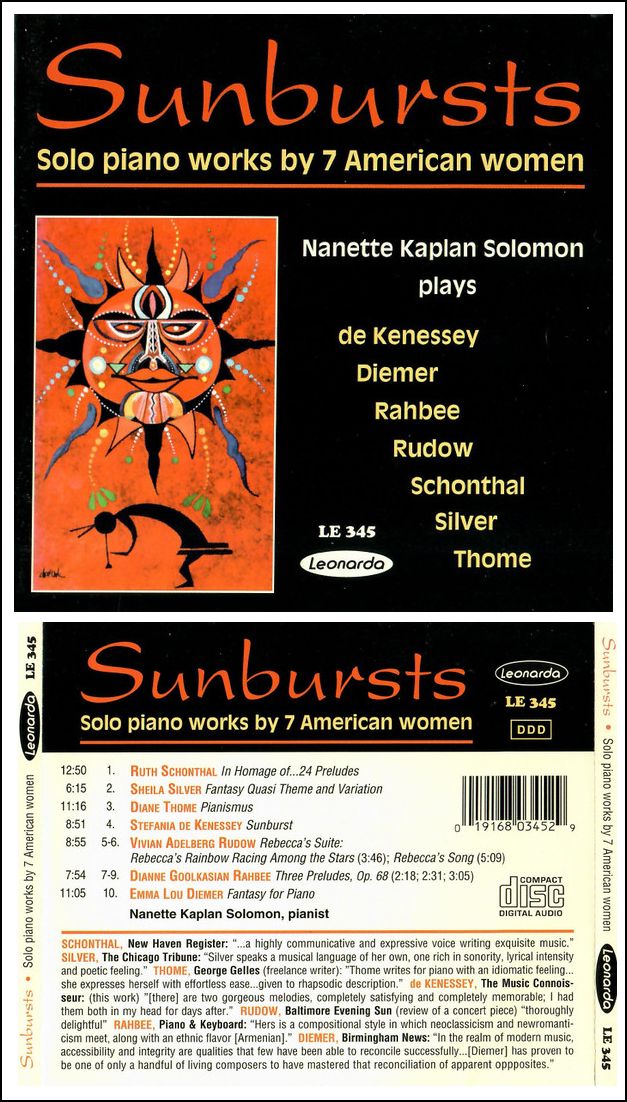
[Vis-à-vis the recording shown at left, see my interviews with Emma Lou Diemer, and Ruth Schonthal.]

Thome:   I would like to be known as a composer.  I always thought of myself as a composer.  It happens that I’m a woman, and I have certainly answered questions and filled out questionnaires about that.  As a matter of fact, there was one I filled out for Perspectives of New Music a number of years ago, which had many responses from many women composers.  It’s interesting to read, but ultimately I would like to be known for my work.

BD:   You’ve probably listened to more music by women composers than the general public.  Is there any real difference between the music that is being written by women, and the non-league of men composers?

Thome:   I couldn’t say so, no, but I haven’t done an exhaustive study of the question.  All of us, men and women, have inside a feminine part and a masculine part.  In men, sometimes the feminine element can be very strong, and in women the masculine element comes forward.  However you want to ascribe this to musical qualities is a very difficult question, but I think the brain does not have gender.  I believe that people who devote themselves to exploring questions about differences between art made by women and art made by men probably have many more thoughts and contributions to make to that question.  I don’t really feel I can answer it in a full sentence, but music, which is the most abstract art, is probably the most difficult art with which to deal with that kind of question... as opposed to literature, where you could say that it was literature by women, having other themes, and other perceptions, and other coloration to it.

BD:   Does it please you that there’s so much music by women composers being presented these days?

Thome:   It’s extremely important, and I’m absolutely delighted that we’re at a point in our evolution where women can be more fully themselves.  It’s wonderful for men, too, that they can be more fully themselves.  Look at what’s happening in terms of parenting, and men claiming time off to parent and so forth.  This is very fortunate.  These kinds of changes are healthy, and desirable, and raise the consciousness.  They’re good for the human race, for people, for individuals, to be more fully actualized, and more fully realized.  Whether they’re men or women, it is a good goal, and is desirable.

BD:   Are you optimistic about the future of music?


Thome:   Yes. Yes, I often read articles saying it’s going to disappear after the beginning of the 21st century, but art is important to many members of the human race.

BD:   Then let me give you the big philosophical question.  What is the ultimate purpose of music in society?

Thome:   I don’t think there’s one purpose.  There are many, many purposes, and these purposes have changed.  They’ve been transformed, and they’ve been modified.  If we look through history, we see that the arts are often associated with ritual, and with celebration, and with various kinds of social context.  Then we see art as individual expression, with the whole culture of romanticism.  We see art as the exploration and experimentation with languages in a very scientific way.  We see exploration of various kinds of problem-solving mechanisms worked out with art.  We also have art which seeks to change consciousness, and seeks to communicate in a meditative way.  For example, all of the music that comes out right now that’s for quieting the mind, or giving you help with biofeedback.  So there are many, many purposes, and I don’t think there’s a single purpose.  It can be entertainment, it can be for a great intellectual simulation, and it can be for emotional and spiritual nourishment.

BD:   Where’s the balance among all of this?

Thome:   I don’t think any single piece meets all of those goals, or all of those needs, or all of those possibilities.  Different pieces fall into different categories, and the balance ends up simply reflecting what’s happening, who’s working, who’s making the music, and who’s disseminating it.  For example, there are people like yourself who make it possible for large audiences to hear music.  The balance is affected by many, many factors.

BD:   When you’re approached to write a piece of music, how do you decide whether to accept the commission or turn it down?

Thome:   If it has some interest for me in terms of the performers and in terms of the medium, then I accept it.  Otherwise, if it’s something for some group, or very unusual type of players, and I just don’t see myself either having the time or the interest to pursue it, then I turn it down.  Even with this recent Marzena commission, I thought about the hard guitar mandolin  parts, and though it was all very nice, I wanted two other instruments to fill that out.  So in this case, I simply extended the original specifications.

BD:   Is there some music that is not commissioned, but you feel you just have to write it?

Thome:   In the past, when I was at another stage of my career, there were pieces that I was interested in writing, period, so I just went ahead.  They have also received performances, but many composers do that.  If something is of internal interest, then you go ahead.  After all, for the most part you’re not talking about people who were living a commercial life.  Most serious composers write music because that’s what interests them primarily to do.  They’re not doing it for fame and fortune.  That’s not that original impetus for doing it.

BD:   Then why do you write?

Thome:   It’s the most challenging and demanding and absorbing activity in my life.

*     *     *     *     *

BD:   You’ve lived in a number of different parts of the country.  Are the publics different from one city to another?

Thome:   I’ve lived in several cities on the East Coast, where in some cases there was already a very large audience for contemporary music.  When I first came to Seattle ten years ago, there was a much smaller audience than we presently have, and I’m very pleased with the developments here.  I was regional co-chair of the American Society of University Composers for several years in the early 1980s, and one of the responsibilities I had was to organize the largest festival of American contemporary music ever held here.  We did this with enormous help from performance groups in four or five different states and Canada.  The Seattle Symphony opened the four-day conference, and I believe we had 26 concerts, and a number of paper and panel discussions, with a number of invited guests.  In these years that I have been in Seattle, I have seen a tremendous flowering of interest.  Now what I notice as I go to contemporary music concerts, I see different audiences.  Even within that sphere, which is a rather rarefied sphere of contemporary music, we have subdivisions.  That’s something which is a result of all of these developments, and I’m quite pleased about that.
thome
BD:   For a piece of yours, would you rather have it on a contemporary concert, or on a program with old and new masterworks?

Thome:   I’ve had both.  It depends on the piece, and I would be very comfortable either way.  I don’t have a categorical answer to that question.  It just needs to be well-programmed.  I certainly don’t believe that contemporary music should be segregated.  It just so often happens that it is, but it can work both ways.  I sometimes go to concerts of a particular kind of new repertoire, and other times I’m happy to go to an orchestra concert and hear one new work. It’s a matter of imaginative programming.  These are large social questions which certainly impact composers and music.

BD:   How can we push the management to do a little bit more... or should we?

Thome:   We should, yes.  It’s partly a matter of having artistic directors and conductors and performers who really have a commitment to new music.  As people become increasingly educated and aware, they come to realize that they can have many different types of series.  For example, if they feel they want to do a few more 20th century or contemporary pieces on a concert, and the large audience is not deeply interested in that repertoire, they know they have a nucleus for an audience that is, so they might do it on one of their smaller series.  There are ways to deal with this, and I don’t believe you have to force people to listen to contemporary music if they are really not interested in it, and don’t understand it.  On the other hand, it shouldn’t be ignored.  Performers should have some kind of commitment to the music of their own time.  Within that, it doesn’t mean they have to like every piece, or do every piece.  But if they can find some works that they have sympathy with, it’s important to have a living music.  I don’t believe in an exclusive museum tradition for music.

BD:   When you perform a piece of music from the Baroque or Romantic era, do you approach it differently because you are a composer?

Thome:   I don’t do very much playing right now, and I haven’t for a number of years.  But when occasionally I’ve played for my pianist friends, they say that I do play like a composer.  They meant that I think structurally.  I consider the structure of a piece very much, but it’s a hard question for me to answer right now.

BD:   Tell me about the particular joys and sorrows of writing for the human voice.

Thome:   I’ve had some wonderful human voices to write for.  Particularly in the last two years, I have a colleague at the university for whom I’ve written a number of pieces.  She’s recorded, as I said, my most recent solo work for piano, voice and tape.  What’s important in writing for the voice is to have in mind the particular voice.  For example, I have a new commission from the Seattle Symphony, and I’m going to write a work for soprano and orchestra.  I already have in mind the particular soprano.  I’m happy to say that other sopranos have done the works that I have written, but I think in terms of that initial performance and that particular voice, because I like to have a concrete awareness of timbre to deal with.  I don’t think there are any sorrows connected with writing for the voice, unless it’s performed by a voice which really is not compatible for that piece.  But singers have a way of saying whether the piece is for them or not.

BD:   Would you ever consider writing an opera?

Thome:   Yes.  I don’t see it in the immediate future, but when I was about ten-and-a-half, I wrote a little chamber opera for the children on my block, and we performed it.  Maybe someday I’ll attempt another opera.

BD:   What would you look for?

Thome:   I’d certainly look for a large chamber opera situation, and I would probably like to use a very avant-garde theater.

BD:   Experimental theater?

Thome:   Experimental theater, right.  I am interested in collaborative work, and I would like to do something unusual, perhaps a work in an experimental theater, visual and even perhaps holography and polarized light projection.

BD:   So you’re going to be involved in more than just the music and the words?

Thome:   Right.  But as I said, this is really quite a distant possibility.  I haven’t thought about it in any practical way.  Until you asked me the question, I hadn’t thought about it at all.  A couple of years ago, someone had talked to me about an opera, and at the moment it’s not close to my compositional priorities.  But it’s not out of the running.  [Laughs]

BD:   Do you work on just one piece at a time, or do you have a couple of things going at the same time?

Thome:   I usually just work on one piece at a time.  Sometimes it’s rapidly followed by a second, but I always admire my colleagues who say they’re working on three pieces.

BD:   You don’t want the schizophrenia of that?

Thome:   It’s not even a matter of not wanting it.  I don’t know that I could take it.  It might be fun to attempt at some point, but I’ve never done it like that.

BD:   Beyond this next piece, what is on the horizon... or do you know?

Thome:   I have several commissions after this next piece.  One of them is basically a solo tape piece, which will be an environmental theater piece of some kind.  Then immediately following, probably will be the orchestra and voice piece.

BD:   I’m glad you were able to come over today.  Thank you for the conversation, and thank you for being a composer.

Thome:   I love to see people doing what you’re doing, and I applaud it.  You do a great service, and composers are indebted for it.


thome


thome


© 1987 Bruce Duffie

This conversation was recorded in Seattle, Washington, on July 30, 1987.  Portions were broadcast on WNIB two years later, and again in 1992 and 1997.  This transcription was made in 2026, and posted on this website at that time.

To see a full list (with links) of interviews which have been transcribed and posted on this website, click here.  To read my thoughts on editing these interviews for print, as well as a few other interesting observations, click here.

*     *     *     *     *

Award - winning broadcaster Bruce Duffie was with WNIB, Classical 97 in Chicago from 1975 until its final moment as a classical station in February of 2001.  His interviews have also appeared in various magazines and journals since 1980, and he continued his broadcast series on WNUR-FM, as well as on Contemporary Classical Internet Radio.

You are invited to visit his website for more information about his work, including selected transcripts of other interviews, plus a full list of his guests.  He would also like to call your attention to the photos and information about his grandfather, who was a pioneer in the automotive field more than a century ago.  You may also send him E-Mail with comments, questions and suggestions.