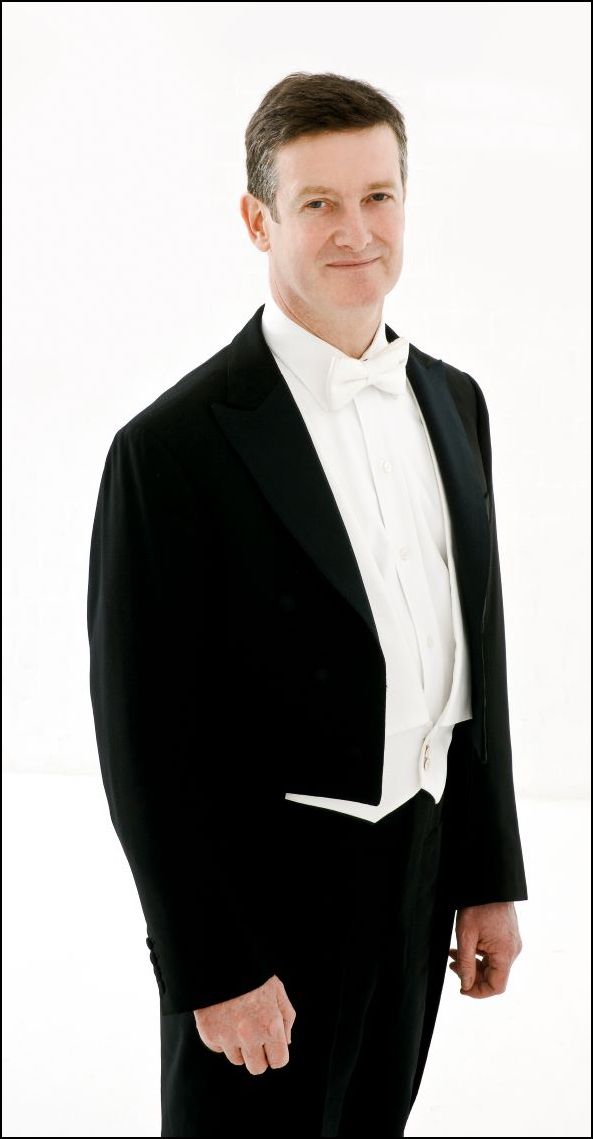
Conductor  Harry  Bicket

A Conversation with Bruce Duffie


bicket


Music Director: Santa Fe Opera. 
Artistic Director: The English Concert. 
Honorary Member of the Royal Academy of Music (Hon RAM)

Internationally-renowned as an opera and concert conductor of distinction, Harry Bicket is especially noted for his interpretations of Baroque and Classical repertoire. Since 2007 he has been Artistic Director of The English Concert, one of the world's finest period instrument orchestras, with whom he recently embarked on a project to film all of Handel's repertoire to create an online resource for all. Their ever-popular annual Handel opera tours regularly fill venues in Asia and the U.S., including Carnegie Hall. In the 2026/27 season, he embarks on a U.S. tour of Handel's Alessandro with The English Concert.

He is Music Director of Santa Fe Opera, where his productions have included Don Giovanni, Orfeo, Alcina, Carmen, A Midsummer Night's Dream, Le nozze di Figaro, Fidelio, La finta giardiniera, Così fan tutte, Roméo et Juliette, Candide and Pelléas et Mélisande. In the 2026/27 season he returns to conduct Janáček's Káta Kabanová, following recent productions of Rodelinda and Die Zauberflöte. Elsewhere in the U.S. he is a frequent visitor to The Metropolitan Opera, and recently returned to the Canadian Opera Company for Le nozze di Figaro.

Highlights of the 2026/27 season also include a return to the Opéra national de Paris for Mozart's La clemenza di Tito. On the concert platform, he returns to the Opernhaus Zürich to conduct Mozart's Mass in C minor and to the Chicago Symphony Orchestra for programmes featuring Bach, Mozart and Prokofiev. He has collaborated with the Chicago Symphony Orchestra on special projects with The Joffrey Ballet in repertoire ranging from Haydn, Milhaud and Coleridge-Taylor Perkinson, and recent seasons have also included returns to the San Francisco Symphony and a debut with The Philadelphia Orchestra conducting Mozart's Requiem.

In 2025, he made his debut at Opernhaus Zürich in Jetske Mijnssen's new production of Agrippina. At the Bayerische Staatsoper he has conducted Rinaldo, Ariodante, Serse, Orlando, Orfeo ed Euridice, Il barbiere di Siviglia, Die Entführung aus dem Serail and Die Zauberflöte.

He has appeared regularly in all the UK's major opera houses, and his Theodora at the Royal Opera House in 2022 was nominated for an Olivier Award for Best New Production. Recent seasons have included a return to Opera North for Purcell's Masque of Might, devised and directed by David Pountney, and to the Opéra national de Paris for Giulio Cesare, following his company debut in 2023 with Ariodante in Robert Carsen's new production.

Born in Liverpool, he studied at the Royal College of Music and Oxford University, where he was organ scholar at Christ Church. He was appointed an Honorary Member of the Royal Academy of Music in 2018 and was appointed OBE in the 2022 Queen's Birthday Honours for services to music.

==  Biography from Bicket's agency, Askonas Holt  
==  Names which are links in this box and below refer to my interviews elsewhere on my website.  BD  


In early 2006, conductor Harry Bicket was back at Lyric Opera of Chicago for Orfeo ed Euridice of Gluck.  During the run of nine performances, he was kind enough to sit down with me for an interview.  

bicket
Bruce Duffie:   You mentioned that you had four days off and it’s odd to come back to it.  Is it difficult to get up to speed again, or would you rather perform every day?

Harry Bicket:   You go through the rehearsal process where you’re rehearsing every day for three weeks very intensively, and then you’re on stage with the orchestra, and you’re really building.  Again, you look at the piece every day and you go through it, and you get very deep inside it.  Then you open, and suddenly you start having these days off.  People disappear and do other things, or they go and visit their family, and then suddenly you turn up in the city again, and walk into the pit and greet them and give the downbeat!  Sometimes, particularly with a piece like this which is so compact and so intense, there’s no way to ease your way into it again.  You have to be there from the very first downbeat.  It requires great concentration from everybody.

BD:   Would you rather that voices didn’t need their rest so that you could perform every day?

Bicket:   Oh, absolutely!  For a conductor, of course, and for an orchestra it’s no problem performing every day.

BD:   [With a wink]  That sounds so hard-hearted.

Bicket:   I don’t know if it’s hard-hearted, but it’s very practical.  In fact, in many places like the Liceu in Barcelona where I work quite a lot, they will do ten performances of Ariodante in thirteen days.

BD:   Why do the singers agree to do this?

Bicket:   Because it’s double-cast.

BD:   Oh, so each singer is only singing every two or three days?

Bicket:   Yes, but the orchestra and myself are there every night.  In many ways it’s very good for everybody.  Ten days in a row may be a bit much, but certainly I do know orchestras like to have that sense of continuity.

BD:   Let me turn the question on its head.  If you’re performing ten days in a row, how do you keep it fresh and spontaneous in the seventh and eighth performance?

Bicket:   [Smiles]  There you go!  The thing with opera is that no two performances are ever alike, and that’s often not to do with me or how I’m feeling.  [Both laugh]  Yes, I’m there to try and recreate a lot of what we’ve done in rehearsal, but I hope also to create at the moment, and I’m helped by singers who, for one reason or another, suddenly go in a different direction one night, or a chorus that suddenly does that, or a piece of staging which suddenly goes slightly different, or the orchestra  members are not quite the same, or a principal player is off, and suddenly you find yourself thinking that’s interesting.  Or sometimes you feel that was a good experiment, [laughs] or maybe that wasn’t a very good experiment!

BD:   I hope that most times it’ll work out, and only once in awhile it will be a disaster.

Bicket:   Yes, but in any decent artistic endeavor, a disaster is not necessarily the worst thing that can happen.  If we just strive to create a CD-worthy performance every time, it would be very dull, to be honest.

BD:   CDs are too sterile?

Bicket:   Oh, completely.  Having said that, I’ve made quite a few of them, but each is, at best, a snapshot of what that particular group of people did at that particular time, and probably at various times because now they tend to be edited out of existence.  In fact, you’re almost entering the realm of the pop industry, where the producer of the record may be more important than the artists themselves, because they literally put it together and produce it, and try and try to end up with a performance that wouldn’t ever be possible in a live situation.

BD:   Do you foresee a day when we’re going to wind up lip synching on stage?

Bicket:   No, I don’t think so.  Funnily enough, even though I’m being a bit down about CDs, my theory is that it’ll make live performance even more extraordinary and even more exciting.  One has these CDs, but if you go and experience it on stage, you’ll see just how different it is, and how people are walking a tightrope every night.  That’s thrilling, rather than just putting the CD on and knowing it’s going to be perfection because you’ve already listened to it twenty times.

BD:   Should there be a warning label on the CDs that this is snapshot, and please come to the live performance, too?

Bicket:   I don’t know.  Even now, on these live performances they’ve bandied around a lot on the labels saying they recorded the excitement of a live performance!  In fact, more often than not it turned out to be four performances done over a certain amount of time, plus some patching.  Yes, an audience was there, but it’s not very fair to say that they’re necessarily live in the sense that it was simply a broadcast of a particular performance.

BD:   [Gently protesting]  But if you record four performances, each time you get to that last aria in the last act, you are fatigued and excited and uplifted and depressed, whatever the story calls for.

Bicket:   Completely, unless it’s patched in the studio later!  [Both laugh]

BD:   For truth in advertising, there should be a  patch list on the last page of the booklet that comes with the recording.

Bicket:   It would be interesting, wouldn’t it?  You could actually see what was done when and how.  This is not telling tales out of school, but when I’ve done recordings with singers where they’ve done the aria a few times and they still haven’t quite got their top note absolutely there, we’ll give it a day
’s rest, and they’ll come back, and we’ll play the lead-up to it where they won’t sing, and then just before the top note they’ll come in and sing, and produce a beautiful clear fresh note.  Then that’ll be patched in, and you honestly won’t know the difference.

BD:   Is that an artistic fraud?  They can actually do it, so it
’s not something they are not able to accomplish.

Bicket:   I don’t think that was even an issue whether they can or they can’t.  Many producers would say that it’s perfectly valid.  Consider Glenn Gould.  There was a man who actually gave up live performance because he said he can actually do a better performance in a studio because he had control over the sound and the editing, and everything else he couldn’t predict in a live performance.  He philosophically thought that the recording medium and the possibility of editing was something which was in the direction that music was going.

BD:   Are we producing something for a recording that is completely different from what we produce on the stage?

Bicket:   I don’t know about
‘completely different’, but it isn’t the same thing.  When you listen to some of the reissued live operatic performances of the 1950s and 1960s where there was no editing, there were some horrendous car wrecks.  But it’s absolutely thrilling when they recover, and if something else happens.  You don’t ever get that with today’s CDs.  Many of those older performances would never get past an editing room nowadays.
bicket
BD:   [Having heard a few very special items]  But every once in a while you get the spectacular evening where everything works, and they go beyond what they really are capable of.

Bicket:   Completely, yes.

BD:   We’ve just finished with the Winter Olympic Games where there has been judging of all of the details.  Occasionally the skater will miss the landing, and sometimes the skier will go off course, so is an operatic performance any kind of contest?

Bicket:   Between whom?

BD:   Between the performer and the audience.  Are the audiences keeping score too much?

Bicket:   I think sometimes they do.  I don’t know so much about it in this country, because I don’t know the critics so well here, but certainly in Europe, and certainly in London, the large papers are very bad about coming to performances with memories of other performances or particularly other singers...

BD:   ...and expectations?

Bicket:   ...and expectations, yes.  They tend to judge performances for what they’re not, rather than for what they are, and that does the whole art form a huge disservice.  It’s no use for a critic to write that so-and-so’s performance didn’t quite eradicate the memories of Maria Callas in 1956.  I feel like telling them to grow up and get out a bit more.  Most of these people weren’t even born, or were like schoolboys in those days.  They couldn’t possibly have heard these people live, and yet there’s still this thing where you put the CD in.  I’m a big Callas fan, but to put a CD on, listen to it, then go and hear a live performance and write a critique based around something that it wasn’t...  I
’ve read items which say that this performance was the finest Mozart conducting since Karl Böhm.  He’s a god, but is that really true?  There’s no one who can really compare between Böhm and whoever was conducting last night at the Metropolitan Opera.  Then all this feeds into the whole thing about opera being old-fashioned, and not enough young people are coming, and yet these middle-aged people and young people are talking about Böhm and Callas.  

BD:   They’ve heard the recordings, and perhaps seen a video or two.

Bicket:   Yes, but can you really judge a singer or a performance by that?

BD:   Instead of putting the warning label on the CD, should we perhaps put an announcement on a subscription packet, saying that the ticket is for a live performance, and should be judged as such, and not held up to certain standards?

Bicket:   Come to enjoy it!  Come to be inquisitive about it!  You don’t even necessarily have to be knowledgeable about it!  I don’t mind!

BD:   [Genuinely surprised]  Really???

Bicket:   To one extent knowledge helps, but I don’t think that being hugely knowledgeable about it necessarily adds to your enjoyment.  Quite often, there are many people who are very surprised by performances, or by pieces they don’t know.  I did Partenope here four years ago.  No one had even heard of that opera, and you couldn’t do very much research about it, because there’s not much written about it.  It’s not a piece that’s very well known.  There was barely a recording out when we did it, and even that one wasn’t particularly representative of the piece.

BD:   I find that when I go to an opera where I don’t know how it’s going to come out at the end, I have a little more excitement than just another Tosca or even another Orfeo.

Bicket:   It
’s the same way if I go to an exhibition in a gallery.  I want to be challenged, and I want to think that’s interesting, or that’s not interesting.  The word ‘inquisitiveness’ is the most essential part for an audience.  At ‘just another Traviata’, it’s natural to think that one part wasn’t so good, and she didn’t put the high C in there.  Again, you’re judging it for what it’s not, and not judging it for what it is.  One should just ask if it was a good performance.

BD:   We’re kind of dancing around it, so let me ask the easy question.  What’s the purpose of opera?

Bicket:   I would put it broader, and ask what is the point of being an artist?  Asking just about opera is a slightly unfair question, because it’s rooted in so much else.  Look at the origins of opera.  I spend a lot of my time doing those very early pieces, seventieth century works of Cavalli, and Monteverdi, and Cesti.  There you’re talking about incredible librettos, most of which would have been done as plays in their own right, heightened by the simplest but most direct form of music.  You actually got someone taking an incredible text and elevating it in a special way through music.  Fast forward a few hundred years, and it’s gone the other way round.  You’ve suddenly got incredibly brilliant writers like Verdi writing the most extraordinary music, but the text somehow has been subsumed to the music in a different kind of way.  So, that’s why opera is an easy target for asking why.  I do think that the business of any of us dressing up in tuxedos, and walking into a pit or standing in front of an orchestra, and everyone sitting there and doing this funny thing of clapping at the beginning or the end is slightly weird, unless we somehow challenge people to find a level of experience and emotional involvement outside what you normally assume you have in your life.  Many people find it in different ways.  They may find it through their relationships, or by taking a swim, or hang gliding, but just from my own experience, I know that music can express things that cannot be expressed in other ways, and if you can tune into that language and be moved, then that adds a dimension to our lives which divides us from animals.  This what makes us human beings.  It
’s what makes us believe in something outside the mundane and the everyday.
 
BD:   Is opera for everyone, in general or particularly the operas that you conduct?
bicket
Bicket:   I’m sure they’re not for everyone.  I don’t think I’d ever expect that everybody would be interested in it, and that’s true of almost any artistic endeavor.  I come from a very unmusical family.  My parents are not musicians, and none of my family are musicians.  It’s all rather strange, but they very sweetly get dragged around the world coming to hear four-hour Handel operas.  For them, a lot of it is just supporting me, but what’s interesting is that over the years they’ve actually become quite into it, and have become opinionated about what they like and what they didn’t like.  It’s not about any form of sophisticated knowledge.

BD:   Is it more than just getting used to the experience?

Bicket:   Yes!  It’s actually going well.  I had this very extraordinary little place on the west coast of Scotland where I live.  We have a studio where we’ve done a lot of work with recordings and also concerts.  One of the things I try to do there is get a lot of the local schoolchildren involved.  We’re talking about very little children, aged 3 to 10, and they all live out on the islands.  We’ve done a few events where they’ve come and listened to an orchestra, or we’ve done workshops with musicians, and we can play Shostakovich, Messiaen, Berio, and Boulez, as well as Mozart, Beethoven and Bach, and they don’t see any difference whatsoever.

BD:   It’s all something new and exciting?

Bicket:   Yes, and they
’re just absolutely amazed!  We did Peter and the Wolf last year, and the orchestra introduced their instruments.  The girl playing the bassoon held it up, and they all gasped.  For 300 school children it was the most exciting thing they had ever seen, and they were absolutely thrilled by it.  Now they apparently all want to learn the bassoon, which, on the Outer Hebrides is slightly a tall order!  [Both laugh]  But what amazes me is that I have less difficulty programming things up there for the children, and for the adult audience as well.

BD:   There’s less resistance?

Bicket:   Yes!  They’re absolutely open, and even to the pieces they don’t know.  You’ll do a piece and people say they didn’t think it was so going to be good, but they found it was really brilliant.  The very first day we opened, I was worried about not doing something Scottish, since it was being in Scotland.  There are not a lot of Scottish composers, but someone suggested a piece by James MacMillan.  He
’s really, really talented, but he’s writing quite difficult music.  It’s not the most difficult, but it’s not exactly easy listening.  The piece was only ten minutes long, so I thought it would be fine, and we would have done a Scottish piece.  I didn’t know the piece at all, and when we did it no one would mention the Mendelssohn, the Bach, or the Haydn that we did.  All everyone would talk about was that piece by James MacMillan.  It absolutely blew them away.

BD:   Was it the percussion piece written for Glennie?

Bicket:   No, it was a piece called Kiss on Wood for violin and piano.  I would recommend you listen to it because it was so moving.  People were in tears in this music, and I just thought I’ve learned my lesson.  Don’t underestimate your audience. Don’t just say they won’t like this or that.  The same thing goes for the audiences.  Coming to the opera, I have heard people say that they don’t like baroque music, or they don’t like choral music!  They go to the symphony, but they don’t go to the opera, and to a certain extent the organizations have played into this by the subscription set-up.  Audiences are actually made or encouraged to nail their colors to the mast, and buy a whole season at Carnegie Hall, or buy a whole season at the opera.  That’s a shame, because I would go to some contemporary play which I’d never heard, or something by someone I’d never heard of.  I give it a go, and if I hate it, I hate it, but I will at least be engaged in it.

BD:   Thinking of Scotland, if these people buy tickets to some or a lot of concerts each year for ten or fifteen or twenty years, someone is going to say that this new guy is the best conductor since Bicket!

Bicket:   Yes!  My point was decrying about things for what they’re not.  I don’t find it very useful for people to say they thought this was better than someone else, even in the recording industry.  I was talking to someone who works in the record industry.  We’ve done various recordings up there, and there was a wonderful recording recently by Ann Murray, who came up and did Frauenliebe und Leben, and the Rückert Lieder.  She’s a fantastic artist.  Someone once said she can actually make the telephone directory sound interesting!  [Laughs]  She’s just one of these people who has an incredible way about her, and her performances are really moving.  The pianist was Malcolm Martineau, and it was reviewed in a recording magazine, which is fair enough, but before the review even started, it mentioned
‘The Benchmark Recording’ with Janet Baker, and the review went all the way through comparing the new one to Janet Baker.  At the end they still thought that Janet Baker’s was the best one, and I wondered why this would be interesting?  Why would someone reading this review be interested that Ann Murray isn’t like Janet Baker?

BD:   Would you have been more pleased if at the end it had said the new one is better than the benchmark?

Bicket:   No, and that’s a very good point.  People say to me that I don’t complain when people give me a good review, and my answer always is that the currency, particularly in the UK, has been so devalued that a good review is as meaningless as a bad review.  I’m not saying we don’t benefit from good reviews, or that we don’t get hurt by bad reviews.  I have agents and artist
’s managers sending me press packs of stuff from singers they want me to hear or want me to employ, and the first thing I do is take the package of reviews and send it straight in the trash can without even opening it.  I’m sorry that you know this now...  Then I look at what they’ve done, where they’ve done it, and find out where I can go and hear them.  I look up who they worked with, and I might give them a call, but mainly I’ll try and go, and try to hear them doing something live.  Then I make my opinion, because it’s just an opinion.

*     *     *     *     *

BD:   You do a lot of baroque and pre-baroque music.  Is this by choice, or just because this is what you get asked to do?

Bicket:   It’s because this is what I get asked to do a lot.

BD:   Would you rather do more MacMillan, or Maxwell Davies?

Bicket:   I’d love to do that.  I would love to have a much wider repertoire, though there are worse places to be stuck than in the eighteenth century.  I could be a Meyerbeer specialist!
bicket
BD:   Then you’d have to get seven stars every night!  [Both laugh]
 
Bicket:   It’s partly the nature of the business now, that most French conductors don’t get work in opera unless they’re conducting Carmen.  If you’re doing Italian opera, you usually get many opera companies which feel they have to get an Italian conductor, and for Russian opera you get a Russian conductor.

BD:   You’d rather be a generalist than get put in a pigeon hole?

Bicket:   No, I don’t think it’s either or.  It can be both.  Look at the career of someone like Charles Mackerras, who started off doing exactly what I’m doing, which is Purcell, Handel, and Bach.  He then went through Mozart, and yet he’s feted as a Mozartian, a Straussian, and especially Janáček!  He’s so brilliant, and I’m not putting myself at his level, but he was someone who was around at a time when no one said it’s a bit strange to be doing a Handel opera.  There was no time when people said he was an Australian music expert.  On the other hand, we have to follow the work.  To be honest, here I am working at the Met and the Lyric and Covent Garden and Munich, and other places doing this repertoire.  I’m under no illusions.  They’re not going to ask me to do Puccini.  

BD:   Would you perhaps get to a position where they want you so much for the Gluck and the Handel that you can say you will do those if they’ll also give you a Puccini or a Verdi?

Bicket:   [Smiles]  It’s not quite as easy as that.  There are some opera houses, and certainly orchestras I work with where I’d say I’ve love to come back, but maybe we can talk about doing something outside my box, and many of them have been very amenable to that.  But it works both ways, because if they’re doing a Handel opera, I’ve done a lot, and I’ve also done so many recordings that it helps them market it.  Don’t underestimate the rightful power of marketing.  Everyone has to raise their money, and they can say they’ve got this person to conduct this piece.  Then people make connections because they
’ve heard some recordings, and it helps sell more tickets.

BD:   Is this one of the advantages that an orchestral concert has over an opera, because an opera is practically always a single composer evening, whereas in an orchestral concert you could have two, three or perhaps several different composers?

Bicket:   Absolutely, and one can also mix stuff .  It’s very interesting to be able to do that.

BD:   When you conduct some contemporary music, either recent music or brand new music, do you come to it with a different eye and ear because you’re so immersed in the baroque?

Bicket:   Yes, and in a funny sort of way it’s also a very different challenge.  With baroque music, what you get on the page is such a sketch.  You rarely get a tempo marking, or any kind of idea or affect the composer wants.  You won’t get affettuoso or marziale.  You might get andante, though that term in the eighteenth century means so many different things.

BD:   I trust you get more than just a tune and a bass line.

Bicket:   Yes, but you won’t necessarily get very much.  With Handel you might get one or two slurrings over the principal themes, so you get an idea that he normally would like those two notes slurred.  But he won’t write it all the way through the piece.

BD:   In that day, you were expected to know the style, and just do it correctly?

Bicket:   Yes, absolutely, and also because it’s partly the nature of the instruments.  If you play as it’s written, the instrument itself will do certain things, which modern instruments don’t.  So that’s another issue when you start doing it with a modern orchestra.

BD:   Haven
’t modern composers asked performers to do all kinds of odd things with their instruments?

Bicket:   Absolutely, and also there’s much more freedom in the eighteenth century.  String players ask me if I want this on the string or off the string, and often the answer is both and neither!  [Laughs]  This is because it’s more like speech.  So much of it is based on text that we actually try and speak with the bow rather than sing with it.  I’m talking now in a legato, but each syllable has a different weight and a different intonation.  So if you see that written on the page, most modern players are taught to even everything out.  It’s all to do with modern string technique where everything must be very even.  Your down-bow must be the same as your up-bow, and the sound mustn’t die at the point of the bow.  People spend years at a conservatoire trying to iron all this out, and then I come along and say that we need to get back this idea of the right arm doing so much work.

BD:   Is eighteenth century music more of a collaborative art than nineteenth or twentieth century music?

Bicket:   It requires an awful lot more imagination from the individual in an orchestra, and this is one of the problems.  Almost without exception, no one really learns an instrument expecting to be playing in an orchestra.  A child learns the violin to play a violin sonata.

BD:   They want to be Yehudi Menuhin?

Bicket:   No, I just don’t think that when you learn the instrument you’re expressing your individuality.  As musicians we are individuals, and then often people get a job in an orchestra where individuality is not particularly encouraged, especially in a big string section.  Your job is to play absolutely what the conductor wants, and also what your section leader is showing you in terms of where the bow goes, and what articulation is used.  Even if you don’t like it, it doesn’t matter.  You’re going to do it because you can’t have one person doing it another way.  Everyone has to do it the same.
bicket
BD:   But an eighteenth-century orchestra is going to be smaller...

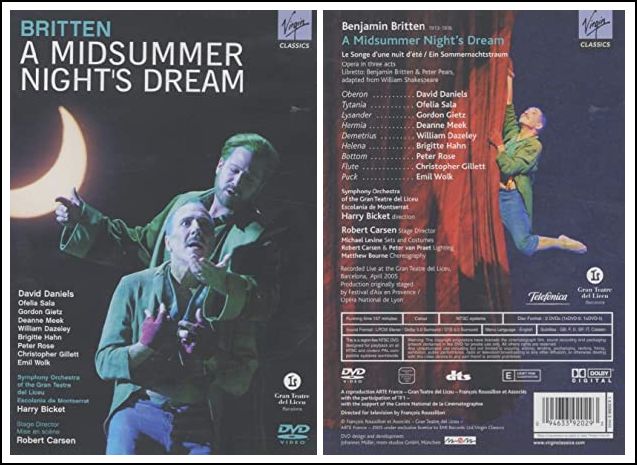
Bicket:   ...much smaller, and because things weren’t written down so much or actually annotated, there was more of chamber feel about it.  You would mix and match whether something was long or short, or whether it was on the string or off the string.  People would really listen to each other, and watch each other so that you got a much more fluid and variegated affect and sound.  That’s incredibly hard to get with a modern orchestra, because we don’t normally have time to do that.  In this Orfeo, where we had to put it on quite quickly, what’s interesting is over the performances I can tell the bits where we get to somewhere.  I know something’s new, because the orchestra on its own collectively have just found a way into doing it.  I did Britten’s A Midsummer Night’s Dream last year in Barcelona [DVD shown at left], and it was so interesting because you don’t even have to say how to bow it.  Every single note is bowed.  Every single note has a dynamic and an attack and an instruction, and the challenge there is to do everything that’s in the score.  So yes, it’s a very, very different kind of approach.

BD:   Is that music, or is it just producing sounds?

Bicket:   Britten had such a clear vision.  He was such a master craftsman that he knew what he was doing, and in a way he wanted to make sure that wherever his music went, that it was as near to what he had in his mind as possible.  You see it starting with Beethoven.  Beethoven’s tempo markings say things like andante non troppo ma sostenuto e più tenuto ma non allegro!  All it means is please, please take care.  Don’t just take any old tempo here!

BD:   Is it partly your responsibility as the conductor to get as accurate a picture that the composer wants, or does it to go beyond what the composer wants?

Bicket:   I don’t think the two are mutually exclusive.  Yes, one wants to ask what he meant by this, or what was the idea, but even in contemporary music there’s a difference.  The opening of A Midsummer Night’s Dream, which has extraordinary glissandos and split strings all over the place, is meant to be the wood at night, the forest, and almost invoke the groaning and creaking of the trees.  Yes, there are many ways of doing it.  How fast are those glissandi?  He doesn’t specify that.  When do you actually start the glissandi?  Do you start on the note and move quicker, or does the glissando start slower and then move faster?  Or does it start faster and then move slower?  Exactly where does the bow go in terms of the fingerboard?  Is it a brighter sound, or a darker sound, or a more muffled sound?  So, those things are just trying to get that idea of what he actually means by playing around with the sound.

BD:   Is there any correlation between what you’ve just talked about in Britten, and the lack of direction in the eighteenth-century parts?

Bicket:   We’re coming back to your original question of whether my work with the eighteenth century informs anything there.  As an example, you will have a metronome mark, and I suppose you could be held up for saying you don’t think it’s a very good metronome mark!  [Both laugh]  Look at what happened when Sir Roger Norrington did Beethoven symphonies with the notated metronome marks.  Everyone said his metronome was faulty!

BD:   There was an error in the machinery?

Bicket:   That’s right, but it’s an interesting point.  Funnily enough, there’s one passage in the Britten where they have to do very, very fast harmonic glissandos.  It’s the first violin, then the cello, the seconds, the violas, and then the double basses.  It’s like [sings very quickly
‘diddle-diddle-dum’] very high up.  It’s very hard to do because you have find the first harmonic, and then you have to pray that you get all five notes out.  Quite often you get the first two, and then it just goes splat.  It says very specifically a tempo [return to the first speed] in the score, and I thought that’s really risky.  Then I put on Britten’s own recording of the piece with the London Symphony Orchestra, which is fine, and they don’t do it like that!  Obviously, they’re just trying to find each note, and it’s perfectly clean but it’s not a tempo.  I went to see Steuart Bedford, who had been Britten’s assistant on that recording, and had been doing that piece for years and years.  I told him that it says a tempo, and it’s very hard to do a tempo, and on the Britten recording... at which point he stopped me and said, “Yes, yes, yes, I know, they don’t do it a tempo!  Every time I said that to Britten, he said to just bully them!  They should do it a tempo.”

BD:   Was he perhaps hoping that maybe a hundred years from now the technique would be available, and they would be able to get it?

Bicket:   [Sighs]  Maybe...

*     *     *     *     *

BD:   Is there such a thing as a perfect performance of anything?

Bicket:   No!  I hope not.
bicket
BD:   Should there be?

Bicket:   No, no.

BD:   But you always strive for it?

Bicket:   Of course.  It’s called life!  [Laughs]

BD:   Can you measure success by how close you come?

Bicket:   No, because along with my idea of something that really worked, there might be someone who says it
’s the worst performance of anything they’ve heard in their life, [both laugh] and vice versa!  All one can do is be as true and open and honest with yourself and your colleagues, and with what you are doing.  There are times when you can sense that everybody has come together.  The audiences are as much part of the performance as the performers.  It is a communal event after all.  That is the difference between sitting in our living rooms and putting on a CD to listen to an opera, and actually going out with 3,500 people who you don’t know, sitting in a large dark room, and experiencing this absolutely unique one-off occasion in real time at the moment when it is happening, and knowing it will never again be repeated that way.  That is what elevates it to something else.

BD:   [Playing Devil
’s Advocate]  How do you shake the guy who wants to press pause in the middle of the performance?

Bicket:   You can’t.  If I had 3,500 people wanting to fast-forward, then we’d be in trouble, and I would say we’re doing something wrong.  But you can
’t try to please everybody.

BD:   Do you want them to all rewind it in order to hear it again, rather than fast-forward to get out of the theater?

Bicket:   Gosh, my experience of going to concerts where something is really, really touched me and moved me, left me with the feeling that I couldn’t possibly listen to it again.  I just couldn’t.  I just wouldn’t.

BD:   I was thinking specifically of a new piece, and the first thing I wanted was to hear it again.

Bicket:   Oh, right then and there?

BD:   Yes!  I wished that they would encore it right there.

Bicket:   How interesting!  There was a tradition of doing that in the 1960s and 1970s in London.  Boulez used to do that quite a lot when he was with the BBC.  He’d start the program with a piece, and then do something else, and he finished the program with the first piece again.  I thought that was really good.  It happened in London recently with the Webern Five Orchestral Pieces
— they did them twice, and it was very effective.

BD:   Of course, those are extremely short...

Bicket:   They’re so short, yes.

BD:   There was a famous Leonard Bernstein performance where the new piece was the end of the first half.  He turned to the audience and said,
“We’re going to  play this piece again.  If you wish to begin your intermission now, you may do so.  If you want, you may stay and hear it again.”

Bicket:   Right!  [Laughter]

BD:   Even though you work so much with eighteenth-century music, do you have any advice for composers today?

Bicket:   [Thinks a moment]  Don’t underestimate your audience, but don’t overestimate them either.  There has been a move for a while to write music which is provocative in its inaccessibility, and that’s a shame.

BD:   Don
’t they seem to be getting away from that?

Bicket:   They’ve been getting away from it a little bit, particularly in the States, but that’s partly to do with the fact that you’re nearly all funded by the private sector.  There’s the whole issue of sponsorship, and who’s paying for something, all of which is a good thing and a bad thing.  It just depends.  It can work both ways.  I’m thinking more in Europe where it’s a state-organized thing, and also there’s a good feeling that audiences should be challenged and not just fed.

BD:   We should trust the composers?

Bicket:   Yes, but it becomes harder and harder.  We’ve got some interesting people now in England, certainly.  There’s James MacMillan, Mark-Anthony Turnage, and Thomas Adès, who is writing some very interesting stuff that is coming back to being slightly more accessible.

BD:   What about Harrison Birtwistle?

Bicket:   Yes.  I’d put it that Birtwistle is revered.  I’m not sure about some of the longer operas where he possibly tests people’s ability to focus.  Among other things, the music is so incredibly complex.  Look at the genius of someone like Britten or Shostakovich.  Even in their theatrical works, they know when to grade these very intense moments with... not light relief, but with music which somehow eases the mood a bit.

BD:   There needs to be balance and contrast.

Bicket:   Yes, exactly.

BD:   As a conductor, do you need balance and contrast in the repertoire that you’re doing?

Bicket:   Yes, and also with the types of orchestras I work with.  The difference between working in the period instrument field and also with modern orchestras, is so different because in doing the same repertoire, period orchestras need totally different things from me than modern orchestras.

BD:   Do you have a preference for one or another, or do you like doing both?

Bicket:   I love doing both, I really do.  I’m very keen that modern orchestras should reclaim a lot of this repertoire which has been stolen from them.  I don’t know about over here in the States so much, but certainly in England there’s been a feeling that modern orchestras can’t do Bach or Handel or Purcell, and I think it’s nonsense.

BD:   Isn’t it nice that modern orchestras have the period instrument sound in their ears when they play?

Bicket:   Absolutely, and that’s what I try and do.  So far, modern orchestras have actually got a lot out of it, but not everyone loves it.  I feel like myself and colleagues of my generation are real pioneers, just trying to get an orchestra not to play everything in the same way.  If you were a pianist, I hope you wouldn’t play Bach and Mozart with the same kind of weight and articulation and phrasing as you do with Rachmaninoff and Liszt... [sighs] but there are many pianists who do.  Someone said to me,
“But music is music!”  It’s not about that!  You could get into a very long conversation about what Bach would have done if he had had a Steinway in his room.  [Both laugh]  But I do think it’s a good thing that we try and think about the sound world that led to this music being composed in the first place.
bicket
BD:   Are you optimistic about the future of music composition, and also about period performances?

Bicket:   The period movement is here to stay.  What I’d love to see is people stop calling it
‘period movement’!  [Both laugh]  It’s fascinating over here because it’s been a slightly slower journey towards period orchestras because they’re so few of them and also like in England.  When they started off, and you listen to recordings from the 1970s and 1980s, technically they were not very good.  People used to joke about the fact that they never played in tune.  They also squeaked and squawked.  That’s really changed now.  We’ve got young players straight out of college who are fantastically good.  I work a lot with the Orchestra of the Age of Enlightenment, and when they do a concert in London, no one reviews them anymore as a ‘period’ orchestra.  Simon Rattle comes and does the Symphonie Fantastique, and it’s the OAE, and it’s just a really good orchestra, and there’s not this kind of thing of ‘them and us’.   

BD:   If the
‘period’ orchestras of the 1970s didn’t play in tune, did the orchestras of the 1870s, or the 1770s, or the 1670s, even come close?

Bicket:   You do wonder, don’t you?  Before I came here to Chicago, I was in Augsburg for the big Mozart birthday celebrations.  Augsburg always feels rather resentful that Salzburg has stolen Mozart as their son, because Leopold [Mozart
’s father] was from Augsburg.  So they were having a big live TV event with Angela Merkel [Chancellor of Germany 2005-21] and Professor Dr. Tobais Stauber from Augsburg University, and all these grand politicians.  They were all giving speeches, and I was there with the Bayerischer Rundfunk Orchestre [Bavarian Radio Symphony Orchestra] doing music in the Goldenasare in the Rathaus in Augsburg [Golden Hall in Augsburg Town Hall] which is incredible.  It’s a beautiful baroque building which really hasn’t changed at all since Mozart’s day.  We were doing a concert in there, and didn’t have very much time to prepare.  We got there in the morning, did a sound check for the TV, and the acoustic was so booming that one side of the orchestra couldn’t possibly hear the other side of the orchestra.  We tried and tried and tried, but it was so hard.  It needed everybody’s concentration, with me being in the middle just to hold it together, let alone what it sounded like to the audience.  At one point I nervously said to the orchestra that I suppose this is very authentic, but it’s not together!  [Both laugh]  That’s no reason why we should not try to play it together, but it does make you wonder.

BD:   If you had a time machine, would you want to go back a hundred years, or two hundred years, or three hundred years, to observe the performances and catch the details, or talk to the composers and see what they would like?

Bicket:   Oh, absolutely!  Wouldn’t it be fascinating just to know whether these pieces were even conducted?  Now there’s me in the middle with a baton.  This just didn’t happen, so what was it?  Was it that, as you say, a style which was so well known that people knew these pieces, and they didn
’t need to be conducted, or were the performances really quite ragged from our point of view?  Maybe people had the freedom to really go for it, and if they fell flat on their faces, that was all part of the performance.  The audiences didn’t mind, and the orchestras didn’t mind.  What mattered was the spirit, and sometimes we find it quite hard nowadays because, again going  back to our very first conversation, if people know a piece from a CD and the perfection that it brings, are they then going to be disappointed by a performance that maybe goes for it, but the horn fluffed that note, and the strings weren’t quite together there?  Do orchestras not also sometimes feel a bit constricted about daring to go for a really broad gesture for fear of it not being together, or it not being in tune?

BD:   Do you really want dare-devils in front of you???

Bicket:   It would be nice to have dare-devils, yes!  [Laughter]

BD:   [At this point we stopped for a moment to take care of a few technical details, and I asked him for his birthdate, which is May 15, 1961.]  Are you at the point in your career that you want to be at this age?

Bicket:   Oh, I’m way beyond anything I ever imagined!  The idea that you plan your career is slightly anathema to me.  I never expected to be a conductor anyway, and if someone had said to me ten years ago I will conduct at the Chicago Lyric, I just would have laughed and asked why they would expect me to.  So, I’m very lucky.  If I ever had any specific ambitions or goals, then I achieved them a long time ago.  But in the long term, I would like not to be traveling eleven months of the year.

BD:   I was going to ask if you have enough days off to study?

Bicket:   No, but on the other hand, I’m in Chicago now to do nine performances in five weeks, so on the days off I’m with my score.  It’s captive time, so in a way, yes, I can study, but it’s more time off to recuperate, and also just to be a human being.

BD:   [With mock horror]  A conductor needs to recuperate???  I can understand the vocalists needing to recuperate but the conductor???

Bicket:   It
’s mentally more than anything else.  I don’t think it’s such a physical thing, but if you believe at all that a musician is not some rarefied creature who lives outside normal life, what I do is hopefully informed by my experience as a human being, and if I don’t have much experience in that field it’s because I’m always on an airplane.  It’s very important to have family and friends, and life, to go for a long walk or doing nothing for a day.  This is all part of what makes us who we are, and it’s very important to be able to try and do that.  I’d love to work more with a specific orchestra maybe in Europe, which is really where my home is.  Those jobs are not so common, and nowadays orchestras actually want music directors to also be globe trotting quite a lot, because it’s all part of the international nature of your profile, and who you are.

BD:   We hope you’ll come back to Chicago.

Bicket:   I’d love to, absolutely!

BD:   Thanks so much for coming, and thank you for the conversation.  I appreciate it very much.

Bicket:   It’s a pleasure.


bicket


bicket


© 2006 Bruce Duffie

This conversation was recorded in Chicago on March 15, 2006.  This transcription was made in 2026, and posted on this website at that time.  My thanks to British soprano Una Barry for her help in preparing this website presentation.

To see a full list (with links) of interviews which have been transcribed and posted on this website, click here.  To read my thoughts on editing these interviews for print, as well as a few other interesting observations, click here.

*     *     *     *     *

Award - winning broadcaster Bruce Duffie was with WNIB, Classical 97 in Chicago from 1975 until its final moment as a classical station in February of 2001.  His interviews have also appeared in various magazines and journals since 1980, and he continued his broadcast series on WNUR-FM, as well as on Contemporary Classical Internet Radio.

You are invited to visit his website for more information about his work, including selected transcripts of other interviews, plus a full list of his guests.  He would also like to call your attention to the photos and information about his grandfather, who was a pioneer in the automotive field more than a century ago.  You may also send him E-Mail with comments, questions and suggestions.