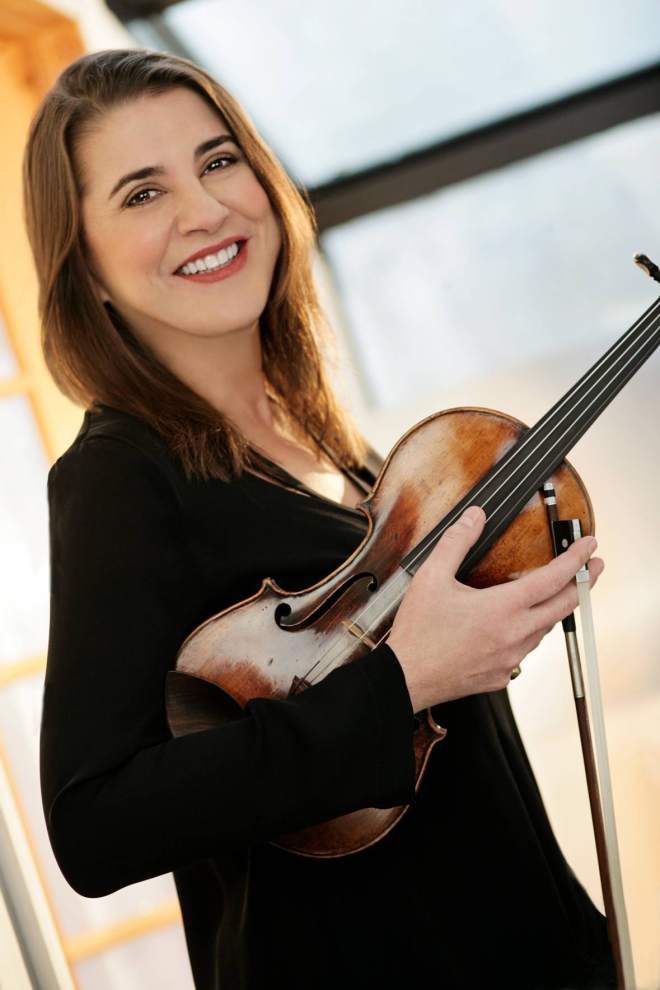
Violinist  Nadja  Salerno - Sonnenberg

A Conversation with Bruce Duffie


salerno


salerno Nadja Salerno-Sonnenberg (born January 10, 1961) is an Italian and American classical violinist and teacher.

She was born in Rome, Italy. Her father left when she was three months old, and she emigrated with her mother to the United States at age eight, relocating to Cherry Hill, New Jersey. She studied at the Curtis Institute of Music, and later with Dorothy DeLay at the Juilliard School of Music and the Aspen Music Festival and School.

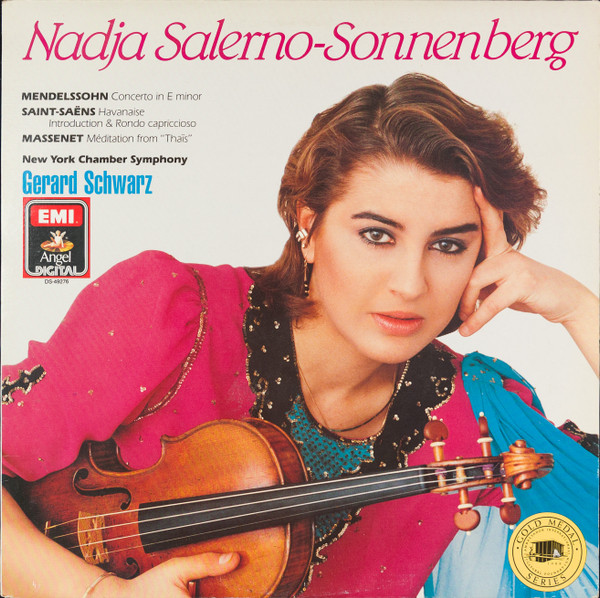
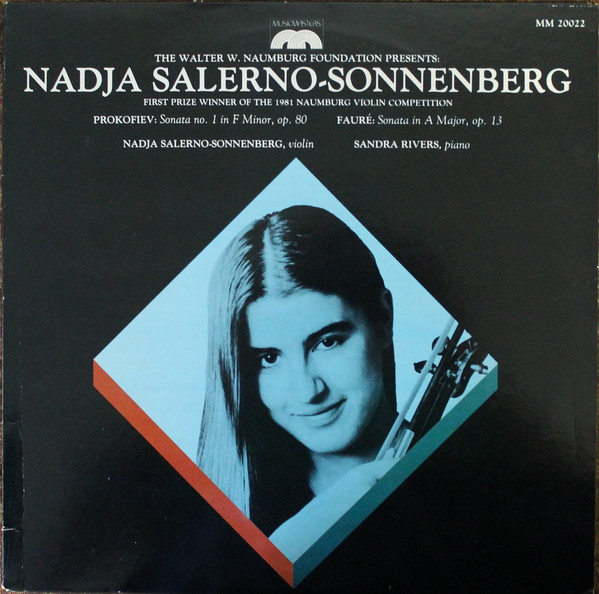
In 1981, she became the youngest-ever prize winner in the Walter W. Naumburg International Violin Competition [cover of LP recording shown at left]. In 1982, she was a soloist with the Naumburg Orchestral Concerts, in the Naumburg Bandshell, Central Park (NY), summer series. She received an Avery Fisher Career Grant in 1983, and in 1999 she was awarded the Avery Fisher Prize for "outstanding achievement and excellence in music".

In 1989, she wrote Nadja: On My Way, an autobiography written for children. In May 1999 she received an honorary Master of Musical Arts degree from New Mexico State University, the university's first honorary degree. She is also the subject of Paola di Florio's documentary Speaking in Strings, which was nominated for an Academy Award in 2000.

In 1994, she badly injured her left little finger while chopping onions as she prepared Christmas dinner for friends and family. Her fingertip was surgically reattached and took six months to heal. During that time, she re-fingered compositions so that she could play using only three fingers, and continued to perform.

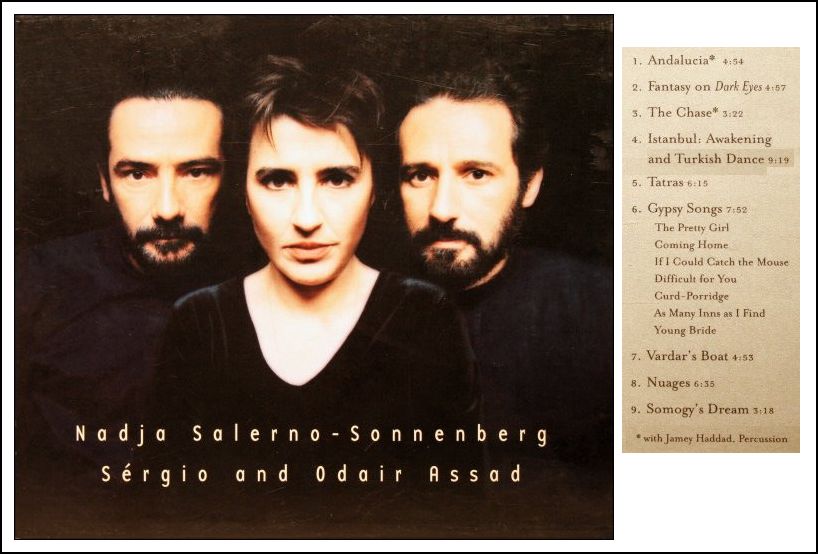
In 2003, Salerno-Sonnenberg performed the world premiere of Sérgio Assad's Triple Concerto, a work for violin, two guitars and orchestra with the Assad brothers and the St. Paul Chamber Orchestra.

She has released many recordings on Angel/EMI Classics and Nonesuch. In 2005, she also created her own label, NSS Music. She has performed with orchestras around the world and played at the White House. She has also performed with such popular artists as Mandy Patinkin, Joe Jackson, and Mark O'Connor.

She was a guest several times on NBC's The Tonight Show Starring Johnny Carson, and was also featured on 60 Minutes in 1986. In May 1999, 60 Minutes II aired a follow-up. In 2001, she appeared as herself on the sitcom Dharma & Greg in the episode "Dream A Little Dream of Her".


In December of 1997, violinist Nadja Salerno-Sonnenberg performed with the Chicago Symphony, conducted by Christoph Eschenbach.  Her solos included the Introduction and Rondo Capriccioso of Saint-Saëns, and Tzigane of Ravel.  The overture to Benvenuto Cellini of Berlioz opened the program, and after intermission, they played the Concerto for Orchestra by Bartók.  It was during that second half of the concert (the first of four) that the soloist graciously agreed to sit down with me for an interview in her dressing room backstage.  She was open and candid about her opinions, and answered my questions directly.

The link above refers to my interview with the conductor elsewhere on my website.

Portions of the conversation were aired on WNIB, Classical 97, and later on WNUR.  Now, in 2026, I am pleased to present the entire chat on this webpage.

As we were settling in for our conversation, she got comfortable and had a small burp . . . . .


Bruce Duffie:   What do you do on stage if you’re playing and you burp?

Nadja Salerno-Sonnenberg:   Oh, I never burp on stage.  It’s funny... even when you’re sick, your body doesn’t know it when you’re performing.
salerno
BD:   Why?

Salerno-Sonnenberg:   I don’t know.  It must be adrenaline, and concentration, and pressure, and responsibility.  You’ve got better stuff to think about.  Sometimes I have had no business walking on stage being that sick, and I have not felt any pain.  Or if I’m coughing a lot, I’ll go through an entire concerto and I won’t cough.  I think it’s adrenaline.  It physically changes you in a chemical way so that you don’t have a spasm.  There’s nothing emotionally but your playing going on, no matter what may have happened or whatever state you’re in.  For me anyway, I am completely devoid of any physical or emotional problems when I’m playing.  It’s the greatest escape.  I should play twenty-four hours a day!

BD:   Even if you’re feeling bad, you know that the performance will go well?

Salerno-Sonnenberg:   I know that I won’t be feeling bad for the duration of the performance.  [Both laugh]  It’s like my drug.  It’s an amazing escape.

BD:   Should we go to hospitals and get them to perform?

Salerno-Sonnenberg:   You never know...  We might be onto something here, as a cure for pain.

BD:   It affects you physically.  Does it affect you musically?

Salerno-Sonnenberg:   No!  Nothing either enhances, or gets in the way, or detracts from how I feel about playing the fiddle and making music.  In the long run, things happen to you emotionally, and everything that happens becomes you.  So one would hope that you bring your life experiences with you on stage.  But immediately if something very bad has happened that day, or if I might be going through some kind of emotional stress, nothing gets in the way when I’m playing.  It’s a complete escape.  It’s a phenomenal thing for me.

BD:   Does this also work in the studio and rehearsal, or just during the performance?

Salerno-Sonnenberg:   It works whenever I have to play, but if I’m in my home alone practicing, I have to say it doesn’t work.  It’s the adrenaline, so if I’m recording, or even if I’m in a rehearsal situation with a pianist or an orchestra, it’s not a performance, but for me it’s still a performance.

*     *     *     *     *

BD:   You mentioned recording.  Do you play the same for the microphone as you do for a live audience?

Salerno-Sonnenberg:   Yes, it is my aim, my goal to do that.  One would think that you have even more freedom in a situation where you’re making a recording, because if that didn’t go well you can do it again.  That’s true enough, except that we classical musicians have an enormous time limit.  It’s a very restricting time limit knowing that you have to get this done.  So we have to move on, because we have ten minutes to get this eight-minute passage, and that doesn’t leave you much freedom.  It actually puts more pressure on you.  So it’s more difficult to record than to play a live concert.  What you want to do is be careful to a certain extent, just so that it’s a passable take.  But you also want to be able to infuse it with your own ideas.  Basically a recording is how an artist played that day, that hour, and that’s it!  That’s all it is.  It’s a documentation of how so-and-so played on that day.

BD:   If you cut-and-piece too much, does it become a fraud?

Salerno-Sonnenberg:   Too much, yes, but it depends on what you mean by too much.  If you cut-and-piece a note here and a note there, and perhaps a run, that’s fine.  But there are certain recordings made where it is pretty much bar-by-bar, and that’s disgraceful.  At that point, why bother?

BD:   [With a gentle nudge]  Get the performers to record each note perfectly, and then let the engineering take over.
salerno
Salerno-Sonnenberg:   Ah, no, no, I wouldn’t dream of it.  [Both laugh]  God, can you imagine???

BD:   Is there such a thing as a perfect performance?


Salerno-Sonnenberg:   It’s individual.  I can think of a couple of perfect performances where technically I was blown away, and musically I was super-satisfied.  These are not my own playing, of course.  I’m thinking of certain artists where I have heard recordings of a live performance, so yes, I guess there is.  But technically speaking, no, I don’t think so.  [Laughs]

BD:   But I assume you keep aiming for it?
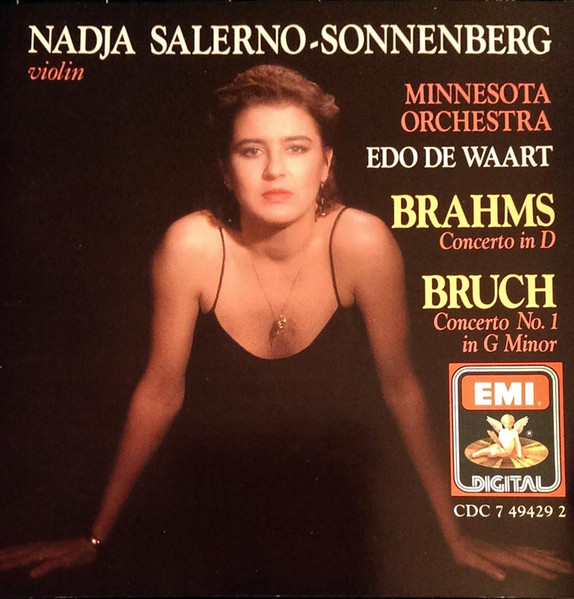
 [Vis-à-vis the recording shown ta right, see my interview with Edo de Waart.]

Salerno-Sonnenberg:   Yes.  There are performances I call
in the zone playing’, where no matter what you do, you couldn’t play badly if you wanted to.  Everything is in harmony.  Your left hand is in harmony with your right, the orchestra is in sympathy with you and the conductor, or with the pianist, whatever it is.  But just the way that the instrument feels with you for that amount of time that you’re on stage, is so like there is nothing else, and there is nowhere else on the planet that you should be right then.  It’s just that perfect, and you feel it when you’re playing.  You know it’s going to be one of those evenings, and you just go with it.  Usually it happens when you’re in Kalamazoo, but sometimes it happens in New York or Chicago, and then I thank God!  [Both laugh]

BD:   Is there a real difference in feeling between Kalamazoo and Chicago?

Salerno-Sonnenberg:   No, it’s just that it would be nice to have one of those
zone performances in great big place.

BD:   Are you conscious of the audience that’s out there in front of you each night when you play?

Salerno-Sonnenberg:   Sometimes.  It’s my choice.  If I feel comfortable enough with the piece, and with how the rehearsal went, and all the factors that go into making a fine performance, then I can look at them and I let them in.  Then I feel them.  If I need to concentrate, perhaps because there wasn’t enough rehearsal time, or perhaps it’s a new piece, I just close my eyes and there’s nothing in front of me.  So, it’s really my choice as to how I’m feeling.

BD:   Do they ever intrude on your concentration?

Salerno-Sonnenberg:   Sometimes.  Earlier in my career, when I would be making my debut pretty much anywhere I played, it seemed like it was always first time here, first time there, especially in Europe, and I remember in Japan there was a feeling that,
“Here’s this American girl violinist who would walk on in pants!  Let’s see what she can do.  There was a very definite vibe.  You walk on stage, and you feel that!

BD:   Did you feel you were being thrown to the lions?

Salerno-Sonnenberg:   Yes, exactly, absolutely!

BD:   Did you win?

Salerno-Sonnenberg:   Yes!  [Both laugh]  That’s an even greater feeling, when you walk away and people come back stage, and you can’t communicate with them verbally because it’s another language, but they got it.  That’s a wonderful feeling.  To walk on and get that tentative applause, and then walk off and know that they love you.  That’s a terrific feeling.  It shows that music really is a universal language.

BD:   Do you like being a wandering minstrel?

Salerno-Sonnenberg:   It is what I am, so I have learned to like it.  It is my life, it is my destiny, and it is my fate, so I have found my peace with it.

BD:   You didn’t accept it willingly?

Salerno-Sonnenberg:   It wasn’t a matter of accepting it willingly.  It was a matter of not really being prepared for what it was like.  When you’re a little kid, you just think it’s going to be great to play Tchaikovsky.  You have no idea what the reality is like, and what sacrifices are made.

BD:   Should the public that comes to hear you be aware of all the sacrifices you made, or should they only be aware of the Tchaikovsky or the Mendelssohn, or whatever you’re playing?

Salerno-Sonnenberg:   No, I don’t think it matters.  Why should they be aware?  There are articles written...  For instance, there was a time pretty recently in my career where I had a very, very bad accident.  I cut my finger off in a kitchen accident, and there were a few articles written about that.  For one thing, I had to cancel a good chunk of concerts while it healed.  A lot of people knew that, so I would walk on stage and they knew.  It was bandaged, and I played four months with just three fingers.  I had to re-finger the whole repertoire of whatever I had to play.  So that’s a personal thing that happened to me that people knew about.  Sometimes there are articles written about you, and the public tends to learn about little things going on in your life, but I don’t think it’s necessary that they know anything about you.
 
BD:   [Somewhat shocked]  You had to relearn everything for three fingers???

Salerno-Sonnenberg:   Oh, my God, it was unbelievable.  That was an incredible time, and I don’t know how I did it.  I played the Tchaikovsky concerto on tour, and the Barber, and two different recital programs with three fingers.  I had to re-finger the whole thing.
salerno
BD:   I assume you never want to go back to that.

Salerno-Sonnenberg:   No!  It’s hard enough with four fingers!  [Both laugh]

*     *     *     *      *

BD:   From the huge repertoire that the violinists have at their disposal, how do you decide you will play this, or you’re not going to play that, or do you just want to play everything?

Salerno-Sonnenberg:   A first rule of thumb is not to play something if you don’t like it.

BD:   But how do you know if you’re going to like it before you play it?

Salerno-Sonnenberg:   Oh, you can tell about a piece of music.  I heard the Glazunov concerto.  It’s a standard piece, and so I thought it sounds like so much fun that I wanted to learn it.  So I learned it, and when I finished learning it and had memorized it, I put it together with the piano, and I hated it.  I just wasn’t having a good time playing it.  I wasn’t enjoying playing it, but that’s the only experience I’ve had with a piece of music where I thought I knew how I was going to feel about it, and I was wrong.  Mostly you hear a piece of music you know you’ve got to play that!  Whether it’s smart or not smart to put it into your repertoire, it takes time to learn it so can you book it.  There’s also so much business involved in it.  It’s not solely up to me what I play.  For instance, this program here in Chicago was decided by Christoph Eschenbach.  He wanted show pieces, and he wanted these specific show pieces.

BD:   But he’s worked with you, so you know and trust each other.

Salerno-Sonnenberg:   Yes.  I’ll do anything for Christoph, but I hadn’t played the Saint-Saëns in ten years.
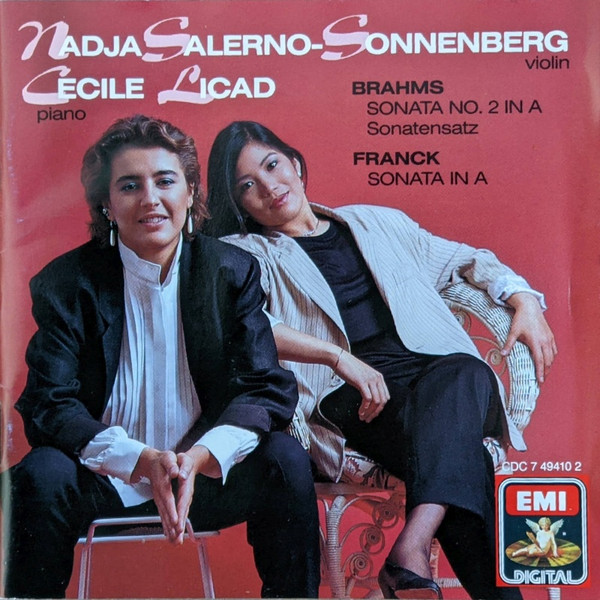
 [Vis-à-vis the recording of this work (shown at left), see my interview with Gerard Schwarz.]

BD:   Was it nice to come back to it?

Salerno-Sonnenberg:   It was weird.  I had recorded it, and yet it was so strange!  [Both laugh]  I thought I knew how it goes!

BD:   Did you come back to it, or did you get a clean score and start fresh?

Salerno-Sonnenberg:   I definitely came back to it.  I had a strong feeling for the piece when I was younger and when I recorded it, so it was just a matter of getting it back into my fingers.  There’s a lot more control and lot more freedom in my playing it now, which is lovely.  You hope for that.  There are passages in the piece where I was so nervous about playing before, and now they’re just not as difficult as they were.  So that’s nice.  I’ve improved a little!  [Both laugh]  I have a different edition now, with no double stops.

BD:   How do you divide your career between solo appearances and concerto appearances?

Salerno-Sonnenberg:   I do mostly concertos with orchestra.

BD:   Is this by choice, or by demand?

Salerno-Sonnenberg:   It’s a little bit of both, but mostly by demand, especially these days.  The business of music is changing in so many ways, and it must be harder to get funding for, or fill up the hall with chamber music.  Mostly I’m playing concertos, and there are chunks of the year that I lay aside for recitals.  One thing I won’t do is play with an orchestra this week, and then play a recital the next week, and then play another concerto right after that.  That’s crazy.  I did that earlier on in my career and that just drives you mad.  You can’t do that.

BD:   Why?
salerno
Salerno-Sonnenberg:   Because it’s a crazy and inhuman amount of preparation and work.  If you want to get your recital program ready, you want to have a decent amount of time to work it through with your pianist.  You then want to play that for a month.  That’s what you do.  You travel and you play.  You’re here Thursday, you travel and play Friday, Saturday you travel and play, and maybe Sunday you have off.  Monday you play and Tuesday you travel... that is what it’s like, and you don’t want to be doing that, and also have to prepare Sibelius.  It’s just crazy.  It’s idiotic.  I did it.  I
ve been there.

BD:   It’s all a mental thing?

Salerno-Sonnenberg:   No, it’s about treating yourself like a human being, and not a workhorse.  By the time they get to their mid-thirties, every single artist should know what their limits are, and what time of the year they’re going to be starting to get tired because they’re heavily booked.  [Sighs]  Gosh, I’m such a veteran already.  I feel so old.  I know when I’m going to start pushing, and you want to put yourself in situations where you are always playing fresh, and feel good.  You don
t want to walk on stage like a wet rag.  You can’t play well, and that’s no good.

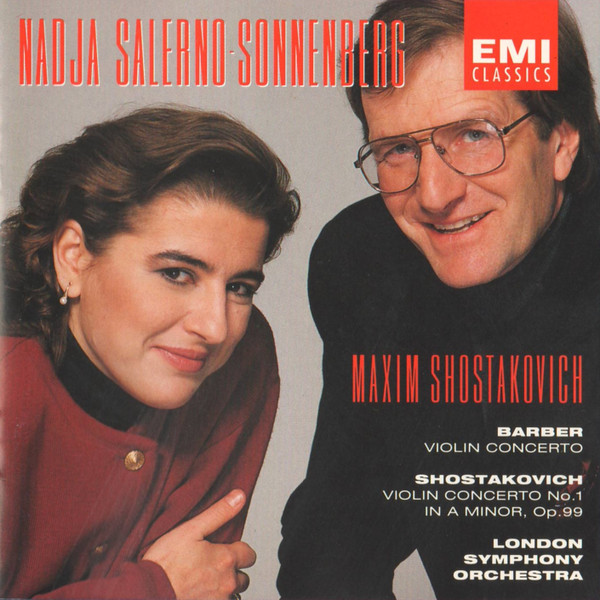
BD:   I talk with singers a lot, and they say that singing an opera is very different than singing a Lieder recital.  Is playing a concerto different than playing a sonata?  [Vis-à-vis the recording shown at right, see my interview with Maxim Shostakovich.]

Salerno-Sonnenberg:   Yes.  Concertos are generally harder technically.  Recitals have such a different feel.  That’s something where I feel I have to take the audience in immediately.  When I’m playing a concerto, I’m like the wide receiver of the football team.  I have the whole gang behind me, and hopefully everybody’s getting along, and you feel their support.  That’s a whole other thing that comes between the orchestra and yourself as well.  You’re not alone on stage.  It’s a different feel, and it is certainly larger in scope, and dynamically you have to adjust to that.  There’s no sonata written that compares technically with the Sibelius concerto.  It’s a different kind of preparation.  It’s chamber music.  You’re the sole focus.

BD:   Do you not try to make concertos chamber music?  Many conductors have said that.

Salerno-Sonnenberg:   No!  There are intimate parts in concertos, intimate moments, but a concerto is a concerto, and you lose something if you don’t recognize that.

BD:   In a concerto, you say you are the wide receiver.  Is there a defensive line that you have to go through?

Salerno-Sonnenberg:   Depends on what section...  [With a wink]  Usually it
s the violas!  [Both have a huge laugh]  Seriously, sometimes there is a defensive line.  For example, as a violin soloist I always have to deal with the concertmaster.  I want to have eye contact with the concertmaster, and I definitely want to have eye contact with the principal cellist no matter how it is set up.  It’s just better to have more communication with the orchestra than just your conductor.  Then sometimes you don’t have such a great conductor, and you need to help it along.  There have been situations where Ive gotten some pretty negative vibes from the concertmaster for a myriad of reasons.  Some people don’t like that you’re a woman, and some people don’t like that you’re a young woman.  I certainly got that early in my career.  Then, I have a certain style of playing that people respond to in a very positive way, or they hate it.

BD:   There’s no middle ground?

Salerno-Sonnenberg:   I don’t think there’s a middle ground with me.  That’s not been my experience.  Sometimes it’s awful to feel this tension between you and this guy or girl sitting two feet from you, when you want to have this camaraderie with them.  If it’s not there, there’s nothing you can do about it.  After a while it’s not such a team sport.  Every single situation is different.  To come to Chicago, this incredible town, and there’s no arguing that the Chicago Symphony Orchestra is one of the greatest orchestras on the planet.  So to have such positive fun with mutually respecting chemistry, I cannot tell you how this feels.  I also have a very close relationship with Christoph, and we’ve worked together a lot.  So to walk on stage at Orchestra Hall with this particular orchestra, have a couple of laughs with Sam [Magad, the concertmaster], wink at Christoph, and play some music, it’s the best gig you can get.    

*     *     *     *     *

BD:   Taking this metaphor just one more step, and then I promise I will drop it...  If you’re the wide receiver, is it unreasonable for the audience to expect you always to make the catch and score a touchdown?

Salerno-Sonnenberg:   Audiences have come to expect me to do that, because I’m a huge risk-taker on stage.  Anybody who knows my playing, or has followed my career at all, knows that.  So yes, as far as I’m concerned, I don’t want to disappoint them.  [Laughs]  That’s a lot of pressure...

BD:   You’re an honest player.
 
Salerno-Sonnenberg:   Yes.
salerno
BD:   Without mentioning names, are there some who are not honest?

Salerno-Sonnenberg:   There are people who are afraid, and they have a problem expressing how they feel in front of a public.  They play a certain way in the rehearsal, and then it’s not there in the concert.  The only difference I can think of is the public.  I’ve seen it.  There are people who have different approaches to music.  There’s a cerebral approach, an intellectual approach, an impulsive approach, and an instinctive approach.  Christoph and I both adore creating different colors.  I see no reason why you should play a piece of music which has a myriad of emotions, with the same sound for the whole piece.  I have enough control of my instrument to create many colors.  I want to do that, and he allows me to do that, so to work with somebody like that is phenomenal.  But I don’t think there are any dishonest players.  There are different approaches to making music, and some players reign it in, but there’s probably a good reason for that.
 
BD:   You say there’s a myriad of colors, and you’re always looking for them.  Are you deciding what colors are going to be there, or are you discovering what colors are already there?

Salerno-Sonnenberg:   Usually everything with me happens instinctively.  I’ll just play it like that, and I will look at the score and see if this will work.  I also look to see what’s going on in the orchestra, and if I can do it.  Then, I decide if it makes sense musically.  I can backup anything I do instinctively with a harmonic or structural analysis of the score.  I know this is why I’m doing it, and it makes sense.  There are so many ways of playing a piece, and when I was younger I just felt that way, and knew that as I got older I would still feel it that way.  Now I know so much more about music, that I can explain exactly why.  By following this line, you can see that this is what’s happening, and it comes out here, and this is why I want to do it this way.  I quite often have had to explain why, because I play things differently, and they know that.

BD:   Let me ask the easy question.  What’s the purpose of music?

Salerno-Sonnenberg:   Music is one of those gifts that make life worth living.  Phenomenal food also makes life worth living.  [Both laugh]  A high is when you have an intimate moment with somebody, whether it’s a great laugh or a beautiful sentiment.  I certainly would not be physically alive if I didn’t make music.  For me it’s the only reason why I would want to be here.

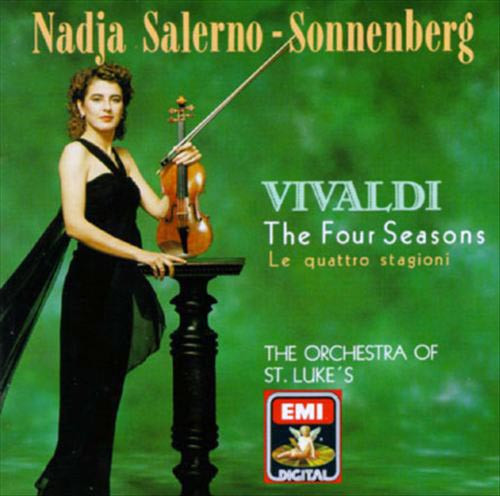
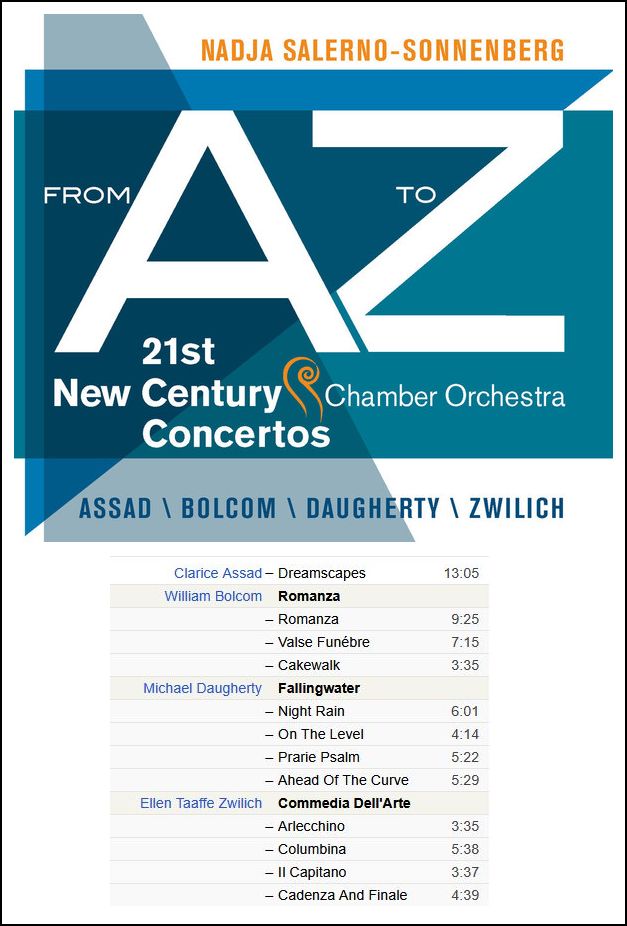
BD:   Do you play any contemporary music?  [Vis-à-vis the recording shown at left, see my interviews with William Bolcom, and Ellen Taaffe Zwilich.]

Salerno-Sonnenberg:   Yes.  I am really branching out big time right now.  [Laughs]  In the last couple of years I have done stuff I cannot believe.  I’ve done it, and it’s been so much fun.  It’s been so great.  It’s not just contemporary music, but completely different styles of music.  I study jazz now.  Whenever I have a moment, I study jazz.  

BD:   [Noting that so much of jazz is improvisitory]  It’s not an oxymoron to study jazz?

Salerno-Sonnenberg:   No!  I never said I was going to perform it, but I play it in my home.  I listen to it, I study it, and I let myself go late at night with a glass of whiskey.  I play jazz to see what happens.  I’ve even played Klezmer recently.  I guested on a rock’n’roll album with a guy named Joe Jackson.  He asked me to be the Devil on his album called Seven Deadly Sins.  I’m also playing Brazilian music now.  It’s just incredibly challenging and fantastic fun to do this.  I would not have considered this a couple of years ago.  Because now my life is only about music, it’s all that I have, so let’s put more into it.  Let’s just keep doing it.  If it sounds marvelous, I’d like to try it, and then do it.  Then it’s funny when you come back to the standard repertoire, which is my bread and butter, and which I can never leave.  The concertos and the sonatas become new, and all have a different light.  It sounds quite corny, but to even after so many years of having done all this other kind of music, you’d be surprised what you discover about Tchaikovsky, and how fresh it is.  That’s a great gift, and it’s terrific.

BD:   Should we try and get the audience for Joe Jackson into the concert hall for Tchaikovsky?

Salerno-Sonnenberg:   That’s a tough question.  There’s a big problem educating the public, especially the younger public so that we can be assured of having a public later on.  I have been successful at this on some level, and I’m very proud of that.  It was not a plan.  It wasn’t thought out or anything.  Maybe it was that I was young, or that I was a girl, or that I liked baseball, but something happened where I started to attract the much younger audience.  They thought I was cool or something, and they could relate to me.  At first there was quite a lot of pressure, and then I realized that this is a wonderful thing.  At some concerts I see kids with like pink hair sticking straight up sometimes, and I hope they might come back to hear another concert.  There’s nothing negative you can say about that, especially these days.  We really just need to fill the concert halls.  It’s not every city that is lucky enough to have an orchestra like Chicago.

BD:   Is it partly your responsibility to fill the concert halls, or do you leave that aspect to the marketing and PR departments?

Salerno-Sonnenberg:   It’s partly my responsibility.  I’ll do whatever it takes to help the local organization sell seats, just as it’s my responsibility to promote my records.  It’s the recording company’s responsibility to produce the records and get them into the stores.  If I want that record to do well, I have to go on TV, and I have to promote it just like a movie star.  I don’t have to, but if I want the record to do well, what’s the point of not doing it?  I don’t really have anything better to do, so let’s go and promote!

*     *     *     *     *

BD:   What advice do you have for younger violinists coming along?

Salerno-Sonnenberg:   I would say for any young musician, don’t do it if you don’t love it.  It’s a hell of a life, so don’t do it unless you have to do it, or you are compelled to do it, or you have no choice, because the business of music is difficult these days.  We’re not living in the heydays of the 1930s, 40s and 50s, when great classical artists were considered treasures.  Now it’s all hurry up, then on to the next artist who’s coming next week.  It can be a very demeaning and depressing life, but if you garner the enormous joy when you’re playing, then stick with it and do it.
salerno
BD:   What advice do you have for audiences?

Salerno-Sonnenberg:   For the audiences that are already coming, just please keep coming.  The ones that we need are the new ones.  There are so many times that I have encountered people who say they can’t go to a concert or opera because I don’t know anything about music, and that’s a shame because so many people feel that they need to be educated for years before they can even go and enjoy a piece of music.  All you need to do is to be able to hear.  That’s it!  If you have one ear that works, that’s all that’s required.  You’ll be affected by what you hear, and you don’t need to know anymore than that.  Don’t be afraid.  It’s not an elitist thing to listen to music.

BD:   So the concerts you play are for everyone?

Salerno-Sonnenberg:   I would hope so, and that’s why things like supporting Public Broadcasting Service [PBS] are so important, because there are so many people who can’t afford a ticket to go.  But if you can see Pavarotti on TV for free, that’s fantastic!  They can’t go to the Met, so you’ve got to bring it to the masses in any possible way you can.  Now we’re living in the 90s, and there are so many ways.  We have to use what’s available to us to get classical music and the arts out to as many people as possible.

BD:   Are you on the internet?

Salerno-Sonnenberg:   Me?  No, oh, no!  [Remember, this interview was held in 1997, just as the internet was becoming ubiquitous.]  I have enough trouble sending my little email notes.  [Much laughter]

BD:   You don’t want to have a website?

Salerno-Sonnenberg:   I love gadgets, but I’m not technical at all.  I just can’t get it.  Very recently I figured out my Video Home Service, so now I can tape Voyager when I’m not home.  I’m so proud of myself for that!  [More laughter]

BD:   Do you have any advice for composers who want to write music for the fiddle?

Salerno-Sonnenberg:   No, I don’t think I do.  I would say strongly that if it’s commissioned, then you already have the artist you’re writing it for.  So, think of that artist.  Think of what it is that artist does best, and what makes that artist special.  What’s different about that artist
s playing?  Then write the piece accordingly for that artist, because if the piece does not have a successful premiere, it’s not going to go anywhere.  It’s not going to have any life afterwards.  So it’s very important that whoever you’re writing the piece for has a great time playing it, and plays it a lot afterwards, not just the first concert.  That’s very important.  Otherwise it dies.

BD:   Do you take that advice and play these new pieces as much as you can?

Salerno-Sonnenberg:   The ones I like, I do, absolutely!  [At this point we stopped to take care of a few technical details, including her reading of a station break.]

Salerno-Sonnenberg:   I hate saying my name!

BD:   Why?

Salerno-Sonnenberg:   I don’t know, I hate it!  [Pauses a moment]  Okay... anytime?

BD:   Anytime!

Salerno-Sonnenberg:   Hello, this is Nadja Salerno-Sonnenberg, and you’re listening to Classical 97, WNIB in Chicago.

BD:   Thank you.

Salerno-Sonnenberg:   You’re welcome!

BD:   May I ask your birth date?

Salerno-Sonnenberg:   January 10th.  I hate having that birthday.  Everyone’s totally broke!  [Gales of laughter]  I get things like slippers because everyone has run out of money at Christmas!

BD:   Are you at the point in your career that you want to be at this age?


salerno


Salerno-Sonnenberg:   As far as playing the violin, I don’t care what age I am.  I will play the violin until I literally drop dead.  I care about my age with what is or isn’t happening to me personally, because I just feel that the passage of time is going by so quickly that I can’t believe it.  It seems as though I was in high school yesterday.  I am a very instinctive person, but also very structured.  I don’t know if that’s a strange combination or not.  I’ve wanted to be doing this, this, and that by a certain age, both professionally and personally, and I have just done the professional side.  I’m really happy, and couldn’t be happier, but things didn’t work out that way personally.  As a woman, you get to a certain age, and you have to think that maybe certain things won’t turn out the way you planned.  But as far as playing music and playing my violin, it just doesn’t matter.  I feel like I’m coming into the realm of peaking.  I
m not even close, but just getting there.  Its like I can see off in the distance a realm of peaking.  It’s fantastic.  It’s a great feeling.

BD:   Do you try to save enough time for you?

Salerno-Sonnenberg:   Right now, no.  It’s my choice.  There’s nothing else I’d rather do.  I have found that the fairest relationship I have had in my life is between me and my violin.  It gives back exactly what I put into it, so I’ll just stick with that for a while!  [Both laugh]

BD:   What is the instrument that you play?

Salerno-Sonnenberg:   I’m playing a Peter Guarneri, which is almost mine...

BD:   Another few payments and it’s yours?

Salerno-Sonnenberg:   A couple more and that’s it.  [Both laugh]


Pietro Guarneri (April 14, 1695 – April 7, 1762) was an Italian luthier. Sometimes referred to as Pietro da Venezia, he was the son of Giuseppe Giovanni Battista Guarneri, filius Andreae, and the last of the Guarneri house of violin-makers

Guarneri lived in Cremona with his father until 1717, when he arrived and settled in Venice. There he blended the Cremonese techniques of his father, working with the Venetian makers of the same period. He married Angiola Maria Ferrari on 5 April 1728, with whom he had eleven children.

His first original labels from Venice date from 1721. His instruments are rare, and as highly prized as those of his father and uncle.


BD:   Do you have just one that you take on tour all the time, or do you have several that you rotate?

Salerno-Sonnenberg:   I have two instruments.  The other is a very, very good modern instrument made by Sergio Peresson.  I’ve had that since I was very young.  I really like playing on that instrument, but I play the Guarneri most of the time.

BD:   Will you be back in Chicago?

Salerno-Sonnenberg:   I hope so, anytime!

BD:   Good.  Thank you for coming, and thank you for the conversation.

Salerno-Sonnenberg:   It’s my pleasure.


= = = = = = = =                 = = = = = = = =                 = = = = = = = =
-----                -----                -----
= = = = = = = =                 = = = = = = = =                 = = = = = = = =


© 1997 Bruce Duffie

This conversation was recorded in Chicago on December 17. 1997.  Portions were broadcast on WNIB in 2001, and on WNUR in 2004.  This transcription was made in 2026, and posted on this website at that time.  My thanks to British soprano Una Barry for her help in preparing this website presentation.

To see a full list (with links) of interviews which have been transcribed and posted on this website, click here.  To read my thoughts on editing these interviews for print, as well as a few other interesting observations, click here.

*     *     *     *     *

Award - winning broadcaster Bruce Duffie was with WNIB, Classical 97 in Chicago from 1975 until its final moment as a classical station in February of 2001.  His interviews have also appeared in various magazines and journals since 1980, and he continued his broadcast series on WNUR-FM, as well as on Contemporary Classical Internet Radio.

You are invited to visit his website for more information about his work, including selected transcripts of other interviews, plus a full list of his guests.  He would also like to call your attention to the photos and information about his grandfather, who was a pioneer in the automotive field more than a century ago.  You may also send him E-Mail with comments, questions and suggestions.