Conductor  James  Sedares

A Conversation with Bruce Duffie


sedares


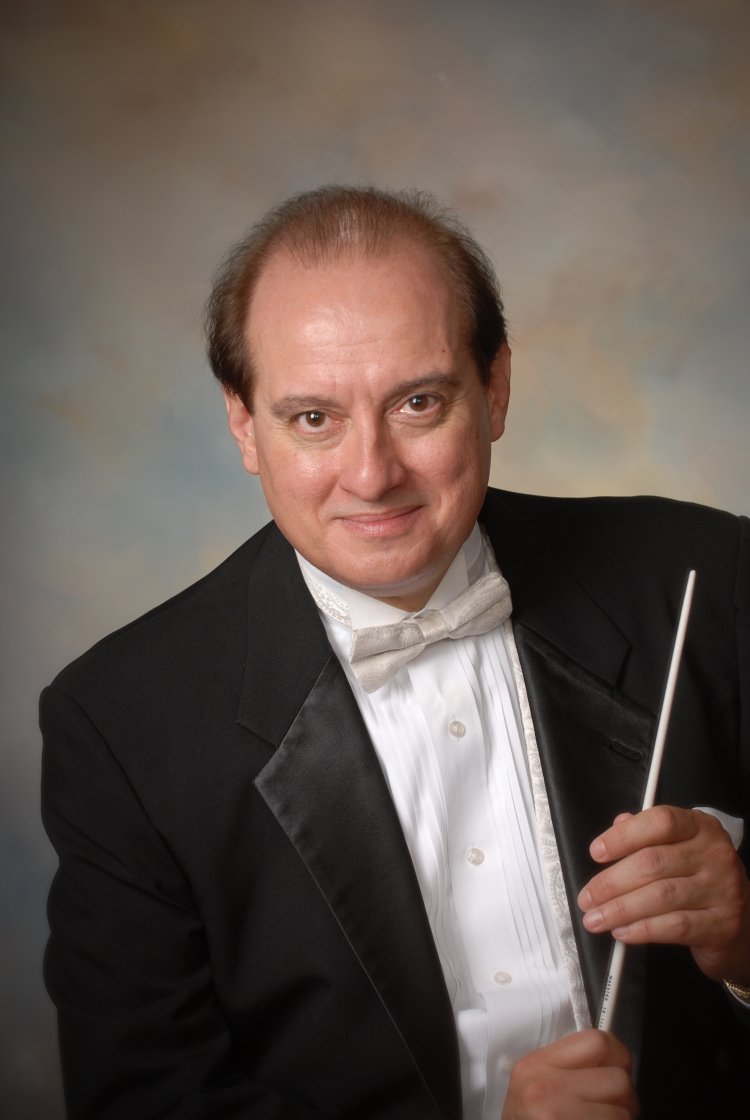
In 1979 James Sedares (born January 15, 1956) was appointed Associate Conductor and later Music Advisor of the San Antonio Symphony. He joined the Phoenix Symphony as Resident Conductor in 1986 and three years later became its Music Director. In this latter position, he has made a distinguished name for himself as one of the most outstanding of a new generation of American conductors. He has enjoyed equal acclaim as a guest conductor in the United States and abroad, the latter engagements including appearances with major orchestras in Europe, in Central and Southern America, and in New Zealand.

His recordings include Grammy-nominated releases with the London Symphony Orchestra and with the Louisville Orchestra, and a series of some fifteen recordings with the New Zealand Symphony Orchestra. With the Phoenix Symphony he has won particular success in the recording studio, with acclaimed award-winning releases, in particular, of works by leading American composers.

==  Biography above is from the Naxos website  
==  Biography below is from the Summit Records website  

*     *     *     *     *


The American conductor, James Sedares, has proven himself one of the best and the brightest of a new generation of American conductors. In 1996 he concluded a ten-year tenure with the Phoenix Symphony Orchestra, an ensemble he placed into the spotlight of national and international recognition. Responding to a performance conducted by Maestro Sedares, the Arizona Republic stated, “If quality and beauty are criteria for attending a concert, patrons should be standing in line to get into Symphony Hall…”

An impressive orchestra builder, James Sedares recently concluded his 6th season in the position of Principal Guest Conductor with the Vector Wellington Orchestra in Wellington, New Zealand (2006). Last season he made his debut with the Rotterdam Philharmonic Orchestra and had his first release on the prestigious Deutsche Grammophon Label in a performance of the Waxman oratorio Joshua performed with the Prague Philharmonia. Upcoming debuts include performances in Mumbai, London, and Seoul.

An active recording artist, James Sedares led The Phoenix Symphony’s critically acclaimed premiere recording of Copland works released on the Koch International Classics label in September 1991, later winning the prestigious INDIE award for best classical album of the year from the National Association of Independent Record Distributors (NAIRD). Sedares’s second recording with the Phoenix Symphony featuring works of William Schuman and Bernard Herrmann, appeared on the Billboard classical album charts for several months and the 1999 release of former PSO Composer-In-Residence Daniel Asia’s Symphonies Nos. 1 and 2 on New World Records received stunning critical acclaim in the recording press. Undoubtedly the foremost success for Sedares and the Orchestra was the recording of Elmer Bernstein’s reconstructed score to The Magnificent Seven on Koch International Classics in 1994. This blockbuster CD was listed on Billboard Magazine’s classical crossover best seller chart and continues to be one of the top rated releases of the year. The composer calls it “the definitive interpretation” and it won the ECHO Award, the prestigious German Record Critics Prize (Der Deutschen Schallplattenkritik Preise); as well as another INDIE award as best CD in the film music category. Another recent film score recording on Koch is that of Miklós Rózsa’s El Cid with the New Zealand Symphony Orchestra.

James Sedares’s collaboration with the Koch International label includes two Grammy-nominated recordings: one with the London Symphony Orchestra and the other with the Louisville Orchestra. Sedares has recorded over 40 projects for release on Koch International Classics. He has nearly 30 recordings with the New Zealand Symphony Orchestra and the New Zealand Chamber Orchestra.

A recent release on Universal Music NZ entitled “Beauty Spot” with the New Zealand Symphony Orchestra achieved gold status and topped the charts, sharing this spot with many of today’s most recorded Pop artists. “Beauty Spot II” was released in 2002 and is still topping the NZ charts.

An active guest conductor, James Sedares has led many of the major orchestras throughout Europe, the Pacific Rim and the USA.


==  Names which are links in this box and below refer to my interviews elsewhere on my website.  BD  


thomson


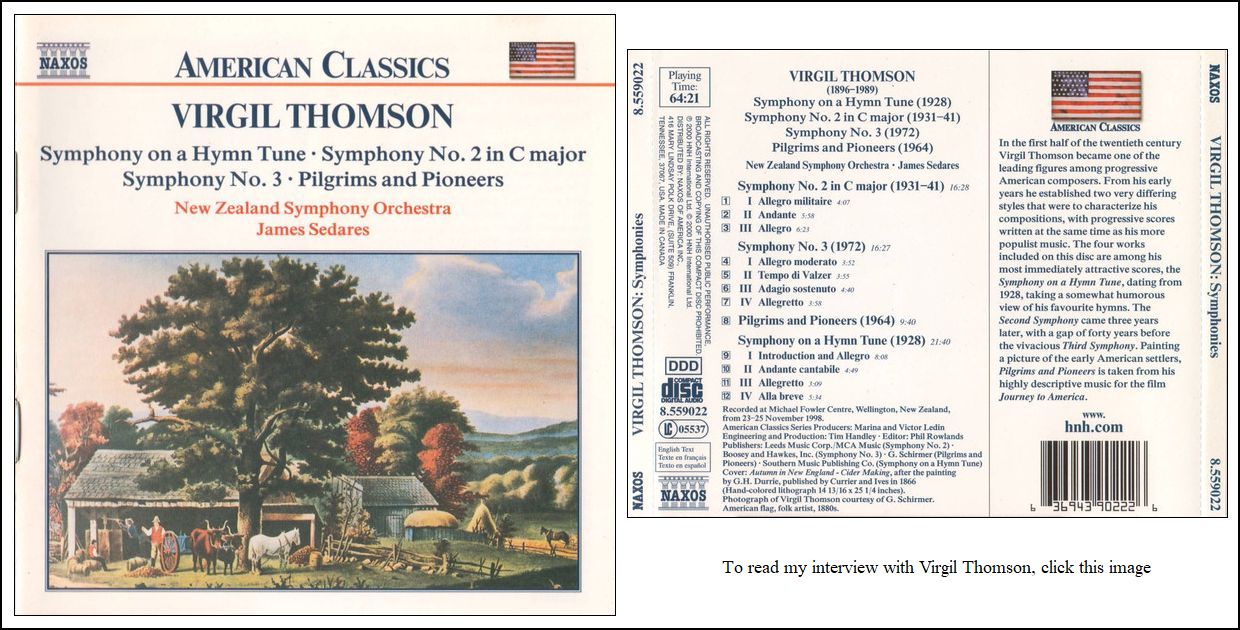
In June of 1996, James Sedares, who was born and grew up in suburban Chicago, was making his Windy City debut conducting the Grant Park Symphony in one of their free outdoor concerts.  The program included a work by Pulitzer Prize winner Ellen Taaffe Zwilich, which he had previously recorded.  During his busy schedule, Sedares graciously took time to sit down with me for a conversation.  Portions were aired on WNIB, Classical 97, and later on WNUR, and also Contemporary Classical Internet Radio.  He had recently turned forty, and now, thirty years later, I am pleased to present the entire chat on this webpage.

While setting up to record, we were discussing audiences, and the task of putting together various pieces on different programs . . . . .


Bruce Duffie:   You present music and hope they like it?

James Sedares:   The first thing I would suggest is to go to as many performances as possible, listen to as many records as possible, and immerse yourself in it.  That will help to develop your taste.  Listen to several different orchestras playing the same piece, and have several different conductors.  See what appeals to you, and find what you like and what you don’t like.

BD:   If you don’t find a difference in all of those conductors, should you give up?

Sedares:   [Laughs]  It does sometimes take a while.  Even for the serious subscriber to classical music or symphonies, sometimes telling the difference between Conductor A and Conductor B is not as easy as you’d think.  Obviously, sometimes we can tell right away.  There’s no question about it.  For instance, I can hear two or three bars of the Brahms Second Symphony, which begins in D major with a very simple-sounding melody in the bass.  I could then probably tell you a lot about the conductor.

BD:   Just from a couple of bars?
 
Sedares:   Just from a couple of bars!  I might not be able to tell you exactly who it is, but I can tell you a lot about the musical values, and the point of view.  Then you can narrow it down to a list of who might be this or who might be that.  Some of it is tempo, some of it is bowing, some of it is articulation, but there’s also the phrasing and the breathing.  When a whole generation of conductors tried to emulate Toscanini’s tempos, they couldn’t do it.  Only he could do it!

BD:   Then eventually you have to be yourself.

Sedares:   There’s no other way.   Even if you try not to be yourself, you’d still be yourself because it’s almost impossible to copy someone else.  What you bring to an orchestra as a conductor is a sound, for good or for bad.  One of the great things that I saw here at Grant Park when I was a student coming back home for a summer, was one of my mentors, Walter Susskind.  He used to be Music Director of the St. Louis Symphony Orchestra, and he conducted at Grant Park a couple of times.  One of the amazing things I never forgot is that within five minutes he had the Grant Park Symphony Orchestra sounding very much like his St. Louis Symphony Orchestra.  In a way, that’s what conducting is all about.  Music is one thing, and conducting serves that, but conducting is about making the sound that is actually being heard match the sound that is in your inner ear, and then bringing those two images together.
wilson
BD:   So then wherever he conducted it would always be his sound?

Sedares:   I think so.

BD:   Wherever you conduct, is it always your sound?

Sedares:   Other people have to judge that.  I can’t be presumptuous enough to say that.  I’ve been told that I carry a good sound with me, and I’m becoming more and more obsessed with sound as I get on in this business.  Sound is more than fifty percent of it with orchestras.  It’s getting that proper sound and ambiance to the sound that we want, and that’s the sign of an accomplished conductor.  The musical side of it is separate from the sound side.  You know the sound that you want, and then you have to do something with it.  There are some conductors who are completely sound-guys.  I chose this particular concert along with James Palermo, who is the General Director of the Grant Park Festival.  He happened to be with the Louisville Orchestra when we recorded the Zwilich symphony a couple of years ago.  He liked it so much, and liked the result of the recording so much that he suggested we include it here.  I’m a great fan of her music, and she has been pretty lucky for me, too.  Both my Grammy nominations came with works of hers.

BD:   Is it easier or harder two years later presenting a work that you have rehearsed and performed, and then recorded?

Sedares:   It has both sides of it.  It’s not a piece that I’ve done a lot of performances of.   I did the performances that week before I did the recording in Louisville, and sometimes you are learning repertoire for specific purposes, like recordings.  To come back to it now is refreshing, because I restudied it, and I might even do some things differently than I did during the recording.

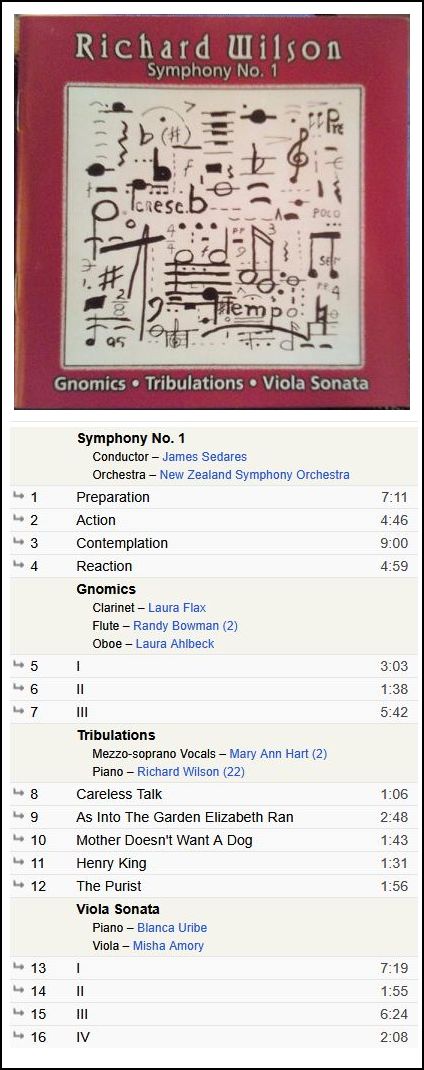
BD:   You’ve made a number of recordings.  Do you conduct differently for the microphone than you do for a live audience?  [Vis-à-vis the recording shown at right, see my interview with Richard Wilson.]

Sedares:   I like to think not, but it’s probably unavoidable that you are focusing on certain things for a recording differently than you are for the concert experience.  It
s not really balances, but rhythmic accuracy, because the microphone is forever.  Michael Fine, the recording producer from Koch, tried to do things in the studio as precisely as possible without losing the spontaneous shape of it all.  Actually, having this double life of concerts and recording helps both.  You are very conscious of architecture and shape while you’re recording it, because sometimes you’re doing small snippets to go back and patch in.

BD:   Are the small snippets after you’ve recorded the whole thing, and you’re just patching a little piece here and there?

Sedares:   It depends.  The process is different each time.  For orchestras like the London Symphony Orchestra, or the English Chamber Orchestra, or in New Zealand where I have done some recordings, they do something called rehearse/record, so the tape is rolling from the very beginning.  Then, when something is up to a level where it’s acceptable, we start to do takes.  The American system is totally different.  The American Federation of Musicians electronic media clauses demand that you have to have rehearsals and public concerts of the repertoire before you go and record it.

BD:   I would think that would be better for the musicians, including the conductor, to understand the work.

Sedares:   I’ve always been of the feeling that the time that’s needed to do a task is the same as the time allotted.  Oftentimes, that’s why people want twelve or thirteen rehearsals for something when they could do it just as well on four or five.

BD:   Is there ever a chance that you get too many rehearsals?

Sedares:   [Laughs]  I don’t tell anybody that, but there is the problem of being over-rehearsed in live music in particular.

BD:   Do you do all of your work in the rehearsal and have it perfect before you come to the concert, or do you leave something for the spark of night of the concert?

Sedares:   I don’t think we ever get it perfect.  If I ever did a perfect concert, I’d probably retire right then and there, and just give it up.  [Laughs]  What’s interesting is that I like to prepare the orchestra to the point where it can take off in the concerts.  It can expound and go further.  I want them to be comfortable, but I don’t deliberately throw any curves.  Some conductors try to take a different tempo in the concert than in the rehearsal.  I don’t really do that, not intentionally anyway, that’s for sure.  You want an orchestra to be comfortable, but you also want them to have a little anticipation of what’s going to happen.

BD:   [With a wink]  Do you throw the Fear of God into them once in a while?

Sedares:   Not fear, but just the anticipation and excitement.

BD:   What happens if in the middle of a concert you get a wonderful brilliant stream of inspiration?

Sedares:   That plays to the level of trust and camaraderie you have with the orchestra.  If you’ve built up through the years and through the concerts, a kind of cachet with them, they’ll follow you into uncharted territory... maybe!  But it’s not always a good thing to do.  One complaint that orchestra members have about conductors is that they’re inconsistent between concerts.  Consistency is a big issue with some orchestra members.

BD:   Do you want to be consistent?

Sedares:   Consistent in a good sense.  For example, I did a lot of ballet in my earlier life, and that is extremely useful to recording sessions, because when you go back and do a passage again, I know it’s going to be in the same tempo, so it’s editable.  But you don’t want to be consistent in the sense that you’re predictable and boring.

BD:   Dancers have to have a certain amount of time to do all of their movements, so that always has to be about the same.

Sedares:   Dancers are pretty consistent, and they know tempo better than musicians because of the way it feels in their body.

BD:   Do they ever ask you to make it just a little bit different for their physical needs?

Sedares:   They’ve never asked that, but if you’re conducting a lot of ballet, as I used to and I still do some, you can look and feel whether a dancer is tired.  Faster is usually the key, and if you play it faster they’re less stressed.

BD:   In rehearsal, do you notice if it takes just a little longer to get down from a leap?

Sedares:   Yes, you have to react to that.  Usually if there are casts A through C with different dancers, they may come to you before the performance and ask if they could have something a little slower or a little faster than the other day for another dancer.  That’s perfectly within the norm.

BD:   I just wondered if any of these physical considerations enter into your musical decisions, or is it all wrapped up into one package?

Sedares:   The best ballet companies, and the ones I’ve worked with over the years, are the ones that dance to the music.  They don’t try to make the music fit the dancing.  The music is really first in many ways, and the great companies would tell you that.  When you watch performances of great companies live or on video tape, you notice that if the music sounds natural, the dancing is probably very good, too.
erb
BD:   That’s the advice you have for ballet conductors?

Sedares:   Oh, I wouldn’t presume to give advice to ballet conductors, but that’s what I do.  The music should not be really distorted, meaning awfully fast or awfully slow from what is perceived as the ballpark norm.  There is a parameter of tempo which is conventionally followed that’s within the realm of reality.  It can be a little faster or slower, and I can determine that through my discussions with the choreographer, and then I start to do it.

*     *     *     *     *

BD:   Coming now back to the concert repertoire, you have this huge amount of orchestral literature from several hundred years to work with.  How do you decide what you’re going to play, and what you’re going to work on, and what you’re going to do next year, and what you’re going to leave aside for a long time?

Sedares:   Let me answer the last part first.  I haven’t tackled any Bruckner yet.  I just turned forty, and have been conducting for about twenty years.  I started pretty early at a professional level, and before that I was a student conductor.  I haven’t done any Bruckner yet for a lot of reasons.  It sounds almost cliché, but it doesn’t speak to me yet at the level at which I could do anything to it or for it.  I understand the music when I listen to it in the concert hall, and I know when it’s being done well.  There are some wonderful Bruckner conductors that I’ve had the privilege of hearing and talking to and working with over the years, but I feel I don’t have much to contribute to that scene yet.  I may change my mind as I get older and study it more.  I’m constantly looking at it and evaluating.

BD:   Can we infer that anything you do conduct means you feel you have something to contribute?

Sedares:   It’s a fair question.  One shouldn’t be conducting works that one has no point of view about, and the temptation for young careers – and forty is still kind of young for conductors!
is great to say I can do that and that.  But there’s no substitute for study, and for some introspection when it comes to music.  Also, you have to live a life.  You have to have other interests to be really the consummate musician.  Experienced writers will tell you that young writers are not always successful because they don’t have anything to write about.

BD:   They haven’t lived yet!  [Vis-à-vis the recording shown at left, see my interview with Donald Erb.]

Sedares:   Right, and music is much the same way.  It
s not that I’m that obsessed with the idea of being forty, but the older I get, the more layers of understanding come with just life in general, and that can’t help but go into the music.

BD:   So, going back to the previous part of the question, how do you decide which works you are going to play?

Sedares:   That is a very complicated set of decisions, and largely it has to do with pleasing and satisfying at least three constituencies.  If you’re a music director of an orchestra, as I’ve been for ten years with the Phoenix Symphony Orchestra, you have yourself to think about, and what’s going to make you grow as a conductor and a musician.  You have the orchestra’s growth and development, and their likes and dislikes and strengths and weaknesses to deal with.  Just because an orchestra is not as strong in one area of the repertoire as others, doesn’t mean that you should avoid that repertoire.  My feeling is that you should go in there and try to get them to do it better.  Then there is the audience, and sometimes those three constituencies are not easily satisfied at the same time.

BD:   There’s not as much overlap as one would think?

Sedares:   I don’t think so.  The priorities are different.  Sometimes, the most important thing is selling tickets.   If you’re in a particularly difficult cash situation with orchestras, as I have been accustomed to over the years, and knowing that you have to put bodies in the seats, that’s a combination of programming and marketing and execution.

BD:   Some musical decisions are based on economics?

Sedares:   That’s not a new thing.  Anybody who doesn’t think that is either not having a reality check, or is not being totally honest.  In Arizona, there’s someone whom I admire, named Glynn Ross, who has just presented a complete Ring cycle.

BD:   He used to be up in Seattle.

Sedares:   Right.  He always said that every artistic decision is a business decision, and every business decision is an artistic decision.

BD:   Then where is that delicate balance?

Sedares:   They’re so interconnected, it
s almost incestuous to a point that you can’t just say.  There used to be the old sandbox theory.  The conductor plays in his sandbox, and the manager plays in his sandbox, but these days we’re each playing a lot in the other’s sandboxes.

BD:   Have we gotten rid of the wall so that it’s really just one sandbox?

Sedares:   In some situations, yes.  I wouldn’t say totally, because sometimes you want to do Gurrelieder, and everybody tells you you’re not going to do it because it costs too much money.  You might try to insist, and I haven’t made my mark in the sand, so to speak, for a long time on issues like that.  But sometimes you have to just swallow hard and do what’s right artistically for the organization.

BD:   Is it safe to assume that, at least in your case, there’s enough economics for you to do most things you want?

Sedares:   Obviously, I’m a working conductor, and I’m not Celebedache, who only comes to conduct when it’s absolutely the perfect thing!  It’s a nice situation to be in, and I have great respect for him and his talent, but those of us who are working conductors don’t always have the luxury of just doing what we have the need and hunger to do.  We have to do a lot of things.

BD:   Have there been times that you have been forced into a situation, and then been pleasantly surprised and glad you were forced into doing it?
sedares
Sedares:   Oh yes, absolutely!  I
ve been forced into going places...  I went to Slovenia one time at the urging of my record producer, right when the country was breaking up in 1991, and I didn’t want to go.  I found all kinds of excuses as to why I wasn’t going to go.  I even called up our US senators in Arizona and asked if they thought I should go.  I was waiting for them to tell me no, and they said I really shouldn’t go, but my record producer insisted, and it was a great experience.  It was the Eastern European premiere of the Ives Fourth Symphony, which is incredible.  There’s a chorus that spoke Slovenian, singing hymn tunes of Ives in English.  It was just completely the most crazy and exhilarating situation I’d been in in a long time.  I can’t say the results were great, but the music works at a certain level.  It may sound like a total mess, but everything’s there.  Ives had a very clear idea of what he wanted, and sometimes what he wanted was that it was a total mess!

BD:   Is it your responsibility to sort out the mess, or is it your responsibility to present the exact mess that Ives wants?

Sedares:   Some of it is out of our control.  We are who we are, personality-wise.  I’ve never warmed up to the sloppy emotional playing that people tend to equate with some conductors.  On the other hand, I don’t think that just because you want things clean means that it somehow lacks juice or emotional content.  You can have both.  For example, the Cleveland Orchestra has had both for years.  They play with technical precision that you don’t hear hardly anywhere, but they also play with line and emotional content and depth, and all the real stuff.  You don’t have to have one at the expense of the other.  You need both, so conductors’ careers need both recordings and concerts to really fulfill their destinies.  I always joke with the producer and with other colleagues that I’m going to become the Glenn Gould of conductors.  But I
ve decided I’m not just going to record.  Why would I do that?  The joy of making music is interacting not only with the orchestra, but also the audience.  There is a special energy that’s created in a hall from these kinds of things, or in an outdoor situation as we have this week.

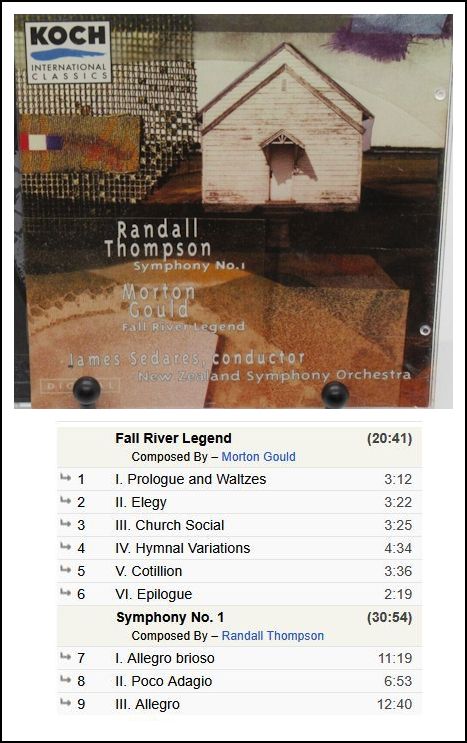
BD:   It might work for a year or so, but then you’d really begin to miss it.  [Vis-à-vis the recording shown at right, see my interview with Morton Gould.]

Sedares:   I’m sure I would.  The joke around my friends and close intimates is that I’ve got thirty-five recordings, and two Grammy nominations, but I haven’t developed the widespread concert hall career that is commensurate with the recordings that I’ve done.  So I have to work on that a little bit to bring them into line if possible.  I’ve become the
house conductor for Koch International.  They’re called America’s Premiere Label, with the intention of the double-entendre.  Their agenda is sometimes at odds with the agenda of the concert hall, because what makes a good record doesn’t always make a good concert.

BD:   It’s two different experiences?

Sedares:   It is, but they do feed off each other, and they do make me a more whole musician as a result of dipping in both pools, so to speak.

BD:   Does it give you a good feeling to know that Koch is behind you, and that you can help in the selecting of repertoire?

Sedares:   Yes, indeed.  As a matter of fact, I’m doing a record signing at the Tower record store here in downtown for some of the records that are out, and that’s an exciting part of my life.  That’s really an important part of what I do right now, and would obviously continue.  I have about six or seven in the can, but thirty-five recordings is pretty high for an American conductor at forty.  So, that’s one distinction which is nice to have.  On the other hand, I would like to have more concert hall experiences as well.  After ten years in Phoenix I’m largely exposed there, and haven’t had the time between that and the recordings to do a lot of the other things that I want to start doing.

BD:   You’ve left Phoenix?

Sedares:   I will leave at the end of this month.

BD:   Then you’re going to be a freelance wherever they ask you?

Sedares:   For the moment.  I will continue to do recordings, and then try to develop some different areas of interest and expertise.  I will have some study, some learning to do, and some growing to do myself.  Any music director can tell you that when you’re heavily into the administration side of running an orchestra, you can sometimes feel yourself losing touch with the things that really brought you there in the first place.  It becomes so important to do fundraising, and public appearances, and all the things that keep an orchestra running, because nowadays, the orchestra boards in general are getting very conservative in their programming and approach.

BD:   Is it being conservative, or are they just scared?

Sedares:   [Laughs]  There is a fear out there.  We just heard some terrible news a couple of weeks ago that the San Diego Symphony Orchestra has filed for Chapter 7.  They’re defunct.  Their concert-master is a good friend of mine.  I’ve done recordings with him elsewhere, and he said they’re dissolving their assets and they’re gone.  That’s very sad.  If you believe demographic studies, San Diego is the seventh largest city in the United States, and is a very wealthy city.  But they couldn’t support an orchestra with a budget of $7.5 million, which is really not very much money for an orchestra.  [Remember, this interview was held in June of 1996.  The San Diego Symphony was re-started in 1998, and continues as of 2025.]  So, yes, the boards are scared, and probably the conservatism comes out of the fear of the new.  That’s why Grant Park is so exciting because it’s the first request I’ve had for the Zwilich since I recorded it.  I’ve guest conducted a lot in the last couple of years around different places, and I always put that out as something that could be done, and this is the first bite we had.  I grew up here in the Chicago area, so I know it’s always been a very innovative kind of place.  They’ve done some exciting things that are off the beaten path.

*     *     *     *     *

BD:   We’ve been talking a lot about music, about conducting, and administration, so let me hit you with the big question.  What is the purpose of music?

Sedares:   For me, the purpose of music is a communication.  It is an expression.  It makes us feel, think, reflect, and grow.  Those are the things which music is best at.  You don’t have to know a particular language, which makes it different from a play.  You don’t have to understand the words that are being said, even in opera, surtitles notwithstanding!  Ballet is similar, but pure music, real music without any other agenda or any distractions, is probably the most pure and spiritual kind of communication and expression.  That’s what it’s all about.  Think about how universal music is.  When they played the Beethoven Ninth Symphony as they tore down the Berlin Wall, Schiller’s text was very important, but beyond that, the exhilarating sense of music transcended people’s language, cultures, and backgrounds.  It just was a universal sort of expression, and that’s what all kinds of music does at its best.  I’ve never believed that there were different levels of what was acceptable music and what wasn’t.  For me, there are only two kinds of music, good music and bad music of all genres.
sedares
BD:   So, music is music, is music?

Sedares:   I think so.  We could get into discussions on what is valid, but the point is that if it’s well done, it’s well done, and it’s good.

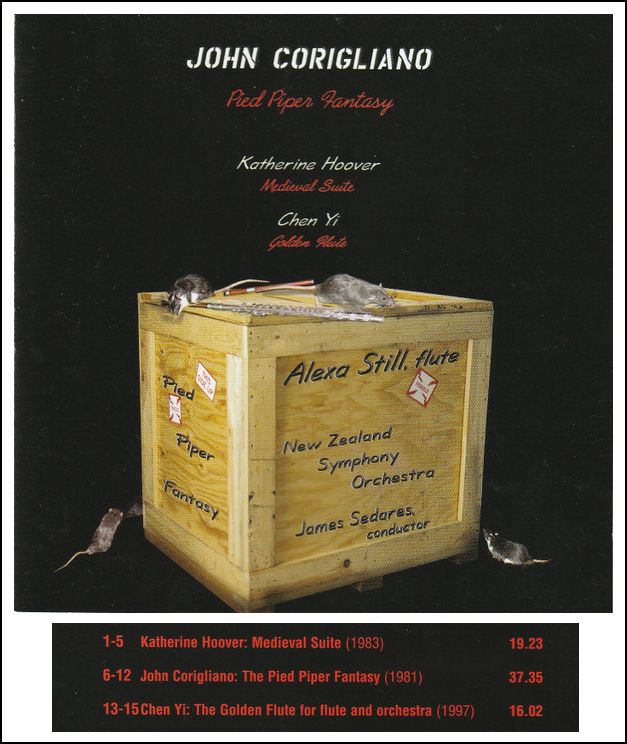
BD:   I assume that we’re not going to get many from the classical concert going to rock concerts, but can we get some of the rock audiences into the classical concerts?  [Vis-à-vis the recording shown at left, see my interviews with John Corigliano, Katherine Hoover, and Chen Yi.]

Sedares:   A certain amount of that happens as people get older.  There’s a big crisis in our industry right now, about the Generation X-ers [people born roughly between 1965 and 1980].  They really don’t inhabit concert halls for symphonic music these days, and we wonder what we are going to do with the audiences who are getting older.  After ten years, they’re ten years older, and they’re not being replenished in numbers necessary to continue.  What are we going to do about that?  When I was growing up in this city, there used to be a Chicago Symphony Orchestra Hour every week on television.  It wasn’t Fritz Reiner who did it, but rather an assistant conductor, but it was on one of the broadcast network affiliates here in Chicago.  Orchestras used to be much more part of day-to-day public life.  Arturo Toscanini was known, and even Leonard Bernstein with his Young People’s Concerts was known by the general public.  Now, I can safely say that any music director of his own city could probably walk down the street and not be recognized.  I can’t speak for Chicago, which is a big megalopolis and breaks all the rules, thereby confirming the rules in many ways.  But I can tell you that if you channel surf and look at the newspapers and at things in general, classical music, symphonic experiences, are harder and harder to find. It seems to be less and less relevant to what people do day-to-day.

BD:   Is it the people who are moving away from classical music or is classical music pulling away from the people?

Sedares:   We’re just not exposed to it like we used to be.  I don’t have the complete answer on how to solve that.  If the educational programs that orchestras have done over the years have been successful, they should be reaping some rewards by now, and they haven’t been, at least not in this development.  I’m not saying they have failed.  I’m just saying that some connection isn’t being met.  When I was trying to procure a grant for the Phoenix Symphony Orchestra about five years ago, the woman who was the chairperson of the grant process asked me how the Phoenix Symphony Orchestra is relevant to a child in the ghetto, and I had a hard time answering that question.  My responses went all the way from trying to find ways that it was relevant, though
I didn’t ask her why was it necessary that it be relevant.  The whole gamut was there in my thinking about all this, and I still don’t have the definitive answer.  I’ve been formulating some ideas over the years...

BD:   Are you optimistic about the future of concert music?

Sedares:   There will always be live concerts, but the paradigm is going to change.  When I was a kid, we went down to the CSO concerts every Thursday night for twenty-four weeks.  Most cities, with the exception of Chicago and New York, are not going to be able to do that, especially western and sunbelt cities such as San Diego, Phoenix, San Antonio, and Sacramento.

BD:   In a way, are you killing the goose that lays the golden eggs by making so many recordings that keep people home?

Sedares:   There’s an argument that can be said that people who are audiophiles hear it better at home than they can at the concert hall.  But the other side of it is that it does whet the appetite to see how it’s done.  But as orchestras get desperate, they try all kinds of gimmicks to try to save themselves, whether it’s flashing lights, or different modes of dress for the orchestra, or anything.  That’s missing the point pretty much.  It’s arranging the deck chairs on the Titanic, as they used to say.  The paradigm has to change to accommodate lifestyle in the 1990s, and to counteract this cocooning situation that’s happening now.  Everybody has their internet, and PC, and CD players, and cable television, and satellite dishes, and they stay home!

BD:   We are retreating into our caves!

Sedares:   We are, and I think that’s sad.  I just read an article on the plane about Amsterdam and its café society.  I spend a lot of time in New Zealand.  I did a lot of my recordings there, and have done a lot of concerts, and part of the life of the New Zealand Symphony Orchestra and its patrons is their café society.  On Sunday, people get their Sunday newspapers, and they go to cafés, and have coffee, and waffles, and breakfast, and they interact with each other.

BD:   Is this just in Auckland?

Sedares:   This is Wellington, which is the capital.  The State Orchestra is based there, though Auckland is the bigger city.  But they don’t stay home all the time.  They go out and do things, and interact with people, and debate, and discuss.  It gave me a nice feeling the last time I was there to be part of those discussions, where people were really talking about some issues, not just watching television, and having it done to them, so to speak.  I like television as much as the next person.  I enjoy watching a lot of things on television, but the trend is for people to stay home.  We’ll see how many people come out for these concerts here in Chicago.  I don’t know what the history is for Grant Park, but I know it used to be quite full when I was a kid growing up.

BD:   Oh, it still is.  We had a huge crowd for Van Cliburn, though I’m not sure we will get that many for the standard concerts.

Sedares:   Yes, Van Cliburn is special, that’s for sure.  But people will come out.  I’m sort of optimistic about the future of all this.  I sense now that there’s going to be a bit of a turn back to more simple values.  This is not to say that music is simple.  I mean a return to more basic kind of endeavors.  Even so, the high-tech wizardry is going to continue.  You can’t stop technology, nor should we.  But I think there’s going to be a return to those kinds of spiritually enhancing endeavors as a getaway from the other side of our daily lives.

BD:   Should music adapt itself to the technological society?
rozsa
Sedares:   We all have to make ourselves as accessible as possible in the broadest sense without changing who we are, or without changing the essence of what we do.  The symphony orchestra can change and has changed, but we can’t forget that it was created for a very specific reason to play a very specific kind of music, and that music has to remain if it’s going to be part of the repository of western culture.  I don’t apologize for the symphony orchestra growing out of western Europe, and I know that’s not a real chi-chi thing to say these days, because multiculturalism is carrying the day in many ways.  There’s nothing against multiculturalism, but let’s not apologize for Aristotle, and Plato, and Beethoven, and Brahms.  Let’s just have them be part of the bigger picture.
 
BD:   To be true multiculturalism, it has to include everybody, and that includes the ones we have grown  up with.

Sedares:   Yes, but the sub rosa context of multiculturalism has always been pushing the dead white Europeans out, and bringing all these other things in, and that’s unfortunate because we’ll lose a great deal of our cultural heritage that way.

*     *     *     *     *

BD:   You do quite a bit of new music.  Do you have any advice for composers who want to write for the symphony orchestra these days?

Sedares:   I have a list of things that are more technically orientated, like making sure your parts are readable!

BD:   But that’s actually very important.

Sedares:   Yes, it is.  I get two or three scores every week, which may not seem like a lot...

BD:   ...from composers known and unknown?

Sedares:   Right, known and unknown.  That may not seem like much but when you add that up over weeks and weeks and weeks, you’ve got a pile of scores during the symphony season.  Some have tapes and some don’t, and you can tell right away, from thumbing through them, that some are not going to do much.

BD:   What do you look for?

Sedares:   First of all I look for the shape of the music.  I look for musical thought that is cogent and cohesive.  I look for orchestration that’s going to sound good.  Like most conductors, we can look at something and get a reasonable idea what it’s going to sound like.  It’s part of our training.  When they enclose a tape, it’s even easier, so I look for that.  I also look for substance, and for a point of view, a voice is the best way to put it.  By voice I mean something that is individual and unmistakable.  For example, how many measures of Copland’s music would you have to hear to know it was him?

BD:   Some places would be very quick, just a couple of measures.

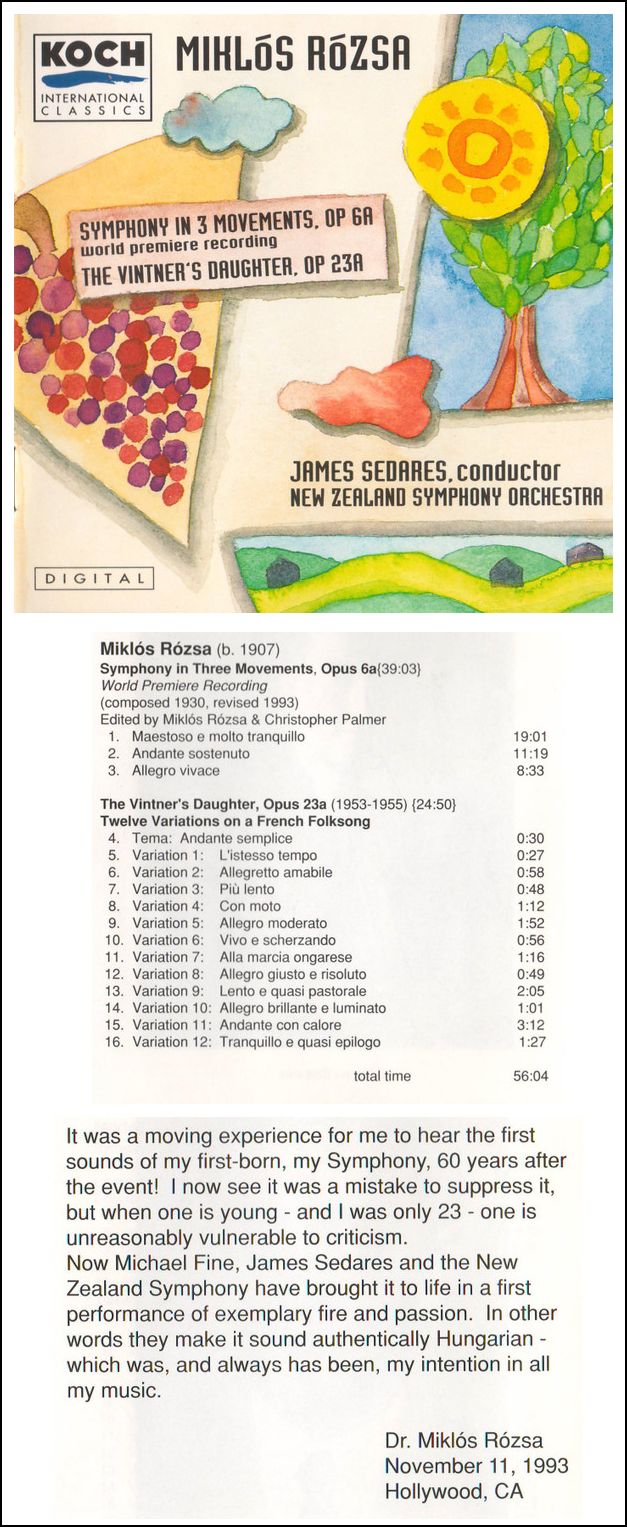
Sedares:   Yes.  A lot of the voices are there, even when they’re experimenting in styles.  I’ve been associated with the music of Miklós Rózsa
, who is primarily known as a film composer.  But before he was a film composer, he was a serious concert composer, who, like Korngold and Max Steiner came from Europe during the Holocaust era to settle in California and create a whole new career for themselves writing film music.  It’s only in America where being a film composer adds a negative stigma.  William Walton wrote film scores, Shostakovich wrote film scores, Prokofiev wrote film scores, even Copland wrote a couple of film scores.  In America somehow, we have not really embraced our own culture.  We still have a cultural inferiority complex to a certain extent.  Somehow, if it’s related to movies or popular culture in any way, it’s somehow not serious.  Rózsa’s voice as a composer is unmistakable, even when he’s doing films like Ben Hur or Double Indemnity.  He is unmistakable as a composer, and I look for that in other composers.  I look for that unmistakable voice, and when I find it, I latch onto it.  Being a champion is too strong a word.  It’s too heroic, but I am an aggressive catalyst for it.

BD:   You are an advocate!

Sedares:   An, advocate.  That’s a nice word!

BD:   In the course of all of this, might you find two, or three, or four composers to champion?

Sedares:   Well, I have to stand in line and champion Ellen Zwilich’s music, but she’s one that I have a great affection for her music and for herself as well.  Her voice is very strong.  It’s very serious, and it is music that has evolved from music of the past.  There is also a composer that we had as composer-in-residence in Phoenix, named Daniel Asia, who was with us for a couple of years.  I premiered a lot of his music, and recorded some of the pieces.  I think he has a good voice and grasp of orchestration and shape.  Some of his pieces are almost monolithic in terms of their architecture.  Some of them are very long... and that’s another piece of advice to new composers.  Brevity is sometimes the answer for the day.  If an unknown composer presents you with a forty-five to fifty-minute symphony, it’s going to be hard to get that done.

BD:   But I assume you want more than just the usual eight-to-ten-minute overture.

Sedares:   Yes, I do want that, but there has to be some middle ground.  There has to be some introductory ideas that come between the composer and the conductor.  That’s a very positive step now.  The composers and the performers are forging a bond in the last five to ten years that they seemed to have lost.

BD:   Are you happy about the fact that new music is becoming more accessible again?

Sedares:   I don’t think
accessible is a dirty word.  Sometimes in the late 1950s, 1960s, and early 1970s, composers were writing for each other in many ways, and the audience was being left out.  If you’re going to create any kind of art, you have to be writing it for somebody, for it to be heard, and for it to be championed, if you will.  It has to be exposed, so I don’t think there’s anything wrong with that.  It’s good that pieces are accessible, so that audiences can appreciate them and hear them more than once.  The good thing about doing this piece by Ellen Zwilich is that we get to do it again now.  Sometimes pieces are premiered and even recorded, and never played again.  That happens a lot!

*     *     *     *     *

BD:   I asked you earlier about advice to ballet conductors.  What about someone who wants to be an orchestral conductor of standard repertoire and new repertoire?

Sedares:   The issue of becoming a deep musician is different than the arrangement of sounds.  It’s like being the complete conductor by recording and performing in the concert hall.  A lot of these elements have to come together to make something that’s really great, and that’s hard.  That’s a lifelong process.

BD:   Do you have any advice for audiences?

Sedares:   [Laughs]  Don’t leave after the concerto!  Sometimes they do that depending on what the piece is in the second half.  You can play all kinds of games with them about that.  Once we had a contemporary world premiere symphony on the second half, and a Beethoven piano concerto ended the first half.  You could have played the music to Exodus at that point, and it would have been appropriate.  The other side of it is that a lot of people go to concerts to have a pleasant experience.  The word
entertainment is sometimes taken as derogatory in Art, but some people just want to go and enjoy what they want.  Then there’s a resentment that comes in if a conductor is perceived as trying to force-feed an audience, and says that this is what you really should be liking.

BD:   New music shouldn’t be castor oil!

Sedares:   No, it shouldn’t be at all, and you can really turn off an audience quickly by forcing them to hear things that they obviously show no interest in.

BD:   You didn’t think of flipping that program to put the new work first and the concerto in the second half?

Sedares:   [Smiles]  Well, I’m doing that this week.  The Ellen Zwilich the first thing on the program.

BD:   Yes, but you know that it’s a good piece.
bennett
Sedares:   Yes!  We’ve tried all kinds of things.  It doesn’t always work, depending on the repertory.  If you have a Mozart flute concerto, it can’t really sustain itself as the only thing on the second half.  So, a lot of those practical considerations come into the decision.  The big thing now with the recording industry is fewer and fewer multiple-composer recordings. They all have to be the same composer, so that they know where to put them in the record stores!  It sounds so banal, but these are the issues that we deal with.  So we do recordings of all Rózsa, or all Beethoven, or all Tchaikovsky.

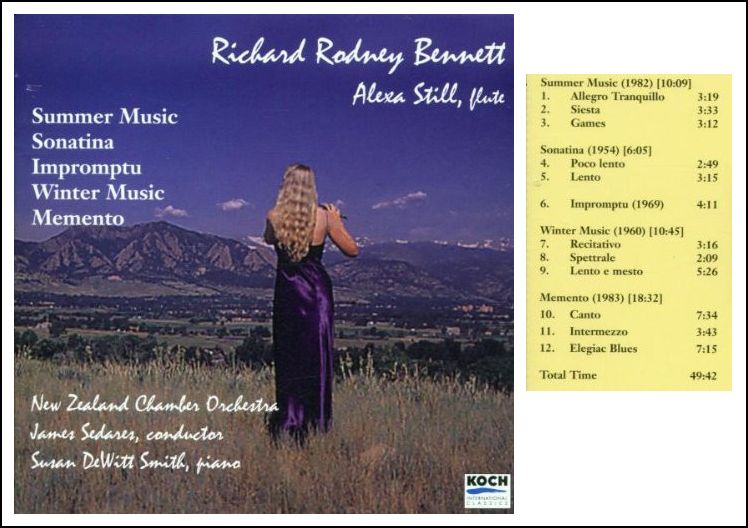
BD:   Does that help the music selection, because if you have something that you know is going to sell, then you can put in something that is lesser-known by the same composer?  That way, it’ll get a hearing.  [Vis-à-vis the recording shown at left, see my interview with Richard Rodney Bennett.]

Sedares:   That’s correct.  Like we said earlier, what makes a good concert doesn’t always make a good recording in terms of repertoire.

BD:   [Noting that he had recently turned forty]  Are you at the point in your career you want to be at forty?

Sedares:   [Laughs]  I don’t know.  In some areas I have done more than I ever thought, and in other areas I want to do a little more.

BD:   You’re originally from the Chicago area?

Sedares:   Yes.  We started in Oak Park [first suburb west of the city], and then my parents moved to Hinsdale, which is a southwest suburb.  I’m hoping to stay an extra six days or so after these concerts are over, to visit everybody.  I haven’t actually been back here for two years, and I’ve never worked here. This is my Chicago debut, so it’s kind of interesting.  It’s also strange being back in Chicago having to think about working now, and not just thinking about going to the baseball game and seeing friends.

BD:   One last question.  Is conducting fun?

Sedares:   When everything is going well, there’s no better fun in the world.  You’re having a good time, and the orchestra is playing well, and there’s a responsive audience, the good stuff all goes with it.  So yes, in general, it is fun.  Sometimes it’s hard work, like any other field.  One thing I can say is that it’s not like I’m going in and punching a clock.  Some people just hate their jobs and hate their lives, and I feel sorry for them.  Having said that, some days are more fun than others in conducting.  It’s always hard work, but sometimes it’s extra specially rewarding.

BD:   I hope those days are plentiful.

Sedares:   I hope so, too.  I’ve had a pretty good run at it so far.


pinkham


harrison


dello joio

See my interviews with Norman Dello Joio, and Andrew Schenck


© 1996 Bruce Duffie

This conversation was recorded in Chicago on June 21, 1996.  Portions were broadcast on WNIB the following March, and again in 1998; on WNUR in 2011, and 2015; and on Contemporary Classical Internet Radio in 2011.  This transcription was made at the end of 2025, and posted on this website at that time.  My thanks to British soprano Una Barry for her help in preparing this website presentation.

To see a full list (with links) of interviews which have been transcribed and posted on this website, click here.  To read my thoughts on editing these interviews for print, as well as a few other interesting observations, click here.

*     *     *     *     *

Award - winning broadcaster Bruce Duffie was with WNIB, Classical 97 in Chicago from 1975 until its final moment as a classical station in February of 2001.  His interviews have also appeared in various magazines and journals since 1980, and he continued his broadcast series on WNUR-FM, as well as on Contemporary Classical Internet Radio.

You are invited to visit his website for more information about his work, including selected transcripts of other interviews, plus a full list of his guests.  He would also like to call your attention to the photos and information about his grandfather, who was a pioneer in the automotive field more than a century ago.  You may also send him E-Mail with comments, questions and suggestions.