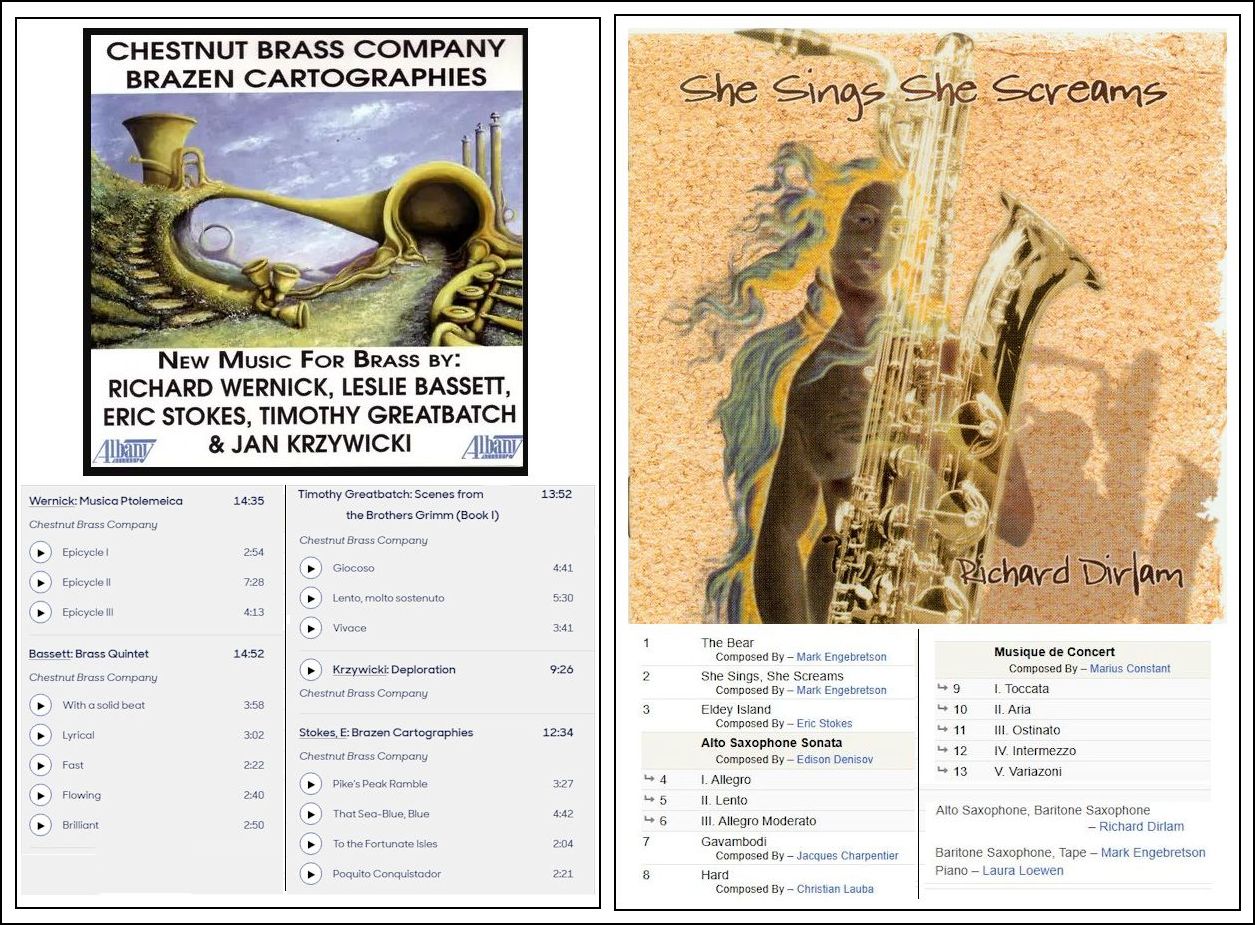
Composer Eric Stokes
A Conversation with Bruce Duffie
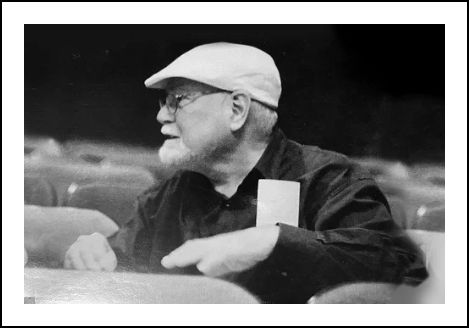
Eric Stokes (July 14, 1930 – March 16, 1999)
was a composer whose work spanned an eclectic range of influences and styles.
Stokes was born in Haddon Heights, New Jersey, about ten miles southeast
of Philadelphia. His mother was a fine vocalist and the early artistic
influence in his life. Stokes studied piano at an early age and began
composing on his own in high school. He held degrees in music from Lawrence
College in Appleton, Wisconsin, the New England Conservatory of Music in
Boston, and the University of Minnesota in Minneapolis, where he taught
for 29 years.
While at the University of Minnesota, Stokes founded the school’s
electronic music laboratory and championed the development of contemporary
music by starting the First Minnesota Moving and Storage Warehouse Band.
His early compositions were tonal and lyrical while his later compositions
were more heavily influenced by Charles Ives, John Cage, and Henry Brant, and used American
music idioms and unconventional sounds in juxtaposed styles.
Stokes is best remembered for his seven operas, many of which premiered
at the Minnesota Opera. His first opera, Horspfal, is a collage
of voices, instruments, and film requiring up to five different conductors.
Stokes’ Rock & Roll (Phonic Paradigm I) calls for rocks
to be hit together and rolled across the stage. His music was a reflection
of his life and personality: eccentric and humorous with an ability to blur
the lines between fantasy and reality.
He died in an auto accident on Interstate Hwy. 94 at 11th St. in
downtown Minneapolis. According to police reports, Stokes was driving
west on 94 from Saint Paul when he collided with a highway repair vehicle
parked on the shoulder
== Names which are links in this box and below
refer to my interviews elsewhere on my website. BD
|
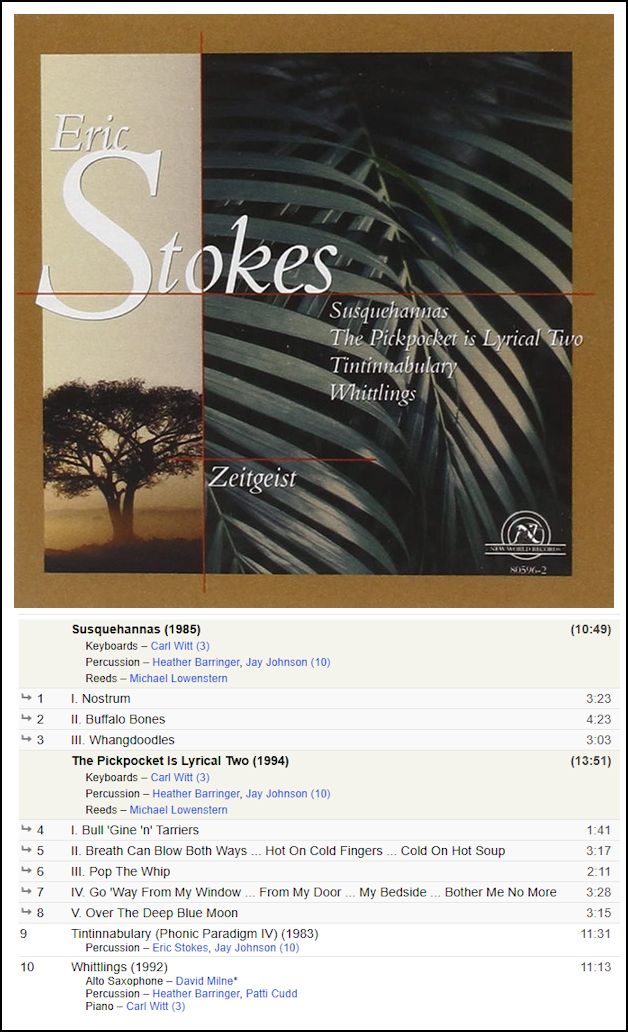
In May of 1988, Eric Stokes was briefly back in the
Chicago area, and he took time to visit me at my home studio. Our
conversation ranged among the various thoughts and ideas he was working
on. After our chat we had a nice dinner, and he continued on his
way.
Portions of the interview were aired three times on WNIB, Classical
97, and now, nearly forty years later, I am pleased to present the entire
encounter.
Bruce Duffie: You are both composer
and teacher. How do you balance those two sides of your career?
Eric Stokes: They’ve sort of balanced
themselves over the years. I like students very much. I
like working with them, and it takes its own shape as it goes along.
When you start out teaching, you think you’re going to teach people
things. You’re going to tell them, and as you go along, it becomes
more and more clear to you that what you’re doing, or your task as
a teacher is to listen to the students in many ways. You are looking
at the work they’re setting out to do, listening to how they talk about
it and their broader interests in life, and then trying to be a mirror and
a responder to that, and be helpful.
BD: Are you teaching theory or composition
or both?
Stokes: Over the years I’ve taught theory
and composition, and I’ve had the New Music Performance Ensemble at
the University since 1970. That year I also set up the electronic
music courses, and we started to establish an electronic music laboratory
there.
BD: Patterned after the Columbia-Princeton
studio [begun in the early 1950s by Otto Luening, Vladimir Ussachevsky,
Milton Babbitt,
and Roger Sessions]?
Stokes: No, no, no. In 1970 it was
state-of-the-art analogue equipment, which was essentially Moog synthesizers,
and others related to all kinds of synthesizers. What we have
since 1985 is another generation upgrade from that. Some people
might say a downgrade, but now we have a lab that is completely digital,
and that’s quite a different story, with a different kind of electronic
sound-synthesis. Some of the principals are the same, and in fact
the underlying ones are the same, but the students, or anyone going to
digital equipment, will not come in direct contact with those principals
right away because it’s so much of it is pre-programmed now. It’s hard-wired,
and in the days of Moog, it was not.
BD: In all of this technology, are we
losing the idea of music?
Stokes: You can! You can lose a lot
of things in technology! [Both laugh] I’ve gone through
the eye of the needle on electronic music resources. When I started
out in 1970, I had to teach myself. I didn’t know much about it.
I really knew very little about it. In those days, that’s what
everyone was doing. They were teaching themselves about it.
BD: That serves the old adage that if
you want to learn about something, teach a course in it.
Stokes: Yes, right! Exactly, and
I did that. I’ve also composed a number of pieces using electronics,
but I’ve never done any pure electronic pieces. That doesn’t interest
me so much.
BD: There’s always the human element somewhere?
Stokes: Yes, with a live performer or
performers. But electronics are not my main interest. I
view it now as just another resource, another sound, an area of sonic
resources that you can draw on.
BD: Another few colors to your palette?
Stokes: Yes, and another set of processes
and ways of viewing sound.
BD: Coming back to my earlier question
about balancing teaching and composing, do you get enough time to compose?
Stokes: [Sighs] I don’t know. To
get enough time, or to take enough time is quite a different question.
Over the years I’ve always tried to take enough time to pursue
those things I wanted to do. Now [1988] I’m leaving the university.
This is my last spring. I’m finishing teaching on a
regular basis, and looking toward trying to carry out more compositional
projects that have been pushed to the back burner for one reason and another.
BD: You’re looking forward to having more
time available?
Stokes: Yes, but the trouble is there
are more projects! [Both laugh]
BD: Amongst all of these projects, how
do you decide which one you will focus on at any one time?
Stokes: In recent years, through the 1970s
and up until now, most of the work I’ve done has been on a commission
of one kind or another. Having a commission almost always involves
a deadline. If it isn’t a firm deadline, that’s very nice, but
it isn’t as good. The best deadlines are ones that say they’re going
to perform this piece on January 20th, and they need the parts by January
2nd, etc. Then you do it.
BD: You just back-time everything from
the deadlines?
Stokes: Yes, you simply do it, and I’ve
worked best that way. When I refer to the back-burner, that’s
the problem. It’s the commissions, not so much the teaching that
have pushed other projects aside. For instance, I’ve been working
on a piece based on Walt Whitman’s poem ‘Out of the Cradle Endlessly
Rocking’. It’s one of the great poems in
American literature, I believe, but I can’t get anyone to commission
it.
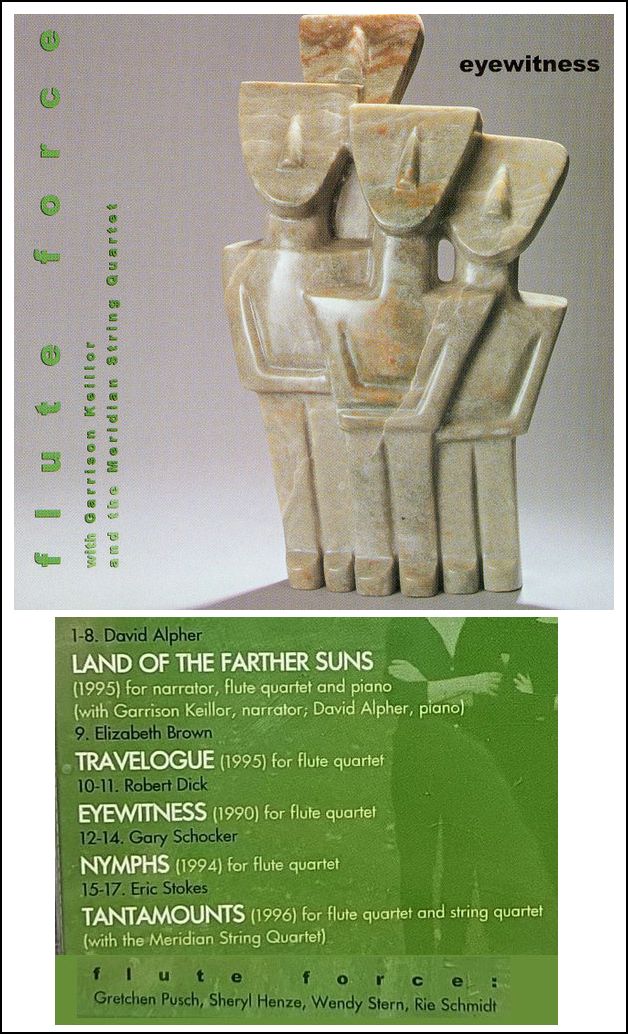
BD: If you have all of these commissions,
how do you decide when you get each one whether you’ll accept it or
postpone it or decline it?
Stokes: I rarely decline them. As
I’ve told all my students, never say no! Always say yes.
You can say no later. [Laughs] I don’t mean that completely
facetiously. I do turn down some commissions occasionally when
I can see that they are not well suited to what I really do well.
Those would be pieces where people have a very rigid idea of what they
want. This is not always the condition that would rule it out.
Some people want, let’s say, a piece for harp and flute, or a piece
for snare drum and oboe, you know, unusual combinations. Those are
challenging and fun, and I would tend to take those, but not if I was asked
to do a very safe piece of music for some very safe occasion, when someone
from a particular point of view is obviously asking me to give them a
repetition of things which they normally perform. This might include
certain church contexts, or something from theater. Sometimes a
theater director will want background music, and what they really want
is some Renaissance dances. Those are are marvelous pieces, and I
love that music, but I don’t really want to repeat it. I can sense
that they don’t really want anything that deviates from the things they’ve
been listening to on the record.
BD: They’re really not tapping your potential.
Stokes: That’s what I’m saying, yes.
* * *
* *
BD: You say there are things which aren’t
what you do well. What do you do well?
Stokes: I know what I do well, and they
are things I feel very strongly about. Therefore, almost all
the pieces I’ve composed are centered on a theme of some sort of social
awareness, or ecological consideration, or something of the human condition
that I feel strongly about. I have not composed many pieces which
are what you would call ‘abstract’.
I haven’t composed sonatas... although I have one piece I call
Sonata, but it’s based on a sonnet of Shakespeare. Something
abstract doesn’t seem to generate a strong response from me. I
need to make a connection with some very concrete and physical or spiritual
or social aspect of life that concerns me.
BD: These things make you respond.
Do they always make you respond in music?
Stokes: Oh no! Sometimes I write
letters if it is a political consideration. I’ve written quite
a few poems.
BD: Have you set any of those poems to
music?
Stokes: No, but I have composed texts for
some of my pieces, or parts of the texts. I wouldn’t consider
those texts as poems, but it’s fun to set them. I like working
on a poem. It’s very concentrated because usually it’s only one
page, so it’s very intense. The way I’ve worked poetry often
is a one follow-through sentence.
BD: Is your music ever too intense?
Stokes: [Surprised] Too intense???
No... I don’t really understand what that would mean. Too
intense maybe for an occasion, or for a situation? Maybe something
that’s too intense for a birthday party, or something like that? [Both
laugh]
BD: Let me cut through this and ask the
big philosophical question. What is the purpose of music in
society?
Stokes: Yes, that’s the big one! Not
to be cute about it, but I think that music must engage itself by addressing
what life brings up to us, what the stress and the unbearable loneliness
of life can be, and the terrors and horrors of life. Music must
engage itself in responding to those things. Otherwise, for me
it’s not there.
BD: Does most of your music meet these
requirements?
Stokes: I hope it does. If I have
doubts about some piece, I try to eliminate them, or suppress them,
or fix them.
BD: Eliminate or suppress the doubts,
or the pieces?
Stokes: The pieces. If you have
a genuine doubt about something, it’s there. As what Virgil Thomson said, if you
have any doubts about a piece that you are presenting to the public,
you can be very sure that they will have ten times as many doubts about
it!
BD: Is this some of the advice you give
to your students?
Stokes: I have on occasion, yes.
BD: Then where is music going these days?
Stokes: [Thinks a moment] We ought
to talk about where music is going in America. I see some very,
very healthy energies at work in our music, and in how we make music,
as well as what we make of it. These energies have been very sharply
increased and encouraged, and have been well supplied in the last two
or three decades, during the time when I’ve been working. When
I was a student in Boston, there were very, very, very few opportunities
for a young composer to find any kind of funding for his or her work. The
prominent one then, was the Fromm Foundation, and that
was more or less the private preserve of some few professors. It
was not public. You didn’t see notices on the bulletin boards saying
that applications were encouraged with submission deadlines, and all the
information you now see on the bulletin boards in the schools across the
country. These days they are plastered with all kinds of nifty things
like composition contests, notices, foundation application possibilities,
and commissioning proposals! We have seen a tremendous change which
started in the 1960s. The New York State Arts Council was invented
in 1960, and it was a model for the National Endowment for the Arts.
The NEA started in 1965, and where I live, the Minnesota State Arts Board
was also initiated 1965 with a $10,000 budget! [Both laugh]
BD: That’s three or four nice small
grants!
Stokes: Yes, or the money was used to
pay a secretary to get it started. That was the total budget
if I remember correctly. Now it’s a sizable budget of hundreds
of thousands of dollars, or maybe more. I’m not up on these figures,
but that’s for a small state with a population of four million.
We’ve seen these wonderful public and semi-public and private interests
burgeoning across the country, and it’s been a very healthy influence.
BD: Is there any chance that we’re getting
too much new music being written?
Stokes: I don’t see how we can. The
question should be, are we getting too much music that is not good?
I would say to remove the word ‘new’, and ask it of all categories.
Then we’d come up with a more honest and a broader kind of an answer.
BD: Before we answer that question, should
we consider what constitutes good music?
Stokes: I think good music is music that
has a genuine integrity, and which speaks out of strong individual
experiences. Good music has roots. This is especially germane
to our experience here in America. This is music which has its
roots in the great traditions of hymnody in America, and in the great
traditions of jazz, or folk-music, of theater music, of dance. We
have many wonderful traditions in America, and to my ear, the music that
springs from those traditions is good. Those pieces have a kind
of Earthy strength in them, and a genuineness that some other types of
music do not have, which are nevertheless rather widely represented on
the present American scene.
BD: Are we now getting enough good music?
Stokes: I don’t think we’re getting enough,
but we’re getting much better at it, and it’s a positive trend. Part
of the problem has been our colonial experience. There has been
a colonial mindset from the earliest days in America, which has gone
parallel to a very independent and even revolutionary mindset. But
there has been a strong colonial point of view which still is evident
in certain circles. The symphony orchestra is an expression of this.
It continues to embody a European point of view about making music.
I grew up loving the old masters. I had a record collection,
and I had my jazz collection. I had all of Beethoven’s symphonies.
I had shelves of recordings, and my parents and friends were very kind
to me. I listened to these things till I knew them by rote, and
I respect deeply the European music. But what I have grown to see
is that the daily music-making, which I grew up with, did not draw on those
traditions. Broadcasts on radio, and recordings were the means
that brought me to that kind of music. But the music I grew up living
with and making, such as singing in the church, was indigenous, and included
much more indigenous musical traditions. This was the jazz, and
the high school bands, and the dance music. All of those things had
much more meaning to me because I was in them. I was part of them.
I was singing in it. I was performing in it. I was there!
BD: That music was participatory?
Stokes: Yes, and not only for myself individually,
but I could see how those types of music worked in the community, and
in the audience, and in the congregation. It was not that I saw
all this intellectually. I only see it now in reflection looking
back. But I certainly sensed it then, and it was right in my breathing,
and my blood and bones as I went along. That’s what I mean, and
that is what the difference is. So I do think we’ve got a problem
with paying too much attention to, and reverence for these European
traditions. They are great and they’re grand, but they tend to
muscle out our own styles. That hooks back to what I said earlier,
that the really good music is the music that grows out of living traditions
that are being actively exercised and expanded and changed and reinvented,
and the symphony has a terrible problem in this. There isn’t much
expansion and reinvention going on. When was the last addition
to the resources of the symphony orchestra as far as instrumental color?
BD: Maybe a few percussion instruments.
Stokes: Right, percussion. Percussion
is the vital energetic area now. The strings were, but that was
in Vivaldi’s time... except maybe for some forms of country fiddling,
or Bluegrass and things like that. There was some evolution in those
styles.
* * *
* *
BD: Your first opera is Horspfal
[pronounced horse-fahl], and you’ve taken that to be the name of your
publishing company.
Stokes: Many times your first efforts
in a genre stay with you very strongly, but Horspfal has a special
place in my heart because we had quite a big success with the piece.
It got a lot of national press. Ironically it’s only been performed
once since! So, I suppose in an underhanded way, I’ve been trying
to publicize it by using its name as the publishing company. [We
come back to a discussion of the opera later.]
BD: Tell me about the joys and sorrows
of writing for the human voice!
Stokes: I grew up singing as a boy soprano
in a church choir until my voice changed. Then I continued to
sing in the choir because there were two or three years where I could
shift gears. I could still sing soprano, and I could experiment
with this new bass voice I was getting. Sometimes I tried to sing
tenor and alto in between. That was a lot of fun. Out of
that I understand the voice a lot. I really know inherently a lot
about the voice and how it performs well. I’ve drawn on that in
my writing. So, in answer to your question it’s mostly joys as
far as I’m concerned in composing for the voice. There is so much
marvelous talent out there coming through the new generations, and it’s
really very exciting and heartwarming to think about. That’s not
true only with voice. It’s true with all of the musical pursuits
across the country. The schools are bursting with incredible talent.
I have met marvelous people.
BD: Have you noticed throughout your career
that the technique and the technical ability of musicians is getting
better?
Stokes: I think so, and many people of
my age feel the same way.
BD: Is the musicality getting better?
Stokes: There’s a lot of contention about
that, a lot of argument. For instance, it seems that all of the
clarinet players are beginning to sound homogeneous. They don’t
have individuality, and probably there is some truth in that. To
some extent, it’s a result of broadcasting, recording, and the general
accessibility that the population of talented people has to what an
older generation is doing. So they have a much more worldly view
of what the technique and the styles are, and they’re drawn closer and
closer together. So it’s harder and harder to speak of, say, a
French style of flute playing, and a German style, which, up until very
recently, were very, very dissimilar.
BD: Is it that every musician is striving
for a certain perfection, and everyone is getting closer and closer
to it?
Stokes: It might be a kind of a perfection,
but to get back to your question about musicality, conductors are under
increasing pressure generated by themselves to shape orchestras or ensembles
that are homogeneous in style and manner of playing, and to reject the
outstanding individualistic kind of player.
BD: So we’re losing a tradition? [Vis-à-vis
the recording shown at right, see my interview with William Mayer.]
Stokes: There is some of that. Compare
it with jazz, where the individual style of each artist is highly prized,
whether you like this one, or that one, or the other one!
BD: When you write a piece of music, do
you want it interpreted in a different way each time and by each different
group?
Stokes: That’s a good question! That’s
coming right down to one of the nubs of the whole thing. When
the composer hands over his or her work to the performer, what is the
bottom line message? Is it do it the way they heard someone else
do it or not? For quite a while now, I’ve been at a stage now where
I cannot and am not interested in imposing a single authentic interpretation
of any of my pieces. In fact, I enjoy the response from conductors,
performers, and directors who ask about doing it this way, or about trying
this. I like that dialogue. I like that energy.
BD: Do you respond to their suggestions?
Stokes: I like to work with them in that spirit,
and yes, many times I’ll say no, you’re off in the wrong direction.
But many times they also bring to it an insight, or a clearer view
of what I was trying to do than I could conceptually or verbally put forward
in manuscript. They see through certain things, or mannerisms,
or ways in which I am operating, and ask if this is really what we want
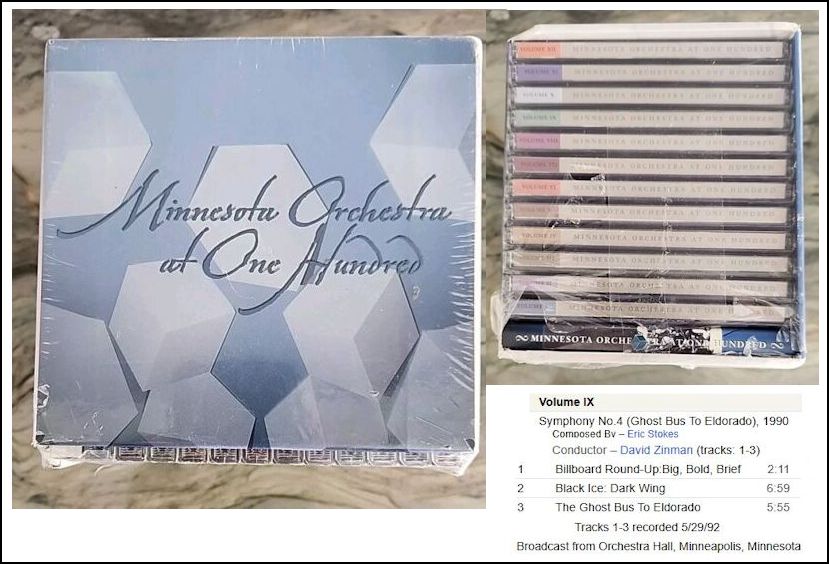
here. David Zinman
is a wonderful person to work with that way, and I have had the terrific
and wonderful opportunity to collaborate with him many times on my works.
BD: Can we assume that there must be times
when you say it must be done this way, and insist on it?
Stokes: Yes, of course.
BD: Are there times when the interpreters
find things in your scores that even you didn’t know you’d hidden
there?
Stokes: [Thinks a moment] Yes, there are
occasions like that, and that’s fun. I like that! Sometimes
I don’t agree with them, but they can prove that it’s there, and I can
say I didn’t know it was there, or I didn’t intend it!
BD: When you’re writing a piece of music,
are you always in control of the pencil or there are times when the
pencil is controlling you?
Stokes: I would say the page can control
you sometimes, and it’s very insidious. So can the computer!
I’ve been using a computer about two years now for some of my work,
just to encode the graphics, and the screen of the computer is small.
It will display a few bars at a time, and only a few staves at
a time, and if you’re not careful you will begin to conform to that small
field of vision. [Remember, this interview was held in 1988.]
It also has other limitations of the program. In the old style
with a pencil, let’s say you’re working on twelve-stave paper, and a thirteen-stave
idea enters. If you’re not careful, the page will try to have
you say it’s not important.
BD: It will force you into the twelve-staves
format?
Stokes: Right! I’ve seen it so often
with students. Their piece of music comes down and ends at the
very end of the last page at the very bottom. [Both laugh].
And it’s not only students! You know the story about the Orgelbüchlein
, the Little Organ Book of Bach? I don’t
know if it’s really true, but the story is that
he decided to write one organ prelude for each Sunday of the church year.
He laid out a book with one double-page for each of these organ
preludes. The old story is that for one of them, he got down to the
bottom of the page, and there wasn’t enough room, and he pasted on extra
manuscript paper because he had planned the next one to begin over on the
next page. [Both laugh] So those things can influence us, and
if you’re not careful, before you know it, there you are!
BD: One might also see the end of the
page, and realize they’ve got to be done by that space.
Stokes: Yes.
BD: Are there times when it’s good that
you do have only a certain amount of paper, or a prescribed number
of days before the deadline?
Stokes: No, but the deadline has been generally
a good thing for me. I’m a terrible procrastinator. I
just love to go out and take a walk, or play around in the garden, and
read and do other things. So the deadline helps to prevent me
from doing that. [Both laugh]
* * *
* *
BD: Let us come back to Horspfal.
Stokes: It’s always hard to talk about.
One of the problems is the fact that it has not had many performances.
It’s an unusual libretto, first of all. It looks like a
newspaper sheet with different columns on it, and the different columns
are for different characters or groups of characters. There’s
a column for the crows, one for the Indian, one for what Alvin Greenberg
[the librettist] called ‘the savior figures’, and so forth. There’s
a number of these, and they are dialogue. Sometimes columns 1 &
2 will be talking to each other, and their dialogue will go in a very naturalistic
way back and forth. Then sometimes they will be silent, so there are
blank spots in many of the columns. An overview of the whole page
would show you that sometimes there are three or four different things going
on simultaneously, and many times there are not. There’s only one
character, or a set of characters going on in a linear fashion, and it
goes in and out of that kind of format. I composed it that way, using
a stop-watch to approximate only the duration of different episodes that
each character or group would have, and the duration of their silences
in between when they resumed. It ran only three nights at the Guthrie
Theater [in Minneapolis]. That first performance was sold out, the
last night was almost sold out. I was very pleased with it.
It’s a large cast. The Indian is central to the American experience
of the European encountering him, and moving into his world. This
is metaphorically represented by an enormous bed, which takes up almost
all of the stage, and this gives him beautiful metaphors for his perception
of life, that sleep is the way. He has mountainous pillows and crisp
clean sheets, so it has a lot of environmental and ecological themes that
run through it. Appearing on the bed in a nonlinear way are representative
characters out of the American experience. The first we see is a tourist
family, mom and dad and junior, and they’re trying to get a picture of the
Indian, who is just waking up and doing things that you do when you arise.
It progresses then through many different encounters between the Indian and
these various prototypes of the American experience. There are a preacher,
John Eliot, a real-estate dealer, a census-taker, Frederic Remington, a church
choir, Betsy Ross, and two D.A.R. girls [Dancers and Revelers,
an indigenous orgiastic cult], who suddenly, when the football
game is just about to begin, are transformed in the cheerleaders.
BD: That didn’t anger anybody?
Stokes: [Sighs] Well, it probably did!
In that sense it is a collage form of composition, sonically as well
as verbally. We did it for the Guthrie Theater stage which was
built with a big thrust. It doesn’t have a proscenium.
BD: So, it juts way out into the audience?
Stokes: Yes. The audience is seated in
a large horseshoe shape, like an ancient Greek theater, and we could
play from side to side and front to back. For instance, sometimes
Betsy Ross and the D.A.R. are having a tea party, but it’s just a tableau
vivant. They’re simply silent but moving, and through that visual
screen you see and hear John Eliot trying to preach to the Indian, who
doesn’t understand what he’s talking about.
BD: It sounds more like a music theater piece than
an opera.
Stokes: Yes. I don’t invest any
money in the word ‘opera’. It doesn’t matter. Music theater
is fine but musical theater is just as apt.
BD: You say you were pleased with this
performance. Are you pleased basically with the performances
of your music that you hear?
Stokes: Yes, most of the time, but not
always.
BD: Are you pleased with the recordings,
because those have more general distribution?
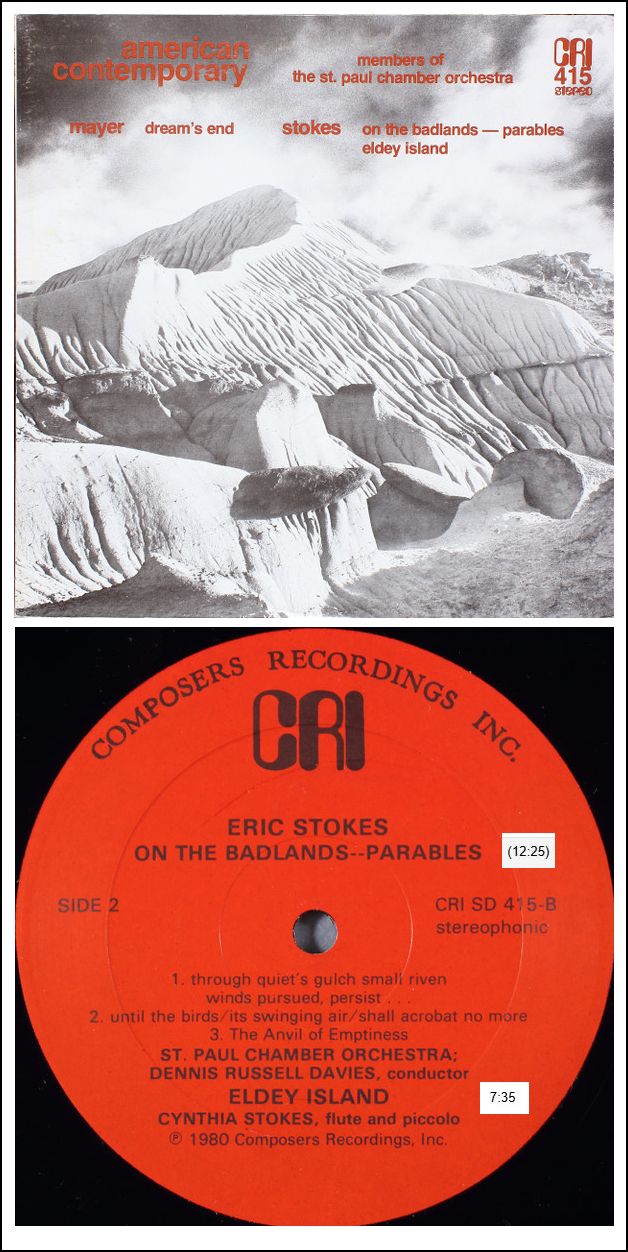
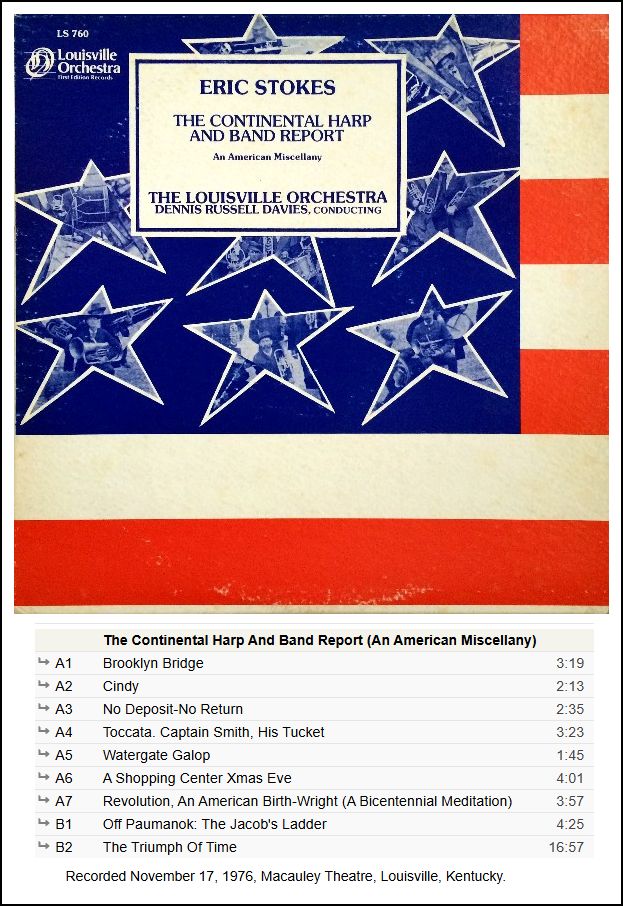
Stokes: Yes. Conductor Dennis Russell Davies
has been a strong champion of my music and I’m very grateful to
him. But it’s not just my music. He is a really devoted
champion of American composers. There is also a little
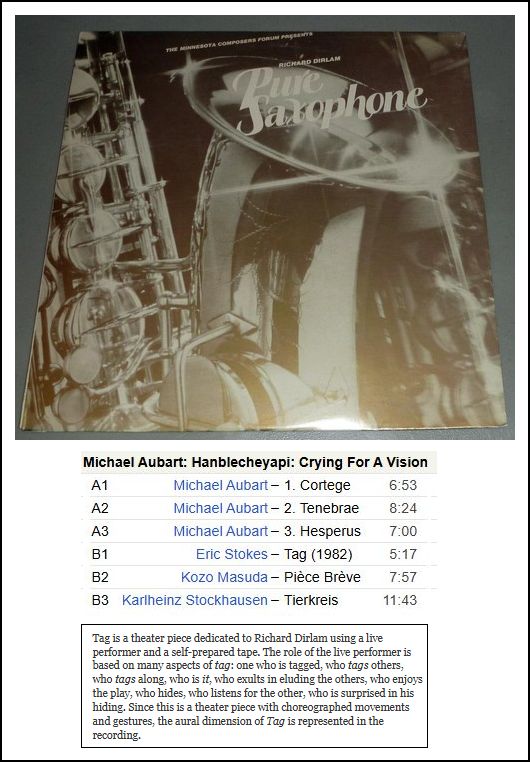
saxophone piece called Tag, which is a theater piece.
It’s for a saxophonist, but he does some soft shoe things on stage like
that. It’s very short. [LP of this work is shown above]
BD: Is composing fun?
Stokes: [Thinks a moment] My librettist,
Alvin Greenberg says if there isn’t some fun in what we’re doing somewhere,
we’re doing the wrong thing! Yes, there’s fun in it, especially
when you can get the ego out of the way. Then it’s more fun.
BD: What advice do you have for young
composers coming along?
Stokes: There is all kinds of practical
advice that we might give, and I try to give them. They’re
professional considerations. One needs to think professionally
and to work actively to be professional in all that you do with your
music, but that’s not really what you were asking about. The deeper
and the more important thing is for each person to discover those roots
that we were talking about earlier, and to acknowledge them, to get upfront
with them, and be as genuine about them as possible. A lot of that
takes a lot of time, and I mean years. It reveals itself to you if
you seek it, so the seeking is the necessary conscious effort that has to
be put into it. You won’t pick it off the shelf just like that.
It may be a reluctant muse, but it will, as one poet said, throw you
a fish every now and then! [Both laugh]
BD: Thank you for being a composer.
Stokes: Thanks very much. It was
a pleasure to talk to you, Bruce.
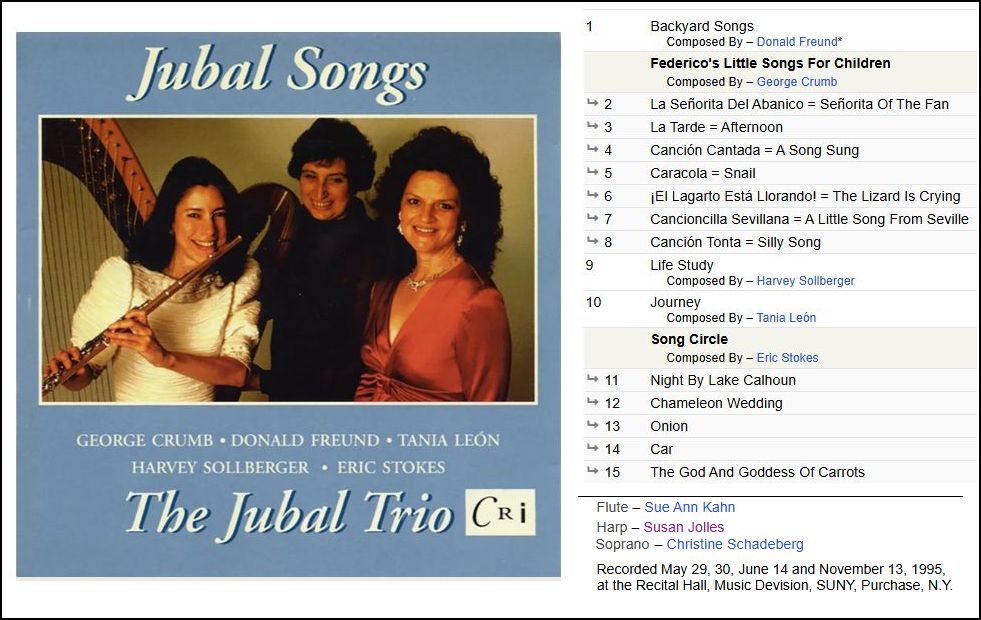
See my interviews with George Crumb, Harvey Sollberger,
and Tania León
© 1988 Bruce Duffie
This conversation was recorded in Chicago on May 21, 1988.
Portions were broadcast on WNIB in 1990, 1995, and 2000.
This transcription was
made in 2026, and posted on this
website at that time. My
thanks to British soprano
Una Barry
for her help
in preparing this website presentation.
To see a full list (with links) of interviews which have been transcribed
and posted on this website, click here.
To read my thoughts
on editing these interviews for print,
as well as a few other interesting observations,
click here.
* * * *
*
Award -
winning broadcaster Bruce Duffie
was with WNIB,
Classical 97
in Chicago from
1975 until its final moment
as a classical station in February
of 2001. His interviews
have also appeared in various
magazines and journals since 1980,
and he continued his broadcast series
on WNUR-FM,
as well as on Contemporary
Classical Internet Radio.
You are invited to visit
his website
for more information
about his work, including
selected transcripts of
other interviews, plus a full
list of his guests.
He would also like to call your attention
to the photos and information
about his grandfather,
who was a pioneer in the automotive field
more than a century ago.
You may also send him
E-Mail with
comments,
questions and suggestions.