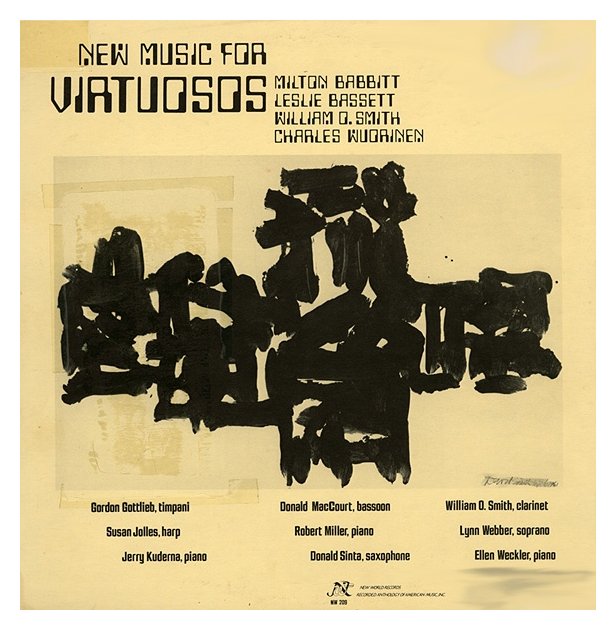
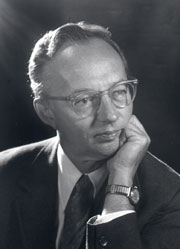
 Leslie BassettLeslie Bassett:
It brought me a better salary at the
University of Michigan, which is nice, but it
didn’t bring as many performances of the Variations itself as you would
have thought. You would have assumed that the orchestra
piece that wins the Pulitzer Prize then would be used. In
fact, my publisher did send the score around to a lot of orchestras
somewhat later, because it wasn’t published right then. But it
hasn’t had as many performances as you would have expected, and I found
that disappointing. I talked with Michael Colgrass not too long
ago, and he was
complaining also that his Pulitzer Prize orchestra piece had not been
played a second time, or at least not more than once, until it was done
by Louisiana State University when he was there as guest composer two
or three years ago. And he found this strange, a piece which
presumably is considered good isn’t immediately grabbed by
orchestras. I think there’s a certain amount of promotional
things that have to be done, and if you have agents and publishers who
are very aggressive in this regard and feel they can invest throwing
away most of the scores, then I think maybe there’s some chance
of it. But it’s a very touchy business. But it has made a
lot of difference, in fact, because when you go to a town and you’re
discussed, or comments
are made by local newspapers, they all know it’s the Pulitzer Prize, so
they give it coverage.
Leslie BassettLeslie Bassett:
It brought me a better salary at the
University of Michigan, which is nice, but it
didn’t bring as many performances of the Variations itself as you would
have thought. You would have assumed that the orchestra
piece that wins the Pulitzer Prize then would be used. In
fact, my publisher did send the score around to a lot of orchestras
somewhat later, because it wasn’t published right then. But it
hasn’t had as many performances as you would have expected, and I found
that disappointing. I talked with Michael Colgrass not too long
ago, and he was
complaining also that his Pulitzer Prize orchestra piece had not been
played a second time, or at least not more than once, until it was done
by Louisiana State University when he was there as guest composer two
or three years ago. And he found this strange, a piece which
presumably is considered good isn’t immediately grabbed by
orchestras. I think there’s a certain amount of promotional
things that have to be done, and if you have agents and publishers who
are very aggressive in this regard and feel they can invest throwing
away most of the scores, then I think maybe there’s some chance
of it. But it’s a very touchy business. But it has made a
lot of difference, in fact, because when you go to a town and you’re
discussed, or comments
are made by local newspapers, they all know it’s the Pulitzer Prize, so
they give it coverage.  LB: Well, I
don’t know. Maybe. A lot
of our orchestras, even the so-called amateur orchestras or community
orchestras, are full of really professional musicians. They may
not seem like professional musicians to the world at large, but they’re
fully trained and they are very good! So they can do a very good
job. Sometimes I think the main problem can come from the
conductor, if
he’s not quite prepared or if he doesn’t have absolute
metronome. If he violates a metronome mark noticeably, that can
ruin things. Or if
he just doesn’t really know the sounds and there are errors that are
played by various people, he doesn’t catch those. Especially in
the professional orchestras, sometimes a player will deliberately play
a wrong note in a
conspicuous passage, just to check to see if the conductor if he’s on
his
toes. He pretends to be innocent, of
course, but nonetheless, these are some of their little tricks.
LB: Well, I
don’t know. Maybe. A lot
of our orchestras, even the so-called amateur orchestras or community
orchestras, are full of really professional musicians. They may
not seem like professional musicians to the world at large, but they’re
fully trained and they are very good! So they can do a very good
job. Sometimes I think the main problem can come from the
conductor, if
he’s not quite prepared or if he doesn’t have absolute
metronome. If he violates a metronome mark noticeably, that can
ruin things. Or if
he just doesn’t really know the sounds and there are errors that are
played by various people, he doesn’t catch those. Especially in
the professional orchestras, sometimes a player will deliberately play
a wrong note in a
conspicuous passage, just to check to see if the conductor if he’s on
his
toes. He pretends to be innocent, of
course, but nonetheless, these are some of their little tricks. BD: Are you
always working within the usual
strictures of music, rather than trying to expand the horizons of the
technical possibilities?
BD: Are you
always working within the usual
strictures of music, rather than trying to expand the horizons of the
technical possibilities?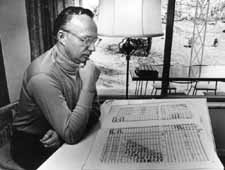 LB: Oh,
yes. I want my music on standard
concerts. I don’t mind if it’s on contemporary ones, but
that’s somewhat like ghettoizing. You’re saying,
“All the people who like contemporary music can come to this program,
and all you folks who don’t like it can stay away.” You never
convert anybody by doing that.
LB: Oh,
yes. I want my music on standard
concerts. I don’t mind if it’s on contemporary ones, but
that’s somewhat like ghettoizing. You’re saying,
“All the people who like contemporary music can come to this program,
and all you folks who don’t like it can stay away.” You never
convert anybody by doing that.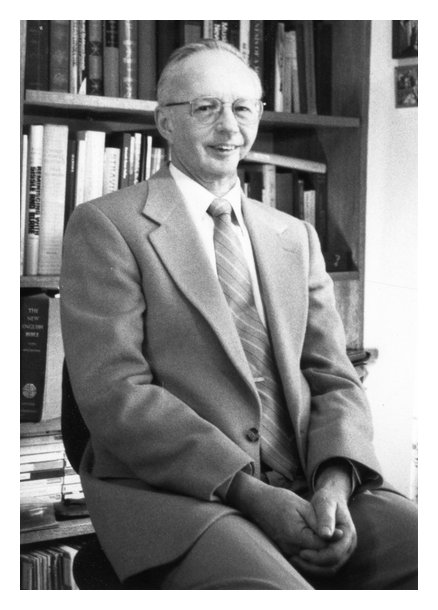 LB: Mainly I
teach composers. I have taught
other things in the past, but right now I teach composers at the
University of Michigan. Every year we have eighty or ninety
applications, and
from that group we carefully choose ten or so who will be with
us. They are
admitted on the basis of the music they have already written, so it’s
almost like dealing with colleagues — at least
as much
dealing with colleagues as it is with students, and this can be
very exciting.
LB: Mainly I
teach composers. I have taught
other things in the past, but right now I teach composers at the
University of Michigan. Every year we have eighty or ninety
applications, and
from that group we carefully choose ten or so who will be with
us. They are
admitted on the basis of the music they have already written, so it’s
almost like dealing with colleagues — at least
as much
dealing with colleagues as it is with students, and this can be
very exciting.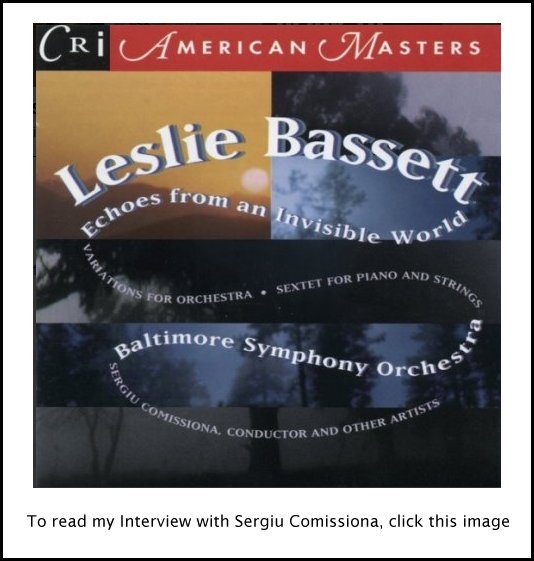 LB: Yes,
pretty much. On some of
them I’ve been around for the recordings, and a lot of them I’ve
not. The recording of the Echoes
from an Visible World by the
Baltimore Symphony was done at a three hour recording session.
The
union demands an hour break, so that’s, in
fact, two hours of recording time. It takes about eighteen
minutes to play the piece straight through, and in
recording they usually do it from the beginning down to a certain
point. If that went well, you’re lucky, but chances are you’ll do
it again, just to make sure. Maybe
there was a slight problem — the conductor’s
baton ticked the stand or
something of the sort, or you needed to move microphones or
whatever. So to get through an entire piece in two hours, with
break along in there is very difficult. I was fit to
be tied by the end of that session, and in fact it did not get
through it, because they were within about twelve measures or so of the
ending, and the time was up. Of course, orchestras are very
unionized; you don’t go over time unless you pay. So they
finished the recording at the next recording session three or four days
later and I wasn’t there for that. So it’s really quite a trying
experience; you’re not so sure
whether things are going well, and if you record a
piece section by section, you don’t have the view of the sweep of the
whole thing, all the way through, which can be slightly detrimental.
LB: Yes,
pretty much. On some of
them I’ve been around for the recordings, and a lot of them I’ve
not. The recording of the Echoes
from an Visible World by the
Baltimore Symphony was done at a three hour recording session.
The
union demands an hour break, so that’s, in
fact, two hours of recording time. It takes about eighteen
minutes to play the piece straight through, and in
recording they usually do it from the beginning down to a certain
point. If that went well, you’re lucky, but chances are you’ll do
it again, just to make sure. Maybe
there was a slight problem — the conductor’s
baton ticked the stand or
something of the sort, or you needed to move microphones or
whatever. So to get through an entire piece in two hours, with
break along in there is very difficult. I was fit to
be tied by the end of that session, and in fact it did not get
through it, because they were within about twelve measures or so of the
ending, and the time was up. Of course, orchestras are very
unionized; you don’t go over time unless you pay. So they
finished the recording at the next recording session three or four days
later and I wasn’t there for that. So it’s really quite a trying
experience; you’re not so sure
whether things are going well, and if you record a
piece section by section, you don’t have the view of the sweep of the
whole thing, all the way through, which can be slightly detrimental.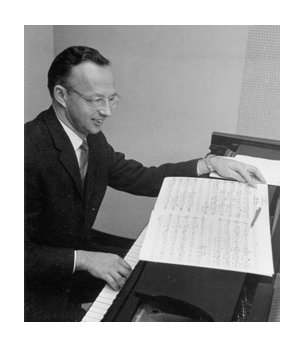 LB: The joys
are that it’s the most
beautiful instrument! It’s just gorgeous, and you
have not only beautiful sound, but you have a person articulating words
which are beautiful at the same time. To hear notes and words
at the same time is wonderful! Furthermore, you look at the
person who is not holding up an instrument under his chin or in his
mouth, but he or she looks right at you. It’s a
very direct communication; very often these are attractive
people — handsome men and beautiful ladies in
lovely gowns — and it’s a very wonderful
thing! Furthermore, if you have choral music, there is an esprit de
corps. These folks are socially attached to one
another.
They have a sense of the fun of being together. And if they’ve
worked hard! Singing is not easy, and if you have folks that
don’t
read music too well, you’ve done an awful lot of teaching to get them
to the point where they can perform. So there’s an awful lot of
investment of time and energy and enthusiasm, which is very
beautiful. I
think it’s a wonderful medium. I love it!
LB: The joys
are that it’s the most
beautiful instrument! It’s just gorgeous, and you
have not only beautiful sound, but you have a person articulating words
which are beautiful at the same time. To hear notes and words
at the same time is wonderful! Furthermore, you look at the
person who is not holding up an instrument under his chin or in his
mouth, but he or she looks right at you. It’s a
very direct communication; very often these are attractive
people — handsome men and beautiful ladies in
lovely gowns — and it’s a very wonderful
thing! Furthermore, if you have choral music, there is an esprit de
corps. These folks are socially attached to one
another.
They have a sense of the fun of being together. And if they’ve
worked hard! Singing is not easy, and if you have folks that
don’t
read music too well, you’ve done an awful lot of teaching to get them
to the point where they can perform. So there’s an awful lot of
investment of time and energy and enthusiasm, which is very
beautiful. I
think it’s a wonderful medium. I love it!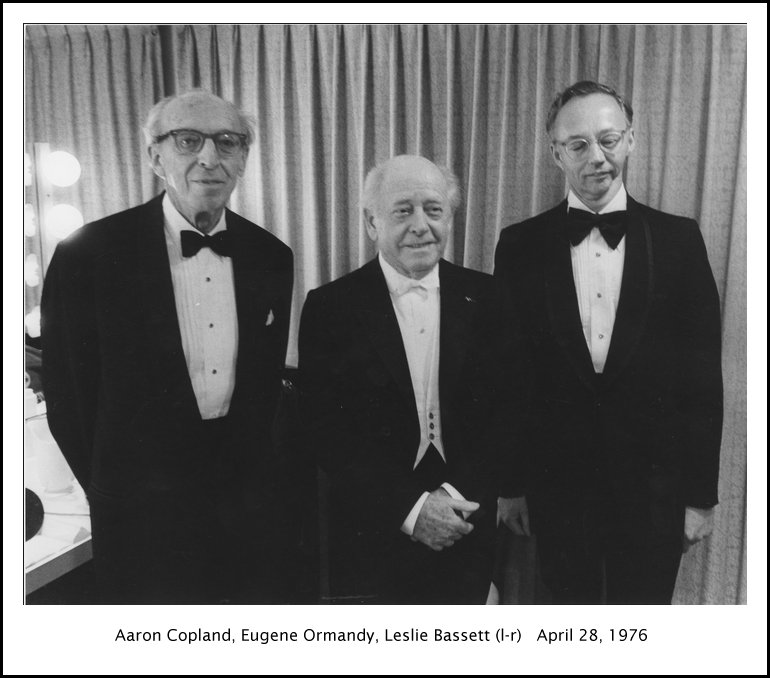
| Leslie Bassett was born in
Hanford, California in 1923, and
was raised in the San Joaquin Valley where he was trained in piano and
trombone. During World War II, he served over three years in army bands
as a trombonist, arranger and composer, and later he studied
composition with such notables as Ross Lee Finney, Arthur Honegger, and
Nadia Boulanger. His many honors and awards include the Pulitzer Prize
in Music, the Prix de Rome, a Fulbright Fellowship, two Guggenheim
Fellowships, as well as commissions from the Philadelphia Orchestra,
the Detroit Symphony, the Koussevitsky Foundation, and the National
Endowment for the Arts, among others. He is a member of the American
Academy of Arts and Letters. Mr. Bassett joined the faculty of the University of Michigan in 1952, where he later served as Chair of the Composition Department. In 1984, he was appointed the Henry Russell Lecturer, the university's highest faculty honor. He is currently the Albert A. Stanley Distinguished University Professor Emeritus of Music and continues to influence the rising generation of composers to this day. Bassett's works have been performed by the orchestras of New York, Philadelphia, Cleveland, Boston, Chicago, Los Angeles, Baltimore, Detroit, Syracuse, Minneapolis, Indianapolis, the radio orchestras of Rome, Zurich, and the Netherlands, and the American Composers Orchestra. In addition to orchestral pieces, he has written extensively for wind ensemble, choir, voice, and a wide variety of chamber music combinations. His catalogue contains over one hundred works. |
This interview was recorded in Chicago on June 11, 1987.
Portions (along with recordings)
were used on WNIB in 1988, 1993 and 1998. A copy of the audio
tape was placed in the Archive of
Contemporary Music at Northwestern
University. This transcription was made and posted on this
website in 2009.
To see a full list (with links) of interviews which have been transcribed and posted on this website, click here.
Award - winning broadcaster Bruce Duffie was with WNIB, Classical 97 in Chicago from 1975 until its final moment as a classical station in February of 2001. His interviews have also appeared in various magazines and journals since 1980, and he now continues his broadcast series on WNUR-FM, as well as on Contemporary Classical Internet Radio.
You are invited to visit his website for more information about his work, including selected transcripts of other interviews, plus a full list of his guests. He would also like to call your attention to the photos and information about his grandfather, who was a pioneer in the automotive field more than a century ago. You may also send him E-Mail with comments, questions and suggestions.