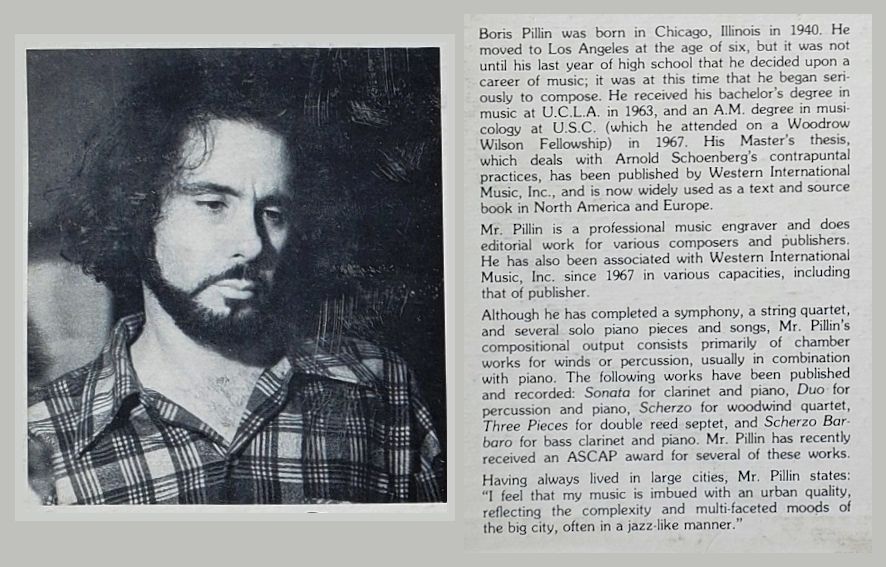
Composer / Music Engraver Boris
Pillin
A Conversation with Bruce Duffie
At the end of January of 1990, in anticipation of his fiftieth
birthday (on May 31), I asked William Schmidt for Pillin’s
contact information, and he agreed to let me interview him on the telephone.
He was in very good spirits, and besides the musical insights, there
was quite a bit of laughter.
Parts of the chat were aired on WNIB for that birthday, and again five
and ten years later. Now, in the fall of 2026, I am pleased to present
the entire conversation.
Bruce Duffie: How are things out in Los Angeles?
Boris Pillin: Unseasonably warm!
BD: You can send some of that out here because
we’re nice and chilly! [Both laugh] You were born here in
Chicago, but you moved away early. Do you have any recollections of
the city?
Pillin: As a matter of fact, I recall very visibly
the area where I lived on Clybourn Avenue. We were back to visit
around 1964, and I found it hadn’t really changed that much. I found
Chicago such an exciting city. Maybe not clean and polished the way
Los Angeles is, but very exciting in its way.
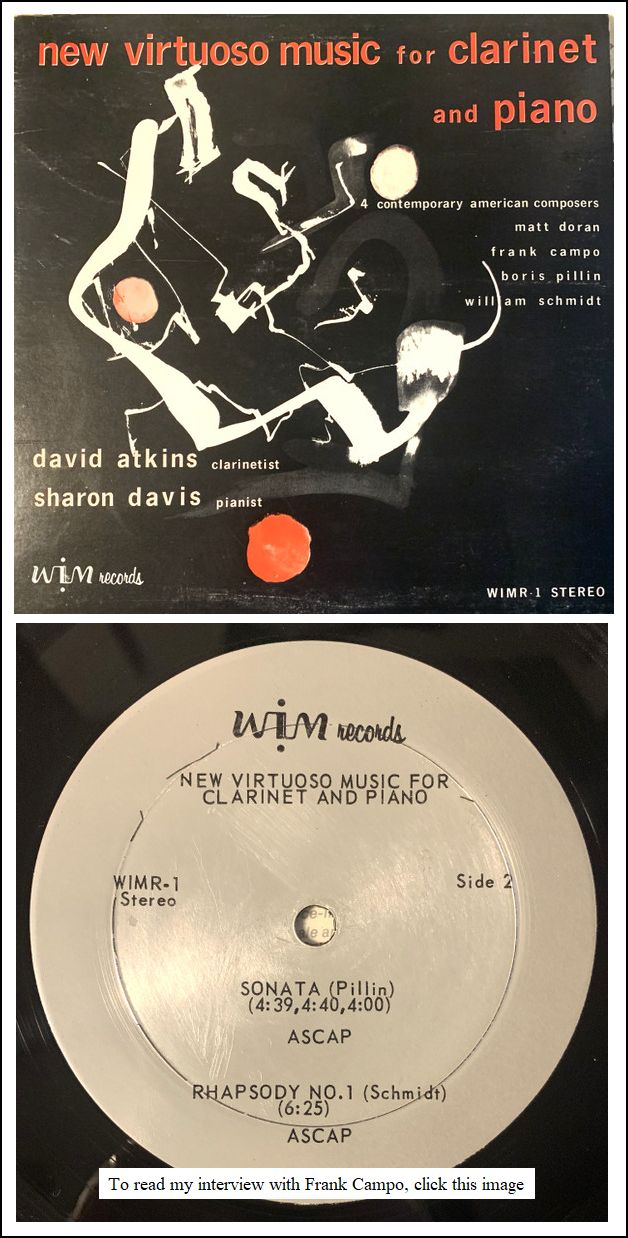
BD: It speaks very well for our city! [Both
laugh] Have you had any performances here?
Pillin: Not that I know of, but of course it’s
possible that some of my pieces may have been played.
BD: I’ve played some on the radio...
Pillin: ...yes, but live performances could
have happened.
BD: It’s true. As a composer, you don’t
know about all of the times your pieces are played. Is that frustrating?
Pillin: In a way, especially when it comes to
collecting ASCAP royalties (The American Society of Composers, Authors
and Publishers). [Both laugh] But I’m a bit philosophical
about that. My feeling is that as long as it’s out there and people
are hearing it, even if I don’t know about it, fine. One hopes
they’re hearing it...
BD: What do you expect of the audience that
comes to hear a piece of yours?
Pillin: I hope they are open-minded, and respond
to the piece as intelligently as possible. That way they can respond
to the same kinds of feelings that I had in writing the piece. That
would be great.
BD: Is it necessary that the audience know and
understand the feelings you had when you were putting notes down on paper?
Pillin: I haven’t been too into ‘program
music’, or writing notes about my music. I hope that
the music speaks for itself, and so far I’ve been fairly lucky. Most
people who have heard my music seem to understand it. They don’t
necessarily like it, but they don’t find it too difficult, partly because
I tend to use the conventional forms quite a bit.
BD: You also seem to use conventional harmonies.
Pillin: Right!
BD: Is this purposeful to get your music heard,
or is it just the way the music has to be?
Pillin: I would say it’s just
the way it must be. It’s just my own preference. I’m delighted
to hear you say that because I think of my music as being fairly conservative.
I try to avoid excessive harshness, but a lot of people who hear
my music tend to tell me that it’s very dissonant. That happens much
more than I would have thought, so it’s good to hear you say that.
BD: Is it good to get that kind of feedback
even if it may or may not be accurate?
Pillin: Yes, but as I get older I do crave more
of the idea of being accessible.
BD: That isn’t that altering your real style,
is it?
Pillin: No, I don’t think so. It’s just
natural evolution.
BD: Is this an outgrowth of a need, or is it
a rejection of what is going on around you?
Pillin: It’s more an outgrowth of a need. Part
of it is the fact that as you get older you just want to economize, and
you just don’t have the energy to want to be a wild revolutionary... though
I don’t know if I ever did. [Laughs] You want to
be natural, and simple, and as direct as possible.
BD: For whom do you write?
Pillin: Myself, and whoever else will listen.
I was fortunate to start getting commissions on a regular basis.
I had specific performers in mind who commissioned works, knowing what
they liked. That went into the equation.
BD: When you get a commission, how do you decide
if you’re going to accept it or turn it aside?
Pillin: Since I really haven’t gotten all that
many, I wouldn’t be too inclined to turn one aside unless I was really
booked up. So I try to accept things. Pretty much any one I
get is a challenge.
BD: [With a wink] Even if someone wanted
a work for ocarina and kazoo?
Pillin: [Laughs] I’d try and do it.
I feel that I couldn’t look myself in the mirror if I’d flatly turned it
down. I’d feel like I was a coward.
BD: That’s just part of just being a professional
composer?
Pillin: I guess so.
BD: Are the ideas always there when you need
them?
Pillin: Yes. They might be in the back
of my mind, but there are times when you feel kind of dry. You
sort of feel that you won’t be able to do it anymore, but then somehow,
when I sit down and start to write, that gets the process started.
BD: Do you know when you first start out about
how long it will take to complete the compositional process?
Pillin: I’m a very slow composer. I tend
to work very slowly, and it depends of course on the length of the work.
Naturally a short piece, like a fanfare which I dashed off in about a week
for a group that my wife and I belong to, is quick, and something like
a full-fledged sonata would take quite a bit longer. But I must be
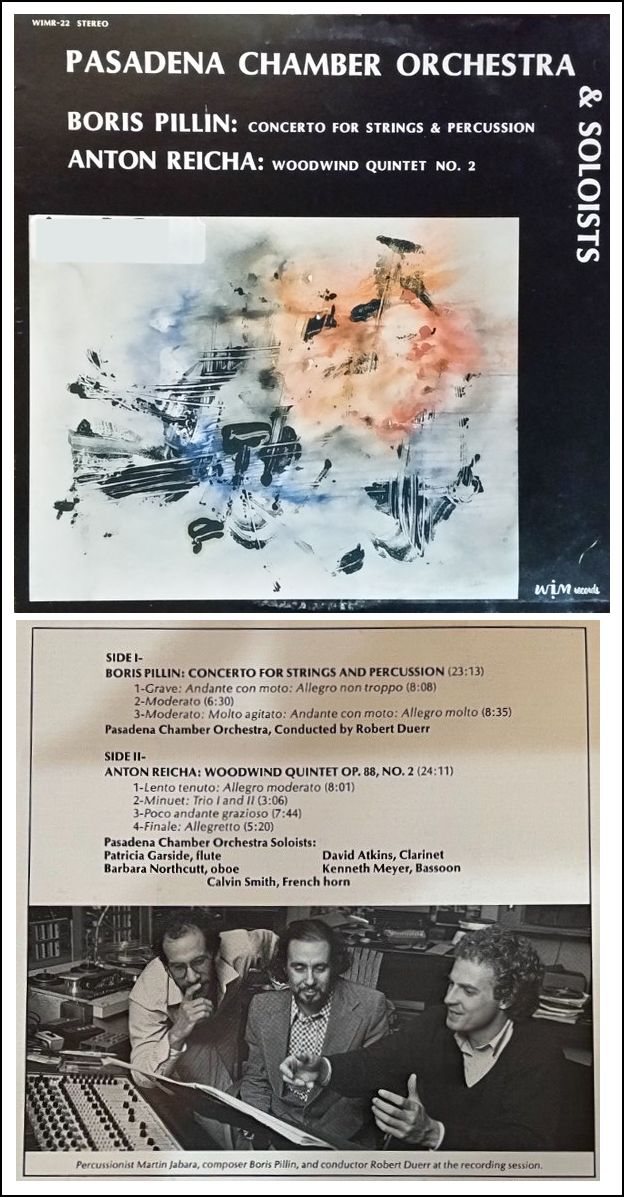
getting faster because for my Concerto for Strings and Percussion
I did all the work on the composing, the orchestrating, and the engraving
of the parts in about two months. That’s the fastest I’ve ever worked.
But generally, I am slow. My Symphony was a labor of love. I
polished that and worked it over for a period of quite a few years.
* * *
* *
BD: When you’re working on a piece, going over
the notes that you have down, and polishing and revising, how do you
know when to put the pencil down and say it’s finished?
Pillin: That’s a difficult question. Somehow
you know... I should mention that I tend to plan a piece in my mind
pretty much before I put pencil to paper. Even if I’m working on
a sonata, I’ll have a whole movement in mind before I start writing.
I’ll then have the next movement, or at least quite a chunk of it in my
mind, so it’s just a question of refining the details. Somehow you
just know it’s finished. I’m not one to revise a piece a whole lot
after having written it, although a lot of composers do that. I
know some who revise it for years and years, and are just never satisfied.
I’m not really too much like that, although one thing I’m into is taking
a piece that I’ve written and transcribing it for another medium.
I’ve written a piano and cello sonata, and reworked it as a piano quartet.
In some cases I have done several versions of a single piece.
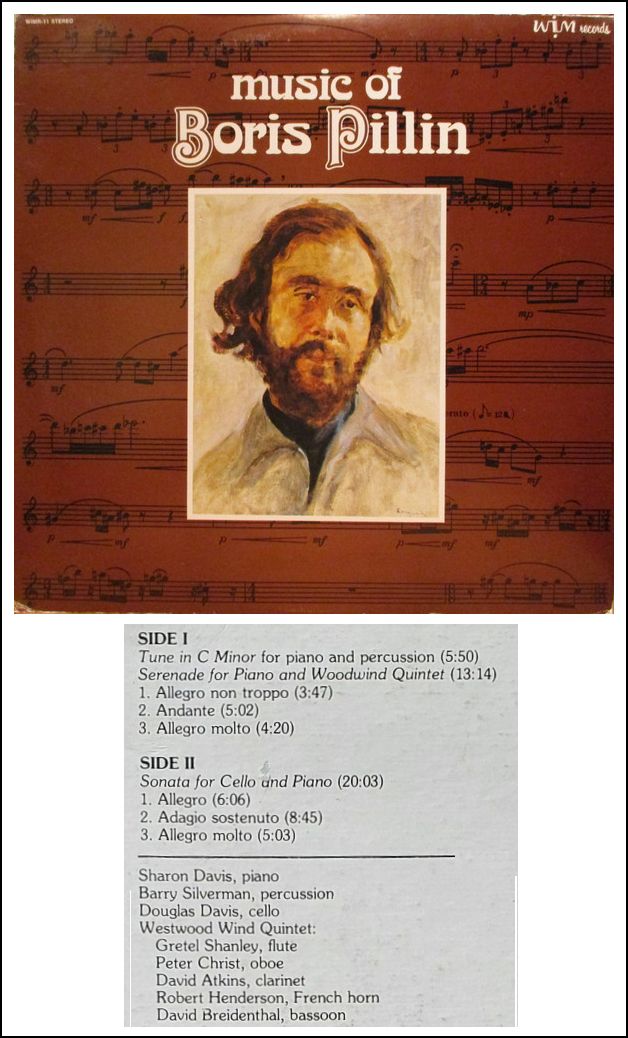
BD: The basic music material is good, and then
you adapt it?
Pillin: Right.
BD: Do you always have the form and the ideas
in your head before you start writing?
Pillin: Pretty much so.
BD: There’s never a time when you start writing
and you haven’t the faintest idea where you’re going to end up?
Pillin: Not too often. There have been
times when I’ve been in that situation, and it just doesn’t seem to work
for me. I really can’t seem to get started with the piece.
I wasn’t able to get anywhere when it was like that.
BD: You had to wait until it was formed in your
head?
Pillin: Right, and then years later that idea
make take shape and I’ll write it down. I would almost say that
the pieces I’m writing today are ideas that I’ve had maybe two or three
years ago. They incubate in my head that long.
BD: Without you really working on them, they’ve
steeped in your brain?
Pillin: Right. As soon as I get an idea
I don’t trust my memory, so I’ll write it down on a piece of paper, but
in fragments. Then maybe years later I’ll go back to
the fragments and see what I’ve done. Hopefully the idea has been
churning in my head, and maybe it has taken some shape.
BD: Are you conscious of the time of performance
as you’re writing the piece?
Pillin: Probably not enough because it is a problem,
especially if you’re writing a piece which you know is going to be recorded.
You have limitations, and almost all of these pieces have turned
out to be longer than I would have liked, and I have to tailor them downwards.
But as I’m getting more experienced over the years, I’ve developed
a little bit more of a sense of how to be aware of the overall length of
the piece, and am able to get it about the length that I want, and what
it’s supposed to be.
BD: Do you ever feel constricted? If you
get a commission for a certain amount of time, might you wish it was a
little longer or a little shorter?
Pillin: There have been a couple of cases like
that. In fact, one piece I was writing for piano and three trumpets,
I wanted to make a long elaborate half hour piece. The person I
was writing it for said I was nuts! With the combination like that,
he said to just make it about fifteen minutes tops, because a sound like
that will just drive the audience to distraction if it goes on much longer
than that. So he gave me some good advice, and told me to use my best
ideas and make it very cogent. I did, and it worked out.
BD: [With a gentle nudge] Did you save
the other ideas for something else?
Pillin: Right, exactly! [Both laugh]
BD: Never throw anything away!
Pillin: I don’t, though I probably should! [Both
laugh] Not only in music, I’m a real packrat. If you saw
my place here, it’s quite cluttered. I never like to throw anything
away. [Both laugh]
BD: You have a sympathetic ear over here, because
I tend not to throw things away, either!
Pillin: Right, you never know!
BD: I hate to throw away anything that can be
useful at some time.
Pillin: Right!
BD: Are there things in music that could never
be useful?
Pillin: [Thinks a moment] Well, sure!
In fact, there are ideas going through my mind all the time, and a lot
of them, perhaps the vast majority of them I wouldn’t bother to write down
because I don’t really think they’re good enough. I don’t see any
potential in them for serious treatment, so I just reject them. The
ideas I write down are the ones which I feel have some kind of potential
to begin with, or can be developed into a piece.
BD: What are the kinds of things that can contribute
to making a piece of music good, or perhaps even great?
Pillin: First of all, the idea itself should
have something in it. It’s very hard to define that something which
animates it, and which makes you feel that this is a live idea, that this
is something which can lead somewhere. It’s got to have something
striking in it, whether it’s a melody or a chord progression or just a
rhythm. It will be anything like that which you feel has something
exciting, or something that animates it for whatever reason. Then
the other thing is the treatment. Roger Sessions said that an idea
by itself is just a gesture and a void. It’s what you do with it,
and to a large extent that’s true. Given that you have an idea in
the first place which you feel is worth using, then your treatment of it
must be worthwhile.
BD: What I’m looking for is what makes the idea
worthwhile.
Pillin: The hard thing is always to understand
the nature of the idea, to know what its consequences are, and what is
the correct and logical way to treat that idea. That’s a process which
I’m still undergoing, and hopefully developing. What makes a mature
composer is one who understands the nature of ideas and how to treat them.
My big hero is Beethoven, who was the sovereign composer in knowing
what to do with an idea, and how to develop it to its logical and inevitable
consequences.
BD: Do you develop all of the ideas in every
piece, or are there things in your music which you think should stand and
not be developed?
Pillin: By ‘develop’
I mean being used in a proper way, not necessarily developed in a complex
or an intellectual sense. Sometimes just the statement of an idea
is enough if that’s the way the idea is.
* * *
* *
BD: You’ve mentioned a couple of other composers
including Beethoven. Do you feel that you’re part of a lineage of
composers?
Pillin: I would like to think so. I don’t
put myself on that level, but if we were talking about aspiration, sure.
Music is a very exciting and wonderful continuum with a great tradition,
and one wants to aspire to be in the direct tradition of these great masters
in some way. Even if you fail, it’s exciting to try.
BD: Why did you pick composing instead of performing?
Pillin: Actually I was a performer before I was
a composer. I studied piano for quite a few years, starting at
the usual age of eight, and at one point I wanted to be a concert pianist.
I always had musical ideas bumbling in the back of my head, but they were
just for fun. They didn’t seem very significant. I always
liked to improvise at the piano, and then something happened to me in my last
year in high school. I should say that I do come from an artistic
family. My mother is an artist, a painter and ceramist, and my dad
was a poet. I was interested in art at the time, and was planning to
be an artist. I still love it, but I was always into music, and in
my last year of high school I turned on to a whole lot of twentieth century
American composers who I hadn’t really heard before. As a kid I was
familiar with Mozart, Beethoven, Bach, and Brahms, and as far as American
composers, I knew about Aaron Copland and some other really big names like
Morton Gould.
But then for the first time I heard composers like Roger Sessions, William Schuman, and Charles
Ives, and it was such a revelation to me that I thought maybe I’d like
to do something like that. [Both laugh] I was studying piano and
composition with Leonard Stein, who was a big wig in twentieth century music
circles, being Schoenberg’s assistant. I seemed not to be getting anywhere
much with the piano, and he said I should forget the piano! That
was just a tool, and what he said really determined that I should concentrate
on composition. It also seemed to be a more permanent way to immortality...
if that’s not too pretentious a way to put it! [Laughs] I
wanted to create something of my own.
BD: Do you expect it to live on after you’re
gone?
Pillin: Hopefully!
BD: I hope it lasts for many generations.
Pillin: Well, thank you!
BD: Continuing with the idea of composition,
where is the balance between the technique that you learn and the inspiration
that must come?
Pillin: It’s a very fine line. Part of the
maturing process of any composer or artist is that the technique simply
becomes the handmaiden to the inspiration. When you mature, you’re
not even aware of using the techniques anymore, but they’re there, and
even when you haven’t fully mastered them, they’re determined completely
by the inspiration. In the early days, you’re struggling to learn
your techniques, and they’re somehow separate. You have your techniques
and you have the inspiration, and you have preconceived molds into which
you pour an idea, because those are the techniques you’ve learned and they
are the techniques you want to use. You’re conscious of technique,
and later on hopefully one becomes less conscious of technique because you’ve
mastered it. Then the inspiration comes first.
BD: Does each piece have its own balance?
Pillin: Yes. I was reading Ralph Vaughan
Williams’s biography, and he makes quite a point of that. In his
last works, the ideas seemed to be dictating to the man who was happy
to be bullied by them. In other words, techniques weren’t even
a question anymore. He had long since mastered them, and it’s just
wonderful when a composer can get to that state.
BD: Are you still bullied by the technique?
Pillin: Probably to some extent, but hopefully
not as much.
BD: Do you feel that you’re a slave to your
artistry?
Pillin: I wouldn’t want to put it that way.
If I am, I’m a very willing slave. [Both laugh]
BD: You’ve written in many different
forms, both big and small. Aside from just the size of the forces,
what is the difference between writing a sonata for an instrument and piano,
and writing a full-fledged symphony?
Pillin: It is mainly just a question of the different
forces, because as far as the substance or the ideas are concerned, it’s
pretty much the same. Certainly composers seem to save their best
ideas for their big orchestral works, and in their smaller combinations,
they seem to use lesser ideas, but I’ve not really been into that. I
always try to use my best ideas for whatever piece I am writing. For
me, the intellectual process of hammering out a sonata, or a string quartet,
or a symphony is just the same. It’s just as hard. I don’t know
how other composers work, but for an orchestral piece I do write it as an
abstract piano score first. That’s where I
thrash out the ideas, and afterwards it’s the process of putting it in an
orchestral dress. Naturally, as I’m writing it I do have some awareness
of what the instrumentation might be, but as far as the significance of
the ideas and the difficulty of getting the form together, I would say
that they’re the same.
BD: It just takes more effort?
Pillin: Right, except that orchestration is
quite a big process in itself. To me it’s
a fascinating process. It’s like doing an oil painting as to opposed
to a drawing.
BD: You have to flesh out all the details?
Pillin: Right, yes.
BD: In the larger scores, do you ever
incorporate instruments that are not generally called for?
Pillin: I’ve only written two orchestral scores
so far, and they’re pretty traditional. I haven’t really used any
out-of-the-way instruments, although in some of my smaller pieces I’ve
written quite a bit for percussion. This was somewhat dictated to me
by the fact that I’ve known several percussionists, and it’s something that
hasn’t been written for as extensively as some of the other instruments.
So to that end I’ve explored quite a few unusual instruments.
BD: Does knowing that there’s not a lot of repertoire
influence your decision, and that the available players would be anxiously
awaiting any new piece?
Pillin: Sure! It definitely is a factor in
the commissions that I’ve gotten, and I know it is going to be proudly
performed more often than, say, a string quartet. I happen to love
the traditional groupings like string quartets and piano trios, and hope
to write lots of them, but I do know that if I write a piece for contrabassoon
and percussion, it’s probably going to have a more immediate chance of performance.
I’ve really gotten to love all the instruments, and it’s a fascinating
perpetual discovery. A lot of these were frankly not things that
I would have chosen to write, but they were commissioned that way, and I’m
really glad because it gave me such wonderful experience.
BD: They say that if you want to learn about
a subject, write a book about it. So, if you want to learn about
an instrument, write a piece for it!
Pillin: Right, that’s true.
BD: Are there any instruments you haven’t yet
written for that you want to explore?
Pillin: I haven’t written anything yet for saxophones.
That’s something I have an immediate interest in doing, maybe a saxophone
quartet. Also, I haven’t written anything for concert band, which
I would love to do. At one point I had a grandiose idea of doing
what Hindemith did, which was writing a sonata in turn for all of the instruments
of the orchestra. [Laughs] I haven’t gotten very far with
that yet, but maybe I will.
BD: I assume there are a few in your catalogue
already.
Pillin: Yes, one each for trumpet, cello, percussion,
clarinet, and I have ideas for quite a few more.
BD: When you’re working on one piece and you get
an idea, do you sometimes know that it will work in the next piece or
two pieces down the road?
Pillin: Yes, increasingly so now. I tend
to have a certain idea in mind which is generally good for maybe two
or three pieces. My piece for double reed septet, and the percussion
concerto, and a piece I’ve written for piano and percussion share quite
a few of the same type of ideas because they were written close in time.
That happens very often. Similarly, with my symphony and my
clarinet sonata, both early pieces which were written about the same time,
share quite a lot of similar material. So that often happens.
It’s something nice to be aware of, because you don’t feel that since you’ve
written a piece in G, you wonder what you are going to do for the next piece.
[Both laugh]
BD: Go right around the circle of fifths!
Pillin: Right! [Both continue to laugh]
* * *
* *
BD: I read in your biography that you’ve worked
as a music engraver?
Pillin: Yes, and I still do.
BD: Tell me the joys and sorrows of engraving
music.
Pillin: It’s hard work, but it’s enjoyable.
Actually, this got started about the same time that I got connected with
the publisher Western International Music [WIM]. I was just out
of USC (the University of Southern California), and wasn’t making incredible
headway getting teaching work in a university. Someone suggested
doing music engraving or copying, and noted that they had a new music
typewriter which had actually been on the market for quite a while.
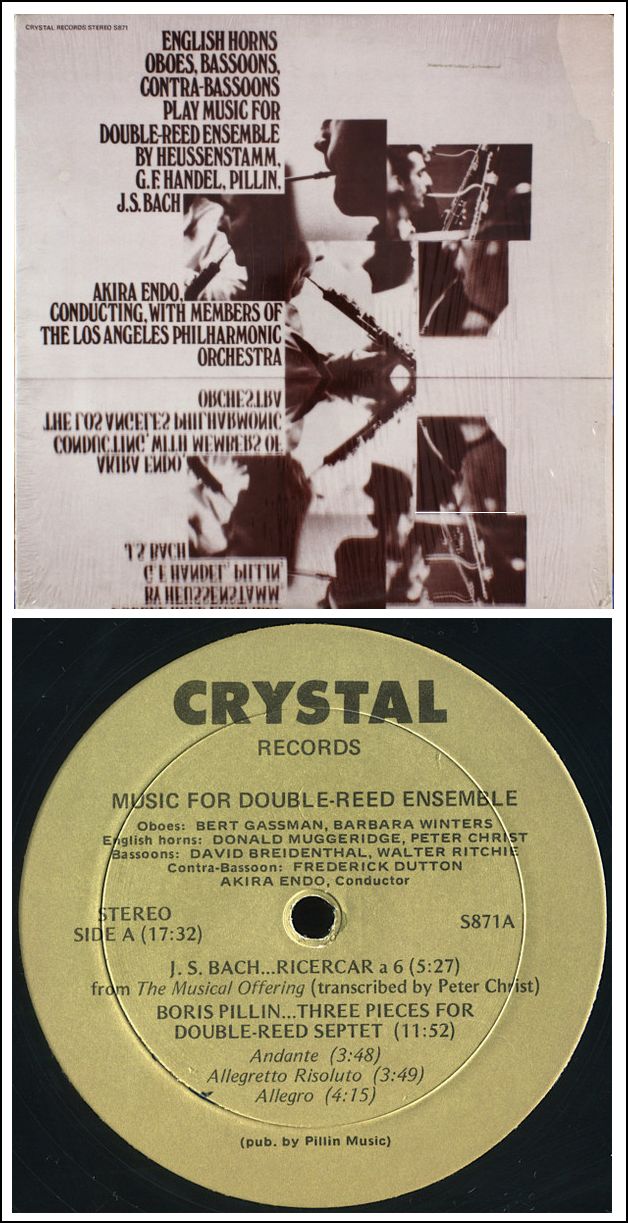
BD: Is that Cecil Effinger’s machine?
Pillin: Right, and the person who was the sole
selling representative of the music typewriter turned out to be William
Schmidt who was the president of WIM. So that started the whole
ball rolling. It turned out to be really nice, and has been one of
my main sources of income over the years, along with the private teaching.
BD: I have this vision of you sitting there with
little chisels, whacking them with a hammer...
Pillin: [Laughs] No, no, it’s very up
to date. I don’t have the very newest model, and I understand they
have some out now which are electric and even electronic. Of course,
everything these days is with the computer.
BD: He’s working with IBM to get the next model
out.
Pillin: Right, and they’re very expensive. For
a few years I got involved in other kinds of work, but in the last year
or two I’ve gone back to engraving music quite a bit, and I do find it
very rewarding. It’s also very hard work. I don’t know how much
longer I want to do it, but it’s been good for these years. For a
time I was an actual music publisher, also connected with WIM. I used
the music typewriter in that capacity, too. But unlike a lot of my
colleagues who use the music typewriter, and who, after they’ve done it,
would never want to do anything by hand, I still also
love hand copying. They would never replace that completely for
me. There’s a certain joy in copying in ink that the typewriters can’t
take away. I use both methods.
BD: Is the music typewriter putting a lot of
copyists out of work?
Pillin: Nowadays it’s
the computers which are putting music copyists all over the world out of
work. They have this new thing.... I forget the brand name, but there’s
one where you actually program it, and it will play a piece of music while
taking down everything that you’ve done in a beautifully finished professional-looking
score. The fortunate thing for the music copyist is that it’s not
perfected yet. It still has a load of loopholes, so there is still
quite a bit of room for the typewriter I use. [Remember, this
conversation took place in 1990, so the progress since then has been (insert
your own descriptive word or phrase, which may or may not include AI!)]
BD: How long does it take to get a piece of music
from the page through the typewriter and then into the printing mechanism?
Pillin: It depends. I’m probably not the
fastest music engraver around, but I would say that on a good day I can
knock out about ten pages of music of moderate difficulty.
BD: Is this full scores, or individual parts?
Pillin: It can be anything like that.
I would say either one. I was involved recently with a job of having
to extract parts, and it was a lot of work. [Both laugh]
BD: Tedious but worth it?
Pillin: Oh, yes.
BD: Does it give you any more sense of value
when someone else engraves your music?
Pillin: That has only happened once that I know
of. My first piece was engraved for me, but since then I pretty
much engrave all my own music. But if I were in the position of
having my music engraved by somebody else, I certainly would appreciate
what the person’s doing.
BD: Do you feel that every young composer should
maybe do a little of it to get a taste, so they understand what’s going
on?
Pillin: That’s not a bad idea. My feeling
is that people should try everything to know how the other person feels,
and to have a total picture. I wish every composer could be a performer,
and vice versa, so each would understand the other.
BD: Do you understand your audience?
Pillin: I’m getting to understanding them better
than I did. With each performance you get to know your audience a
little bit better.
BD: Are audiences different from city to city,
and venue to venue?
Pillin: Yes, and from audience to audience.
If I’m having a piece of mine performed in front of a group of society
ladies, I know I’m going to get a very different reaction than if it is
performed before a bunch of composers or jaded musicians. [Both laugh]
But it’s all exciting, and one hopes to reach them all.
BD: Do you think that music should be for everyone?
Pillin: As much as possible. I know it’s an
impossible goal, and a composer really has to please himself first,
but he should never shut out his audience. He should never live
in an ivory tower. It’s a fine balance. On the one hand you
don’t want to write down to anyone. Of course, in popular or commercial
music that doesn’t apply, but since we’re talking about serious music,
I don’t think one should deliberately write down to anyone. But
on the other hand, one should be aware of the audience, and not write
as though nobody is ever going to hear it.
BD: Do you have any advice for audiences?
Pillin: Hopefully to be open, and try not to
prejudge a piece. Try to accept it for what the composer was trying
to do. If it’s boring, then it’s boring, but in some way hopefully
it will be interesting, and that’s what to look for.
BD: What advice do you have for composers coming
along?
Pillin: Try to understand the nature of what
you do best, and pursue that. Don’t try to be what you’re not.
BD: That assumes you are able figure out what
you are.
Pillin: Right, which isn’t easy to do! [Both
laugh]
BD: Does that put too much responsibility on young
shoulders?
Pillin: I guess so, and it takes a lot of time.
BD: Is your private teaching in composition or performing?
Pillin: Both. My wife and I have a studio
in our home. In fact, we have been putting on several productions.
I’ve been pretty much exclusively in the classical music, and thanks
to my wife, I’m getting involved more and more in the performing end
of Broadway music. I’m finding that increasingly rewarding.
I teach piano and composition, and my wife teaches voice, and it’s really
kind of exciting.
BD: I’m always curious about that... Is
composition really something that can be taught?
Pillin: In a large sense, no, just like you can’t
really teach writing or painting. You can teach the techniques,
and that’s why I never like to say that I’m teaching composition as such.
What I really like to do is teach theory, harmony, counterpoint, orchestration,
and then the most advanced form of that would be … you’d have to say composition.
But what you’re really doing there is just supervising, because
the creative effort has to come from the student. You can’t teach
creativity. All you can do is give them advice. They come
to you with a piece, and you have to try to point them in the right direction
without imposing too much of yourself.
BD: That’s the trick, to keep yourself out of
it!
Pillin: That’s the trick, right, but I would
agree that I wouldn’t want to think of it as teaching composition.
* * *
* *
BD: Have you basically been pleased with the performances
you’ve heard of your music over the years?
Pillin: I’ve been very fortunate to have worked
with some really fine musicians. In fact I almost would say I’ve
been spoiled! William Schmidt and his wife, Sharon Davis, who is
a very fine pianist, and her brother, Douglas Davis, who is a fine cellist,
have been very good to me. Through them I’ve met quite a few really
top-notch musicians in Los Angeles, and I’ve gotten some really good performances
of my works. Frankly I don’t write music which is easy to play,
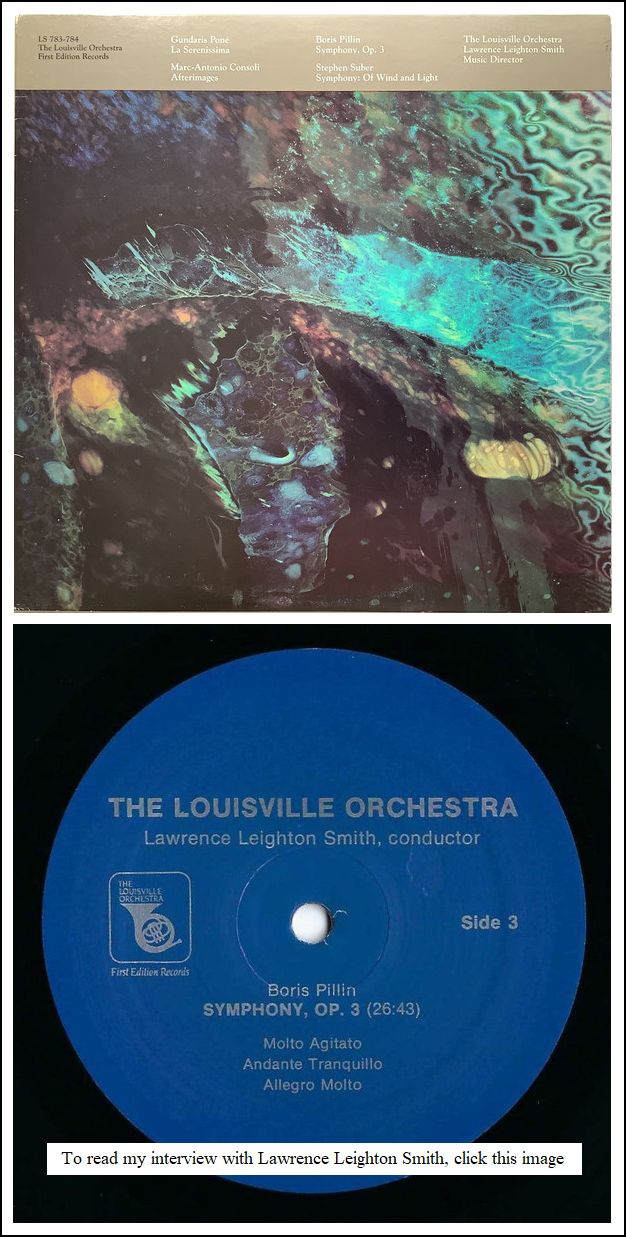
so I’ve been very fortunate. Then there was the Louisville award
where I was able to be performed by the Louisville Orchestra, which is a
very fine ensemble [LP shown at right]. So yes, I’ve been very
lucky so far.
BD: You’ve had a number of your pieces recorded.
Are you very pleased with those discs?
Pillin: Oh yes!
BD: Have you supervised those recordings when
they were made?
Pillin: Yes, I was on hand at all recordings,
and I always trust the engineer and whoever was really in charge there.
I co-supervised putting everything together. Of course, I’m
not knowledgeable enough about acoustics, so that I had to leave to the
engineers. But as far as the musical part, I was in control.
BD: In a performance or perhaps in a recording,
are there ever times when the performers find things in your score that
you didn’t know you’d put there?
Pillin: Oh yes, and in fact that’s how several
things will get changed, even at the time of the recording. Several
times, Sharon Davis suggested doing certain things with the piano part
which made it even more pianistic. This might be an embellishment,
and we’d change it right there at the recording session.
BD: But you would not alter the overall design
or concept?
Pillin: No. That will already have been
determined. Changes like that would be a little bit too much to
make at the last minute.
BD: I trust you’re always
looking ahead, so what is next on your plate?
Pillin: I’m working on quite a few new pieces.
There is a piano sonata right now, and a piece that I started a long time
ago for woodwind quintet, which hopefully might get performed.
I’ve also completed three art songs on poems by my father, William Pillin,
which I have a couple of singers interested in. So there’s a possibility
there.
BD: Are you optimistic about the future of music?
Pillin: I’m always optimistic. Music, like
any art, is constantly changing, and I don’t know exactly what the current
state of serious music is. For a while there seemed to be a saturation
of dissonance. This was two or three decades ago with the twelve-tone
composers and then the serialists. Music got about as dissonant
as it could get, and then my hope was that there would be a swing of
the pendulum in the opposite direction with a search for more harmonic simplicity
and consonance, even a Pollyannaish kind of sound, which we got in the
music of the minimalists such as Philip Glass, and Steve Reich. Now there
is this ‘new age’ music, which is straddling between
pop music and a type of serious music. There’s always going to be
something new, and as long as mankind is around, there’s going to be
music.
BD: Do you hope some of it will be yours?
Pillin: [Laughs] I would like to think
so!
BD: Do you have any thoughts on hitting the big
five-oh?
Pillin: I’d be much more depressed about being
fifty if I weren’t married. I would think this is it, I’m an old
man. But being married, I look upon it as a nice milestone in my
life, rather than a millstone! I really don’t feel that old, and I’m
kind of excited about it, and looking forward to it.
BD: Are you now where you thought you’d be,
or where you think you should be at this age?
Pillin: I guess so. I would like to write more.
I want to be more prolific. I’ve never been a tremendously
prolific composer who just turns the works out one after another. As
time goes on, I would hope those sluice gates are really going to open, and
a flood is going to pour forth.
BD: Before we go, I want to ask about your teacher,
Robert Linn. Tell
me a little bit about him.
Pillin: He was my teacher at USC. He may even
be the head of the department now, because the position rotates. He’s
kind of conservative. In fact, he went to a lot of pains to describe
himself as conservative. He studied with Darius Milhaud, and his
music is the same type that I’m into, meaning very classical-orientated
with classical forms... at least I was at that time. I haven’t heard
much of his recent work, but ten or twenty years ago it was very classical.
I thought he was a really delightful composer.
BD: Are there some others of your generation
that I should know about?
Pillin: Well, let’s see... I’ve been kind of
out of touch... I don’t get out to concerts all that much in recent
years because there’s been so many upheavals in my life, with getting married,
and my mother broke both of her hips last year and was in and out of the
hospital, so I had to attend to that. Sometimes the engraving work
gets so hairy that I don’t have time to go out, so I’ve lagged behind. Halsey
Stevens recently passed away, and Donald McCleskey died tragically in a
fire. He was a composer I greatly admired. William Schmidt
and Rayner Brown
are composers that I’ve known and worked with, and I think they’re both top-notch.
As far as younger composers, I really couldn’t tell you off hand.
BD: Do you talk to Bill Schmidt very often?
Pillin: Not really, but it’s one of those friendships
that endures over the years even though we don’t really see a whole lot
of each other, because they’re so busy running the publishing company in
Colorado. They’ve been there about a year or a year and a half now,
and they really love it up there. They’re really happy. As
a matter of fact, I plan to call him and thank him for sending me to you!
BD: It’s been great talking with you. I’m
glad it worked out.
Pillin: Likewise! It’s been
a great pleasure, and I’m so pleased that you wanted to do this.
= = = = = = = =
= = = = = = = =
= = = = = = = =
-----
----- -----
= = = = = = = =
= = = = = = = =
= = = = = = = =
© 1990 Bruce Duffie
This conversation was recorded on the telephone on January 29, 1990.
Portions were broadcast on WNIB the following May, and again
in 1995
and 2000. This transcription
was made in 2026, and
posted on this website at that time.
My thanks
to British soprano Una Barry for
her help in preparing
this website presentation.
To see a full list (with links) of interviews which have been transcribed
and posted on this website, click here.
To read my thoughts
on editing these interviews for print,
as well as a few other interesting observations,
click here.
* * * *
*
Award -
winning broadcaster Bruce Duffie
was with WNIB,
Classical 97
in Chicago from
1975 until its final moment
as a classical station in February
of 2001. His interviews
have also appeared in various
magazines and journals since 1980,
and he continued his broadcast series
on WNUR-FM,
as well as on Contemporary
Classical Internet Radio.
You are invited to visit
his website
for more information
about his work, including
selected transcripts of other
interviews, plus a full
list of his guests.
He would also like to call your attention
to the photos and information
about his grandfather,
who
was a pioneer in the automotive field
more than a century ago.
You may also send him E-Mail with
comments,
questions and suggestions.