Composer Albert Tepper
A Conversation with Bruce Duffie
|
Albert Tepper (born June 1,
1921 in Manhattan, New York City; died June 8,
2010 in Glendale, California) was an American composer
and music educator.
Tepper was a professor of music at
Hofstra University from 1952 until his
retirement in 1987. He
taught music theory and composition and established the jazz history department
at the university. He conducted various ensembles and the symphony orchestra
for university performances, served as musical director of the Drama Department,
and composed music for more than 100 stage productions. In 1972, he was
one of the five founding members of the Long Island Composers Alliance. Tepper was also a prominent composer
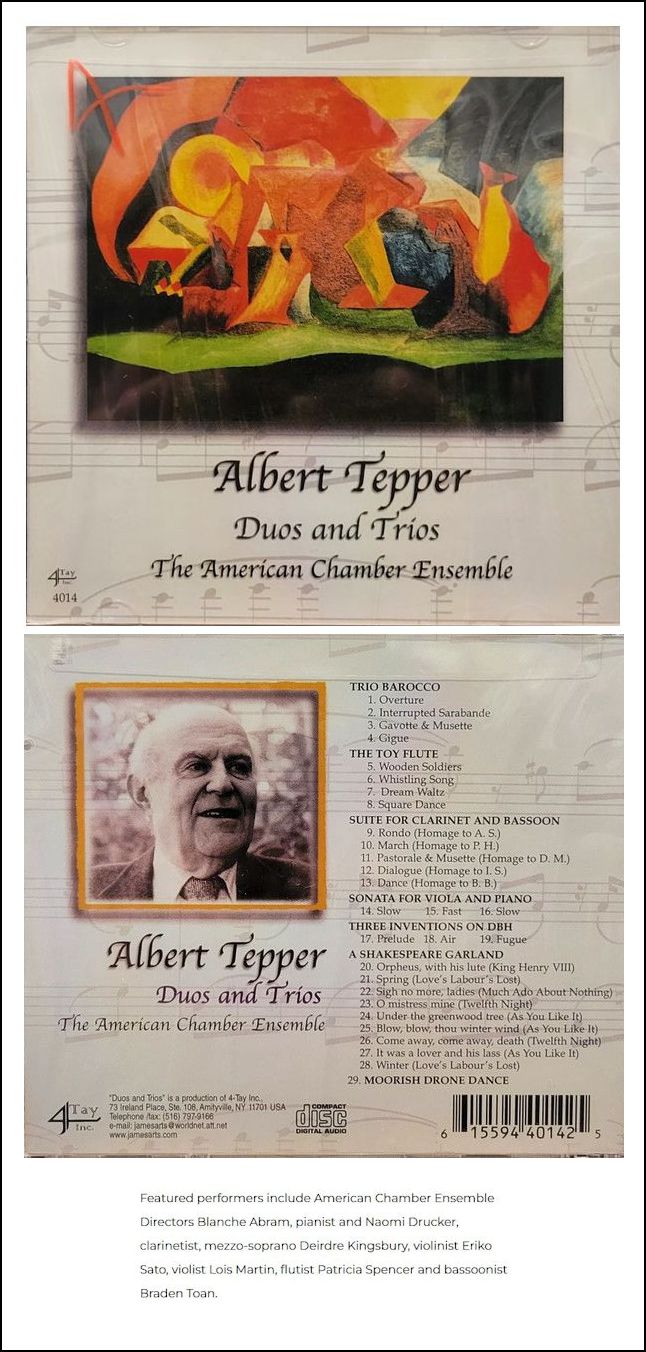
of chamber music and songs. A collection of his chamber works was recorded
on CD by the American Chamber Ensemble.
|
In mid-November of 2000, I made contact with composer Albert
Tepper, and arranged to have an interview on the telephone. I was
able to use portions of this chat as an 80th birthday program for him, albeit
a bit early, and now, in 2026, I am pleased to present the entire encounter.
As usual, names which are links refer to my interviews elsewhere on
my website.
As we were setting up to record, he asked me about the use which would
be made of our conversation . . . . .
Bruce Duffie: I do a series of programs on WNIB,
Classical 97, here in Chicago. You can listen to us on the internet.
Do you have a computer?
Albert Tepper: No, I don’t. I’m still in
the nineteenth century! I haven’t written much recently, but the
music that I write is all done by hand.
BD: Your technical usage of equipment is in the
nineteenth century, but is your musical language of the nineteenth century?
Tepper: I prefer to think not, but that’s hard
to categorize. I used to say that I was really a twentieth century
conservative, but then I listen to the music of people like Philip Glass and John Adams. I’m
not talking to their approach to formal structure, but about their vocabulary.
BD: The melodic line and the harmony?
Tepper: Yes, or lack of harmonic language. [Both
laugh] So, I guess I’m still twentieth century.
BD: Is that a good place to be?
Tepper: [Thinks a moment] I can start to
answer that with a question to you! How did you find out about me?
After all I’m not as well-known as a lot of other people you can name.
BD: There is a recording of your music, and I contacted
you through the record company. [He then mentions a couple of
other records which were available.] Does it please you that there
are several recordings of your pieces available to the public?
Tepper: Yes! [Laughs] I wish there
were more. The problem is that these things have to be vanity affairs.
They don’t happen through the recording companies. They happen
because the composer pays for them, which not only puts us back into the
nineteenth century, but into the eighteenth century or even earlier, where
the composer published his own music.
-- -- -- -- -- -- --
--
Vis-à-vis the recording shown at left... Directed
by Marilyn Lehman, The American Chamber Ensemble was founded in 1965
by pianist Blanche Abram and clarinetist Naomi Drucker. In residence at
Hofstra University, the ensemble explores the great chamber music literature
for piano, strings, woodwinds and voice and presents performances featuring
world-class artists. ACE consists of the finest freelance musicians in
the New York area and has been cited by critics for their superb presentations
of chamber masterworks.
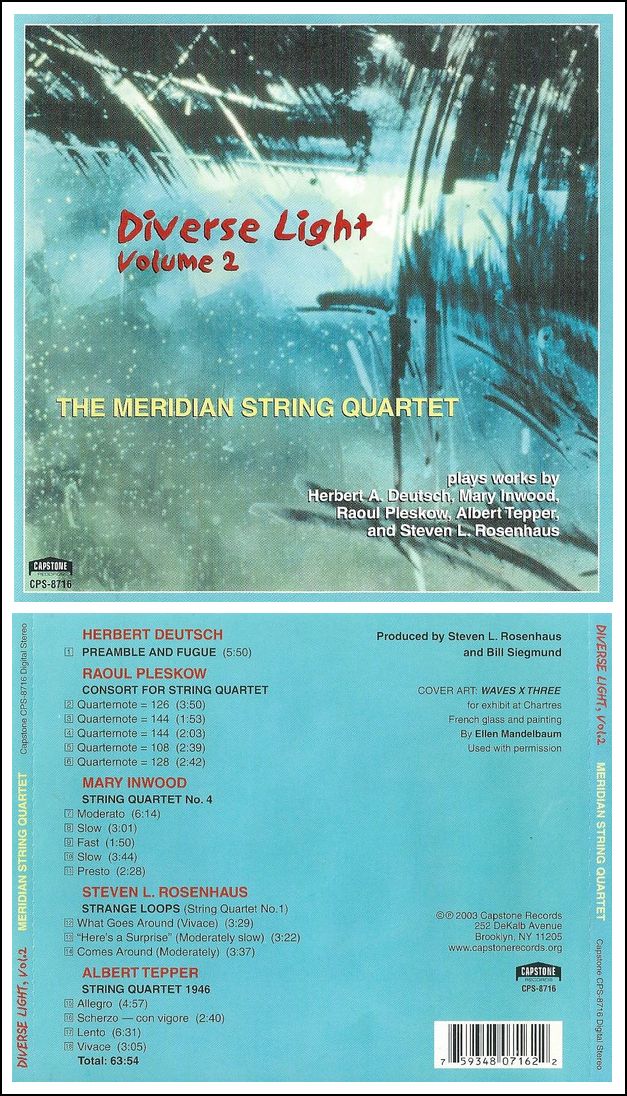
ACE is dedicated to presenting the music of living American composers
and has commissioned and presented World Premieres by Joelle Wallach, Martin
Wind, Jonathan Russ, Andres Maldonado, Elie Siegmeister, Meyer Kupferman, Benjamin Lees, Leo Kraft, Julie Mandel,
Vally Weigl, Max Lifchitz,
David Hollister,
Albert Tepper, Marga Richter,
Dana Richardson, Edward Smaldone, Jerry Rizzi, Katherine Hoover, Josef Alexander and
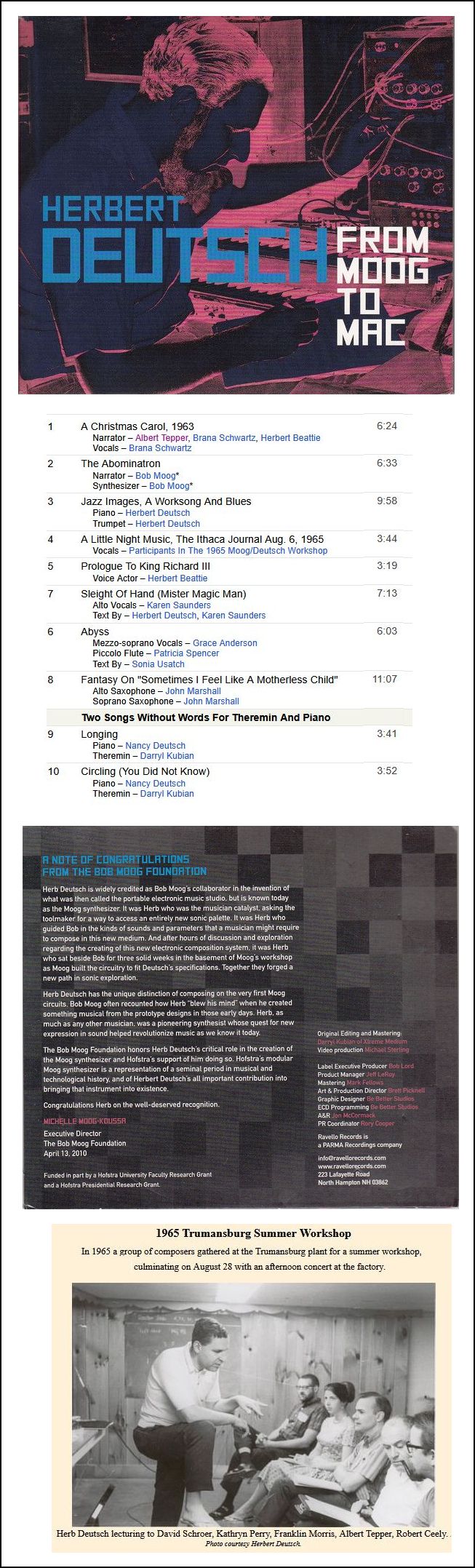
Herbert Deutsch.
They have performed music by American composers André Previn, Peter Schickele, Morton Gould, Judith Lang
Zaimont, Aaron Copland, Virgil
Thomson, Leonard Bernstein, Vally Weigl, Haskell Small, Robert Muczynski,
Philip James, Angelo Musolino, Miriam Gideon, Daniel Gregory
Mason, Charles Ives, George Kleinsinger, Douglas Moore, Amy Beach, George
Gershwin, Alan Hovhaness,
Robert Starer and many
others. They have recorded for Elysium, Leonarda, Gasparo, Soundspells,
Cala, Dionysus & 4Tay, including complete disks of the music of Peter
Schickele, Albert Tepper, Meyer Kufperman and Herbert Deutsch, as well
as individual works by Judith Lang Zaimont, George Kleinsinger, Elliott Carter, Virgil
Thomson, Gary Schocker and Douglas Moore.
Because ACE is Long Island based, it has, since 1980, included a work
celebrating the Festival of Long Island Composers on many of its concerts.
The purpose is to help our audience realize that today’s composer is their
neighbor whose contribution to our culture, although relatively unrecognized,
is very important.
Core members of ACE are Marilyn Lehman, piano, Mindy Dragovich, clarinet,
Eriko Sato, violin, Deborah Wong, violin, Lois Martin, viola and Chris
Finckel, cello.
-- -- -- -- -- -- --
--
BD: Beethoven sponsored concerts of his own music...
Tepper: Right.
BD: Do you feel that you are part of a lineage of composers
dating back through the centuries?
Tepper: Yes... [Laughs] You make me
feel embarrassed now! [Both laugh] There is a continuity,
absolutely. I remember, in my early or late teens or early twenties,
when I was shopping around to find a composition teacher I would like
to work with, somebody suggested that I go to see Joseph Schillinger. Oscar
Levant studied with him, and a lot of the Hollywood composers also studied
with him, because it would be a shortcut to get in and to write film music.
But that wasn’t his idea, it was their idea! Anyway, he was in
New York, and an arranger in New York suggested that I go to see him, and
he asked me about my ideas, and what I wanted to. I said I wanted to
be an original voice in the world, and he said if that’s what I was interested
in, we could certainly do that. In fact, he said that when we were
finished, I’d be writing music that wouldn’t be understood for the next
300 years! [Both laugh] At that point, I told myself to wait
a minute!
BD: That’s not what you wanted?
Tepper: That’s not what I wanted, and that was the
end of that. It cured me as far as Schillinger was concerned.
So, getting back to your question, I very much believe in the continuity
of music. As a matter of fact, I can even tell you the composers
I felt have had the greatest impact on me through my life. Aside from
the classic masters, I used to spend hours playing hooky
from school when I was at the New England Conservatory. I would sit
and play Bach Preludes and Fugues as well as I could. Then there
were Haydn, Mozart, Beethoven, possibly Brahms. Wagner was one of my
early influences. In fact, I think it was Wagner who made me decide
to become a musician.
BD: You wanted to emulate him, or just continue
his style?
Tepper: As a person, oh no! [Much laughter]
Just musically. But I hadn’t had much thought of this.
I thought of going into journalism. A friend of mine got me hooked
on listening to music. Although I had been taking piano lessons since
I was seven, I hadn’t really thought anything about it. Then this
young man was an opera-nut, and started spouting names and so forth. I
guess it made me a bit jealous, and I mentioned to my piano teacher about
going to the opera, and that somebody had suggested a good place to start
would be Carmen.
BD: Sure, that’s a good first opera.
Tepper: Right, but she said I should start with
Wagner!
BD: [Laughs] She wanted to plunge you into
the deep end.
Tepper: Yes. She had been an accompanist for
a Wagnerian tenor at one point. I had heard things before that,
but my real immersion into serious music was the Ring when I was
fourteen years old. It knocked the hell out of me. It really
knocked me off my pins. This was in the winter and the spring of 1935/1936.
BD: That was the Flagstad-Melchior era. [For
more details about all of this, see my interview with Edwin McArthur,
the accompanist for Flagstad and many other major singers.]
Tepper: Right, exactly, and Lotte Lehmann, and
Elisabeth Rethberg, and Friederich Schorr. That whole crowd. When
the Met had a Ring with them, it was unbeatable. But I didn’t
realize that. In fact, as far as I was concerned, the voices were
interfering with the music! [Much laughter]
BD: I assume you don’t still feel that way...
Tepper: No, no, far from it. You’ve heard
some of my songs... Anyway, the Met had a spring season. I don’t
know if they’ve ever had one like it since, or if they’d had one before
that, but this is back in the days when the family circle, the cheapest
seats at the old Met, were a buck. Then they had a spring season
where the cheapest seats were 25 cents, and I played hooky from high school
to go to the opening of the first opera.
BD: You’d get a whole Ring for a buck!
Tepper: [Laughs] Well, it wasn’t that, because
the opening night was Aïda, the second night was Rigoletto,
the third night was Lucia di Lammermoor. These were operas
I’d heard about, and that I knew about. So, I went down to get my
tickets, and unfortunately by the time I got to the window, the price range
that I could afford was sold out. But then I was able to pick up tickets
for Rigoletto and Lucia. At the Rigoletto, I
sat there and was absolutely stunned. What kind of nonsense is this???
[Both laugh]
BD: It let you down?
Tepper: Yes. Just to show you how naïve
I was, I had heard that Lucia di Lammermoor was a great work, and
I thought things would improve the next night.
BD: But it was the same kind of stuff?
Tepper: It was. Of course, now I enjoy Lucia,
and Rigoletto is a masterwork.
BD: These operas took a little longer to get into
your psyche?
Tepper: That’s right, and it wasn’t until about
twenty years later that I ever got to hear Aïda.
BD: So the Ring made an immediate impact,
but the Italian operas took much longer for you. When you became
a composer, did you try to balance the idea of immediate impact and depth
of performance?
Tepper: I think so. To be perfectly honest,
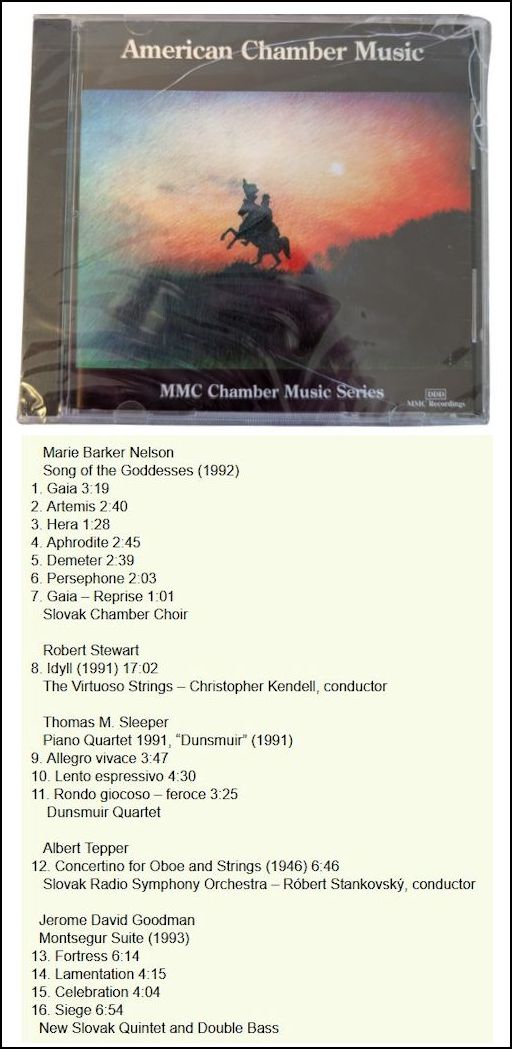
when I composed the Concertino for Oboe and Strings in the summer
of 1946, I was twenty-five, and it was for a competition. By that time
I was commercial enough in my attitude. After all, I had my Local
802 card, and I worked as an arranger in New York from the time I was twenty.
I went back to school after World War II, and I read about this competition.
My immediate thought was that I wanted to write something which would
sound fresh and contemporary to the naïve listener, but wouldn’t shock
anybody. [Laughs] How commercial can you get? I feel
almost like a traitor now to say this, but I asked myself who does that
best? Shostakovich! [Both laugh] In a way it’s true,
but it completely overlooks things like the string quartets, particularly
the later ones like the eighth and the eleventh. But what I was thinking
back then was the Shostakovich of the early ballets, and a lot of film music.
BD: Probably the Fifth Symphony, also?
Tepper: Yes. I had heard that in the late 1930s.
As a matter of fact, at that time, in the mid-1940s, I heard the Bartók
Concerto for Orchestra for the first time. In addition to those
I mentioned earlier, the composers I feel were my main influences were
Bartók and Hindemith, whose name is hardly mentioned anymore, and
Stravinsky. The first piece of contemporary music that I ever heard,
and that I remember, was The Firebird. That was when I was
about ten years old, and by the time I was twelve, I was already familiar
with Petrushka. When I was fifteen, I bought my own recording
of The Rite of Spring, which was done by saving money out of my allowance.
Those were, of course, 78s!
BD: Sure, big albums...
Tepper: ...and expensive ones. The two recordings
I saved up for were The Rite of Spring and Strauss’s Also Sprach
Zarathustra.
BD: [With a gentle nudge] You couldn’t have
loved the Minute Waltz, because it’s so short, and just takes up one
side?
Tepper: [Laughs] Well, I had a diet of Chopin
when I was studying piano, but it took a long time before I came to the
realization that he is one of the greatest composers who ever lived, and
was a tremendous influence on so many people.
BD: When you started writing, did you want to
become one of the greatest composers that ever lived?
Tepper: [Has a huge laugh] I suppose so. I
don’t know... I’m trying to think. I started out, as I said, thinking
I was going to go into journalism. I started writing my first novel
when I was eight years old. I didn’t get much into the first chapter,
but later, when I was in high school, I was thinking of going into journalism
at the Columbia School of Journalism. I even took a journalism course
in high school, an elective which we were screened and allowed into.
I enjoyed very much doing all kinds of things, eventually being editor
of the school paper. I even did headline writing, and all kinds of
things. It was at that point that I had begun to become interested
in music, and I began to be torn. I thought maybe I’d become a music
critic! Somewhere along the line I realized that would be foolish.
I should be a composer! So, I applied and was accepted at the
New England Conservatory of Music in Boston, as a music major with the
idea that I was going to be a composer. I’d never written a note
in my life! I wasn’t accepted as a composer, but by the time I finished
my first year there, I had to go before a faculty screening committee for
a composition, and I suddenly realized I’d better write something.
[Both laugh] I had taken harmony courses, and even some counterpoint...
BD: Can we assume that you’re glad you went
into music rather than journalism?
Tepper: I suppose so. I don’t know what it
would have been like to be in journalism. [Laughs] I can’t
say, but I’ve enjoyed my life in music.
* * *
* *
BD: You spent quite a bit of your time teaching music.
While you were teaching, did you get enough time to compose?
Tepper: Not really, but part of that is my own fault.
I taught at Hofstra University for thirty-four years starting
in 1952. When I’d been there for four or five
years, I got involved with the drama department. This lasted for nearly
thirty years. First it was unofficially, and then officially for a
quarter of a century I was the music supervisor of the department, which
meant that over the years I supplied original music for over a hundred productions.
BD: So, you’re back almost to the opera again?
Tepper: [Laughs] Except that I had never
written one! I wrote incidental music, and sometimes songs. There
are actually three Shakespeare song cycles that I’ve done with over a hundred
productions, of which about two dozen were productions of Shakespeare plays.
This was not twenty-four different plays. In fact, I decided
I had enough when I did the music for my fourth Romeo and Juliet,
[both laugh]. Of course, every director had a different conception,
which is good. That gets the juices flowing. I actually found
that the way it works for me is to have a project and a deadline.
Once, a student who was a very talented flutist, mentioned to me about giving
a recital, and I asked if she would like me to write something for it. She
said that would be wonderful, and I asked what she would like. She
asked if it could be between six and eight minutes, and I said fine, okay!
[Both laugh]
BD: You need the parameters to help form your thoughts?
Tepper: Exactly!
BD: Were there ever times when you had the parameters
and you just felt it had to be longer, or shorter, or different than what
was asked?
Tepper: No! By the way, the work that I wrote
for the flutist is on the disc of duos and trios. It’s a toy flute!
[Both laugh] One of the parameters was to write anything I
liked, but she didn’t know who the accompanist was going to be, so I wasn’t
to make it too challenging. So, what I wrote was something I felt
that I could handle without embarrassing myself as an accompanist! I’m
not that great a pianist...
BD: Was there ever be a time that you would say
you had too much to do, and maybe put it off until later?
Tepper: I’ve never been asked that often, I’m sorry
to say. Actually, my plate has generally been pretty full because
of the drama thing, and the teaching, though I have been able to squeeze
things in.
BD: Were there some things that you wrote because
you just had to get them out?
Tepper: [Thinks a moment] I know what you
mean by that, and I think the answer is no, which is probably the reason
why I haven’t composed anything in the past fifteen years or so. I’ve
composed on demand, basically. As an undergraduate, there were certain
requirements that had to be done, so I composed on demand. After that,
there have only been a couple of things that I composed when I felt I should
try to do something else. Actually, I composed for a purpose. I
suppose, in that sense I am more baroque than a lot of composers.
BD: When you were asked to write a piece, were
the ideas always there?
Tepper: Not necessarily, and not to begin with.
For instance, in the spring of 1964, I received a commission, which surprised
me that I was chosen. It was for a work for orchestra at a concert
that would take place on Long Island in the summer. The commission
wasn’t limited to Long Island composers. It just so happened that
they chose me. This was for a work for orchestra between twelve and
fifteen minutes, with forces that were no larger than those for the Gershwin
Piano Concerto, which was going to be on the same program. Beyond
that, I was given carte blanche to do whatever I wanted. It was
going to be performed under a tent, and I struggled with that for weeks
trying to get ideas. I began to think about all possibilities, including
at one point [laughs] not quite, but almost suicide! Finally, six
weeks before the performance, I stumbled on something which was quite different
from anything that I had thought about up until that point. There
was eight or ten weeks of scraps of paper with nothing, and all of a sudden
I hit on this one thing. Then, in ten days’ time I’d sketched a
thirteen-minute work for orchestra in five movements, and had scored two
of the five movements. At one point I told this story to a student,
who asked if I’d spent more time on it, would it have been a better piece?
I said that if I had spent more time, the piece wouldn’t have been written
at all! [Both laugh] It was one of things where it was necessary
to see the approaching deadline. In my mind, I’d already spent the
money!
BD: When you had the parameters in front of you, did
you ever feel you were a slave to them?
Tepper: No! I find them liberating!
At the risk of sounding very pompous and self-serving, there’s a remark
of Stravinsky that I came across a number of years ago in which says, “The
greatest art is produced under the greatest restriction.” I’m not
saying mine as being great art, but I can understand what he’s getting
at.
BD: Perhaps your greatest art was produced under
your greatest restrictions.
Tepper: Maybe? You’ve heard some of my music,
so you can decide that better than I.
BD: I assume you are pleased that we are going to
be listening to some of your music.
Tepper: I wish I could afford to produce more recordings
so more people could get to listen to it. I’m not the most prolific
composer by any means, but I do have a small body of works, and it would
be nice if those that I felt were worth putting on disc, were on disc.
* * *
* *
BD: We’re dancing around this, so let me ask
the real easy question. What’s the purpose of music?
Tepper: [Thinks a bit] May I broaden it
a moment to talk about artistic endeavor?
BD: Sure!
Tepper: I think it serves two purposes.
One, of course, is to entertain, and the other is to disturb.
BD: In equal measure?
Tepper: Not necessarily. It depends on the
work, but some of the most disturbing works are also the most entertaining.
BD: Is it the composer who decides the balance, or
is it the public that decides that balance as it listens?
Tepper: It can work either way, or a combination
of both. Something like the Twenty-Fifth Variation of the Goldberg
Variations, the very slow one, is one of those profound statements
in music. It’s heart-rending, and yet you can’t
live without it once you’ve heard it.
BD: Have you basically been pleased with the performances
you’ve heard of your works over the years?
Tepper: Yes, basically. You always search for
perfection, and it’s never going to come. For instance, I was not
at the recording session for the Oboe Concertino. It was in
Bratislava, and I just couldn’t afford to spend either the time or the money.
I know people who went to some of those MMC recordings, and I got the same
report from two different people, who said that the engineers just turned
their backs on them and wouldn’t listen to any comments they had about preparing
the works for recording.
BD: That’s too bad.
Tepper: Yes, but they were still basically pleased.
In my own case, in that six-and-three-quarter minutes of the piece,
there were just a few seconds towards the end of the slow middle section
where I felt if I’d been there, and if they had listened to me, I would
have asked them to tweak it a little bit. But that was all. That’s
the extent of my critical comment about that work. As far as the
duos and trios are concerned, anything that went wrong slipped through
the sieve of the performers, who are all excellent, or of the producer
or the recording engineer, as well as the composer who was sitting there
the whole damn time! [Both laugh] It is amazing that things
do slip through. On the other hand, there’s almost seventy-one minutes
of actual playing time on that disc, and I’m very happy with it.
BD: Coming back to your teaching, is there some general
advice do you have for younger composers coming along, or must it be individual
for each person?
Tepper: I think it must be individual. The
only advice I would give is don’t do it! [Much laughter] But
as a matter of fact, it true. I think I really do mean it. Unless
you cannot live without it, don’t do it.
BD: It must be a burning desire?
Tepper: Exactly, yes.
BD: Do you have any advice for audiences of new music?
Tepper: I once wrote a short essay, not so much about
new music but about listening to music in general. I wrote program
notes for some Long Island orchestras through the years, and basically
my advice for listening to new music is that, in a sense, any piece of music
you haven’t heard before is new music. Sometimes the vocabulary is
more familiar than at other times, but basically my advice is not to make
a decision about it on first hearing, unless it is so simple that you really
do grasp its meaning. Give the piece a chance to seep in, to percolate,
to become part of you.
BD: Is this what perhaps contributes to the greatness
of a piece of music, that it can percolate for years and years in your
mind?
Tepper: I think so, yes. You can get tired of
some pieces, but then let them lie fallow for a while, and come back to them.
If it’s great music, you’ll hear things you’ve
never heard before. Greet it like a real old friend that you’ve missed.
BD: Are you optimistic about the whole future of
music?
Tepper: I have to be! I don’t know how
true it is, but there is a story that Strauss and Mahler were walking on
the seashore, and Strauss was bemoaning the state of music and the decline
of music, and how things were ending. Mahler pointed out and said,
“Look, Richard, here comes the last wave!”
[Much laughter]
BD: It should be true, even if it’s not!
[More laughter] I appreciate your taking the time to chat with me.
I look forward to putting together a program of your music.
Let me ask your birthday.
Tepper: On June 1st, 2001, I will be 80 years
old!
BD: Does that please you or distress you?
Tepper: Neither! Well, in a way it pleases me.
When I was kid, it never even entered my mind about the twenty-first century,
which, by the way, we haven’t reached yet. [Remember, this conversation
took place in November, 2000.]
BD: Right! It will be another few weeks before
January 1st!
Tepper: Approximately another month and a half.
I’m convinced that that’s why Arthur Clarke entitled his novel 2001.
I’ve never questioned it, but if it wasn’t in his thoughts, it should
have been. But I’m happy to be alive, and I’m enjoying myself.
My wife is here with me, and she’s beaming at me! At the risk of being
unchivalrous, she’s going to be 80 next year, also. Our birthdays
are four months and ten days apart. We were born in the same hospital,
as a matter of fact, but we didn’t know each other then! [More laughter]
BD: Did you meet early, or was it long time before
you got together?
Tepper: She was seventeen and I had just turned
eighteen. We lived at opposite ends of New York. She was living
in a suburb almost to the Nassau county line, and I was living in Mid-Manhattan.
The connection was a friend of mine from high school days, who was
a classmate of hers at Queens College. This is my debt to Wagner!
He and I were both Wagner nuts at the time. That’s how he became such
a good friend, because of our infatuation and adulation of Wagner. Then
he went to Queens College, and was not a music major, but he became friendly
with this young woman, who was a music major there. I was at the New
England Conservatory in Boston, and he felt we two should get together.
It was a blind date, and sixty-one years later, here we are! We’ve
been married for fifty-seven years.
BD: That’s just absolutely wonderful.
Tepper: To round things off, we have two daughters.
One lives forty-five minutes east of us here on Long Island, and with
her we have two granddaughters. My other daughter lives on the west
coast, in Glendale, California, a suburb of Los Angeles, and is married
to an actor. She herself was a dancer, but at the age of fifty-two
you’re not a dancer anymore! [Laughs] June 3rd is a Sunday,
and there’s going to be a concert in my honor at Hofstra that afternoon.
They gave me one five years ago when I was 75... they probably didn’t think
I’d be around five years later, but here I am! [Much laughter] [Normally
I would schedule the round-birthday programs very close to the actual birthdates
of my guests, but because WNIB was suddenly sold and changed format early
in 2001, I did the program on February 3, to be sure it would be aired.]
BD: I hope you’ll be around for many more!
Tepper: Oh, let’s not push it too far! [More
laughter] It’s been a pleasure talking to you.
BD: Thank you so very much.
= = = = = = = =
= = = = = = = =
= = = = = = = =
----- -----
-----
= = = = = = = =
= = = = = = = =
= = = = = = = =
© 2000 Bruce Duffie
This conversation was recorded on the telephone on November 16, 2000.
Portions were broadcast on WNIB on February 3, 2001.
This transcription was made in
2026, and posted on this website
at that time. My
thanks to British soprano Una Barry for
her help in preparing this website
presentation.
To see a full list (with links) of interviews which have been transcribed
and posted on this
website, click here.
To read my thoughts
on editing these interviews for print,
as well as a few other interesting observations,
click here.
* * * *
*
Award -
winning broadcaster
Bruce Duffie was with WNIB,
Classical 97 in
Chicago from 1975 until
its final moment as a classical
station in February of 2001.
His interviews have also appeared
in various magazines and journals since
1980, and he continued his broadcast series
on WNUR-FM,
as well as on Contemporary
Classical Internet Radio.
You are invited
to visit his website
for more information
about his work, including
selected transcripts of other
interviews, plus a full list of
his guests. He would also like to
call your attention to the photos
and information about his grandfather,
who was a pioneer in the
automotive field more than a century ago.
You may also send
him E-Mail with
comments,
questions and suggestions.