Composer  Daniel  S.  Godfrey

A Conversation with Bruce Duffie


godfrey


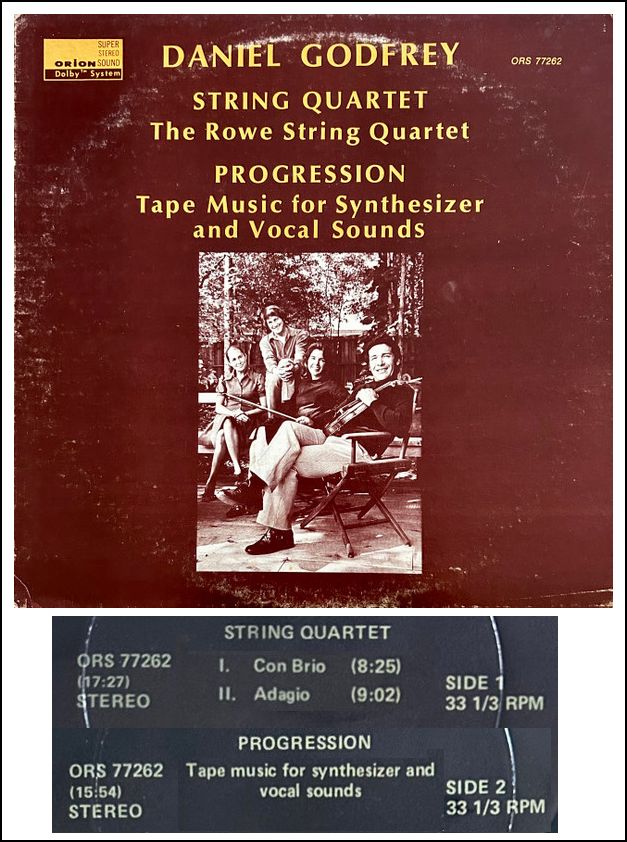
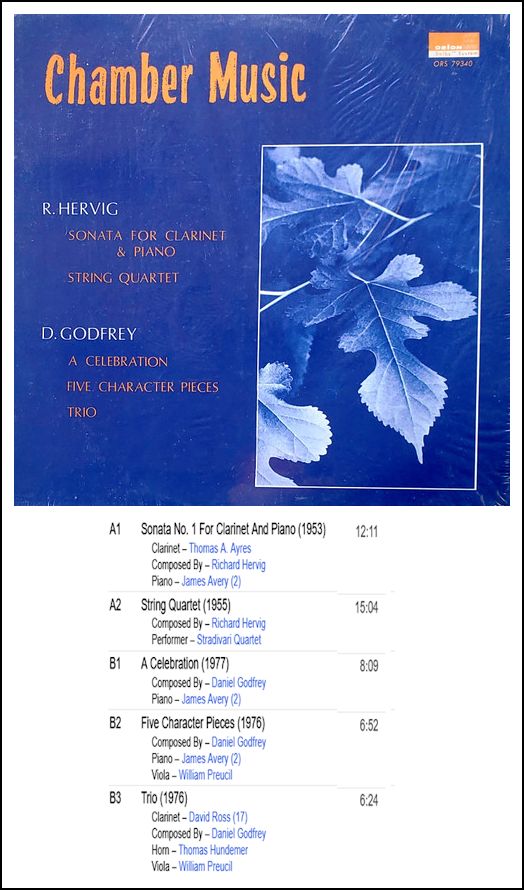
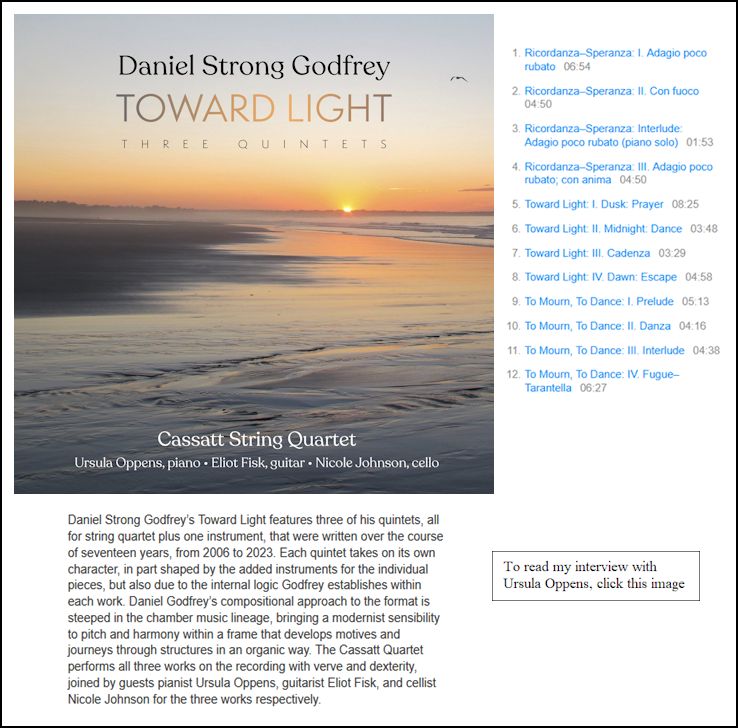
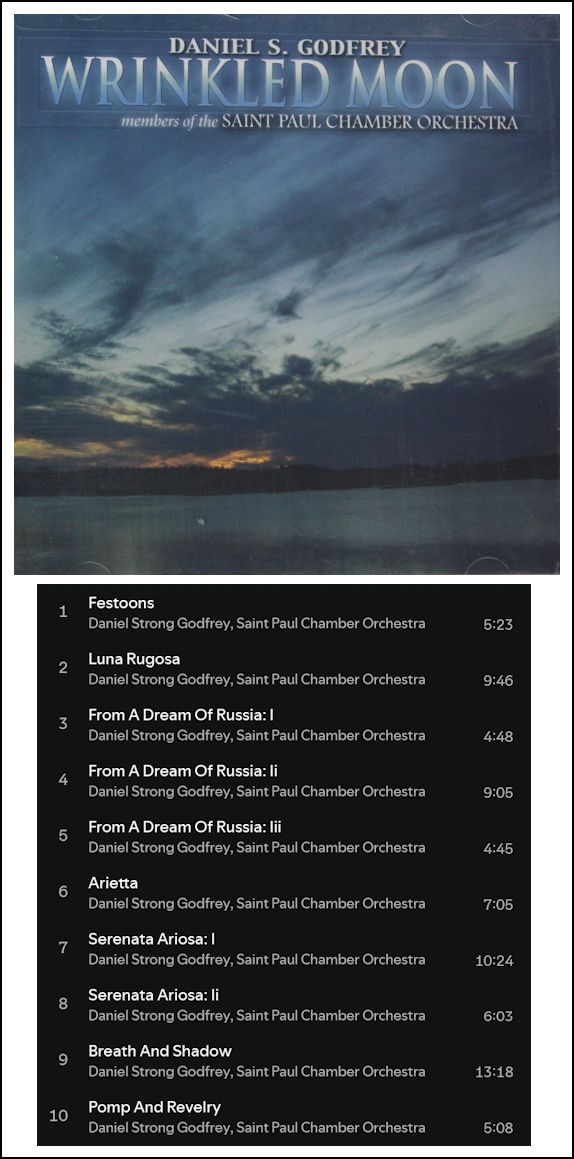
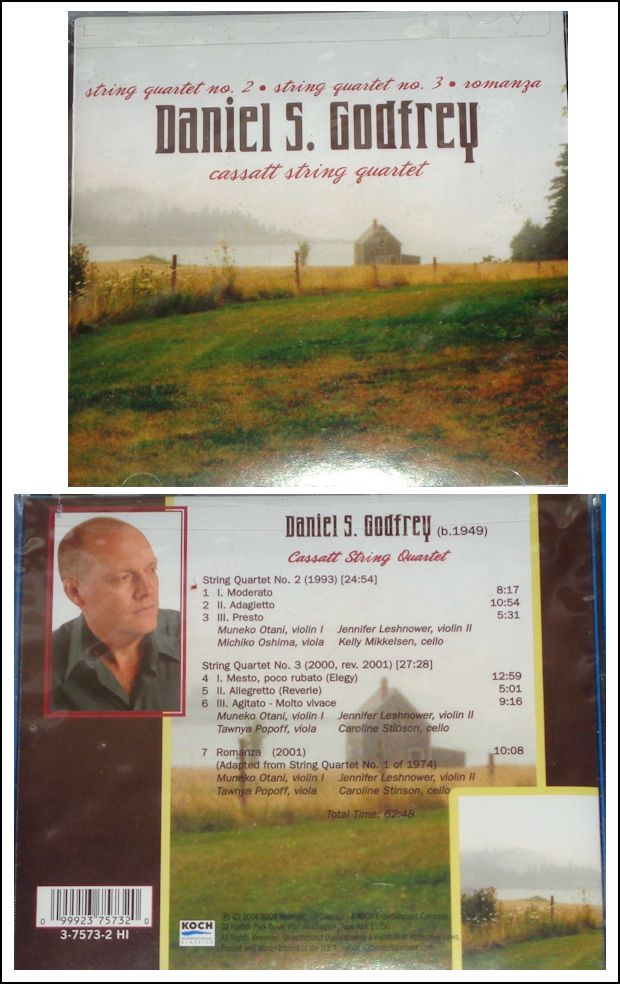
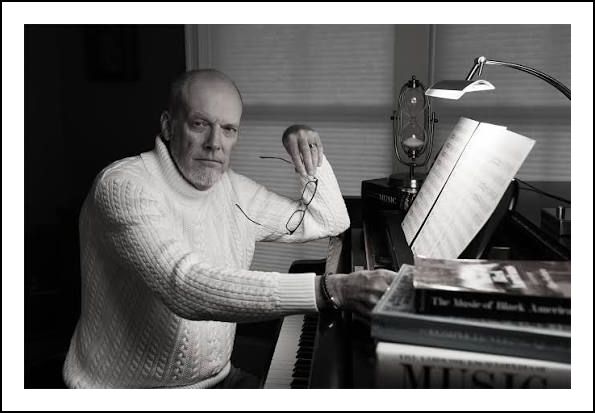
Daniel Strong Godfrey (born 1949 in Bryn Mawr, PA) is an American composer who has written for symphonic bands as well as a large body of chamber and orchestral music.
He began composing at the age of eight while his family was living in Ankara and later studied with Mario Davidovsky, Robert Morris, Martin Jenni and Richard Hervig, earning graduate degrees from Yale and the University of Iowa.

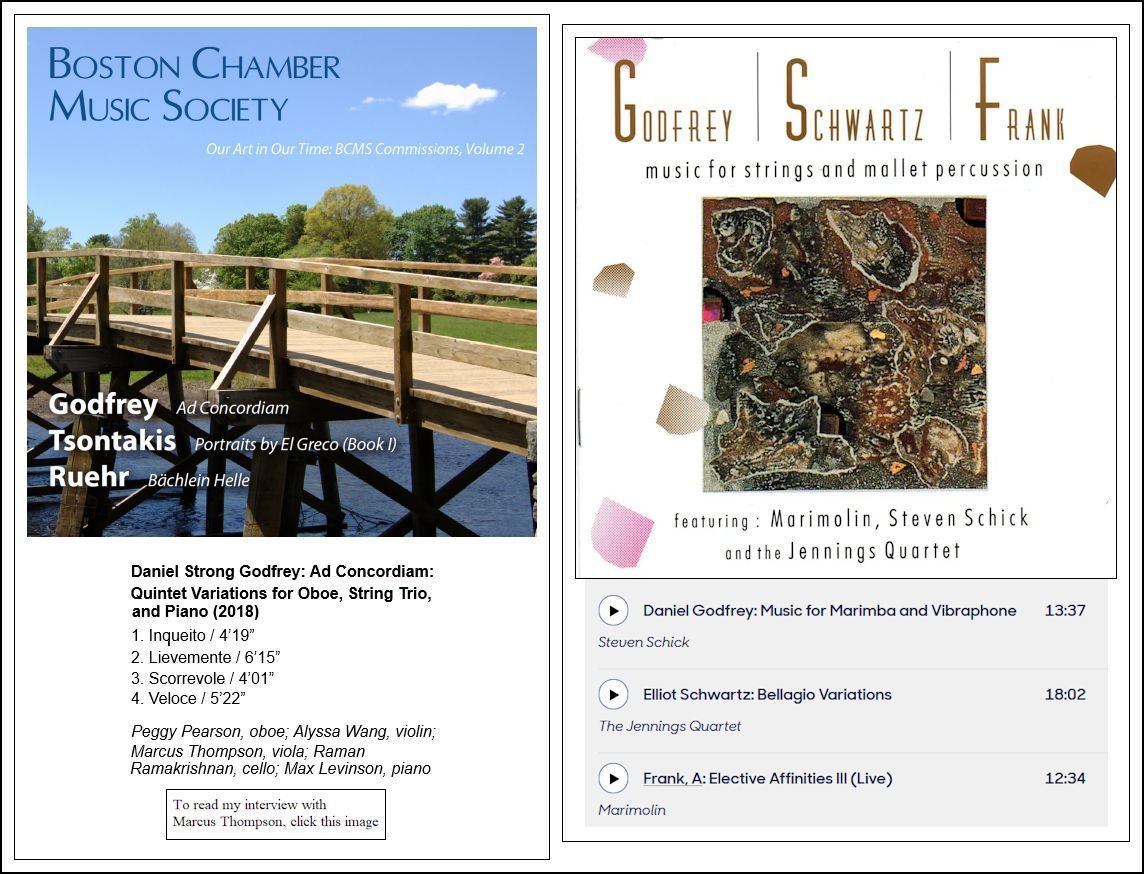
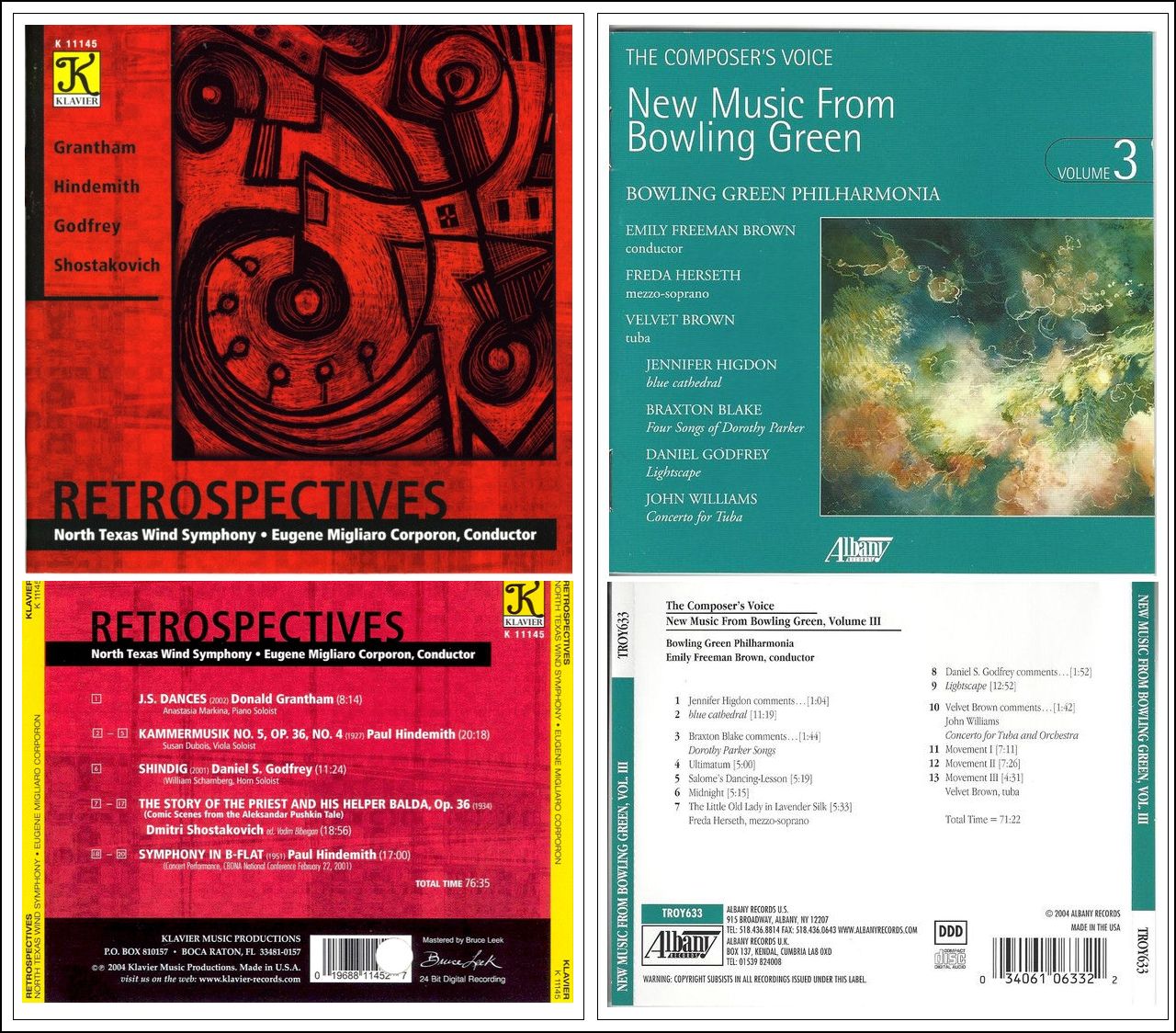
Daniel Strong Godfrey has earned awards and commissions from the J.S. Guggenheim Memorial Foundation, the American Academy of Arts and Letters, the Fromm Music Foundation, the Rockefeller Foundation, the Bogliasco Foundation, the Koussevitzky Music Foundation, and the Barlow Endowment for Music Composition, among many others. His music has been performed by soloists, chamber ensembles and orchestras throughout the U.S. and abroad. He is founder and co-director of the Seal Bay Festival of American Chamber Music (on the Maine coast) and is co-author of Music Since 1945, published by Schirmer Books. Godfrey's works are recorded on Albany, Bridge, CRI, GM, Innova, Klavier, Koch, and Mark compact discs. His music is available through publishers Carl Fischer and G.Schirmer.

He is Professor and Chair in the Department of Music at Northeastern University's College of Arts, Media and Design in Boston, MA. Prior to his recent appointment at Northeastern, Godfrey was Professor of Music Composition, Theory and History at Syracuse University's Setnor School of Music. He has also held guest faculty appointments in composition at the Eastman School of Music and the Indiana University School of Music.

==  Names which are links in this box and below refer to  my interviews elsewhere on my website.  BD  


godfrey

What you are about to read is an interview with the distinguished American composer Daniel S. Godfrey.  I say that because the next few lines of this introduction will seem a bit off-topic, but please bear with me.  There is a reason for the detour...

In the earliest days of automobile manufacturing, many men experimented with vehicles of various sizes and types.  Though unremembered today, one of the most significant companies was that which produced the Columbia cars in Hartford, CT, from 1895-1913.  My grandfather, Lawrence Duffie, was head of the department that tested the Columbia gasoline cars.  They also produced electric vehicles — including most of the cabs that serviced New York, Boston, Washington, D.C., and other urban areas — but that is another story.

In late September of 1903, Duffie, along with Bert Holcomb and a couple of others established the record for a non-stop trip in an automobile from Chicago to New York City — 76 hours!  To read about this event, click here.  For more photos of the cars and drivers, as well as articles and other items, see my History of the Columbia Car.  These days, according to the driving directions on the internet, the 800 mile direct route can be covered in about twelve and a half hours, to say nothing of the mere two hour plane ride!

One month shy of a century later, in late August of 2003, my girlfriend and I were taking a road trip of our own, and the first leg was a
‘re-creation’ of that original run.  I put the word re-creation in quotation marks because we did not follow the exact route the whole way — although we were told by locals in OH, PA and NY that some of the roads we were on were, indeed, at least 100 years old — and we certainly took our time and stopped conveniently along the way.  But we did follow the city-to-city path (which is noted in the newspaper reports) and felt the presence of the ancestors on several occasions.

The point of all this is to show why we were in New York State at that time!  In planning for the trip, I also had arranged to connect with a few musicians along the way.  As we traveled to the Berkshires, we met Phyllis Curtin.  Earlier, when we arrived in Syracuse we met Neva Pilgrim.  She invited us to her home, and she also introduced us to Helen Boatwright and Daniel S. Godfrey.

Portions of all of these interviews were included in my radio series, and as noted by the links, the full conversations are now transcribed and posted on this website.  

Here is the one with the composer . . . . .


Bruce Duffie:   Earlier we were talking about religion, a subject of which you seem to have a very big interest.  Is it safe to assume that every piece you write has some kind of spiritual quality?

Daniel S. Godfrey:   I hope it does, but it isn’t deliberately applied in terms of any particular theme.

BD:   Why is that?

Godfrey:   I’m not comfortable with pieces that preach.  Music reveals itself when it’s written with real honesty.  The more that the pretensions are set aside, and the more the music is allowed to breathe its own air, the more it reveals very telling things about what’s deep inside of us that simply can’t be put into words.  That’s even true of music which has words with it.  The words are almost a vehicle that in some ways are just a kind of marker, and a relatively superficial one, or a form of expression that’s essentially nonverbal and much deeper.

BD:   Are you trying to reveal something specific, or is it just that it reveals something hidden about you?

Godfrey:   My sense is that if I try to reveal something specific, or if I make a conscious effort to engineer the revelation of something specific, it’s bound to be less true, less interesting, less telling, and more burdened with artifice just by virtue of the fact that it comes from a conscious conceit, than if I did not make an agendum out of putting that into the music.

BD:   Are you then surprised by what you see being revealed in the notes?

Godfrey:   I feel informed by it.  I’m not sure
‘surprised’ is the word.

BD:   Are you pleased or horrified?

Godfrey:   That’s a complicated question because a composer’s output is so personal that two opposite things are warring with each other... at least I find that in my case.  One is that when I write a piece, it’s my baby as it were, and it reminds me of what it was like to be the father of a very young son.  You take your son to day care, and there are twenty cute kids running around, but somehow yours just has to be the cutest, and you can’t quite believe that everybody doesn’t recognize how much cuter your son is, and how all the other kids are made ordinary.  That’s just part of human nature, and it’s the same way with pieces of music.  After this long gestational endeavor, you feel this special affection for what comes out, and you notice every little thing about it, and you almost assume that everybody else is going to notice all the wonderful little things which, of course, isn’t true.  They may be thinking about where they’re going to get their ice cream soda after the concert!

BD:   Then do you try to highlight or spotlight the things that you want them to notice about the pieces?
godfrey
Godfrey:   Not consciously.  Again, if you introduce that kind of artifice, then you’re going to undermine the effectiveness of what you’re doing.  But the other side of it is that the music is so personal that it brings out one’s deepest insecurities as well.  So there’s this side that is inclined to be proud of the music, and this other side that is riddled or tortured with self-doubt.  I find that both of those things are constantly in a tug of war when I’m writing, and my job is to switch those circuits off, and the more I’m able to do that, the better the piece is in the end.  It’s not that there isn’t a great deal of intellect that goes into anything I do.  I’m sure that’s true of most composers, but what I don’t do is have a list of communicative goals that I’m going to consciously set up.  I’m going of follow my muse whatever the topic, and try to do the best I can at being true to whatever that evokes in both the intuitive and intellectual sense, but without a conscious engineering or attempt to predict what kind of impact it’s going to have on the listener.

BD:   Are you following the muse, or are there times when you try to nudge it just a little bit one way or another?

Godfrey:   I think the muse is nudging me!  What happens is that you get to one level and there are things that seem to work, you get into a pattern, and there’s a part of you that says you need to take another little step here.  When you do try another angle, that’s the muse talking.

BD:   You mentioned self-doubt.  Do you find that once the piece is finished, or when it
’s performed, you’re rid of self-doubt?

Godfrey:   It happens in stages.  First of all, I often find that even if I’m compelled because of time pressure or practicality to pursue an idea, I begin to doubt one that seems effective at first.  Then, after living with it, I begin to think this is a dumb idea!  I have to overcome that and say I’m not a stupid person!  Even if this is a dumb idea, I can make something intelligent happen with it, and so I’m just going to do it.  Eventually that self-consciousness is overcome by involvement in the piece, and the things that the ideas can do often begin to reveal themselves in surprising ways.  Then the piece is there, and one is excited about it.  In a way I am biased towards it, unless one knows that once in a while you can blow the opportunity.  But what happens next is that you hear the first rehearsal, and even though I know these people are just reading and they haven’t practiced the parts very much, they’re just getting accustomed to the piece.  It sounds perfectly awful, and at first reading people know it sounds awful, and they’re kind of complaining about this little thing or that little thing.  What I tend to do is think that I’m just going to have to throw this piece out.  We’ll go through with the premiere, and I’ll call it a life experience, and chuck it.  Of course, what happens is that within three or four rehearsals the whole thing transforms itself.  It’s just amazing what can happen even between the dress rehearsal and the premiere.  There’s an astonishing leap of clarity, and then, if it goes well, all of a sudden it’s a very fulfilling experience.  It’s kind of tossed up and down by the whole process.

BD:   Does it make you schizophrenic?

Godfrey:   No, it’s still me!  [Both laugh]  Having mood swings is what I am!  I’m not two people.  I’m this guy who has mood swings.

BD:   Can we assume that basically you’ve been pleased with the performances you have heard of your music over the years?

Godfrey:   I’ve been really lucky.  I’ve had terrific performances of most of my pieces.

BD:   Are there ever times when the performers will find things in the score that you didn’t know you’d hidden there?

Godfrey:   There are things that we find together.  For example, certainly they find mistakes just in terms of notation and errors of one kind of another.  These get caught in the whole process of preparing a piece.  But what does get discovered
— and sometimes it’s a performer who catches it before I do — is that there are connections between ideas in the piece that are very palpable, and that often help to tie it together.  I didn’t realize them consciously, but there are a lot of those connections which are very conscious.  Then there are a lot of others that aren’t, and I find myself grateful that I didn’t recognize them until after the piece was finished, because I might have tried to see if I could wind up my natural capacities to speak in an integrated way, and mess it up somehow.  The human mind is this extraordinary instrument that has the capacity to integrate ideas in order to make sense out of the environment and forms of expression without our having to command it outwardly.  A lot of times that capacity or that skill is something we can’t consciously improve upon, any more than we can consciously improve upon when our stomach decides to pass something along the intestines at just the right moment.  There’s something else going on in there that’s much better at this than we are in our outward waking state.  For me, composing is part letting go, and allowing both the conscious and the subliminal or unconscious work together in a friendly relationship, without a lot of nervous interference from the conscious part.

BD:   Is it always a friendly relationship?

Godfrey:   No!  That’s the problem!  [Much laughter]  It’s often not a friendly relationship!

BD:   Who wins?

Godfrey:   Everybody loses when the artifice, and the pretense, and the outward agenda take over.

BD:   In the end though, is it all worth it?

Godfrey:   [Thinks a moment]  In pieces where that happens, it’s worth it if you can go back and try again and make it happen, or see where you can improve upon things.  I find there’s always something good in every piece.  There’s always something that can be salvaged because the spirit is indomitable.  There’s a part of us that usually won’t let other parts of us go completely astray.  There’s a light in there that’s always on, and you can see it glimmering.  A composer can see a glimmering in the worst piece of music.

BD:   Can the public see that glimmer?

Godfrey:   Often not.

BD:   Should they?
godfrey
Godfrey:   No.  It’s composer’s responsibility to make that light glow, and to make the music a conduit, a projector of that inner light.  That’s the composer’s duty, not the public’s in my view.  I’m somebody who doesn’t like to rely heavily on program notes.  I like getting up and talking to the public, but I try not to get into deep explanatory areas, because that’s like stacking a deck.  It’s like trying to anticipate where a marriage screwed up.  It’s like saying, “Maybe you’re not accustomed to all this high-class contemporary music, but just in case, here are a few things you don’t hear that we experts can really hear.”  To me that’s a lot of hooey.  I know I’ve done that a lot, and, looking back, it embarrasses me.  But it’s something that we as composers are expected to do all the time, and we fall into line.  I’ve also done seminars where I’m talking about a piece to other composers, and as I’m talking I notice the connection.  It might be the structural outline that helps the piece do what it does, that I actually hadn’t noticed in a way that I could articulate before.  But then in the front of the seminar, I’ll start articulating it as though I had thought of it consciously myself.  [Laughs]  It makes me sound like this brilliant intellect who has somehow managed to juggle all these elements.  When they have to talk about their music, that’s something which composers get sucked into.  It’s an egoistic projection of the process.  I often get up in front of an audience and say that if you don’t understand the music you’re about to hear, you don’t have to make the excuse that you haven’t heard that much new music, and you’re sure it’s very interesting but maybe you’ll have to listen to it ten times!  I hope they listen to it ten times, and that they’ll get more out of it each time, but if the first time there’s nothing that comes across to them, I tell them it’s not their problem.  It’s my problem!  My job as a composer is to communicate.  If there’s no communication, it’s my fault.

BD:   What if your piece communicates to some and not to others?  I trust you don
’t want to change it so that it communicates to the others and not to some.

Godfrey:   Right, that’s true.  You can’t get to everybody.

BD:   Should you?

Godfrey:   [Thinks a moment]  It’s sort of like calculus.  You can approach the goal, but you may never get there!  You do your best.

BD:   Speaking of getting there, how do you know when a piece is done?

Godfrey:   When I work my way into a piece, by the time I’m about a third of the way into it in terms of time invested, I really know where everything is going.  I know what I want to happen, and when I want it to happen.  I’m not sure of the best way to handle every part of it, but the kind of trajectory and points of arrival that really get me excited about what’s going to happen in this piece are there, and I work towards getting all those pieces of the puzzle together, so that it’s there from beginning to end.  I really spend a lot of time listening to the piece in my head in real time.  I try not to do it, and I can get a really bad headache doing this, but short of that and short of becoming obsessive and paranoid about details, I really try to get a sense of what I’ve done in real time.  It’s usually apparent to me when I get to a certain place that it’s not quite doing what it’s supposed to do there.  Maybe the proportion isn’t right, or the shift in harmony isn’t right, or the spacing of rhythmic elements isn’t right, and that’s a gut thing.  I can really feel it.  Sometimes I can consciously explain why it’s not working, and other times I just feel it’s not there.  But at my best, I’ve written a movement where, from beginning to end I feel it
’s right when the double bar gets laid down at the end.  Then it’s ready to go.  There are also times when I know I’ve almost got it, and it’ll work, and I’ll learn more from hearing it rehearsed and played.  Then I’ve got to let it go even though it’s not perfect.  There is this thing about writing the perfect piece.  The perfect piece is a fiction, and this search for perfection can bring one to a dead halt.

BD:   What about a perfect performance of a piece?  Is that possible?

Godfrey:   It’s a contradiction in terms for me.  When you’re recording a piece in a studio or in a hall, and you anticipate editing, there’s this balance between wanting the recording to be a really flattering document of what you’ve done, but still have the pulpy, vivacious sense of real time communication that you look for in a live performance.  That’s a very hard balance to get in a recording.  In an actual performance, you are not in a position to edit, and if you were, you wouldn’t get a lot of what you do get in a live performance.  You have to undertake the search for perfection as a performer, and as a composer working with the performers, but then when you get to the performance, you have to let go and let it happen.  You have to give up the search at that moment, and just make it happen as best it can.  It’s a lot like the book called The Inner Game of Tennis [by Timothy Gallwey], where all the right moves are practiced over and over and over again until they’re as perfect as the player can get them.  Then the coach says that when you go on the court and you play your match, you just completely forget about that.  Then, the extent that all of that hard work has been integrated will come out, and to the extent that it hasn’t, if you start double-checking yourself along the way, you’ll just get in the way of your ability to play.

BD:   You must be a natural?

Godfrey:   Yes.  The natural part really has to be there, and at least with the kind of music I write, it just won’t come to life if there’s an obsession with detail.

BD:   We’ve been talking about the end, so let’s go back to the beginning.  You get a number of commissions.  How do you decide whether you want to write this piece, or no, you won’t accept this commission?

Godfrey:   Like a lot of composers, I suspect I tend to be acquisitive about these things.  If a commission comes along, I think,
“Great!  This is an opportunity to do x, y, or z,” and my problem is that I tend to take on way too much.  When I started to become more successful, which was right around 1991, it was like turning a kid lose in a candy store.  Every time somebody asked for something, just the fact that somebody was asking and was really interested got me excited, and I said yes to everything.
godfrey
BD:   Did you miss deadlines?

Godfrey:   No, I didn’t, but I got closer and closer to disaster, and somewhere within the past two or three years, disaster finally hit.  It took ten years for the whole thing to overwhelm me, but the combination of that over-accepting tendency, and taking on other things outside of composition, it became more than I could handle all at once.  I finally got to a point where I was missing deadlines to the point where one or two performances had to be either canceled or put off, and that has required just a major reassessment of how I go about things.  I’m at a stage now where I can’t take on everything.  I have to pick and choose, and it’s hard to do that.  There’s a tendency to be somewhat cynical about it, and pick the things that are most advantageous from a career point of view.  But there’s a problem with that, which is that occasionally you sign onto projects that just don’t have any real interest.  Recently I had a fellowship that allowed me not to teach for a whole year, and I proposed a whole gaggle of pieces for that period of time, and promised them to people because I had the support for it.  I only got through about half of what I promised, and so now I’m trying to catch up with it all.  In addition to actual commissioned things, it’s a tricky period for me because with each level of success, there seems to be a requirement of somewhat greater maturity in terms of how you handle your circumstances, and that’s a constant process.
 
BD:   Does each piece grow and improve upon the previous one?

Godfrey:   Definitely not.

BD:   But do you grow?

Godfrey:   Yes, but that’s a very different question.  I recently wrote a big piece.  I won’t prejudice any listeners [and now readers] by saying which one it was.  It really didn’t work out to my satisfaction at all, and it took me an enormous amount of time and effort.  It cost way more than it should have to get copied, and the results were not only not what I had hoped for, and even in some ways less than I feared.  Although not irredeemable, I’m not going to make this piece right.  However, that experience brought me to my knees, and forced me to up the ante one more time to increase the risks and effort in terms of how disciplined I am with myself.  This involves picking projects and being realistic about time, and deciding what it is I want to do and don
’t want to do with the actual sounds, no matter what I feel compelled to do because of time pressure and outward expectations.  I am learning the necessity to be more mature about juggling those things, and being more true to oneself, and more realistic about one’s need to lead life sanely in the process.

BD:   [With mock horror]  Really???  You want to be sane???

Godfrey:   [Laughs]  Yes!  Composing for me is like a search for sanity.  It’s emblematic of other kinds of experiences in life.  There’s a part of it where you have to be very focused and controlled about how you proceed with your work environment and your time and your schedule, and there’s another part of you that has to decide where neither choice A nor choice B quite fits.  You can’t let your ego wrapped up in the consequences of making a wrong choice, so you let go and make a choice.

BD:   Rather than finding choice C?

Godfrey:   Perhaps there is no choice C.  This is one of the wonderful things that can happen.  Part of letting go is feeling okay, so you let go and forge ahead with a choice that you’re not completely happy with.  What happens to me all the time is then choice C comes to mind, and not before.

BD:   Is this early enough that you can insert the ideas, or is the performance already gone?

Godfrey:   No, this is while I’m writing the piece.  It could be that I have to throw out everything I’ve done the previous day.  That’s where the question of integrity comes in.  I really don’t want to start all over again on those completed measures.  You have finished your work that day, and when you’ve gotten to the end of it you say that’s the best I can do.  Then at 3 o’clock and choice C comes to mind, you realize that’s what it was supposed to be!  It’s so much better than what you had, and that means you have to take choice B or A and chuck all the twelve hours it took to work that out.  You then have to go back and work with choice C and really get into it.  When that happens, I always feel I’ve done the right thing, and I’m always glad I did.  That’s a very specific way in which the integrity of the process is to be found.

*     *     *     *     *

BD:   You’re teaching here at Syracuse University.  Do you get enough time to compose?

Godfrey:   I do now.  I didn’t used to.

BD:   What advice do you have for young composers coming along, either the ones you are working with directly, or ones you may never meet?

Godfrey:   My advice is not to accept as given the career patterns that have established themselves for most of us today in North America.  These are composers who have in mind something along the line of an art-music career, of concert music whatever it might be and however you want to name it.  The idea usually is to go to a university, work your way up through a doctorate, and end up teaching.  The idea there is that you get paid to at least be involved with music, and it is assumed that you’ll find time on the side to do your own work.  I was brought up in that tradition, and I find that now, thirty years later, other composers are still stuck in that same rut.  There are fewer, but many still are, and I am really one of them.

BD:   It must obviously work for some.

Godfrey:   It works for some, but for a minority, and I’m not sure it’s even working for them.  It didn’t really work for me.  Teaching was very rewarding for me.  I wouldn’t give back a minute of my teaching experience, but the balance between the time I spent talking about what other composers both present and past were doing, and actually doing it myself, was completely off.  Two or three years ago I found myself giving a lecture about whomever... it could have been Berio or Elliott Carter, or whoever it was that was still alive and, I thought that I’m alive, and nobody’s giving a lecture about me.  Why?  Because I haven’t had time to build a repertoire that’s worth lecturing about.  Instead, I’m lecturing about what these guys did when they were ten, fifteen, twenty years younger than I am now.  That doesn’t make any sense, and that’s not a way to lead a life as an artist.  So when I arrived at that point of view, I felt it was time I had enough going for me professionally that I could begin really to negotiate with Syracuse University about an arrangement that made more sense for both of us.  So now, my nom de guerre [war name] is
‘composer-in-residence’.  I do spend a lot of time on campus, and I do some teaching but not the kind I used to do, which was the classroom teaching of theory, history and all of that.  I teach more about things that are relevant to me.  The notion is that if it’s something which really has currency for me and is a vital concern for me, that’s something the students also need exposure to.  So, with the teaching that I am doing now, there’s just as much energy going into it, but it really has more to do with who I am as a functioning artist.  This is not to say that I talk about my own music necessarily, but it comes out of my interest as a present-day functioning artist much more than it used to.  It required that kind of epiphany for me to get to the point where I had to put my foot down, because I was ready to sling burgers instead of teach if I had to.  Fortunately it didn’t work out that way.

BD:   What advice do you have for audiences that come to hear your music, or other music being written today?

Godfrey:   I have spent a lot of time in my life advising audiences on how to listen to other people’s music, and I have a book out that I co-authored called Music Since 1945, in which Elliott Schwarz and I talk about every kind of music, including music that I personally don’t relate to at all.  We talk about ways to remain open to that experience, and pre-educating oneself so that one can begin to assimilate the language that’s coming across in some meaningful way.  Although I would like to do a new edition of that book, which would require me to be schizophrenic, the real me right now just doesn’t want to do that anymore.  The only question that interests me right now is how I want audiences to listen to my music, and my advice to them is to come as you are and see what happens.  Period.
godfrey
BD:   If you were relieved of all of the burdens of getting dollars, would your music sound any different?

Godfrey:   No, not in the least.  I don’t make that much money doing it.  [Laughs]  What ultimately motivates me is that I’m looking for something.  It’s something in myself, but it’s also something in the sound and in the artifact that I’m searching for.

BD:   When you find it, are you going to quit?
 
Godfrey:   I don’t expect to.  It’s a moving target, and I think it’s going to take me farther and farther.  As soon as I get to one place, it’s going to urge me on to the next step, next step, next step.  I’m compelled in that direction.  What the money does in a commission is that it makes it easier to do.  It takes the financial pressure off, and allows me to spend time not teaching, for example.  I can take a semester off.  Or it allows me to have somebody else extract the parts so I have more time to function artistically.  It also allows me to find ways to pay my manager, or to help fund another recording if that’s what I have to do.  It helps me to function as a composer, but it doesn’t provide motivation for writing one kind of music or another, or for writing at all.  The motivation is a given.
 
BD:   Coming back to this idea of the moving target, do you ever get to the target, and if so, is it a real target that has moved, or is it an imaginary target that you find completely allusive?

Godfrey:   [Thinks a moment]  It’s getting close to the target.  This reminds me a little bit of an experience I once had way back in the early to mid-1970s, chasing after an Indian sage.  I knew I couldn’t sit on his lap or hug the guy, but I just felt the closer I got to him and the more I heard of him, the more I could feel it.  Then, when I was right up next to him at one point, it just felt like bathing in a warm wonderful bath!  But I’m not there, because what he was pointing to was something that I have to go towards.  So when I hear music, or when something in my own music seems where I’ve gotten closer, I feel that glow, and the stronger the glow is, the more I know which direction I need to keep going.  It’s not a matter of getting there.  In a sense you have gotten there.  You’ve gotten to the next step, but the goal is always one step further.  That’s not frustrating.  It’s a wonderful thing.

BD:   It’s finding new vistas?

Godfrey:   It’s finding a new richness.

BD:   You’re not pointing at this sage, but you’re trying to point at what this sage is pointing at?

Godfrey:   Exactly!  It’s important not to mistake the map for the territory, and it
’s the same thing in one’s own music.  You have found this way to do a certain thing in the music, so the music does X, but that’s just on the surface.  What is the music pointing to?  What’s on the surface is like the map.  It’s your entry into a new level of experience or understanding.  But it’s the experience that matters, and the experience can always be broadened.  The Universe goes on forever.  You can always go a little further, a little wider, a little deeper, a little richer, and that’s what we’re here for.  When you’re heading in the right direction, music is constantly opening that up, and that’s the way I feel about my own music.

BD:   Then is it fairly easy to know you’re going in the right direction, because there’s so much working against you when you get off track?

Godfrey:   Yes, absolutely, and that’s a very important point.  That’s where the real gut sense comes in.  When you know that all the different parts of your brain are really helping you move in the direction you need to move, I can feel it.  The intellect and the intuition, and all the other moving and unmoving parts are all working together, and the music that results seems to open up a new sense of what you’re looking for.  It’s a nonverbal thing that I can paint a picture of, but when it seems to do that, then you know what it feels like.  When all the things are working well, you know when you’ve seen something a little more than you’ve seen before.  It
’s something different, and those feelings guide you in the right direction.

BD:   [At this point we stopped for a moment to take care of a few technical details.  I asked how he wished to be addressed on the air, and he said Daniel S. Godfrey.  I also asked his birth date, which is November 20, 1949.]  Are you pleased with where you are at this point in your career?

Godfrey:   No!  I feel like I’m behind.  There should be a broad panorama of music that I had written by now from which I could move on, but they’re still in front of me.  Even specific things like, for example, I don’t have a piano sonata in my repertoire.  I don’t have an opera in my repertoire.  I might never get to some of these things, but the kind of richness that one gets from writing an opera I do want to have, and haven’t had because it’ll take me another step.  It will take me further, and a lot of those steps are ones I wished I had somehow managed to take a lot earlier than I have.  But it’s never too late.

BD:   [Optimistically]  But then you wouldn’t have taken the steps you have taken.

Godfrey:   True!  There’s a point at which you can afford to look back, and I’ve gotten to that point.  [Pauses a moment]  When some Edith Piaf-type person is asked on his or her death-bed if they have any regrets, and they say they have no regrets, I think that’s completely phony.  I don’t believe it for a second!  We’re human, so we can’t do everything we’ve aspired to.  We can
’t achieve union with the infinite divine, so there’s always something to regret.  That doesn’t mean you have to feel bad about regretting, or pretend that you don’t.

BD:   Hopefully the regrets are omissions not commissions!

Godfrey:   Right!  That would be helpful for one’s conscience.  [More laugher]

BD:   I hope there are lots more wonderful steps for you in your career.

Godfrey:   Thank you, I appreciate that.

BD:   Thanks for the conversation.

Godfrey:   My pleasure!


godfrey

See my interviews with Donald Grantham, and Jennifer Higdon


godfrey


© 2003 Bruce Duffie

This conversation was recorded in Syracuse, New York, on August 22, 2003.  Portions were broadcast on WNUR the following year, and again in 2009, and 2018.  This transcription was made in 2026, and posted on this website at that time.  My thanks to British soprano Una Barry for her help in preparing this website presentation.

To see a full list (with links) of interviews which have been transcribed and posted on this website, click here.  To read my thoughts on editing these interviews for print, as well as a few other interesting observations, click here.

*     *     *     *     *

Award - winning broadcaster Bruce Duffie was with WNIB, Classical 97 in Chicago from 1975 until its final moment as a classical station in February of 2001.  His interviews have also appeared in various magazines and journals since 1980, and he continued his broadcast series on WNUR-FM, as well as on Contemporary Classical Internet Radio.

You are invited to visit his website for more information about his work, including selected transcripts of other interviews, plus a full list of his guests.  He would also like to call your attention to the photos and information about his grandfather, who was a pioneer in the automotive field more than a century ago.  You may also send him E-Mail with comments, questions and suggestions.