Tenor  Robert  White

A Conversation with Bruce Duffie


white


Robert White (born October 27, 1936) is an American tenor and voice teacher who has had an active performance career for eight decades.

He began performing Irish songs on the radio in 1942 at the age of six on programs such as Coast to Coast on a Bus and The Fred Allen Show; earning the nickname the "little John McCormack". In the late 1950s, he embarked on a career as a concert tenor, and achieved success as an exponent of early music by such composers as Handel, Bach, and Monteverdi during the 1960s, 1970s, and 1980s. He has performed in concerts with several major orchestras, including the New York Philharmonic under Leonard Bernstein and the Philadelphia Orchestra under Eugene Ormandy, and has performed at the White House for Presidents John F. Kennedy and Jimmy Carter.

White was born in the Bronx, the fifth of six children of tenor, composer, and radio actor Joseph White and lyricist Maureen O'Byrne White. His mother was originally from Galway, Ireland, and his father was the grandson of an Irish immigrant from Kerry. His father achieved fame portraying the title role on the NBC Radio program The Silver-Masked Tenor; a program for which he also composed many of the songs. White's mother Maureen was his father's lyricist.

White began performing on WJZ radio at the age of 6 under the name Bobby White, and recorded his first album, Ring of Gold, at the age of 7. He usually performed Irish folk songs and ballads on the radio, and was dubbed by Milton Cross as "our own little John McCormack." Some of the radio programs he performed on were Coast to Coast on a Bus; Irene Wicker, the Singing Lady; and The Fred Allen Show. On the latter show he became acquainted with The DeMarco Sisters, with whom he was notably trapped for four days during the North American blizzard of 1947. He also had the opportunity to perform with such legendary entertainers as Humphrey Bogart, Bing Crosby, and Frank Sinatra on Allen's program. By the age of 12 he was performing challenging tenor songs with full orchestras on NBC radio, such as 'Ah, Sweet Mystery of Life' from Victor Herbert's Naughty Marietta.

White's initial training as a singer was established through lessons with his father. His skills were also sharpened as a chorister at St. Jerome's Church in the Bronx. He earned a Bachelor of Music in vocal performance from Hunter College. He then pursued studies in Germany, Italy, and at the American Conservatory at Fontainebleau in France with Gerard Souzay and Nadia Boulanger. He went on to earn a Master of Music in vocal performance from the Juilliard School in 1968 where he was a pupil of Beverley Peck Johnson. While at Juilliard, he played the role of Charles in the world premiere of Paul Hindemith's The Long Christmas Dinner for the Juilliard Opera Center in 1963. He continued to study voice privately with Johnson throughout his professional career.

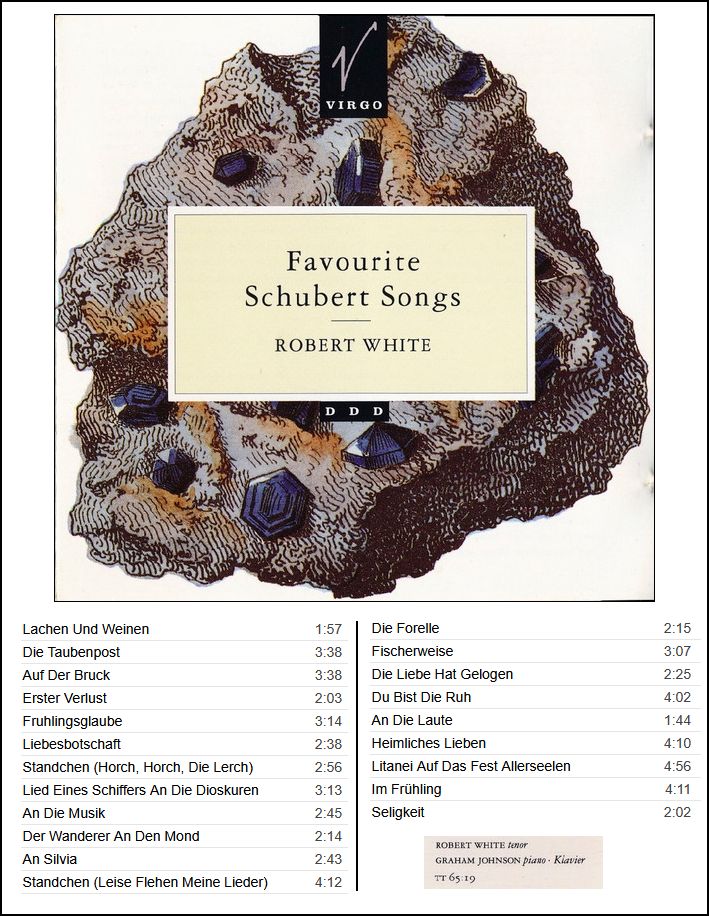
In the mid 1970s White returned to his roots as a performer of Irish songs, and achieved fame internationally as an 'Irish tenor,' drawing comparison to John McCormack; he even performed on programs for BBC television in honor of the late tenor. He continues to perform in concerts with a diverse repertoire ranging from Irish ballads to opera to contemporary art songs and works from the classical tenor canon. Several composers have written works specifically for him, including Mark Adamo, William Bolcom, John Corigliano, Lukas Foss, Stephen Hough, Libby Larsen, Lowell Liebermann, Gian Carlo Menotti, Tobias Picker, Ned Rorem, and David Del Tredici. He has made several recordings for RCA Victor Records, mainly of Irish songs and ballads, and has also recorded a diverse repertoire for Virgin Classics, EMI, and Hyperion. A former faculty member of Hunter College and the Manhattan School of Music, he currently teaches on the voice faculty of the Juilliard School. He also works periodically as an interviewer for the radio station WQXR-FM.

==  Names which are links in this box and below refer to my interviews elsewhere on my website.  BD  

Sadly, just as this webpage is being posted in March of 2026, we learn of the passing of this fine artist at age 89.  


In March of 1989, tenor Robert White was back in Chicago for a program at St. Patrick
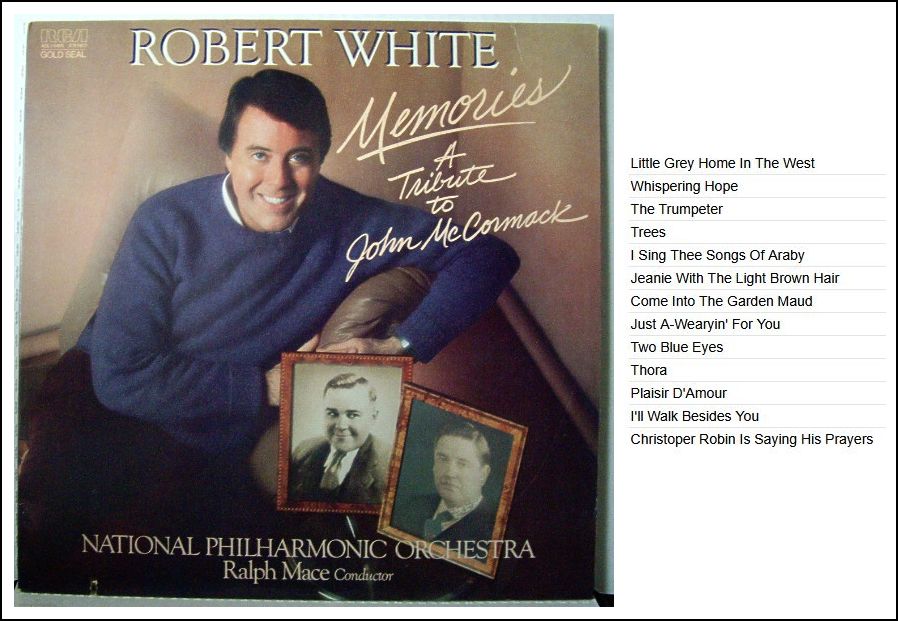
s Cathedral in Chicago.  He was most gracious to spend an hour with me for an interview, and the topics ranged from his work with the shade of John McCormack, to the then-current fashions of music and life.

Portions of the conversation were aired on WNIB, Classical 97, and now, as he approaches his 90th birthday, I am pleased to present the entire chat.

Since he was presenting his tribute to the famed Irish tenor, that is where we began . . . . .

white
Bruce Duffie:   Tell me the joys and sorrows of continuing the tradition of John McCormack!

Robert White:   [Laughs]  The joys are many, and the sorrow is that John has gone.  It’s a combination of just following my own career, and the fact that I’m Irish in the sense that my mother was born in Ireland.  I’ve never had to work very hard either to push or to avoid the Irish tag, or name, because it’s part of me.  Having grown up with McCormack’s glorious recordings, and the fact that my dad was a friend, it’s just been a natural thing.

BD:   Is this something though that fits your psyche?  You wouldn’t rather be a Wagnerian tenor?

White:   It’s a good question.  No, I think it fits my psyche.  I just want to be the tenor that I am, which happens to be a light lyric tenor, and I happen to be Irish.  John, with his glorious gifts, recorded and sang virtually everything that any tenor with any kind of voice would ever want to sing in the bathtub or on RCA Red Seal.  You can’t avoid it.  [Both laugh]

BD:   From this vast array of art songs, and ballads, and even arias, how do you decide for each program which bits and pieces you will select to sing?

White:   No one’s quite ever asked me that.  When I am alone, I ask myself that question every time I’m making up a program, and there’s no pat answer.  It’s something I do.  There’s input... what kind of an event it is, and if it is a series.  Is there a theme that’s wanted?  It’s what any artist does when they’re making up ‘a program’, and I find that the audiences love what I select.  In a regular concert situation of Lieder and things like that, I’m always asked if I would still do some of the Irish ballads, and I would never refuse.  Most of the time I’ll do them anyway without being asked, but if I’m asked, there’s no question.  They’re gorgeous.  They’re wonderful to sing, and what I love most about them is their effectiveness, or their seemingly endless ability to move people.  It’s not just what I do or don’t put into the program.  It’s the piece or pieces themselves, the straightforwardness of the lyrics, and the beauty of the musical line.  Then, of course, there is the shared memory that so many of them mean.  I did a program recently in San Diego, and one section was World War One songs.  This gave me ‘Roses of Picardy’...

BD:   ‘Over There
?

White:   Yes, ‘It’s a Long Way to Tipperary’, and others.  This was in the midst of a program that had Schubert and things like that.  [Pauses a moment]  I’m going to choke up right now!  When I got to ‘God Be With Our Boys Tonight’ and ‘It’s a Long Way to Tipperary’, and the audience started to join in, the larynx goes into spasm if you think of the feelings.  If I hear World War One songs, I think of my father.  That was his time, and he was over there in France and in Belgium singing those songs, as well as fighting.  They are terrific feelings for me.

BD:   You don’t find any political statement in singing some German Lieder and some World War One songs?

White:   No, no, just the politics of love, meaning the love of art.  [Both laugh]

BD:   You must study the songs before you perform them. How do you decide whether you will or will not spend the time on any particular song?

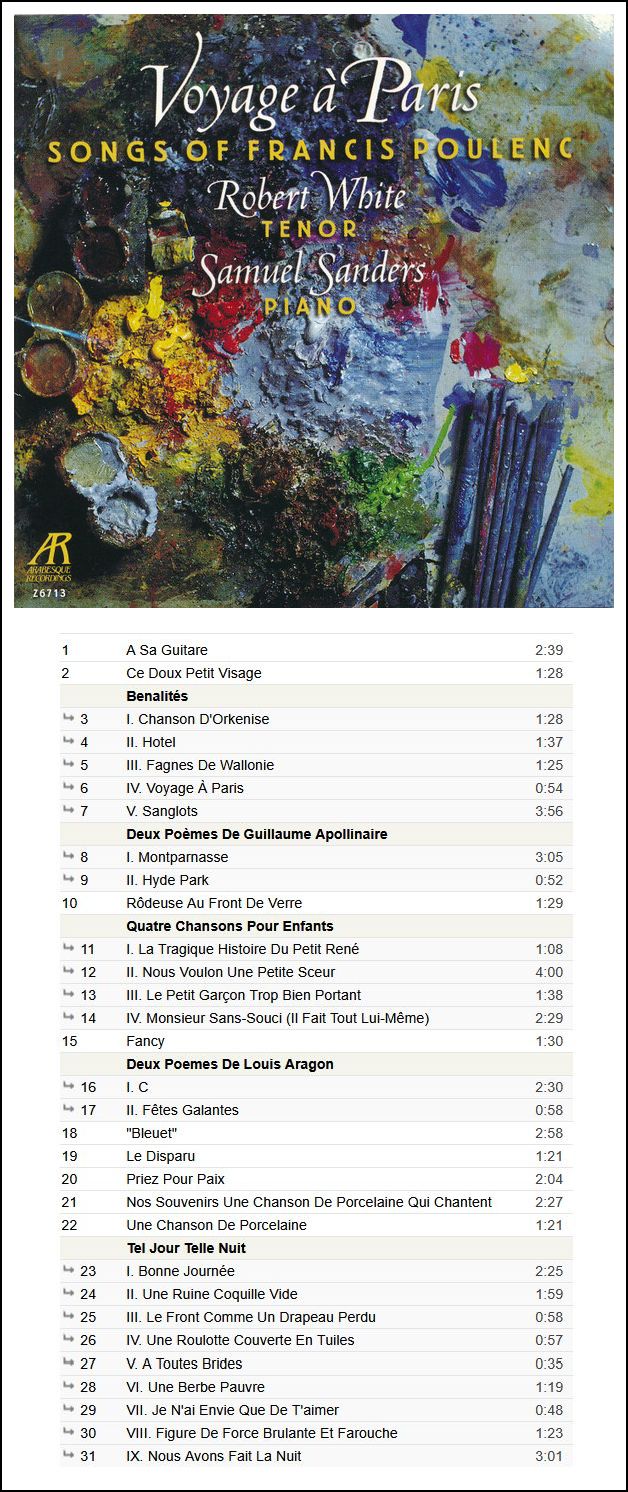
White:   If I love it!  If it hits me!  If it just does something!  It’s the same as a totally classical piece.  If I really like it, I find I get moved.  One group of pieces that I’m doing for St. Pat’s here in Chicago is made up of Rodgers and Hammerstein, as well as Kern, and Lerner and Loewe.  It’s just amazing when you really get into the great classical Broadway stuff.  Some of that stuff is just to die for!  It’s so beautiful.  I was rehearsing with Samuel Sanders in New York the other day for this particular concert, and when we were going though something as recent as ‘I Talked to the Trees’ from Paint Your Wagon, with that Biguine rhythm in it, we both said what a great piece this is!  What a great song!  The message is so clear, and the lyricism is there.  That’s what’s so often missing today in popular music, and has been up until recently pretty much at a premium in a lot of the contemporary classical music.  We need the idea of feelings, and people being touched in a common ground through musical terms.  This is what was pretty much left out.

BD:   What advice do you have for someone who wants to write new songs?

White:   Get in touch with feelings while they’re writing.  Don’t leave it totally cerebral.  It’s very hard to say what it is, but just think if you want to move people, or don’t you?  Do you want to share something with somebody, or don’t you?  Do you want to appear vulnerable, or don’t you?  Do you want to be moved by just the sheer beauty of music, or not?  I was passing a record store here in Chicago today, and the sound of the beating on the loudspeaker from within the store was so loud.  I wondered how that can attract somebody?  If I go in there, it’s like going into battle for my eardrums’ sake.  The sign said that classical music was on the top floor, and I wondered who was going to go in and pass through that gauntlet?  That part of the assault is like smoking on airplanes.  We used to scream about Muzak in elevators, and where did it go?  [Both laugh]  Now it’s like [demonstrates a rough sound] wherever you go... if they’re going to have music at all!

BD:   Does the public in general want it this loud, or are we getting a kinder, gentler public?

White:   Again, I don’t know.  I think that the public is being more than seduced.  They’re being beaten into accepting loud music for the sake of loud music, and their ears no longer tell them that it’s that loud.  Mind you, I have enjoyed rock music, and I still do.  I’m not trying to play the snob, because there is so much good rock which I’ve enjoyed it all my life.  There’s no question about it.  It’s just that when it hurts to hear it, I go crazy.  I’ve gone to rock concerts where even with good earplugs I literally had to leave.

BD:   It was painful?
 
White:   It was painful, and it scares the daylights out of me what it means to the ears.  To me, it’s as much of an assault on that part of the body as drugs are in some other ways.

BD:   In your concerts, do you try to attract any of the same crowd that will go to big loud rock concerts?

White:   I don’t try!  I wouldn’t know how to convince them, except that I do get a very broad range of people coming.
white
BD:   Young ones, too?

White:   Oh yes. In England, a lot of young kids come because they’re just as easily moved.  If I’ve been moved by something that was written fifty or a hundred years before, it is possible that they might be moved, too.

BD:   Do you take into account your audience while you’re performing?  Are you conscious of them?

White:   Yes and no.  I’m conscious of the fact that whatever I’m doing, I’m trying to please them on some level.  I’m trying to play to them, and let them know that this is something I like, and hope that the way I’m doing it is going to pass muster.  All of those things go through one’s head when you’re singing, but beyond that I don’t identify one audience as opposed to another.  I’ve never quite seen that.  I have just gotten warm or lukewarm audiences all my life, one way or the other.  It’s the luck of the draw.

BD:   Do you feed off of them during your performance?

White:   Sometimes.  If I’m talking, I do.  I don’t know where it comes from, but once I get going, if I’m in a particularly happy or flippant frame of mind, I can get them to laugh.  That’s rather nice, because then you can get into the most serious things again, and they’ll go along with you.

BD:   Do you adjust your technique at all for the size of the house you’re singing in?

White:   You use the same technique, but you have to adjust the use of that technique.  Some houses are cruel to you.  They don’t give you back anything to fine-tune with.  You don’t hear yourself.  There are some rooms that are resonant whether they’re small or large, and they give you a buzz around your own sound that you can then do a little bit there.  Then there are others you can sing to the cows come home, and you don’t know what the heck you’ve done.
 
BD:   [With a wink]  You don’t realize it when there’s great applause?

White:   You don’t realize it.  You just pray that it went alright.  My technique is one that I sing very much from feel, rather than real listening.  It’s a technical thing to know when it’s feeling right, and you know you’re balancing various and sundry muscle feelings, which your ear hears, and your mouth sets in the body.  If it’s going out, and you are feeling nothing in the larynx, then you’re home free.  That’s when the adjusting goes on, whether the room is kind to you right up there on the stage or not.

*     *     *     *     *

BD:   Do you work particularly hard at your diction, knowing that a lot of the songs you sing are in English?

White:   I’m a singer in Italian, and German, and French, too, believe me!  I work at my diction pretty much all the time.

BD:   [Gently pressing the point]  But do you work harder at the English ones?

White:   Not particularly, no.  I’ve been lucky to have a pretty decent automatic diction, but there are times when I’m taken to task, or brought up short, and people tell me they don’t know what the heck I’m saying there.  Then, I had better brighten that one up!  I find that in recording studios, too.  You think that every word is going to come through crystal clear because there’s a microphone, but it’s not always the case.  So you have to really make sure you’re getting certain things to sound, such as the ends or words, the Ts and the Ds.

BD:   The final consonants?

White:   The final consonants.  You think you’ve done it, and you listen, and it isn’t there.  Then what do you do?

BD:   Do you sing differently for the microphone than you do in the concert hall?

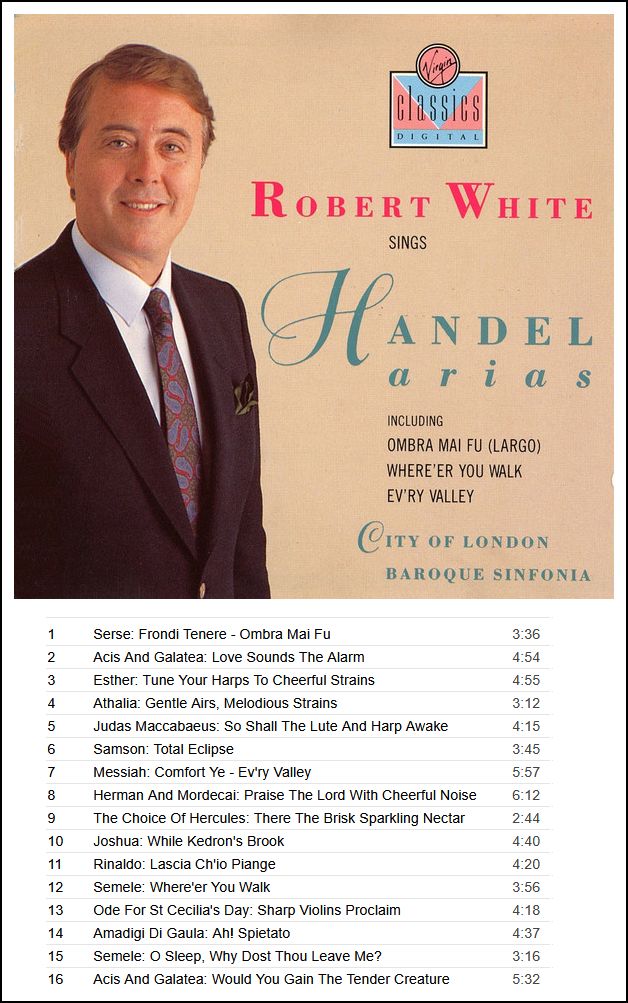
White:   I try not to, but again, that’s a very seductive medium.  It’s very funny...  At times, the microphone can let you get away with a certain easier delivery or technique, than when you’re in a bigger house.  Even so, the mike and the loudspeaker don’t lie.  I’m in the process right now of editing a Handel album that I just did with orchestra for Virgin, and it will be coming out in July.  Literally, as I got on the plane in New York to come here, I finished the last listening to what I consider the right editing.  Then I had a long conversation with my producer in London, to put our heads together.  This is the nicest way of working as an artist and a producer.  He really respects what I would hope would be an optimum situation throughout the record, and he uses that as a paradigm, and does his own work.  I acquiesce to him in most any situation that might arise, where there might be a problem with an orchestral moment, or he might really feel I could sound better in a certain spot.  I’ll usually go along with it, but it gives me the overall view.  For an artist, those recordings are the legacy not only when you’ve gone, but while you’re here, because I’m not singing in every nook and cranny of the world at any given moment.  You can only sing live in one place at a time.  [Laughs]  As a kid, if we were good, the nuns asked us which saint would we be?  I said there’s only one saint that had one of those gifts that’s really a winner.  His name was St. Martin De Porres (1579-1639) from Lima.  He had the gift of bilocation, meaning that he could be in two places at once.  I kind of thought that would be really nifty!

BD:   Do you feel that you are in many places with your recordings having been distributed everywhere?

White:   With the recordings, unquestionably.  I get mail from all over the world, and that’s really very thrilling.  One friend was on a ship in Norway going up towards the North Pole.  They were sitting having their morning coffee, and she said she heard my voice over the wireless!  [Both laugh]

BD:   That’s a very World War One-ish turn of phrase!

White:   Yes, it is.  [More laughter]

BD:   Do you ever feel that you’re competing against your recordings when you’re singing the same material on a concert?

White:   Again, yes and no because I find that when I’ve made the recording and then listened, and at first I think it’s the best thing since forever.  Yes, that’s the bee’s knees!  [Again, both laugh]  Then I start listening with another set of ears and I don’t like it!   A month later I don’t like what I recorded, and I get angry.  I think it could be better.  Sometimes that helps me to sing something even better in public.  I first thought what I heard was so terrific, and then I start working on it again, and something feels easier.  Then, I’d like to record that one again, but you don’t get that chance too often.

BD:   Have you re-recorded anything?

White:   Yes, I have.  On my new Princess Grace album, there are a few pieces, including ‘Danny Boy’, that I had recorded about eight or nine years ago.  There’s always a cut-off of five years.  You’re not allowed to record the same material for any given recording contract for five years after you’ve signed the contract, which protects the record company.  So, I was thrilled to get another crack at ‘Danny Boy’.    

BD:   What are you going to do when someone comes up to you and says they’re doing a doctoral dissertation on your various performances and recordings of ‘Danny Boy’ and how you’ve changed along the way?

White:   [Laughs]  If someone is doing a doctoral dissertation, they had better get a nurse for when they listen to that many ways of singing ‘Danny Boy’.  I never thought that I might be the subject of a doctoral dissertation.  My own master’s degree is as far as I ever got.  [More laughter]

BD:   Do you feel that you’re defending your own doctoral thesis every time you sing?

White:   No!  No, no, no!  I love singing, and it’s all pretty much part of the present whenever I do it.  If it goes on to a recording, I know that that’ll be around a long time, and that gives me great pleasure.

*     *     *     *     *

BD:   Do you sing any opera anymore?

White:   Yes, I’m going to be doing The Impresario of Mozart at the Metropolitan Museum of Art.
white
BD:   Would you ever sing at the Metropolitan Opera?  It’s such a huge house...

White:   No!  It’s not my métier.  I have no delusions about that.  It’s not important for me.  Of course, it would be wonderful if I sang at the Met, and had a voice for that.  I look at someone like Hugues Cuénod.  My God!  There’s a man who was 84 last year, and he brought down the house.  I was there at the opening night two years ago when he did the Emperor in Turandot.  I was sitting in a box at the Met with Alice Tully, who is a great friend of Hugues.  They’re virtually the same age, and I thought this is simply astounding.  Alice turned to me and said,
Bobby, you still have a chance, meaning to sing at the Met!  [Laughs]  I’ve got quite a few years before I hit 84, so I’m not going to worry about it!

BD:   Do you like singing in places like the Metropolitan Museum of Art?

White:   They have a very lovely auditorium, the Grace Rainey Rogers.  It was a choice of either that or the Egyptian Tomb Exhibit, so I chose the Grace Rainey Rogers.  [Laughs, then muses for a moment]  I remember as a kid hearing Noah Greenberg from the New York Pro Musica.  In some places, the thing that I remember is that it had a lovely sound, a lovely acoustic.  If a place makes you feel good singing, that sticks with you.  It’s like strings to a violin.  Good wood will take your sound with it.

BD:   Do you have any special routine before you sing?

White:   No.  I just try to get my rest.  I try not to have used the voice inordinately.  I have a thermos with hot water and honey, which I sip, and that keeps me warm and moist at the throat.  The honey supposedly goes into the blood stream with a little energy in it.  I find that great, and then in between sets I can step out and take a little swig of that.  That really helps just keep everything moist and going, because there are just two little muscles in there
the vocal cordsdoing some pretty fantastic work for you.  So you got to treat them nicely.

BD:   Do you feel that you’re an athlete always in training?

White:   Absolutely!  I give that idea to my students.  I teach at the Manhattan School of Music in New York, and there are some lovely voices there.  It’s interesting for the kids, especially because they’re all so young, and everything works when they want it to.  They seem to think that they can be supermen and superwomen as far as the voice box goes.  With some of them I’ve had a decent success in sharing the idea that it is a hardy instrument, but they shouldn’t take it for granted, and they shouldn’t do things that are counterproductive.  Certainly, you don’t smoke.  After singing a lot, you don’t run out into the cold night air and start talking in the street.  Keep your mouth shut, so that you don’t get a Charley Horse in the larynx!  It’s got to be supple.

BD:   Are you pleased with the young voices that you hear coming along?

White:   Yes, absolutely, and they know a lot.  Some people ask if you knew up front all the pitfalls and frustrations, would you let them do it?  Well, you get that in any field.  I’ve seen a lot of frustrated lawyers, and bankers, and clothiers trying to find their way in life.  It doesn’t come down a gangplank to you. You’ve got to keep reconnoitering!

BD:   Let me ask the proverbial talk-show question.  If you were not singing, what would you be doing?

White:   I’d be on Madison Avenue making advertising campaigns, and wordplays.  I love that, and selling things. That’s really exciting.

BD:   Do you feel that every time you sing, you’re selling the song?

White:   Sure, because every song is a little universe in itself, and you want to make that look nice.  You’ve put it in a nice setting, and the setting is good sound, and good interpretation.

BD:   Are you selling more than just the tune?

White:   I’m selling feelings, and I’ll give them just as well as sell them.

BD:   Is singing fun?

White:   Yes, sure!  Last week I did two performances of the Benjamin Britten Serenade for Tenor, Horn and Strings, and they sent me the tape of it.  Then the fun was all of a sudden to sit back and listen, because it’s really like walking a tightrope.  I know how Philippe Petit must have felt like when he walked on that wire between the World Trade Center.  You feel that in the performing of a work.  Later, with the tape, I came back and was able to listen.  I knew I wasn’t going to fall off the wire, and all of a sudden the fun was to listen almost as if it was someone else.  I could just really listen to the music and the words, and to what Benjamin Britten was doing.  That was a gas.  I find that people are just as movable with show tunes, or ballads, or folk songs, or pieces by Hugo Wolf.  If they don’t happen to speak the language, or even if they’re not particularly interested in a certain kind of music, or a composer, or a period, if you’re just patient for a few minutes, and you can talk about what it is, and then do it, any of them can really rise to the occasion.  Much of the time they get the message!  [Sighs]  But there are people who don’t like La Bohème.  They are idiots, and you can’t move them!  [Both laugh]  I just get so overwhelmed if the music is beautiful and if it’s well done.  There’s just no way to explain the feelings I get at Parsifal, or Die Walküre, or anything.  I go crazy!  Listening to Monteverdi is the same thing, and an Irving Berlin song will just drive me up the wall.  The other night I was watching cable TV, and they did an hour-and-a-half tribute to Irving Berlin.  I was just blown away.  I thought I knew what he wrote, and then after about two dozen mind-boggling hits being done or talked about, more would come.  All of that stuff came from that one man’s mind.  They also showed street scenes where he grew up.  He was running around the streets of the lower east side, where my own dad was born, and then you realize he’s still here!  He’s still with us through all these eras.  This extraordinary genius with his lyrical gift... that’s Irving Berlin.  It’s just unbelievable.  Just those simple songs...  [Sings a bit of one]  Just like a melody that lingers on, it seems to haunt me night and day!  I don’t know why, but to me that’s just like a little art song.  It’s wonderful!

*     *     *     *     *

BD:   When you do a program with piano, do you feel you are more in control than when you’re doing one with a chamber group, or even full orchestra?


white

See my interviews with William Schuman, Virgil Thomson, and Eric Ewazen


White:   Oh, sure.  If I’m performing with Samuel Sanders, then it’s perfect, because he’s everything in a sense that no matter what you do, you can become Agogics Incorporated.  [
Agogics is the musical theory that rhetorical emphasis involves not only dynamic stress but also the emphasis implied in the greater relative length of the tones to be emphasized... the quantitative aspect of musical nuances involving all variations from the rigid basic meter (as of retard, pause, accelerando)... similar to rubato.]   He’s right there with you, and it’s just terrific.  With an orchestra, there’s all the other things.  You can’t be quite as nonchalant about where you’re going.  On the other hand, you have that vast palette of colors to play with.  I love it when the cellos come in under you, or the flutes are doing something special.  I’ve just recorded, ‘There the Brisk Sparkling Nectar’ from The Choice of Hercules, and the horns are playing away with that wonderful kind of tongue-in-cheek nobility marshal way.  Handel wanted to do that like nobody else, and it’s just such a great color.  What a privilege it is to be able to become part of that.  I remember reading Janet Baker’s book Full Circle, and she said the music is bigger than all of us.  We serve the music.  That’s true, but then again, all the music is in all of us, so it’s something from within.  The music not just something out there.  It is us!

BD:   Do you still study constantly, refining and broadening your technique, and adding repertoire?

White:   Always repertoire and technique.  It’s important to have another set of ears outside.  He will say that a particular bit sounds lousy, or something else sounds good.  To me that is important, and then you keep using that input as you go on with your own work.

BD:   Do you like the life of a wandering minstrel?

White:   [Sings a bit of
A Wandring Minstrel I, from The Mikado]  Yes, I like it when I can take time off like I’m going to do next week after I get finished in California.  I’m going for a week to Nassau, and I can’t wait because then I go crazy again.  So, I’m just going to put my feet up.  I really want to do that.

BD:   Do you make sure you tell your agent to block out certain areas of time so that you get some rest?

White:   Yes... no concerts at four in the morning!  [Both laugh]  No, it’s important.  [Pauses a moment]  I wanted to say something else about the musical idea...

BD:   Please do!
white
White:   It’s the listening to music.  That to me is so extraordinary.  It has nothing to do with voice or vocal music, which I love too, but just music-music.  I could stay for hours listening to Bach on an organ, for instance.  [Remembering that BD had mentioned having studied bassoon as a youngster...]  One of my first records was Leonard Sharrow playing the Mozart Bassoon Concerto with Toscanini.  [Sharrow was a founding member of the NBC Symphony, and later principal bassoon with the Chicago Symphony 1951-64.]  I remember my first multi-record sets where I splurged as a kid.  Helmut Walcha, the blind organist, doing the Bach ‘Preludes and Fugues’, and Sylvia Marlowe and Julius Baker doing Bach Flute Sonatas.  [Pauses again]  Here I am trumpeting that I like music!  Isn’t that great?  But I really do!  The thing that burns me up is the pigeon-holing by every part of the industry, as far as the public’s taste and their ability to refine and open and expand and feed that taste in music.  You can’t do this because that’s not the audience.  This radio station only caters to this thing, and classical is only classical.  That is such nonsense.  In our parents’ generation, in America at least, you had a broader scope.  People listened to The Bell Telephone Hour, and all the rest of those kinds of shows.  Everyone, man, woman, boy, girl, was listening to all kinds of music, classical and otherwise, and could enjoy it.  But now, they won’t listen to something with just a guitar.  It’s insanity, and yet all of it should be out there for us.

BD:   Is there any hope?

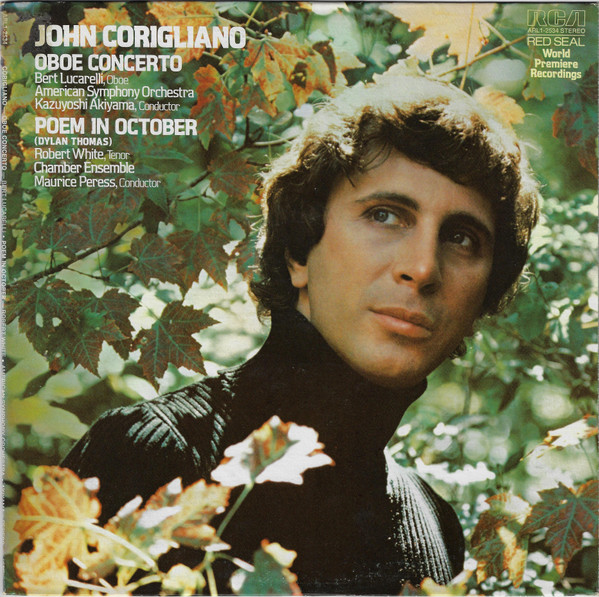
White:   Well, sure! [Both laugh] I mean, it’s going to keep going no matter what.  I just like to gripe once in awhile.  [He then laments smoking on airplanes (which was allowed back then), and both laugh.  We then tended to a few technical details, and I asked his birthdate.]  I share a birthday with Dylan Thomas.  We were talking about John Corigliano, who is the composer-in-residence here.  His beautiful piece that I recorded, ‘The Poem in October’, was written by Dylan Thomas.  I have the same birthday, so someday on my birthday I’ll do that piece.  
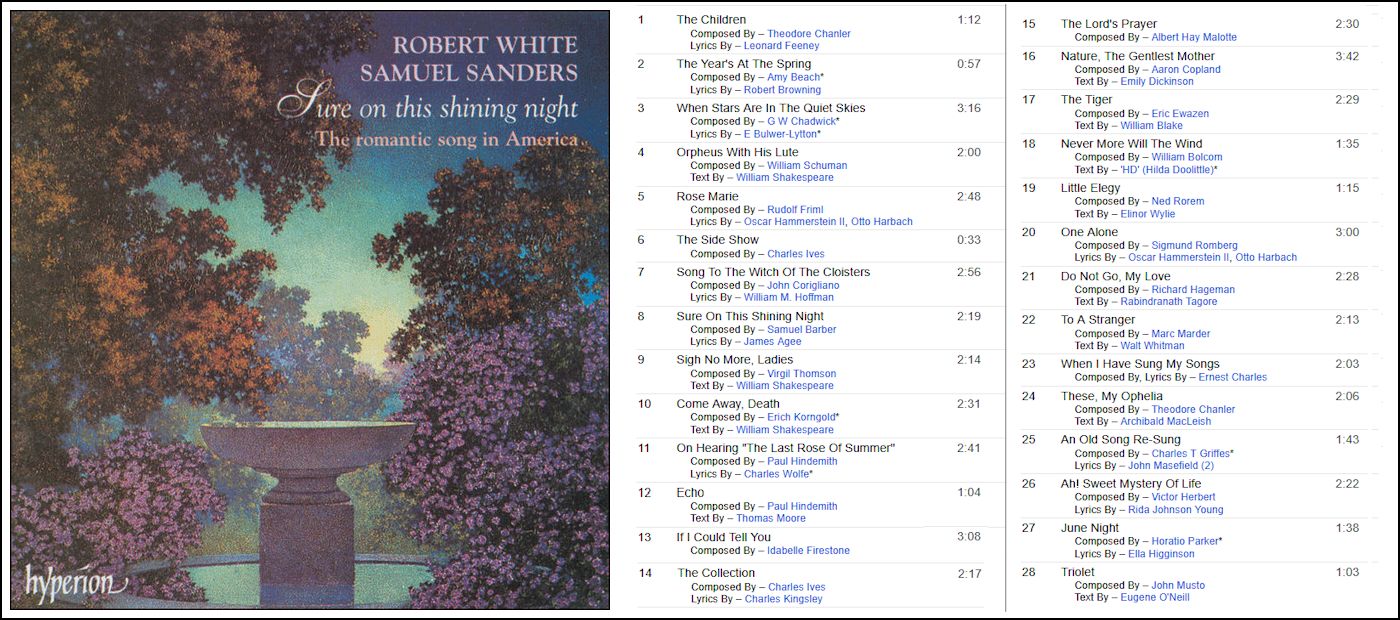
[Vis-à-vis the LP shown at left, on the CD re-issue, White also sings Coriglianos Three Irish Folk Song Settings.]  Helmut Walcha is also on my birthday.  There’s a wonderful book of musicians’ birthdays that Boosey & Hawkes puts out in London, and they got me in it!  Also, Dominick Argento!

BD:   Some of these composers are in my mind just because I’ve done 50th, or 60th, or 65th birthday shows for them.  I did a 75th birthday show for Hugo Weisgall!

White:   Really?  Wow!  Nice man.  He was down in Santa Fe, if I remember.

BD:   I wish you lots of continued success and hope that you will come back to Chicago.

White:   Thank you. That would be a great pleasure.  I love Chicago.  This city is so sensational.  First of all it’s absolutely delicious on the eyeball.  The buildings are just spectacular.  It’s so vibrant.  It doesn’t take its hat off to anyone.  You really see what you get here.  You really feel that it’s all of a piece.  It’s like what London and New York and a few other places are.  You have the whole thing happening here within its own terms, and so for me it’s like an adventure, and the people are basically very nice.  In Chicago, I really want to go out and feel the whole place.

BD:   Do you like singing in little bitty towns?

White:   Yes.  I’ve sung in little bitty towns in England and Ireland and Scotland, and after about two hours, which is just about the concert time, I do wish to get back to London.  I’m not a country person.  I really am a city person, and that’s why Chicago turns me on.

BD:   Good!  Thank you so much.

White:   Thank you!  I had a lot of fun.

= = = = = = = =                 = = = = = = = =                 = = = = = = = =
-----                -----                -----
= = = = = = = =                 = = = = = = = =                 = = = = = = = =


© 1989 Bruce Duffie

This conversation was recorded in Chicago on March 10, 1989.  Portions were broadcast on WNIB in 1996.  This transcription was made in 2026, and posted on this website at that time.  My thanks to British soprano Una Barry for her help in preparing this website presentation.

To see a full list (with links) of interviews which have been transcribed and posted on this website, click here.  To read my thoughts on editing these interviews for print, as well as a few other interesting observations, click here.

*     *     *     *     *

Award - winning broadcaster Bruce Duffie was with WNIB, Classical 97 in Chicago from 1975 until its final moment as a classical station in February of 2001.  His interviews have also appeared in various magazines and journals since 1980, and he continued his broadcast series on WNUR-FM, as well as on Contemporary Classical Internet Radio.

You are invited to visit his website for more information about his work, including selected transcripts of other interviews, plus a full list of his guests.  He would also like to call your attention to the photos and information about his grandfather, who was a pioneer in the automotive field more than a century ago.  You may also send him E-Mail with comments, questions and suggestions.