Bass  Carlo  Colombara

A Conversation with Bruce Duffie


colombara


Bass Carlo Colombara was born in Bologna on August 7, 1964. He began his training at age twelve with piano lessons and began singing from age fifteen, studying with Paride Venturi in Bologna. In 1986, he won the prize for the best Italian singer in the G.B. Viotti competition, and the following year he won the As.Li.Co. competition in Milan.

He then made his professional début as Silva in Giuseppe Verdi's Ernani at the Teatro dell'Opera di Roma (Rome, Italy).

He has sung in the most important theaters in the world, including the Wiener Staatsoper, Metropolitan Opera of New York City, Teatro Colón de Buenos Aires, Opéra Bastille in Paris, Covent Garden in London, Arena di Verona, Maggio Musicale Fiorentino and many others.

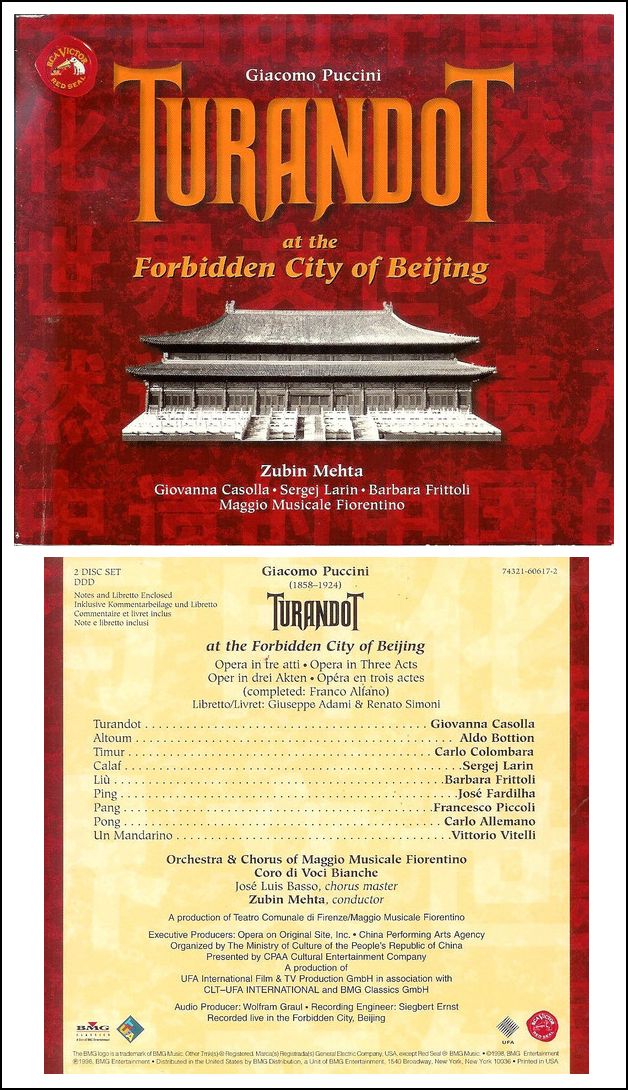
He collaborated with many important conductors, including Riccardo Chailly, Myung-Whun Chung, Colin Davis, Gianandrea Gavazzeni, Carlo Maria Giulini, Eliahu Inbal, Lorin Maazel, Riccardo Muti, Antonio Pappano, Michel Plasson, Georges Prêtre, Wolfgang Sawallisch, Philippe Auguin, Giuseppe Sinopoli, and Georg Solti. With Zubin Mehta, he performed in an open-air production of Giacomo Puccini's Turandot in the Forbidden City, (Beijing, China), which was recorded and broadcast worldwide.
colombara

In recent years, he débuted in the roles of Mefistofele of Arrigo Boito, Escamillo in Carmen, Don Pasquale, the four bass roles in Les contes d'Hoffmann and Don Giovanni. In 2012, he débuted in the role of Scarpia in Puccini's Tosca in Prague and Parma. In 2013 Verdi's bicentenary, he interpreted the Messa da Requiem with the Boston Symphony Orchestra in Boston, at the Southbank Centre for the Royal Festival Hall in London and at the Savonlinna Opera Festival.

In 2014, he débuted in the new work of Kolonovits El Juez with José Carreras at the Teatro Arriaga in Bilbao. He also performed in Simon Boccanegra in Piacenza and Modena, and in celebrations of the great Bulgarian bass Boris Christoff at the Theatre of Sofia; in three productions (Aida, Nabucco, Don Carlo) and Verdi's Requiem under the direction of Antonio Pappano in Birmingham and London.

In 2015, he sang Aida, La Bohéme and Verdi's Messa da Requiem in Teatro alla Scala di Milano with Zubin Mehta, Aida in Arena di Verona, Maria Stuarda in Paris, Messa da Requiem in Gasteig, Munich and in Prague, and in the big concert in memory of Elena Obraztsova in the Bolshoi Theater in Moscow, the only Italian artist invited to sing. In the 2016, season he sang in Rigoletto at La Scala in Milano, Oroveso in Norma at the Teatro San Carlo in Napoli and Aida in Moscow in a concert with Zubin Mehta, Nabucco, Macbeth in Brussels, Faust in Zagreb and the debut in Boris Godunov in Bulgaria. In December of 2017, after the successes in Modena (Attila) in Montecarlo (Simon Boccanegra) and at the Teatro alla Scala in Milan (Anna Bolena and La Bohème) he was awarded the International Opera Award - Oscar della Lirica as best bass of the year during an important tour in China.

In the year 2018 he sang at the Teatro alla Scala in Milan (Aïda) then Don Giovanni at the Opera of Belgrade and at the Roman Opera of Craiova, Count Walter at the Staatsoper in Hamburg in Luisa Miller and the role of Raimondo in Lucia di Lammermoor at the Seoul Opera Art in Korea.

In addition to the operatic side, Colombara undertook an intense activity as a concert performer, singing many different times Verdi's Messa da Requiem in cities such as Florence, Rome, London, Naples, Paris and Modena − the latter in memory of Luciano Pavarotti, with whom he appeared in the last Requiem performed by Pavarotti.

== Names which are links in this box and below refer to my interviews elsewhere on my website.  BD  


colombara


Early in 1997, bass Carlo Colombara appeared with Lyric Opera of Chicago in their production of Norma.  Also in the cast were June Anderson, Robynne Redmon, and Richard Margison, with Carlo Rizzi conducting, and Colin Graham directing the production designed by John Conklin.

Toward the end of the run of ten performances, Colombara graciously agreed to sit down with me for a conversation.  He was forthright in his ideas and opinions as we spoke of his portrayals.  
My sincere thanks to Marina Vecci, Production Administrator for Lyric Opera, for providing the translation during our meeting.

Portions of the chat were aired on WNIB, Classical 97 in Chicago, and now, nearly thirty years later, I am pleased to present the entire encounter on this webpage.

Noting that some roles for the bass can be long, while others just have one aria . . . . .


Bruce Duffie:   Do you prepare differently when the role is of short duration?

Carlo Colombara:   Absolutely not.  First of all I must study the opera.  That is different, because a shorter role has different needs than a longer role.  But when I go onto the stage, it requires the same emotional investment.

BD:   Even though you have only a few lines to bring forth the entire character?

Colombara:   [Laughs]  I’ve never done such a short role!

BD:   Do you like playing fathers, priests and kings?

Colombara:   By now I’ve gotten used to sharing my life with these older roles and people.  Naturally, it is far more complicated, because for a young man to interpret the roles of older characters, this goes against nature.

BD:   Do you look to your father, or to other father-figures for inspiration?

Colombara:   No, my father is a very youthful person, so I couldn’t take inspiration from him.  In opera, this inspiration comes out of the music and text, which gives you all the indications to get deep into the character.

BD:   When many of these parts were written, did they put too much age on the older characters?

Colombara:   That depends on the opera.  For example, in the case of Philip II in Verdi’s Don Carlos, he is too old.  In history, he was only thirty-five.  Timur in Puccini’s Turandot is the same way.  It’s incredible that he should be ninety years old when he is the father of Calaf, who is supposed to be very young, even though one would wish for Timur to live long into his nineties.  Perhaps Timur has led an active life.  [Both laugh]  The same is true of Oroveso in Bellini’s Norma.  He’s usually portrayed as very, very old, but he’s Norma’s father, so he couldn’t be that old.

BD:   But is it right, now in the 1990s, to portray such an old man, when we now have more youthful elderly?

Colombara:   That is right, because opera was born as a typical art in itself, and it only obeys its own rules.  This is also the case with literature and painting, so we don’t need to update those as we do with opera.  In my opinion, the only way to make opera live well into and beyond the year 2000 is not to exaggerate by updating it, or by adapting it to the times.  I’m afraid that we would get to the point where we would update and modernize opera, and take it out of its time so much that we would then have nothing left to the imagination, and this would mean that opera would end up dead.  It is up to the theaters and the stage directors to be able to find new ideas and new imaginative ways of staging operas, yet remain within the tradition and the context of the libretto and the musical style.  We can be innovative, but yet present something that makes sense.

BD:   Are you optimistic about the future of opera?

Colombara:   Sometimes yes and sometimes no!  [Both laugh]  I’m afraid that in those theaters which are very fond of taking characters out of their times and places where they belong, and just updating things without any regard that they might not make sense, the audience would get used to that, and would soon tire of it all, and would choose to go to the cinema, for which I wouldn’t blame them.

BD:   [With mild trepidation]  I hope there are more times you feel yes than no.

Colombara:   Yes, yes, because this is true especially in Germany, where they have reached limits beyond which I don’t see how they could go further.  You just can’t go beyond certain points, so things would have to get back to normal.

*     *     *     *     *
colombara
BD:   From the admittedly limited selection of roles that you have at your disposal, how do you decide which ones you will sing, and which roles you will turn down?

Colombara:   When I’m offered a very important role, something that will commit all my energy, it’s true that I have to try and think about it a lot.  This was true for Attila, and for Nabucco when I did it in La Scala, Milan, and also for Philip II, which I will debut in Bologna next year.  But I also have had the courage to say no to seven productions of Nabucco, which were very tempting, because I was only twenty-three years old when I was first offered that role.  I had finally made my debut in it when I was thirty years old, and if I’m in good vocal health, I owe this all to saying no to some of those roles which were too soon in my career.

BD:   What kind of a bass voice do you have?  Is it a basso cantante, a basso profundo, or is it difficult to put a label on it?

Colombara:   No, I do believe it is good to start putting back those labels again on voices, because of the big confusion which has happened.  Many sopranos who have the high notes have come back or changed into mezzo soprano, and there are many, many more examples of this type of which I’m sure you’re very aware.  I’m a basso cantabile with a typical Italian voice.  I do more Donizetti and Verdi roles, even though I’ve been asked to sing Mozart many times.

BD:   Do you like fitting into that category?

Colombara:   In my opinion, this is not a label or a category.  It’s really as I am, and what my voice is like.  Rather than singing roles that are not congenial to me, and then hear from the critics that I went outside my range, it’s much better to be like Alfredo Kraus.  He did a certain number of roles all his life, and then remained vocally intact after all those years.

BD:   So, you’re looking for the long career?

Colombara:   I’m looking for career that is well thought out, and is right for me, but without stealing anything, and without giving too much.

BD:   Do you like the characters that your voice category imposes on you?

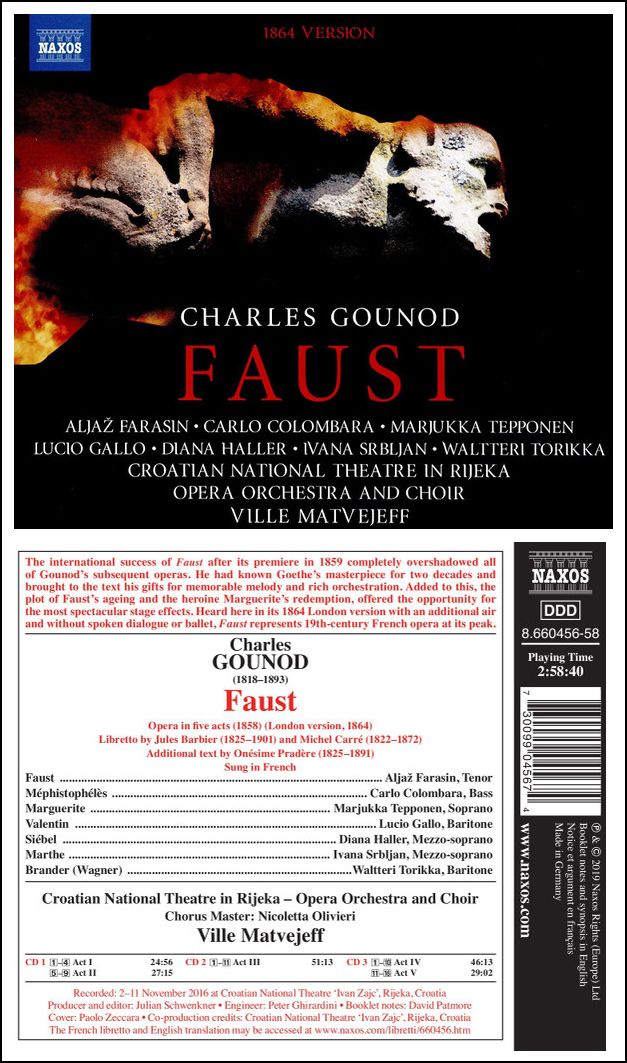
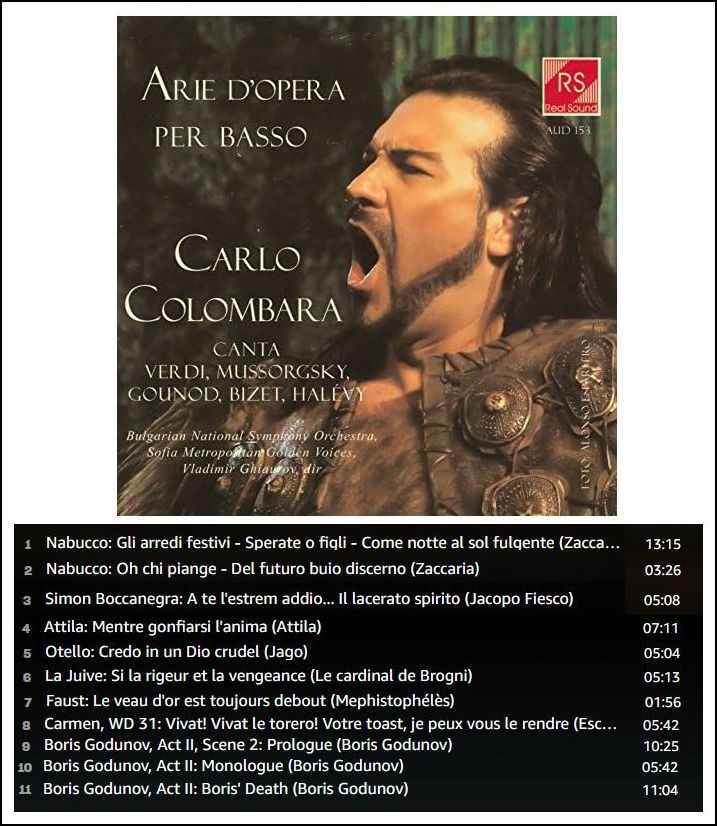
Colombara:   I like some of those very much, like Méphistophélès in Faust, Philip II, and Verdi’s Attila.  Some others I like less, and I’m trying to eliminate those gradually from my repertoire.  [Vis-à-vis the recording shown at right, see my interview with Lucio Gallo.]

BD:   Would you rather be a tenor, so you would sometimes get the girl?

Colombara:   Never!  [Much laughter]  It’s too easy to get the girl on the stage.  Everything has already been written out, so you know you’ll get her!

BD:   [With a wink]  Perhaps we should have operas written where the audience makes the decision at the end.

Colombara:   There is a sitcom in which people have decided.  They goad the audience, and ask them to vote on which ending to use.  Maybe that’s the same way they should do operas [laughs] or have them written that way.

BD:   We won’t tell producers of nineteenth century operas, or that they will incorporate that!  [Much laughter]

BD:   Of the characters you like to portray, is there any that is perhaps too close to the real Carlo Colombara?

Colombara:   Hmmm...  I didn’t quite expect this question!  I’m only thirty-two years old, and it’s a bit tough given the age of the characters that I portray.  All the characters I do are older, so it’s harder to find someone who’s really close to me.  This is really the effort that I put myself through every time, trying to interpret them well in spite of the fact that they’re not like me at all.

BD:   Is it possible for you to sing a role that fits your voice beautifully, but doesn’t fit your psyche?

Colombara:   Luckily the reverse is easier.  There are lots of characters that are not at all congenial to me psychologically, but they don’t fit my voice at all.

BD:   You
re able to keep those together?

Colombara:   Right!

*     *     *     *     *

BD:   Do you change your vocal technique at all for the size of the house, if you are in a large house or a smaller house?

Colombara:   My vocal technique is the only thing that I never change.  To change one’s vocal technique is the worst mistake one could make.  Every technique is individual, but I wouldn’t change it just for the size of the house.  It would damage the voice.

BD:   Do you change your technique at all for the microphone in recordings?

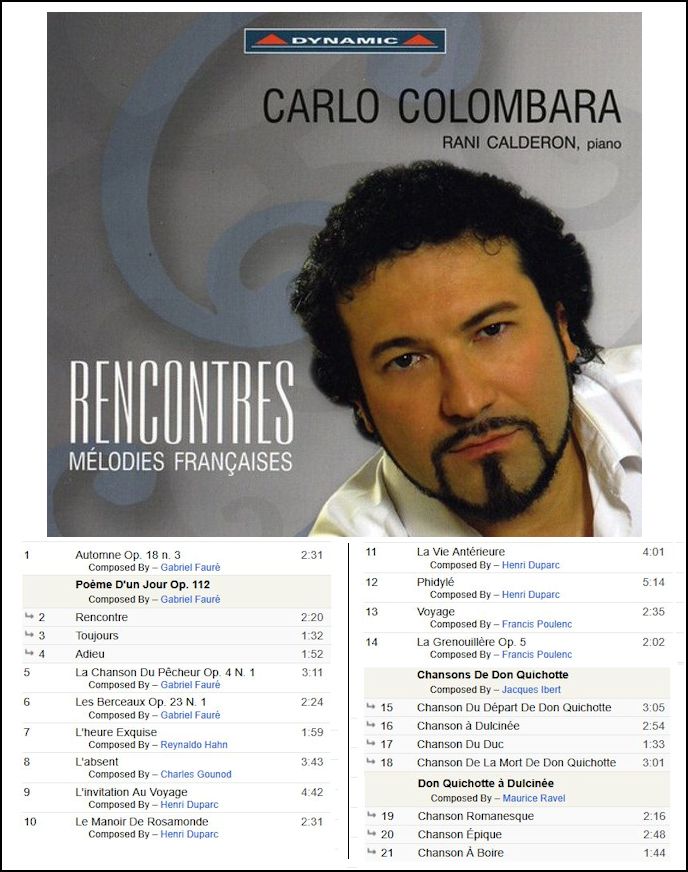
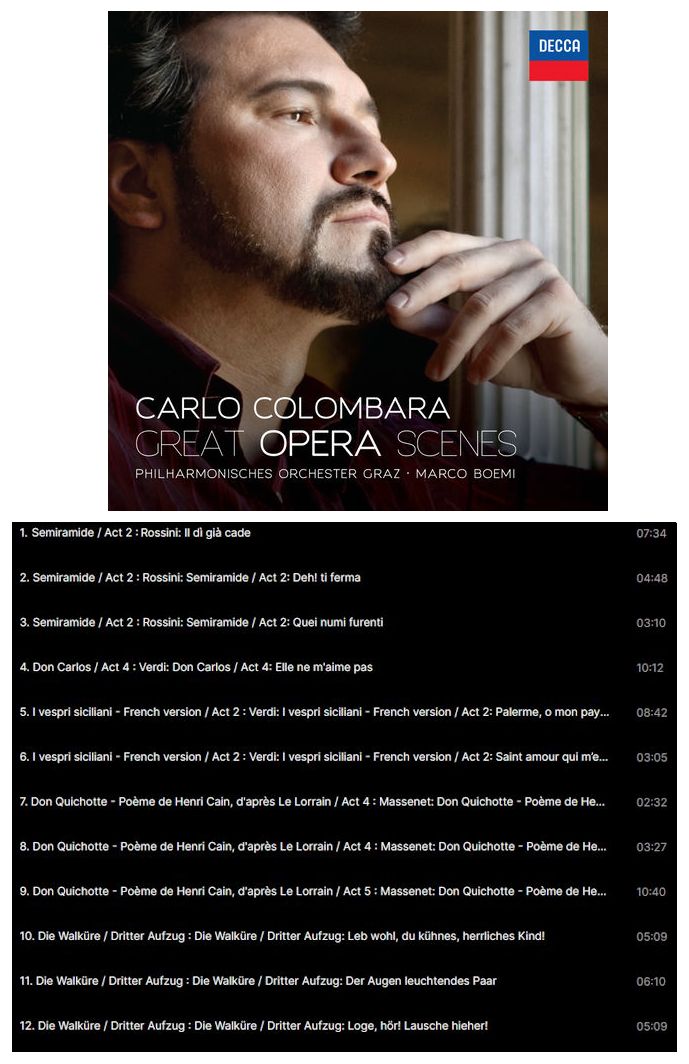
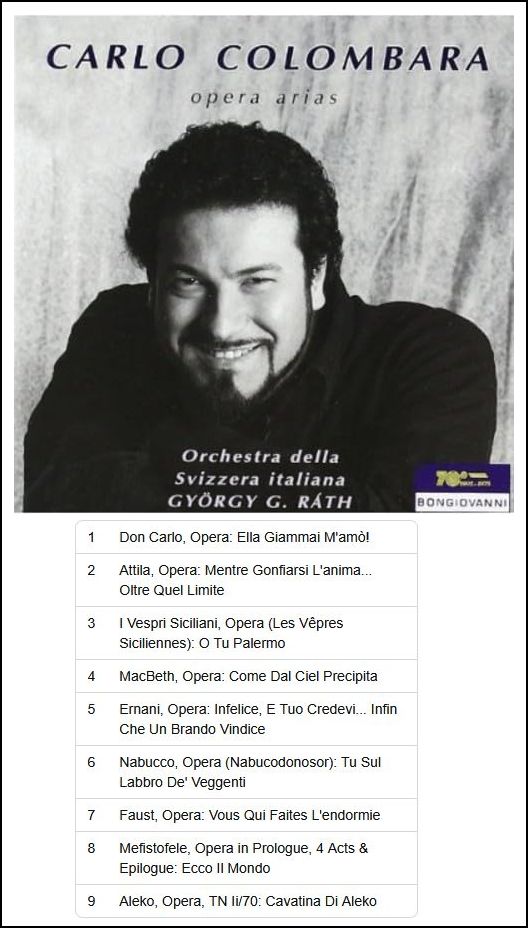
Colombara:   No, technique cannot be changed.  I certainly don’t ever change my technique for that.  Maybe the volume changes for recording purposes, and that depends on what it is.  I’ve just finished doing another recording of the Verdi Requiem, and after listening to the first recording, one understands fully how sensitive the microphone is.  One understands whether one should sing with more timbre, or more loudly or less loudly, but that is always with the same technique.  [We then spoke briefly of the recordings he had made thus far, and some of the covers are used as illustrations on this webpage.]
colombara
BD:   Are you pleased with the recordings that you have made?

Colombara:   I would like to do them now instead of before!  My voice has changed a lot, so they would be different.  For instance, the second Verdi Requiem is very different from the first one, and my voice has matured and become much darker.  It’s a different sound and quality.  However, I like the first one that I did very much, and there are many things that I still like a lot about it.  [
He would eventually record the Verdi Requiem four times, conducted by Colin Davis, Pier Giorgio Morandi, Yuri Temirkanov, and Helmuth Rilling.]

BD:   That’s good, but I’m glad you like the progress you’re making.

Colombara:   Yes, absolutely.

BD:   How long does it take you to prepare a new role?

Colombara:   [Thinks a moment]  It depends on the role.  I think about it for about six months, and then take maybe another six months to study it seriously.  The most important time is the first six months, the thinking part, realizing you can do it, and realizing how you can do it well.  When you’re sure of that, then you overcome any problems one at a time.

BD:   Do you ever solve all the problems?

Colombara:   So far, I’ve only chosen roles in which I have been able to solve all the problems.  [Much laughter]

BD:   Is there such a thing as a perfect performance?

Colombara:   Thank God, they do exist!  Maybe
perfect is not the right word, but many times I’ve been involved in beautiful performances which I remember with great fondness and pleasure.

BD:   I hope those are many.

Colombara:   [With a broad grin]  Thank you.

*     *     *     *     *

BD:   Did Verdi write particularly well for the bass voice?

Colombara:   I think that Verdi wrote particularly well for all the voices.

BD:   Why?

Colombara:   Because he was already later than Donizetti and Bellini, so he learned all of that, and he hadn’t reached the verismo style yet.  He had many scruples and took great care and attention for the singers.  He’s the greatest employer for the bass voice.  [More laughter]

BD:   Without mentioning any names, are there composers today who are writing well for the bass voice?

Colombara:   I don’t know any.

BD:   You don’t sing any modern roles?

Colombara:   The most modern composer I have sung is Stravinsky.  The way I like it, or the way I think of good modern music has gone into the musicals more than in opera.  I’m not tremendously fond of contemporary opera.

BD:   Would you ever sing musicals?

Colombara:   If I knew the English language well, I would.

BD:   They won’t do musicals at La Scala?

Colombara:   No, no, not yet unfortunately.  I like musicals very much.

BD:   Do they do musicals in other theaters in Italy?

Colombara:   Yes, perhaps with the touring companies from London, but not a lot.  For instance, Evita is playing in Milan right now.  But in Italy generally, there isn’t much, maybe because of the problem with the language.

BD:   You wouldn’t want to sing musicals in Italian?

Colombara:   No, that’s a different thing.  A musical is an American-English thing.

BD:   Do you like the idea of having the supertitles in the theater?

Colombara:   Sometimes they’re indispensable.  On the other hand, aesthetically they’re not really good or really beautiful.  But I realize you need them, especially here in the States, where the Italian language is so different.
colombara
BD:   You don’t think that it brings the audience closer to you?

Colombara:   One has to see how translations are made, and pay a lot of attention to them, because sometimes a literal translation doesn’t give you any idea as to what’s really going on.  For instance, the famous example
Ma falle gli’occhi neri in Tosca is rendered give her a black eye.  This has created a lot of translation grief in the past.

BD:   It should just say
Give her dark eyes’, rather than black eyes.

Colombara:   Yes.  It’s very, very useful for those who do not know the opera.  If somebody in the audience knew the opera or the text by heart, they would be distracted by the surtitles.

BD:   Well, they don’t need to look at them.

Colombara:   Certainly, but I’m not a good judge of this, because I can’t put myself in the shoes of the audience who do not know the opera at all, and judge this from a distance.

BD:   Are the operas that you sing, for everyone?

Colombara:   I think it’s universal and for everybody.

*     *     *     *     *

BD:   Are you at the point in your career that you want to be at this age?

Colombara:   For now, it’s very easy for me to be at this point in my career.

BD:   Do you leave enough time for a personal life?

Colombara:   I would like to have more time for my personal life, and be able to devote myself to many other things apart from singing.  For example, I really try to combine the two things.  My wife is always with me, and not having any children, we are our family, and we’re always together.  When we’re in a new place, we try to go out and see as much as we can, and get familiar with the city.

BD:   [Remember, this interview took place in February]  Despite the cold temperature, I hope you have found Chicago a warm city.

Colombara:   I like Chicago very, very much.  Unfortunately, the weather didn’t leave us a whole lot of time to go walking around, but we have seen all the important museums, and many good things.  [Here he mentioned a few details in his calendar, with dates around the world several years into the future.]

BD:   Do you like being booked that far ahead?

Colombara:   It’s a good thing and a bad thing at the same time, because there’s a certain sense of safety to know that there is an engagement, and to know that I will have work in three years’ time.  At the same time, it gives you a sense of anguish that I’ll be here again when it is cold!  [Both laugh]

BD:   One last question.  Is singing fun?

Colombara:   If one doesn’t have a good time, one doesn’t stay at this job.  It’s impossible to do this job without enjoying oneself doing it.  It’s about enjoying one’s self with a sense of responsibility, but it’s about enjoying oneself.  I do it with passion and with love, because it’s really tough to sing and to enjoy yourself at the same time.  [Laughter]  It would be very nice if one could!

BD:   Thank you for coming to Chicago and thank you for the conversation.

Colombara:   Thanks to you, and thanks to Marina for translating!

Marina Vecci:   It was an enormous pleasure.

BD:   Mille Grazie!  [Smiles all around]


= = = = = = = =                 = = = = = = = =                 = = = = = = = =
-----                -----                -----
= = = = = = = =                 = = = = = = = =                 = = = = = = = =


© 1997 Bruce Duffie

This conversation was recorded in Chicago on February 28, 1997.  Portions were broadcast on WNIB a couple of days later, and again later that year, and in 1999.  This transcription was made in 2026, and posted on this website at that time.  My thanks to British soprano Una Barry for her help in preparing this website presentation.

To see a full list (with links) of interviews which have been transcribed and posted on this website, click here.  To read my thoughts on editing these interviews for print, as well as a few other interesting observations, click here.

*     *     *     *     *

Award - winning broadcaster Bruce Duffie was with WNIB, Classical 97 in Chicago from 1975 until its final moment as a classical station in February of 2001.  His interviews have also appeared in various magazines and journals since 1980, and he continued his broadcast series on WNUR-FM, as well as on Contemporary Classical Internet Radio.

You are invited to visit his website for more information about his work, including selected transcripts of other interviews, plus a full list of his guests.  He would also like to call your attention to the photos and information about his grandfather, who was a pioneer in the automotive field more than a century ago.  You may also send him E-Mail with comments, questions and suggestions.