Mezzo - Soprano  Janice  Felty

A Conversation with Bruce Duffie


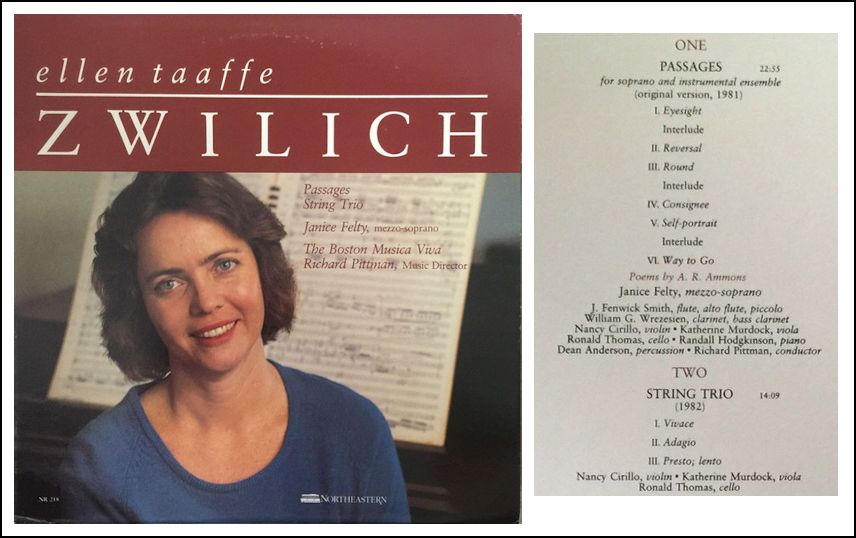
felty Janice Felty (born August 23, 1947) is an American operatic mezzo-soprano, known for her interpretations of contemporary composers including John Adams, Philip Glass, John Harbison, Lee Hoiby, Ellen Taaffe Zwilich, and Judith Weir.

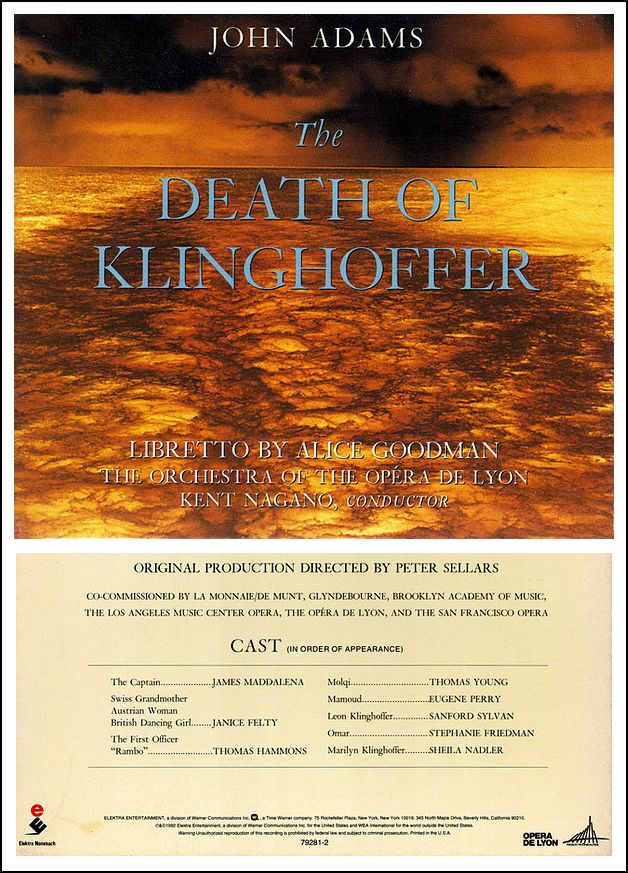
Besides new works, in 1987, Felty played the title role in the Handel oratorio Athalia at Symphony Hall in Boston with conductor Christopher Hogwood, and she sang Dorabella in Così fan tutte of Mozart in the Vienna production directed by Peter Sellars, which is available on Decca DVD. In 1991 Felty premiered several roles in John Adams' The Death of Klinghoffer and recorded this work for Nonesuch Records.

She appeared in the première of Steven Stucky's To Whom I Said Farewell with the Los Angeles Philharmonic, the composer conducting, Haydn's Arianna a Naxos with the Santa Fe Chamber Music Festival, and Colin Matthews’ Continuum with the Los Angeles Philharmonic under Esa-Pekka Salonen. They then repeated the Matthews work with the Chicago Symphony's MusicNow series.

==  Names which are links in this box and below refer to my interviews elsewhere on my website.  BD  

felty
During January of 2006, mezzo-soprano Janice Felty was in Chicago for Continuum by Colin Matthews.  It was part of the MusicNOW series featuring members of the Chicago Symphony.  As noted in the box above, the work was conducted by Esa-Pekka Salonen.  The program also held a wind quintet composed by Salonen.

Though her visit was short, Felty graciously agreed to sit down with me for a conversation.  Held the day before her concert, our chat mostly concerned new music, including its creation and performance.  
 
We began with the obvious question . . . . .


Bruce Duffie:   Tell me the joys and sorrows of singing new music.

Janice Felty:   I will start with the sorrows.  It’s a great deal of work.

BD:   Too much work?

Felty:   No, no.  It’s definitely well worth the effort, but because of the lack of harmonic centers a great deal of the time, I have to really work on muscle memory so much that the voice just knows where to go.  That takes more work than something that’s totally tonal.  Tonal music takes a different kind of preparation, and often we have extremely limited rehearsal time.  So that can make it a little bit cliff-hanging-like.

BD:   Are you not expected to come to the rehearsals completely prepared?

Felty:   Oh yes, but working on my part and putting it with the orchestra are two different things.  When I get with the orchestra, I’m sometimes hearing things that I did not expect to hear, even though I always work with the full score.  It sometimes happens that a certain instrument will shoot out, and I was expecting to hear a different one.  So that can be confusing.  The joys are manifold.  To work with a composer is a great joy, and to premiere a piece and to interpret it for the first time is wonderful.  It is a big responsibility, but well worth the effort.

BD:   Without mentioning names one way or the other, is it good or bad to have the composer there, giving you either good advice or misleading instructions?

Felty:   I don’t believe I have ever had misleading instructions.  On balance, definitely I prefer having the composer there.  I’m always open to any suggestions, and as much as I can, I want to sing it the way they’ve heard it in their imaginations.  I’m always happy to have comments and suggestions.

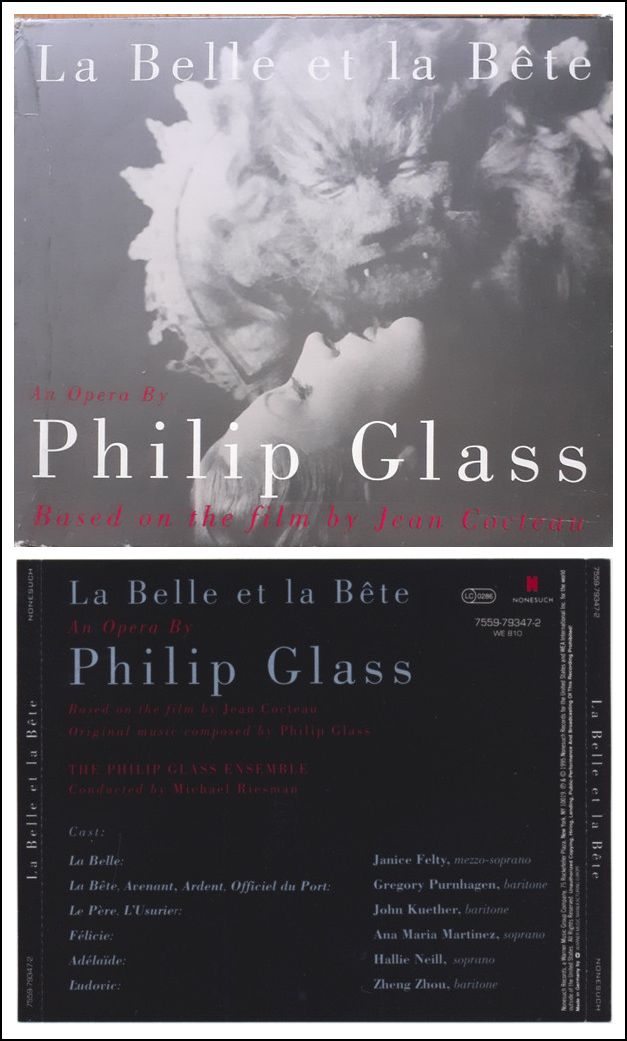
BD:   Do you miss it when the composer is of a previous century and is not available?  [Vis-à-vis the recording shown at right, see my interview with Ursula Oppens.]

Felty:   No, I don’t think so.  I have enough of an idea of what the style would call for so as to feel confident in that.  If I want, I can listen to recordings.

BD:   There’s new music, and then there’s brand new music.  Is there a difference between singing something from the middle of the twentieth century, and something where the ink is still wet on the page?

Felty:   No, I don’t think there’s essentially that much difference.  It just takes a lot of concentrated work, and a lot of learning to just love the text.  The text is the essence for a singer.  Those words are the highway signs, and so many fine composers are reflecting the text in the way that they write.  So, being immersed in the text is a great joy.

BD:   Even a concert work becomes a little music drama?

Felty:   Oh sure, absolutely!

BD:   Do you work very hard on your diction?

Felty:   I work on diction.  I don’t always just sing it, I speak it a lot, and I speak it from memory.  Then it becomes more a part of my being.  I have visual images that come to mind in given texts, and that helps color the voice.  The voice and the body and the mind are all connected.

BD:   That’s right, you carry your instrument.  Are there ever times when you wish you could take the voice out of the throat, and put it in a little box at night?

Felty:   Oh sure.  Last night I could have gone to the Symphony concert, but I was feeling a little strange.  It didn’t feel quite right, so I had to stay in and take care.

BD:   Yet, on a day of a performance you have to feel right whether you feel right or not.

Felty:   That’s right!

BD:   The show must go on.

Felty:   Absolutely!  It must go on.  [Both laugh]

*     *     *     *     *

BD:   You’re offered to learn a lot of works.  How do you decide you will learn this piece, or you will not learn that piece?

Felty:   It’s mostly whatever works for my voice.  I’m very careful about saying that I’ll do a piece.  I look at it very carefully, and work on it before I accept it.  I don’t want to be in a position of having to sing something that’s not right for me, and I don’t want anyone to have to listen to something that’s not correct.  So, that’s the biggest factor.

BD:   I assume there are some composers you work with again and again, so they know your voice and perhaps tailor works a little bit to you?

Felty:   Perhaps sometimes that’s been done, and sometimes they have not necessarily had anyone in mind, but it happens to work for my voice.
felty
BD:   Are there some pieces you have created that you then hear others perform?
 
Felty:   Oh, sure!

BD:   Is that a comforting feeling to know that you’ve given birth to this, and it’s now out on its own?

Felty:   Yes, it is a wonderful feeling, absolutely.

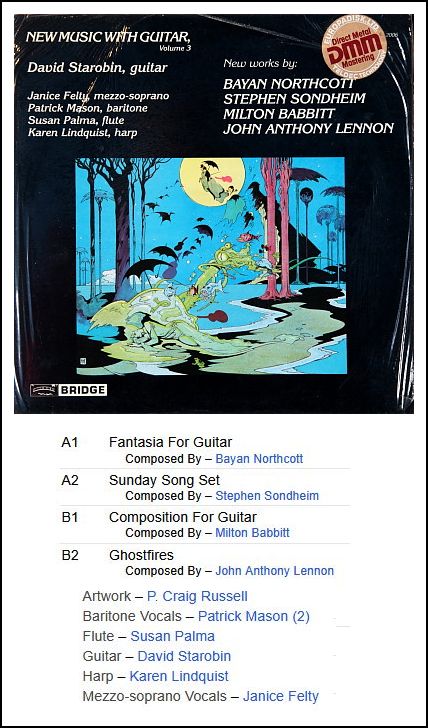
BD:   Are there times when someone else will give a little different shading or interpretation, and you do that next time?  [Vis-à-vis the recording shown at left, see my interview with Milton Babbitt.]

Felty:   Sure, absolutely.  That’s the advantage of having the opportunity to hear others sing.  Sometimes I hear others do it, and feel even more convinced that the approach that I used is correct for me.  So it can work both ways.

BD:   A composer comes to you, and helps to shape and refine things.  Do you also give input to the composer, not necessarily how it was built but how it should be shaped?

Felty:   No, I have not worked that closely.  Usually by the time I have a piece, it’s pretty much formed.  If I have a problem with a certain very small aspect of it, depending on the composer they’re happy to work with me and make it work for me.  But generally, if there’s a lot that’s just out of the realm, I just won’t even try to do it.   But I can’t think right now of any time that I’ve worked so closely with a composer that they wrote it based in part on my suggestions.

BD:   If a composer comes to you and says he would like to write something for your voice, do you have any advice for them?

Felty:   No.  I tell them my range, and what I can and can’t do, and what part of my range I can do certain things with, and that I can’t do certain other things.  Then, I let them take it away.

BD:   Do you find that modern composers are treating the voice more like instruments rather than as a voice, because on an instrument one can use the extremes of the ranges more?

Felty:   Yes.  That would be an example of a piece that I would not do.  I don’t really do the very instrumental extreme kinds of pieces.  I would rather sing something that’s more melodic, or at least melody within the vocal line.  I’ve done a little bit of that, like Ligeti, but I prefer melodic beautiful singing.  There are many, many wonderful composers that are writing that way, so I’m fortunate.

BD:   You’re known for doing more melodic things?

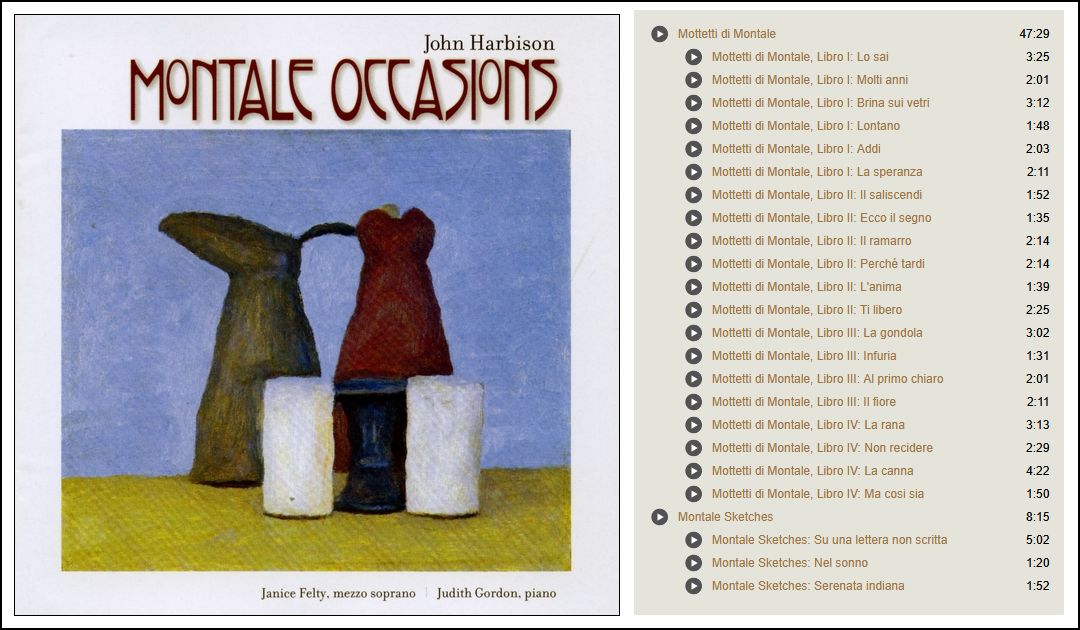
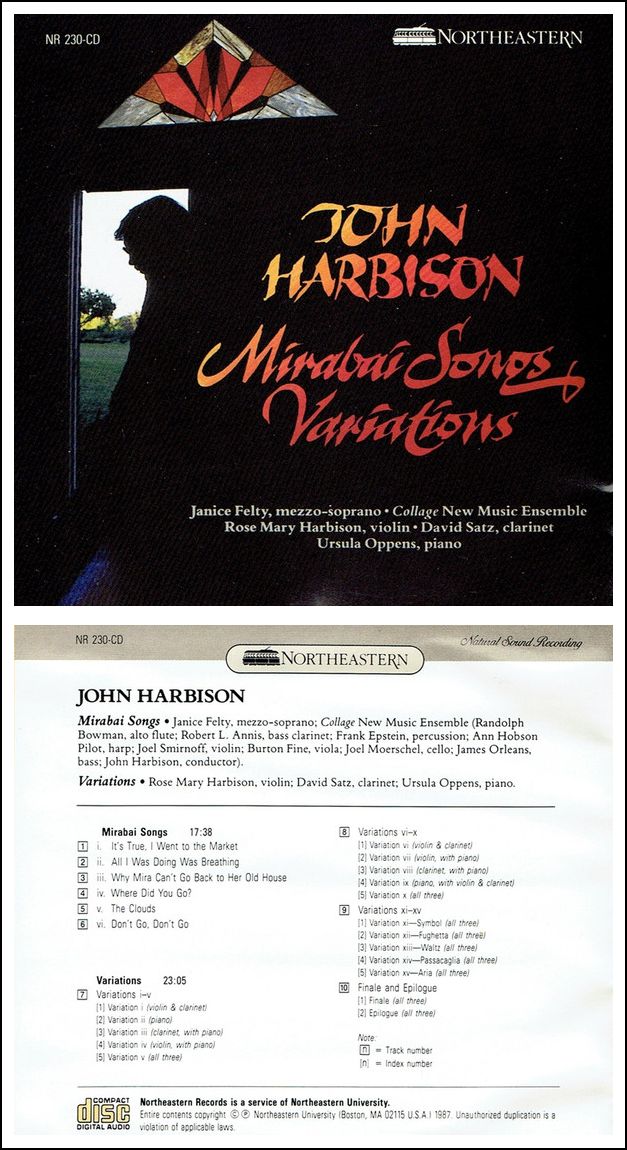
Felty:   I don’t find that many composers approach me who write the really far-out stuff.  I think of all my work with John Harbison.  Even with being a new-music singer, you still get pigeonholed as one who can really go out on the fringes, or one that would prefer to sing more
vocal music as opposed to instrumental types.

*     *     *     *     *

BD:   Do you do any teaching?

Felty:   I don’t teach.

BD:   Why not?

Felty:   I’m not quite sure.  In part it
s because of where I live.  I live in the Southwest, and I don’t come across that many singers who really want to work hard.  I’ve done some teaching, but they just don’t work hard enough for me.  What I have to offer them would be more coaching than voice building.  So it would have to be someone who’s pretty well-established with their technique.  Then I would be happy to work with them on the diction, and intonation, and some of the details.  But I just have not run across enough of them to where I felt like opening a studio.  Living out in the sticks, I hate to ask anyone to have to come that far.  I would be happy to work on any kind of music with them, but I just haven’t been home enough, or made enough contacts, or know enough people who are still at the student level in my community who are really dedicated.

BD:   Are you optimistic about the future of singing?

Felty:   Oh, sure.  There is wonderful singing going on.  Just because it’s not in my little community, or I’m not aware of it, but singing is going great.  There are many, many wonderful new-music singers, and I’m always happy to hear them.

BD:   In general, what advice do you have for a singer who wants to sing new music, or even the established repertoire?

Felty:   Work hard!  Don’t start trying to build the voice until you’re a little bit older, and don’t sing repertoire that’s too much for you when you’re too young.
felty
BD:   When you’re sixteen, how do you know what’s too hard for you, or what’s too much for you?

Felty:   Someone has to tell you!  You don’t sing the heavy literature when you’re young because then you don’t last.  That’s one of the ways teachers have to help their students understand the voice.  It is one of the last things in the body to fully mature, and if their repertoire is too heavy too soon, it can spell disaster.  Handel, and Mozart, and Purcell would be great to start out, and also art songs.  But depending on the voice type, it takes a long time for it to mature.

BD:   Have you found anything in the new repertoire that would be on that same lightish level of Purcell or Handel?

Felty:   In the twentieth century, Copland and Rorem, but no one else is popping in my head right at the moment!  Some of John Harbison’s material would work fine for a younger singer, and probably some Philip Glass.

BD:   Is some of it just the result of the conductor overpowering you with the orchestra, or is it the way it is actually written for the voice?

Felty:   When I’m talking about singing too heavy too soon, I’m thinking more of operatic repertoire, not necessarily new chamber music for voice and piano.  I don’t think you can get into trouble as much singing that sort of repertoire as you can with the heavy operatic stuff.  Most new music could work for younger singers if they’re willing to work hard, and if they’re blessed with perfect pitch.  That’s wonderful.  That’s a big help.

BD:   Relative pitch won’t quite cut it?

Felty:   It helps, but singing it enough times to where you develop a muscle memory is a big part of it.

BD:   Yet you still have to listen and adjust all the time.

Felty:   Oh, yes.  That’s why it’s difficult when you get with the orchestra.  All of a sudden you are hearing so many things that you had no idea you’d be hearing.

BD:   Do you adjust your technique at all for the size of the house, if you’re in a great big house or a very small dead chamber?

Felty:   Somewhat, but not overly.  It’s pretty much the same technique, but maybe just not as much breath behind it.  I love also singing Baroque music with baroque instruments.  It’s a great joy, and it can be compatible with the new music.

BD:   Leaving a big gaping hole in the middle for the romantic repertoire that you don’t sing?

Felty:   Not necessarily don’t sing, but a voice that can do well with Baroque could very well also do new things.  The new music could also work fine for a lighter voice.

BD:   It seems that a number of singers who sing Baroque works also sing twentieth century pieces.
 
Felty:   Yes, and also there is the whole business pigeonholes.

BD:   Is that a good thing or a bad thing, or just a thing?

Felty:   It’s a thing.  I don’t know if it’s good or bad, but it is a thing.

*     *     *     *     *

BD:   How do we get audiences to be more accepting of new music?

Felty:   [Sighs]  Years ago in Los Angeles, one thing we did with one of John Harbison’s pieces was to do the piece twice.  It can help open people’s ears to hear a new piece more than once.  Interviews with composers are also helpful, so that the audience really understands what they had in mind.  Obviously, new music that involves singers would have a text, but if they get excited about the poetry, that would be special.  These Eugenio Montale poems are wonderful, and I’ve done a lot of Montale with John Harbison’s music.  People would understand and grasp the music more completely if they knew and could understand the text.

BD:   Should composers put a text with a string quartet, even if it’s not actually sung, but as a key to unlock some of the ideas of the piece, especially if a poem was the inspiration?

Felty:   Sure!  I would think that could enrich a piece a great deal, because texts, poetry, and words bring images, and feelings, and emotions.  It could be a handle for the listener, and that couldn’t hurt!  [Both laugh]

BD:   How far should we delve into what the composer had in mind, and how far should we let the audience have their own individual fantasy as they’re listening to the piece, either with or without text?

Felty:   [Thinks a moment]  That is a very good question.  It depends on the individual.  Some people like to have a lot more help, and others who are used to listening to music perhaps may have richer imaginations.

BD:   We’re dancing around it, so let me ask the big question.  What is the purpose of music?

Felty:   It is to lift us from the mundane and the day-to-day.  I just spent some time in Brazil, and the way that music is a part of these people’s lives was very striking to me.  It’s in their bones.  It’s a part of them.  We’d see kids beating out rhythms on public phone booths, or buckets, or boxes.  It’s just in them all the time, and that is just their way of reminding us that there is more than just keeping the nose to the grindstone.

BD:   We seem to have a bit of that here with the street musicians...

Felty:   ...but in Brazil it is always everywhere.  It was almost too much for me at times.  It’s very loud, too loud for me.  I had to put in earplugs because they were using speakers and electronics.  But music is to help remind us of the beautiful aspects of life, just like seeing a wonderful painting.
felty
BD:   How do the electronics and the amplification effect you?  Your voice is not going to be amplified the same way that a guitar or some other instruments will be amplified, even if youre using a microphone.

Felty:   I don’t have enough experience with the amplification to know.  In Brazil I heard some wonderful singers, but they had it so loud that their voices were distorted.  I thought it was such a shame that I couldn’t really hear the purity of the voice.

BD:   Is this a general thing, that even in our private listening we’re turning the volume too high?

Felty:   I wonder if there isn’t a slow loss of hearing, and as a result they have to keep turning it higher and higher.  I don’t know.  What’s the chicken, and what’s the egg?

BD:   I’m not so sure it’s very slow.  We, as a nation and a world, are now losing our hearing.

Felty:   I suppose we are losing our hearing.  I don’t know why people want to hear it so loud.  I don’t understand that.

BD:   Is there any way to get people to be a little bit more discerning?
 [Note that twenty years later, when this is being prepared for the website as we begin 2026, there are many ads on TV and the internet about various hearing aids.]

Felty:   Maybe our pace of life is so fast and so noisy that it needs to compete with that.

BD:   Perhaps a piece that is written in the last few years will be a product of this fast and loud pace.  How do we make sure that the music of earlier generations can still be meaningful to people who have gone through depressions, and world wars, and atomic bombs... or is that something we even have to worry about?

Felty:   I don’t know.  There will always be appreciation of an audience for acoustic music... or at least I hope so!  But I do think it is becoming more of a commodity.  I don’t mean necessarily in this country, but around the world, and that people just don’t get it.  It just doesn’t quite penetrate if it’s not really loud, and they don’t get it if it’s not immediately accessible, or it doesn’t have a rhythm they can hook into.  It’s just not interesting to them, and I worry about that.  I realize that my problem with the loud music was that I am used to hearing acoustic music, and that’s what my ear is adjusted to.  So when I hear this stuff which is really turned up to the point of distortion, I just can’t even relate to it.  I am sure there are people on the other end of the spectrum who can’t relate to acoustic music.  It’s not loud enough to penetrate.

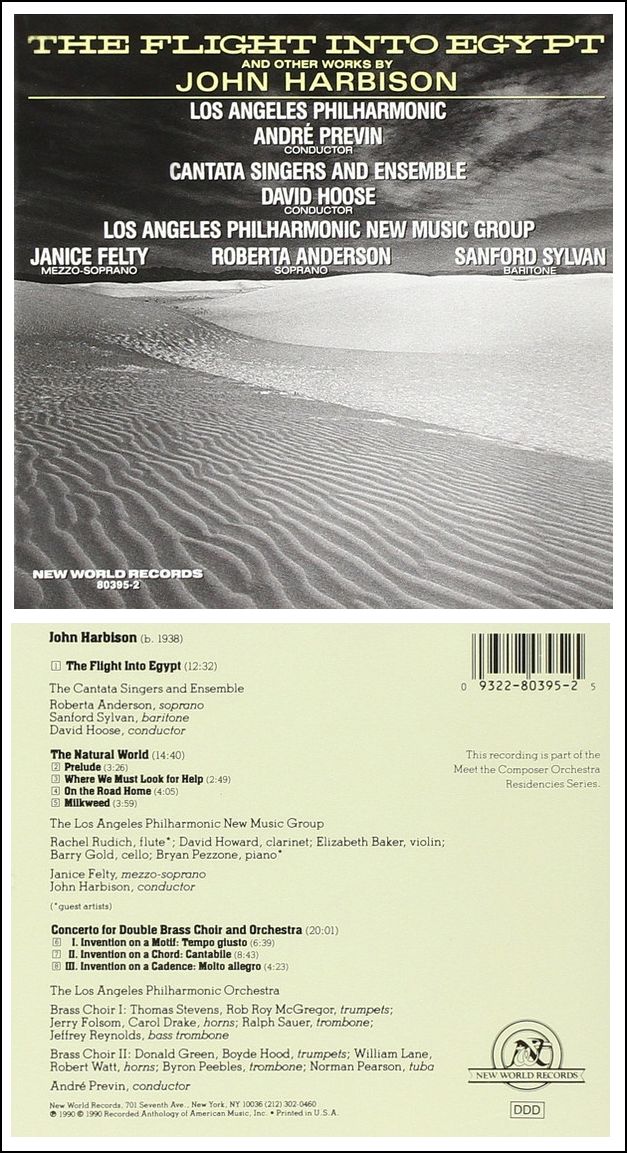
BD:   Should we try to grab them and teach them, or are they just a lost generation?  [Vis-à-vis the recording shown at left, see my interview with André Previn.]

Felty:   I really don’t know.  Things are changing so fast.

BD:   Too fast?

Felty:   Sometimes I think so, yes.

BD:   Is it the responsibility of music and the performers and the composers to keep up, or is it the responsibility of the public to make a place for the music?

Felty:   I think the latter, and whether that will happen or not, I don’t know, but the composers and the performers have to be true to themselves.  There’s enough going on to where adjusting to the demands of the public is going on in other forms of music.  I don’t think there needs to be a place for that in classical music or contemporary music.  We need to hold onto the older traditions for the very few who still can appreciate it.  I don’t know, it’s so hard to tell.  Things are changing so quickly.

BD:   Is the music that you perform, for everyone?

Felty:   I don’t believe so.  It maybe could be, but for everyone?  No, I don’t think so.  It has to be for people who can understand another language.  I don’t mean that they’re able to speak it, but that they’re able to look at the translation and spend a little time, even if it’s right there in the concert hall, trying to grasp the whole inspiration for this piece.  Again, that’s when a piece has text, but I’m speaking now for the composer, assuming that the text is a big part of what is behind how they’ve written a piece.  Certainly, audience members need to read as much as they can about a piece before they hear it.  That information is there for a reason.

BD:   In the copious program notes?

Felty:   Copious program notes, yes.  That means getting there quite early and focusing for a few minutes.  That certainly helps me a lot, and, as I said before, hearing something more than once is beneficial.  The time I remember doing it, it was an informal gathering for the Los Angeles Philharmonic Board Members, but they seemed to get a lot out of having heard it the second time.  It was like their light bulbs went on!  I don’t know how that could possibly be done in the context of most concerts...

BD:   There was a concert last year, where they had two or three pieces.  They played the first piece and then explained it.  Then they went through the rest of the concert, and finally played the first piece again at the end of the concert.  That worked very well.

Felty:   Good.  I’m glad to hear that.

BD:   I’m not trying to pigeonhole you, but in your experience of performing new music, is it better to keep it on a new music concert, or should it be placed on a mixed program that also has Mozart and Beethoven?

Felty:   I think they should be mixed.  That’s a wonderful way to bring general audiences in more.  For instance, they did John Adams last night with Sibelius and Mozart.  To me, that’s a wonderful combination.  It also helps people start getting their ears a little more open to other sounds.  In many ways, the best way to show new music is to combine it with things that people can grasp more easily.  New music concerts are also fabulous.  Of course, within new music, there’s a wide range of what can be heard.

BD:   If you’re singing a new music concert, do you feel you’re preaching to the converted?

Felty:   There is some of that.  That’s why, if you can sneak it into regular programming now and then, maybe some light bulbs can go on and they’ll say, 
“Wow!  I didn’t know this new music was so wonderful!  You can catch a few that way.
 
BD:   At least it was something they would not mind hearing again.
glass
Felty:   Yes, exactly.  That’s right!
 
BD:   Should music always be beautiful?

Felty:   No.  There should be times when it’s very disturbing.  It needs to really touch the emotions, and it should be uncomfortable at times to hear.
 
BD:   Then it’s a different kind of message?

Felty:   I suppose, even if it’s a message at all.  It’s vibrating with all the different levels of our emotions.  To just assuage the nice feelings is great, but the fear feelings and paranoia feelings all should be touched upon at times as well.

*     *     *     *     *

BD:   Do you still perform operas occasionally?

Felty:   Not the traditional repertoire.  I haven’t done that in years.  The last opera I did was by Philip Glass.

BD:   Beauty and the Beast?

Felty:   No, Beauty and the Beast was before that, and it wasn’t an opera per se.  It was with a film going on.  This later one was kind of a concert setup, and was called The White Raven.  It was a Robert Wilson-Philip Glass production that we took around.  We also did it at the Lincoln Festival [conducted by Dennis Russell Davies].  But as far as traditional repertoire, no, I have not done that in at least a decade.

BD:   Do you wish opera was a major part of your life, or you’re happy doing just what you’re doing?

Felty:   No, I’m very happy doing what I’m doing.  The older I get, the less inclined I am to be on the road a lot, and with opera you’re there a long time, and reasonably so.  Things need to be well rehearsed and it is needed, but I’ve been very happy doing the repertoire I’ve been doing, and working with wonderful people, especially the composers.  They are just great human beings!

BD:   You’ve made some recordings.  Do you sing differently for the microphone than you do in a live concert?

Felty:   No.  I leave that up to the sound person.  That’s his or her problem.  I’m not interested in doing that, particularly.  If there’s something that they will need to do with their microphones, they’ll deal with it.  If they say I’m really blowing that one out, I’ll maybe step back or do whatever they suggest if it’s really a problem.  But no I don’t adjust my singing for a recording.

BD:   You just go out there and sing?

Felty:   I just go and sing it, yes, being present in the text every moment whenever possible.

BD:   That calls for a lot of trust on the part of the other musicians, and especially the conductor for balance.

Felty:   Yes, it does.  I don’t think the balance is always well worked out, but after a while in the business, you realize what is your responsibility, and what’s the other person’s responsibility.  I just do the best I can, and hope that the balance is working out.  I’m not sure that it always is, but...

BD:   In the live performances, I would think that in some cases the conductor is in the poorest place to adjust the balance.

Felty:   I know!  That’s why we need ears out in the hall that can be trusted.

BD:   As you say,
That can be trusted!  [Both laugh]

Felty:   That’s right.  Those are important words, and each time it could be slightly different.  The balance may be fine in this particular passage, or even in this particular run through, and then another time it may not be as fine.  But I’m always so impressed with the musicians I work with.  I just am in awe of what they can do.

BD:   You’ve been working with musicians for many years.  The technical ability has gone up.  Has the musicianship also gone up?

Felty:   I would think so, but I don’t know that I can really answer that.  I don’t know that I have that perspective.  They certainly are good, and it
s just amazing to me how they can just walk in and begin playing.

BD:   You’re fortunate to be at a level where you’re working with the best musicians in the business.

Felty:   Yes, I’m very fortunate, and I know it.  I’m always thankful for that.

BD:   Are you optimistic about the whole future of music?

Felty:   Yes, I think I am, though, as I said earlier, things are changing so rapidly, even just in my lifetime.  It’s hard to say, though I do believe there is more of an understanding and embracing of new music than there was thirty years ago.  I may be wrong, but it’s hard in a lifetime to have much perspective, because in the greater scheme of things, a professional lifetime is not very long.  It seems to me like there’s an awful lot of new music going on in the country, and that’s encouraging, and exciting.

*     *     *     *     *

BD:   Do you like coming back to old pieces that were new when you created them?

Felty:   Oh yes, that is a true great joy!  That’s one of the reasons I’m so pleased to be coming back and doing Colin Matthew’s piece here in Chicago.  It wasn’t the first performance, but it was the American premiere in Los Angeles, and I just know that I’m going feel more comfortable this time around.
felty
BD:   How long ago was that?

Felty:   It was just one year ago [in January of 2005.  The work was premiered in 2000.]

BD:   But that’s still very new.  What about a piece that is ten or even twenty years old?

Felty:   Oh yes, I just love coming back to pieces that I sweated blood over twenty years ago.  Then I am able to just enjoy them.  Having done the bulk of the work initially, now it’s all icing!

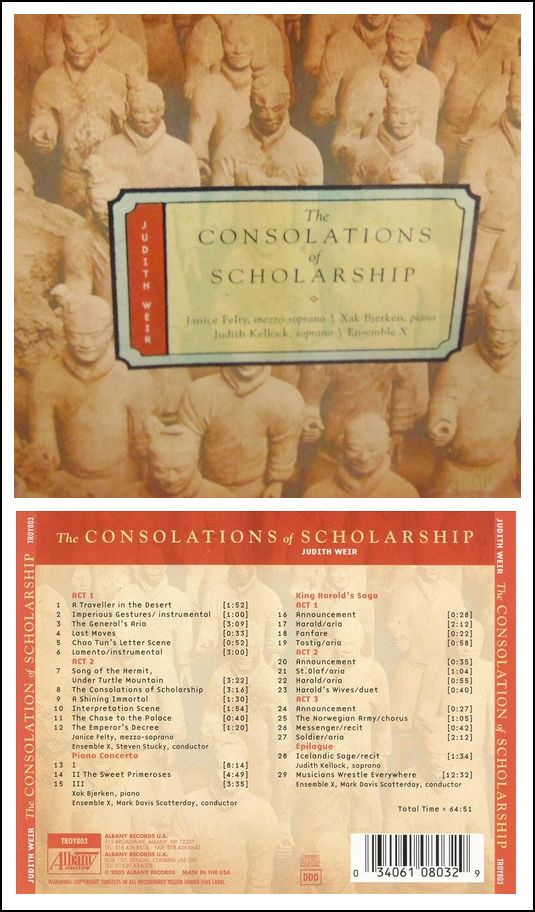
BD:   Is there a balance between art and entertainment, and does that change from piece to piece?  [Vis-à-vis the recording shown at right, see my interview with Thomas Young.]

Felty:   [Pauses a moment]  Golly, I never think in terms of entertainment in that way.  I always think of it as art, and something else is entertainment!  Isn’t that funny?  I always think of another kind of music being entertainment.

BD:   Do you find singing fun?

Felty:   I do, and it’s very healthy.  I just recently found out how healthy it is to sing.

BD:   Of course you’re breathing a lot.

Felty:   All that wonderful breathing just helps with the whole system.  What gets it all going is exercise and breathing.  So singing is very healthy, physically and emotionally, and I recommend it to anyone.

BD:   [With a wink]  Have some of these composers write music to be heard while you’re doing Pilates!

Felty:   Yes!  [Much laughter from both]  That’s a good idea.

BD:   Are you pleased with where you are at this point in your career?

Felty:   Very pleased, yes.  I feel it’s starting to wind down a bit, and I’m ready for that.  It’s been over thirty years.  I wouldn’t trade the experiences that I’ve had, especially doing new music, for anything in the world.  As I said earlier, I am very fortunate to have worked with such fine composers, conductors, and performers, so I really couldn’t be happier.  I’ve been able to have a life in the mountains in the Southwest, where there is clean air.  I’ve also been able to have a family so I’ve really been able to have the best of both worlds.  Perhaps my career would have been bigger had I lived in a center, but it wasn’t me.  In order to bring my best to the music, I had to be renewed in the ways that I get renewal.  So it was a trade-off, but well worth it.

BD:   Did you always want to do music, even as a child?

Felty:   No, but music was always easy for me.  I started studying the piano when I was five or six, and that has been a tremendous help in being a singer.  I sort of stumbled into singing.  I went to the Merola Opera Program in San Francisco, and was just thrilled with it.  To have people so interested in the music was just a revelation to me.  Then I eventually branched into the newer music.

BD:   You’re a good advocate for the new music.  I’ve heard the recordings, and I’m very glad to find a chance to meet.  Is this your first trip to Chicago?

Felty:   No, I worked here a couple of years ago [2003] in the theater at the University of Chicago.  We did a run of one of Philip Glass’s piece, The Sound of a Voice.  I enjoyed Chicago very much.  We went to the Film Festival at the Art Institute, and it was great.  I enjoyed it.  I’m very delighted to be here.

BD:   Are you still learning new pieces, or is that the winding down process?

Felty:   I don’t have anything new that I’m working on right now.  I’m going to be doing some Bach later in the spring, but I don’t really have anything else on the horizon right now.

BD:   I hope the career keeps moving exactly the way you want it.

Felty:   I hope so too.  It’s in a nice place right now.  There’s a certain level of... not stress, but unease that I experience coming up to a performance.  Now that seems to be diminishing as I grow older, but I don’t enjoy that aspect.  It can’t be a normal day... at least for me it’s not a normal day when I have a performance.  I have mixed feelings about whether I want to experience that kind of low-level anxiety too much more.

BD:   [Being optimistic]  I would think it would help to make the performances sparkle.

Felty:   It does.  It’s a heck of a way to ruin a day [both laugh], but well worth it!

BD:   Thank you for making so many sacrifices to be a singer.

Felty:   Oh, thank you.  It’s truly been my great pleasure.  I feel very fortunate that it worked this way.


felty

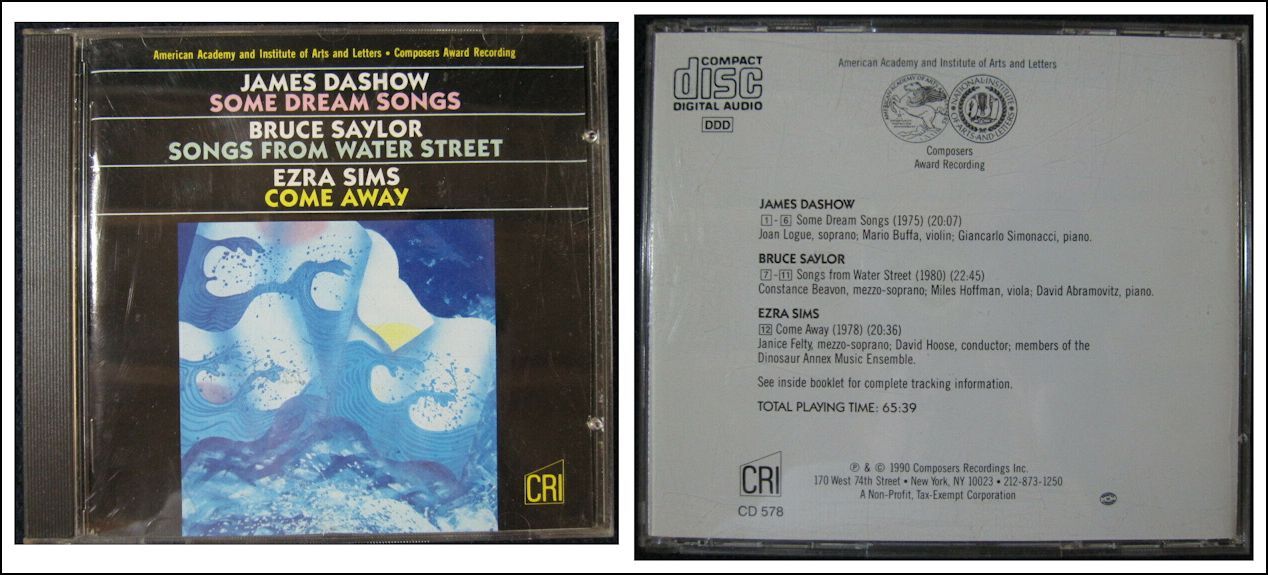
See my interviews with James Dashow, Bruce Saylor, Constance Beavon, and Ezra Sims


felty


felty

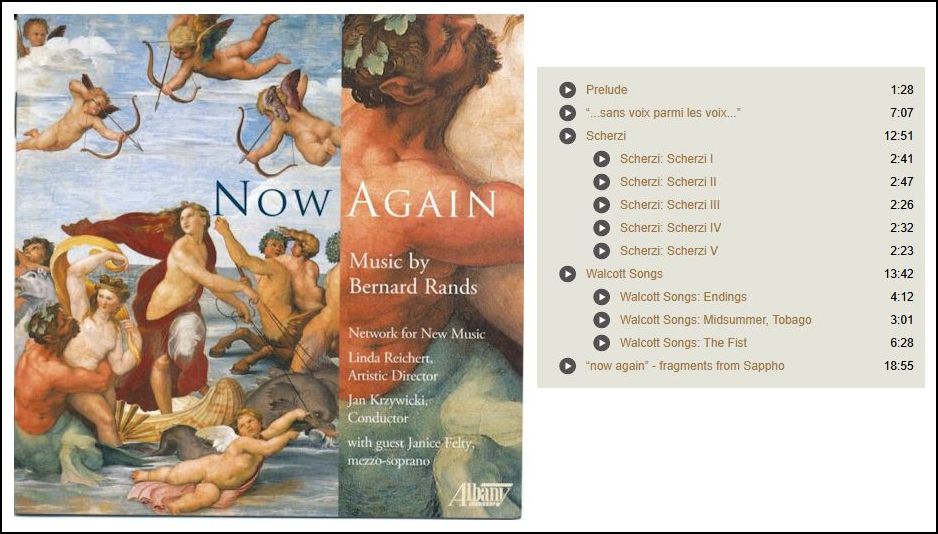
See my interview with Bernard Rands


felty


© 2006 Bruce Duffie

This conversation was recorded in Chicago on January 22, 2006.  Portions were broadcast on WNUR the following July, and again in 2018; and on Contemporay Classical Internet Radio in 2007.  This transcription was made at the end of 2025, and posted on this website at that time.  My thanks to British soprano Una Barry for her help in preparing this website presentation.

To see a full list (with links) of interviews which have been transcribed and posted on this website, click here.  To read my thoughts on editing these interviews for print, as well as a few other interesting observations, click here.

*     *     *     *     *

Award - winning broadcaster Bruce Duffie was with WNIB, Classical 97 in Chicago from 1975 until its final moment as a classical station in February of 2001.  His interviews have also appeared in various magazines and journals since 1980, and he continued his broadcast series on WNUR-FM, as well as on Contemporary Classical Internet Radio.

You are invited to visit his website for more information about his work, including selected transcripts of other interviews, plus a full list of his guests.  He would also like to call your attention to the photos and information about his grandfather, who was a pioneer in the automotive field more than a century ago.  You may also send him E-Mail with comments, questions and suggestions.