Pianist  Justin  Kolb

A Conversation with Bruce Duffie


kolb


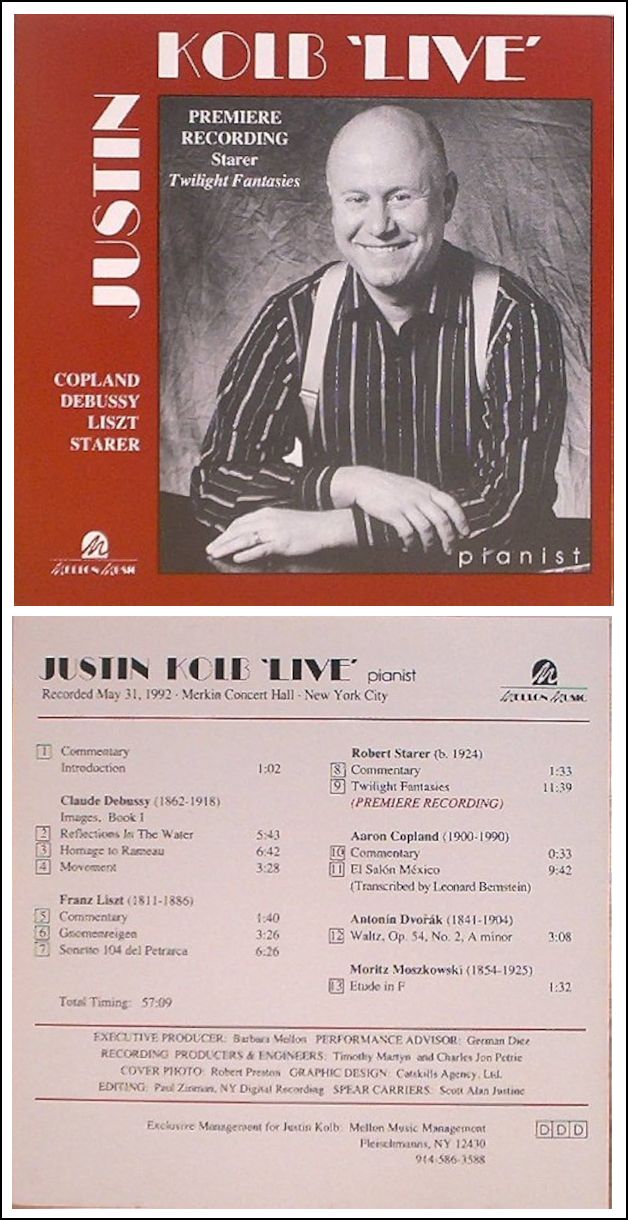
Justin Kolb’s recitals include lively commentary that is always interesting and sometimes humorous. He enjoys programming music from the traditional literature with music by living Americans — South, Central and North — and Franz Liszt.

A proponent of American music, Kolb frequently performs the music of Joan Tower, Tania León, Aaron Copland, Samuel Barber, and Peter Schickele. His performances include premieres of compositions of Robert Starer, Paul Alan Levi, and Jan Bach. Kolb's program of Starer's solo piano music in Weill Recital Hall at Carnegie Hall was hailed by The New York Times as, "A Piano Recital Program With A Difference." Kolb also performs much of the standard keyboard literature with an emphasis on Beethoven, Liszt, and Alkan.

Kolb began his piano studies at age four and soon became a student of Francis Clark and Lillian Whitaker DeCamp in Hammond, Indiana. He made his concert debut at the age of ten in solo performances with the Chicago Symphony Orchestra and the Gary Symphony.

While serving as artistic director, Mr. Kolb designed and developed The Belleayre Conservatory Summer Music Festival in the Catskill Mountains, and serves as program advisor to several arts organizations including the Woodstock Guild in Woodstock, New York and The Center for the Performing Arts in Rhinebeck, New York. Kolb is frequently engaged by colleges and universities to present his interactive lecture titled KNOW THE SCORE: Inspiration and Motivation for Surviving in the Business of Music. Also Travels with a Piano Player and How to Avoid Being a Nerd are two programs presented by Kolb to grades K-12. These music enrichment and student motivation programs are popular in the private and public school sectors. His musical impact in all areas prompted DePaul University to present him with the 1994 Distinguished Alumni Award.

At DePaul University, Kolb studied with Herman Shapiro, Alexander Tcherepnin, and Paul Stassevich. On loan from the US Army, Kolb was among the first to serve as a cultural ambassador under the US Dept of State and the United States Information Service. Performing concerts he also addressed student youth groups in Europe and the Middle East. He has studied with Rolf Beyer in Heidelberg, Gui Mombaerts in Chicago, Martin Canin and German Diez in NYC. Private lessons with Hans Rosbaud in the Chicago studio of Fritz Reiner are a special memory. Luiz de Moura Castro currently coaches Kolb.

Kolb is currently on the Board of Directors of the American Liszt Society, is a co-founder of the Phoenicia Int’l Festival of the Voice and was recently named Chairman Emeritus.

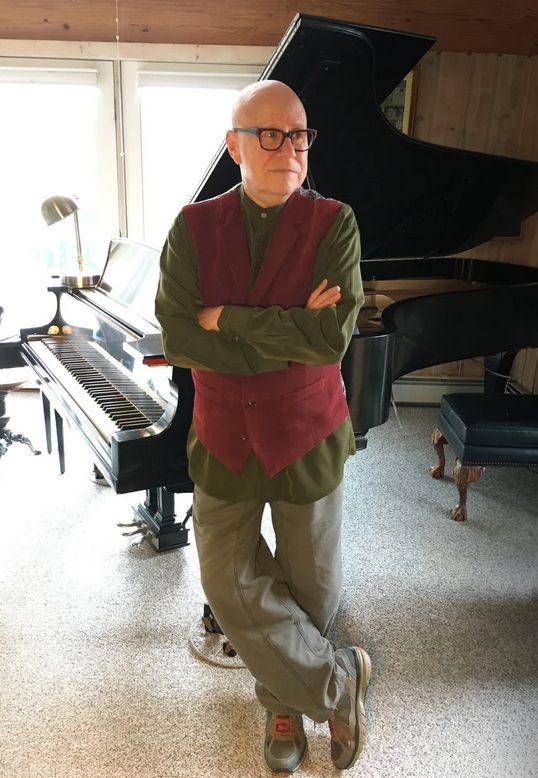
Kolb is married to prize-winning mosaic artist Barbara Mellon Kolb, and they make their home in New York’s Catskill Mountains.


==  Names which are links in this box and below refer to my interviews elsewhere on my website.  BD  


kolb
In May of 2002, pianist Justin Kolb was back in Chicago.  We arranged to meet at my home studio, which was just a few blocks from the very short street named Eastlake Terrace.  I mention this because the composer John Downey had lived there and had written a piano piece with that name, which Kolb included in his repertory!

Portions of this interview were aired twice on WNUR, and now, as we begin 2026, I am pleased to present the entire chat.

Since the pianist was known for playing new and recent works, we began our conversation there . . . . .


Bruce Duffie:   We’re talking about the plight of the modern American composer, and the contemporary American pianist.  What advice do you have for pianists who want to play more contemporary music?

Justin Kolb:   It’s not unlike someone asking what book they should read to become a virtuoso.  You don’t become a virtuoso by reading anything.  You become a virtuoso by playing.  You become a musician by performing.  You become a really fine pedagogue by teaching.  People laugh, but Joan Tower uses the acronym DWEM, meaning Dead White European Males.  I tell kids they have to understand that not all great music was written by dead white guys who lived in Europe.  In the concert honoring the Chicago virtuoso and pedagogue Herman Shapiro, who spent many, many years at DePaul University, they gave us a grant to celebrate his life in concert.  I said,
Let’s get some Chicago composers in, and I’ll premiere those works.  I’ll choose some composers that studied with Shapiro at DePaul.  Chicago had John Downey.  As it happens, today we’re talking in the shadow of Eastlake Terrace.  That’s probably his most well-known piano work, although Pyramids has really become popular.  I spoke with John, and he was delighted.  I had performed the Toccata at my senior recital in 1964, which ended up being the third movement of his Piano Sonata, which James Tocco plays really, really well.  I asked John to give me a companion piece, because I didn’t want to learn that whole sonata.  I asked for something lyrical to go against that original Toccata.  So he did that.  I asked William Ferris, who was an old friend and a colleague to write something, and he wrote a marvelous piece with the title Epitaph.  Then I called Robert Muczynski and he said, “This may sound strange, but I’m just tired of writing piano music.  I wanted him to be part of this program, and he said, “No one plays my second or third piano sonata, so why don’t you play that?  So, I played it.  

BD:   Muczynski didn’t want to write new piano music, but hoped you would do some of his old works.  You do a lot of new pieces, but does it behoove you also to resurrect a few of the older pieces by some of these same composers?

Kolb:   Yes.  I have an agenda.  People went for years saying that if you wanted to make it as a concert pianist, you need to find a niche, and I thought you had to play all of this stuff that was hard-edged.  It was the heavy metal of classical contemporary music.  Then someone introduced me to a man by the name of Robert Starer.  I had been completely away from the music scene for twenty years, and when I met him I said,
Excuse me but I don’t know who you are other than your name.  He said, “That’s okay.  I’m a composer, and the following day he sent me a piece of music called Twilight Fantasies.  I didn’t look at it for a year.  We had just moved to the mountains in the Catskills.  I left business, and my wife and I goofed off for a year building stone walls on our property and drinking a lot of wine, and just generally shaming ourselves.  One night she asked me when I was going to start to practice?

BD:   Had you left business to do music, or had you left business to clear your mind, and music just came back to you?

Kolb:   I left business because it was a war that I was tired of.  We moved to the mountains, though subconsciously my goal from the time I was a little boy, was to become a pianist.  It was always there.  I didn’t say I was going to quit, and start learning Scarlatti sonatinas.  What happened was I needed a coach.  Someone said my playing sounded like a businessman, which I didn’t think was particularly offensive.  So, I considered Byron Janis as a teacher, and several other New York people.  I finally found a man by the name of German Diez.  He was a student of Claudio Arrau, and Arrau was a student of Martin Krause, and Krause studied with Franz Liszt, and Liszt studied with Carl Czerny, and Czerny learned from Beethoven.  That means if you take a piano lesson with me today, you’ll be an eighth generation Beethoven student!  Diez asked me what I wanted to work on, and I said how about one of the Chopin sonatas.  I’d never done those, and Diez said I couldn’t play a Chopin sonata until I could play a Chopin waltz, and he suspected I was unable to do that.  He changed my technique, and I became less panicked, and less frantic.  A year later, Barbara met a couple of concert agents who were women, and they taught her the business.  So Barbara started booking.  I played six gigs for free at nursing homes and senior citizen villages.  Then I spent a year getting more concerts and charging expenses.  People started paying us small fees.  I tell students if they want to make money, you need to develop your own concert circuit, which gets us back to this issue of what to do.  There are a zillion wonderful pianists out there, and a lot of them are fifteen and sixteen-year-olds who have the Transcendental Studies [Liszt] memorized.  Even in the sixties, kids were going into the Juilliard Preparatory School, and playing the Fugue from the Barber Sonata.  Barber told Paul Stassevitch that he had just heard a kid play the Fugue, and it was the first time he had heard the correct tempo.  This was after Vladimir Horowitz’s premiere!  Everyone just zings their way through it, and you can’t tell it’s fugal!  It’s different in a lot of ways, but the key to a performance career in classical music is to forget about becoming well-known, and just concentrate on sharing music.  Concentrate on becoming a good musician, not just a ‘good violinist’, a ‘good contrabassoonist’, or a ‘good pianist’.  If you do that, you will be fulfilled.  In the old days, we would play concerts in the hinterland.  We would work  and work for two and three years, and develop a repertoire, and then when we really came close to being masterful.  Then we would do a New York debut, and a critic would notice us, and that review would find its way to a symphony orchestra conductor, who would put you on stage at Orchestra Hall.  Then a record company would come to you, and that meant you’d arrived!

BD:   Now we’ve turned everything on its head.

Kolb:   [Laughs]  Haven’t we?  Especially with the technology, you no longer do a demo tape.  You just make your own CD, hire a hall, and do your New York debut, and then if you’re successful, you’re playing in small towns all over.  But the point is to have fun.  The senior citizen villages in this country, at least the high-end ones, all have at least one good Steinway seven-foot B, because there is a resident there who is a graduate of Juilliard.

*     *     *     *     *

BD:   Now you play for nursing homes, but you also play for kids in schools.

Kolb:   Oh yes, that’s important.  I’m absolutely convinced that the school budgets should not cut music.  Music is different from the rest of the arts and sports.  It’s very important to be healthy, but you also need creativity.  Any human being who speaks the four languages of music
rhythm, melody, harmony, and tonal colorwhich are Aaron Copland’s elements of music, and then employs them with other musicians, doesn’t have to practice for hours.  They can practice fifteen minutes a day, but if it’s focused, their brain begins to work differently.  They’ll never become professional musicians, but this focusing is the key.  Then they must perform with other musicians, and they must perform under stress.  It doesn’t have to be in front of a thousand people.  It could be in front of Uncle George and Aunt Sally, but the kids still get stressed because they want to do a good job.  This is a skill that the kids don’t know they’re doing, but their body starts being educated very fast, and this is all important to creativity.  We know for sure that kids who do this score highest on the SATs.  That is irrefutable.  Educators are tracking this at the University of California, Irvine.  

BD:   So, you’re learning not just how to deal with music, but how to deal with everything in life?

Kolb:   Yes, and that’s why they score higher.  I give these programs, and after I’ve gone through all this with the kids, I ask them to name a skill that they think they’ve developed because of this musical experience which would be helpful when you’re away from the world of music.  They invariably begin with being a good listener.  There are corporations such as the people at 3M who bring us Scotch tape which require middle-management and senior executives to attend the workshop developed by Training House of Princeton, New Jersey called Effective Listening Skills.  They’re teaching older people how to listen.  Kids will come up with a compromise, and we know that conflict resolution has been on the agenda of the United Nations General Assembly for years.  These days, all school teachers have to go because of gang warfare, etc.  When they go to a conflict resolution seminar, the very first thing they go through are compromise exercises.  Chamber music players, rock players, hip-hoppers all do this, and the kids are very quick to tell us that when we get along, we cooperate.  I cap off my program by saying that the next time your mom or dad want to know where that money is going for those horn lessons, whip out your own personal skills inventory, and say,
This is the person I am becoming, and this is where that money is going.

BD:   Now we have to figure out how to get it through to the people who have the money, that teaching music teaches more than just music.  They don’t have to wind up being professional musicians.  They become better people.
 
Kolb:   Oh yes, unquestionably.

BD:   How do we do this?  How do we get that into their heads, so there’s less cutting of the music programs?
kolb  
Kolb:   I’m unclear about that, although I feel that the world is becoming more clear about it.  There’s a marvelous report available on the net called Champions of Change.  It gives all of these statistics and says who is doing what.  That Irvine study was just outrageous with what they did with advocacy.  I spent a lot of time in Ontario, and music conservatories and universities there and in the U.S. do not have a course that will teach a music education person how to defend a budget request.  I’ve talked to music teachers who usually don’t even understand the process and the sequence of what every department has to go through in presenting their request for the following year.  Thats ridiculous!  I saw a wonderful thing which just taught me a lot of potential when I spent a week in Waukegan [35 miles north of Chicago] that culminated in doing Rhapsody in Blue with the high school band.  I visited all the grade schools, the middle schools, and the high schools, and the band teacher told me about the most astounding thing happened.  The football coach came to the band room because he needed a video machine so that he could get feedback after each game.  He went to housekeeping, and they promised to construct a scaffolding so that he could see the players.  They had a marching band, and the band master had been wanting to shoot video of the patterns for the marching band.  No one had given the bucks, and so the coach said to come along with him, and they got themselves a video set between the two departments.
 
BD:   That’s cooperation and coordination.

Kolb:   The thing about getting their own concerts is that we don’t teach kids how to establish a private teaching studio... although most music majors these days are going to teach.  They’re already going.  When you’re an undergraduate, the primary difference between you and your colleagues or counterparts in business and marketing is that we, as music students, are already doing what we’re going to do.  We’re in music school just to develop performance indices of standards, to refine them, and to learn what history has taught us about performance practices and styles.  Business majors are doing case study work as something that they’re going to begin to be doing after graduation.  I’ve talked with my colleagues in business departments at universities, and they say we don’t understand.  Today, this case study stuff is very serious, and we have corporate internships now.  I was in business for twenty years, so I know what that means.  You get free Xeroxer, and someone to collate.  They don’t ‘do’ business in these business internships.

BD:   You perhaps are the best person to talk about this.  You’ve played for the old people in the retirement centers, and you’ve played for the kids in the schools.  Should we do more playing for the businessman, the middle-aged guy who’s in business now?

Kolb:   I’ve done some corporate retreats, and I’m looking at that more and more.  There’s a guy by the name of Boris Brott.  He’s a marvelous symphony orchestra conductor, and he’s in high demand as a motivational speaker.  He’ll go into a corporation and talk about the job of the CEO, which is quite the same as a symphony orchestra conductor.  He does this thing with tone bars.  He divides everybody in the audience into sections, and has them reach under their seats for a tone bar.  Then he puts the Toronto Symphony on video, minus the melody of ‘Ode to Joy’, and they do the Beethoven Ninth Symphony.  He gets the entire audience to do ‘Ode to Joy’ via the tone bars.  The point is to show leadership, chain of command, feedback, consequences, management, theory, communication, and information.  There’s empirical data that says of the requests for training that go to a corporate training department, 85% would not be the students who are not performing due to a lack of knowledge.  If their life depended on it, they could perform, but they’re having problems because there’s a lack of information.  No one has set performance standards, or punishing consequences.  Punishing consequences have to be put in the balance, and I believe in the balance of consequences.  Short-term consequences are more powerful shapers of behavior than long-term ones, and this all affects the way everybody behaves, including the idea of developing a music budget and an arts budget.

*     *     *     *     *

BD:   Let’s return to Robert Starer.

Kolb:   It’s been a year and three weeks since Robert passed away.  He taught me a lot about the wonders of music, and the craft of high art.  [Speaking softly, as an aside]  
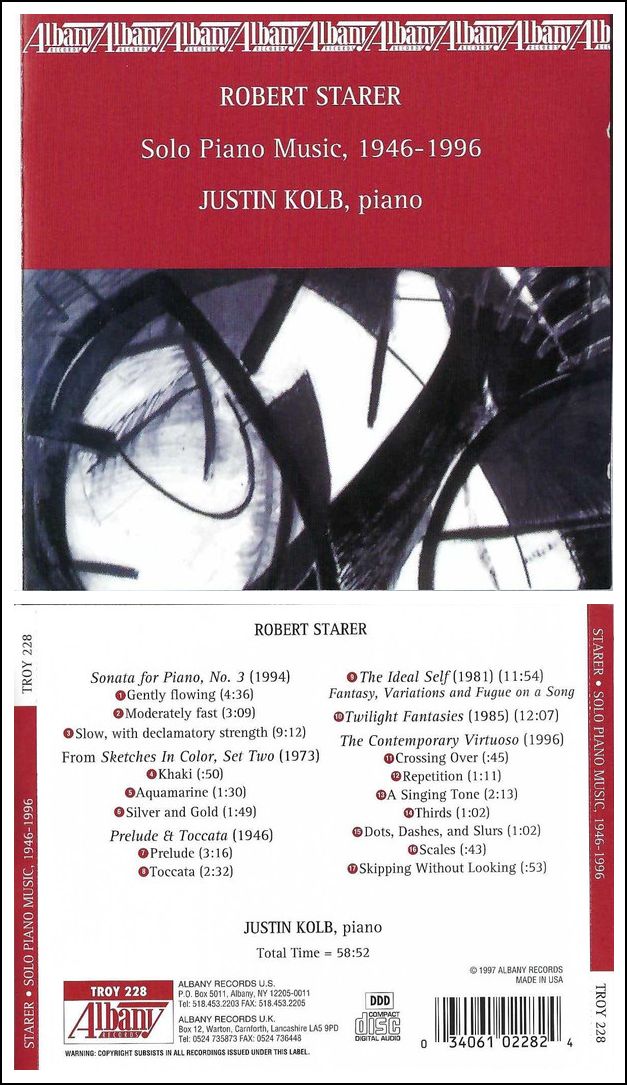
Craft is a sort of a dirty word that belongs with making wallets and pot holders, or tapping brass and copper with little tiny hammers.  [Returning to normal volume]  Robert could take three notes and sequence them, and tell you where to place the emphasis so that tonal color comes out.  He was a sculptor of sonics.  You play his music, and it’s not the Liszt B Minor or the Prokofiev 7th, but you aspired to these works.  I actually had people ask why I was playing that stuff by Robert Starer.  I don’t know why!  I like it, but I also play the [Liszt] Mephisto.  Starer’s music is not hard-edged twentieth-century stuff, but it’s original.  He was known for melody more than anything else.  Martha Graham collaborated with him two or three times in ballets, and George Szell and Zubin Mehta conducted his works.  He wrote three piano concertos, and David Bar-Illan premiered each of them.  When Robert passed away, we got letters from people from the furthest stretches of Europe.  He used to say that when he was in a restaurant or deli in New York City, young kids would say hello, and he would be so pleased thinking that they had heard his oratorio Ariel: Visions of Isaiah, or Twilight Fantasies, or chamber works.  They would the say, We all had to use that horrible book of yours on ear-training.  It was the hardest thing we were required to do at Juilliard!  [Much laughter]  I don’t know that it was ear-training... it may have been sight-reading.  Its a rhythm book, and he said that the only reason people perceived sight-reading as difficult is that they don’t understand rhythm.  That book is a required textbook all over the country, and piano teachers all over the world have taught his Sketches in Color.  I just played ‘Pink’ at Brooklyn College.  We had a memorial concert for Robert, and I did a couple of things.  Everybody played ‘Pink’ when they were a kid.  He also has ballads, and his Third Sonata is just wonderful.  That was not dumbed-down so the public would like it.

BD:   He wrote what he felt?

Kolb:   He wrote exactly what he felt.  Rhythmically, it’s polyrhythms.  He did not have to show off, and what he writes is not easy.  It’s not Charles Ives, but people love it.  I’ve played movements from the Sonata for little kids and for old codgers.  We did a whole half of a program at Weill Recital Hall of Robert’s works.  We premiered that piano sonata, and people loved it.  We put it back-to-back with the Liszt transcription of the Beethoven Symphony No. 5.  It was his 70th birthday, and I told him that I wanted to celebrate.  I had ended up learning that first piece he gave me, and after that I really pursued his music.  I was attracted to the big pieces, and to the really small pieces, the stuff that little kids play.  So to do an all-Starer bash, and I thought this is intelligent from a business point of view.  The critics have come out for a premiere, and students will come out because it’s Robert Starer.  He was loved by everybody at Juilliard and at Brooklyn College.  When I told him of my plan, he said in that deep voice that one cannot play a whole program of my music.  They’ll be gone by the intermission.  [Both laugh]  But we had a marvelous time.  Robert got up, and we did an encore of a four-hand piece.  Then when we did the CD of his solo piano music, Robert thought it would really be great if we put in some rudimentary student pieces, including Dots, Dashes, and Slurs.  That way, little kids can hear a recording artist play their stuff instead of just a Chopin polonaise.  It
s something that they’re really working on.

BD:   It's good to have the variety.  You have the big pieces and also the little pieces, and that’ll attract different audiences for this CD.

Kolb:   The CD is actually popular.

BD:   I hope that gets them into other music by Starer, and then music by other living or recently deceased composers.

Kolb:   It amazes me that so many teachers throw undergraduates right into Messiaen.

BD:   You have to lay a foundation and then build up to it.

Kolb:   I think so.  I wouldn’t say it’s exactly an acquired taste, but you have to learn how to do this stuff.

BD:   Are you optimistic about the future of music?

Kolb:   [Bursts out laughing]  Yes, of course.  Music is life!  [With a scowl]  There’s this thing called ‘The Mozart Effect’.  It says you can have your kid become a genius by playing Mozart for them!

BD:  
[Citing another popular item]  ‘Build your baby’s brain.
kolb
Kolb:   That’s a crock!  It’s got to be music that has simply stated melody, rhythm, harmony, and tonal color.  It can be hip-hop or it can be Mozart, as long as it’s good!

BD:   [Gently protesting]  But I don’t think hip-hop needs much help.  Mozart maybe needs a little help.
 
Kolb:   Oh sure, because rhythm is the most popular thing, and in popular music, rhythm is obvious!  What’s interesting is that young artists don’t understand rhythm in classical music.  You can’t just tap your foot and lay it out there.  It is subtle.  Robert taught me a lot about rhythm.  Peter Schickele said to just pretend there are no bar lines!  There’s an awful lot of rhythm in there, but he just doesn’t want you to hit everybody over the head with it.  Robert always appreciated it when someone played his music.  He was never critical.  He was never harsh unless you hadn’t practiced it, or if you missed the climax.  Bernstein was the opposite.  You had to go through stuff with Bernstein.  I never worked with him, but that’s my understanding.  He was adamant, pedantic.  Robert just appreciated you doing it, and that you started on time and ended on time.  That’s a wonderful thing when composers are willing to sit in the audience and not look over our shoulder.  This was Robert Starer.
 
BD:   I’m glad you have brought Starer to more people.

Kolb:   I’m not the only one. There’s a guy by the name of Gerard Berthiaume.  He’s out in Washington state, and he has a marvelous CD where he does works that I don’t do.

BD:   You’ve recorded some Starer, and you’ve got a few other favorite composers.  Are you doing more and more of those composers, or are you looking for yet other composers?

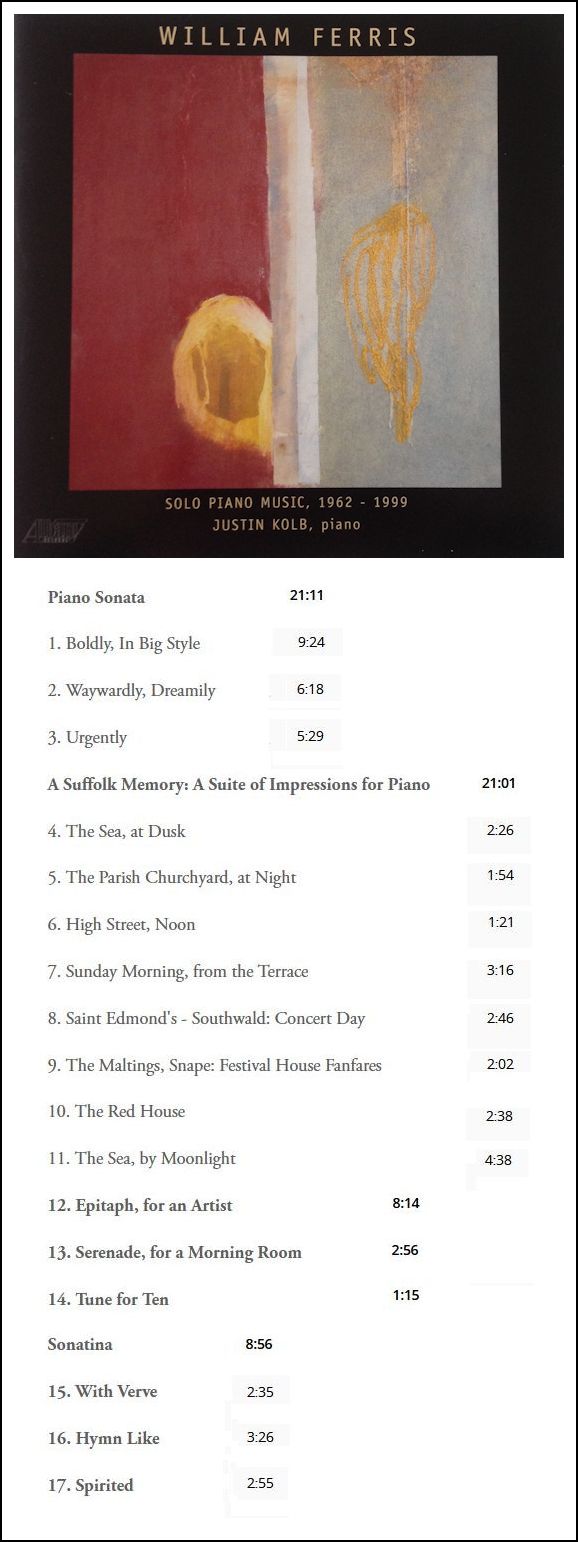
Kolb:   All the above.  My next project is the solo piano music of William Ferris.  His situation is not unlike that of Leo Sowerby, another great Chicagoan.  Sowerby is known as a church musician, but he has five symphonies and a couple of piano concertos.  He has a large oeuvre.  He wrote in every large and small format, as did Ferris.  Sowerby won the Pulitzer Prize, and Ferris had a piece nominated for it.  The Chicago Symphony commissioned his Organ Concerto, and he has maybe an hour and a half of solo piano music which we’re going to record for the Albany Label.  Next week I will do another performance of the Schickele Concerto in Washington, but my summer is going to be spent with my nose to the grindstone with the Ferris music.

BD:   I wish you lots of success with that, and I hope the recording comes out the way you want it.  With a solo recording, I assume you have enough time to get it right?

Kolb:   Yes, but I hate to record.  There is sort of a rule of thumb that says for every CD it takes an hour of work to get five minutes of recordable, producible, and marketable material.  It’s exhausting, and every time I record, I’m determined to go in there and just do everything perfectly.  For a sixty-minute CD, Barbara and I do our own edits, and that’s forty hours’ worth of work.  If you
ve got half a brain, then you’re up for it, but it’s exhausting if you’re doing your job.

BD:   I trust you’ll be back in Chicago?

Kolb:   Oh, I love Chicago!  Barbara and I both grew up in the Midwest right across the line in Indiana, and Chicago is very good to me.  DePaul University is especially good to me and for me, and several venues have asked me to play an all-Ferris recital.  They’ve heard about the CD, but that’s going to happen next season.

BD:   You could assemble quite a diverse group of Chicago composers, from Rudolph Ganz and William Ferris and Leo Sowerby, to Ralph Shapey and Easley Blackwood.  [We also mentioned Shulamit Ran, who would later become more of a fixture here.]

Kolb:   And something not everyone knows, Ned Rorem was here [born and brought up in Indiana, and studied with Margaret Bonds and Leo Sowerby], as was Vittorio Rieti [taught at the Chicago Musical College 1950-54].

BD:   There are some people at DePaul, such as George Flynn, and at Northwestern including William Karlins.

Kolb:   George Flynn is phenomenal, and Kurt Westerberg is at DePaul.  DePaul generously asks me to come in and talk to their kids, and I’m there about every three years.  Kurt is always interested in everything that’s going on, and he’s a good composer.

BD:   Kurt and I were in high school together, and we both played the bassoon.

Kolb:   How fun!  Also at DePaul was Alexander Tcherepnin [1950-64, and who had works played by the Chicago Symphony under Kubelik and Reiner.  Among his students were Philip Ramey, Gloria Coates, Robert Muczynski, and John Downey.]

BD:   [At this point we stopped for a moment to take care of a few technical details.  I then asked his birth date, which he said was June 7, 1942.]  Are you pleased with where you are at this point in your career?

Kolb:   I’m the luckiest guy I know.  I thought it would look differently.  The thing about goal setting is that if you don’t have goals, you’re going to end up in a place where you’re very unhappy.  What I learned is that the route to goal attainment is always circuitous.  In my case, it took twenty to twenty-five years.  I played with the Chicago Symphony Orchestra twice by the time I was eleven.  I played with the Gary Indiana Symphony Orchestra when I was nine.  Everybody said I had it made!  I had 175 concerts under my belt in Europe and the Middle East, and a few community concerts and association concerts by the time I was twenty-six.  When we were in Europe I wrote to all the agents.  They said to stay in Europe, because they’ve got it locked!  This was 1969.  They would not even audition me because the artists on their books were suffering for lack of engagements.  Nobody told me this was going to happen.  We had three babies.  I was twenty-six years old.  I went to Northwestern graduate school, and worked for a semester, and had to quit because we needed to eat.  I got a job as a money counter at Arlington Race Track.  That was the beginning of five years without touching a keyboard.

BD:   Maybe another time you could tell me about Phil Georgeff.

Kolb:   Oh, he was a great race caller!  [Coming back to the topic]  When you attain a goal, it is always going to look different, and it shows the value systems.  You go into college, and they just teach you.  You wouldn’t be there if you weren’t talented, so all you have to do is practice more than everybody else.  We are educating kids for jobs that do not exist.  Someone should tell you that you’re not going to be on the cover of Time Magazine by the time you’re twenty-five!  The odds are you’re never going to headline the Mostly Mozart Festival ever in your life.

BD:   So, you have to figure out why you are doing it in the first place?

Kolb:   Yes!  It’s like moving to the Catskills because people go there.  I see it all the time.  They take their life savings, buy property, and in a year they’re really unhappy.  Typically, they run through their money in five years, and then they have a big decision, whether to leave or not.  What it really is, is another review of their personal goals.  Then they start deciding what is it that they want.  Are they willing to get two or three jobs to make up forty hours a week?  It’s a fascinating thing to watch, and for everybody it’s a series of goal-setting, and decision-making.

BD:   I’m glad you figured out your goals.

Kolb:   My goal is to learn how to play the piano!   I’ve had a fabulous life.  My children have ten fingers and ten toes, and they’re all employed.  Barbara and I have been extraordinarily lucky, and we’re doing this thing together.  We’re like the Lone Ranger and Tonto!

BD:   It’s great that you can bring her along to do all of these things, and have her turn pages for you.

Kolb:   [Laughs]  She’s the only one I trust turning pages!  That’s an interesting thing... I refuse to stay home on Saturday nights memorizing music, and going over something that I had memorized ten years ago.  There’s no way.  I could possibly make a mistake out of fear that I might make a mistake when I’m going to play this, and life is not worth it.  The intent of music may be sacred, and the curious thing is you still get just as nervous.  [Both laugh]

BD:   Thank you for all your work, and for speaking with me today.

Kolb:   It was a pleasure.  Thank you.


========                ========                ========
-----        -----        -----
========                ========                ========


© 2002 Bruce Duffie

This conversation was recorded in Chicago on May 18, 2002.  Portions were broadcast on WNUR the following year, and again in 2006.  This transcription was made at the beginning of 2026, and posted on this website at that time.  My thanks to British soprano Una Barry for her help in preparing this website presentation.

To see a full list (with links) of interviews which have been transcribed and posted on this website, click here.  To read my thoughts on editing these interviews for print, as well as a few other interesting observations, click here.

*     *     *     *     *

Award - winning broadcaster Bruce Duffie was with WNIB, Classical 97 in Chicago from 1975 until its final moment as a classical station in February of 2001.  His interviews have also appeared in various magazines and journals since 1980, and he continued his broadcast series on WNUR-FM, as well as on Contemporary Classical Internet Radio.

You are invited to visit his website for more information about his work, including selected transcripts of other interviews, plus a full list of his guests.  He would also like to call your attention to the photos and information about his grandfather, who was a pioneer in the automotive field more than a century ago.  You may also send him E-Mail with comments, questions and suggestions.