Pianist  Santiago  Rodriguez

A Conversation with Bruce Duffie


rodriguez


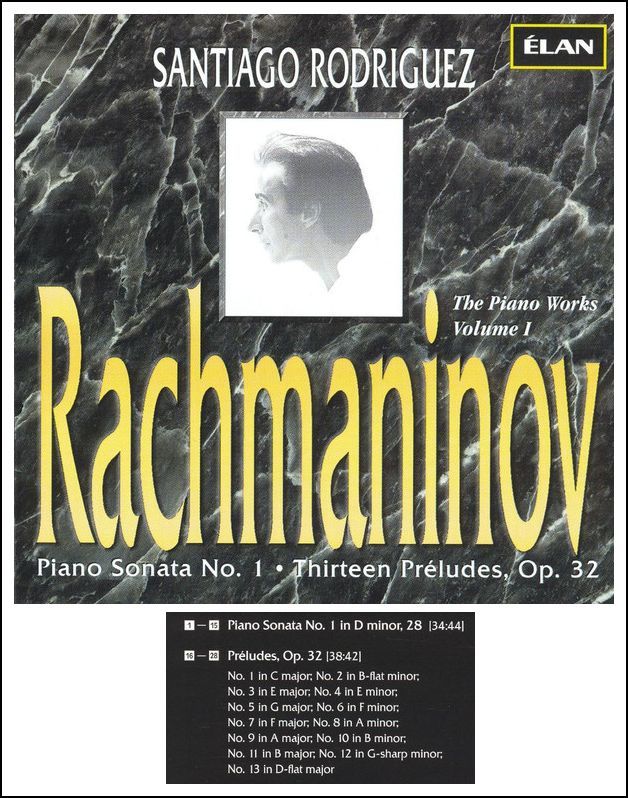
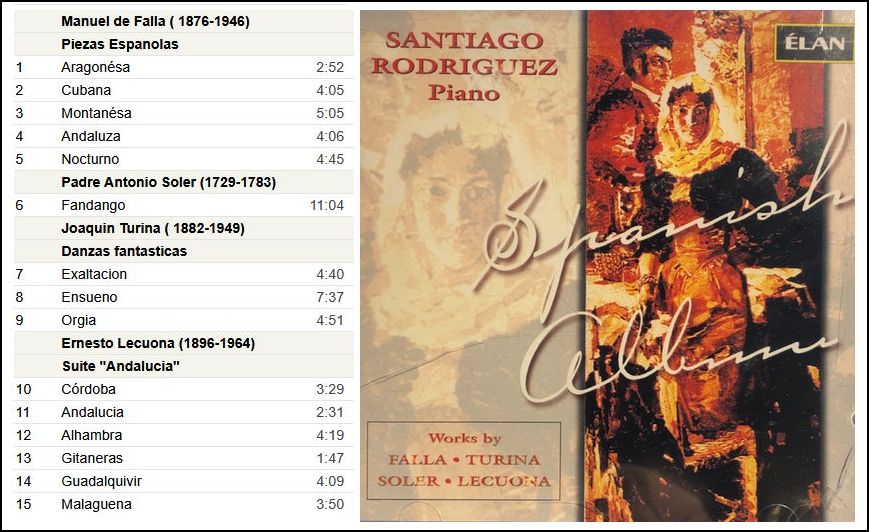
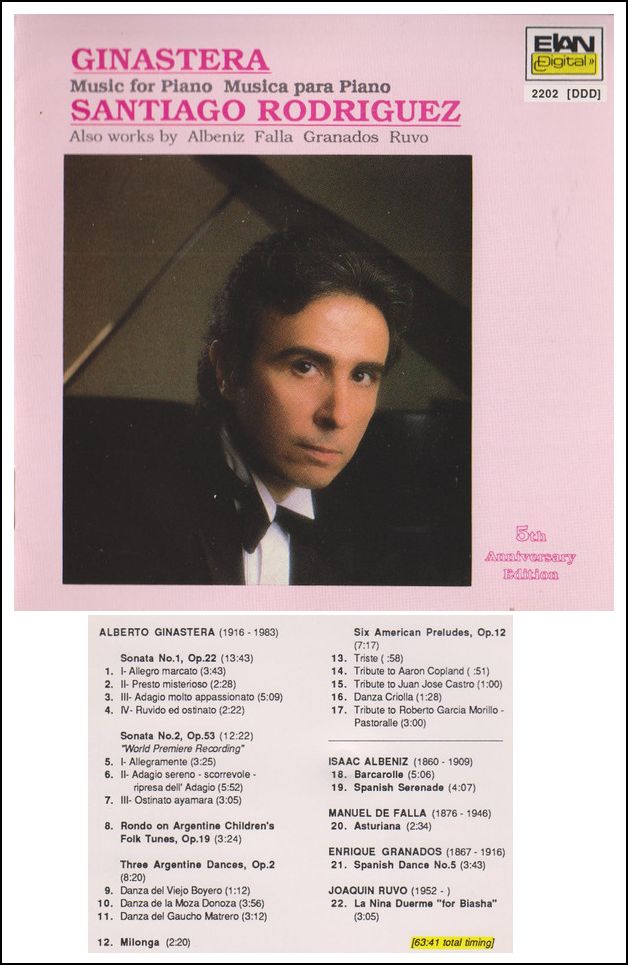
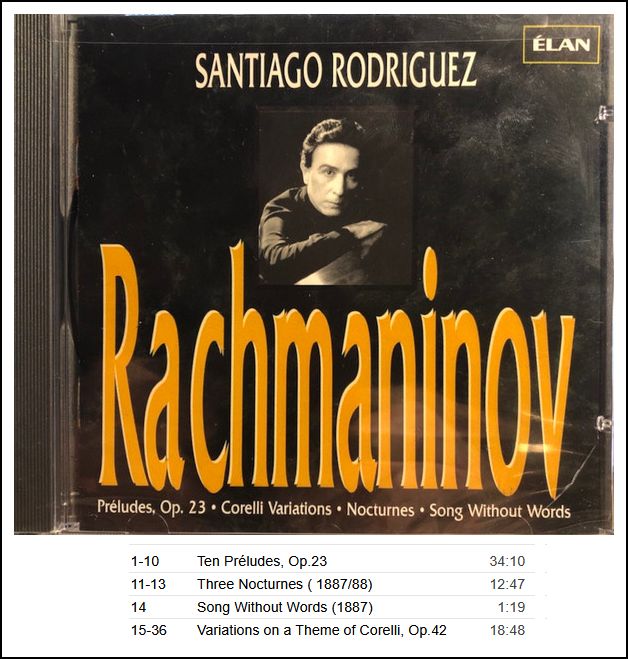
Santiago Rodriguez (born February 16, 1952) is a Cuban-American pianist. Rodriguez is an exclusive recording artist for Élan Recordings. His Rachmaninov recordings received the Rosette award in The Penguin Guide to Recorded Classical Music and he is a silver medalist in the Van Cliburn International Piano Competition.

Rodriguez was born in Cárdenas, Cuba, and began piano studies at age four. When he was eight years old, he and his brother became part of Project Peter Pan, a project sponsored by Catholic Charities which brought Cuban children to America during Fidel Castro’s regime. Although his parents originally thought that they would be quickly reunited, it took six years for them to immigrate to America. Santiago continued his piano lessons while living in the orphanage in New Orleans supported by money that his mother had sewn in his coat. When he was ten years old, Rodriguez debuted with the New Orleans Symphony Orchestra performing Mozart's Piano Concerto No. 27. He entered Holy Cross School in eighth grade, and graduated with the Class of 1969. Anthony Laciura and Dennis Assaf were classmates. Rodriguez completed his Bachelor of Music degree at the University of Texas and the Master of Music degree at the Juilliard School. After winning the silver medal at the Van Cliburn International Piano Competition in 1981, Rodriguez launched his international career.

Highlights include performances at Carnegie Hall, Schauspielhaus in Berlin, Leipzig’s Gewandhaus, Queen Elizabeth Hall in London, Montreal's Théâtre Maisonneuve, Alice Tully Hall in New York, The John F. Kennedy Center for the Performing Arts in Washington, D.C., and the Herbst Theatre in San Francisco. He has performed internationally with orchestras, including the London Symphony, the Staatskapelle Dresden, the Staatskapelle Weimar, the Yomiuri Nippon Symphony Orchestra of Japan, the Tampere Philharmonic of Finland, the Berliner Symphoniker, the Philadelphia, Chicago, St. Louis, Baltimore, Seattle, Indianapolis, American Composers, as well as the Houston Symphony Orchestras, the National Symphony Orchestra of Washington, D.C., and the American Symphony Orchestra at Avery Fisher Hall in New York. Festivals include the Santander Festival in Spain and the Ravenna Festival in Italy.

As a chamber musician, Rodriguez has performed with the Guarneri Quartet, Chamber Music Society of Lincoln Center, Ruggiero Ricci, Nathaniel Rosen, Walter Trampler, Ransom Wilson, Gervaise de Peyer, Aurora Nátola-Ginastera, and Robert McDuffie.

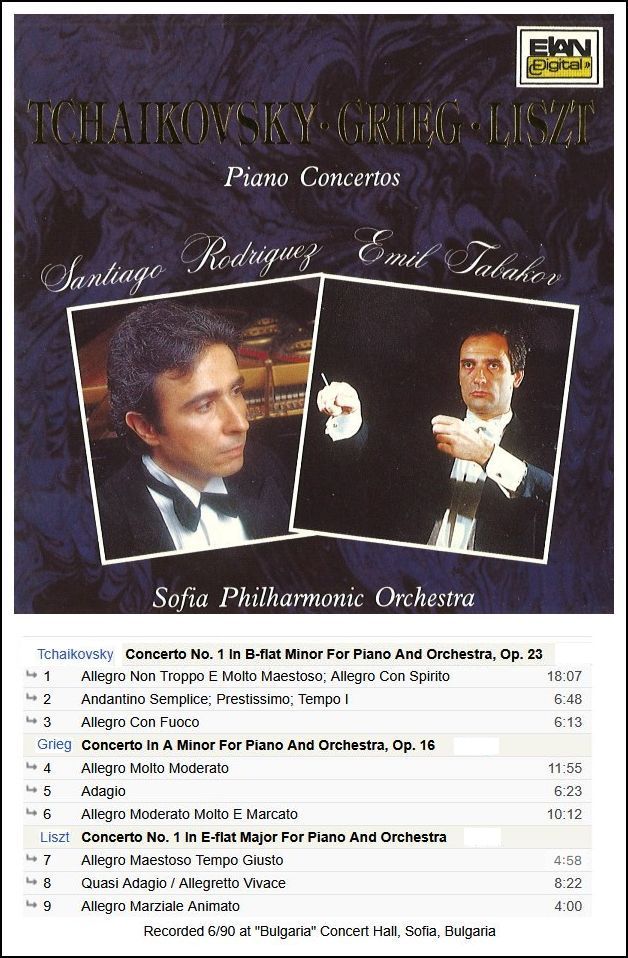
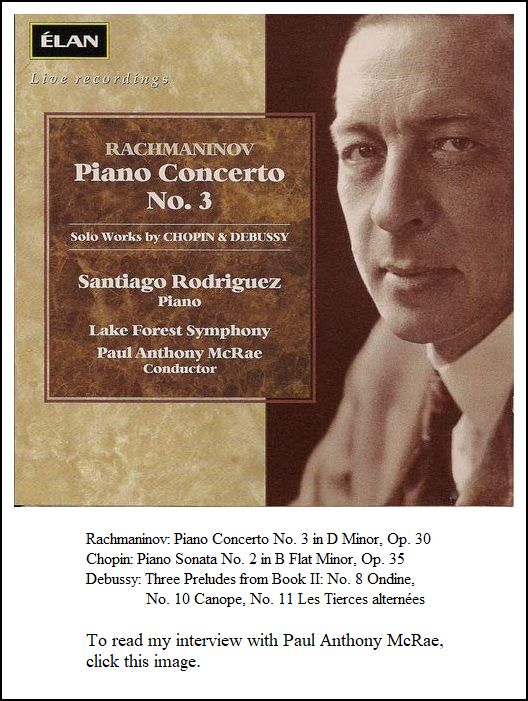
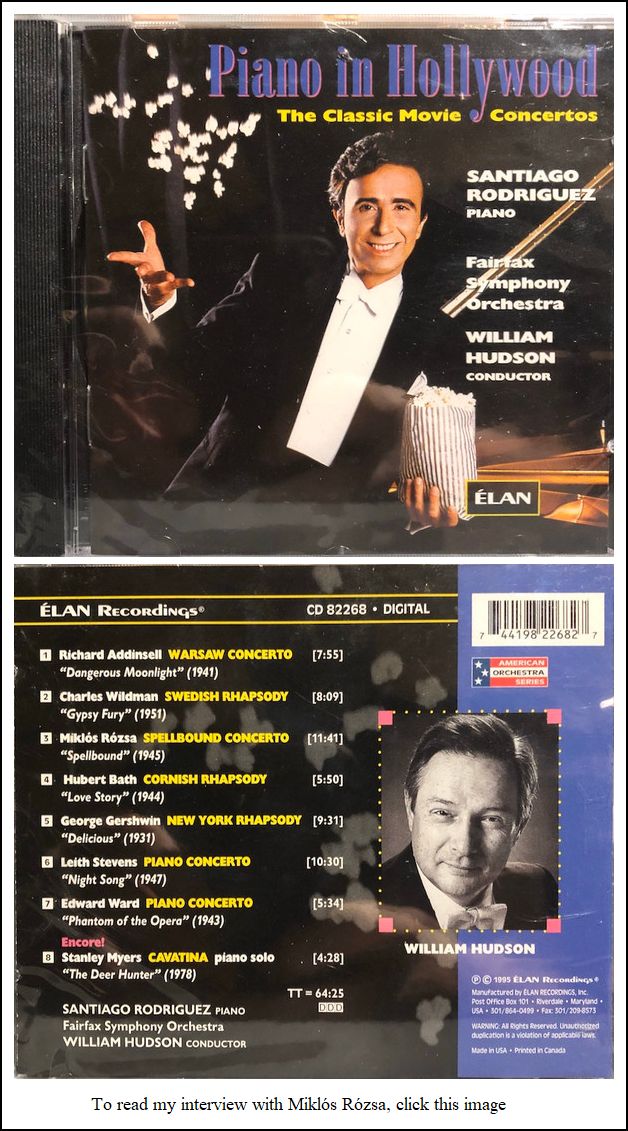
Rodriguez records exclusively for Élan Recordings, a record company which he and his wife, Natalia Rodriguez, founded in 1985. He has recorded for the label works by Rachmaninov, as well as some of the Spanish composers in which he specializes. Other recordings include works by Bach, Brahms, Ginastera, Liszt, Tchaikovsky, and Grieg.

Rodriguez is active as a pedagogue and masterclass clinician. In 1977, Rodriguez began his teaching career at University of Missouri in Columbia, Missouri. In 1980, he joined the University of Maryland, College Park as Artist-in-Residence and Professor of Piano. He remained there until fall 2009, when he moved to Frost School of Music at the University of Miami as Chair of the Keyboard Department, Professor of Piano and Artist-in-Residence. Rodriguez is also active as a judge for major piano competitions. Most recently, he was Chair of the Jury at the William Kapell International Piano Competition and the San Antonio International Piano Competition,


==  Names which are links in this box and below refer to my interviews elsewhere on my website.  BD  


rodriguez
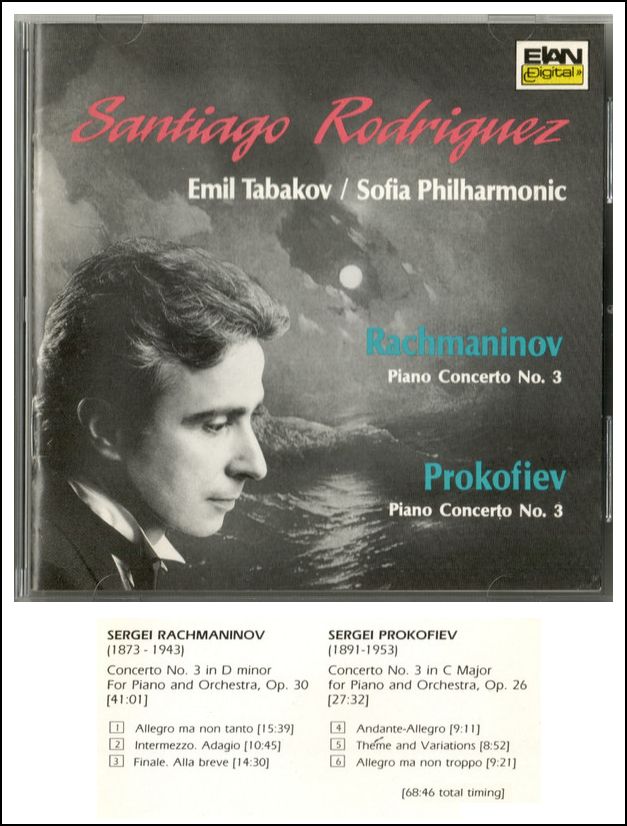
In May of 1990, pianist Santiago Rodriguez was in suburban Chicago performing the Prokofiev Concerto #3 with the Evanston Symphony.  He graciously took time from his busy schedule for an interview, and our discussion ranged from his repertoire, to his feelings about being a pianist.

We met in his hotel room, which was nice, but certainly not luxurious . . . . .


Bruce Duffie:   Do you like being a pianist?

Santiago Rodriguez:   Some days.

BD:   When do you like it best?

Rodriguez:   When I’m on stage.  The times I don’t like to be a pianist is when I’m flying, or when I’m in the hotel, but it’s worth the few minutes you’re on stage.  Also the practice, which is abominable.  It’s one of the few businesses that every day you have to keep practicing what you’ve been practicing since you were five years old.  It just never finishes.

BD:   Are you really practicing what you practiced when you were five years old, or are you actually getting better and doing new things?

Rodriguez:   [Smiles]  What happens is that it’s still the slave labor.  It’s just like you’re five.  You have to go practice, but you want to go to the movies.  No, you have to go practice.  It’s almost like your mother is in the back of your head.  It’s amazing how easy it was.  I was practicing over at Northwestern today, and I was sitting there with a bunch of students practicing around me.  If I had forgotten that I’m older, I could have thought I was back at Juilliard practicing along with somebody else practicing etudes on this side and Bach on the other side.  It’s just mind-blowing.

BD:   You studied at Juilliard?

Rodriguez:   Yes, but my main study really was done in New Orleans when I was a kid, where I grew up from the time I was eight-and-a-half till I was 17.  I had a very good private teacher by the name of Orville Klopp.  He was one of the real big influences in my life.

BD:   How early did you decide that you wanted to go into playing the piano as a career?

Rodriguez:   When I was 17 or 18, right before I went to college.  I went to University of Texas, and it wasn’t until I got there that I finally figured out that I could do this about as well as I could do anything else, so perhaps it should be something I could take seriously.  But the thing that got me was once you get into a music school, it’s a completely different set of influences.  Not only did I get the influence of the piano teacher, and the influences of the other students, but there were the theory, the solfège, and the composition classes.

BD:   You liked all of that stuff?

Rodriguez:   Yes.  That was another part of music I had no idea about.  Usually, as a kid in a nonprofessional setting, all you did was practice the piano, and do little concerts here and there.  Then the idea hit me that perhaps I enjoyed it.  I liked all the trials and tribulations of it, but I had no idea what to expect.  I don’t think anybody really understands what’s going on unless you’re really in the business for a long time.  You never know quite what to expect, because it doesn’t really count sometimes how you play these days.  More than anything it
s how long you’ve been playing, and how long you’ve been doing it.  I like to think of a career as something you look back on, not something you look forward to, because you really don’t know what to expect in a career.  You can’t say you’re going to have a career in music.  It doesn’t mean a thing, because a career is when you can go 30 to 40 years, and you can look back when you’ve been playing 60 to 70 concerts a year.  Then you can say you have a career.  But you don’t know at the beginning.  That all sounds so nice and fancy, 60 to 70 concerts a year, but then when you actually get to do it, and it isn’t really that pleasant an experience.  You hardly see your family, and much of the time you’re in a room about this size, doing absolutely nothing, either practicing or listening to music.

BD:   I’m surprised you don’t bring some kind of a keyboard with you.

Rodriguez:   I used to, but it’s so heavy that I started carrying it less and less and less.  When we go to our vacation house in the summer I take a portable keyboard along, because I don’t want to have a piano in the house during the summer.  So what I do is a silent practice to keep my muscles in shape, and if I have to learn some new repertory, I’ll do it at the silent keyboard... which is a real trip because you’re forced to listen in your head.  [Laughs]  That is the hardest thing.  Usually, when you’re playing, you get lazy and you’re listening to the harmonies.  But when you actually have to listen to that music while you’re reading it, it’s extremely personal, and you get a lot closer to it quicker than if you’re actually just drumming at it on a real piano.

BD:   Isn’t there some point when the mechanics just fade, and it becomes so natural that it is one piece rather than mechanics and music separately?
rodriguez
Rodriguez:   Yes.  The older you get, the more you start getting a certain confidence about the mechanism, and the younger you are, you have that less.  You feel more dependent on working on the mechanism.  It’s just a matter of getting older, and listening for different things in the art.  But the basics, which are just being able to play cleanly, and with speed and control, the things that will enable you to make music, are always the same.  In talking to people in the business, whether they’re violinists or trumpet players or pianists, say that they never have a day of liberty, that they really feel they can lay off and still be the same the next day.  No one, not even the super-duper virtuosos, the people that you think were born with a mechanical way of playing the piano so natural and so inbred that it’s almost inhuman, even those guys don’t admit to being able to lay off on the piano more than a day or two.  They say they would lose an edge, and it’s the truth.  The hands are not really built to play the piano.  We’re made to climb trees, or do something with the grabbing motion.  But the fine touch that’s necessary to produce real good piano playing, professional piano playing, is just not inherent in human beings.  Maybe a thousand years from now, when we have bred a new generation of pianists in the 15th or 17th generation of the next Orwellian World, maybe then the pianists will have gotten those fine muscles to react to very little practicing.  But now we’re still rather crude in how we make music, and the piano is rather a crude instrument to begin with.

BD:   [With a wink]  Might we first invent a machine that will fit our hands, rather than letting the hands evolve to the machine?

Rodriguez:   Well, probably.  [Laughs]  Anything is possible in this day and age of mechanical parts.  I find that very interesting, very futuristic.  I’m a rather big fan of science fiction, particularly futuristic science fiction.  I’m always curious to see what it would be in 2,000 or 3,000 years, even if the human race is still around.

BD:   Do you think that our music of today will be still around in 2,000 or 3,000 years?

Rodriguez:   [With a big smile]  Oh, I’m absolutely convinced that it will!  In fact, if we are able to get ourselves into some sort of situation like Orwell or other authors dreamed up, with cultures that are devoid of the human touch and human emotion, I think that this music of Beethoven and Chopin will be probably the way that society returns back to some sort of emotion.  It is music so beyond its time.  I was just listening to the Prokofiev Fourth Symphony, which is not one of his more popular works, but even something like that is just beyond an idea of how our music will ever become old.  To me, it sounds just as fresh now as when I first heard it.  I can imagine the people who heard it for the first time when it was composed.  When I listen to a Beethoven concerto, whether I play it or go to a concert to listen to it, I’m just mesmerized by not only the beauty of it, but the lasting quality.  Even an old salt at the piano like me, who has played it a hundred times, can still find a great deal of joy and satisfaction.  So imagine somebody who’s coming to it for the first time!  That’s an amazing thing.

BD:   You find joy and satisfaction in each of these repeat performances.  Do you always find something new each time you play an old warhorse?

Rodriguez:   I make a point of doing it like that.  I sometimes make a point of doing it in error, in that I try very hard to find something new, and something that is not in the final analysis.  Listening back to a performance, at something that is really honest, sometimes it’s a bit manufactured.  When I look at a piece, I try to learn from those experiences.  I try not to see more than is there, but I try to change a view of a piece, to make it more contemporary, or make it older, depending on how I’m thinking.  I’m always very curious.  I’m just a curious personality, period.  I’m one of those people who likes to look under rocks...

BD:   [With a wink]  You
re inquisitive.

Rodriguez:   Inquisitive, yes.  I’m always looking around for something I never heard before, or someone I never met, or something I never discovered, or food I haven’t eaten.  I’m just like that by nature.  So consequently, in the music I play, I’m always looking under each note, wondering whether I left something out.  Sometimes you can dig so much that you can just be hitting dead wood.  You’re really not getting anything new.

BD:   Then do you pile everything back on and re-dig?

Rodriguez:   No, then the thing to do is to just leave the work alone.  When I get to the wall with a piece of music, something that I feel I just can’t find anything else to say, I could sit there and imitate somebody else, but what good would that be?  It would just be a cheap imitation.  So I just leave it alone.  I find that if I put it away, it will hit me.  I’ll be driving a car or, water skiing, and something will pop into my head.  If it’s a possibility, you go back and look, and sure enough, the section which gave you trouble makes a great deal of sense.  But I’m always suspicious when a performer who is already known for a certain composer or a certain style just keeps polishing the apple.  After a while, you get tired of looking at it.

BD:   Then do you change the repertoire, by putting things away and taking new things out?

Rodriguez:   I take new things out as inspiration starts hitting me about these different pieces.  Sometimes you end up with some pretty weird-looking recital programs.  A year ago I wound up doing both of the Mozart sonatas in minor on one half, the C Minor first and then the A Minor.  I found such incredible possibilities in both pieces, not only for their foresight and what was to happen later in Beethoven and Schubert, but the amazing romanticism of these pieces.  It was almost as a reaction to the new wave thing of hearing everything on period instruments.  The incredible possibilities of the piano, not the fortepiano just hit me dead in the center.  I feel these pieces belong on the piano, but I’m sure somebody can make a case for the fortepiano.  So I made it a point of playing them on the piano, and I got extremely good reactions.  A few people were a little stunned in some places, saying I hadn’t heard Melvyn Tan doing them, but I said that yes I had.  I keep up with a great deal of music.  It
s like Glenn Gould using pedal in Bach.  That’s kind of interesting, but Glenn Gould is Glenn Gould.  He can do those things, but I firmly believe that really we’re looking at a real backlash of this early music interest that’s going on now with the period instrument.

BD:   It’s run its course?
rodriguez
Rodriguez:   No, it’s going to continue, and it’s going to help clarify a lot of things as far as how people in that period listened to that music.  But at the same time, people’s tastes change, and performers are going to begin getting the guts again, which they haven’t been doing in the past few years.  Theyll be going back and playing Bach on the piano, and not apologizing for using the piano.  We’re almost at the point where we pianists are going to start playing Bach using every capability of the piano.

BD:   Will we also be going to go back presenting the big orchestral transcriptions of Bach?

Rodriguez:   I certainly hope so, and I’ll tell you why.  I listened to the four suites of Bach, which I think are among his better pieces.  There’s a lot of pomp and circumstance in those pieces, as tragic as some of them sound, that there’s a tremendous ceremonial quality about them.  Very little really separates that music from Elgar, in my mind.  The circumstances were the same, the impositions of society upon the musicians were the same.  The composers were told to write something that the public can feel good about by listening to it.  I’m looking forward to a disc that will come out soon of Stokowski transcriptions that we don’t know.  There are hundreds of them lying in some library.  But Bach on the piano is something that’s going to happen, at least in my recital programs, when I get around to really committing 100% of my time to it.  To use the possibilities of all three pedals to play Bach is going to make a lot of sense.  I will try to keep some of what we learned from Mr. Gould and from the harpsichordists, yet at the same time not apologize that we have this wonderful new mechanism to advance in the piano.

BD:   In other words, Bach would have used the later piano if it had existed?

Rodriguez:   Exactly.  Everybody says if Bach came back, he would have certainly used the piano instead of the harpsichord.  I don’t know.  Maybe, but we can’t answer that question.  The point is why don’t we go ahead and try it, and see what his music would sound like on the piano.  Everybody talks about it, but really nobody has done anything about it.

BD:   So then the Rodriguez performance should be right alongside the Melvyn Tan performance?

Rodriguez:   I will insist upon that.  The one thing in my life that I can always fall back on, at least in my appearances, is that I’m not trying to fake anybody out.  I don’t do anything either to promote my career or my musical intentions.  I do what I believe in completely.  I
ve always been behind that in everything I have done since the early days of the Leventritt Foundation, which was the first touring things I ever did in this country.  I never try to fake somebody out by making a ritard here that wasn’t written, and just throwing my hands up in the air.  I’ve tried to avoid that part of music, which is the charlatanism that is so prevalent sometimes.  I not only insist on that for myself, but I hope that I am listened to with the same sort of ears that I’m putting to it.  An audience knows when you’re trying to finagle them, and to kind of lead them by the nose down a rough road.  They kind of chuckle at you if you’re not very serious.

BD:   When you’re playing any piece, are you conscious of the audience that is out there, that has come to hear you that evening?

Rodriguez:   At first I am.  You can’t help but acknowledge that there are people out there, simply because it’s a physical situation.  It would be preposterous to try.  It’s just like entering a room and not seeing anybody in that room.  Maybe there are some people who can be like that, but I certainly cannot.  I have to know there’s an audience there.  Then as you get going on what you’re doing, you have done it so often professionally that you know when to focus your attention on what you’re actually about.  Then the audience will get the results.  What I always find interesting, and one of the reasons that sometimes concerts prove to be rather bothersome to me, is that I know the performer is thinking of a thousand different things that I am experiencing as an audience member.  I’m hearing the music, and I’m hearing the final product of all that pedaling, all that technique, all that time spent with the score, while he’s up there thinking about the next note, and where he is going from here.  These are things that are practical.  It’s just like there’s no pilot in the world that will tell you that he lets his mind wander when he is trying to land an airplane.  There’s no pianist in the world that’s going to tell you he relaxes during the opening cadenza of the Tchaikovsky Piano Concerto.  This is the time when God reminds you that you’re human after all.  Being a performer is an interesting situation because you want to portray this person that does everything naturally, but at the same time, you’re really a working person up there.

BD:   But I assume it’s more than just a job.

Rodriguez:   It’s an adventure... no, it’s an art!  After a while, after all that practicing, this is where you don your tuxedo and get up on stage and put on a performance.  At that one moment it’s a job.  You’re being hired to do something, to entertain, to create some magic for people who can’t do it themselves.  Yet at the same time, you had to take a plane to get there, and that cuts you back down to size.  At least not yet, there’s no way of getting from here to there without making any effort.  The effort, and the boredom, and the hotels, and everything else usually play a part on how you feel.

BD:   But should the audience be aware that you flew coach in a cramped seat, and had a lousy meal on the plane?

Rodriguez:   Oh no, no, no, no, no!  Absolutely not.  The audience should only get the best... at least that’s the way I look at it.  No matter how bad the situation, even if the piano stinks, or the orchestra is not playing as well as they could, or if you are tired, or, like you said, you’ve been on a cramped flight the whole day, no, the audience should not be told about that.  You should just go out there and pretend you have been brought by four white horses in a carriage full of gold lace, and been carried on the stage by an armful of admirers, and put in front of the most beautiful piano in the world.  A performer does a real disservice to the art of making music by grimacing or acting unpleasant.  I don’t believe in that.

*     *     *     *     *

BD:   You mentioned being hired to entertain.  
Is there any balance between your artistic achievement and an entertainment value?

Rodriguez:   That’s a hard question.  The artistic achievement is measured by what you feel after a performance, and the entertainment value is measured by what the audience feels after a performance.  This is because 99% of the audience are not that artistically well versed to know whether any major depths have been touched.  They know if it’s been beautiful, if it’s been clean, if it’s been light, if it’s been heavy.
rodriguez
BD:   I trust you still try to plumb those depths.

Rodriguez:   Of course, But you see, that’s my job.  If I am just going to make it pretty, the audience will get absolutely nothing out of it.  It’s by my practicing of that piece, trying to find new meanings to those pieces, trying to do something significant, that the audience gets those basic feelings of whether it is beautiful, or if they loved the soft playing.  Even though you were not exactly thinking you’re going to play softly because musically it says that to me, the audience is getting something.  But if I was just going to say to myself I’m going to play this pretty, I don’t think the audience will even get it as being pretty.  They would just get that they heard it, and it was there.  The artist has to work very hard, and sometimes we get very little in return.  It’s almost like digging an enormous hole in the ground to come out with two ounces of gold.  But two ounces of gold is better than no gold at all.  For me it’s not dirty work.  For me, every day finding nuggets is important.

BD:   When you work the magic on the audience, is the magic Beethoven or Prokofiev, or is the magic Santiago Rodriguez playing Beethoven or Prokofiev?

Rodriguez:   It’s the latter... or really it’s the combination.  I have to feel like I have something to do with it.  If I was just a lackey for the composer, I wouldn’t be in this business.  There’s a certain amount of personal emotion and personal gratitude that a performer feels towards the composers.  No person, especially somebody like me who has tried to do some amateurish compositions when he was a student, can forget that painful reality of coming up with something which is downright terrible when you finally hear it.  You may have spent days and days putting this little fugue together for your teacher.  When you know that frustration, you can’t help but be thankful that people like Beethoven and Bach and Prokofiev were able to create such compositions with not only great beauty and intelligence, but great art together that’s been lasting for many, many years.  We have to acknowledge that the dirty part of music making is actually coming to a blank sheet of paper and putting something significant on it.  After you read of the many changes Beethoven did in his manuscripts, the amount of sacrifice, and the amount of gut-wrenching reality of just sitting there erasing and thinking inside his head of what to write when he was completely deaf, you can’t help but take your hat off and understand that this must be a bloody job.  So you feel thankful to the composer.  Yet, at the same time you want to put your own two cents in.  Maybe he wrote a ritard there, but it doesn’t have to be like the ritard which so-and-so plays.  It can be the ritard that I hear in my ear.  Neither the other pianist or myself is necessarily right or wrong.  That difference of opinion is what’s creating and perpetuating the art within those pieces.  If we had come to a quick conclusion of how to play Johann Sebastian Bach’s Second Partita or Italian Concerto, that music would have been long gone by now.  It would have gotten the same fate as some of the other minor composers who have come and gone, and that’s the end of that.  Their music is easily accessible and everybody has figured exactly how to play them immediately.  The greatness of these pieces by Bach is that they lend themselves, and, in fact, the greater the piece, the greater the amount of interpretation you can do to them.  I don’t think a piece like Beethoven will ever suffer an interpreter.  The interpreter will suffer.  But you can never damage Opus 101.

BD:   Is this what makes a piece great, that it can’t be killed or even damaged?

Rodriguez:   Yes.  You can’t kill it.  I have gone to the worst student recitals of people playing, say, the Pathétique Sonata.  You can’t kill the piece.  Somewhere in there, even in the most pathetic (!) performances of that piece, you will always find one or two measures where even the most insignificant, untalented human being can make sense out of it.  You can’t damage Beethoven.  That’s the great thing about him.

BD:   Do you have any advice for someone who wants to write music for the piano today?

Rodriguez:   First, I wish him a great deal of luck.  [Laughs]  I sympathize completely for him, because it’s certainly not an easy career.  It’s a very unforgiving career in that they’re well aware of what’s been written before, and that makes it so, so hard.  They almost suffer the plight of trying to find a new voice, or trying to find something significant to say using some new technique that hasn’t been invented yet.  That’s extremely difficult.  If somebody really has gotten beyond that point but they’re still going to write because they feel they’re a significant composer, then if they’re going to write for the piano, learn the piano.  One can’t write for the piano unless they know it.  It is the same for any instrument.  You can’t write a great violin concerto without knowing how to do something on the violin, or at least talking to a performer about the piece, or always checking if this or that is viable.  Then, if something’s impossible, how can I still attain the same success?  The piano is really quite easy to write for, because it has lent itself through history to so many different possibilities.  You can play inside the piano, like George Crumb.  He has composed four sets of Makrokosmos that have used almost every possibility of outside and inside piano work.


Crumb's most ambitious work, and among his more famous, is the 24-piece collection Makrokosmos, published in four books. The first two books (1972, 1973), for solo piano, make extensive use of string piano techniques and require amplification, as dynamics range from pppp to ffff. The third book, known as Music for a Summer Evening (1974), is for two pianos and percussion. The fourth book, Celestial Mechanics (1979), is for piano four-hands.

The title Makrokosmos alludes to Mikrokosmos, the six books of piano pieces by Béla Bartók. Like Bartók's work, Makrokosmos is a series of short character pieces. Crumb's first two books of Makrokosmos for solo piano contain 12 pieces, each bearing a dedication (a friend's initials, however he also wittily dedicates a piece to himself) at the end. On several occasions, the pianist is required to sing, shout, whistle, whisper, and moan, as well as play the instrument unconventionally.


rodriguez
BD:   Do you enjoy playing inside the piano?

Rodriguez:   When I’ve tried it with a second pianist, which we never got to play, he was much better versed with the techniques inside the piano than I was.  You have to put tape on the strings to make sure that you know which ones to pluck and which ones to strum.  You literally have to learn it like you’re learning how to play outside the piano.  But I enjoy the possibilities.  I’m floored that a composer can hear inside his head things that I haven’t been able to hear yet.  It isn’t until I actually get inside the piano and pluck these strings that I’m going to actually get this wonderful possibility.  I think the third Makrokosmos of Crumb is a masterpiece.  In fact, even the first two books for solo piano are masterful.  They are some of the best pieces written for piano in the 20th century.  Every time I listen to the Ravel Quartet, I just can’t believe that a guy heard that inside his head, and then wrote it down.  The possibilities are so unbelievable that it’s beyond me.  When I listen to these works, I keep wondering why I didn’t hear those things.  It seems so simple, because it’s just a series of notes that happens to fall in such a position that creates those sounds.  It seems so simple, but it took somebody very special to actually put those things together.  That’s what I find just totally flooring about composition.  In one case, Mozart basically took a one chord, a four chord, a five chord, and a five-seven chord, and made the 41st Symphony.  The whole last movement is basically a progression of one to five to five-seven back to one.  That’s all it is.  There’s a little fugue thrown in for color, but under anybody else’s hands, it could sound like Czerny.  We marvel at it, because Mozart made it sound very special.
 
*     *     *     *     *

BD:   With this huge repertoire that you’ve got, going back to Bach and Scarlatti right through George Crumb, how do you decide which pieces you’re going to play, and which pieces you’re going to let go, or which ones you will just postpone for a while?

Rodriguez:   First you begin with the practicalities of performing in public.  I enjoy playing pieces that I like very much, and where I have something important that particular season to say about those pieces.  But also, I have to figure that a program must be entertaining, and also that the evening must be planned.  If I was sitting in the audience, I would expect that courtesy.  I am a little bit hesitant to go to a one-composer evening.

BD:   Even all Beethoven???

Rodriguez:   Even all Beethoven.  To me, all Beethoven is too heavy.  I feel that after Op. 109, I want to go home and think about it.  I don’t want to be hit with Op. 110 and Op. 111, and then some bagatelles after that.  It’s just too much.  I’m a simple human being.  Even as much music as I’ve heard, and as much music as I deal with every day, Op. 109 alone in one half is plenty.  After that, I try to surround it with something that is going to frame it as the important piece it is.  To frame 109 with 110 is just masochistic.  Now, Mr. Serkin has been doing the last three sonatas for many years to great acclaim and great success, but I wonder if those people who go to those concerts can really say that they enjoyed 109, 110 and 111, or if they only enjoyed snippets.  I just don’t feel personally capable of enjoying more than one great sonata in one half.  Imagine a program of the Appassionata, the Liszt Sonata, and the Bartók Sonata in one program.  To me, that is totally too heavy.  I just cannot take that rich a diet.
 
BD:   You’ve got to have balance and contrast.  Just as there’s balance and contrast in each piece, you’ve got to have that in the program.

Rodriguez:   Exactly.  That’s the way I look at it.  For me, it works that way.  I’m not saying the other is wrong... nothing is ever wrong.
rodriguez
BD:   It’s just not you.

Rodriguez:   It’s just not me.  I tried to do that when I was in college.  I thought it was very cerebral to go out there and play one of the late sonatas of Beethoven, and then follow it up with some of the darker pieces of Liszt, and then finish with Mussorgsky
s Pictures at an Exhibition.  It looks wonderful on a program, but really its more like a gymnast eating healthy food.  After a while you wonder whether they’re really enjoying all that bran going down their gullet.  You want to have a little chocolate, and a little champagne... at least I do.  [Both laugh]  That’s the way I draw the recitals.  If I was sitting in the audience, what would I like to listen to?  When I go out there to play, I have to think of something that I’m comfortable in playing musically and technically, that’s going to make sense the whole evening, that I can end the recital and people will feel satisfied but not bloated, and that I will feel satisfied but not so exhausted that by the last piece on the program I have no energy left to give the composer.  I think of those things, and then each season I pick things from all this repertory that will surround great pieces.  I don’t play the late Beethoven sonatas any longer.  In fact, I play hardly any Beethoven now.

BD:   Can we assume that maybe 10 or 20 years from now you’ll come back to him?

Rodriguez:   Oh, I’m positive of that.  I don’t think anybody can ever lay off Beethoven forever.  What I’m discovering now is what many people found first, and I found later.  I’m becoming very interested in his symphonies, because I never listened to them before.  I thought I had heard him so often, but with the advent of the early period instrument performances, we have so many choices.  There is a Roger Norrington set, and a Hogwood set, but even Norrington with his Schubert 9th has made me think a lot about some of the clarity of this repertory, and has made me enjoy it even more.  I have not given up my Toscanini recordings or my Klemperer performances, or my Karajan and Bernstein sets.  I find myself really very comfortable listening to a Beethoven symphony.  What I don’t find myself comfortable with is either playing or listening to a Beethoven sonata.  Like you say, maybe it will take me ten years, or maybe less.  What I’m having a great deal of joy discovering is Mozart and Debussy, composers I never had in my repertory before.  I am also keeping up with some of the things that I always have had in my repertory, such as the Romantic composers like Rachmaninov, and more contemporary composers like Ginastera and some of the other Spaniards, which I’ve only gotten into my repertory in the past three or four years.  I never used to play Spanish composers.

BD:   With a name like Rodriguez, one might think that you would have played quite a bit of them.

Rodriguez:   Interestingly enough, I just stayed away from it.  I never really found anything to like in Spanish music.  All of a sudden, I heard a piece that wasn’t by a Spanish composer, but it was Chabrier.  I was listening to España, and all of a sudden it hit me that this is great stuff.  So I went back and I found de Falla, who I think is the greatest Spanish composer.  Anything by de Falla satisfies not only the musician in me, but my search for the darker side of Spanish music certainly is there.  If you’ve been to the Prado and seen some of the dark period paintings of Goya and listened to de Falla, the Fantasia Baética or the Four Spanish Pieces, you can’t help but put them together, even more than listening to the Goyescas of Granados.  I prefer the darker Spanish flavor right now, the more acerbic, the more chilling side of Spanish music.  The other stuff has been played well, and has been played a lot, so this part of the repertory needs discovering, and I play it a lot.

BD:   Is your heritage Spain or South America?

Rodriguez:   Spain.  Both of my parents are were born in Spain.  I’m a first-generation Cuban.  There was not much time that I actually spent in Cuba, since I left very early in my life.  So I didn
t get any sort of natural feel for the Spanish rhythms as something you hear every day.  I lived in Cuba until I was eight, when I immigrated to this country, and Ive been here ever since.  I’m 30 years now in the United States.  I’m going back to Spain to play and to visit.  I have still some family in Tenerife, where my father is from.  You feel like you belong.  There’s a part of you that goes, and I can understand where I came from.  Yet at the same time, I’m just so bloody American in everything!  I get back to Kennedy or Dulles Airport, and I’ll kiss the ground and feel that I’m home.  I love going overseas, but please get me home quickly.  I’m really so American that I have to force myself to understand some of my heritage, and even to spur my kids on to speak Spanish to keep that flame alive.  Even if it comes through de Falla and a little bit of Granados, I feel like I’m touching a part of me that has been hidden for nearly 30 years.  It’s only been in the past few years that I’ve been able to really get this emotion out of me to play this repertoire.  But I listen to it constantly all the time now.

*     *     *     *     *

BD:   When you get to a new city and you’re subject to whatever piano is there, how long does it take you to get into that piano and make it yours?

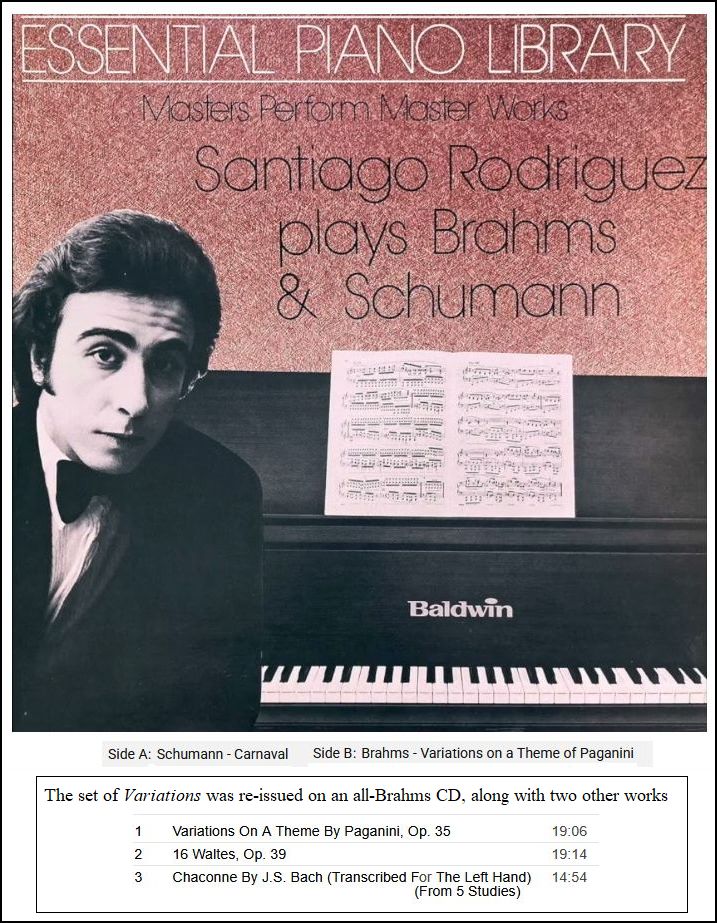
Rodriguez:   When you play in a town like Chicago or the surrounding area, you usually have a very good piano.  I’ve been playing Baldwins all my life, and they sent me a very good Baldwin to play here during my visit.  The last two times I was in Chicago, Baldwin also provided a good piano, so it hasn’t been that big a deal.  Around the country, Baldwin has pretty well taken care of most of my needs.  Of course, sometimes you get into a city where the piano didn’t get delivered because of a snowstorm, so you have to get used to the local piano.  This is because you arrive the night before the concert, or the day of the concert, and there’s just no other way of doing it.  For me, the best way of getting adjusted is always to forget what’s bad about the piano, and just try to bring out what’s good.  Very few things could possibly be worse than a piano which is dull and stiff at the same time.  This makes it hard to play.  What you try to do is not play beyond the piano
s possibilities, because what happens is you look like you’re working very hard up there.  But the audience is not listening to anything significantly louder, so you look like a fool.  Your tonal palette will be sacrificed, and your performance will be compromised because of the sound of the piano.  That’s a real problem for us pianists.  We’re at the mercy of the pianos we play on.  But at the same time, a satisfying evening can be made if you just don’t let anybody know that you’re having a tough time.  If you start grimacing, or telling everybody how terrible things are, you only make it uncomfortable not only for yourself, but for everybody else.

BD:   Whether it is good or bad, do you try to make the piano sound like you, or do you simply try to get the best out of the instrument, whatever that is?

Rodriguez:   You begin by trying to do what you want to do, but you have to meet the limitations of the instrument.  Unless the piano technician is there and can do quick work in a few hours, then of course, you have them fix whatever is probably wrong.  Baldwin has sent technicians for me all around the country.  But sometimes they either can’t get there in time, or the situation is so tight that nothing can possibly be done.  So you do the best you can with what you have.  You don’t do anything less.  You don’t ever think that a small town has nobody important.  The first time you do that, it will only be a temptation to do it the second time, and then the third time, and after that you’ll probably even take a drink before you go on stage.  Then, it can get ridiculous.  You always try to be very well prepared, and be very well warmed up.  You try to do everything like you normally do for a good performance.  At the same time, if the piano doesn’t want to play any louder than forte, then you sit there and you play forte.  You can’t play fortissimo that night.  But as you continue in this business longer and longer, there are things you can do musically, even with the tempo.  You can adjust the music to fit the piano sometimes, and that can make the piece almost as effective as if everything was working together.  Those changes are usually done on the spur of the moment.  They are things that hit you at the time.  [Pretending to think out loud]  If I just put the soft pedal down here, that way when I let it go in that forte section it will sound twice as loud to the ear.  [Both laugh]  Little tricks like this you develop over the years that make you react.  But, knock on wood, in about 85% of the places that I play, I would say that the piano situation is really quite good, even in the smaller towns, which is a lot better than it was 15 years ago.
rodriguez
BD:   Is this because Baldwin is making more pianos available?

Rodriguez:   Baldwin has always been very good about that.  But even in places you would consider small towns, with 100,000 to 150,000 people, or even 60,000 people, they have gotten quite sophisticated.  Whether it’s a university town or simply professional people, they’re really quite sophisticated, and they make a point of getting a good piano.  Then, if I can’t get a Baldwin that night, and I have to play the house piano, whatever make that may be, it usually turns out to be a decent instrument.  Although not as fast as getting good pianos, another improvement in the piano world has been that we’re getting better piano technicians who are more understanding.  They’re not just tuners, they’re technicians.  I always prefer to work with a technician, a person who really knows the piano inside out, and who can translate some of my more idiotic comments, like,
“It feels mushy, or, I feel like I’m playing in a waffle.”  I just hope the person doesnt think, He needs a psychiatrist, not a piano technician.  [Both laugh]  We’re getting more and more intelligent young people into the business, and that’s very important.  In fact, I sometimes recommend that pianists who don’t particularly care that much about performing become piano technicians, because they have a basic knowledge of what to do, yet they’re put in a business that’s still music.  We are so dependent as professionals, and I would like to see more people become piano technicians if they actually don’t like all the weight and all the pressure of performing in public.  They’re able to make pianos sound beautifully for somebody who doesn’t mind getting in front of the crowds.  I don’t know a thing about being a technician, and I would like a good technician to tell me exactly what they’re doing.  Then, instead of saying I’m playing in a waffle, I can explain more exactly what I need.  We are getting a lot more of these folks in the business.  Before, they were limited to big towns like Chicago or New York or Los Angeles.  Now you find very competent technicians in smaller towns, often in the employ of universities.

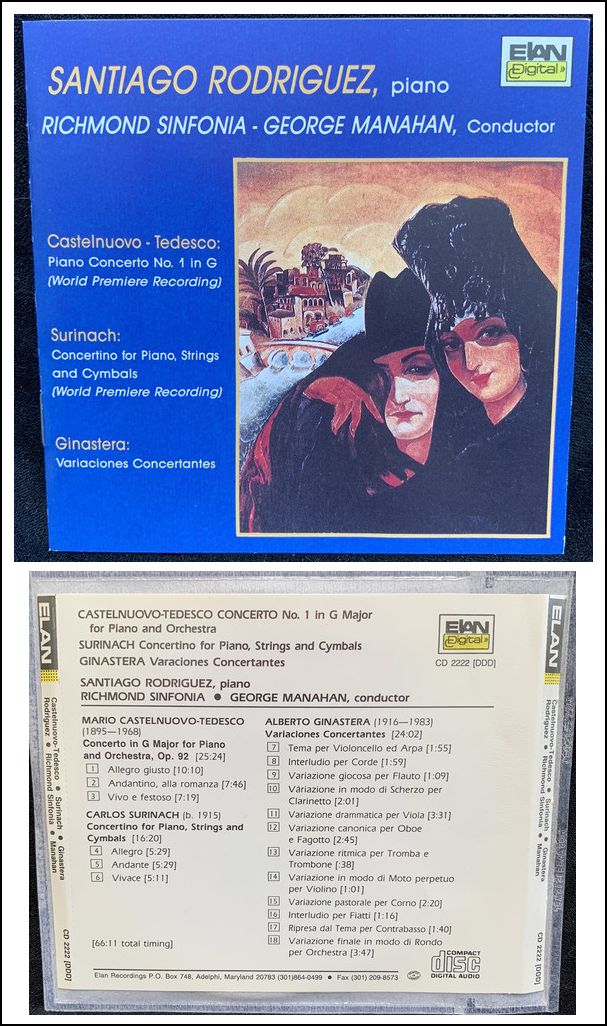
BD:   If you were very wealthy, would you travel with your own technician?  [Vis-à-vis the recording shown at right, see my interviews with Carlos Surinach, and George Manahan.]

Rodriguez:   Yes, that would probably be possible.  In fact, I would probably travel with my own technician before I would travel with my own piano.  But I would like to meet the person who says they have all the money they need!  [Laughs]  Everybody always needs something or other.  If somebody offered me the choice between a private jet and a piano technician, I would always choose the piano technician.  I love piano technicians.  I’m a big fan of them, and I’m just very happy that some of them haven’t lost their composure when they’re handling people like me, who sometimes cannot describe the situation very well.  I would travel with one all the time, or I would have one or two in different sections of the country that I could just call up and have them meet me at the venue.  I would certainly pick a piano technician over any other convenience in my life, because they can literally make a bad piano a great piano overnight.

BD:   If you were endowing a school, it wouldn’t be a chair for teaching piano, but rather a chair for teaching piano technology?  [Note that I have interviewed Franz Mohr, who was Chief Concert Technician for Steinway 1968-92, and composer Leon Levitch, a Holocaust Survivor and a significant piano technician for many years.]

Rodriguez:   Instead of giving only scholarships, which are very important of course, I would also give money to hire a piano technician to get in there and do those pianos.  In one of his otherwise wonderful books, Alfred Brendel wrote a famous phrase, saying that a piano is only as good as the person who plays it.  I feel this is complete bunk.  A person who plays is really only as good as the piano he plays on.  I have heard some of the greatest artists sound completely insignificant on bad pianos.  Because of their poor sound, the piano made a tremendous artist sound like an amateur.  Their articulation is nullified by the bad instrument they’ve been put in front of.

BD:   Then each piano is only as good as whoever works on it?

Rodriguez:   Exactly.  I believe so.  We had a problem with one of the pianos, so I called Baldwin and they recommended a guy.  He came and had this piano rip roaring overnight!  I thought this piano had no life in it, so I just gave up.  I said to chop it up and put it in a fireplace!  But he made this piano really come to life.  Little miracles like this can happen.  This past season I had a wonderful technician who worked on a piano in Mexico City.  This man put a piano together for me in just a couple of days.  Again, I thought that there was nothing to be done with the instrument.  There was no top, no bottom, no middle, no nothing.  But the piano was spectacular by the time the concert came around.  We were doing the Brahms First Concerto, so you know you needed a good piano.  I can’t praise piano technicians enough.  If we can get some of the old hands who have been doing great work for many years into the teaching profession of other piano technicians, and we can get people who love the piano into becoming piano technicians, that is where musical education should go.

BD:   Rather than just more pianists?

Rodriguez:   Yes.  We’ve got plenty of pianists, though I would never discourage a kid from becoming a pianist.

BD:   Do we have too many pianists?

Rodriguez:   No, I don’t think we ever have enough of anything that is good.  If a 12- or 13-year-old kid out there is thinking of becoming a concert pianist, I say go ahead, go for it.  When they get to be 17, they’ll realize how stupid it is, and when they get to be 21, they’ll despise their talent.  When they get to be 30 and have been in the business for a decade, they’ll despise airplanes.  But if you are really good, and you make it through this labyrinth of managers and concert life, you’ll be adding something significant to the human existence.  There’s never enough of a good thing in any field.  We always keep making things better and better.

*     *     *     *     *

BD:   Do you play the same in the recording studio that you do in the concert hall?

Rodriguez:   I personally always try to.  I like long takes with as few splices as possible.  I don’t view the recordings like a concert.  Recordings are going to be more permanent, so consequently I don’t want the recordings to go out there with any clinkers on them.  I sometimes will sacrifice a clinker for something that’s really impetuous and really to the point, where there is no point in doing it over again just because of a fractured note here and there.  I view recordings like films.  I don’t think anybody who goes to a theater to look at a film is asking how many times the actor forgot his lines before he got it right.  In one particular movie, with that famous line,
Dr. Livingstone, I presume? they said that Spencer Tracy needed many takes of that line because he couldn’t keep from cracking up.  When I play, I don’t want anybody asking if the record took a hundred splices.  It’s just one recording, and when they listen to me live, it could be different or it could be the same.

BD:   Does a recording with a few splices set up an impossible standard that you can’t duplicate in the live concert?

Rodriguez:   No, because in a concert, a person who knows a concerto will listen inside and out.  I might listen to a certain work being played by somebody else, and they make a couple of mistakes.  But by the end of the performance I really can’t remember where they made those mistakes, unless I go back and listen to a radio aircheck.  Then I will notice that he messed up the octaves, or she messed up that run.
rodriguez
BD:   Then, when you get to the end, do you have a feeling that he made a couple of mistakes, or was it a great performance even with the problems?

Rodriguez:   I don’t worry about mistakes in a performance.  When I’m playing, if I’m worried that I’m going to make mistakes, not only do I end up making a lot of mistakes, but I don’t really play that well.  I try to free myself from that straight jacket of trying to sound perfect.  Sometimes I sound about as clean as humanly possible, but without sacrificing any of the impetus or any of the drive of the performance.  But even listening to other people, when I go to a performance, I go not expecting perfection.  I go wanting to be shown something different, to be given something important to take home with me by looking at the artist play.  My heroes were people like Rubinstein and Horowitz, two pianists who were never note perfect in public.  I heard them both play in New York, and it didn’t matter if they forgot something, or if they dropped this note or that octave.  At the end of the evening, a sensitive musician interested in the art can’t remember mistakes.  The problem with a recording is that it is a document to be taken out of this little jewel case and plunked in that player.  It can be repeated in your house, and if there is a major clinker in the recording, unfortunately it will take away some of the satisfaction of listening to that piece of music.  You don’t listen at home with the same intensity and the same ambiance of a concert.  In a hall, you’re in a place where anything can happen.  Simon Barere died in the middle of the Grieg Concerto in Carnegie Hall.  If you’re sitting in the balcony, you’re going to get a different sound than if you’re sitting right at the stage.  People in the balcony might think the pianist had a great right hand, while people on the left of the main floor could think he had a great left hand.  Other people will think he didn’t have any articulation whatsoever.  It depends on where you sit in a hall.  To me, a hall is one of those places you go, and like any new experience you don’t know what you’re going to find.  Even though I’ve rehearsed the pieces, and I’ve killed myself over this and that particular detail, I go on stage and the first thing that comes into my mind is that anything can happen.  The conductor can forget to give the downbeat.  The flute soloist can forget to come in.  Something can always go wrong, or something can always go better than you expected.  The hall ambiance is like a new ballgame every night.

BD:   Do you have any great stories about conductors getting lost, or flutists throwing their music at you?

Rodriguez:   The worst thing that can happen while playing in public is something beyond your control.  For example, the top of the piano starts sliding down because one of the hinges is loose, like it did while I was playing the Funeral March Sonata of Chopin.  Every pianist has a similar story.  One time I was playing in Jackson, Mississippi, and they had built this wonderful new concert hall.  I was playing a recital, and smack in the middle of the G Minor Ballade I realized that the right pedal didn’t work any longer.  For the first time and only time in my life I’ve ever had to do this. I got up and said I cannot play without the pedal.  Everybody was in a nervous titter, and I tried to make it as casual as possible.  I asked if there was a technician in the house, and three guys come streaming down the aisle in tuxedos.  It was a very formal affair.  They dove underneath the piano, and I went back to the dressing room.  Fifteen minutes later I checked the pedal, and everything was fine.  So I finished the concert, played encores, and after it was over, these three guys showed up backstage.  They just didn’t look like piano technicians... they wound up being three physicians that threw themselves underneath the piano to fix the pedal for me.  [Both laugh]  They said they just liked the music, and didn’t want it to stop.

BD:   They figured they could find the problem and fix it.

Rodriguez:   They figured it out.  If they can take out a gallbladder, they can fix a pedal.  It didn’t seem to be that difficult a proposition.  [More laughter]  It is unintentional humor, as Brendel calls it.  Every so often, while playing with the orchestra, you’re sitting there and thinking to yourself that it would be nice if something impromptu would happen.  Maybe if the tempo got faster, or the conductor lost his place... or if I lost my place!  There’s a little devil inside all of us.  The concert hall is the place for adventure.  I like those performances where things happen that are so unforeseeable.  The possibilities are not there at the rehearsals, and then all of a sudden it comes together in performance.  I did a concert in Boston with the Boston Pops.  It was a summer concert, and it was the first time I ever worked with John Williams, the famous movie composer.  He turned out to be a really disciplined guy.  Interestingly enough, he studied piano with Rosina Lhévinne.  We did the Prokofiev Third Concerto, the same work I’m doing here.  In the rehearsal, everything was real stiff and belabored.  The Boston Pops is really the Boston Symphony minus some of the players, so they are always good.  But I was kind of tired, and they were tired because they had a concert the night before.  I figured it would just be OK.  But when we got up there that night, it was so fast and so clean!  It was exciting, and the people went crazy.  The conductor hugged me, and I hugged the conductor.  It was just one of those wonderful nights, and you could never have guessed at the rehearsal that it was going to happen.  I mention that because usually summer concerts are put together quickly.   But this was one of those memorable things that happened when you least expect it.  The hall is like a circus, and anything can happen.

BD:   The Prokofiev Third Concerto was the one he wrote for Chicago.

Rodriguez:   Yes.  He did it in Chicago with Frederick Stock conducting.

BD:   Is it special to play this in the Chicago area?

Rodriguez:   I always thought it was apropos to do any Prokofiev in Chicago, since he got lambasted here.  At the same time, he got probably his first real taste of American success here, even more than New York.  Love of Three Oranges was premiered here in Chicago, too.  Chicago and Prokofiev go hand-in-hand, and I’m very honored.  It’s a sensational orchestra.  I worked with them in Ravinia one summer [August, 1984], and if they’re not the greatest orchestra in the world, I don’t know who is.  It’s just beyond belief when I listen to them play.  I have listened to their recordings since I was a kid, but to actually sit there playing the Tchaikovsky First Piano Concerto was very special.

BD:   How does the Evanston Symphony compare with that kind of sound?

Rodriguez:   Of course, it’s going to be less accomplished, but it is fantastic.  What you find now with local orchestras, and with smaller budget orchestras, is that because of the many musicians that we graduate from colleges and universities, they’re able to do things that they could not attain 20 years ago.  The professionalism and the level of musicianship with the young players has just become incredible.  In any part of America, even in the smallest corners, you find not only competent music making, but inspired music making.

BD:   Is this partly due to the accessibility of records and television and radio?
rodriguez
Rodriguez:   Absolutely.  People want to play up to the level that they listen to, and the more kids we graduate, the better these local orchestras are going to become.  There are only so many spots that can be filled by the Chicago Symphony, or the Boston Symphony, or the Cleveland Orchestra, and the other orchestras matter very much.  I don’t care how big or small the career, nobody will ever subsist only on playing big dates.  We all have to go to the middle part of the country and play the smaller towns.  But now these orchestras are so good that most of the time it’s a pleasure to go play there.

*     *     *     *     *

BD:   I wanted to be sure and ask you how you divide your career between concertos and solo recitals.

Rodriguez:   I try to do as many concertos as I can.  This is not simply because they’re much easier to do than recitals, but it’s easier to play four dates with the symphony and be there for a while.  You feel like you can take your clothes out of the suitcase and hang them up.  When you play a recital, you don’t even bother to empty the suitcase because you literally are living a one-night existence.  This year I’m playing about 70 concerts, and 20 are recitals.  The rest are all orchestra dates.  Some years it’s about half and half, but I don’t mind either one.  To me a performance is a performance.

BD:   Are you now where you expected to be at this stage of your career?

Rodriguez:   Absolutely.  The wonderful thing about my career is that I’m calling my own shots.  I have always wanted to be able to combine my career and my family, and to have done one without the other would have been just impossible.  To have done the career while trying to establish a family is also impossible.  I was able to find the right woman at the right time to have the right children, and at the same time be playing the piano.  It’s all falling into place, and I am doing exactly as I feel God intended me to.  I’m just very thankful that I’m still playing, and hope that I get to the day that I can look back and say that I’ve been playing the piano steadily for 40 years.

BD:   I hope that happens.  Thank you for chatting with me today.

Rodriguez:   A pleasure.  It was a lot of fun.
 Being on the radio really helps out a lot.  It is wonderful that you have this sort of programming.  When I was a student in Austin, Texas, one of the first stations that did classical music the whole day was a non-commercial music station.  They sent out a program guide, and they had all this classical music on.  Most of my experiences of knowing various conductors and orchestras came from that radio station, because the records were too expensive for me to buy.  Just by turning on my radio, I could get all this music, and listen to various interpretations.  It was just flabbergasting!

BD:   It’s lots of fun, and I enjoy it.  I’m also a great proponent of new music, and Ive done a lot of interviews with composers.  The CSO did the Corigliano First Symphony, and it was recorded by Erato.  It’s about 42 minutes and when I talked with Corigliano after a concert last week, he said he hoped it would come out soon.

Rodriguez:   Corigliano is here as a composer-in-residence?

BD:   Right.

Rodriguez:   Oh, wonderful.  With his music, this orchestra should be sensational.

BD:   They’ve played several of his pieces, including the Clarinet Concerto [with Larry Combs], but this was the first thing he wrote for them.

Rodriguez:   If they did the film music for Altered States, the brass would have a field day.  It’s a great piece.  It’s a very artistic piece, even though it’s film music.  His Piano Concerto is fantastic.

BD:   Have you played it?

Rodriguez:   No, but I’ve studied it.  I wish people would ask me for it.

BD:   Aren’t you in a position where you could say you would like to do that?

Rodriguez:   I put out a feeler about it, and the Busoni Piano Concerto.

BD:   That
s seventy-five minutes, and has a chorus, too.

Rodriguez:   Yes.  I’d come out in a cape with that.  I love the romance.  In fact, I would like to have that nude choir of men in the back.  [Both laugh, but that is what the composer called for!]  These pieces need to be played, and I think the Busoni is a masterpiece.

BD:   There’s a new recording of it with Garrick Ohlsson.  I haven’t heard it yet...

Rodriguez:   Oh, it’s great.  Garrick’s a fantastic performer.  He’s spectacular.  John Ogdon brought it to prominence, and then it laid aside.  Garrick brought it in with the Cleveland Orchestra [conducted by Christoph von Dohnányi], which I thought was a masterstroke for them.  That piece should be heard all the time.  Certainly, I would like to hear it more than I would the Emperor sometimes.  Give the Beethoven a rest for a season, and do other things, so when we hear it again we’ll realize what it is, and we won’t take it for granted.

BD:   It would be great if we could get away with it.

Rodriguez:   Yes.  I just heard a recording of Maskarade of Nielsen.  That’s a fantastic piece.  In fact, I can
t believe that the Nielsen symphonies are being recorded by two or three different labels.  Sibelius is being done by five or six different ones.  I remember when I was a junior, in order to get one recording of a symphony by Sibelius or Nielsen, you had to go to a Scandinavian import shop, and get something that came in underneath somebody’s coat!  [More laughter]

BD:   J
ärvi is recording everything.

Rodriguez:   In fact, it was his Prokofiev 4th I was listening to with the Scottish National Orchestra.  He
s also doing Tubin symphonies.

BD:   That’s right.  Tubin wrote a Balalaika Concerto.  I was on a cruise to Alaska and I met this balalaika player named Sheynkman, and I did a little interview with him.  Then, when he had a birthday I found the Tubin Concerto with him and Järvi, and I played it.

Rodriguez:   Fantastic.  I love it.  Things by Arvo Pärt are also coming out.  Most of his works are becoming very well-known.  He’s so mesmerizing.  You can’t but just sit back and wonder why this guy hasn’t been played more.  My wife has a couple of old scratchy Russian records of Pärt, and that was the extent of his notoriety until BIS started coming out with his stuff.  Now ECM has started...  [And with that we thanked each other again, and wished each other continued success.]


= = = = = = = =                = = = = = = = =                = = = = = = = =
-----                -----                -----
= = = = = = = =                = = = = = = = =                = = = = = = = =


© 1990 Bruce Duffie

This conversation was recorded in Evanston, Illinois, on May 9, 1990.  Portions were broadcast on WNIB in 1997.  This transcription was made in 2026, and posted on this website at that time.

To see a full list (with links) of interviews which have been transcribed and posted on this website, click here.  To read my thoughts on editing these interviews for print, as well as a few other interesting observations, click here.

*     *     *     *     *

Award - winning broadcaster Bruce Duffie was with WNIB, Classical 97 in Chicago from 1975 until its final moment as a classical station in February of 2001.  His interviews have also appeared in various magazines and journals since 1980, and he continued his broadcast series on WNUR-FM, as well as on Contemporary Classical Internet Radio.

You are invited to visit his website for more information about his work, including selected transcripts of other interviews, plus a full list of his guests.  He would also like to call your attention to the photos and information about his grandfather, who was a pioneer in the automotive field more than a century ago.  You may also send him E-Mail with comments, questions and suggestions.