Composer Allan Blank
A Conversation with Bruce Duffie
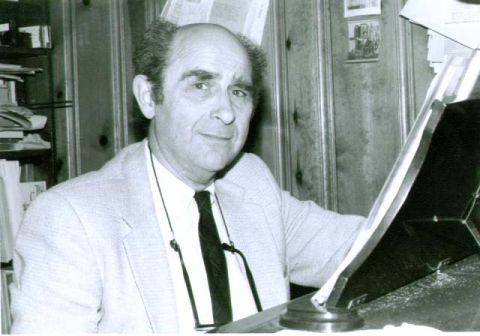
Allan Blank (December 27, 1925 – November
12, 2013) was an American composer who has more than 60 published works.
He attended the Juilliard School of Music (1945–47) and obtained a bachelor's
degree from Washington Square College (1948). He received a master's
degree from the University of Minnesota (1970) and also studied at the
University of Iowa. He was a violinist in the Pittsburgh Symphony Orchestra
(1950–52). He taught composition at Western Illinois University (1966–68),
Paterson State Teachers College (1968–70), Lehman College (1970–77), and
at Virginia Commonwealth University (1978–96).
In 1985 he received a commission from the New York State Council
on the Arts' Presenting Organization to compose "Quintet for Clarinet
and String Quartet" for the Roxbury Chamber Players. Other awards include
the First Prize in the George Eastman Competition (1985) sponsored by the
Eastman School of Music for his "Duo for Bassoon & Piano", and a grant
(1985) from the National Endowment for the Arts to support his one-act
opera, The Magic Bonbons. The Virginia Shakespeare Festival
at Williamsburg commissioned Blank to write music for their production
of Measure For Measure. In 1990 he was awarded a grant from the
Virginia Commission for the Arts to commission his "Concerto for Clarinet
and String Orchestra." The concerto was premiered by David Niethamer with
the Richmond Symphony Orchestra, George Manahan, conductor,
and was recorded on MMC Recordings in 1994 by Niethamer, with the Silesian
Philharmonic Orchestra, Jerzy Swoboda, conductor.
Blank died at the age of 87 on November 12, 2013, due to complications
from the effects of a brain tumor. He was predeceased by his wife, artist
Margot Blank, a Holocaust survivor, whose papers are archived at the
Virginia Holocaust Museum in Richmond. In 2017 Old Dominion University
honored composer Blank with a concert. The composition notebooks of Allan
Blank are archived at Old Dominion University.
== Names which are links in this box and below
refer to my interviews elsewhere on my website. BD
|
In June of 1995, in preparation for a program celebrating
his 70th birthday, I made contact with composer Allan Blank, and he
graciously allowed me to call him on the telephone for an interview.
Portions were aired on WNIB, Classical 97 later that year, and again
five years later.
Now, in 2026, I am pleased to present the entire conversation.
Bruce Duffie: You’ve been a composer and
a teacher for many, many years. How do you divide your time between
those two taxing activities?
Allan Blank: [Laughs] I was born in
New York City, and I found myself at a point in my mid-twenties that
I was teaching there. I started out teaching in junior high schools
and the high school, and I found out that if I wanted to compose, I
had better do it every single day. I really developed a very firm
discipline, and would give it part of my day. When I first started
to teach in the junior high schools, I would compose from 3 PM until about
5 or 6 PM. Then I might work a little bit in the evening after dinner,
and it has gone on like that continually. I would also work on the
weekends. I really tried to maintain a daily schedule, and I must
say that it’s very, very rare that I go for extended periods without doing
something related to my work. I am not one for working very long hours
at one time, but I will work very intensively, and then move away from it
to do some other things, and then come back to it again. That’s generally
been my approach. Since 1978 I’ve been at the Junior Commonwealth
University, and I follow exactly the same procedure. Of course, the
schedules are different, and sometimes I can work for an hour or so in the
morning before I go in to school. Then I work again when I come back
in the evening. So, I manage to put in time every day, and on the
weekends, too.
BD: When you start to work, can you command
the ideas to come, or do you resurrect ideas that you’ve thought of
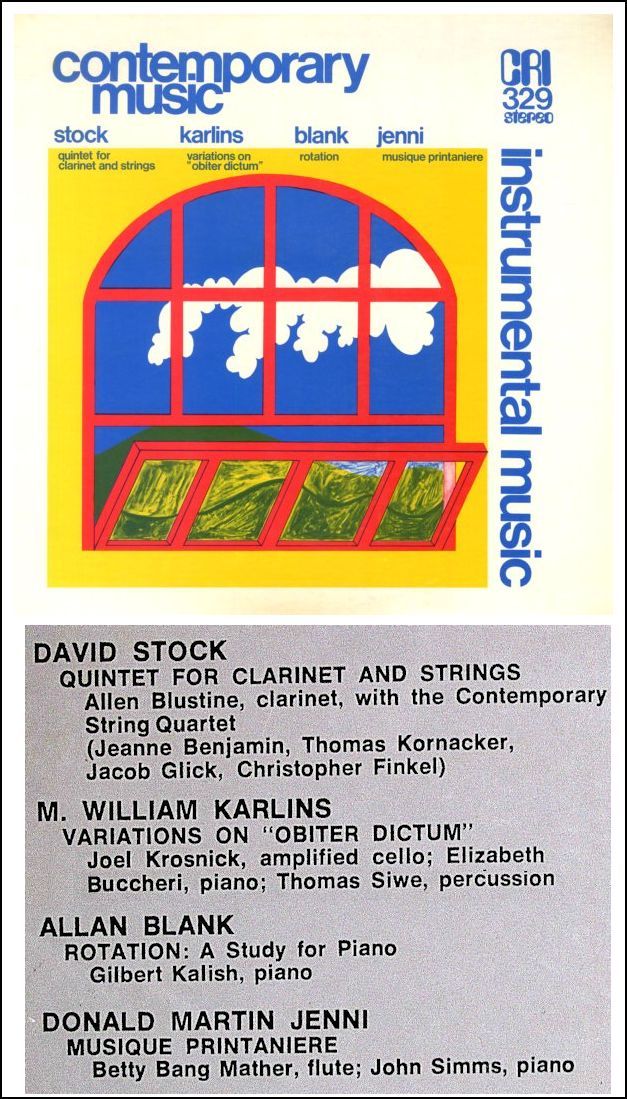
at other times when you’ve not been able to jot them down? [Vis-à-vis
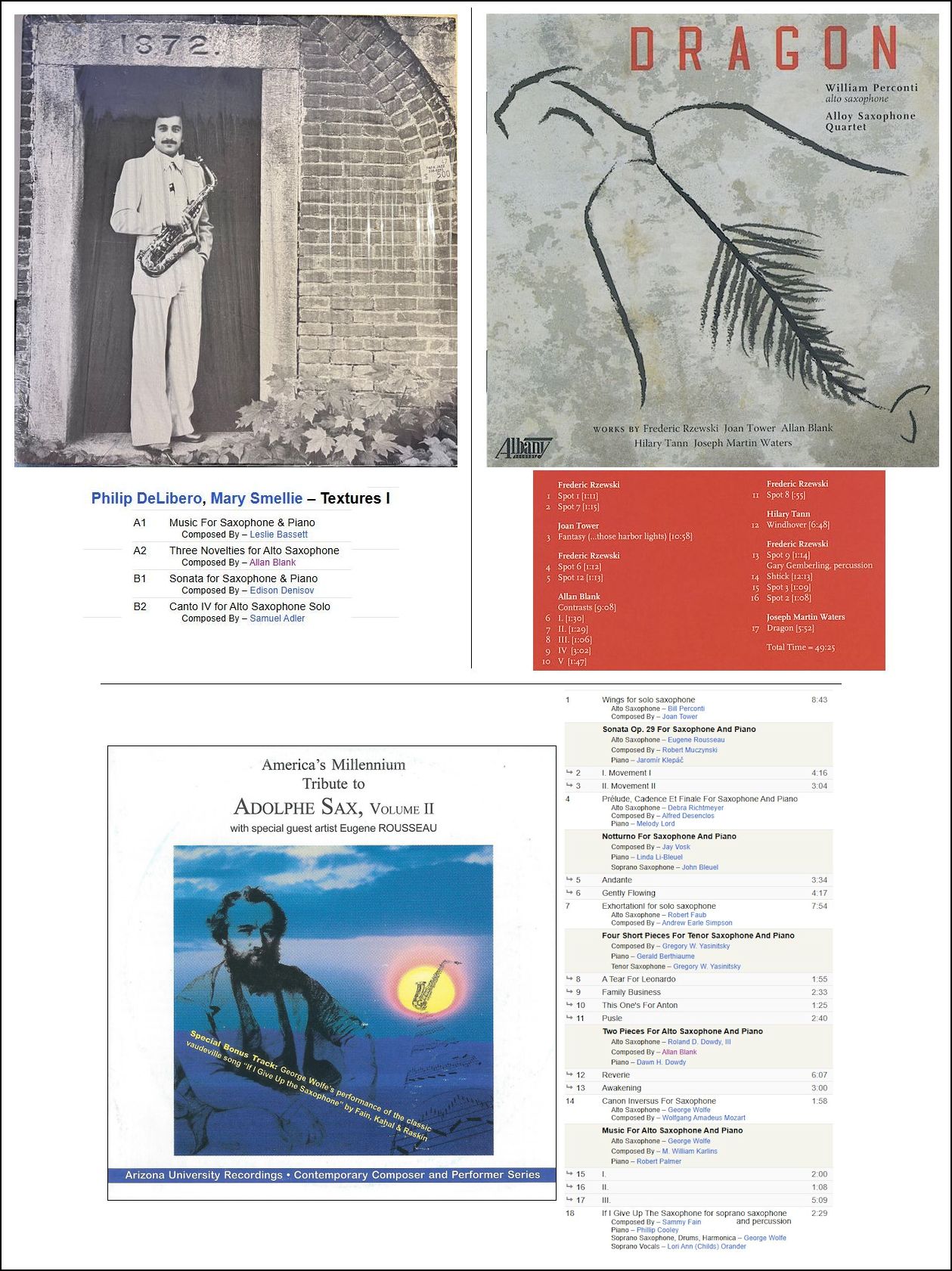
the recording shown at left, see my interviews with David Stock, M. William Karlins, and
Gilbert Kalish.]
Blank: I’ve kept notebooks for many, many
years. I will sketch things out in notebooks, either actual
statements about what I’m interested in doing as reminders for me, and
in some cases little musical ideas. So I do try to hold onto the
things that shoot through my mind, and I’ve learned to try to bring them
to the front of my mind when I need them.
BD: When you were teaching junior high
school, were you leading the band and orchestra?
Blank: I worked in junior high schools for
four years. One year at one school, and for three years I was in
charge of a program where I taught all instruments and conducted the
band. The orchestra was kind of a combination, doing band music with
violins! [Both laugh]
BD: When you were teaching at that level,
were your ideas for your compositions significantly different than they
are now that you are teaching at the collegiate level?
Blank: I don’t think there’s ever been a
specific relationship between where I’ve been teaching and what kind
of music I was writing. I am not the kind of composer who generally
writes with the notion of writing for children, or writing for schools,
though I have written some works that could be used that way.
In some of my first teaching, I was involved in writing a string quartet
which was very difficult from a compositional point of view. I
was teaching the most rudimentary things in the school, so there was
never any direct relationship. It’s as if I were two different
people!
BD: As you’re working with the ideas that
come to you, are you always controlling where those ideas lead, or do
you sometimes follow their direction?
Blank: That’s a very big question, and I
have swung in many different directions. For the most part, my
thinking at present comes back to a point that I like to feel as if
I’m going to be surprised, and I don’t always know where something is
going to take me. So I like to ride on the idea and see where it will
go. As one learns more about one’s material, I feel freer to allow
the ideas to grow, and to take the turns that they want to. That
freedom is a wonderful experience, and an adventure that I don’t want
to give up. There have been periods where I try to pre-plan a great
deal, and a number of my works going back thirty years were based on a
lot of pre-planning. It’s not that I don’t do it now, but when something
wants to go its own way, I just hold on and let it go. [Both laugh]
BD: Is it really surprising where it takes
you?
Blank: Sometimes yes, and then other times...
not that it’s less surprising, but one develops fingerprints, and you
begin to see the signs of them. Those fingerprints are what we
begin to call one’s style, or one’s idiosyncrasies, or one’s hang-ups!
[Both laugh]
BD: Are you finding that these free-ranging
ideas work themselves out, or are they starting to be a little bit
predictable, so that you sometimes know ahead of time where they’re
going to go?
Blank: No, no! There may be approaches
on other levels. Maybe, for example, I’ll choose certain harmonies
with recalled choices I’ve made in the past, but generally I’m not
interested in that kind of predictability. I want it to just go
where it wants to go. However, it depends on the kind of form
you’re working with, because sometimes there is a form of structure where
you know that you want to go to a certain point, and you drive the music
to those points.
BD: Are there times when you get an idea,
say, for a string quartet, and it turns out that the idea might be perfect
for, say, a piano sonata?
Blank: That brings up a totally different
kind of question, and an interesting one in my case. The history
of my writing has been that I generally work on several pieces at the
same time. I can carry something through for several weeks, and
then I reach a point where I may just become fatigued, and I’ll have something
else that I pick up and work on. That has been a habit with me for
many, many, many years. Works may have ideas that overlap into one
another, but they do tend to develop into the unique shape of what the
finished work happens to be. But it’s very rare that I’ll actually
just work on one piece from beginning to end without thinking about other
things. It’s impossible. This is where teaching, and the experiences
of working with a lot of different kinds of music play a large role
in terms of the way my whole thinking takes place. I teach analysis,
so I’m working with many different kinds of styles in terms of the classroom
and of a new music ensemble which I conduct. So music of different
periods, and even of our own period, are running through my mind continually.
* * *
* *
BD: When you start to write a piece,
do you know about how long it will take to complete the compositional
process?
Blank: No, unless it’s a shorter piece. Then
I have a general notion of what might be involved. I like to
write for the voice and for the chorus, so in cases like that I may have
a general notion. But when I deal with a so-called abstract piece,
I have no notion of where it’s going to take me, or how long it’s going
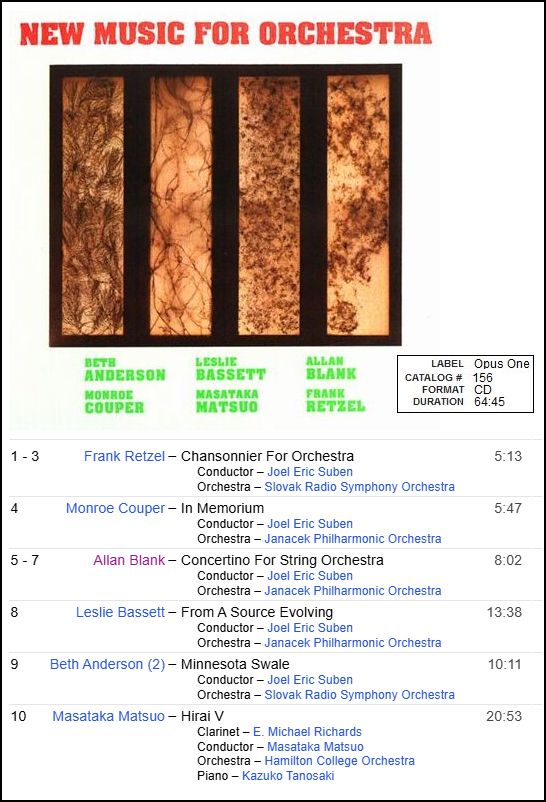
to take me. Sometimes I’m surprised! I remember back in the
late 1980s, I wrote a work called Concertino for String Orchestra.
It’s a short work of about eight and a half minutes, in three movements,
and I actually sketched out the entire line of the piece in one weekend.
I was absolutely flabbergasted that I had worked so quickly. But
these are not things that generally happen. That doesn’t mean the
piece was finished, but I could tell from the materials that I knew the
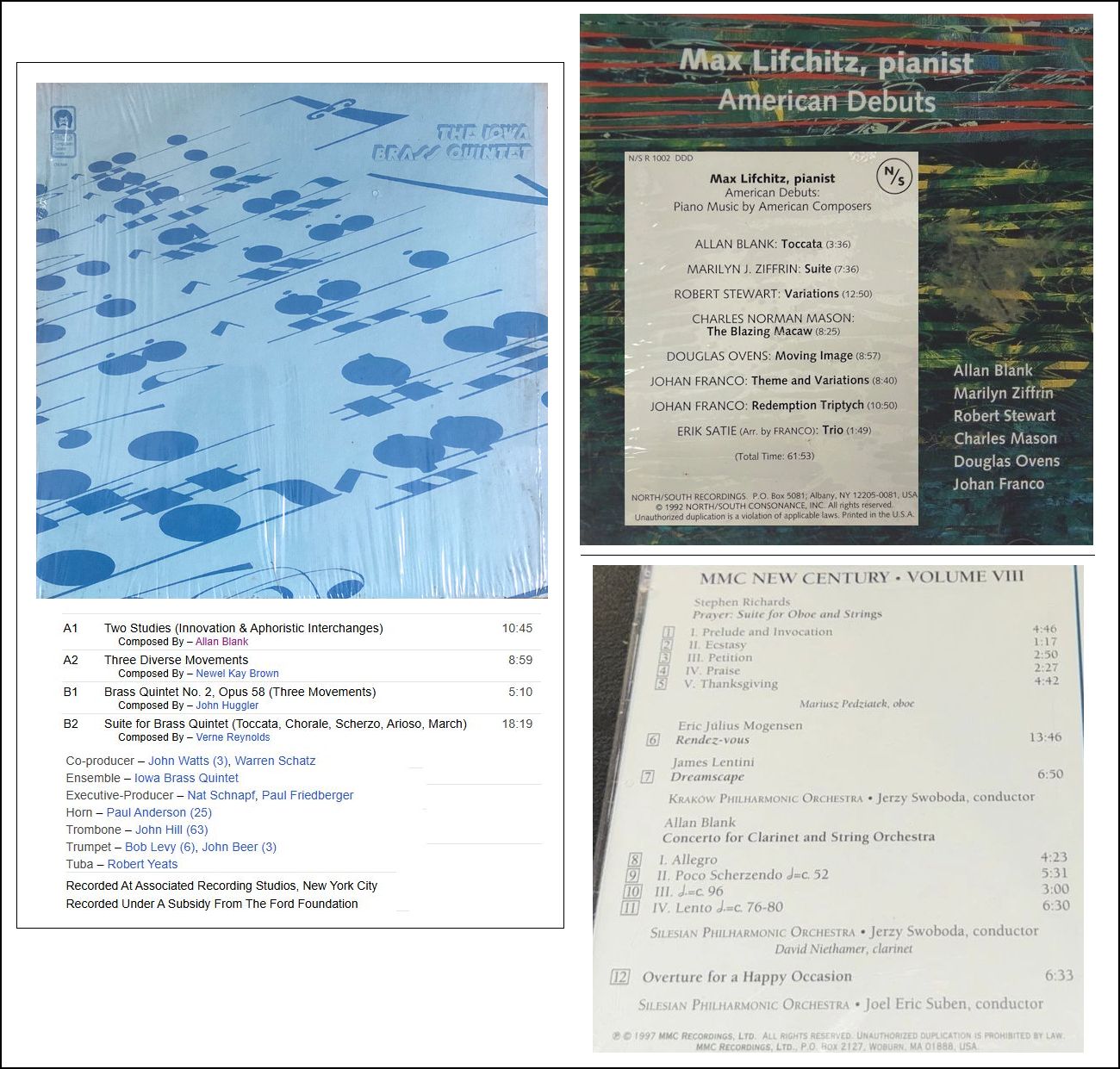
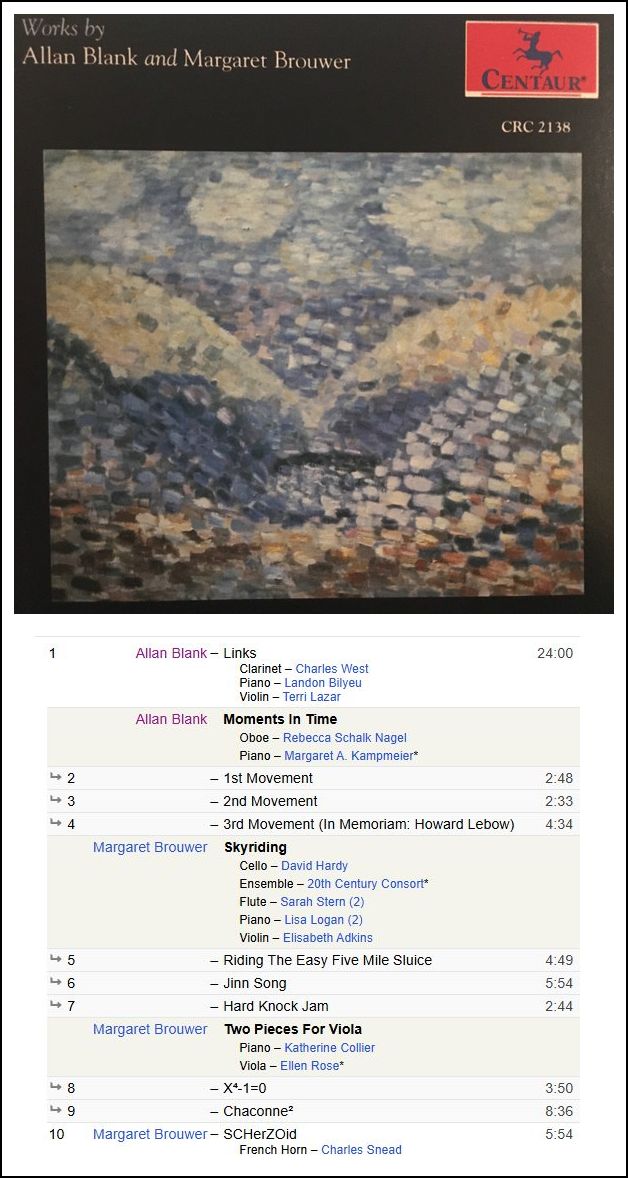
entire piece within that weekend. [Recording shown at right. Also,
see my interviews with Monroe
Couper, and Leslie
Bassett.]
BD: Did you stick with the outline?
Blank: Oh yes, definitely. I may have
made minor changes, but I knew where the piece was going, and what
the material was like.
BD: When you’re working with it and sketching
it out, you get to the end of the piece and you go back and fiddle with
it, and make adjustments. How do you know when it’s done?
Blank: One senses that you have said what
you’ve wanted to say, and that the material has lived out its course,
so to speak. It’s had its run, and it’s out of breath.
BD: Do you set it aside and come back to
it, or do you know that it’s finished and that’s it?
Blank: Sometimes I will set it aside for a
bit. I’m very much concerned with wanting to experience the piece
when it is fresh. So even when I’m very close to the end, sometimes
I’ll just stop and put it aside for a couple of days while I’m working
on something else. Then I’ll go back and
try to experience the piece again, and calculate whether some of the
timing elements have been worked out properly or not. But I generally
know when it’s finished. I don’t think that I’ve ever had a problem
of knowing when it ends. With longer works, the issues include where
you want to take some of the material, how the material flowers, to what
extent you want it to blossom, or what do you want the piece to do when
it’s two or three minutes into itself. You must consider how many ideas
you want within it, and if it’s a dramatic piece,
then what is the range of conflict that you want within it. Those
inner issues are much more challenging than to know when I feel that it’s
run its course.
BD: When you’re thinking about all of these
things, are you manipulating the music or are you making the music
manipulate your audience that will hear the work?
Blank: I don’t think in terms of the audience.
I’m thinking in terms of the materials, and the way I respond to
the material. I’m thinking of myself in the dual role of the creator
of the music and as the listener and performer of the music. I
always place myself in that position.
BD: Are you ever conscious of the audience
at all?
Blank: No, I’m not conscious of it in that
sense. If you want to say that I internalize the audience into
that part of myself, which is the listener, then I am the audience, but
I am the critical listener. I am not the passive listener.
I am the listener who is really riding with the music, not the listener
who is just allowing things to go by.
BD: As the listener, are you ever too critical?
Blank: Yes, I think so. That happens
when I’m very much involved in the piece, and I feel like I may not be
able to evaluate some moves that I’ve made. The solution for me
is to just put it aside for a while and experience it fresh. I trust
my musical instincts, and that’s how I try to deal with those issues at
that particular point.
BD: When the piece is all written and the
parts are copied out, and you go to a rehearsal or two, are you ever
surprised by what you hear?
Blank: No. I have never made mistakes
of that nature. I’ve never had that kind of experience. What
surprises I do have would be that I have to adjust a tempo somewhat,
or I have to adjust a balance in terms on dynamics. But these are
performance problems, not conceptual problems. I don’t bring the
piece out until I feel that I know what I’m going to get.
BD: Are you’re always right?
Blank: I don’t know if I would use the word
‘right’, because that’s a value judgment. But that’s what I
assume I would get.
BD: Do you allow or encourage interpretation
on the part of the performers?
Blank: Oh, yes, but not with the notion that
I write free music where it’s based on improvisation in any sense... although
I have parts within pieces where there are some elements along those lines.
There is interpretation, sure, but this is flexibility in terms
of tempo, or a slightly different feeling in terms of articulation or balance
and dynamics. But I really work it out very, very carefully before
I bring it out. I have a feeling and a strong notion of what it
is I want. I don’t work in terms of guesses. So when I put
it in front of the players, they won’t try it another
way. That doesn’t work. I do remember a case where I called
for a mute on some string instruments, and in terms of the balance it
didn’t quite work. When I heard it I thought it would be better
without the mutes. But with regards to structure, I don’t remember
ever changing something along those lines.
BD: Do you want every performance to
be an exact duplicate of any other performance?
Blank: I don’t believe that’s possible
at all. They have to adhere to my general tempo and character
of the material, but the players, through their very nature, will bring
out emphasis a bit differently. So, the sense of sound and tone
and warmth or coolness towards the line will vary. All kinds of
individual aspects will take place, which is fine.
BD: Have you basically been pleased with the
performances you’ve heard?
Blank: Yes, for the most part, I have been.
BD: You’re very lucky!
Blank: Yes.
BD: Quite a number of your works have been
recorded, and those, of course, will be exactly the same each time they
are played. Is that a good thing, a bad thing, or just a thing?
Blank: It’s a thing. [Both laugh]
I’d love to go back and rework some in terms of the interpretation,
and the sound, and the balance of some of my earlier things, especially
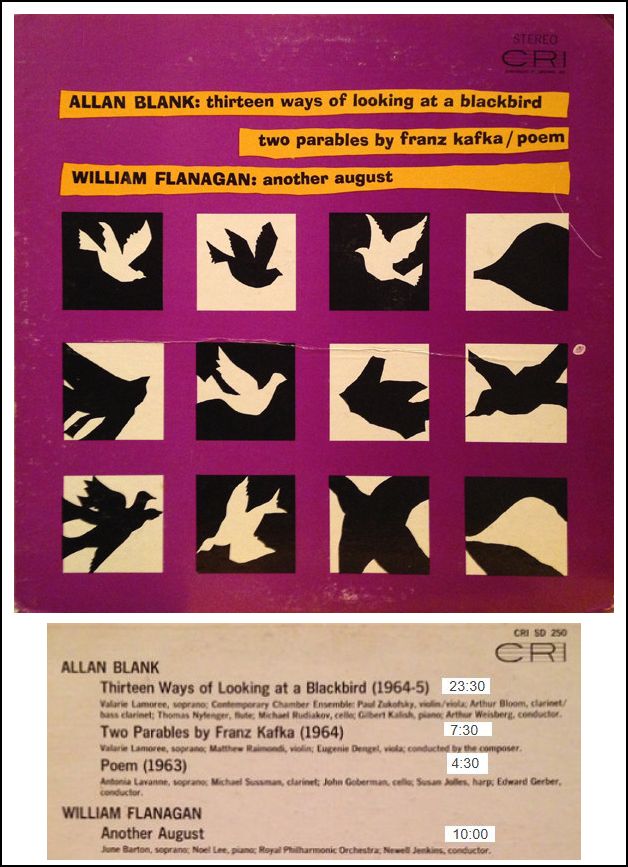
some of the ones on CRI. For example, my Thirteen Ways of Looking
at a Blackbird I’d love to be able to do again. This is not
that I would change the piece, but I remember we had so much trouble
because of the hall we were in, and the kinds of balances we had. Now
it could be handled a little bit differently.
BD: But that sounds like a somewhat minor
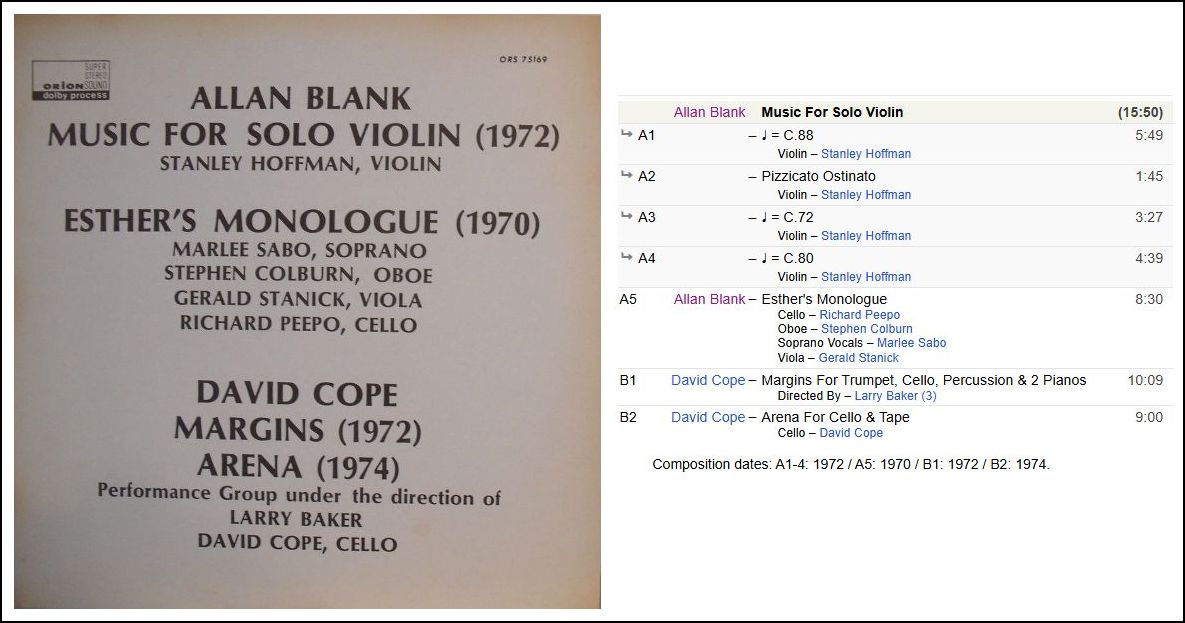
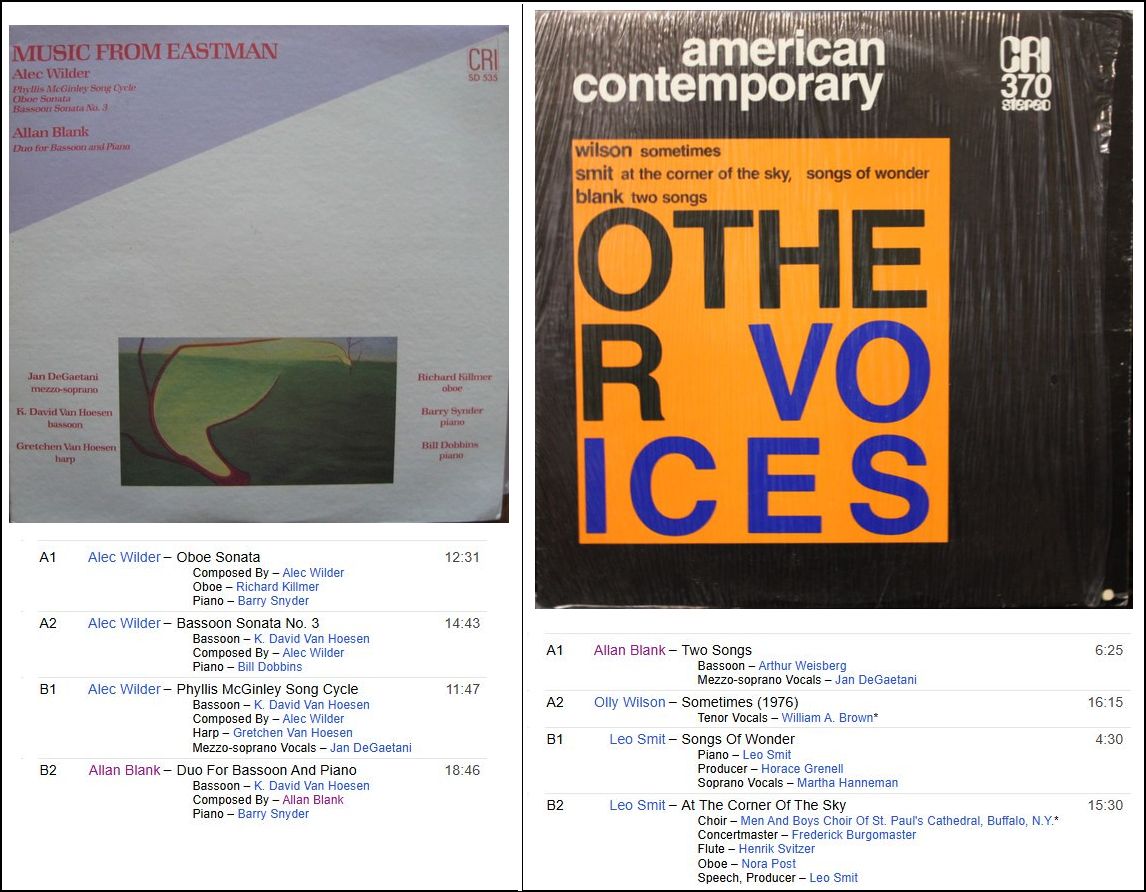
thing. I trust you don’t disown that recording? [Vis-à-vis
the recording shown at left, see my interviews with Arthur Weisberg, and
Noel Lee.]
Blank: No, no, I don’t disown it, but now
with CDs and the kinds of sounds we can get, it’s a difference of an
additional almost thirty-five years of technology.
BD: [With a wink] I assume you wouldn’t
want to add a fourteenth way of looking at it?
Blank: [Bursts out laughing] No!
* * *
* *
BD: We’re talking
about the creation of music, and you say you don’t think about the listeners
except yourself as an audience, so let me ask the big question. What
is the purpose of music?
Blank: First of all, for me the purpose of
music is to somehow move the spirit in touch with the spirit of a person.
If you ask me what that spirit is, I don’t know if I can give you any
kind of profound definition of what I want to see there. But
one knows when you hear something that moves you. You know that
there is something in the relationship of the sound, and the way the
composer has conceived his material that touches you, and draws you
in, and wants you to follow and get on his track and stay with him.
I’m very much concerned with that. That is the kind of music which
has the greatest meaning for me. There are many others kinds of
things that music can do, such as entertain, and stimulate, and challenge
the mind, and I don’t negate any of that. But for me to touch the
spirit in some way, to feel as if music is saying something and has some
kind of emotional meaning, that is the primary function of its value.
BD: Has your idea of this meaning changed
at all over the twenty, thirty, forty years?
Blank: It only gets richer and richer, and
is continually confirmed when I hear things about how it touched me
that way. Of course, I’ve come to understand other possibilities
of music’s experience. Music can also engage and charm, or be able
to entertain. Music can also show off the performer. So there
are many different subunits of delight, but the first is the deeper,
the more profound one, which is music that touches.
BD: Is there a balance between this depth
and other subunits?
Blank: The way I try to deal with balance
in the various kinds of works that I’m writing at any one moment within
myself is how I want to move from something which deals with a serious
expression to something that might take on a totally different aspect
for a thought or meaning. I’m very conscious of doing something heavy,
something light, or something in between. When I said that I work
on a number of things at one time, that’s one of the ways I’m able to
handle it, because the works generally have nothing in common with one
another. Right now I am working on a violin concerto, and at the
same time I am doing something for children’s chorus. So, there
is no relationship between the two. It is a totally new world of sound,
and a totally different world of emotionalism.
BD: So that keeps you fresh?
Blank: I don’t know if it keeps me fresh, but
it certainly keeps me in a state of balance that I find helpful. There
are some composers who, when they’re working on one thing, that’s the
only thing they’re filled with. What happens in my case is that
I have to deal with so many things. As a composition teacher, I see
a great deal of music of my students all the time. So I’m involved
in many different kinds of stylistic gestations, and I am pressed to retain
an enormous amount of intellectual fluidity, so to speak, in the way a
student might go with his piece. All of these things seem to feed
into one another, or have to be screened out of my own thoughts when it
comes to my work.
BD: It sounds like it’s a difficult balancing
act.
Blank: It is a very difficult balancing
act, but in the last fifteen or twenty years I have been able to hold
it very clearly together.
BD: What advice do you have for the young composer
coming along?
Blank: It’s a tough road. It’s a very,
very tough road.
BD: Is it too tough?
Blank: That depends on one’s character and
one’s determination. I have found it very tough. It’s not
been easy in any aspect. We’re lucky when a piece seems to move along
very nicely, but there are times when you’re really sweating something
out. You’re searching for something, and it’s hard to find exactly
what you want. It depends on what your standards are in terms of
what you want.
BD: Does all this change when you have a
deadline looming?
Blank: Generally, I’m pretty good with that.
I’ve had deadlines, but I try to get there before, so that has not
been a problem. I’d rather have more on my plate than less.
BD: So, you’re seeking out more commissions?
Blank: It’s always nice to know that you’re
writing something that will be played, but you don’t always know that.
BD: Are there circumstances when you would
not accept a commission?
Blank: It’s never been the case with me.
[Returning to the idea of advice] It’s terribly important
to develop a disciplined approach, and for me, that means every day
I do something relating to the music. If you can link up with performers
who have some interest in your work, so they can know you’re writing something
that can have an immediate performance, that’s always helpful. Seek
out performers who are interested in you, and who are interested in championing
new music.
BD: That leads me to my next question.
What advice do you have for performers of new music, either your music
or that of others?
Blank: [Laughs] Play more of it, and
play it more often! I’ve had a few very devoted performers who
have played my works, and have enjoyed them, and have gone back to them.
I could use more, but I’ve had some, so that has been fine.
* * *
* *
BD: You mentioned a choral work, so tell me
the joys and sorrows of writing for the human voice.
Blank: I love it! It comes primarily
from my primary instinct, which is the violin. I’m very much line-orientated,
and I just have great fun for the voice. Some of the first things
of mine to have been recorded are works that use the voice. These
include Thirteen Ways of Looking at a Blackbird, and Two Parables
by Franz Kafka, and one simply called Tone by e e cummings.
All are instrumental and vocal works, so that has always been something
I’ve enjoyed a great deal. To this very day, I do find it hard
to find texts that really seem to be right for me. I tend to
be very fussy, and fundamentally that comes down to one thing. Does
the text have a spark within it which seems to call out for music?
I read a lot of poetry and a lot of other literature, and to try to
find things that I feel will attract me. I just find it very difficult
to choose.
BD: Do you have to make sure that there’s
room for addition?
Blank: Room for addition, and room for a
personal spark. It’s a very individual experience of what set
of words or what kind of imagery will set you off.
BD: Can we assume that some poems may touch
you, but you feel they are complete?
Blank: Yes, if by being complete in themselves
you mean do not call out for music.
BD: Right.
Blank: Then I just bypass them. That’s
all. [After a short pause, he spoke briefly about a few other
works, some of which had been, or were about to be recorded.] There’s
a work for ten wind instruments which I call Polymorphics.
It was commissioned here in Richmond by a group at our sister university,
the University of Richmond. There’s a group there called Currents,
which is a modern music group made up primarily of members from the
Richmond Symphony Orchestra. The work was commissioned for this
particular combination. I consider it one of my major works. Another
work which I mentioned before is the Concertino for String Orchestra.
This is a totally different style, and it is due out soon on Opus
One. Then this past December I had two works recorded in Katowice,
Poland. One was a short orchestral piece which I call Overture
for a Happy Occasion. It was actually premiered here with the
Richmond Symphony Orchestra with our new conductor George Manahan who
was starting his first season. It was recorded by the Silesian Philharmonic,
and then there is a Concerto for Clarinet and String Orchestra,
another work that I consider one of my larger and more important works.
Those two will be out early next year on the MMC label.
BD: Then there is the Orion record...
Blank: Yes. I’ve written three big solo
violin sonatas, and that LP has one.
BD: I’ve been able to get a couple of other things
from used record stores. I just picked up a copy of BICINIUM
2, for bassoon and clarinet. Would you pronounce the name for
me?
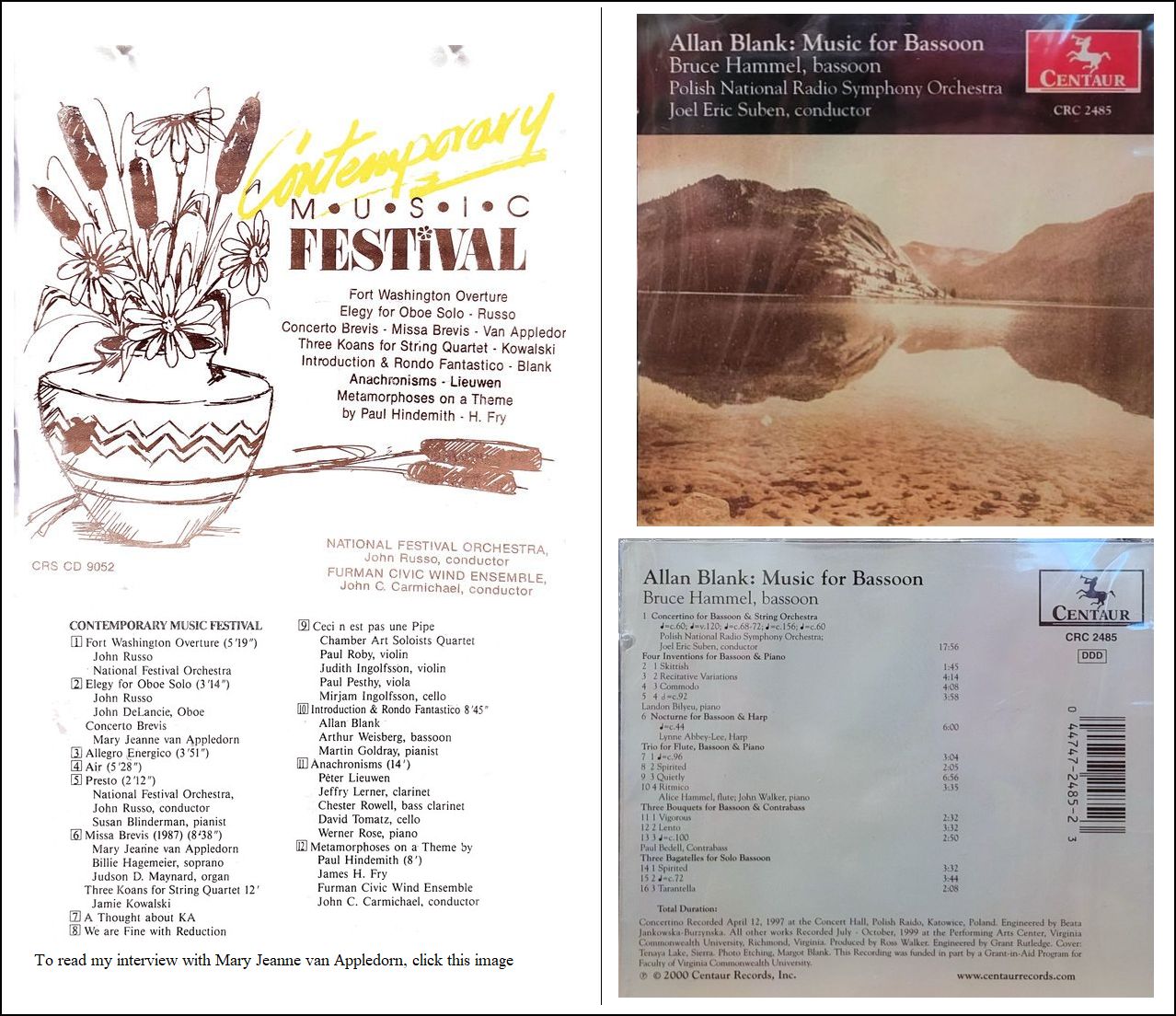
Blank: Bee-chin-ee-um. [Bicinium
3 for clarinet and bass clarinet is on a different CD, and both are
shown below.] And how about Two Studies for Brass Quintet
on Trilogy Records, with the Iowa Brass Quintet.
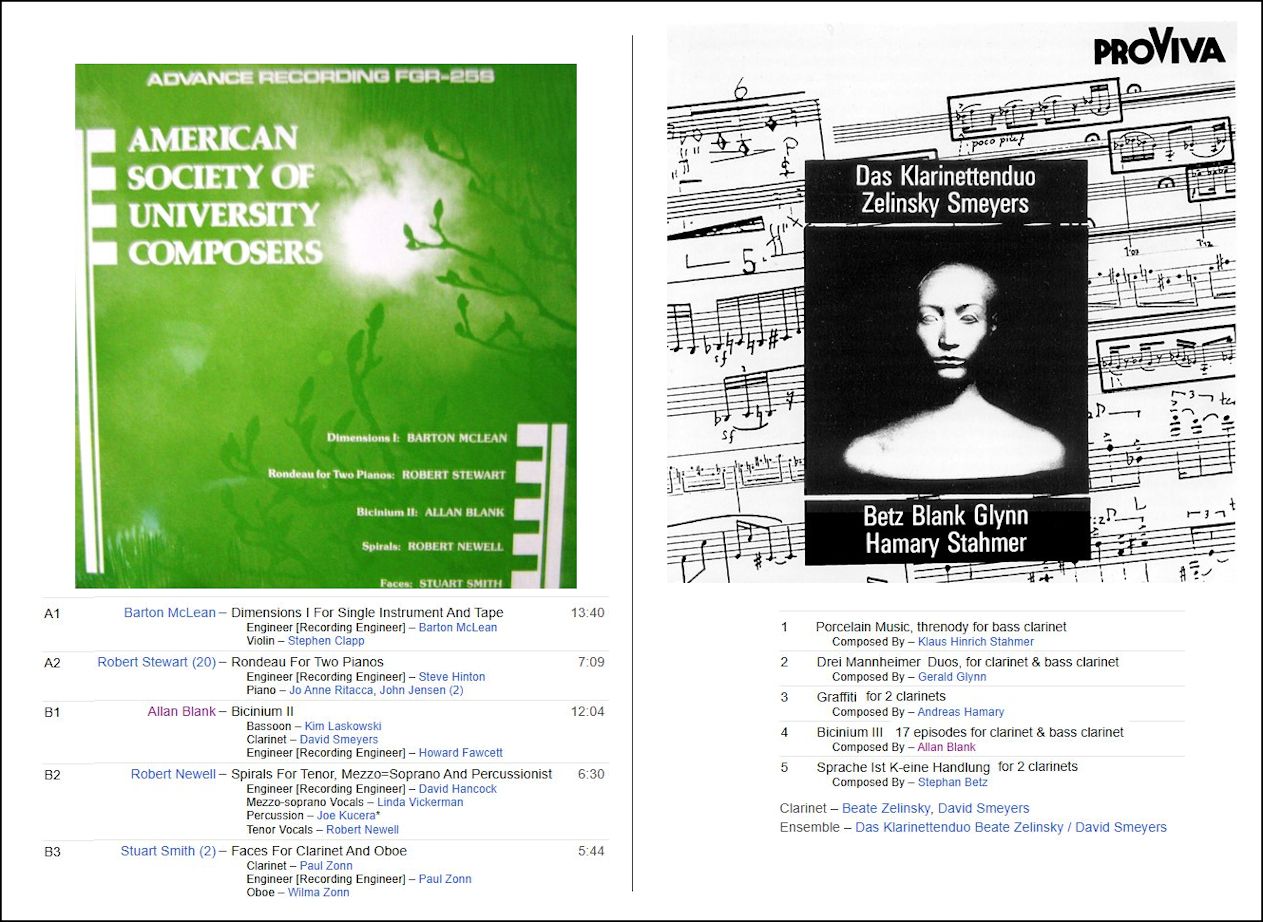
BD: I have that, and also the North/South CD with Max Lifchitz.
Blank: Right. That is the Toccata
[shown below].
BD: Then there’s a piece on the CRS label...
Blank: Oh yes, that’s my bassoon and piano
piece. The first year I was here in Richmond, I wrote three pretty
big pieces for bassoon and piano. That’s the only one available
on CD right now, called Introduction and Rondo Fantastico. It’s
a fantastic performance, played by Arthur Weisberg. It’s had
a number of performances, and has been very well received by both bassoonists
and audiences.
BD: I’m an old bassoon player, so that piqued
my interest.
Blank: Oh, very good! I have a very
special fondness for the bassoon. I’ve written for it quite a number
of times. I have a very large work for bassoon that I’m hoping
one day we can record. Its the Concerto for Bassoon and a Large
String Orchestra. David Van Hoesen performed it with Eastman
Philharmonic a number of years ago.
BD: Thank you for spending this time with me
today. It’s been a great pleasure chatting with you.
Blank: No problem at all! Thank you
very much.
© 1995 Bruce Duffie
This conversation was recorded on the telephone on June 19, 1995.
Portions were broadcast on WNIB later that year, and again
in 2000.
This transcription
was made in 2026, and posted on
this website at that time.
My thanks to British
soprano Una Barry
for her help in preparing
this website presentation.
To see a full list (with links) of interviews which have been transcribed
and
posted on this website, click here.
To read my thoughts
on editing these interviews for print,
as well as a few other interesting observations,
click here.
* * * *
*
Award -
winning
broadcaster Bruce Duffie
was with WNIB,
Classical 97
in Chicago from
1975 until its final moment
as a classical station in February
of 2001. His interviews
have also appeared in various
magazines and journals since 1980,
and he continued his broadcast series
on WNUR-FM,
as well as on Contemporary
Classical Internet Radio.
You are invited to visit
his website
for more information
about his work, including
selected transcripts of
other interviews, plus a full
list of his guests.
He would also like to call your attention
to the photos and information
about his grandfather,
who
was a pioneer in the automotive field
more than a century ago.
You may also send him
E-Mail with
comments,
questions and suggestions.