Tenor  Kenneth  Riegel

A Conversation with Bruce Duffie


riegel


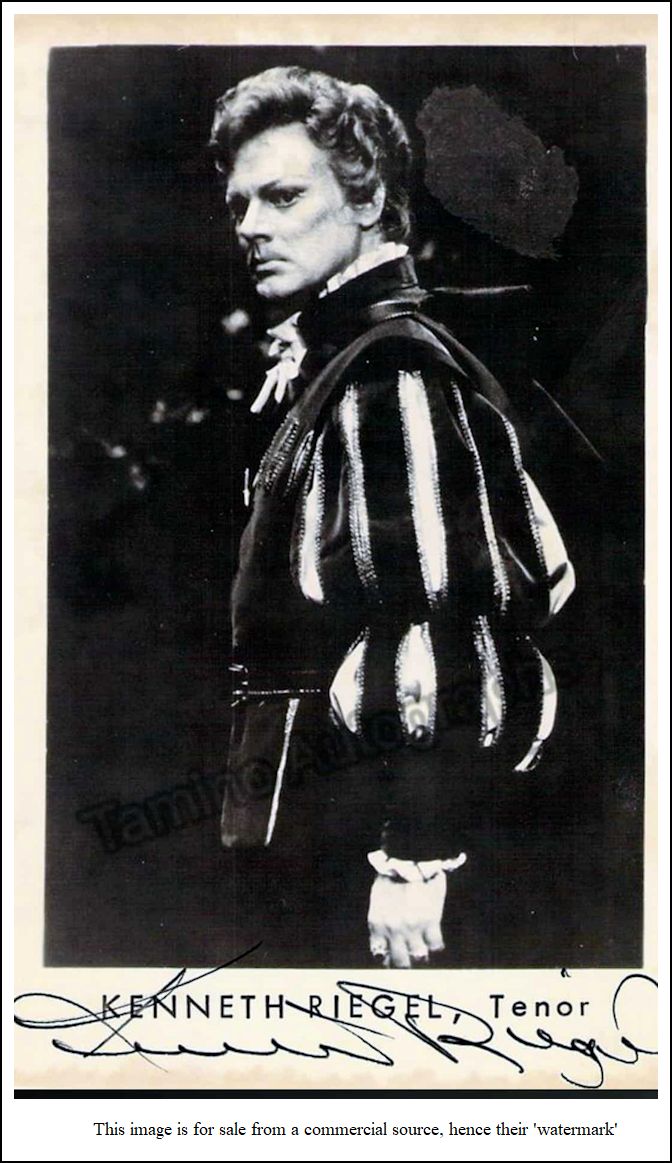
Tenor Kenneth Riegel was born on April 19, 1938, in Womelsdorf, Pennsylvania. He made his theatrical début as the Alchemist in König Hirsch [Henze] at Santa Fe Opera in 1965, debuting at the Royal Opera House, Covent Garden in the same year. He was engaged at the New York City Opera from 1969 to 1974.

He debuted at the Metropolitan Opera in Les Troyens in 1973 (as Iopas, opposite Jon Vickers and Shirley Verrett), subsequently appearing at the Met in another 102 performances in operas including La clemenza di Tito, Les contes d'Hoffmann, Elektra, Fidelio, Lulu, Die Meistersinger von Nürnberg, The Rise and Fall of the City of Mahagonny, Salome, Die Zauberflöte and Wozzeck. He made his first appearance at the Salzburg Festival in 1975. In 1979, he sang Alwa at the first performance of the 3 act version of Lulu at the Paris Opera. He played the title role in Der Zwerg [Zemlinsky] in Hamburg in 1981. In 1983, he created the role of the Leper in Saint François d'Assise [Messiaen].

Riegel died in Sarasota, Florida on June 28, 2023, at the age of 85.

==  Names which are links in this box and below refer to my interviews elsewhere on my website.  BD  


riegel

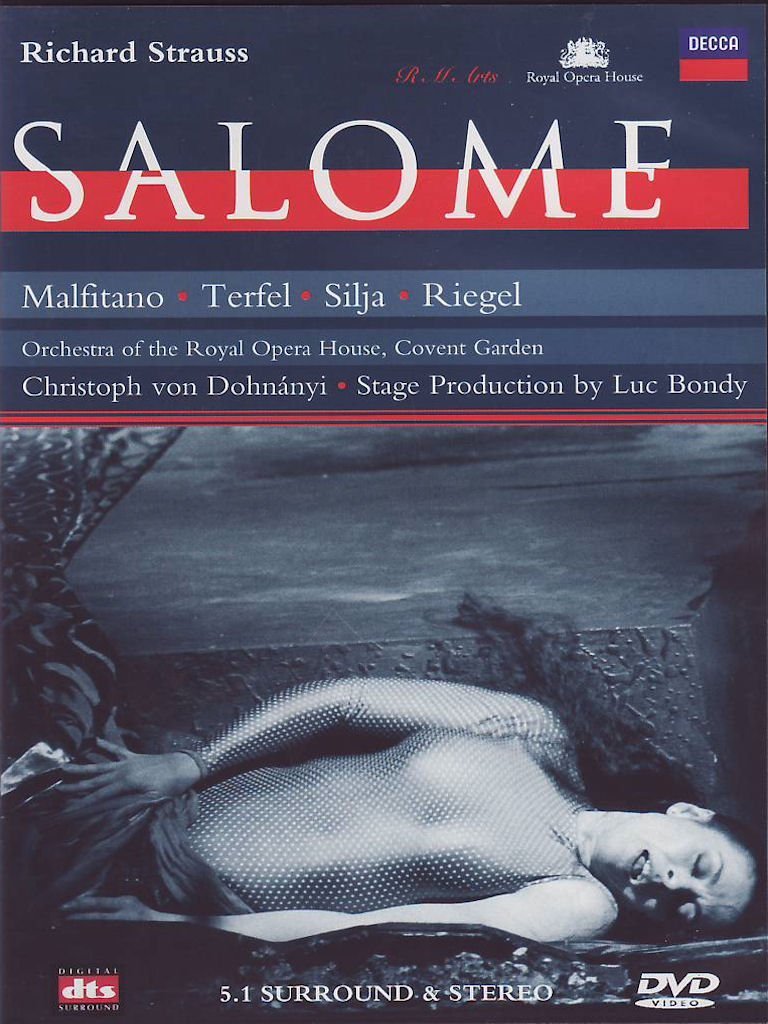
In the fall of 1996, Kenneth Riegel returned to Lyric Opera of Chicago for Herod in Salome, a production which featured Catherine Malfitano in the title role, Bryn Terfel as Jokanaan, and Anja Silja (who had sung the title role in Chicago in 1971!) as Herodias.  [The DVD shown at left, with the same principal cast and director, and Dohnányi conducting, was recorded in London a few months later.  The CD version with a similar cast had been recorded in 1994.]  In Chicago, Antonio Pappano conducted and Luc Bondy directed.  Though he had also sung with the Chicago Symphony, Riegel
s only previous appearance at Lyric was as David in Die Meistersinger in 1977, conducted by Ferdinand Leitner.

On a day between performances of Salome, Riegel graciously sat down with me for an interview.  He was in very good spirits, and we spoke of many things concerning his career and the music world in general.  Portions of the conversation were used on WNIB, and now, as we begin 2026, I am pleased to present the entire chat.


Bruce Duffie:   You have sung opera, concerts, old and new music...

Kenneth Riegel:   [Interjecting]  ...and recitals!

BD:   How do you divide your career amongst all of that?

Riegel:   I don’t know if I divide it.  It just happens to fall into a pattern.  [Laughs]

BD:   Do you prefer singing opera to concert, or do you emphasize one or the other?

Riegel:   I don’t emphasize one or the other.  I don’t do a recital next to a Strauss or heavier operas, or even a Mahler Eighth.  I’ve recorded Mahler Eighth three times [Bernstein/Vienna Philharmonic 1975, Ozawa/Boston Symphony 1980, and Inbal/Frankfurt Radio Symphony 1986.  Also, a 1991 performance on the BBC led by Tennstedt/London Philharmonic would be released in 2011.], plus I’ve done many concerts and videos.  But I try to put the recitals at the end of a year when I have time to rehearse them.  But all the operas and concerts fit into my schedule.

BD:   Who decides the schedules?

Riegel:   I do!

BD:   Not your agent?

Riegel:   Oh, no, no, no.  First the offers have to come in.  One doesn’t do anything until an offer.  Then I have to decide what I want to do, and where I want to do it.

BD:   How do you decide what it is you want to do?  When you get an offer, how do you decide yes or no?

Riegel:   Some opera houses offer you in advance, and other opera houses do not.  So I fill in my time with Munich, and Berlin, and Covent Garden, and the Met, because they’re very fast and they know what they want to do.  Also, Italy, some in Greece, and I sing in Paris sometimes.  I just came from Nice, which was difficult.  They tend to lag behind and decide if they have the money, and can afford it.  They want to do it, so they schedule you, and then all of a sudden, they cancel at the last minute.  So one has to be wary.  It’s difficult fitting it all in.

BD:   These days I thought every opera house scheduled things two or three years in advance.

Riegel:   Not at all.  They want to, and they do, but then all of a sudden they’ve over-scheduled, or they’ve over-budgeted and they don’t have the money.  That’s the way it is, and that’s where it ends.

BD:   Is that more the case in Europe than in America?

Riegel:   Yes.  All of a sudden it comes closer to the time, and they don’t have the money to do it.  Money in the United States is very tight.  The opera companies and the symphonies are toning things down because they do have these problems.

*     *     *     *     *

BD:   I assume that you’ve sung the roles that you want to sing, and that the offers for those roles continue to come in.

Riegel:   I’ve been singing for thirty years, so I’ve done a lot in those years.  I’ve not only done the handsome lyric tenor parts, but I’ve done a lot of interesting, complicated, and wonderful character roles.  It gets me very upset when people come up and say,
I remember you.  You’re old, so now you’re going into the character roles!  I just cringe.  I guess Herod [in Salome] is a character role, but my gosh, the music is very difficult to sing.  Those notes have to be sung.  It used to be always sung, and it got into a period of time where a lot of the character tenors spoke it.  I like to sing those notes. Those notes and those melodies have to sung.

BD:   So it
s a point of pride with you to make sure that the roles are sung properly.

Riegel:   Oh, absolutely!  But people don’t even recognize it.  They don’t even know, and that
s what gets me a little bit upset about the role... but, of course, you can’t expect everything.


riegel

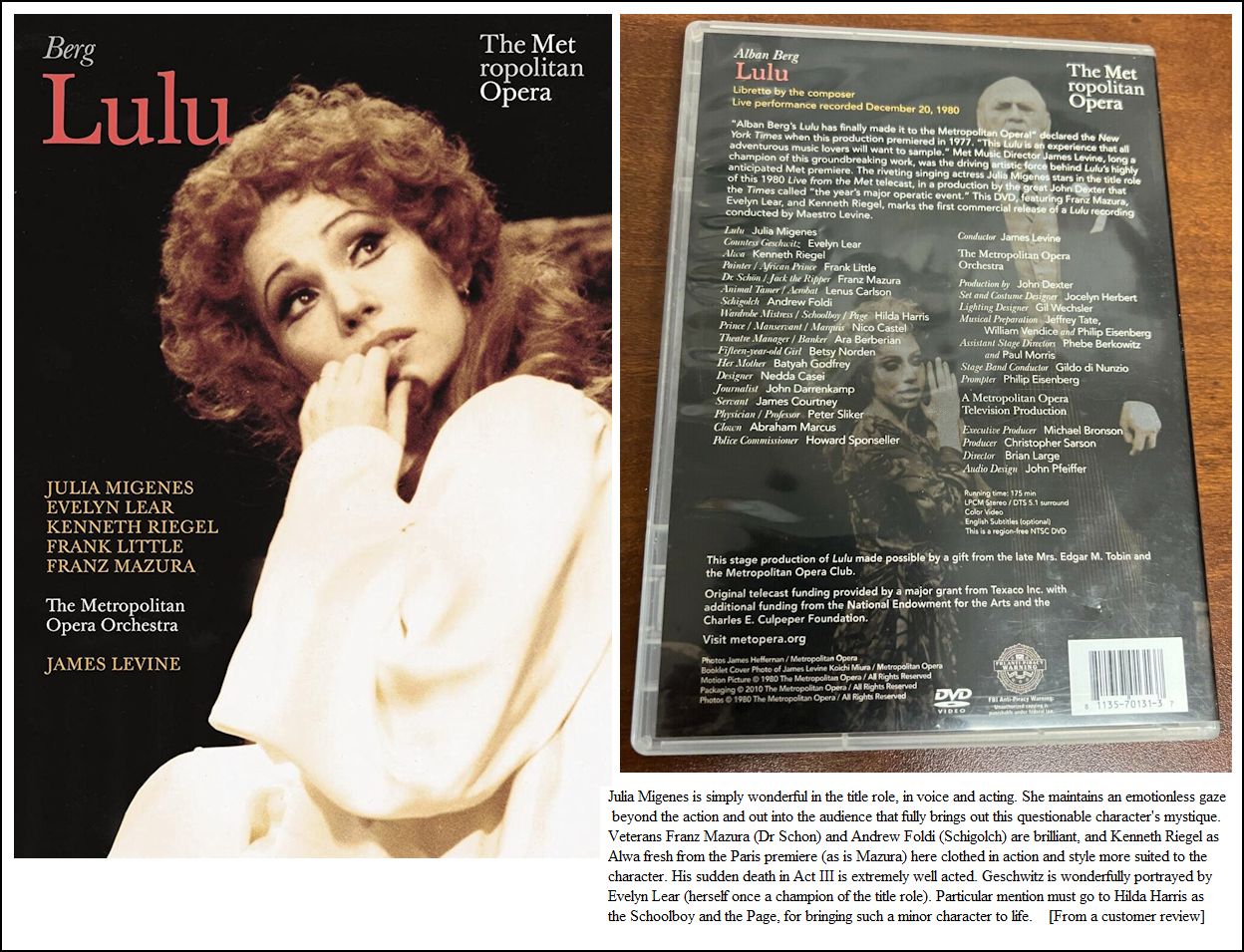
See my interviews with Evelyn Lear, Frank Little, Lenus Carlson, Andrew Foldi, Hilda Harris, Jeffrey Tate, and James Levine


BD:   This brings up an interesting balance question.  In the opera, where is the balance between the music and the drama?

Riegel:   The notes have to be sung.  I’ve always considered myself a singer, and I have to be able to produce those tones no matter what I do on the stage, as I told Patrice Chéreau.  I work with a lot of interesting directors, including film directors and theater directors, because I like to act and I like to act and sing.  But we have to be able to produce those tones, and we have to be able to sing it, and if we can’t sing it, then something has to change.  Then we have to change the way the action is on the stage so that one can produce those vocal qualities.

BD:   Are the directors demanding too much of the singing-actor these days?

Riegel:   I think so.  They’ll push you to your limit, but I must say, in all fairness, I’ve been able to tell them that I just cannot do this.  My limits are here.  I will go as far as I can, and I will try it.  I will never say I won’t try it, and walk off the set, and create a big thing like some people do.  I will just try it, and if it doesn’t work out, then we will try something else that is comparable, and seems to be the best way.  This is diplomacy!  [Laughs]

BD:   Even if you feel the director is wrongheaded, you’ll still work with him and try to do it that way?

Riegel:   As I do with conductors, I suggest the way that is best for me.  I know my voice, and I know what I can do and what I can’t do.  But I will always try their way first, and then we’ll go onto other ways of doing it.

BD:   Having sung so much in Europe, have you been involved in some far-out productions, such as where Aïda is a washerwoman?
riegel
Riegel:   Oh yes, of course.

BD:   Do those productions really hold credence?

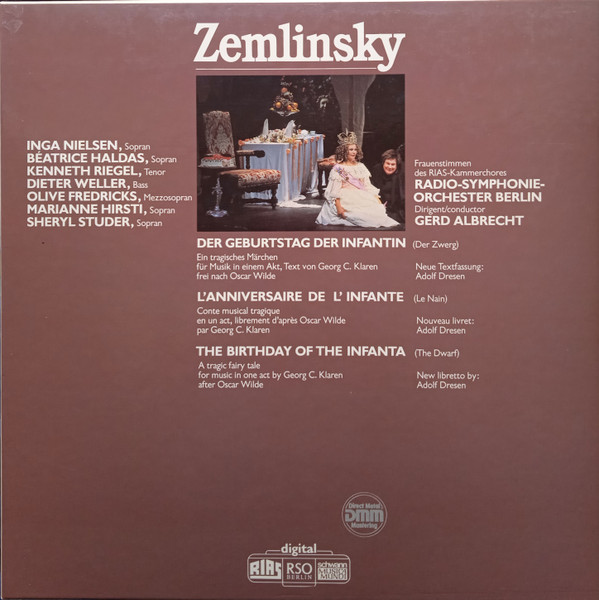
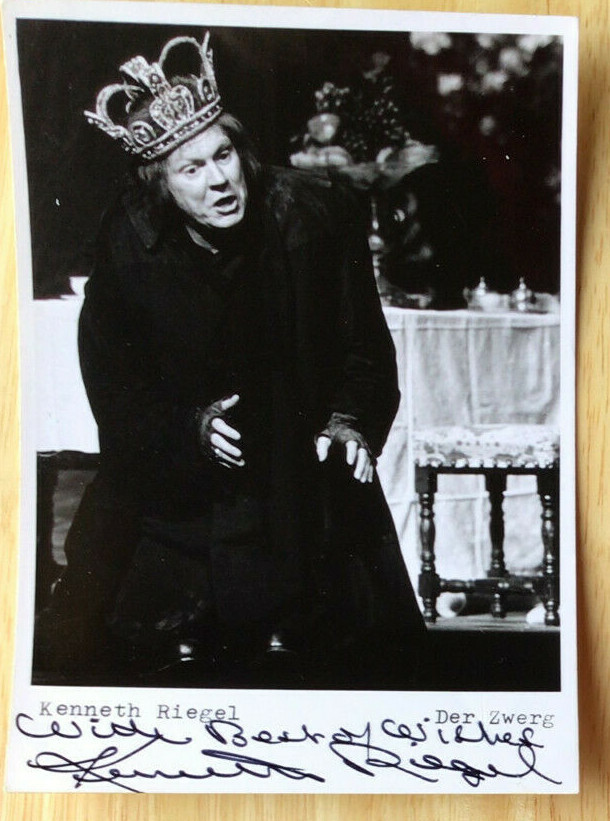
Riegel:   [Thinks a moment]  Some of them do, and some of them don’t!  [Has a huge laugh]  I’ve done some strange productions of Don Giovanni which I thought just weren’t making it.  I thought it hindered the music and the flow, and it added disturbances that were unnecessary.  I have done a lot of contemporary music, but they’re singing roles.  These are wonderful characters and wonderful music, like in Zemlinsky’s opera Der Zwerg [The Dwarf], in which I sing on my knees for over an hour.  But the thing is that music is so ethereal, and so gorgeous, and so beautiful that there were standing ovations every night from Hamburg to London to Edinburgh to Vienna.  Every single night I sang that piece, there were standing ovations, and one cannot say that about every opera one does, believe me.

BD:   But that’s not a brand new opera.

Riegel:   It’s an old opera that was written back in the 1920s, and it hadn’t been done since the 1930s when I started to do it in Hamburg.  This was with Dohnányi.  Friends of mine from Paris, and German friends from Vienna said I had to do this opera because it was written for me, and it was!  I knew Madame Zemlinsky quite well.  She lived in New York, and she just passed away a couple of years ago.  S
he was one of the girls in the chorus at that time, and was much younger than Zemlinsky.  She gave me a lot of her husband’s songs that I do in a recital called The Vienna of 1900.  She said her husband would have been so much in love with me.  She said I was the ideal voice that he wanted for this role.  She never came to a performance, but we had the video from Hamburg.

BD:   Did he write for a specific tenor who was alive then, or did he just write for a voice, and you happen to be it?

Riegel:   He wrote for a voice, and he wanted this voice.  It was the Oscar Wilde’s story of The Birthday of the Infanta, who torments this poor dwarf who doesn’t know what he looks like.  He’s really quite ugly and quite deformed, with a hunchback.  He finally sees himself in the strange mirrors at his palace, and it’s heart-rending.  I like that music, as well as Franz Schreker, Mahler, and Richard Strauss, of course.  Schreker wrote wonderful music.  There’s one piece I’d love to do on the stage and he is also a deformed character, but he has this voluminous beautiful music to sing including a duet with the soprano which is like a Tristan and Isolde duet.  The opera is called Die Gezeichneten [The Stigmatized].  It’s a strange piece, but I’ve been trying to get people to do it.  Every time I’ve tried to get Berlin to do it, and they said that it was just done in Frankfurt!  [Laughs]  That’s the way they are.  But Beverly Sills wanted to do it, and I had a contract from New York City Opera.

BD:   It fell through?

Riegel:   It fell through because Christopher Keene came in and wanted to do his own things.  So he canceled the contract.  It was too bad.  Sills came to Hamburg and saw it, and was so enthralled.  She said I had to do it.  I had to come back and sing this in the States.

BD:   Do you find a couple of roles like this that you champion?

Riegel:   Oh, absolutely.  If I feel that they’re worth championing, that it is something I really get into, and that was one of them.  I would have liked to have done that work very much.  I also do Schreker’s music on my recital program.  Some of his pieces are very fine.

BD:   He knew how to write for the voice?

Riegel:   I feel so.  As I said, in the Vienna of the 1900 period, there was this enormous number of composers, and the music was so beautiful.  Some of it hasn’t been heard yet.  It
s in the archives, and people from the international music society in Vienna keep sending me all of these, because they know that I love to do this type of music.

BD:   How do you decide if you will accept to do a world premiere?

Riegel:   I have to see the music!  I’ve turned down two pieces that were from Canada.  But I have to see the music and really know how it’s written in my voice.  You have to study.  You have to go into it.  You have to find out about the character, and how he fits in with the whole work.  If there’s a play, you read the play, and I do that with all of my music that’s new.  I go into a lot of research.
riegel
BD:   Is it possible to over-research some of these things?

Riegel:   No!  I wouldn’t know how.  One likes to learn about everything.  Joseph Losey, with whom I did the film of Don Giovanni, wanted me to be in his film of a book called Silence.  It takes place in Chicago during the Depression.  He wanted me to play a bartender in this film, [sighs] and then he died.  I lived in Paris for seven years, and he lived there too, so we became very close.  He was from Pennsylvania, where I’m from, but I was really looking forward to doing that film.  I got the book, and studied it.  It was too bad.

BD:   No one else could take over?

Riegel:   Harold Pinter was helping him to write the play, and somehow it just all fell through.  Of course, he was not beloved in Hollywood during the McCarthy era.  There were all kinds of accusations against him.

*     *     *     *     *

BD:   You have the opposite ends of your spectrum.  There are the brand-new works, and you have Mozart.

Riegel:   Right.

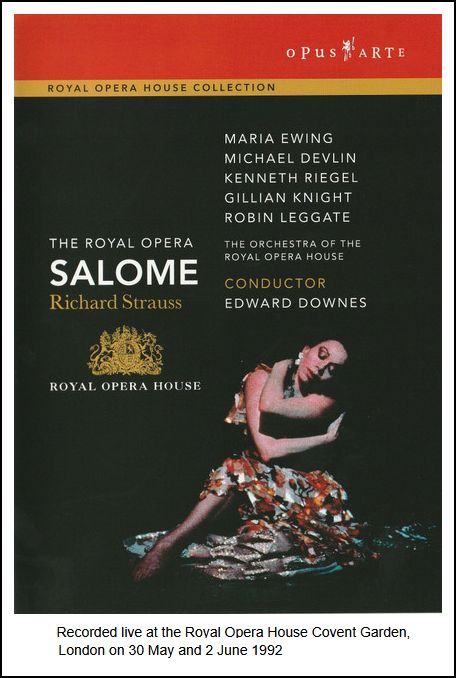
BD:   How are you able to keep the voice in trim for both the new works and the Mozart?  [Vis-à-vis the DVD shown at right, see my interviews with Gillian Knight, and Robin Leggate.]

Riegel:   Now I’m older, and after thirty years of singing I don’t sing Don Giovanni any more.  I still do Hoffmann, and I still do the Mahler Eighth, but not very much anymore.  I’m 58 years old...

BD:   Are you at the point in your career that you want to be at this age?

Riegel:   Absolutely.  I’ve had a brilliant career.  If I would stop tomorrow, I have such marvelous memories.  I’ve done twenty-six recordings, and I’ve done everything I
d like to.  I’ve done pieces that other people have stayed away from and wouldn’t tackle, and I’ve done them successfully.  That’s a great credit for me.  They can’t say I’m in this Fach and only do Puccini and Verdi.  My scope is wide, and it’s wonderful because you never stop learning.  To me, that was the most interesting part of my career.

BD:   You have done a lot of French opera.  Tell me about the joys and sorrows of singing in French.

Riegel:   The one who got me into it was Emerson Buckley.  He was a champion of all of Massenet and Berlioz, and all of those things.  He told me I had the right voice for Werther, Le Roi de Lahore, Thaïs, and all these things.  So I did them all with him.  I have tapes of radio broadcasts of all these things that I did.  Then I sang for Rolf Liebermann when he ran the Paris Opera, and he said that I must come there.  He wanted me to do The Tales of Hoffmann, and Faust.  I was the first American to sing Hoffmann and Faust at the Paris Opera, and it was not easy.

BD:   Did the French public accept you?

Riegel:   No, not at all, especially as it was a very controversial production.  It was a very physical thing.  I was much younger then [laughs], and Chéreau wrote pages of new dialogue!  I was just going crazy learning it.  The minute I learned one set of dialogue, he said,
No, let’s just strike this and go onto something else.  We tried this, and would do this, and do this, and do this, and it didn’t come so easy for me.  I was doing very well, but I wasn’t walking along the streets making great conversation with all my French friends.  [Both laugh]  It was really difficult, but I did it.  He was very nice to me, and he loved me dearly.  He appreciated what I did.  We worked on it, and we really got the production down.  Finally I said, Now, stop!  We have to stop with all this new dialogue.  I have to learn this.  The premiere’s coming, and let’s just do it!  Finally, I proved to them that I could do it, and I did it well.  After the third or fourth performance, there were no boos.  There were great bravos, and by the end of my run I had done over twenty-five performances, because they kept those productions for a long time.  It was a very expensive production, and was one of those wonderful things.  I was even invited to parties, and was introduced as this American tenor, a great acting-singer.  That was nice.

BD:   It did your heart good!

Riegel:   Oh, yes.  I did Faust, I did Hoffmann, I did Oedipus Rex, and I did the first three-act Lulu, and the recording, with Pierre Boulez.  I remember, at the dress rehearsal, after a little bit over two hours, the orchestra stopped playing!  They got up and walked out one by one, and there was Boulez conducting with just one or two people.  [Bursts out laughing]

BD:   They couldn’t take it anymore???

Riegel:   It was over their time, and they refused to play any longer without pay.  So, they just got up and walked out.  [Both laugh]

BD:   Was it impressive to be in the world premiere of an established masterpiece?

Riegel:   Oh yes.  It was wonderful, especially where you have a great conductor like Boulez.
riegel
BD:   It was almost a unique situation, where you have an established masterpiece, and yet you're doing the premiere of part of it.

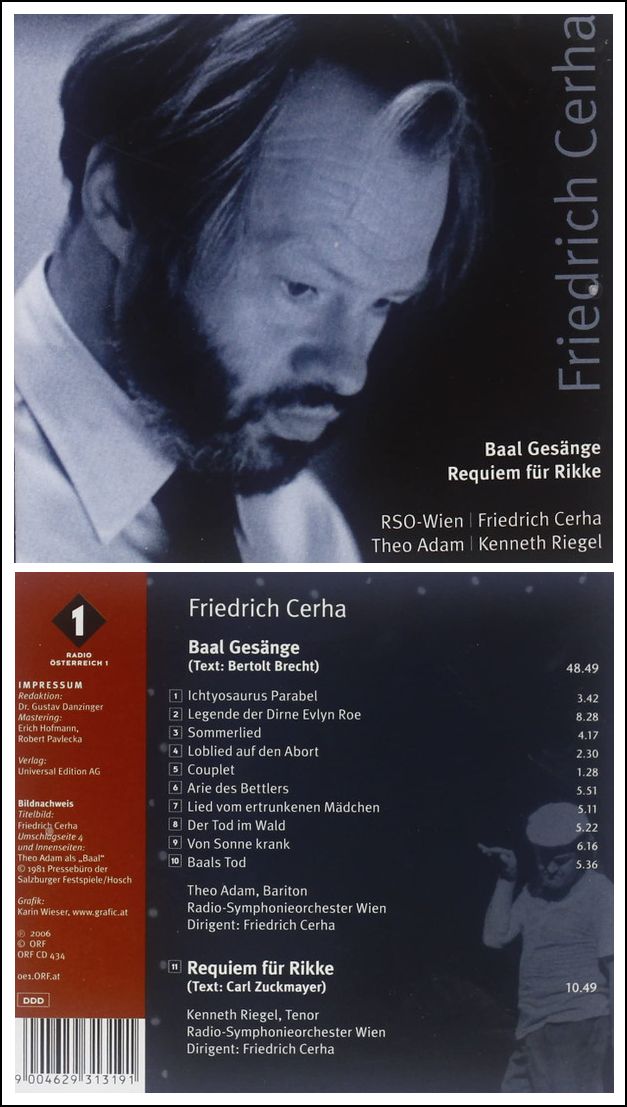
Riegel:   Yes, and Friedrich Cerha, who wrote the third act, was at all of the rehearsals.  He was sort of sketching in things, and taking some things away, and so it was like it was being written on the spot!  It was great, and then to do the recording was very difficult.  What not many people know, is that Teresa Stratas was not singing for the recording.  It was done later as a voiceover.  I had to sing these duets, with all that difficult music, without her.  She was acting it out while I was singing, so I could give all the passion, but it was really strange.

BD:   You’ve done a lot of new operas.  Do you have any advice for someone who wants to compose operas at the end of this Millennium?

Riegel:   Oh gosh, yes.  Where are they?  Where are the composers?  Where are the operas?  Where are the American operas?  I’d love to do them, even any contemporary opera.  They think they have to make something so diversified, and so different, and so challenging that they end up messing up their own art a lot of the time.  I would like to see them concentrate more on details other than the music and the storyline, and really fill it in with something that’s coming from the stage to the audience, rather than try to be ethereal and so indifferent to everything.  I just did Il Prigioniero of Dallapiccola, and was thinking about this.  Un re in ascolto [A King Listens] was such a grand piece.  [This work by Berio was given its American premiere at Lyric Opera during the time Riegel was doing the Salome production.]  Why hasn’t that piece been done on the stage more?  I know it’s a short opera but what a piece of music!  How strong it is, and it’s just brilliant.  I did it in Florence and in Salzburg with Zubin Mehta, but the first time I did it, in Bregenz, everyone was floored by this piece.  You need a great baritone to do it.  The baritone is the central role, and it’s the most wonderful role to do.  I can’t imagine any baritone not wanting or striving to do that role.  [Noting that Jean-Philippe Lafont was doing it here in Chicago]  I spoke to him after the Salome, and we had a nice discussion.  I’m always looking for new pieces to do.  Of course, now I’m getting older... not that I’m giving up, let me tell you!  I have another ten years to go, and I’ll go on until I drop!  It’s the challenges that are there.  It’s just so exciting to do these pieces.  I’ve done Henze pieces, and they
re wonderful!

BD:   The Young Lord?

Riegel:   Yes, and The Bassarids, and Boulevard Solitude, and The Stag King.  These are really interesting pieces.

BD:   Some opera company should do a
Manon Season’, with the Auber Manon Lescaut, the Manon of Massenet and his Le Portrait de Manon, then Manon Lescaut of Puccini, and finally Boulevard Solitaire.

Riegel:   Yes, exactly! That would be very interesting to do.

*     *     *     *     *

BD:   You’ve sung in opera houses all over the world.  Do you change your vocal technique at all for the size of the house?

Riegel:   No, I wouldn’t say that at all.  If you try to do that, you run into difficulties.  My technique is what I do, and I know my voice.  I know how I perform it, and I wouldn’t dare to change it.  Then you become self-conscious.  You let the opera house take care of it.  It works itself out.

BD:   You rely on the acoustics?

Riegel:   Yes, absolutely, and if they’re bad acoustics, what can you do?  There’s nothing you can do about that.  I’ve sung in some places that were a little bit difficult, mostly in concerts, and especially when they are outside concerts.  I love singing in Tanglewood, but I always felt strange about singing outside.  I don’t like the outside concerts, but I did a lot of them from Ravinia to the Hollywood Bowl, everywhere!

BD:   Since you don’t like them, why not turn those offers down?

Riegel:   It’s because I like to do the works.  Some people get satisfaction out of these outdoor performances, there’s no doubt about that.  Under the roof there are some wonderful acoustics close up, but when you get back into the corners and out on the lawn, you have a different type of setting.  But what counts is that we cannot stop any kind of classical music in the United States.  It dwindles and it’s far behind, so we have to push it all we can.  I go for the education, too.  That’s why I was so happy to see here at Chicago Lyric Opera, how much they do for education and in the schools.  To me that’s wonderful, and I applaud them.  I told the lady there who was on the Board of Directors that this is so fantastic.  A
s an American singer who goes and spends eight months in Europe all the time, I cannot tell you how happy it makes me singing this music.  I’ve been out to many of the provinces here, and the people just don’t understand classical music, or even want to understand it.  It’s hard.  Out there, it’s all football, and jazz, and the pop-contemporary things.  I’m not against pop-contemporary music.  I love Sarah Vaughan and all those people.  The jazz pianist Roberta Flack played arias for me.  She was a grade school music teacher when I knew her in Washington DC while I was in the army there!  I know all this, but I just feel as though every time I come back here, a little bit more and more of the classical material falls by the wayside.

BD:   Is the abundance of opera on the radio and television helping at all?

Riegel:   I really don’t know the statistics on that.  I want to think so, but when you hear that the Philadelphia Orchestra is on strike, and they were canceling their radio contract, that makes you think about all of these things.  Just now, San Francisco is on strike, and isn’t the Cleveland contract up?  All these things happen, and the monies are very tight with these organizations, so we have to fight for it.  We have to really work for it, and that’s why we have to get new audiences who are interested all the time, because we need that.  We don’t have the government backing.

BD:   In spite of all of this, are you optimistic about the future of opera?

Riegel:   Oh always, yes.  I wouldn’t give it up for the world.  I’ll fight for it until my dying days, and especially for American singers.  I grew up at a time when I had a lot of opportunities, and I find those opportunities are not around for young singers like I had.  I was very, very lucky, and because I had five debuts with five major symphony orchestras at one time, and including Chicago when I sang with Sir Georg Solti [Mahler Eighth (1980 performances), and Damnation of Faust (1981 performance and recording)].  He opened up wonderful doors for me.  When I did Salome in Salzburg [1992], he was there for Die Frau Ohne Schatten, and he wrote a beautiful note to me.  What other conductor would take the time to do that?  He said,
Ken, you’re so brilliant.  Please forgive me for not being able to come back stage!  He went on and on, but he took the time for a handwritten note.  Those are moments which make it all worthwhile.

BD:   Does that then inspire the next performance?

Riegel:   Absolutely!

*     *     *     *     *
riegel
BD:   When you’re on stage performing, you get into these characters and into the music.  Are you portraying a character, or do you actually become that character?

Riegel:   That’s a hard question.  It starts out as you portraying a character, and then you study that character, you apply make up as that character, and you give yourself into that character.  So it’s certainly part of you, but all of a sudden you become him.  In fact,  Luc [Bondy, the director of Salome] said to me at the opening,
You have really become that character!  That was such a compliment.  The thing is, you can’t get yourself lost in the character.  You have to hold yourself back.  You have to be that good an artist to know how far to go, and how far you can and you can’t go.

BD:   Then you go right up to that point?

Riegel:   Well, maybe not.  I don’t feel that I have ever gone up to that point.  I have always reserved myself.  It’s just like reserving your voice.  You need to know you can still sing after the opera.  You have to know how to budget yourself without damaging the voice.

BD:   So, you subscribe to this idea of using the interest and not the capital?

Riegel:   Not all the time.  I use that capital, but sparingly, and knowing when to use it.  That’s what makes an intelligent singer.  One has to.  I don’t know of any singer who really has a long career that doesn’t do that, otherwise they wouldn’t have that long career.

BD:   Is there any character that you have portrayed that is maybe a little too close to the real Kenneth Riegel?

Riegel:   The only time I’ve almost lost myself was in the Zemlinsky opera [Der Zwerg].  The angst, and the patheticness, and the beauty got to me.  I was an emotional wreck every night after I had sung that opera.  When I think about it, it just makes me tear.  They devised an ingenious thing, so that the shoe part of the boots came out of my knees.  It was beautifully done.  He wore the sack of a thing, and even on the stool I wiggled my knees in these things.  [Both laugh]  We did a little dance, as much as I could being on my knees.  But there was beauty to this piece.  It was heart-rending, and you saw the audience as they wiped their tears.  It’s just one of those special things.  I only wish in my lifetime that I could have brought this opera to the United States.  It
s really too bad, because he lived and died in New York, and his wife died in New York.  He was finally sent back to Vienna [in 1985].  Before she passed on, his wife said to me, When you go back to Vienna, please go to the cemetery where all of the great composers are buried, and take a picture of the graves.  Let me know how it all is there.  I did that, and brought it back to her.  She said, Now I am at peace, and I know that when I die I know where I will go.

BD:   I’m sure he’s looking down, and is pleased that you are champion his works!

Riegel:   Bless his heart for writing such a piece.  He also wrote other pieces that are very interesting.  I do his songs...  Ehetanzlied, Op10 [The Marriage Dance] is quite an interesting song cycle.

BD:   It seems that we’re not getting so many song recitals these days.  Is there anything you can do to make them more popular, especially in the United States?

Riegel:   It’s just that I don’t think the money is there for song recitals, and the people don’t come out to the song recitals, though they all come out for the super-duper stars...

BD:   Have the super-duper tenors helped or hindered your career?

Riegel:   [Laughs]  We do different things!  I can’t imagine Pavarotti getting on his knees to sing this opera.

BD:   No, but is just their proselytizing for opera making it more popular perhaps?

Riegel:   Oh yes, they’ve done something, but now it’s going a little bit overboard.  I don’t like to see so much commercialism... getting the mugs, buying the scarves, buying this and that.  It gets a little bit much.  [Laughs]  Every time I turn on the television, there was an advertisement for the video!  [Both laugh]  But I take off my hat to them to go out there.  It doesn’t bother me at all.  I do what I do, and I know what I do is good, and I’m happy in that.

*     *     *     *     *

BD:   Do you work a little harder at your diction when you’re in the country of that language?

Riegel:   My family has a German background, so German was fluent for me.  French was a little bit difficult.  I’ve really worked hard on that, and I studied it with a lot of people.  I didn’t sing in Italian that much, but early on, when I was at the Met Studio years ago, Rudolf Bing was there, and they had this wonderful program where I took all these languages.  Then, when I was going to Manhattan School of Music and I was working at Macy’s trying to get myself through, I was singing at all the churches in town!  I did it all.  I worked at it.

BD:   Is it easier or harder singing Faust in Paris than in Vienna?
riegel
Riegel:   It’s easier because you have the language around you.  Then you really get into it, and that’s wonderful.  I’ve heard all my colleagues talk about that, and once you’re there, you really get it.  It’s wonderful.  You really pick it up.
 
BD:   When you’re on stage singing, are you conscious of the audience that’s out there each night?

Riegel:   No, not after thirty years.  I used to be, early on, and especially if someone come back and said so-and-so is here.  Now it
s so what?  I’m glad they’re here!  [Laughs]

BD:   Do you change your technique at all for the microphone?

Riegel:   No.  The dials are manipulated, so you don’t have to.  In a recording, those dials are all there to make it right.  They make the distance right, they make everything right, and in all the recordings I’ve done I’ve never felt that.  At the beginning it was a little strange.  I had a hard time listening to myself, when going back and hearing the retakes and all of that, but you get used to it.  After a while you get to know your voice on the recording.

BD:   Is there any chance that a recording becomes too perfect?

Riegel:   Oooo, boy, I wish!  [Both laugh]  No, you wish for the most perfect rendering.  You want to sing all the notes in Lulu.  You also want to sing all the right notes in Salome, but it’s difficult because this is a difficult role.  People pass it off, but it’s one of the most difficult that there is.  I was told this in Europe all the time by coaches who were there under Richard Strauss in Munich.  I’ve learned it from the sources there, and I know all the traditions.  But I always like to make sure that every note is there.  Strauss had this idea that every note has a right to be heard.

BD:   He gave each little blob on the paper its own moment of glory!

Riegel:   Absolutely.  He would agree with that.  A lot of composers like to hear their notes heard.

BD:   Do you bring a lot of yourself to these characters?

Riegel:   Oh, absolutely.  I bring what I feel.  However, there were some directors who were so dictatorial in their directions, that everything had to be done the way they wanted.  But I was able to convince one or two of those people that I did have something to say.

BD:   Otherwise, you felt you were in a straightjacket?

Riegel:   Oh yes, absolutely.  I can’t work that way.

BD:   Does that influence whether or not you accept or turn down a new contract with that person?

Riegel:   Possibly, yes.  It would have, but he died, so...  [Laughs]  Most of the people that I work with are just fine.  I love working with Patrice Chéreau.  I really enjoyed him so much.  He was terribly intense, and he overrehearsed you in the beginning.  But if you keep the ideas flowing, it will all work out.  When you have theater people, they always add to the thing, but those people forget that in the theater they’re not going to get up and sing.  Having to go through the whole aria, and use all that energy to sing is something else.  You have to be able to produce those tones, and produce them well, even with all your theatrics on the stage.

BD:   Have you basically been pleased with your performances on recordings?

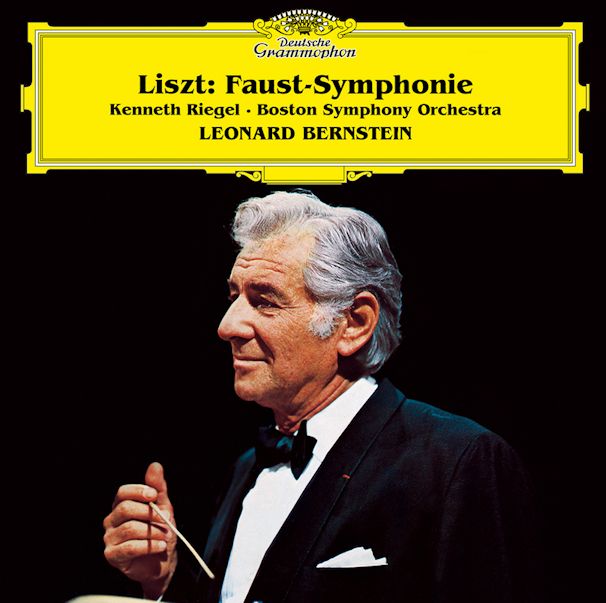
Riegel:   Oh yes, very pleased.  I don’t think I’ve done any recording that I’m not happy with.  Lenny [Bernstein] was one of the most brilliant people, and had a feeling of the Mahler phrase that one just gets goose bumps thinking about.  I just did Gurrelieder with Giuseppe Sinopoli, and one recording you might not know of is
music by Arthur Laurié, with violinist Gidon Kremer.  In fact, I conducted that!  I sang Little Gidding by T. S. Eliot.  It’s in English, and it’s quite modern, but it’s a very interesting piece.  We did a Russian tour because he was Russian.  He then went to Paris, and later to the U.S.  There are just reams of his music around.  I would love to get more of his things.

*     *     *     *     *
riegel
BD:   Let me ask the great big question.  What’s the purpose of music?

Riegel:   I think music is food for the soul.  I can’t imagine living without music.  It’s one of these things that’s built inside of you, and makes your character and your dreams.  [Pauses a moment]  I’ll have to write a thesis on that!  [Both laugh]  That is difficult.  Music is my life, but it might not be everyone else’s.  Music is different to every person, and I don’t think it ever takes away or damages.  It’s always adding something, so there’s nothing wrong with it.  It’s such a marvelous spiritual thing.

BD:   I’ve never heard anyone else say that it’s always positive.  They’ve never said it’s negative, but this is something that is always positive.

Riegel:   I’m speaking about the kind of music I do, the classical music.  I think all music can be positive... no, wait a minute!  [Laughs]  There’s metal and maybe some other music which might not be positive.

BD:    I take it you would turn down an offer to sing a gangster-rap opera?

Riegel:   Oh, I don’t know... if it had a good melody... [Both roar laughing]  I don’t know.  It all depends.  Are the words going to be detrimental to your life?  If they talk about killing people, that has to be taken into consideration.

BD:   [Gently protesting]  Of course, in many of your operas, you are killed, or you kill somebody.

Riegel:   Yes, that’s very true, but I don’t think the whole opera is not based on that theme, and you’re sort of vindicated in the end by a little ‘Hosanna to the highest’, or some goodness in life.  The goodness outdoes the evil, and that’s magic.

BD:   One last question.  Is singing fun?

Riegel:   Oh, yes!  I wouldn’t do it if it weren’t!  It has to be, otherwise I’d be a mental mess.  But it’s fun for me.  There are moments...  We have all our stresses, and it’s very difficult for a singer.  The public doesn’t realize that.  It’s a physical thing, and if you have a cold, that is something which will upset.  Then I really can’t produce the best, and that will wear on me.  I’ll wonder why I am doing this when I have all this Angst about it, because I always want to do the best I can.  I’m a perfectionist that way, and I like to do everything right.  It is hard to have everything going at the same time.  I don’t spare my feelings.  I’m into my music, and that’s where it’s at.  You are or you aren’t, and the public can always tell.  If an artist gets there and is standing away from what they’re singing, or they don’t understand what they’re singing about, or they’re not really into the phrasing, or they’re not really into the hope of the beginning to the end of that piece, you can really tell, and that is too bad.  When I talk to young people, that’s why I say it’s a complete dedication.  It’s a complete life, and you have to be able to give your all.  It’s just not something you just stand back and sing lovely notes here, and a good B-Flat, and ringing bass tones here.  It’s a whole spectrum of learning, and singing, and communicating.

BD:   Are you coming back to Chicago?

Riegel:   I hope so!  There have been inquiries, and some things are not working out because I have a schedule about three years ahead of time.

BD:   Does it give you a secure feeling to know that on a certain Thursday, three years from now, you’re going to be singing a certain role in a certain house?

Riegel:   Sure!  It’s good to know that you have a job to go to.  [Both laugh]  Aren’t you happy to have your job at your radio station?

BD:   Absolutely!

Riegel:   You know that’s where you’re going, and you like to have that last as long as you possibly can.  I’m no different, believe me!  I need to make a living.  I’m not an independently wealthy person, and it’s all part of the joys of life.

BD:   Thank you for the chat.  I appreciate it very much.

Riegel:   Thank you.


riegel

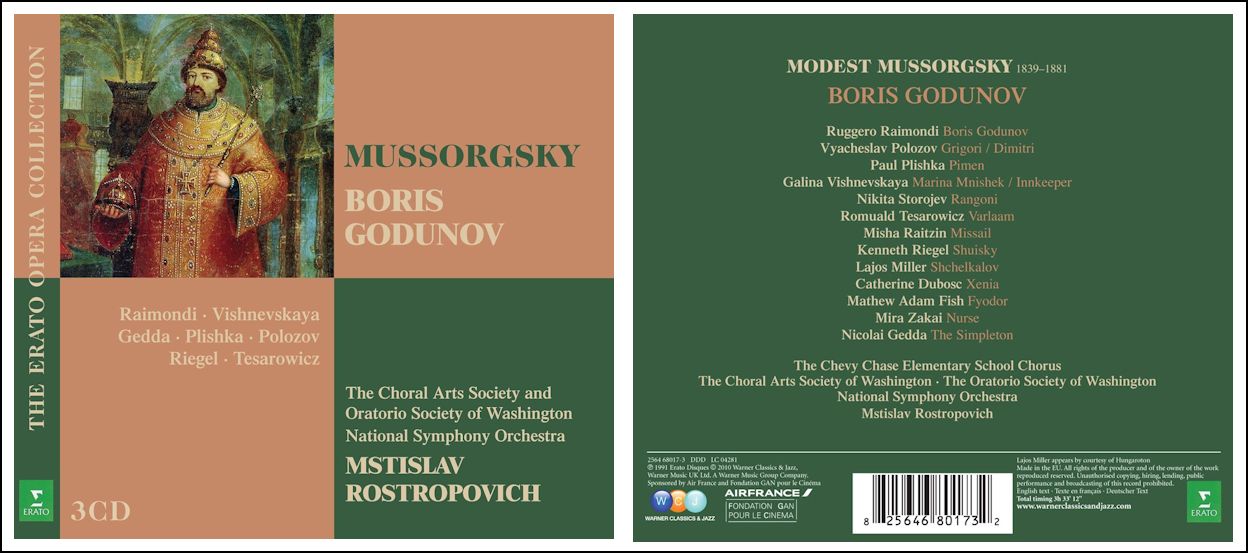
See my interviews with Ruggero Raimondi, Vyacheslav Polozov, Paul Plishka, and Mstislav Rostropovich


© 1996 Bruce Duffie

This conversation was recorded in Chicago on December 6, 1996.  Portions were broadcast on WNIB in 1998.  This transcription was made in 2026, and posted on this website at that time.  My thanks to British soprano Una Barry for her help in preparing this website presentation.

To see a full list (with links) of interviews which have been transcribed and posted on this website, click here.  To read my thoughts on editing these interviews for print, as well as a few other interesting observations, click here.

*     *     *     *     *

Award - winning broadcaster Bruce Duffie was with WNIB, Classical 97 in Chicago from 1975 until its final moment as a classical station in February of 2001.  His interviews have also appeared in various magazines and journals since 1980, and he continued his broadcast series on WNUR-FM, as well as on Contemporary Classical Internet Radio.

You are invited to visit his website for more information about his work, including selected transcripts of other interviews, plus a full list of his guests.  He would also like to call your attention to the photos and information about his grandfather, who was a pioneer in the automotive field more than a century ago.  You may also send him E-Mail with comments, questions and suggestions.