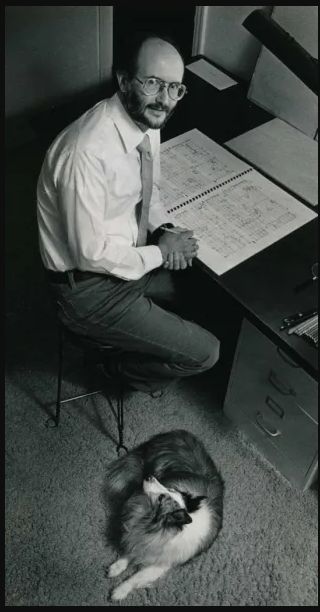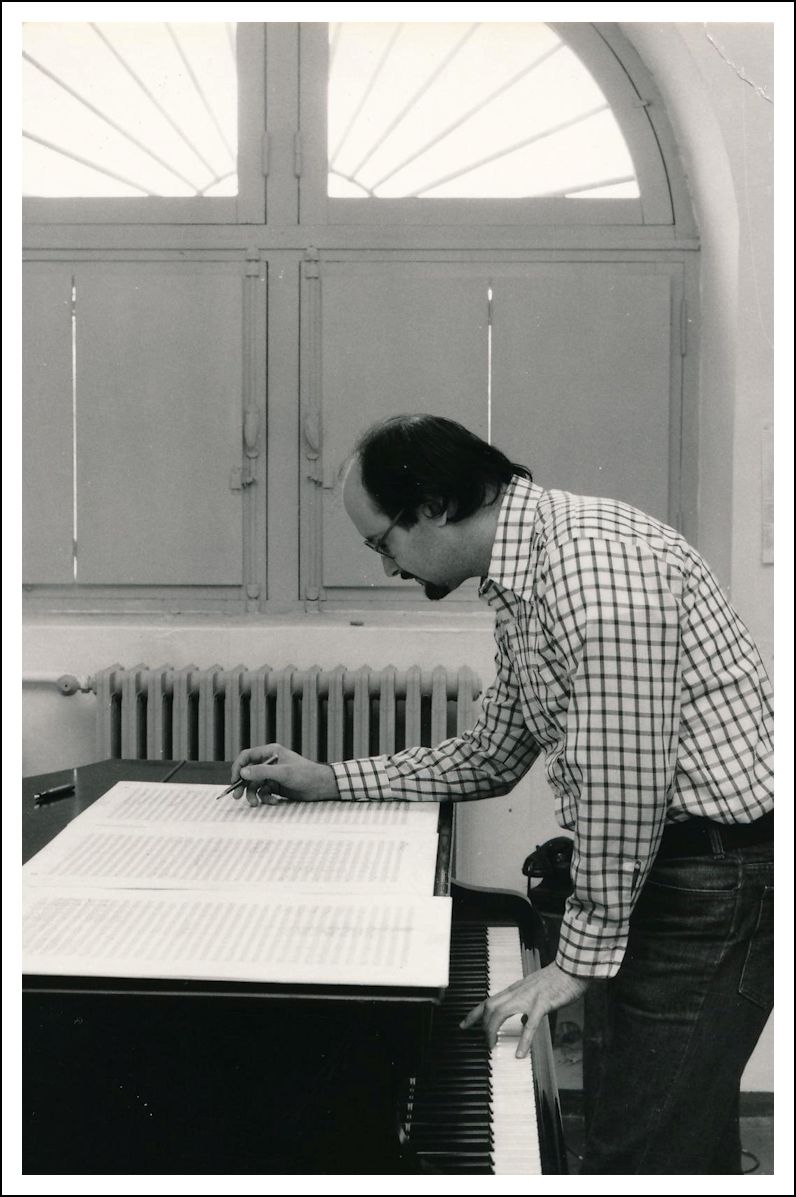
Composer  Gerald  Plain

A Conversation with Bruce Duffie


plain


plain Born in Sacramento, Kentucky, in 1940, Gerald Plain has borrowed heavily from his early exposure to folk music through his parents and his grandfather. In addition, his music reflects his passionate interest in the pedal steel guitar, which he played as an adolescent.

Studying principally with Ross Lee Finney and Leslie Bassett, both of the University of Michigan, Plain has received numerous awards, including the Rome Prize Fellowship (Prix de Rome) in 1974, the Prince Pierre of Monaco Prize in Musical Composition in 1980, the Charles Ives Fellowship in 1988, and the Academy Award in Music in 2001, the latter two awards from the American Academy and Institute of Arts and Letters in New York City. Most recently, he earned the 2011 Al Smith Individual Artist Fellowship by the Kentucky Arts Council.

Plain’s music has been performed by  Indianapolis Symphony Orchestra, Milwaukee Symphony Orchestra, Brooklyn Philharmonic Symphony Orchestra, Civic Orchestra of Chicago, Alabama Symphony Orchestra, Cincinnati Symphony Orchestra, Cleveland Chamber Symphony, and Pro Arte Chamber orchestra of Boston. European orchestras presenting Plain’s music include Radiotelevisione Italiana Orchestra of Rome (RAI) and the Philharmonic Orchestra of Monte Carlo.

A few specifics follow...


Education:

BME (music/art) - Murray State University, 1963 (Murray, Kentucky)

MM (composition) - Butler University, 1966 (Indianapolis, Indiana)

Post-Graduate Study (comp.) - University of Michigan (Ann Arbor, MI)


Teaching Experience:

Texas Tech University,  Visiting Assistant Professor,  1971-72  (Lubbock, Texas)

DePaul University,  Instructor,  1973-74  (Chicago, Illinois)

Chicago Musical College of Roosevelt University,  Instructor,  1974

University of Wisconsin (Stevens Point),  Instructor,  1977-78

Eastman School of Music,  Assistant Professor,  1978-81  (Rochester, New York)


==  Throughout this webpage, names which are links refer to my interviews elsewhere on my website.  BD  


This conversation was held in February of 1990, when Plain was back in Chicago for a performance of Portrait 2: Pretty Polly with the Civic Orchestra conducted by Michael Morgan.  Among other conductors of his music are Gerhard Samuel, Lukas Foss, Lawrence Foster, Kenneth Jean, Gunther Schuller, Stewart Robertson, Andrew Davis, and Edwin London.

At the time we met, he was adjusting his life in order to spend most of his time composing.  At first, he had a bit of trepidation about speaking with me on tape for the radio, but he was quickly at ease and the ideas flowed freely.  Portions of the chat were aired three times on WNIB, Classical 97 in Chicago, and now, in 2026, I am pleased to be able to present this transcript of the entire encounter.
plain
Having taught in the 1970s, it was logical to begin by asking about his current direction . . . . .

 
Bruce Duffie:   Are you a composer and a teacher, or just a composer?

Gerald Plain:   I’m just a composer.  I spend all of my time composing... well, more and more of my time composing.

BD:   You’re able to make ends meet that way?

Plain:   My wife has a job, and in the past I designed and built customized furniture for people.  But at present I’m trying to phase that out and spend more and more of my time composing.  So I hope to get more and more income off the composing end.

BD:   When you were writing music and then you went to make a piece of furniture, was it better than teaching music so that you could get completely away from the sounds?

Plain:   I have found that almost everything you go into is time-consuming... maybe a little too time-consuming.

BD:   So, you spend all your time composing now.  Even though you have all of your time devoted to that, is it enough time for composing?

Plain:   Ah, yes!  As I have phased out the woodworking, I’m getting more and more time to compose, and it’s working out.  Of course, when you have that much time, it works out very well.

BD:   Do you schedule enough time to be away from it so that you do have a rest from the composing?

Plain:   Yes, now also I take care of my mother.  My aging mother lives with me, and so I have to cook her meals.  That gives me a little time away, and then when I go out on performances to various places, that’s gives me a little break.  Also, even though I don’t take on any woodworking commissions anymore, I go down in my shop from time to time, and work on a piece for myself or for the family.

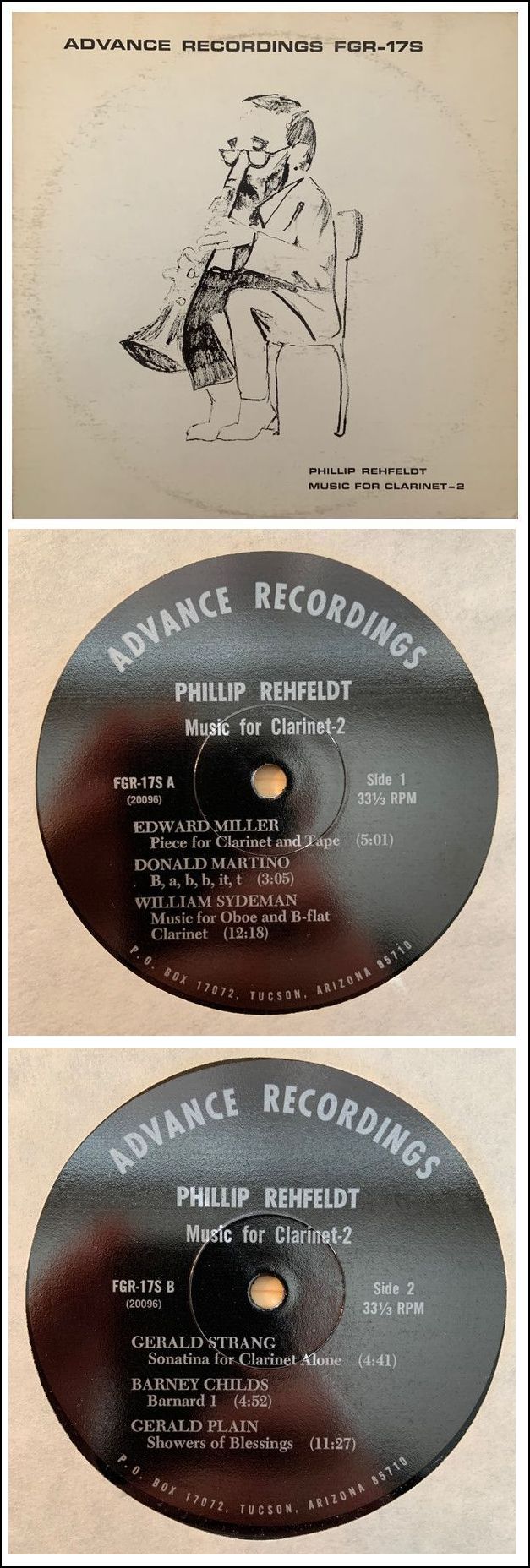
BD:   Can we assume that you have quite a number of commissions coming in?  [Vis-à-vis the recording shown at right, see my interviews with Donald Martino, and Barney Childs.]

Plain:   Not at the present, but things are looking up.

BD:   When a commission does come in, how do you decide if you will accept it, or perhaps turn it aside?

Plain:   [Laughs]  At the moment I might accept anything, but the last few years I’ve been extremely interested in writing for orchestra.  So I’m looking for orchestral commissions.

BD:   A big orchestra, or a small orchestra?

Plain:   Right now I have a small orchestra in the balance.  I don’t want to mention the orchestra itself, but there is a possibility of a commission, so at the present I hope that will come through.  Then later on I would like to do a large orchestral piece, because the last two orchestral pieces I’ve done are a little bit smallish in terms of their forces.  They are sort of chamber music orchestra, and I’ve reached a point where I want to write a huge orchestra piece with all the ambiance of percussion and sound that you would get out of that large orchestra.

BD:   Is this is not something you would just sit down and do, and hope that it would then get played?

Plain:   I have done that in the past, and I have always found that by holding my faith they are played.  Maybe it would take a couple of years, or maybe three years.  They’re always played, but it takes time.

BD:   If you have a specific commission, do you tailor the piece for exactly that group and those performances?

Plain:   You have to take certain things into consideration.  Sometimes they are limited in a certain area, and they’ll tell you.  If you’re limited to three percussion players, or only one keyboard, or a certain number of strings, they’ll give you that information right at the beginning and you have to customize it to that.  Only in certain instances could you demand a particular instrument, like a harpsichord, and they would have to pay a little extra for it.

BD:   If you write a piece that is tailored to one orchestra, does that preclude it from being played by another orchestra of different dimensions?

Plain:   No.  If it’s not too far out of bounds, then you would get other performances.

BD:   Might you recast it very slightly?

Plain:   No, that’s very difficult.  If the change could be made on the spot, like a keyboard change, if you couldn’t get that harpsichord, maybe substituting a piano or an electronic instrument that would give a harpsichord type of sound.  But other more complicated types of changes would not work at all.

*     *     *     *     *

BD:   When you’re writing a piece of music, are you conscious of how much time it will take to perform?

Plain:   Generally, I simply write a piece of music.  Once I have initialized my ideas, I start feeling and sensing an overall timing of the piece just by the type of ideas I have.  I can tell whether it’s going to turn into a fifteen-minute piece, or a twenty-minute piece, or a ten-minute piece, or if it
s only good for six minutes.  I can pretty much tell that, and can pace myself according to the characteristics of the ideas.

BD:   Are you ever very far off?

Plain:   Ah, sometimes as much as five minutes.  I might find that I can spin out a little longer.

BD:   When you’re writing the piece of music, are you always in control of the pencil or are there times when that pencil is controlling your hand?

Plain:   We’re talking about inspiration here.  I have two types of inspiration that I experience. I refer to the first type as the hopping-jumping type, where it strikes me like a lightening bolt and I go hopping and jumping around the room.  I work very fast with those ideas, sometimes just scribbling to get those ideas down.  Those are real fun, and that’s a real fun experience, I must say.  Then there’s another type of inspiration, which is perhaps the most common type, where it just sort of seeps and creeps into you.  You grab one idea, and you have to hold onto it.  Then suddenly there would be another idea that would augment it, and then you grab another one, and then another one.  You eventually pull together all your ideas, and form them and shape them.  Any inspiration is good, and it’s those moments when you’re blank that are the scary time.

BD:   I hope those are few and far between.

Plain:   [Laughs]  I hope so too, but they do occur.

BD:   When you get an inspiration, is it always for that piece, or might it perhaps be for something that you would use two or three pieces hence?

Plain:   I have a log of pieces ahead of me, various ideas I’m working on in my mind.  I have as many as three pieces that I’m chewing on, but I can only work on one at a time.  I’m not a composer that can be physically working on getting notes down on two or more pieces at once.  I have to concentrate on one piece, but at the same time, I am thinking about others that I’d like to write.

BD:   You say you want to concentrate on orchestral music at least for a while, but you’ve also worked with electronics.  Are there times when you combine electronics with the live orchestra or live soloists?

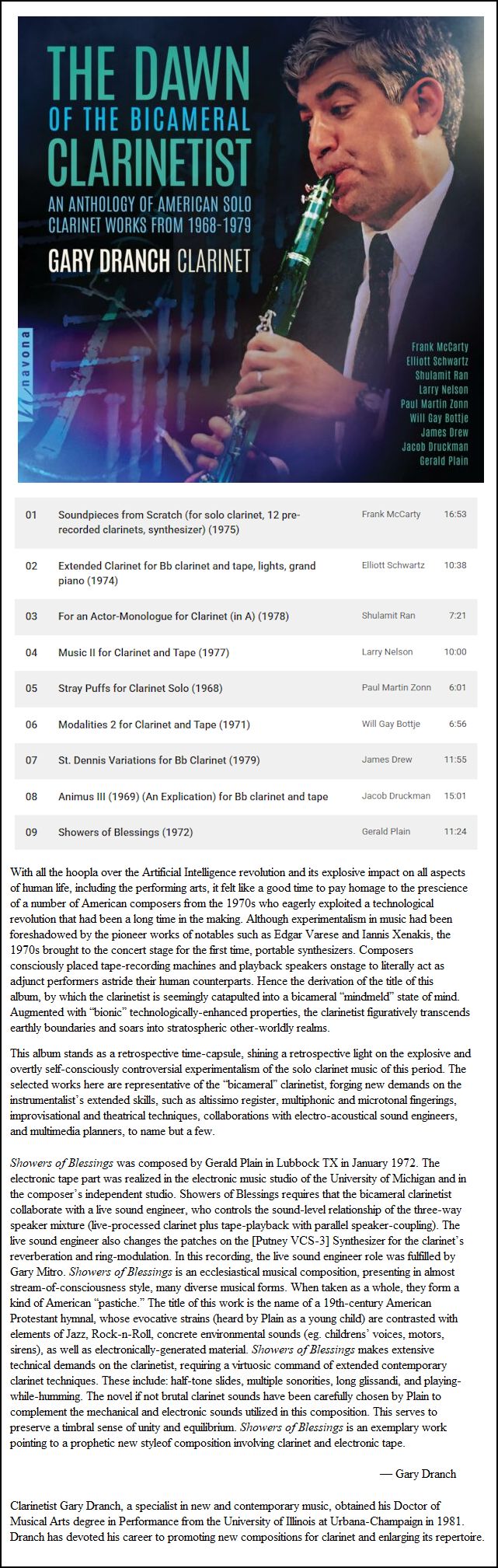
Plain:   I’ve never worked with electronics and orchestra together, although I’ve wanted to, but it just hasn’t really presented itself.  But I have combined other instruments with electronic tape.  For instance, Showers of Blessings for clarinet and tape, which was written back in 1969 or 1970.  It was played by Philip Rehfelt, a well-known contemporary music clarinetist. 
The work is abut fifteen minutes or seventeen minutes, and it’s a highly charged piece.  The clarinet itself is amplified and manipulated.  [LP shown above-right]  I also wrote a piece called aCHATtaNOOgaCHOO for amplified alto flute, electric guitar, amplified double bass, and four tracks of electronic sound.

BD:   Not A Chattanooga Choo Choo?

Plain:   No, no!  [Both laugh at the joke]  There’s nothing to do with that, really!  I just like the syllables.  They are unaccented and accented, and I added the 
‘a’ at the beginning, so it’s a playful title.  That was performed in Chicago years ago when I was teaching at Roosevelt University.  It was also played in New York and in Ann Arbor, Michigan, where I was a student.

BD:   When you get some pieces played in various locations, are they very different, or are they very much the same, especially pieces without electronics?
plain
Plain:   The piece pretty much stays the same.  The environment would change it slightly, depending on the hall it’s played in.

BD:   What I’m leading up to is how much interpretation do you want on the part of the performers?

Plain:   Surprisingly, I find that the performers are a little bit more predictable than the electronics.  The electronics would change more if you had a different set of speakers, or if the amplifier was not quite big enough to drive the speakers.  There were plenty of variables at the electronic end of composing and performance, and surprisingly the performers were a little more predictable!
 
BD:   Yes, it does sound strange...

Plain:   ...because electronic music was to be always predictable.  It was also to eliminate the performer!  [Gales of laughter]  That didn’t happen, and will never happen I would think.

BD:   Have you written some pieces which are just straight electronics?

Plain:   Yes, I have two.  One is called Golden Wedding, and the other is called Ripsnorter.

BD:   Did you not want to have a performer, but just the pure sounds?

Plain:   In those particular pieces, that was true.  I wanted them to be purely electronic, and they were not written side by side.  Golden Wedding was the first.  Then I did Showers of Blessings and aCHATtaNOOgaCHOO for both electronics and acoustic instruments.  Then came Ripsnorter which was electronic.

BD:   Are these electronically-generated sounds, or are they electronically manipulated acoustical sounds?

Plain:   In those days I was working with a combination of both tape-manipulation and the electronic-generated type of sound, which I found more interesting.  In fact, I find it more interesting today than some of the electronically-generated sound.  It just seemed to catch sound manipulated by a tape recorder.  It had a nice sonic effect that seems to be missing nowadays, especially in the New Age type of music, which is far more subdued.

*     *     *     *     *

BD:   We’ve started in this direction, so tell me... where is concert music going these days?

Plain:   I’m not sure.  [Bursts out laughing]

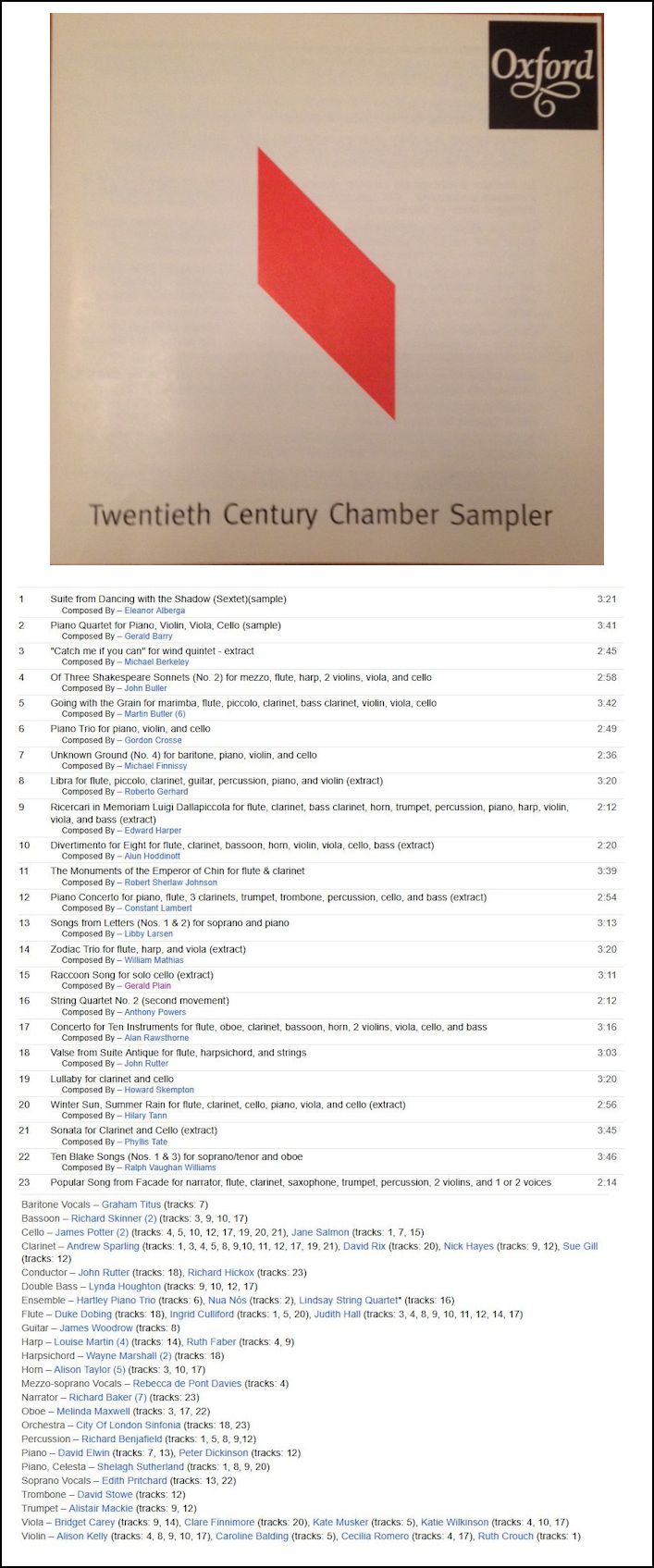
BD:   Are you not part of a direction???  [Vis-à-vis the recording shown at left, see my interviews with Alun Hoddinott, Libby Larsen, William Mathias, and John Rutter.]

Plain:   It’s hard to point out a direction.  I know what my music is doing, and it’s been doing it for twenty years.  During that time my music has been saying,
Let’s get together and enjoy ourselves!  Let’s get together and have fun!  Through the years I have been adding elements that musicians, composers, and the audience can enjoy.  I started this twenty years ago with a piece called Raccoon Song for solo cello.  It had a folk song that was sung at the end.  It also had a hog call and various snorts.

BD:   How would that go over with people who are accustomed to string quartets?

Plain:   No doubt it was very strange, but the performances I had were highly successful.  The audience really enjoyed it.

BD:   I trust you didn’t write it as a novelty piece.

Plain:   In a sense, no.  It’s not a Peter Schickele PDQ Bach by any means.  It’s very serious.  There is one general snort in the middle which took the crowd by surprise.  It was calculated to subdue the tension at that point, and to get a mild audience reaction.  It was structural in that sense.  At the end there was a rousing ripsnort, and a hog call.  Then the performer would sing the folk song, the elements of which he had been playing all along.  By that time, the audience would have known all the melodic elements of the song.

BD:   Then you pulled it all together?

Plain:   Yes, it is all pulled together in the song, and it was highly successful!  You don’t get many cellists to play it.  They’re scared of it.  It takes a special personality to pull it off.  They have to sing and snort, and come out with a good rousing hog call at the end!

BD:   Do you know the Arditti Quartet?

Plain:   Yes.

BD:   You ought to write something like that for him.  He’s always [snorts].

Plain:   [Laughs]  Yes!  I talked to him, but I was not able to influence him.  Then to boot, he gave me his cold!

BD:   Let me ask a big philosophical question.  What’s the purpose of music in society?

Plain:   I don’t know!  [Laughs]

BD:   [Gently protesting]  But you’re doing it every day...

Plain:   Yes.  Maybe it’s to give society a much needed break from what they do.  We definitely need to experience music in some form or another.  It’s very important to us as a release from the tedium that we sometimes find ourselves in.

BD:   Earlier we were talking about technique and inspiration.  Where is the balance in a piece of music between this inspiration and the technique of composing?

Plain:   You have the element of inspiration.  A composer without inspiration is no composer, but also you need the technique.  The most important element is the inspiration first, and then after that you must start working.  I work from a series of drafts, and sometimes my initial ideas are just scribbled on large news print with words.  Instead of trying to focus in on minutia at that point, I always try to think about the sense of timing, or proportion, and run that music as far forward as I possibly can at that moment to capture all of that sound.  After that, I start finding the notes.  Sometimes I go through as many as three generations of sketches, and the third might be on the vellum, or, as it is now, on the computer.  So, there’s a lot of work after the inspiration.

BD:   You keep working at it, and revising it, and filling it in, and doing detailed work?

Plain:   Yes, yes.

BD:   How do you know when you have finished?

Plain:   I just know.  I have a sense of about that.  You just feel good about it.  Sometimes there might be a section where you are a little uncertain, but you let it go and watch it very carefully during the performance.  If need be, I can always come back and revise it!  [Laughs]

BD:   Do you do a lot of that, or a little of that?

Plain:   Some pieces I hardly touch at all, and others I have to go through and do several things to it to get it to really work.  It really varies.

*     *     *     *     *

BD:   Have you basically been pleased with the performances you have heard of your music over the years?

Plain:   No.  There are good performances and bad performances, and composers are always after a better performance.  No matter what you get, you want a better performance, and a better tape.  This is human nature.  But performances really do vary.  One orchestra will have a very good first violinist, so a solo will really shine.  Then, the next orchestra might have a concert master who will be more laid-back, and he will not be able to capture the style that you want.  Some percussion sections are very good, and they can do anything.  There might be another percussion section where you can hardly get them to talk to you.  You can hardly communicate with them.  Some brass sections are excellent, like the Chicago Symphony Orchestra is known for.  In Europe, some orchestras don’t have good brass sections.  Some orchestras go as far as to import American brass players!  I ran into this in Italy.  There, the strings are always quite good, but the brass and percussion may be weak.

BD:   Is there any place where everything is balanced?
plain
Plain:   Some orchestras are that way.  The Minnesota Orchestra could sight-read almost anything, and you just have to work out some of the oddities.  They seem to be very solid in everything.

BD:   You’ve mentioned the percussion section a couple of times.  Have you written anything strictly for percussion alone?

Plain:   No, I haven’t.  I
ve thought about this, and I have a piece for singers and percussion.  It seems like every time I deal with percussion, I want to add something else in with it.  The piece I am chewing on right now in my mind will have a lot of percussion and a lot of odd instruments.

BD:   Odd for odd’s sake, or just strange things that are needed in the piece?
 
Plain:   I just want these sounds.  I’m sure there’ll be wooden drums, slit drums, and a lot of African instruments.  They’ll also have steel drums.  In my shop I’m building mouth bows, which are rather ancient instruments from Africa.  The American Indians use them, and it’s an instrument in Appalachian folk music.  So I have built a couple of different sizes of those, and they’ll be used along with the singers.

BD:   You going to be another Harry Partch, and build your own unique items!

Plain:   [Laughs]  Oh, no!  I won
t go that far, but I do build instruments.  I find myself making mallets for percussion because they don’t exist.  For instance, I made a hard mallet that is wooden on one side with an aluminum plate on the other, that would play the tubular bells.  They don’t exist.  You can’t buy them.  That way you get a clanging noise with the aluminum that’s just right, and it’s a soft metal so it doesn’t damage the chimes.  Things like this I make myself.

BD:   Do you ever take a piano and do other things that are not normal with it, such as playing inside the instrument?

Plain:   I have done that to a certain extent.  Not to the extent that George Crumb or John Cage have done, but I have done things like muting the ends of the strings.  When you strike the hammer, it gives a muted effect.  It cuts off some of the higher harmonics, and gives a more percussion-like sound.  I have also had a player picking a string every once in a while, but other than that I really have not gotten into it.  That is an area which has been really exploited, and it just doesn’t interest me.

BD:   Are you always looking for something new because it’s new, or are these things which just happen in your head, and you have to communicate them?  [Vis-à-vis the recording shown at right, see my interviews with Elliott Schwartz, Shulamit Ran, Jacob Druckman, and Iannis Xenakis.]

Plain:   Things just keep evolving, but not for the sake of being new.  I’m not really conscious of that.  It’s just reaching out and finding a certain thing that is interesting, like an old washboard.  That would be an interesting sound.  So I hold that, and finally find a piece of music which has just the right place for it... which I have.  I have used a washboard, and a lot of odd instruments.

BD:   [With a gentle nudge]  You don’t feel it incongruous for a man in a tuxedo or a woman in an evening dress to be playing a washboard?

Plain:   Ah, no!  [Laughs]  Percussionists love it.  A percussionist by nature wants to do different things.  They’re quite adventurous, and are among the most adventurous of the whole orchestral personnel.

*     *     *     *     *

BD:   What do you expect of the audience that comes to hear a piece of your music?

Plain:   I would like for them to enjoy themselves.  That is what I would like for them to do.  I don’t write music that you have to hear several times, and I don’t write music that you have to contemplate for long periods of time.  I would like for it to be immediate, to have an impact, and for them to be able to smile at something or laugh at something or find something serious at moments.

BD:   Do you make sure that there is something in there for the fifth and the eighth hearing?

Plain:   I would think so, yes.  I hope that I don’t write music that burns out quickly on the listener.  I would want them to be able to listen to it for long periods of time.  All composers would like that.

BD:   Has the audience response basically been favorable to your works?

Plain:   Surprisingly, I think it has been of late.

BD:   Why surprisingly?

Plain:   Back in the 1960s, we went through a time when everyone was writing mean, mad music, and although there were some very good pieces at that time, especially from my electronic period, I was writing rather loud music.  The rock era had something to do with that, and people could stand higher levels of sound.  This includes young audiences that you would find in schools and colleges around the country.  I later noticed that there was a shift of the threshold of pain.  At that point, I really felt that I turned some people off by loud electronic music.

BD:   They became less tolerant rather than more tolerant?

Plain:   Yes, and at that point I experienced a different audience reaction.  But here of late, my directions in orchestral music have been totally different.  I do get a more favorable reaction from audiences.

BD:   What can the audience expect of you?

Plain:   [Laughs]  Hopefully that I’ll keep writing music!

BD:   Is that what you want to do for the rest of your life, keep writing music?

Plain:   Oh, very definitely.  I’m going to keep writing music, keep surviving, and do whatever I have to in order to survive financially.  But I will keep writing music.

BD:   Have you been offered teaching positions?

Plain:   No, I haven’t, and I’ve not sought a teaching position for about eight years.

BD:   So, it’s a conscious choice?

Plain:   Yes.

BD:   Is composition something that can be taught, or do you just not want to get involved with it?

Plain:   Yes, it can be taught, but it always depends upon the quality of your students.  You can’t teach someone to write music who doesn’t have the talent.  But it can be taught in some fashion, and I have done it in the past.  I’ve taught composition and I’ve enjoyed it, but I was finding that the teaching world was just too taxing on me.  I’ve gone through just about every phase of it, and everything fell short.  So as far as I’m concerned, it’s something for me to stay away from.  I don’t know whether I’ll go back to it in the future for some reason or another.  If a good job was offered to me with a steady paycheck, I would have to think about it.  [Laughs]  But I would definitely not subject myself to a situation where you’re just a workhorse teacher, and nowadays more and more jobs are that way.  You just teach.  You teach that extra course in relation to what your teacher with whom you studied in earlier years taught.  At some of the smaller colleges you find yourself working, and working, and working long hours, and after that you come home and you have to grade papers, because you’re teaching not only composition, you’re teaching theory and you’re teaching orchestration, and you have to prepare your lessons.

BD:   Then you don’t have any time to compose!

Plain:   Right.  You lose your time to compose, and then the reward is that the university will take your contract away because you haven’t composed.  You haven’t produced.  It’s a mad circle, although there are some people who are able to do that and make that formula work for them in some manner or other.  It’s hard to say if their music pays a price for it or not because they’re working.  You don’t see the music they would be turning out otherwise.  But for me, it just didn’t seem to be a very workable situation, so I’m away from it now.

BD:   Now that you’re just doing it, is composing fun?

Plain:   There are elements of it that are fun.  I also find there’s a lot of drudgery making the manuscript, and inking a score and parts.  [Pauses a moment]  Actually, inking the score is somewhat fun.  You see the score grow.  You see the pages of music, and they have a visual appeal as you’re moving along.  So that’s a little reward to see those pages grow and end up with a nice manuscript.  But then when you get to the parts, and you’re going over the same material again, it’s very grueling.  The new thing in my life is the computer, and the software for doing notation is just one wonderful improvement.

BD:   Can you push a button and extract a part?

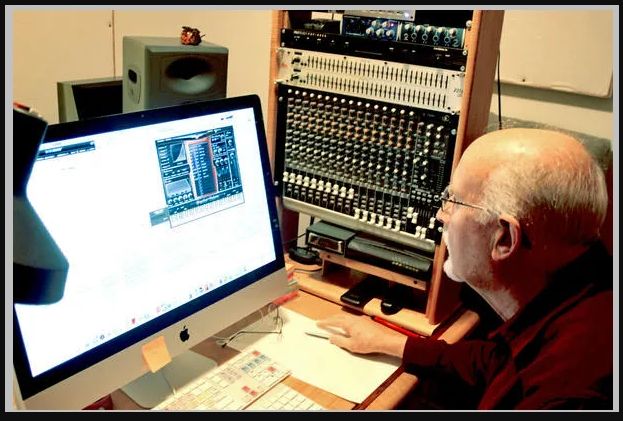
Plain:   Not on my software.  I may work with that later on, but it’s not as simple as it sounds.  Pushing the button gets you the part, but it just runs off all the pages because it totally ignores the page-turns.  So you would have to take it a couple of pages at a time, or one page at a time, and you would have to have the button plus the brakes.  Anyway, I don’t have that in my system right now.  It uses a different set-up.  In the old way of working with notation, I would use templates, and pens, and triangles, and straight edges, and all kinds of little aids.  No matter what I would need, it always seemed to be on the bottom of the pile.  Plus there would be razor shavings on the straight edge.  I had to clean it off, and that meant a lot of dust around.  With the computer, everything is right there under your fingers.  You just sit there and look at your score if you’re extracting the parts, and then you do the pages.  You just work on it, and work on it.  Nothing is ever lost unless you lose some of your files!  [Laughs]  But I look for great improvements in the software in the next number of years.  Eventually every composer will be using computers and software to work with notation, as well as other elements of composition.
plain
BD:   Is this putting copyists out of business?

Plain:   The copyists will finally go to computers, too.  There will always be some die-hards.  They’re out there right now, and some of the older composers are not about to change to computers.  In fact, I’ve always been a little edgy on that type of technology.  After all, you’d go to the grocery store and you’d be turned away because their computer was down.  Your checkbook would be messed up once in a while because the computer malfunctioned.  But after I started seeing what it could be for me in terms of saving my time and the agony of doing all the copy work, then I had to have it.  So that’s where I am right now.  That’s added an element of fun to my composition.

*     *     *     *     *

BD:   Will you be coming back to Chicago?

Plain:   I hope so!  I lived here for two years in the early 70s.  That was a number of years ago, and Chicago has changed a lot in that time.  The skyline is different, and I’ve noticed new buildings.  Even walking the streets, some of those little craft stores that I remember have changed into computer service stores.  There’s been a lot of change, but Chicago is still Chicago!  My wife and I lived in Skokie [a very close northern suburb], and I taught at DePaul University and Roosevelt University.

BD:   Was that a happy time for you?

Plain:   Yes, it was. We had a lot of friends here, and we went to little gatherings after concerts.  My wife worked as a librarian at the Northwestern University Music Library, and we enjoyed ourselves.  From there we went to Rome.  I got the Rome Fellowship, and we spent two years in Italy.  Then we came back and stayed one year on our farm in Kentucky.  I have a part-interest in the family farm, and there was an old house on it, which was in good shape at that time, so we spent one year there.  We had a nice garden.

BD:   Did you compose there?

Plain:   Yes, I composed there.  It was a wonderful place to compose.  We were really isolated... [laughs] Lordy were we isolated!

BD:   I have this picture of you writing a Rutabaga Concerto!  [Much laughter]  That’s the city boy in me!

Plain:   We did gardening that year, and we grew a lot of our vegetables.  I remember the fall with the changes of the leaves, and there was a wood right to the side of our house, and the nights sounds...  It was very quiet, and you’d hear all the night predators.  It was a nice year.  Then we went to Stevens Point, Wisconsin, and I taught there one year.  Then I went to the Eastman School of Music and taught there for three years.  We’ve been in Rochester, New York ever since.  [Pauses a moment]  I wish you could play some of my orchestral pieces, but they are not recorded yet commercially.  
One is Arrows, and another is and left ol’ Joe a bone, AMAZING!  It’s one of my best orchestra pieces, and is the one thus far that’s been played the most around.  

BD:   How was the performance of Polly last evening?

Plain:   It was a good performance for a student orchestra, and it was spirited.  I have a new orchestra piece, Portrait 1: Sally Goodin.  This is to be done by the Alabama Symphony Orchestra and Paul Polivnick in mid-November.  It was originally a chamber music work, and I saw all kinds of possibilities in it, so I exploded it into an orchestral work.  Originally I needed a piece that would get some performances, but it has a harp in it.  You can’t find a classical harp player!  They are few in between, and then you have the groovy harp players who will play contemporary music, and finally you get to the point where you don’t get any performances.

BD:   I wish you luck with that, and for all of your upcoming presentations.  Thank you so much for the conversation.  It’s been fascinating chatting with you, and I’ve learned a lot.

Plain:   It’s been pleasurable for me, too.  I just turned loose!


= = = = = = = =                = = = = = = = =                = = = = = = = =
-----                -----                -----
= = = = = = = =                = = = = = = = =                = = = = = = = =


© 1990 Bruce Duffie

This conversation was recorded at his hotel in Chicago on February 24, 1990.  Portions were broadcast on WNIB later that year, and again in 1995 and 2000.  This transcription was made in 2026, and posted on this website at that time.  My thanks to British soprano Una Barry for her help in preparing this website presentation.

To see a full list (with links) of interviews which have been transcribed and posted on this website, click here.  To read my thoughts on editing these interviews for print, as well as a few other interesting observations, click here.

*     *     *     *     *

Award - winning broadcaster Bruce Duffie was with WNIB, Classical 97 in Chicago from 1975 until its final moment as a classical station in February of 2001.  His interviews have also appeared in various magazines and journals since 1980, and he continued his broadcast series on WNUR-FM, as well as on Contemporary Classical Internet Radio.

You are invited to visit his website for more information about his work, including selected transcripts of other interviews, plus a full list of his guests.  He would also like to call your attention to the photos and information about his grandfather, who was a pioneer in the automotive field more than a century ago.  You may also send him E-Mail with comments, questions and suggestions.