Mezzo - Soprano Anne Sofie
von Otter
A Conversation with Bruce Duffie
Anne Sofie von Otter (born in Stockholm, Sweden,
May 9, 1955) is a Swedish mezzo-soprano. Her repertoire encompasses lieder,
operas, oratorios and also rock and pop songs.
Her father was a Swedish diplomat in Berlin during World War II. She grew
up in Bonn, London and Stockholm, and studied in Stockholm and at the Guildhall
School of Music and Drama in London.
From 1983 to 1985, she was an ensemble member of the Basel Opera, where
she made her professional operatic début as Alcina in Haydn's Orlando
paladino. She made her Royal Opera House, Covent Garden, début
in 1985, her La Scala debut in 1987, and her Metropolitan Opera début
in 1988.
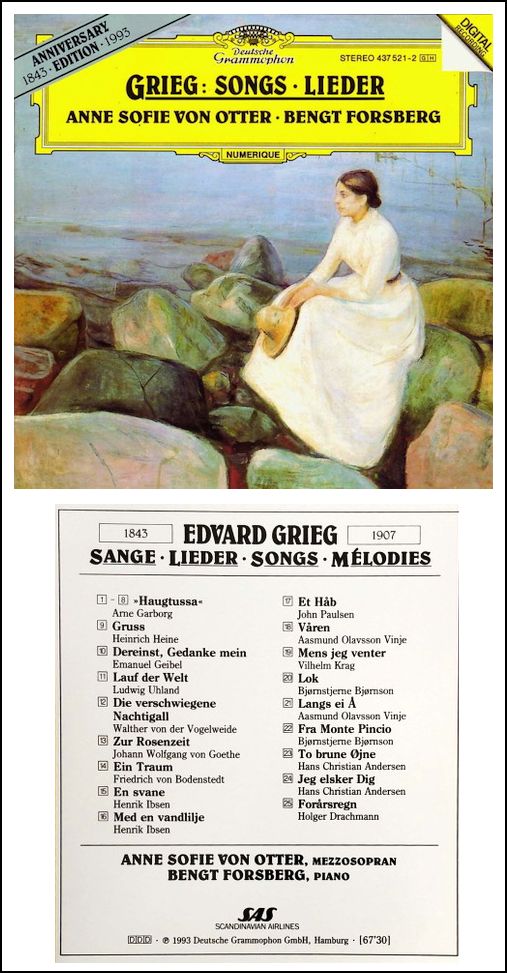
Her recording of Grieg songs won the 1993 Gramophone Record of the Year,
the first time in the award's history that it had gone to a song recording.
|
After having performed and recorded with the Chicago
Symphony at Orchestra Hall since 1985 (her American debut), Anne Sofie
von Otter returned in the fall of 1989 to sing Octavian in Der Rosenkavalier
with Lyric Opera. Also in the cast were Anna Tomow-Sintow, Kurt Moll, Kathleen Battle,
Julian Patrick,
Jonathan Welch, Florindo Andreolli,
Jean Kraft, and
Arnold Voketaitis.
The conductor was Jiří Kout. There were
eight performances, and toward the end of the run, the mezzo graciously
invited me to her apartment for a conversation.
Her English was excellent, though she made one gaffe which
sent us both into hysterics! Portions of the chat were aired several
times on WNIB, Classical 97, and now thirty-five years later, I am pleased
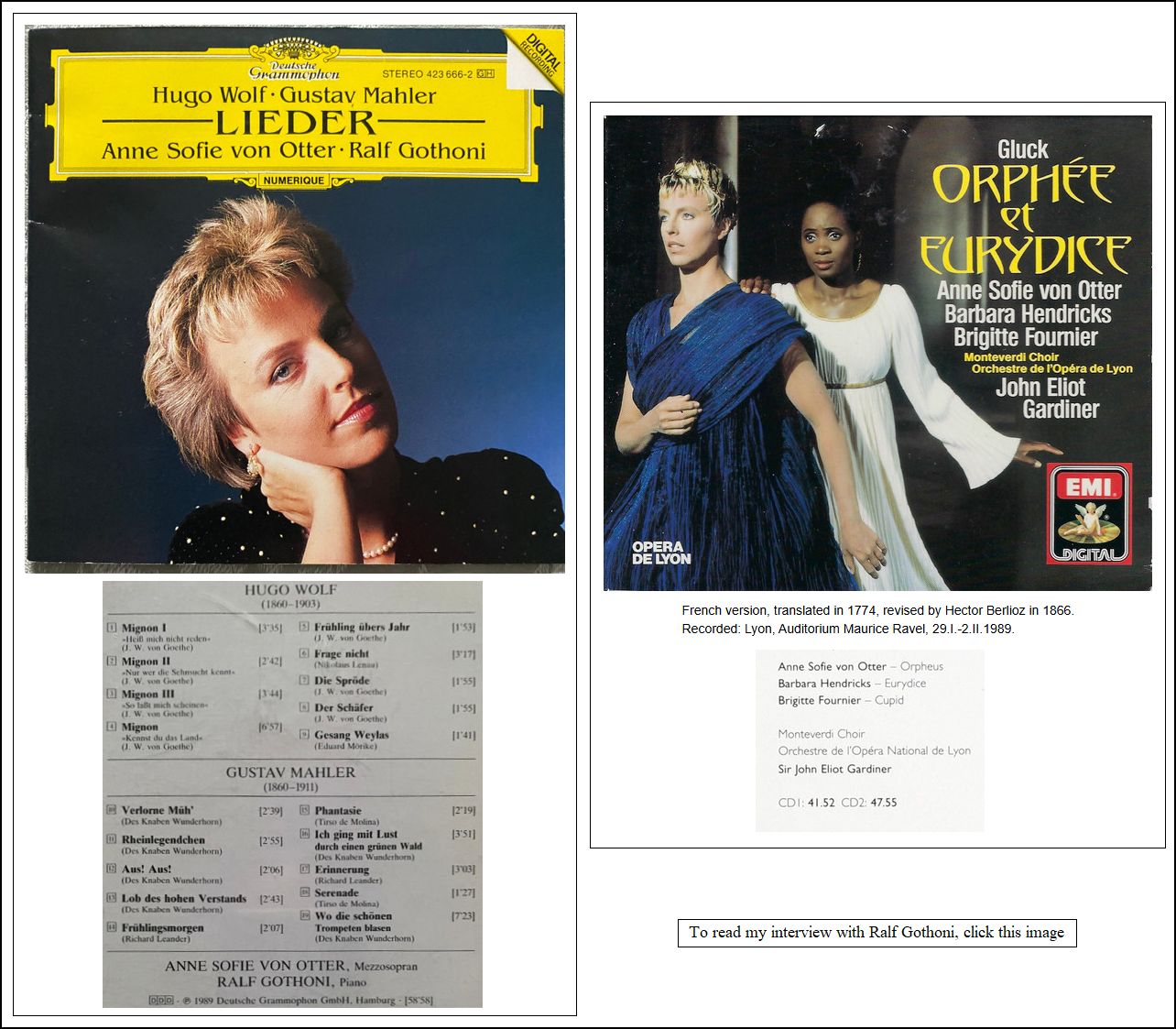
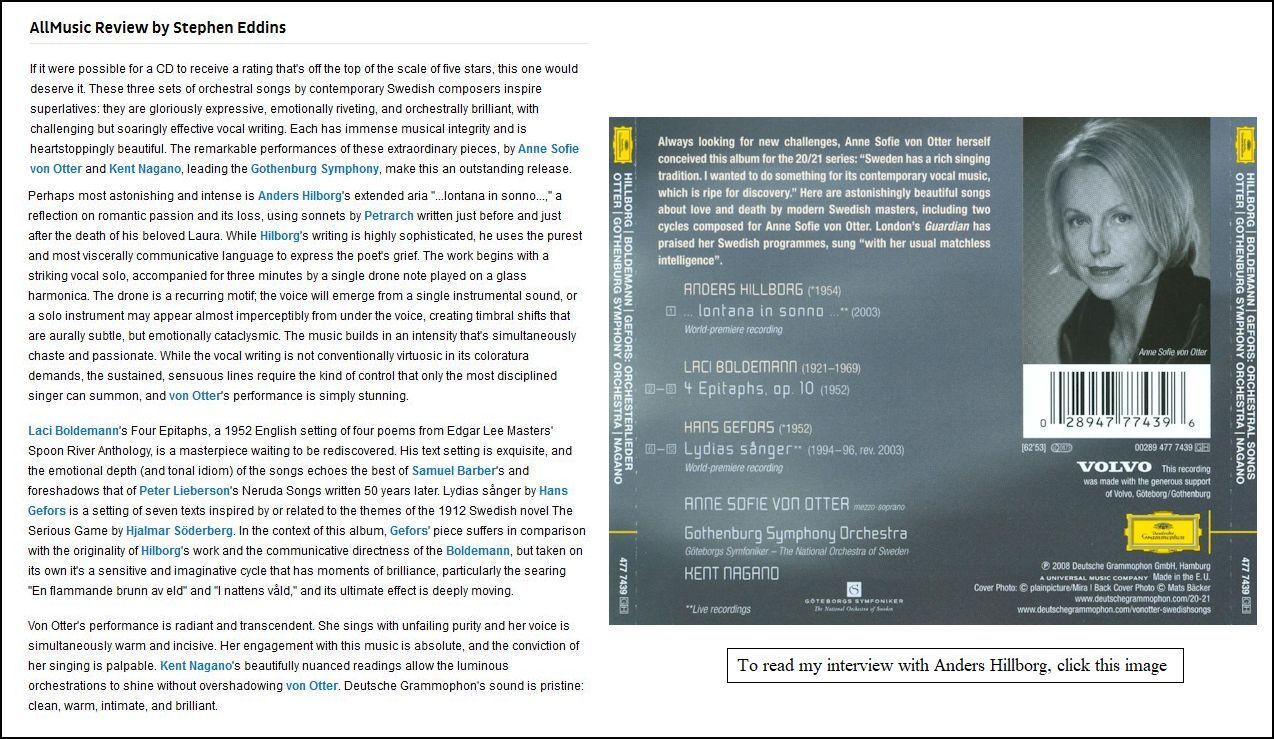
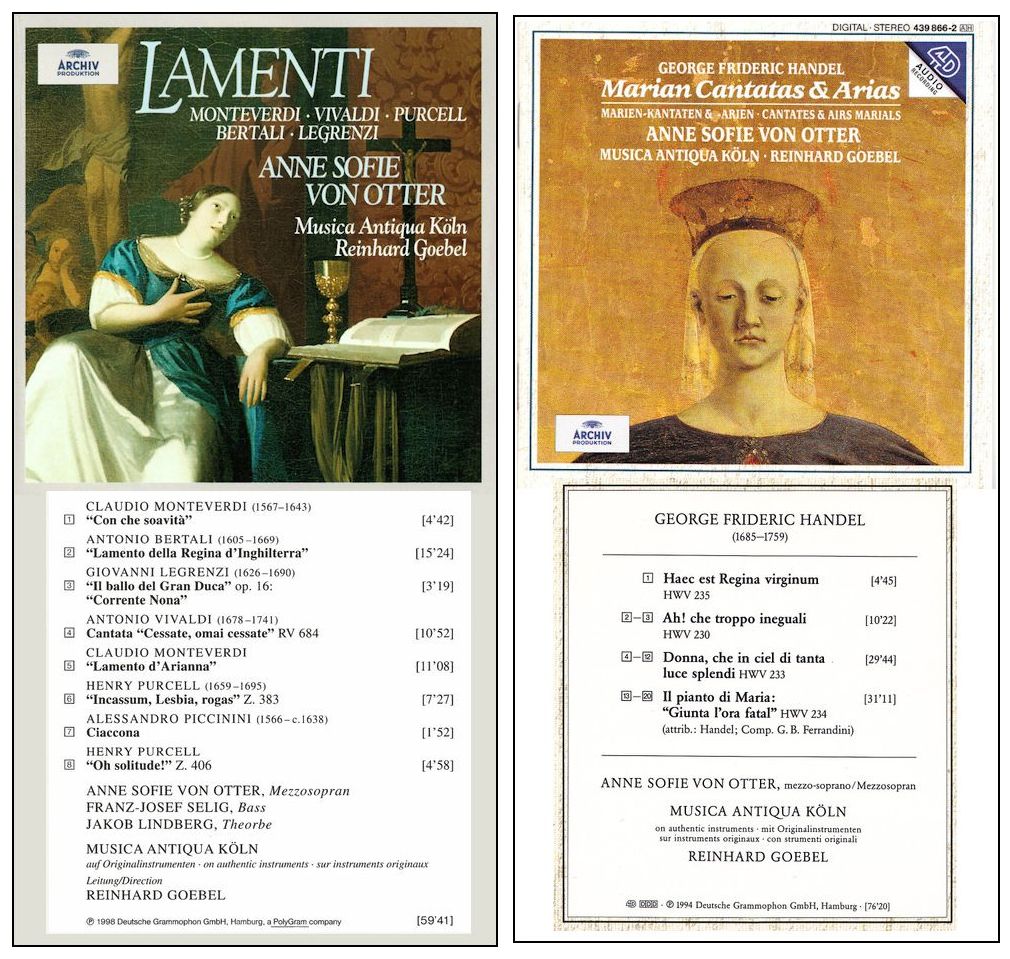
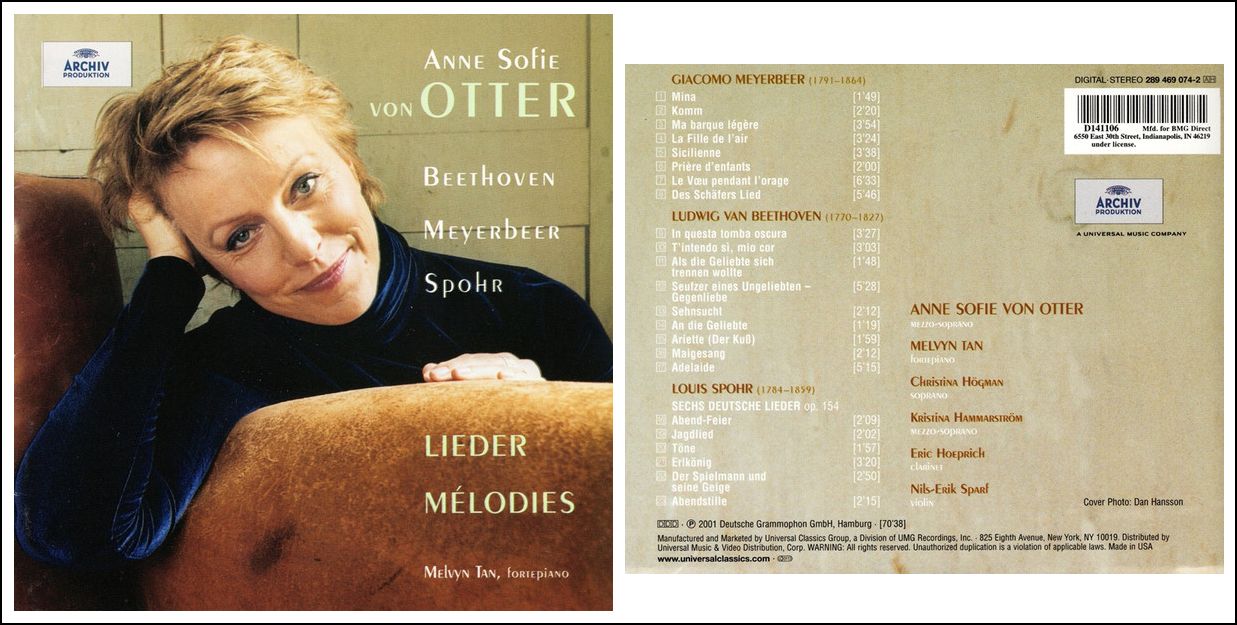
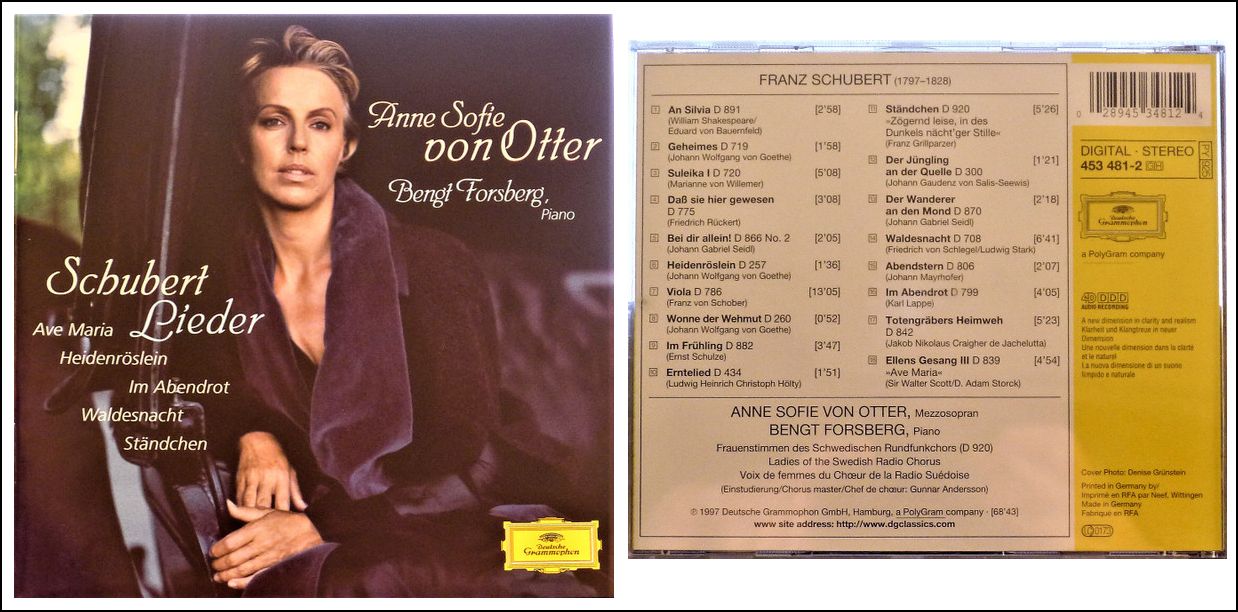
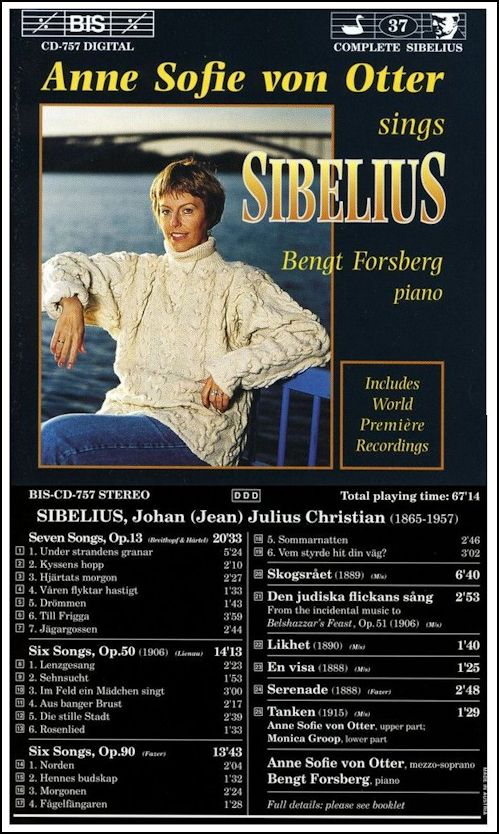
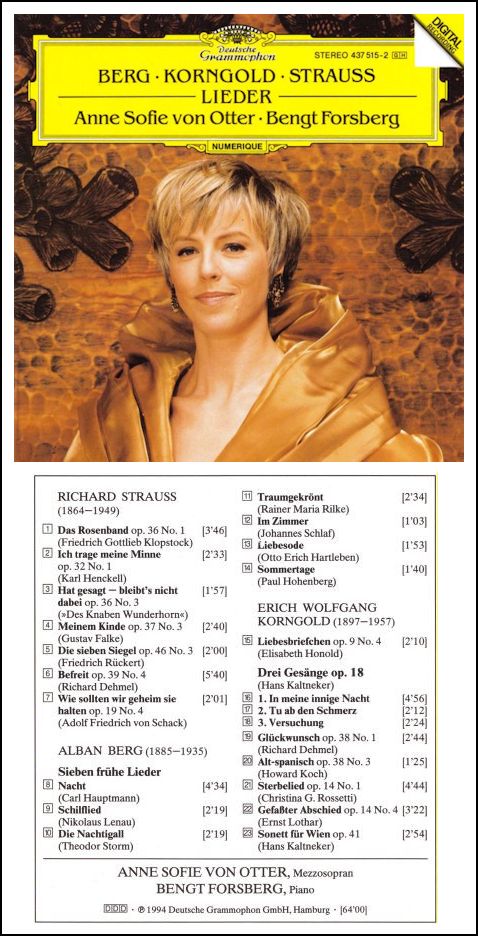
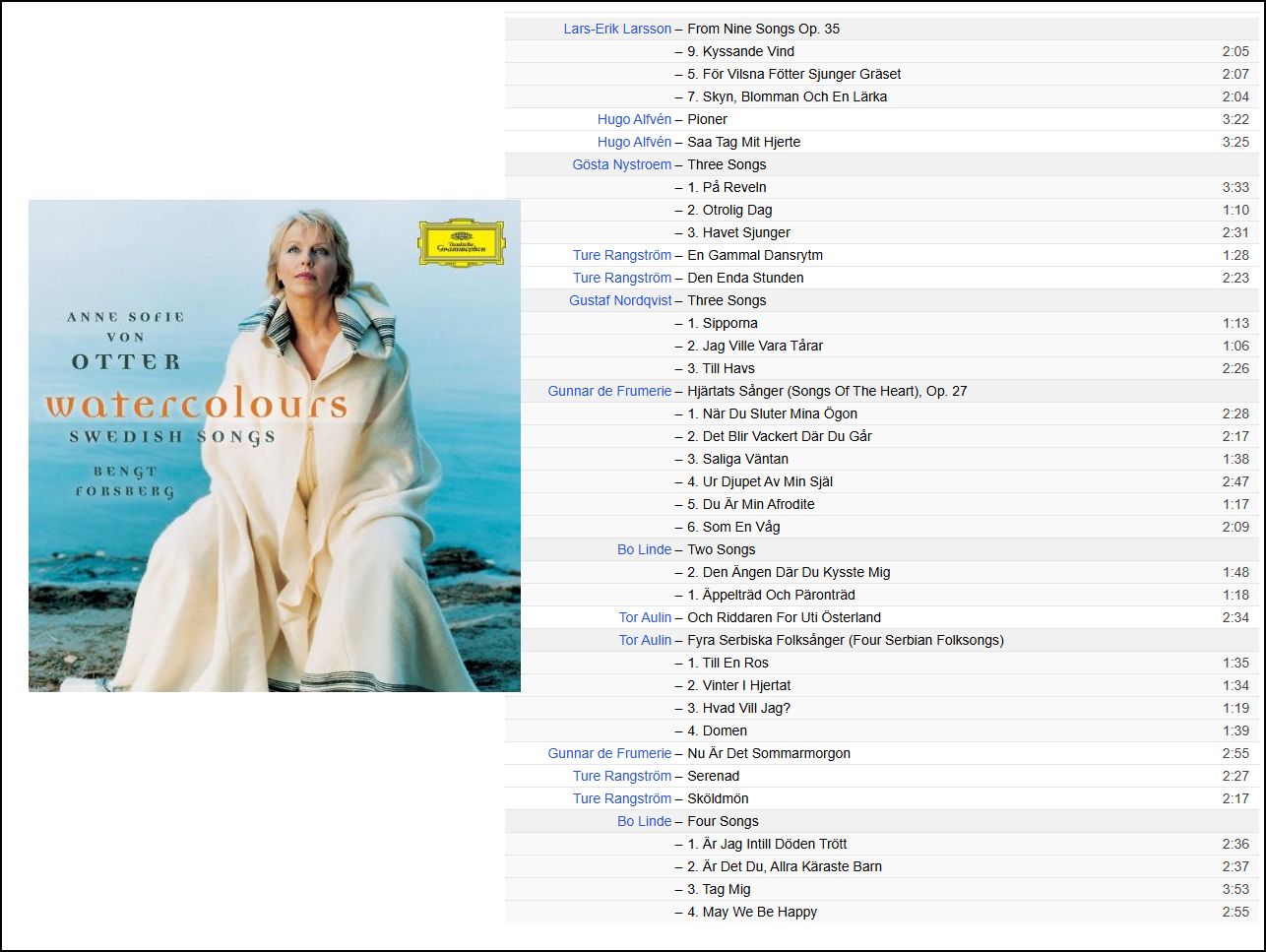
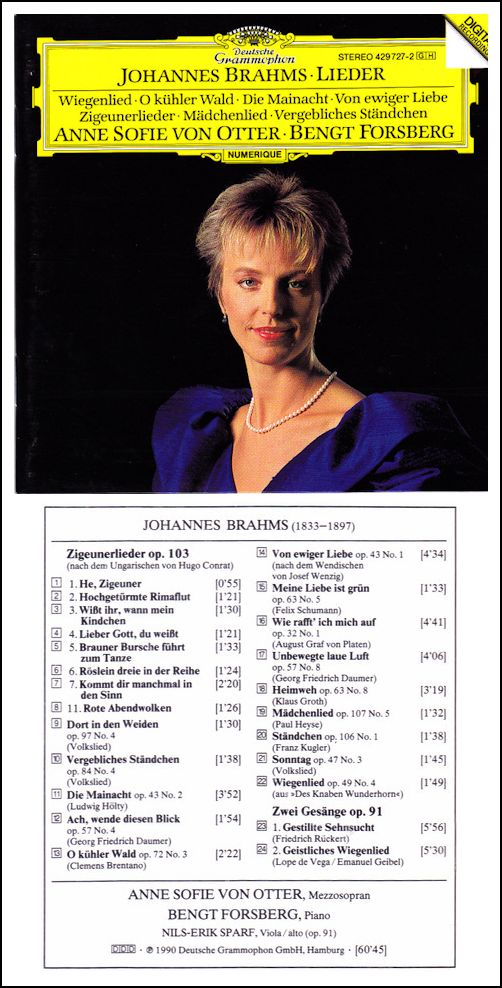
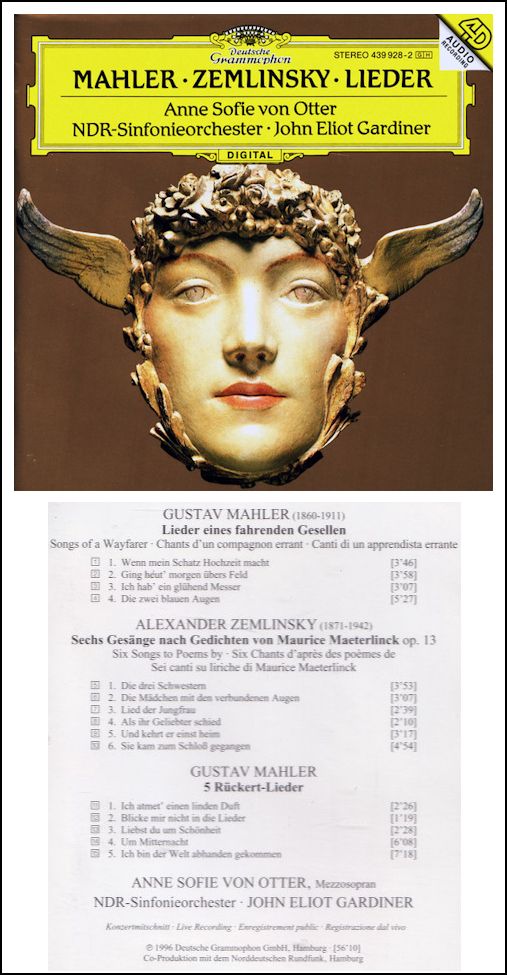
to present the entire encounter. Several of her many recordings are
shown as illustrations on this webpage. As usual, names which are
links refer to my interviews elsewhere on my website.
We began with her personal situation . . . . .
Bruce Duffie: You’ve come to Chicago
with your child. What are the joys and sorrows of balancing
an international opera career with motherhood?
Anne Sofie von Otter: The joys are many
and great, as you can imagine. My life used to be a great deal
less full when I was just traveling around singing. The days when
I wasn’t performing, I would just feel that I was wasting my life sitting
in a hotel, and going out shopping. Normally you don’t have that
much time, so you don’t really go out sight-seeing properly, and also
if you’re by yourself, it’s not as much as fun. But now I have my
baby, and I feel that even my spare time is very important to me, and
I never feel lonely. It’s really nice, and he’s wonderful.
As he gets older it’ll get more difficult to travel with him, because
he’ll want friends and eventually school. But he’s now fourteen
months, and it’s not a problem at all. My husband can also
come along quite a lot, so right now it’s more joys than anything else.
BD: When you started singing, did you
dream of having the international career, or did you want it to be
just localized?
von Otter: When I started in terms
of being a singer, I didn’t really have dreams. I just hoped
that I would make it as big as possible, and to have an international
career. But my dream wasn’t to sing at La Scala or at the Met.
My dream has been more to work with good conductors, and make as good
music as possible.
BD: Do you find that it’s easier to
make good music when your colleagues are on a higher level?
von Otter: Yes, definitely, but particularly
the conductors. It means a lot if they’re good, because otherwise
tempos and ideas can just fall flat. The concerts are mostly
nice because everyone gets an adrenaline high, and the audience is there,
but the rehearsals can be so amazingly boring or terrible if the conductor
isn’t good. In this case with Der
Rosenkavalier, my colleagues agree that we are very lucky to have
Jiří Kout from Czechoslovakia to conduct. He is never boring
He loves the piece, and he’s a great musician, and every beat
he conducts has energy, which is wonderful.
BD: Have you sung this piece in other
productions?
von Otter: I sang it once before in
Stockholm in Swedish, so this is my German debut of Rosenkavalier.
BD: Tell me a little bit about Octavian.
What kind of a character is he?
von Otter: He’s like Cherubino. He’s
a nobleman, and he likes to dress up and play tricks on people. He’s
a great lover of women. He loves the Marschallin, and he falls
very easily in love with Sophie because she is a different kind of
girl. I suppose she’s pretty but she also says things that make
him amazed. He’s a wonderful character because you get to show
so many sides of yourself... or him! There is the comical and
the sad sentimental lyric at the end in the big trio and the duet. There
is the big drama in the end of the first act where the Marschallin tells
him to leave when she’s had enough of him for the moment. When
she’s feeling melancholy, she sends him away, and he’s tearing his hair
out. So it’s really a wonderful role.
BD: You say ‘yourself...
or him’. Are you portraying the character
or do you really become Octavian?
von Otter: [Laughs] I don’t think
I become Octavian, but I don’t know. I play more on instinct
and what feels right, and what the composer, Strauss, has put into
the music. I am not an intellectual actress. I more follow
what the composer has put in the music and the words, and then try
to make a character out of that. Then, of course, you add big chunks
of yourself and what suits your temperament. So it’s a combination
of Octavian and Anne Sofie von Otter on stage!
BD: Are you something of a tomboy yourself?
von Otter: I can be, yes.
BD: Is it schizophrenic in the third
act when it’s a woman playing a boy playing a girl?
von Otter: Back in my student days,
before I ever did Octavian, people were talking about this.
You’re a woman playing a man who’s playing a girl, blah, blah, blah!
I don’t know, because it’s not such a deep situation. He’s just
having a good time in the inn. When he’s trying to play a big trick
on Baron Ochs, I generally go for having a good time, and trying to make
the audience laugh. I don’t care if I’m sending it up a bit.
They need that, and I need it, and I can’t make it work any other way.
He’s pretending to get drunk, so I don’t see why not have a good time.
BD: Are Octavian and Sophie happy
in the ‘fourth act’?
von Otter: [Smiles] This is the
question! If it were a modern situation, today’s story, then probably
she would be just one of his girlfriends. He’s only seventeen,
so Sophie would just be one in a row of many before he finally settles
down.
BD: Would she be a conquest, or just
a girlfriend?
von Otter: You mean if he actually stays
with her for a while?
BD: Yes.
von Otter: As the case is in the times
that this is supposed to have been playing, then I suppose he stays
with her for a while because it wouldn’t look good otherwise. I
don’t know how fast they were to get married. If they got serious
with each other, then maybe they had to get married fairly quickly.
I don’t know at what age exactly he has to get married. If he’s seventeen,
maybe he can wait for a while, and then maybe he can choose someone
else. After all, she is not quite up to his nobility standards.
BD: She is, of course, completely inexperienced.
von Otter: Yes, yes.
BD: Octavian has been with the Marschallin,
who has tremendous experience, and has taught him a lot.
von Otter: Oh, yes, yes, yes!
BD: Is Octavian going to be disappointed
with Sophie?
von Otter: Maybe he’s going to try and
teach Sophie a lot. [Both laugh]
BD: You mentioned that today’s society
would do something different. Is it difficult to play a role from
a remote time, and bring it to today’s audiences?
von Otter: I don’t really try to make
it believable in that sense. I was just thinking about that today.
I simply try to make it generally credible, the way the music works
with the whole story. It is, after all, not a fairytale, but
something made up.
* * *
* *
BD: How do you balance your career with
opera and concert?
von Otter: I do not do more than two,
or at the most three opera productions a year.
BD: Why?
von Otter: Because I want to spend as much
time at home as possible. My husband and I are very anxious
that I am at home in Sweden as much as I can, and still be able to have
an international career at the stage I am now. I like to be at
home because I like Sweden and Stockholm. My husband is an actor
in Sweden, so he can’t work anywhere else with the language problems
that would arise. Obviously he has to be in Sweden a lot.
I don’t want to be away from him too much, and he doesn’t want to be
away from the baby too much. Also, it’s very important for the baby
to know where his roots are. I myself am the daughter of a diplomat,
and lived in different countries when I was small. So it’s very
important for me now to feel where my roots are, and for my family, too.
Also, I enjoy singing concerts a great deal. The repertoire
is very beautiful, and some of it is very good for my voice... like the
Mahler, and the different oratorios, and Lieder recitals. I’d rather
mix these same operatic roles with other repertoire. It does me
a lot of good, and my voice likes to change like that.
BD: When you’re presented with the idea
of singing a role or a certain work in concert, how do you decide
if you’ll accept it or turn it down?
von Otter: It depends on my time, and if
I feel I want to be away from home at that point. Then the
conductor is very important, and which orchestra it is. If it’s
a good orchestra, then it’s very tempting because that also makes
an enormous difference. You get some orchestras which are so undisciplined,
and they only get down to work during the concert. Before that
they will sit and chat, and go in and out, and they don’t pay attention
to what the conductor is trying to tell them. That’s generally unbearable!
Maybe it’s terribly boring to sit in an orchestra that isn’t one of the
top class ones, and they have lots of different conductors who they don’t
respect and like. So I can understand why they sometimes behave
like a class of school children, but it’s not much fun to work with in
that case. I may sound snobby, but I can afford to be that right
now.
BD: I don’t think it’s wrong for a singer
in your situation to expect that every place will be a special concert
or opera.
von Otter: Music is special, and everyone
should try their best.
BD: Let me ask the big philosophical
question. What is the purpose of music?
von Otter: [Laughs] I don’t know.
It certainly gives humanity a great deal of pleasure, and it makes
people have feelings they don’t have in normal everyday life. [Thinks
a moment] It is so difficult to put into words... It doesn’t
degrade other sides of life, but music can be something very magical.
It is a wonderful experience if you get on the same wavelength
as the music. I always hope that people will experience something
special when they go to a concert.
BD: Do you feel that concert music and
opera is for everyone?
von Otter: It is definitely for everyone
if it’s performed well. People may not like all sorts of music,
or all kinds of music, but if it’s a good piece of music, such as something
by Mozart or Bach, or even the Rosenkavalier, it has to be performed
well. If it is performed well by good musicians and people who
can act, then it definitely has something for everyone, even if you
are not someone who regularly goes to listen or see performances.
I believe that it can give something special to everyone, even someone
who has never ever been to that sort of music, or who is not into that
and normally only listens to rock music. They can get a great kick
out of classical music if it’s given to them in the right way.
BD: Is there any way to get more of
the rock audience into the concert hall and the opera house?
von Otter: A good way is to start bringing
in school children. Bring in a class and get them to sit in
the rehearsal. Tell them what’s going on, and what the people
are working at. Let them hear an hour, but not more to begin with
for young people at least. Also, have someone tell them things
in an interesting way so they don’t think it’s ‘high culture’
and above their level. You should begin when people are fairly
young, and send more of it on television, too.
BD: Do you think that opera works well
on the small screen?
von Otter: It depends on how it’s made,
of course. You have to have very clever picture producers,
and maybe the stage producer also has to be clever for that media,
for television. Or it might even have to be made specially for
television in a studio.
BD: So that it’s arranged for the camera’s
eye?
von Otter: Yes, maybe. It depends
on which opera it is.
BD: Have you done some television?
von Otter: I have done some television.
I’ve only made one program in Sweden with some Swedish songs, and
sea songs. The poems are about the love of the sea and living
by the sea, so we went to a house by the sea on the west coast of Sweden.
The program was fifteen minutes long, and it worked very well,
but doing art songs on TV is difficult.
BD: Do you like the idea of having the
supertitles in the theater?
von Otter: Yes. I’ve been asked
this before, and I think in general I do, but the audience has to
look at what’s happening onstage as well. There are some times in
the Rosenkavalier that we’re doing things on stage that should
be catching their attention that should be funny, but we sometimes
we get the laugh before we’re being funny, or after we’re being funny,
because the funny line appeared at that point above the stage. [Both
laugh] That shows you that, as an audience, you have to be aware
that you mustn’t sit with your eyes glued to this thing, because then
you’re really missing something.
BD: Do you ever get two laughs, one
when they read it and another when they see it?
von Otter: Oh, that can happen too,
yes!
BD: The Italian singers have told me that
happens especially in the slapstick comedies.
von Otter: Yes, yes, yes! Maybe
you don’t have to translate every single word. Maybe you get
a translation every now and then. That can be enough sometimes.
* * *
* *
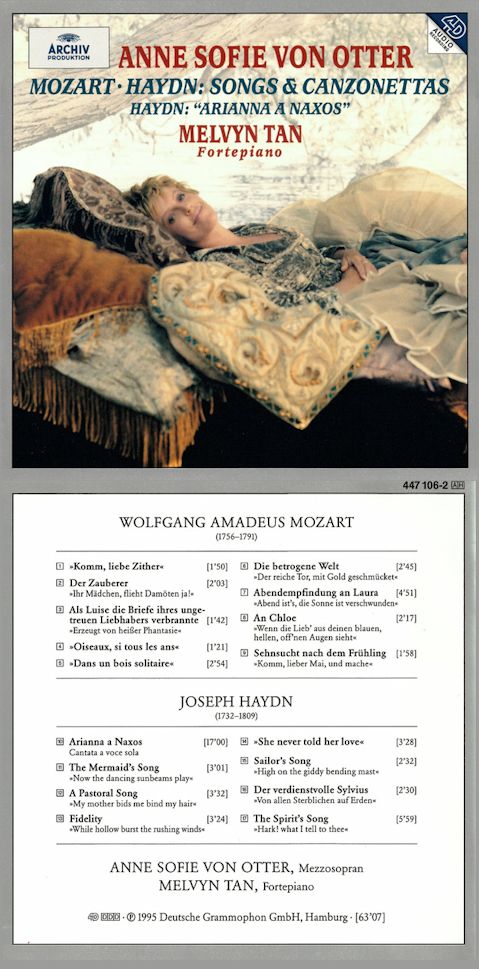
BD: You’ve made some recordings. [Remember,
this interview was held in 1989, and since that time she has made many
more CDs.] Are you pleased with the way that your voice
sounds on the discs?
von Otter: [Thinks] I think so!
[Laughs] Yes! I do like recording. I like
the work in the studio, and I’m happy with some of the recordings
I have made, again, depending on who I made them with.
BD: [Chauvinistically] Obviously,
the Chicago Symphony Orchestra records are special.
von Otter: Yes, the Matthew Passion
with Sir Georg Solti.
That was special because he’s a special person. He’s somebody
I admire a lot. But I’ve had fun on some of the other occasions
with John Eliot Gardiner. We’ve made some Bach and some Mozart,
for instance. This summer I made a Hansel and Gretel with
Barbara Bonney. She
was Gretel and I was Hansel, and we did it with the Bavarian State
Orchestra. They played marvelously and we had such a good time.
The conductor was Jeffrey
Tate, and that was wonderful.
BD: Once again, you are a boy.
von Otter: Yes, yes!
BD: Do you feel restricted in the fact that
your repertoire includes several boy parts?
von Otter: No, not at all. I enjoy
singing those boys. They suit my voice, and they suit me as a person,
both the way I look and the way I am.
BD: Then is it special when you play
a woman on stage to bring out your femininity?
von Otter: Sometimes I have a problem getting
used to the feminine way of waving my arms around. I have done
four or five productions of Dorabella in Così Fan Tutte,
but not for a long time because I got so tired of doing her. Otherwise
I don’t know if there are that many women that I’ve done.
BD: Have you done Charlotte?
von Otter: No, not yet. I’d like
to do her, but Werther is a very difficult opera to bring off.
It can be a real boring stinker, and have the audience asleep.
[Both laugh] You need a good production for it...
BD: ...and a good tenor! [On
her recording which was issued in 1997, Jerry Hadley sang the title
role.]
von Otter: Yes, a nice good tall tenor!
I’m doing Cenerentola in 1991 at Covent Garden, and that’s going to
be exciting to have a go at. I might like to try The Barber
of Seville to see what it’s like. I’m always asked if I would
like to do Carmen, but I don’t think I have to do her. Let all the
other mezzos do Carmen. [Both laugh] [She would sing
it at Glyndebourne in 2002, and the recording was issued in both audio and
video.]
BD: It would be interesting to see a
tall slender Carmen.
von Otter: Yes. With my northern looks
I don’t know if it would work. That would need somebody who
decides to do Carmen the way I am, the way I look, and not have the
ideal Spanish black-haired fiery lady, because that’s not the way I
look. [Pauses a moment] Donna Elvira is a role I always
find quite exciting, but it’s maybe on the high side. So I don’t
know, but I’d like to have a go.
BD: Is there a secret to singing Mozart?
von Otter: [Thinks a moment, then laughs]
I don’t know! What would that be? I suppose a certain
type of musicality. How you like to sing maybe is the answer
to that. I am not an ideal bel canto singer for Donizetti, or
Verdi, or Puccini. I would have to change. It’s not my instinct
to sing like that. My instinct is more to sing the way that suits
Mozart. That’s my experience so far, and it suits my voice.
It’s better suited to the way I phrase and so forth.
BD: Do you then bring that Mozart style
to Strauss?
von Otter: In a way I suppose I do, but I
have a fear of being known as a purely Mozartian singer. I don’t
want people to think I can’t sing anything other than baroque music and
Mozart, because I can sing Strauss well now that my voice is a bit firmer
and more mature than it was three or four years ago. The lighter
German repertoire is also definitely for me, but all the crooning
and scooping is nothing that comes absolutely naturally to me. I
have to adopt that style of singing when I do those roles, and that’s
tough.
* * *
* *
BD: What other recordings have you made?
von Otter: Messiah and Dido and
Aeneas I’ve done with Trevor Pinnock, and with John Eliot Gardiner
I’ve done the Mozart Requiem, Christmas Oratorio, and the
Berlioz The Childhood of Christ, which is a very beautiful recording.
I’ve also recorded The Damnation of Christ [laughs]... Oh no!!!
[Corrects herself] The Damnation of Faust with John
Eliot.
BD: [With a wink] I will look
for The Damnation of Christ, and L’enfance du Faust!
[Much laughter]
von Otter: As for operas I did Olga
in Eugene Onegin with James Levine, and that’s
a wonderful recording.
BD: Is Olga a role that gets lost, or
can you do something to bring her out?
von Otter: You can do your best, but it’s
still not a thrilling role. It’s not one that I would ever
like to do on stage. It’s not grateful at all, but I enjoyed recording
it because Levine did something wonderful with Tchaikovsky’s music. Also,
the Staatskapelle Dresden Orchestra played like gods. It was
wonderful. We had a good time during this recording with Neil Shicoff and Mirella Freni and Thomas Allen. It’s
a very good recording. I listen to it occasionally, and my
husband does too. Then there’s Così Fan Tutte,
which is being finished now. In two weeks’ time I go to put
my voice on the rest of the gang, because I was extremely pregnant
at the time it was being made, so I never went to London where it was
being recorded. The arias I’ve done separately a while ago, and
some of the duets I’ve done with Karita Mattila. We
recorded them properly together, but the ensembles and some of the recitatives
unfortunately I just have to stand with the headphone and put my voice
on the tape. That’s with Sir Neville Marriner conducting. After
I’ve done that, then the recording will be finished. I’ve also done
a nice recording of The Tales of Hoffmann with Francisco Araiza and Samuel Ramey, complete
with many more arias than usual, and the spoken dialogue.
BD: Are you singing one role, or two,
or three?
von Otter: [Laughs] No!
I’m only doing Nicklausse, and that had problems too when it was
being made.
BD: Doesn’t Nicklausse also often do
the Muse?
von Otter: Yes, yes, the Muse, yes, yes.
My role was very big in this particular case, and it was wonderful, with
lots of beautiful music to be sung. But we had two of the ladies
who pulled out at the last minute, so it was never completed. They
had another go last summer, and a third go this summer, and now it’s
almost ready to come out.
BD: It sounds like it’s almost cut-and-paste,
with a little bit here and a little bit there.
von Otter: Yes, it’s dreadful when people
don’t turn up. You have this problem, and the recording companies
go crazy. [Thinks again for a moment] I’m doing The
Marriage of Figaro with James Levine this coming May, and I’m also
doing the Rosenkavalier in August with Dame Kiri Te Kanawa.
So, I’m looking forward to that.
BD: Is it special to know that you’re doing
these performances of Rosenkavalier and within a few months
you will be committing this to a permanent recording?
von Otter: Absolutely! It was
absolutely necessary for me to do a nice long run of Rosenkavalier
in German before I recorded it. It would have been terrible
to record this opera not really knowing it well enough. I did
four performances in Swedish one and a half years ago, but when I
started the rehearsal period here in Chicago, I felt as though I’d
never sung the piece before. Four performances in another language
was definitely not enough for this very long role. Octavian is
on stage from the beginning to the end with the exception of the scene
in the first act, which is just a few minutes long. It’s a huge,
huge role. It’s one of the bigger ones that there is. But now
I feel that I know the role fairly well. I’ll know it better still
after some more productions, but I’m very grateful that I had this chance
before I record it.
BD: You mentioned that you had sung it in
translation. Do you like doing operas in translation?
von Otter: No! The composer has
certain linguistic patterns, or melodies from the language that
it is based on, and the colors of the vowels, and the length of the
words. You can’t just change that without problems arising.
BD: You don’t feel that the added closeness
with the audience overcomes the deficiencies?
von Otter: It may be better particularly
for audiences that don’t know other languages, or as we spoke about
before, don’t go to the opera, or don’t know the art form particularly
well. You can always read the story and see what it’s about, but
either it’s good to have these surtitles, or it’s good to have in the language
that everyone understands... not that you can always understand what a
singer is singing anyway...
BD: I was going to ask if you work a
little harder at your diction when you know that everyone in the audience
presumably could understand all of those words?
von Otter: I think so. You probably
become more aware of it. Actually, I feel more scared of forgetting
the words, or forgetting a line or two if I’m singing to an audience
who understand the words, because then I always think that they’re
going to prick up their ears and wonder what’s happened. Did she
get lost? Whereas we’re singing Rosenkavalier in German
to this American audience, so we know almost for sure that if we forget
a word here or there, nobody will really notice.
BD: Do you rely on a prompter at all?
von Otter: It depends on how well I
know a piece. This piece I do because some of the entrances
are really quite tricky. But in other pieces I don’t look at
them at all.
* * *
* *
BD: Do you do any modern music or contemporary
works?
von Otter: No, not really. There isn’t
that much that’s performed, and if it is, then it’s usually a quite
difficult piece, and then you’d need to spend a lot of time learning
it. I don’t have always the time, and I don’t get very many offers.
The situation where I could be doing contemporary music would
be in my Lieder recitals. There I do mix in twentieth century
music, but not necessarily modern-sounding works. Some of the northern
repertoire, Swedish or Sibelius, are from the twentieth century, but
it’s not modern. I don’t do modern pieces very often, but when I
do I enjoy it because it makes me have to work. My brain has to
work while I’m learning it.
BD: [With a gentle nudge] You
mean your brain doesn’t work when you’re performing it???
von Otter: [Laughs] No, not in
that way. It’s like doing a crossword or solving a mathematical
problem, because you have to think in intervals all the time. There’s
a big sixth coming up, or a minor seventh. You have to think like
that while you’re learning it. After a while you have it in
your brain and in your throat, so you don’t think anymore.
BD: It comes automatically then?
von Otter: Yes, yes.
BD: I hope you never get to the point
where everything becomes so automatic that it’s routine.
von Otter: No, no, I mean the actually
deciphering of the music.
BD: Octavian is a very long and demanding
part, but perhaps in a shorter and simpler part, what can you do
in the eighth or ninth performance just to keep it fresh?
von Otter: I’m always afraid, not
that I’ll start running out of enthusiasm, but inspiration. When
you leave a piece after having done ten performances, it’s always a
relief for me. It’s not that I’m tired of
the piece, but somehow my throat needs a change. I don’t know why
this is, and it’s not necessarily that I’m tired vocally.
BD: You need to keep refreshed?
von Otter: Yes. I need to sing
different things, different intervals and different words.
BD: Then when you’re planning your long-range
career choices, are you careful not to accept too many of the same
piece too often?
von Otter: Yes. I wouldn’t like to do
another run of Rosenkavalier after this somewhere else. Even
if I had a few weeks in between, I wouldn’t like to do the same music
again, simply because my voice likes a change. But keeping the
performance fresh is not difficult if you have a good production, and,
as I keep saying, a good conductor, because a good conductor helps you
along so much. He keeps it fresh. But you have so many conductors
where the premiere is good and the second performance is quite good,
and then after that they start getting slower. It’s getting automatic,
and it’s so boring. Then on stage you start to try to do the work
for him, trying to give him some spark. This is not only me, but
my colleagues also have this experience. Being a conductor must
be so difficult, so I don’t want to sound horrible but...
BD: Do you also play off the audience?
If they’re down a little, do you try to rev them up?
von Otter: Yes, maybe...
BD: Are you conscious of the audience?
von Otter: Yes sure, but of course the audience
is new every evening, so at least you know they haven’t heard it seven
times in a row before. But sometimes they can be tired. It
depends on which weekday it is, or what time of year it is, or if it’s
raining. They can annoy you if they’re sitting on their hands
and refuse to clap. [Laughs] Then you do try to wake them up.
BD: Are the audiences different from
Sweden to America?
von Otter: Yes, and from town to town. New
York audiences are much more ‘laid back’
than this audience in Chicago. This audience is very good, and
also when I’ve sung with the Chicago Symphony they have been quite good
in the sense that they like to show their appreciation. But it really
varies a lot. Even a concert audience in one city can be very different
from the opera audience in the same city. In Stockholm, for instance,
the opera audiences can’t be bothered to clap. They’re blasé
somehow, whereas the concert audiences are wonderful. Solti likes
to go to Stockholm because of this. He thinks the audience there
is wonderful because they cheer and stand up when he comes in! He’s
been there quite a few times.
BD: Will you be back in Chicago?
von Otter: I will be back in January
to sing the B Minor Mass with Solti, which we’re also recording,
but with the Lyric Opera I don’t know... maybe! [She would return
in 2014 for Clarion in Capriccio with Renée Fleming,
conducted by Sir Andrew
Davis.]
BD: Do you like Chicago?
von Otter: Yes! I like Chicago.
I find it a friendly city, and these places where I have been staying
are very good. The Lyric Opera has been wonderful. The staff
are very friendly and very helpful, and of course the standard of
the singers is very high, so I’ve really enjoyed working there. But
I must say that spending seven to eight weeks in Chicago, I start missing
my hometown.
BD: At least you brought one other third
of your family with you!
von Otter: Yes, yes.
BD: Has your husband been able to come
and see the Rosenkavalier?
von Otter: Yes, he saw the premiere,
as a matter of fact. He was here the first week during the rehearsals,
and then also a week later on.
BD: Good. I wish you lots of continued
success.
von Otter: Thank you.
© 1989 Bruce Duffie
This conversation was recorded in Chicago on October 12, 1989.
Portions were broadcast on WNIB twice the following year, and again
in
1992, 1995, and 2000. This transcription
was made in 2026, and
posted on this website at that time.
My thanks
to British soprano Una Barry for
her help in preparing
this website presentation.
To see a full list (with links) of interviews which have been transcribed
and posted on this website, click here.
To read my thoughts
on editing these interviews for print,
as well as a few other interesting observations,
click here.
* * * *
*
Award -
winning broadcaster Bruce Duffie
was with WNIB,
Classical 97
in Chicago from
1975 until its final moment
as a classical station in February
of 2001. His interviews
have also appeared in various
magazines and journals since 1980,
and he continued his broadcast series
on WNUR-FM,
as well as on Contemporary
Classical Internet Radio.
You are invited to
visit his website
for more information
about his work, including
selected transcripts of
other interviews, plus a full
list of his guests.
He would also like to call your attention
to the photos and information
about his grandfather,
who
was a pioneer in the automotive field
more than a century ago.
You may also send him
E-Mail with
comments,
questions and suggestions.