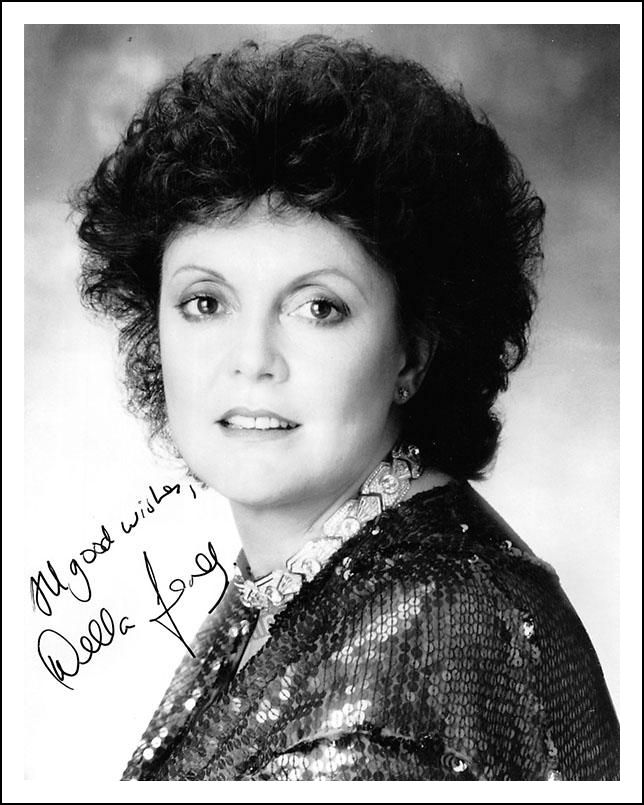
Mezzo - Soprano  Della  Jones

A Conversation with Bruce Duffie


jones


jones The Welsh mezzo-soprano, Della Jones (born April 13, 1946), studied at the Royal College of Music, where she won the Kathleen Ferrier Memorial Scholarship, and later in Geneva. She made her professional debut in 1970, as Feodor and Olga. Her career took off when she joined the English National Opera in 1977, performing many of the standard mezzo roles as well as contemporary music. She joined the Royal Opera House, Covent Garden in 1983. Since then she has performed regularly with all the major British companies, and began appearing abroad notably in France, Italy, and the USA.

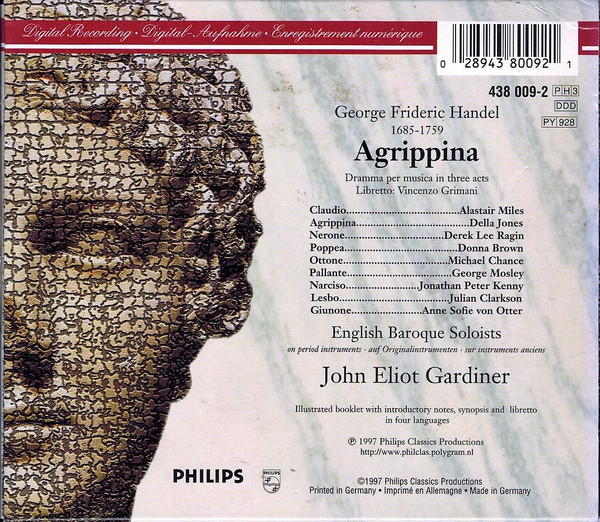
[Vis-à-vis the recording shown at left, see my interviews with Derek Lee Ragin, and Anne Sofie von Otter.]

One of the most versatile performers on the international classical circuit, Jones is equally at home in early music and contemporary repertoire, with a specialty in the bel canto operas, notably of Rossini. She is one of the few performers whose voice and dramatic talents seem to be suited to all kinds of music, spanning five centuries; from Monteverdi through Purcell, Handel, Mozart, Rossini, Donizetti and Wagner to Alban Berg, Edmund Rubbra, Benjamin Britten, Leonard Bernstein and Peter Maxwell Davies, with a touch of Gilbert and Sullivan on the way.

Dramatically, Jones has a flair for both comedy and tragedy, playing the full range of heroines, maids, confidantes and villains. As with all mezzo-sopranos, she is also just as likely to appear in breeches in the many 'trouser roles' written for that voice, such as Mozart's Cherubino in The Marriage of Figaro and many roles in Handel and Monteverdi operas. On the concert stage, she regularly performs in music as diverse as Verdi's Requiem and recitals of intimate and lyrical French song, and at such grand events as the handover of Hong Kong in 1997 and the Last Night of the Proms in 1993.

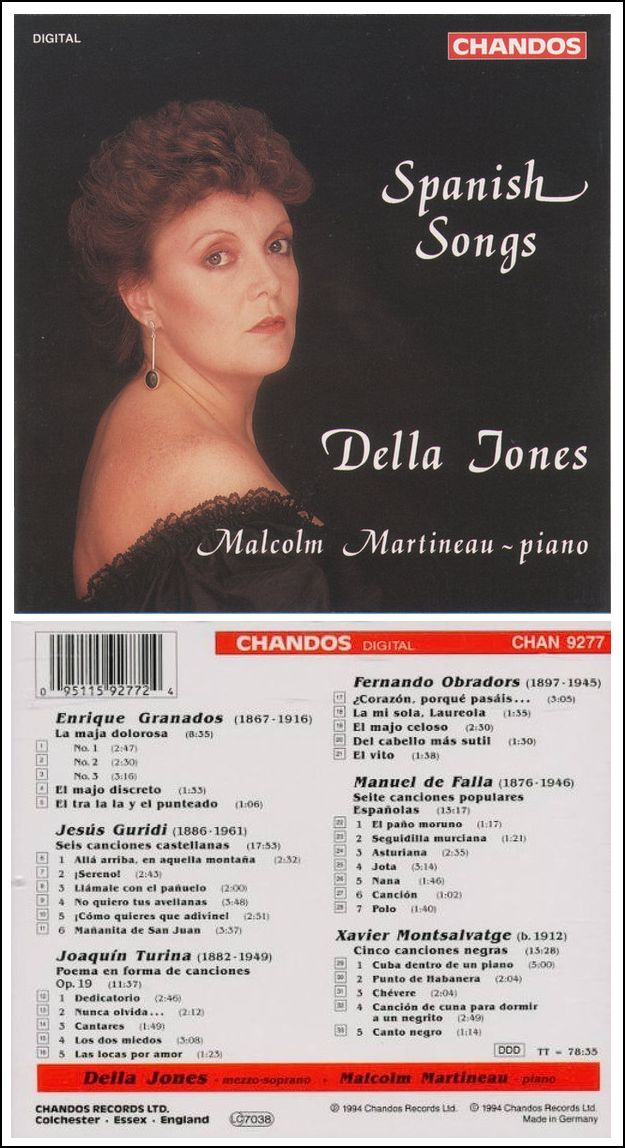
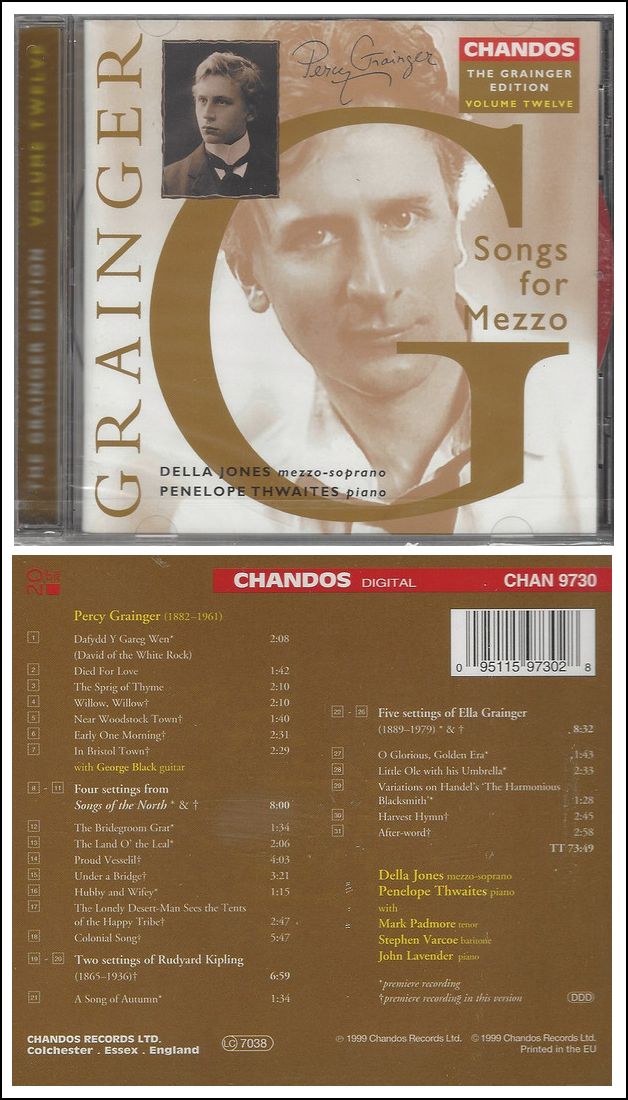
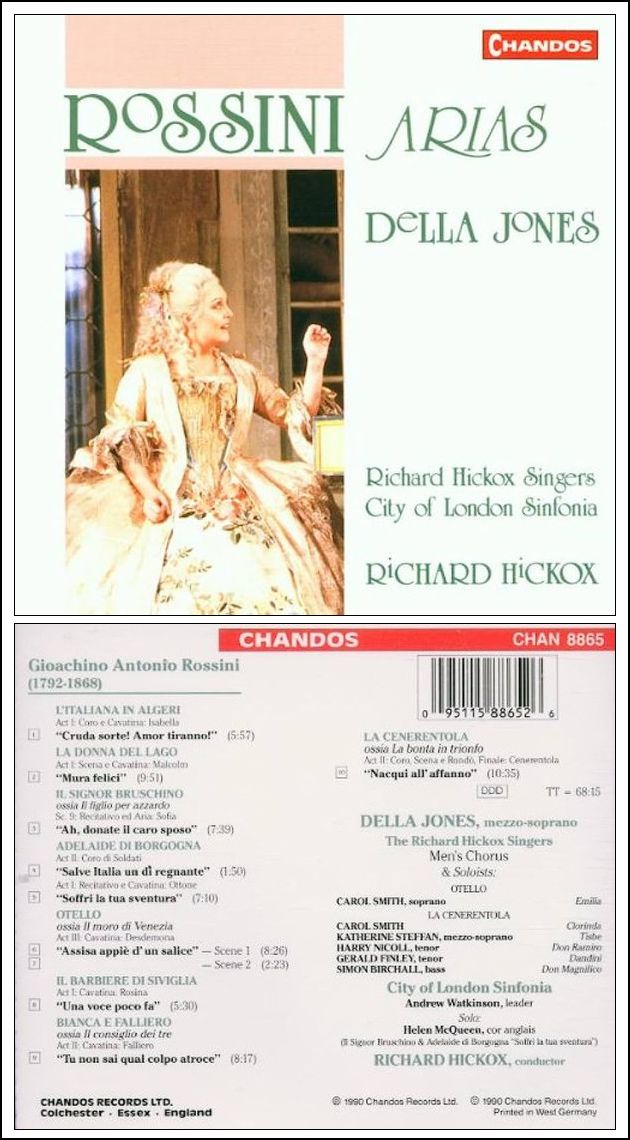
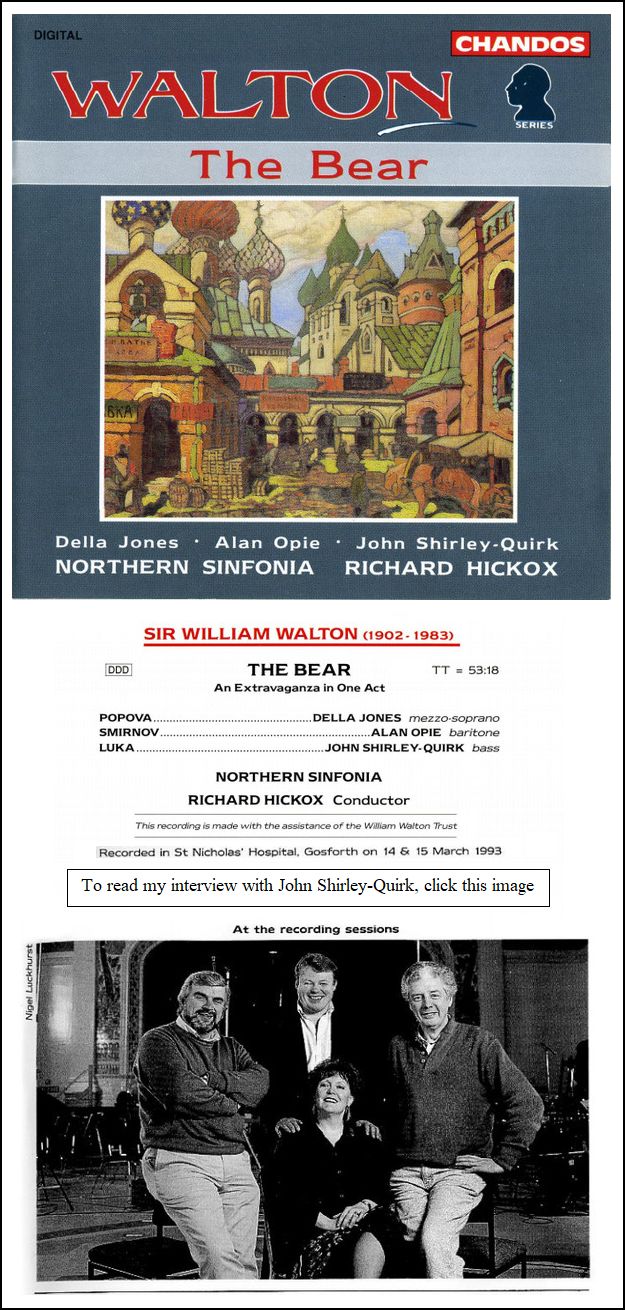
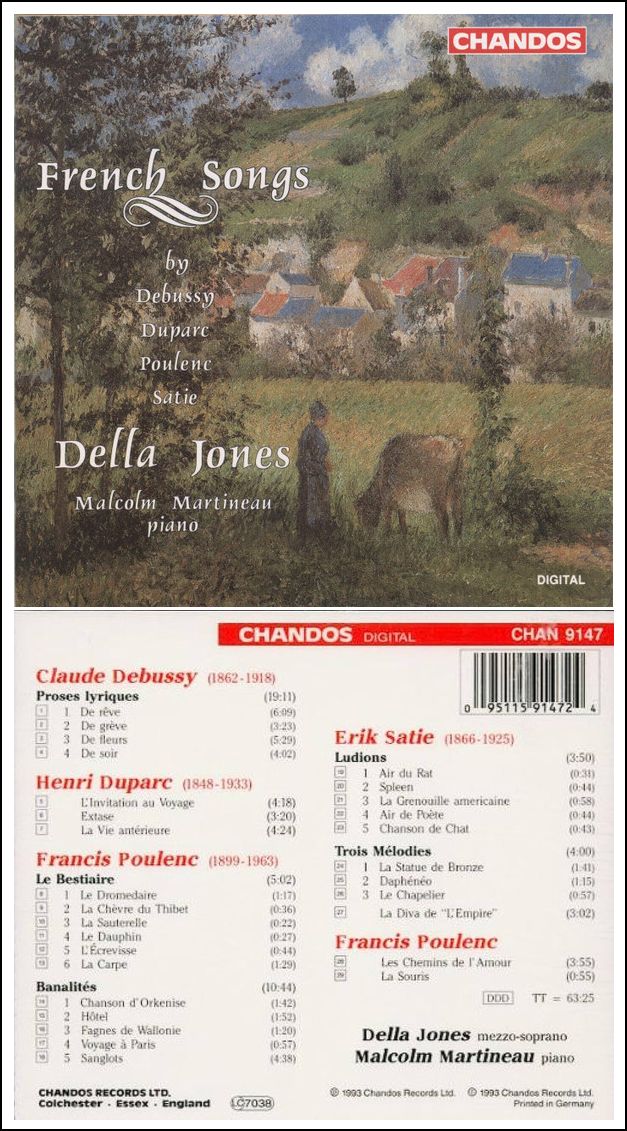
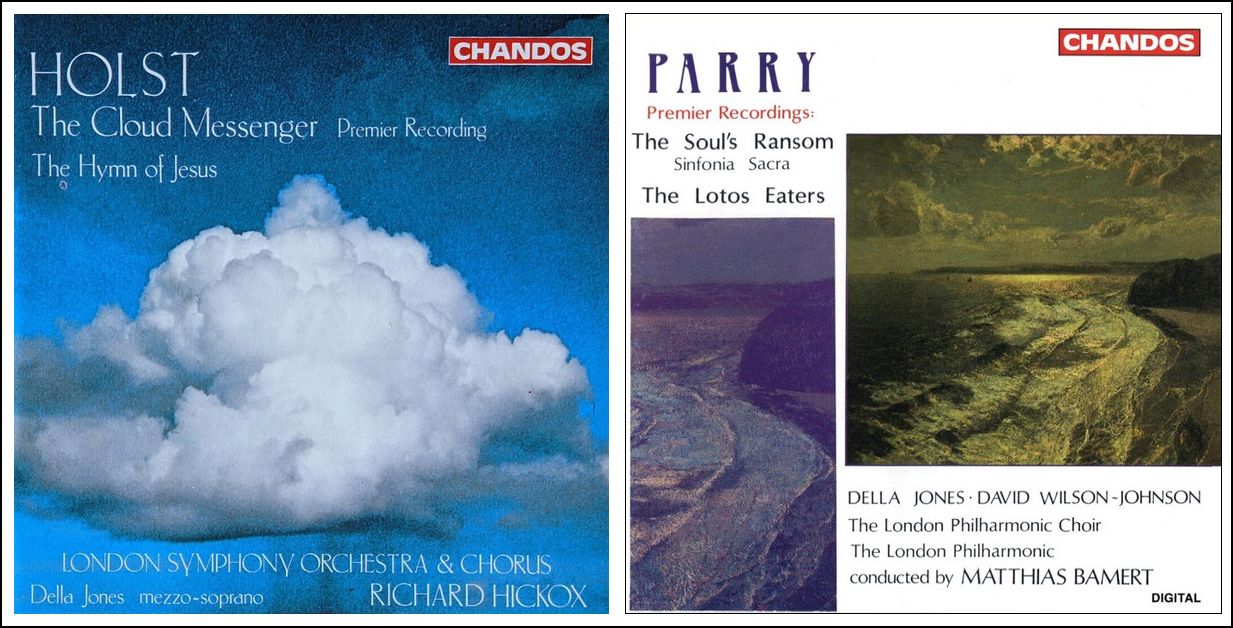
Jones has recorded prolifically throughout her career, several of which are used as illustrations on this webpage. Much of this is in the field of opera, but she has also recorded song recitals and concert music, including a good deal of contemporary music. She has also made many appearances on radio and television both in Britain and abroad. In the mid 1970s she began a long association with Opera Rara, appearing in many long-forgotten bel canto works, both on stage and recording. She has also recorded the Rubbra Symphonies with the BBC National Orchestra of Wales conducted by Richard Hickox.

==  Names which are links in this box and below refer to my interviews elsewhere on my website.  BD  


In the fall of 1995, Della Jones was part of the large cast of The Ghosts of Versailles by John Corigliano, presented by Lyric Opera of Chicago.  [Others included Sylvia McNair, Håkan Hagegård, Sheri Greenawald, Wendy White, Graham Clark, Dwayne Croft, Sunny Joy Langton; Leonard Slatkin, Colin Graham, John Conklin, and Maria Tallchief.]

Between performances, Jones graciously agreed to sit down with me for a conversation.  Portions were used on WNIB when we played some of her recordings, and now, as she marks her 80th birthday, I am pleased to present the entire interview.

jones
Bruce Duffie:   You sing old music and new music and everything in between.  How do you decide which roles you’re going to perform and which ones you will turn down... at least for a while?

Della Jones:   I’m very happy with the way my career has gone, in that I have such a variety of things.  Sometimes I think,
Oh golly, there’s always something new to learn.  I do such a lot of repertoire that the amount of learning I have to do is amazing.  It’s sometimes...

BD:   Too much?

Jones:   No, because I find it very exciting with that plop of a new score on the floor for the letterbox, and I’m [actually] stimulated by that.  If I had done Rosinas and Cenerentolas constantly, if I had kept to the same roles [and] repertoire, I would have been bored.  My career has just happened to have gone that way, of doing so many diverse things, and I like it.  I mean, one of my favorite periods is Monteverdi and after the Handel, but I also adore Rossini and I also love contemporary.

BD:   Doesn’t that leave a great gaping hole in the middle?

Jones:   No, not at all.  I’m capable of singing everything.  I adore Berlioz, and I would love to do more Mahler.  I’ve done only a little Mahler.  One of my favorite roles is Dido in The Trojans, which I just love doing, and I was so fascinated by the history.

BD:   Doing so many new and different things, is it nice to come back to a role that you know?

Jones:   Yes, of course, it always is.  Sometimes it’s a such long time since I’ve done it, and I wonder if I have done this before.  [Laughs]  And I do such a lot of rare operas.  I also do a lot of recordings, so one doesn’t have to memorize those.  For Opera Rara, I’ve done Donizetti and Meyerbeer, and this year I recorded with Bruce Ford Ricciardo e Zoraide, [slyly] that ‘well known’ opera by Rossini!  [Both have a huge laugh]  It is a splendid opera, actually.  Then, again with Bruce on Chandos, we have a new The Barber of Seville, which has come out this week.  It’s the only recording in English.

BD:   I know there are recordings of Barber in French and German and Russian, but not in English.

Jones:   In Russian too???

BD:   Oh, yes.  The old Russian State Recording Company recorded everything in Russian... Lohengrin, Tosca, all of them.

Jones:   How wonderful!  Golly, yes!

BD:   Tell me the joys and sorrows of singing in English.

Jones:   I don’t think there are any sorrows, to be quite honest.  Singing English for an English-speaking audience is very satisfying, as is singing Italian for an Italian-speaking audience.  But in any language, if your words are enunciated and clearly spoken, even if an audience doesn’t understand the language, it can get so much from the color in your voice, and the expression on your face.  We know this ourselves if we hear an opera if we don’t speak the language.  Of course, we don’t understand everything, far from it, but with the right colors and clean enunciation, then it is possible to get quite a lot of the emotion through complete ignorance of the libretto.  I don’t find it so, but a lot of people say English is a difficult language to sing in.  I don’t see why.  I don’t understand this.  Every language has its difficulties.  French is difficult.  The ‘ü’ sound can be hard.  I remember doing Gluck’s Armide, ironically in Versailles.  [Remember, in Chicago she was performing in The Ghosts of Versailles.]  We did it in the opera house, and we rehearsed in the theater there for three weeks, which was very special.  The role is very high and low, with a lot of ‘tü’s up high.  The lady singing La Haine [Hatred] said,
Della, I don‘t know why you’re bothering to do the ‘tü’ on a high note, because the French never do!  We always just Italianate it, and do ‘too’!  But, of course, when you’re not doing your own language, you daren’t take risks.  You have to sing it as accurately and as idiomatically as possible.

BD:   [With a gentle nudge]  Then the critics will say that you were the only one who could be clearly understood!

Jones:   Right!  [Laughs]  But for your own language, one can take risks and iron out things.

BD:   Is it different to sing Rossini in English, which is a translation, as opposed to Elgar or Delius, which are originally in English?

Jones:   It depends entirely on the translation.  I’ve sung some bad translations, and some wonderful ones.  The one on this recording is by Amanda and Anthony Holden, and it is very brilliant.  It’s witty, and it has the rhyming couplets as the Italian does.  It doesn’t overuse the words, but it doesn’t sort of make them up.  It does repeat as the Italian repeats, without thinking that because there are more words in the English vocabulary than there are in Italian, so they have to use different ones.  They don’t mind repeating things exactly as the Italian does with rhyming couplets, and a witty translation.  This is the thing in recitatives, as in the cavatinas and the cabalettas.  It must maintain the same idiom as the original language.  If you do that, then you have a good translation and it’s fine to sing.  Of course, it’s always a joy to sing in the original as well, but I think there’s room for both.  I don’t know if it would work, and it’s been done a few times, but I often wondered how it would be if the cavatinas and the cabalettas were sung in the original, and then the recitatives in the language of the people.  I have said this to various people, and they’ve said that’s giving into it.  But I don’t know...  It could be interesting.  I would be very interested to know what audiences thought of this, especially for operas with a lot of secco recitatives.  This would not be for sung operas, and obviously for Wagner with its long, long songs, as I call them.  But it would be very interesting to know how this would work with pieces which have a lot of fast-moving passages.

BD:   Now we’ve inserted a new joker with the supertitles.

Jones:   Ah, yes!  I’ve just been to, and thoroughly enjoyed, the dress rehearsal of Don Pasquale this afternoon [with Paul Plishka, Ruth Ann Swenson, Bruce Ford, Timothy Nolen; Paolo Olmi, Paolo Montarsolo (directing!), John Conklin, Duane Schuler, Donald Palumbo, and Stan Dufford].  Funnily enough, it was the first time I’ve ever seen it on stage.  I have felt that I don’t want supertitles when I’m singing... on the other hand, sitting out there today, although I know the story of course, for some of the funny passages and the quick patter things, I did find it very instructive and very helpful.

BD:   [With eager anticipation]  So now you’re a convert?

Jones:   Well, yes.  Audiences have to teach themselves how to use supertitles, and I have to say they were brilliantly done today.  I’m sure they are great for The Ghosts of Versailles because it doesn’t come on every single line.  It gives you the general idea, and they’re not repeating every word.  So you’re looking at the stage, and you just see them flickering on and you can glance up again.  It just depends, again, on how well the translation is, and how succinct and well-timed they are.  If they give the end of the line, or the answer before it sung, then that’s bad.
jones
BD:   The comic singers often tell me that they got two laughs, one when the people read it and another when they hear it!

Jones:   Yes, and it was very good today.  It was very clever, and I know from my scene in Versailles that it goes well, because I asked everybody.  I said that I was a bit concerned, that when I have this short scene and some extraordinary translations of the Arabic into these peculiar proverbs
which really are a load of nonsense, but funny nonsenseI was so frightened that the punch line would come before I’d sung it.  But it didn’t.  We discussed it, and it comes after.  I hear from the reaction of the audience that this is exactly what’s happening.  So the supertitles don’t give the game away.

BD:   Do you always feed off the reaction of the audience?

Jones:   Certainly it helps for comedy.  For emotional roles it’s a different thing, as when you do something like Dido or Handelian roles.  Naturally in a light, witty role, like a comedian you have to wait to see whether there’s a laugh.  You feel the atmosphere of the audience, and like in a tennis match you play with them and to them, but not to the extent that if you don’t get a laugh, you wait for it, because then you lose your timing.  But yes, you feel it and play with it.

BD:   [With a wink]  You’re not restricted by the guy waving the stick at you from the pit?

Jones:   It depends on the orchestration.  In the role here that I have, my scene is quite lightly orchestrated, and we have time. They’ve written in this feeling of colla voce [with the voice].  They’ve written in the freedom.  Leonard Slatkin and I have a good rapport.  He knows when I will take a little longer, and it’s written into the music.  John Corigliano has done that brilliantly, and so I have time to play and to use facial expressions, and use hand gestures until we get into the real dance.  That has to keep pretty strict because the cross-rhythms there are quite tricky.

BD:   Without mentioning names, is it better to work with a conductor that likes the voice and admires the voice, rather than a purely orchestral conductor?

Jones:   Of course!  But I don’t think I’ve ever worked with somebody who doesn’t like the voice.

BD:   You’re very lucky!

Jones:   I am lucky.  There are some who appreciate, and take into consideration the voice more than others.  Sometimes, as you say, one is treated instrumentally, and occasionally conductors don’t give you breathing space.  But I’ve yet to meet one who doesn’t respond, to be quite honest.

BD:   We’re kind of dancing around this, so let me ask the Capriccio question.  In opera, where is the balance the music and the drama?

Jones:   In this role or generally?

BD:   Generally.

Jones:   For me, one is as important as the other.  Every operatic composer has written the opera with a libretto in mind, and there’s no question that it has to be balanced.  The audience has to understand the text, and the performer has to do the research on the character to bring out as much as is necessary.  It is so important to do the background on a character.  Some characters you can only read so far and go so far.  For example, in Rosina you can read the Beaumarchais.  It’s a wonderful witty play, but Rosina is really quite a flimsy... well, not flimsy, but there’s not much to her.

BD:   [Gently protesting]  But she seems like a rather strong woman.

Jones:   Oh, she’s strong, yes, but you can’t find out what made her tick before it began, and where she goes in The Barber of Seville.  In The Marriage of Figaro, it’s a different kettle of fish altogether.  Then she becomes that strong woman, but you can’t play Countess Almaviva in The Barber except for moments where you know what she becomes.  But she hasn’t become that yet.  She’s very young there, and you could only take that character so far in The Barber.  You can show gestation bits, but you can only take her so far.  This is like Cinderella in Cenerentola.  You can’t take her beyond a certain level, and however many times you do it, you can’t develop that character any more.  The music is wonderful, and different productions are entertaining to do, and there is the rapport and the way it changes your development with other characters on stage.  But unlike a Dido or a Ruggiero, which is a trouser role, and another one of my favorite roles in Handel’s Alcina, you can only take them to a certain level.  You can’t delve much deeper.

BD:   So, you don’t want to go into that unwritten next act after the final curtain?

Jones:   Absolutely, but you can’t for that show.  In The Barber of Seville you can’t say Rosina is actually going to become a very unhappy lady.  You can’t show that yet.

BD:   And yet two dramas later, she’s actually going to wind up having a child with Cherubino!

Jones:   Exactly, that’s absolutely right!   But that doesn’t mean to say it’s very entertaining in the relationship.  I’ve always wondered... I think Rosina has had an affair with Figaro!  The only thing that stopped them was the class system.  But when you think of their rapport in any production of Barber, with that wonderful easy twinkling duet they have, they’re flirting with each other constantly.  I’ve always thought they know each other far better than is let on.

BD:   Does that then translate in the next opera to a closeness or a rivalry between the Countess (Rosina) and Susanna?

Jones:   I think there is.  Rosina and Figaro have a wonderful relationship in The Marriage of Figaro.  I’ve seen it played where they become quite close, and it’s most interesting.  You get all sorts of odd different layers.  Again, it
s the class thing, so they can’t get too close, but there’s still that little frisson, as, of course, there is between the Countess and, more so, Cherubino.


Frisson (UK: /friːsɒn/FREE-son, US: /friːˈsoʊn/free-SOHN French: [fʁisɔ̃]; French for "shiver"), also known as aesthetic chills or psychogenic shivers, is a psychophysiological response to rewarding stimuli (including music, films, stories, people, photos, and rituals) that often induces a pleasurable or otherwise positively-balenced affective state and transient paresthesia (skin tingling or chills), sometimes along with piloerection (goose bumps) and mydriasis (pupil dilation). The sensation can occur as a mildly to moderately pleasurable emotional response to music with skin tingling.

The psychological component (i.e., the pleasurable feeling) and physiological components (i.e., paresthesia, piloerection, and pupil dilation) of the response are mediated by the reward system and sympathetic nervous system, respectively. The stimuli that produce this response are specific to each individual. Frisson is of short duration, lasting only a few seconds. Typical stimuli include loud passages of music and passages such as appoggiaturas and sudden modulation that violate some level of musical expectation. While frisson is usually known for being evoked by experiences with music, the phenomenon can additionally be triggered with poetry, videos, beauty in nature or art, eloquent speeches, the practice of science (mainly physics and mathematics), and can also be triggered on command by some people without any external stimuli. During a frisson, a sensation of chills or tingling is felt on the skin of the lower back, shoulders, neck, and/or arms. The sensation of chills is sometimes experienced as a series of 'waves' moving up the back in rapid succession and commonly described as "shivers up the spine." Hair follicles may also undergo piloerection.

Frisson may be enhanced by the amplitude of the music and the temperature of the environment. Cool listening rooms and cinemas may enhance the experience.

jones

BD:   In The Marriage of Figaro, your part is Marcellina, who is Figaro
’s mother.

Jones:   [Laughs]  Yes!

BD:   But she doesn’t know that she’s Figaro’s mother.  Is there any chance at all she’s had a flirtation with Figaro?  After all, she has loaned him the money.

Jones:   I don’t think so.  Of course, she absolutely fancies him rotten, but it’s because Marcellina is so often played as somebody who is sixty, or seventy, or even eighty.  She’s not.  Marcellina is in her early forties.  She had Figaro when she was sixteen, or seventeen, or eighteen.  But it’s in that period where early forties was considered to be older, and she is just now jealous of the fact that there is somebody, namely Susanna, who is very much younger.  Marcellina’s a very, very experienced sexy lady.  There are two reasons why I think this must be so.  In the duet with Susanna, when they talk about the best person in Spain, Susanna turns round and says,
Your age! which clearly infuriates Marcellina.  If she was really older, in her sixties, seventies, eighties, she wouldn’t mind that, because she would say, “Yes, my dear, my experience.  But it’s at the fortyish period where it makes you very angry.  The other thing is after the sextet, when Marcellina and Figaro have revealed themselves to each other as mother and son, and they’re embracing, Susanna comes in and hits Figaro because she is very jealous.

BD:   She thinks that there’s really a possibility???

Jones:   Yes.  If Marcellina was old, Susanna would say something to the effect of,
What are you hugging that silly old bag for?  But she comes in and she’s genuinely jealous.  So Marcellina has to be a sexy, viably attractive woman to Figaro.

BD:   Then back to my original question.  Before Marcellina realized that Figaro was her son, could they could have been together?

Jones:   I don’t think Figaro has ever fancied her, and this is because he’s besotted with Susanna.

BD:   [Gently pressing the point]  But he had a relationship with Marcellina for the money.  Isn
t this the whole point, that she wants satisfaction of the debt, either him or the money?

Jones:   They had met, but he knows that because Marcellina fancies him so much, he can wangle anything out of her.  So he sucks up to her.  I don’t think he has any interest in her, and that makes her very vulnerable.  It’s quite sad because he just thinks he’ll get it out of her.  She fancies me, and I’ll wheedle her.  But then comes that lovely turnabout when she realizes that he’s her son, which is wonderful.  What she thought was this incredible attraction is a maternal attraction, and it changes incredibly.

BD:   Does that make her feel good, or sad?

Jones:   Oh, very good!  She was beginning to feel very frustrated thinking she can’t get the young man, and now she doesn’t have to because he’s her son, and that’s why she loved him.  She hasn’t made a fool of herself after all, and that’s why she felt the attraction.

BD:   She’s happy that he has made a big success in the society.

Jones:   Exactly, exactly!

*     *     *     *     *

BD:   Let’s go back to the Rosina which you sing.  Is there a secret to singing the music of Rossini?

Jones:   I’ve always tried to do it on a very, very legato line.  The main secret is that it must not be sung on an aspirate.  The eighth notes must be cleaned out completely, because within every coloratura phrase there is a melody.  Whatever it is, there is a beautiful melody, so you find the melody and you sing that melody on the open vowels so you have that line.  Then the coloratura runs are divided up.  It’s like running a marathon hurdle race.  You know where you’re going with the muscles and the mind, and then one hopes one gets a flow.  Sometimes you can pick up a score, and suddenly you can read it through.  I’m very lucky that I could read music before I could read a book.  You can do it maybe first time, and then you do it again, and you wonder where am I going?  You have to muscularly learn it, which is the technical side of it, as well as the mental side, knowing subconsciously where the leaps are and where you’re going.  I break it down so that if I’ve got a triplet or an interval of a seventh, I do it in the rhythm that’s written.  Then I try counter-rhythms, so I change the patterns so that the leaps don’t become huge leaps.  If there’s a leap, it could be just an interval of a second.  I just try and make it all, but never forgetting this hidden melody that goes throughout.  So I wind up doing everything really on a bel canto line.

BD:   When you get out there on stage, and you have all of these details to think about, are you still portraying the character, or do you cross the line and become the character?

Jones:   I think I become the character.  I hope I do.

BD:   That’s not dangerous?

Jones:   It’s dangerous if you get emotionally involved, and then, of course, you have to step back.  But you’ve gone through that at the rehearsals.  I came quite close to this in Dido, both the Purcell, which is a much smaller scale, but then The Trojans of Berlioz, when you’re singing the last aria after you’ve fought with Aeneas.  It’s a pretty exhausting role.  One almost cries.  You feel your own throat closing up with the emotion of Dido.  You go through this in the rehearsal period, and you daren’t do that on stage.  That is where acting as singing technique comes in.  You’ve been through your own emotions in rehearsal.  You’ve been through your own technical physiological process, and you’re hoping by the time you’re presenting it to the public that it is coming across without you yourself getting involved.  I remember in my very early days, when I won the Kathleen Ferrier Memorial Scholarship.  I was a soprano then, and my singing teacher at college was Gordon Clinton.  He used to have a singing class, and he had all his pupils there.  I did my program, and I sang “To This We’ve Come” from The Consul by Menotti, which is an extraordinarily moving aria.  I cried at the end, and Clinton said, You will never do that again!  You moved yourself, and you didn’t move us one bit!”  I learned a very, very big lesson that day because the more one is moved, your own joy or sorrow at yourself does not carry across the footlights.
jones
BD:   You do have to divorce it a bit?

Jones:   Yes, from that point of view, but you have to go through it in the rehearsal.  You have to be that character and then deliver it.

BD:   You must learn how far is too far?

Jones:   That’s right, absolutely.  It’s the same in everything, really.  For example, once I had a huge, huge sword fight, and you have to technically do that.  [Laughs]  You obviously can’t go around either killing somebody or yourself physically or vocally.

BD:   When did you decide to go from soprano to mezzo-soprano?

Jones:   It actually happened quite naturally.  When I think about it, I probably always was a lyric mezzo.  It is just that when I was in college, the weight of voice I’ve got led to the roles I then looked at, such as Mimì, but I also did Popova in Walton’s The Bear [recording shown at right], and Gretel in Hansel and Gretel.  But throughout all my career I’ve done a lot of concert work as well and in those days, I would sing Messiah, and the Creation, and Elijah as a soprano.  When I went to Geneva as a student, I began to realize that the top of the voice was not lying comfortably when I began to look at operatic roles as a whole, rather than excerpts as one did in college.  So I thought there’s either something wrong with the top of the voice, or it’s not in its right place.  When I worked on Cenerentola, I began to realize that I could sing that role and those sorts of roles all day.  It came quite naturally that I was a lyric mezzo, and in fact my voice is higher now and lower than it was when I thought I was a soprano.  I always relate it to a ship at anchor.  If the ship is anchored properly, you can cope with the ocean high or low, as, hopefully mine is now!  [Laughs]  But it’s true.  I have more ease now with the height than I ever did when I thought I was a soprano, because I found my Fach.  I love the repertoire that I do, and I have a great variety.  I just recorded Vitellia in La Clemenza di Tito with a top D, and someone asked if I am turning into a soprano!  No, I’m a mezzo who happens to be able to sing a top D.  Why deny a mezzo a top D?

BD:   You can sing a top D, but you wouldn’t want to stay there all night.

Jones:   Oh, no, no, no, no, no, no!  It’s just a rare happening!  [Both have a huge laugh]

BD:   Even though you have this wide range, the voice does dictate certain characters that you sing.  Do you like the characters that are imposed on you by the voice?

Jones:   Yes, I do.  I would adore to sing Madam Butterfly, and also I would adore to sing Boris in Boris Godunov.  Now I would no more sing Madam Butterfly as I would sing Boris.  I can’t become unhappy that I can’t sing Butterfly.  It’s not because my voice isn’t big enough or high enough.  I just don’t have that voice.

BD:   So, if some director asked you to do Boris en travesti, you would do it?

Jones:   I would!  [Another huge laugh]  I certainly would, because that’s an interesting thought!

BD:   So, you’re happy being a mezzo?

Jones:   I’m very happy being a mezzo.

BD:   That’s seems to be a bit rare...

Jones:   Is it?

BD:   A number of mezzos have tried to do Tosca and other leading roles.

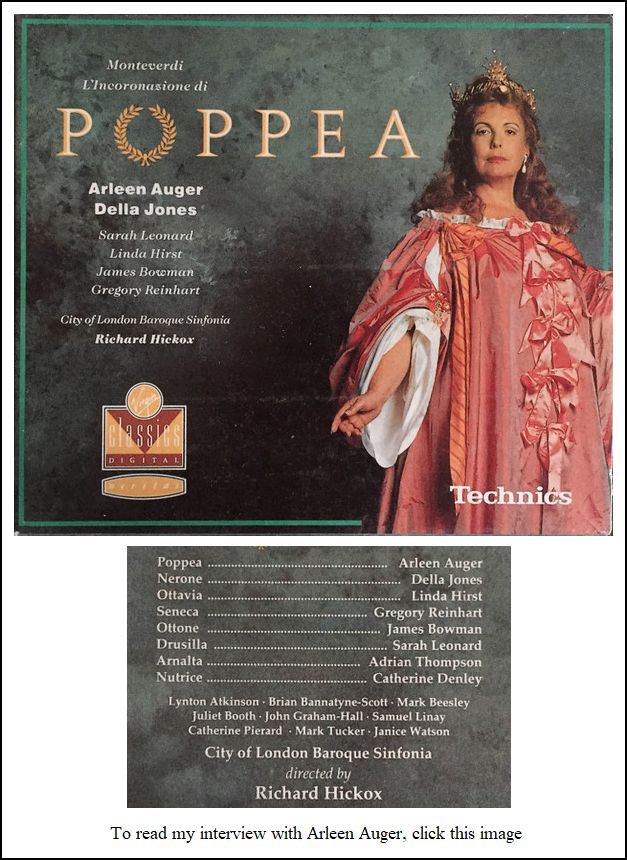
Jones:   Maybe I’m lucky because I do Nero in The Coronation of Poppea [recording shown below-left], and all the Handel roles, so I have the girls and the men.  I wish there was more Puccini for a mezzo, but I love doing Suzuki.  That
s the only Puccini I’ve done.

BD:   Do you like playing a guy?

Jones:   I do, yes.  I’ve played lots of guys in my life.  The characterization of those roles just adds another dimension from the nice girls.  For a long time, I did goody-goody two-shoes girls like Ninetta in The Thieving Magpie.  Rosina and Cenerentola and The Italian Girl in Algiers are quite fiery.  The text of Orlando Furioso is so interesting, with the characters and the relationships.  In Poppea, Nero is this incredible figure.  Apart from the historical side of it, the character himself is in love with Poppea and every other woman in sight, and yet he is a homosexual.  So you have this extraordinary role with a woman playing a homosexual.  I find the mental relationships quite challenging.

BD:   [With a wink]  Sounds like it’s occupational therapy!

Jones:   [Has a huge laugh]  I like the challenges of different characters, and for the mezzo you have a fantastic choice.  I also like doing a lot of concert work.

BD:   How do you divide your career between opera and concerts?

Jones:   It depends on what comes in first!  Operatic things tend to come in fairly in advance, but from here I go back to Britain to record for Chandos Frank Martin’s In Terra Pax.  It
s a piece in French which is wonderful.  It’s called ‘Breve Oratorio’, and is a very studied piece.  Then I sing with the English Chamber Orchestra Phaedra by Benjamin Britten, and Purcell’s Dido and Aeneas in the same program.  That’s two extraordinary ladies together.  Then I do Purcell’s Dido at Covent Garden, and then Sea Pictures.

BD:   Elgar!

Jones:   Yes, and then it’s Christmas Eve!  [Both laugh]

*     *     *     *     *

BD:   You travel all over the world for these engagements.  Do you sing differently in a small house, as opposed to a large house?

Jones:   No, the core of the voice remains the same.  Obviously in a smaller house, you can possibly take a quieter pianissimo, but it depends on the size of the orchestra entirely.  In a small house, if it’s a big orchestra you can’t sing less.  I’ve done Brangäne in Tristan and Isolde with Charles Mackerras and the Welsh National Opera in fairly small houses where there is no pit.
jones
BD:   Where did they put the orchestrato the side, or the back?

Jones:   At the side, but they took out some of the front seats of the auditorium, and the orchestra just stretched out.  So you can’t afford to sing too pianissimo on those occasions.  I’ve also done The Trojans in those houses, but again with the right conductor the balance is attained.  This is a terribly important thing.  Lyric Opera is a wonderful house to sing in.  [BD silently applauds at Chicago
s good fortune.]  One is aware that the house goes back a long way, and for some areas perhaps I would give a little more than I would in a 600-seat house.  [Lyric has 3600 seats.]  But the acoustics here are just incredible.  You just feel the voice as it goes out, and it’s not difficult.  But I’m not aware of changing my vocalism unduly, apart from sometimes not doing quite as much pianissimo.

BD:   Do you sing differently for the microphone than you do for a live audience?

Jones:   Yes.  Not in changing the character of the voice, or the quality of the voice, but if one is suddenly doing a great fortissimo on a higher note coming out of nowhere, you either stand back a little or the engineer turns you down.  The thing that I never want is the color of my voice to be changed.  If it’s not right, then please tell me, but I don’t want somebody technically interfering with what I want to give, at least without a discussion.  It happened once.  I remember starting off a recording of a Handel opera, and when I heard a playback I didn’t recognize my own voice!  I have a certain timbre to my voice.  I suppose one calls it a vibrancy, and obviously this engineer didn’t particularly like it.  He took every bit of a natural vibrato out, and it wasn’t my voice.  It was very difficult, because meeting somebody for the first time you don’t want to say,
I don’t like what you’ve done with my voice!  Luckily, the conductor didn’t like it either, so that was fine.

BD:   So the two of you could get him to put it right?

Jones:   I did actually say,
That doesn’t sound like me, so could we change the balance please?  Id like my voice to sound more like me, and then if we don’t like it can we discuss it.  The conductor actually wasn’t quite that polite.  He said, “Let’s do that again!  Redo all the microphones, and I want the color of Della’s voice as it is.  So, we got it.  The engineer was maybe experimenting, too.  He hadn’t heard me before, and he wanted to iron out the natural vibrato in my voice, but then it was colorless.  So it’s just fine tuning for the microphone.  I don’t want to change my voice, and I don’t like cheating in the studio.  Nobody does, really.  I tend to just perform.  I use the microphone as an audience, otherwise it can become stale or flat.  Sometimes you have to take care that you don’t blast it, especially in ensembles.  If it’s not multi-tracked, then you have to fine-tune yourself.

BD:   Once you get through the recording, they can cut and paste it together.  You say you don’t want it to be untrue, so at what point though does it become a fraud if it gets to be too technically perfect?

Jones:   In most of the recordings I’ve done, they tend to like running full pieces, rather than snipping and editing.  You rehearse it, you do a take, and then the producers say,
“We’ll use large chunks, so we’ll go from, say, Bar 1 to Bar 40.  In that section there are three bars where maybe it was the singer, or maybe it was the third horn, or maybe it was the violins that could be better.  You have to do it, but they prefer to get really a complete conception, a performance of the piece.  That happens more and more.  Of course, there are disasters where one does need to snip in, or if you have a cold...  I was doing Missa Sobriensis, and I woke up on the second day of recording with absolutely no voice at all.  I had a throat virus, and couldn’t speak.  So, I tracked my part in three months later.  Everybody has to do that from time to time, but generally, recording companies like a performance.  It’s much easier for the singer.  I love getting a run of it, and then going over it in large sections.  But if you’ve done the first run, and you’ve got it nearly all in the can, then you can relax.  Then when you’ve done another complete run, you’re utterly relaxed, knowing you’ve got it.  Often they use the first or the last time.  We did that on the Don Giovanni for ‘Mi tradì’.  We did a run, and then we did long bits, and then it was finished.  I was very pregnant at the time, and everybody was relaxed.  It’s lovely to have that freedom.

BD:   Thinking about stage performances where there is an audience, is there such a thing as a perfect performance?

Jones:   [Thinks a moment]  No!  Perfect in what?  Perfect for the audience’s point of view, or for the performers’ point of view?

BD:   I’ll be greedy, and say in every way!

Jones:   Well, I’ve never done a bad performance.  I’ve been sometimes satisfied with some of it, and maybe that interpretation worked that night.  At another, I might wish a certain note had been better, but I don’t get too analytical like that.  I’m not that sort of person unless I’ve done something really horrid and messed up a note.

BD:   I hope there are more performances where you think it went really well tonight.
jones
Jones:   Oh yes, one gets that, but perfect, no.  There’s never a perfect night, but then life isn’t perfect!  [Both laugh]  I don’t think any performer can ever say it was a perfect performance.  This is why live performances are so incredible, because things sometimes happen on stage that have never happened before.  You might create a magic moment, and if that’s perfection, yes, but the whole thing can’t be perfect.  The whole evening can be sensational perhaps, but the audience makes a combination of forces and atmosphere.  If excitement is perfection, then yes, but it’s subjective.

*     *     *     *     *

BD:   Do you like being a wandering minstrel?

Jones:   I like traveling.  I love home, and just before going away I hate going.  But it’s part of the job, and one does have a chance of seeing wonderful places.  I must say this is my first time in Chicago, and it is a wonderful city.  I’m not just saying that.  The people are friendly, and they’ve made me feel really welcome.  Again, I really mean it when I say that the Lyric Opera is a fantastic company to be in, and it
s one of the nicest I’ve been in.  I really have had a happy time, and now my family have joined me here as well, my husband and a little six-year-old.  So it’s lovely.

BD:   How do you balance the career with family life?

Jones:   My husband is a sound recordist, and he travels a lot, too.  But we try not to be abroad at the same time.  So, it balances.  Quite often I do a lot of work in Britain and in Europe, and from Europe I can get home.  Some people have jobs where they are out from 7 AM to 7 PM, and perhaps only see their children at the weekends for a long time.  I’m sometimes working in London, or rehearsing at home, so it evens out.  The thing is, if you’re happy in your job, then you’re happy in your life, and I’m happy in my job.

BD:   Do you make sure that you schedule enough time off?

Jones:   I don’t have a lot of time off, actually, but I like working.  I don’t have a lot of gaps, and I’m very happy to sing.  I do have two weeks over Christmas, and I have something to learn, but that’s fine.  I’m at home, and these forthcoming things now after Chicago are in Britain.  Some time ago I was away quite a lot when my child was quite young, but then he came with me.  Of course, it will get harder as he progresses in school, and one has to think and plan a little.  That’s inevitable, but it’ll be worked out.

BD:   Do you have any advice for young mezzos coming along?

Jones:   Never do things that you don’t believe you’re ready for, even though you are may be asked to do those things.  Find out your Fach.  Find out where your voice lies and where you’re comfortable.  If you believe in your teacher’s recommendations, stick to what he or she says.  But you must find the right one.  Don’t be persuaded to do things that you know are going to ruin your voice, even if you want to do them in your heart.  Never go beyond your Fach, and keep working as much as you can on the repertoire.  Languages are so important in the operatic and concert repertoire.  Explore the combination because I find it so fulfilling.

BD:   But how do you know at twenty or twenty-five what is good for your voice, and what is going to damage it?

Jones:   The first thing is you know if it’s hurting.  Maybe not at twenty, but you know it at twenty-five.  You begin then to know where the comfort and the weight of the voice lies.  You know!  I remember in college I saw a poster which said,
Sing Turandot at Covent Garden!  I took the score out the next day and sat down to play it for myself.  When I tried In Questa Reggia, I knew I could sing a top C, but I came out voiceless!  That was crazy.  I couldn’t sing for a week because I tried to sing that aria loudly!  [Both laugh]  We all make mistakes, and do things we shouldn’t, but we learn what feels uncomfortable in the voice.  You have to cajole and love your instrument and study the repertoire.  Then you’ll find what’s right, along with good coaches and good teachers.  You have to have somebody you believe in, and then take their advice.  But the biggest advice and the best advice you can get is from within yourself.  You know really inside what’s right and wrong.  Matthew Epstein rang me up one day and said he wanted me to sing Ariodante in Wales.  I said that would be fantastic!  He also said he wanted me to sing Brangäne, and I said, No way!  How on earth do I know if I can sing that, other than engaging a full Wagnerian orchestra and putting it in my garden and singing along.  But it was with Charles Mackerras, and Anne Evans as Isolde, so it was a lyric interpretation from everybody.  Its the only Wagner Ive ever sung.

BD:   [Gently protesting]  But you’ve sung over a Mahler orchestra.

Jones:   Oh yes, but it’s a very different thing doing Brangäne.  I’d never done Wagner, and I didn’t know about doing this at that time in my career.  Matthew come to the Sitzprobe and jokingly said,
I can hear you!  [Both laugh]  But it was a risk I took because I believed that Matthew wouldn’t have suggested me unless it was Charles Mackerras.
 
BD:   It was the conductor you trusted.

Jones:   Yes.  You believe in people that you believe in.  I knew I could sing it, and of course I was nervous that I wouldn’t be heard, but it was the lyric tradition.  There are certain sopranos I couldn’t do it with because they’ve much heavier voices.  Then it would be a ridiculous balance.  But it worked, thank heavens, and I’m doing it again in 1997 [two years hence].  But I would only do that role again with certain people because of the size of my voice.

BD:   You also sing new music, so what advice do you have for composers who want to write for your voice?
 
Jones:   Treat the voice like a voice, not an instrument.

BD:   [With mock horror]  You mean you’re not a clarinet???
jones
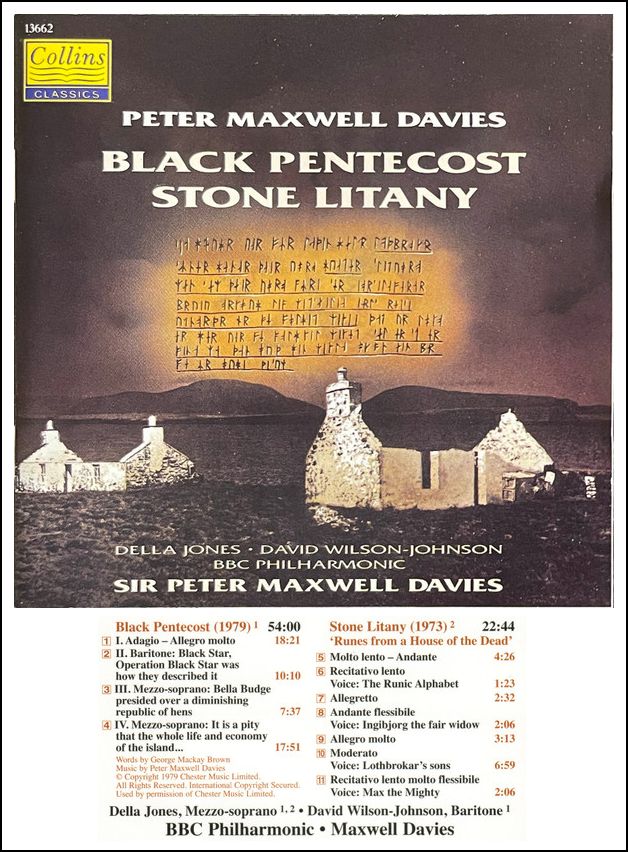
Jones:   [Laughs]  I am not a clarinet, although having said that, last year I recorded Stone Litany by Peter Maxwell Davies [shown at left].  His music is quite instrumental, but extraordinarily lyrical.  Stone Litany is in the runic alphabet, which is quite amazing.  It’s wonderful because nobody can criticize my pronunciation!  [Laughs]  I was dying for a British critic to say something about it, but it’s one of the most difficult pieces I’ve ever done.  It goes from a bottom E to a top C, and you almost sing a duet with yourself.  There’s one bel canto line where you reiterate things with a top C pianissimo.  Although it’s fairly instrumental, I always come out of that piece feeling exceedingly warmed up, because he knows how to write for the voice.  Even though it’s quite instrumental, there is this legato vocal line.  We recorded this in front of an invited audience in Manchester with Max conducting, and when I came off, I said, Max, we could do that again!  When I first looked at it, I thought this is going to really blow my voice out, but it doesn’t.  John Corigliano is the same.  Obviously, Versailles is a very different style, but one is exceedingly comfortable in doing it.  I’ve never wanted to do any contemporary music that has one make peculiar noises that would harm the cords, but some people do that, and do it brilliantly.  Quite early on in my career I did Transit by Brian Ferneyhough.  It was an amazing piece.  I did it in the Rouen Festival, and I loved doing it.  Then they were recording it, and he asked me, but he wanted more bizarre, very guttural vocal sounds, and I said I really didn’t want to do that.  I have perfect pitch, and it’s not easy.  Perfect pitch is a great gift, and then it’s sheer luck that I can pick a note and sing it.  So, early on in my career I didn’t want to just become known for that, because it would have been so easy to just go into that stream and then lose any bel canto, and line, and lyricism in the voice.  So, it’s a compromise, but young composers just have to learn to know the voices, and what the voice can do.  They need to know that the singer has to support and breathe, and have time.  It’s very different from an instrument!  Our instrument is in our bodies, and we can’t just take it out and polish it, and change the pads at night, and buy a new reed!

BD:   Would you prefer if you could take it out and put it in a box at night?

Jones:   Sometimes it would be quite nice!  [Both laugh]  After a performance when you’ve got another concert the next day, you think you’d just love to chat, but you must go home to bed!  There
s a concert tomorrow.  This is another thing for young singers.  It is your instrument within you, and for any person, whether you are a singer or not, its a medical fact that the first place which gets tired is the throat.  You only notice it more if you’re a singer.  Whenever you’re ill, you’re affected there.  You really have to take care because it is within you and you can’t take it out and put it in a box and polish it up tomorrow.  On the other hand, one must never become neurotic.  My husband says I’m the only singer he ever sees going around without a scarf around her neck.  One must take care, but you can’t become neurotic.  Otherwise, you may as well give up life.  You’ve got to live in this world.

BD:   You do what you can and then let it go?

Jones:   Yes, absolutely.  If somebody comes up to you with flu, you try and keep away, but you can’t go round in a train or a bus or a taxi and say that I am a singer, so keep away!  It’s a happy mental balance between knowing and doing the best to protect yourself and your job, but still remaining a member of the human race.

BD:   You don’t want to live in a bubble?

Jones:   I don’t want to be in a bubble, no!  We are human beings after all.

BD:   Are you pleased with where you are at this point in your career?

Jones:   Yes.  There’s always something that one wants to do more, but I’m very happy with the way things are going.  Like every artist, sometimes you wish you’d done that, but then I may still do it!  But I’m really very happy with the repertoire I
ve done, and am doing, and which is coming.  There are some roles I’d still like to do that I haven’t done.  I’d like to do Vitellia on stage.  I’d like to do more Mozart, and I’d like to do more Mahler, and I’d like to sing at the Met but I haven’t!  [Has a huge laugh]  No, I’m very, very happy with how it’s going, yes, but one is never completely satisfied or we wouldn’t be artistes.

BD:   Are you optimistic about the whole future of opera?

Jones:   Oh, very!  Yes, and so many companies now are doing so much for young people.  One is always in fear of recessions and fundings.  This has been a problem since the beginning of time, and it will go on, but there is the encouragement that the young people in schools, and everywhere are getting.  People are being introduced not just to opera, but to concerts, and to everything from all the media, and this is very healthy.  Today, at the dress rehearsal I was just standing in the foyer and I heard someone saying that they’re doing Don Pasquale in their school, so they’re doing related projects.  You hear this everywhere, and this is what I love.  I brought my six-year-old to the rehearsal today, and I hear so many children in schools are doing little arias of it.  This just takes a pianist.  They are our next audiences, and if they begin from the earliest age to know that opera is a way of life, a part of their lives and not an elitist thing that they can only go to sometime, but they are included in it.  Then we have the next generation of opera and art lovers.  This applies to all the arts.  Take the young children to the art galleries.  Don’t make it a special place that you only go when you’re older.  Art is for everyone, and that’s the only way we can maintain it and keep it going forever.

BD:   Will you be back in Chicago?

Jones:   I hope so!

BD:   I hope so too!  Thank you very much for the chat.

Jones:   Thank you for having me.


jones

See my interview with Matthias Bamert


© 1995 Bruce Duffie

This conversation was recorded in the office suite of Lyric Opera of Chicago on October 26, 1995.  Portions were broadcast on WNIB a few months later.  This transcription was made in 2026, and posted on this website at that time.  My thanks to British soprano Una Barry for her help in preparing this website presentation.

To see a full list (with links) of interviews which have been transcribed and posted on this website, click here.  To read my thoughts on editing these interviews for print, as well as a few other interesting observations, click here.

*     *     *     *     *

Award - winning broadcaster Bruce Duffie was with WNIB, Classical 97 in Chicago from 1975 until its final moment as a classical station in February of 2001.  His interviews have also appeared in various magazines and journals since 1980, and he continued his broadcast series on WNUR-FM, as well as on Contemporary Classical Internet Radio.

You are invited to visit his website for more information about his work, including selected transcripts of other interviews, plus a full list of his guests.  He would also like to call your attention to the photos and information about his grandfather, who was a pioneer in the automotive field more than a century ago.  You may also send him E-Mail with comments, questions and suggestions.