Radio Commentator and Author
George Jellinek
Two conversations with Bruce Duffie
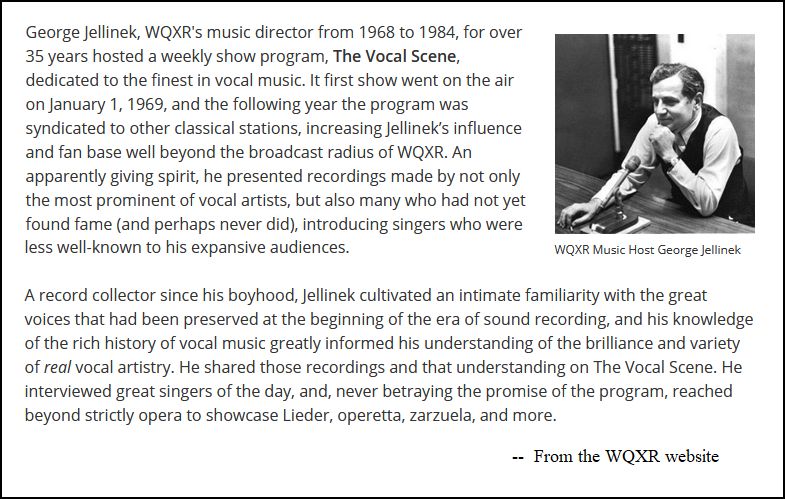
This webpage contains two interviews with radio commentator
George Jellinek (December 22, 1919 - January 16, 2010), long-time
host of the nationally syndicated program The Vocal Scene.
Amazingly, however, what you are about to read is both typical
and unique.
The typical part is simply two interviews with a
guest who was notable in the field of Classical Music, in this
case specifically opera. It is also typical that names which
are links on this page refer to my interviews elsewhere on my website.
What is unique is that, to the best of my recollection, the
second interview, from September of 1995, is the only case in my
entire radio career when the conversation was done live on the air.
All the others were pre-recorded, and selections from the conversation
were broadcast, along with recordings and/or promotion of upcoming
performances. This time, Jellinek and I were both in the studio
together, and the program was being transmitted as it happened. We
inserted musical selections to illustrate specific topics, and we both
knew various ideas we wanted to discuss, but it was live and not pre-done.
This did not bother either one of us, but, as I say, it was unique
in my experience.
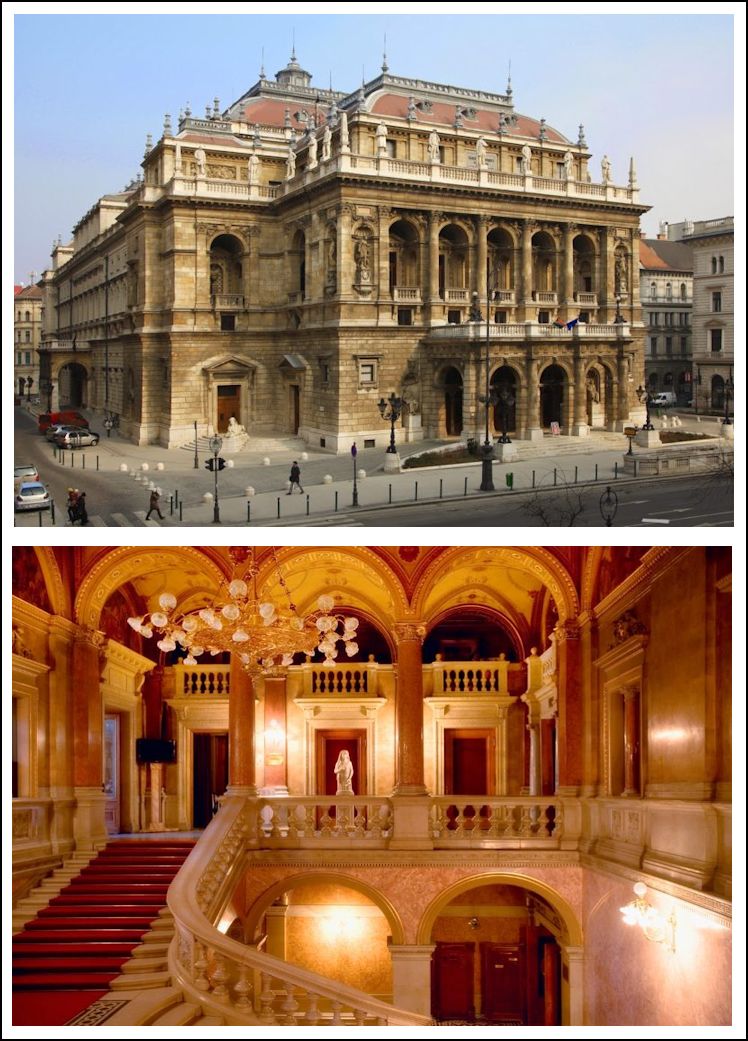
Jellinek was born in Hungary, where he lived until he was nineteen.
He developed his love for opera there. Included on this
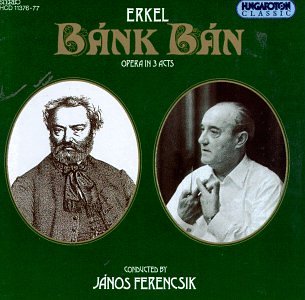
page are a couple of photos of the Budapest Opera House, and images
of recordings of some of the Hungarian operas he mentions during our
discussion.
We begin with the first of our two meetings. Jellinek
was in Chicago at the beginning of 1988, and when we got together
at his hotel, we jumped right into the topic at hand . . . . . . . .
.
George Jellinek: So, what are
we going to do?
Bruce Duffie: First, you can
answer the burning question... Where’s opera going today?
GJ: Oh, just like that?
BD: Just like that.
GJ: Opera is going into many,
many directions, and I hope that they will come soon to where opera
will be returned to the people who create illusion, not necessarily
the directors. What I’m trying to say, in my awkward way, is
that there’s too much power right now being exercised by stage directors,
and designers, and producers.
 BD: Where should the balance be between the music
and the drama?
BD: Where should the balance be between the music
and the drama?
GJ: It is not the balance that
bothers me. It is the liberty that certain individual directors
take in approaching the opera from personal and untraditional viewpoints.
I know that marks me as a deep-rooted conservative, which I’m not,
really. It’s just that some of the innovations, or very, very
daring departures, bother me. They seem like self-serving
efforts rather than product or music-orientated efforts.
BD: Do you expect the stagecraft
to grow and be innovative?
GJ: Absolutely, yes. We’ve
just had a very interesting Ring cycle in New York.
It did not please everyone. In many ways it was traditional,
but it presented a beautiful picture along traditional lines, and yet
it did not have any of those antics with the helmets and stage mannerisms.
We have a generation of singers that has been pulled away from these
stock gestures. They’re intelligent, and often they’re good-looking,
and do respond to intelligent direction, but that direction should
not be bizarre. Opera, after all, is not a modern art, especially
when you deal with traditional works. It’s useless to pretend that
this is futuristic. I have a feeling that this has grown out of
a very distinguished past, and one eye should be directed to tradition.
BD: Where should the balance
be between the old traditional operas and the brand new works?
GJ: You mean in terms of repertoire?
BD: Yes.
GJ: There again, I’m a very practical
person, and I feel that if you ignore the demands of the box-office,
opera will die, and there will be no opportunities for innovation.
Certainly, a smart manager must realize that his first goal is survival.
Let’s take your season in Chicago. I don’t want to talk about
the Met because, after all, I am in Chicago. You have about ten
operas per season. Am I right?
BD: Right. It’s nine this
year.
GJ: With about ten operas, at least
three or four of them should be repertoire staples, the kind that
will assure one hundred per cent attendance. For the remainder,
there should be at least two twentieth century works, and I don’t
mean necessarily Puccini. I mean, perhaps more imaginary pieces,
such as Peter Grimes, The Carmelites, Wozzeck,
Lulu. This is probably not a very popular view, but I don’t
believe that a first performance of a very, very modern opera should take
place in a major theater. The major theaters
— such the Met, Chicago, and San Francisco
— should not present a test of work. I know
that I’m probably contradicting myself, but La Fanciulla was
not tested when the Met produced it in 1910, and a number of other successes
came to mind. But unless you have total freedom from financial pressures
— and who has that freedom today?
— I don’t think you should take a work like, for instance,
Penderecki’s Paradise
Lost, which you did a few years ago. It probably cost a
fortune, and it has not been heard of since. This is what bothers
me. If the opera is worth doing, it should be worth doing twice,
or three times, or four times. But if it results in a forbidding
kind of failure, then who is going to be the suicidal impresario who
will bring it back? If you had a certainty that you had another
Puccini in your hands, then I imagine you can be emboldened to do such
a work. But I will say that new works should be done under modest
auspices. Then, having tested the waters, if the work is navigable,
by all means lead it into a safe harbor.
BD: You’re advocating not taking
any risks whatsoever?
GJ: It’s easy for me to tell an
impresario to take risks because it isn’t my budget. The Met
has done a certain amount of risk-taking, and they lost a lot of
money, and I don’t want these major opera companies to go under.
BD: Should opera ever be made
to pay its own way?
GJ: It cannot happen. It
is not on the cards. I don’t see how. A number of years
ago, I was told by Rudolf Bing [General Manager of the Met from 1950-72],
or one of his assistant managers, that every night they lose money.
At one time, it was a very dangerous thing to do. There was a
strike, and somebody in management at the Met took a very sardonic
and unpleasant view. I don’t know who that person was, but
he said, “That’s all right. We’re making
money while the theater is dark.” It’s
a horrible thing to say, and yet these are the horrid economics of
the situation.
BD: Then let me ask the big philosophical
question. What should be the place of opera in society?
GJ: Opera in society has always
existed. It is an elitist art. I don’t see opera as
a populist art, so sacrifices must be made. Subsidies must be
given to sustain opera, but it would be unrealistic to expect a Federal
government, or the State of Illinois, or New York, or California, to
sustain opera. There are too many social problems today that require
grants and subsidies. Much as I love opera
— it’s been my life — but
it is not today’s first item on the agenda. We have to face that.
We have to know that. So, the sustaining of opera should come
from private sources. It should come from subscribers, and from
the opera lovers. Actually, we, as opera lovers, are taxed to
sustain what we enjoy. I’m not so sure that this is unjust, because
you have to pay for the good things in life, and perhaps it is unrealistic
to have people who would rather go to the ball game rather than the theater,
and who don’t really believe in opera, for them to be taxed. In
a society like Austria, people who have never seen the inside of the Vienna
State Opera are absolutely convinced that it is their pride, and it must
go on, it must be lavishly budgeted. We don’t have that kind of tradition.
BD: Should we?
GJ: I think we should but we are
a different nation. We have a different and very, very
important traditions. Traditions sometimes come from the
old west — which can be just as cherishable
— but they have nothing to do with the Viennese
tradition of Mozart and people who went before Mozart. We are
a different society. I don’t think it’s good for us to try to ape
the European model.
BD: Is having opera on the television,
so that can come into everyone’s home, going to expand the audience
and make it more of a populist thing?
 GJ: Yes, it is. The one
danger with opera on television is that we have been very anxious
to create super-stars, and the television audience is geared to
personalities. People who watch Sutherland
and Pavarotti on television may not be willing to go to a theater
to see that same opera with a lesser but worthy cast. Our
audiences have been sort of guided along star-gazing, and insisting
upon seeing the great personalities. We don’t have that many
right now.
GJ: Yes, it is. The one
danger with opera on television is that we have been very anxious
to create super-stars, and the television audience is geared to
personalities. People who watch Sutherland
and Pavarotti on television may not be willing to go to a theater
to see that same opera with a lesser but worthy cast. Our
audiences have been sort of guided along star-gazing, and insisting
upon seeing the great personalities. We don’t have that many
right now.
BD: Is there any way to get around
that? Can we let them know that Madam X does it almost as
well, or even as well, as Sutherland?
GJ: Recordings have done a lot
to introduce new talent and to create a beneficial, or a benevolent
attitude towards another artist. The public does not move
easily, and we have this powerful exposure to hype, which is difficult
to overcome. Public relations is a very powerful tool in all fields
of American activities — certainly
including music and opera — and
it is not easy. Very often I have this problem, also [on
my radio program]. I would feature an artist whose career
is limited, or primarily concentrated in Europe. For reasons
of convenience, or family obligations, some wonderful artists
— such as Margaret
Price, or José van Dam
— seldom come to New York. Then, if they
do come, the Met allows three or four years before they re-engage them
for certain roles. In the meantime, the public forgets about
them, and then when I play a record by such a person, the reaction I get
is, “Never heard of her! Never heard of him!” People conceive
an artist revolving around the United States, and the Met and Chicago
cannot pay the fees that La Scala or the Paris Opera pay their stars.
Consequently, they don’t come there. In Europe, Artist
X can sing in Milan tonight, Vienna the day after tomorrow, and in London
three or four days later. What’s involved is a few hours of
flight, whereas coming here, it’s much longer. It’s a strain
on the voice. You have to worry about air conditioning, jet lag,
and all that. People have to consider these things, so my hope
is the rise of American talent. I think the best singers today
are Americans. Just look over the galaxy which includes Marilyn Horne and Samuel Ramey.
Here in Chicago you’re going to have the debut of Susan Dunn. I
think she’s fantastic!
BD: But how can we get the public
to be curious enough to give these artists a chance?
GJ: Good reviews will do a lot,
and then you can have Miss Dunn on your show...
BD: Which we will [and did]!
GJ: ...and make the public conscious
of them. These are the artists of the future, and are not
just the future. They are here now! There are some good
tenors even coming up, such as Jerry Hadley...
BD: Neil Shicoff?
GJ: Shicoff, absolutely.
American artists are coming up because the quality of teaching
is excellent, and the opportunities are getting better. I
would like to foresee a rise of serious local American opera.
In other words, I would like to see Cleveland, Cincinnati, Newark
doing more. San Diego is already there. These almost-million-population
cities should be having serious opera companies, beginning with
maybe a five-opera repertoire and growing from there.
BD: Here in Chicago we have the
Chicago Opera Theater, which starts when Lyric closes, and they
do everything in English with young singers and simpler productions.
GJ: It’s wonderful. Of
course, now the surtitles are complicating the situation.
BD: I wanted to bring that up
at some point, so let’s wade into it right now. Do you think
it’s a good idea?
 GJ: I think it’s a very good idea. I witnessed
the beginning of surtitles at the New York City Opera. The
system did not work perfectly, and there was malice directed towards
it. They pointed out the mistakes in timing, and, of course,
it’s not an unalloyed joy. On the other hand, I believe they
are now in their third season and it’s going fine. I recently
visited San Francisco, and they’re a huge success.
GJ: I think it’s a very good idea. I witnessed
the beginning of surtitles at the New York City Opera. The
system did not work perfectly, and there was malice directed towards
it. They pointed out the mistakes in timing, and, of course,
it’s not an unalloyed joy. On the other hand, I believe they
are now in their third season and it’s going fine. I recently
visited San Francisco, and they’re a huge success.
BD: They seem to be a huge success
here in Chicago.
GJ: I remember at home listening
to a broadcast of the San Francisco opera by delayed broadcast
on tape of The Marriage of Figaro. It’s a comic opera,
and to hear the reaction, to hear laughter and the joy at the right places
was a wonderful thing.
BD: What about the people who
complain that you see the line, and you laugh before the singer’s
actually sung in those words?
GJ: Well, that happened.
The system must work, and this is still to be perfected. It
also upsets the singer’s timing. But I believe these are improvable
things, perfectible things. You don’t have to read the line
if you’re a purist and you feel that you know the opera. But
there is a lot of pretense here. How many Americans know every
word in Boris Godunov? Let’s be realistic.
BD: How many Americans know every
word in La Traviata?
GJ: Or, for that matter, Peter
Grimes. City Opera is now doing surtitles for English
operas as well, and it helps. It also helps eliminate the misguided
thinking in opera that the libretto is not important, that the text
is not important. That is very important!
BD: Is the use of surtitles going
to mean the death of opera in English?
GJ: Not the death of opera in
English because, for instance, opera at a local level may not be
able to afford the luxury of surtitles. The temptation for
managers is to utilize the vernacular will always be there. When
you are dealing with the American talent, English comes naturally to
them, but it is going to endanger opera in English. I am mindful
of the danger, and yet I think it’s an excellent experiment. I
deplore the fact that the Met right now has gone on record saying it will
not employ it because the Met audiences are in no way superior to your
Chicago audiences. They don’t know any more, and possibly less
about the text of operas, and they can use as much help and support as
opera audiences anywhere else.
BD: Do you feel that having opera
on the television, with the translations there on the screen, has
helped to bridge the gap, and allow it to come into the theater a
little more easily?
GJ: I believe so, absolutely.
I’ve yet to find a person who objected to it. As a matter
of fact, even people who object to surtitles in the theater point out
that on television it’s something else. I don’t know why, but they
do like it on the TV.
BD: Possibly because of the proximity?
GJ: Yes, and the position is
not distracting. I find it equal. If you want to be
distracted, you are distracted, but I find it terribly helpful.
BD: I’ve not seen them from the
main floor yet. My regular seats are in the front row of the
top balcony, so I’m looking down on the stage. It’s really
just a flick of the eye to see the titles at the top of the proscenium,
but I can think that the people in the fifth or tenth row downstairs
would need to move their head a tremendous amount.
GJ: Yes, but if it’s done right
it can work well. For instance, at the City Opera
— and possibly here, too
— they eliminate the repetitions. They don’t write
“O Dio”
seventeen times. I have not yet seen how they manage an ensemble
piece, for instance, the Lucia sextet. I’m very curious
to see that.
BD: We had it here in Figaro.
There were occasions when there were two titles at once, and even
occasions when there were three titles at once, and they made sure
that in the staging, the person singing each title was under in the
right place on the screen. In other words, a person singing that
phrase was in the right position, so that you could co-ordinate what
you were seeing up and down.
GJ: And it did work?
BD: It worked perfectly.
GJ: There you are! That’s
wonderful. I’m delighted. I’m all for it.
* * *
* *
 BD: I do want to be sure
and ask you about Hungarian opera. You are from Hungary
originally?
BD: I do want to be sure
and ask you about Hungarian opera. You are from Hungary
originally?
GJ:
Yes, I was born in Hungary, and I left when I was nineteen.
I was born on the same day Puccini was born [he in 1858], and André
Kostelanetz [1901]. André and I became friends when we
discovered that we were born the same day.
BD: You stayed there until you
were nineteen years old, so your whole early opera-going was in
Budapest?
GJ: Yes, it was, and it was fantastic
because my father’s business moved to the capital from the suburbs
in 1937. It was a restaurant in a theatrical section of Budapest,
and that meant near the opera. Maybe a year after that I became
a very avid opera-goer, and I spent, by my later calculations, about
150 evenings per year for those two years that I still remained in Hungary.
I learned my repertory right then and there. The Hungarian
Opera had an enormous repertory of perhaps fifty operas per season.
BD: In those fifty operas, how
many were standard repertoire, how many were new operas, and how
many were Hungarian operas?
GJ: [Laughs] It’s a long
time ago, but very roughly I would say about a dozen Hungarian operas.
In 1937, Turandot was eleven years old, Arabella, which
they did not play was about seven or eight years old, so these were
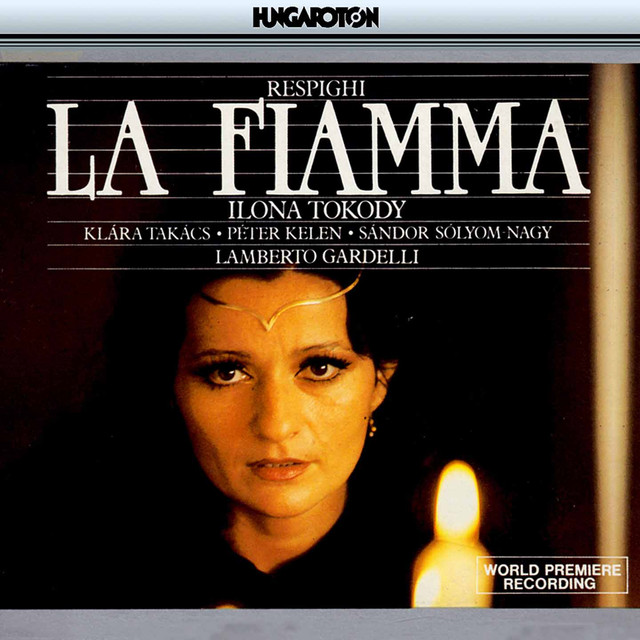
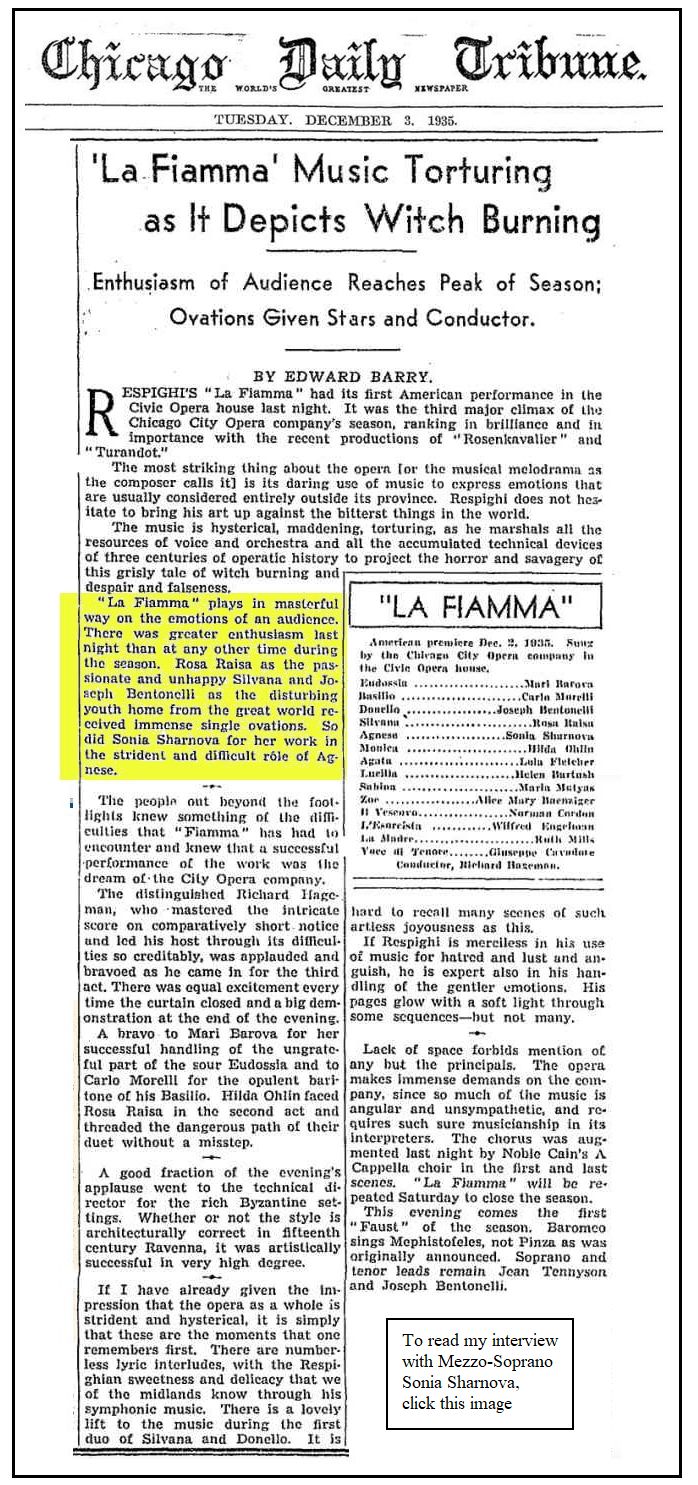
the contemporary operas of my time. La Fiamma [1934]
by Respighi, which I did see, received its first performance in Hungary
in 1935 [the same year it was given in Chicago! See the newspaper
review at right]. I saw it in 1937 so that was absolutely
contemporary.
BD: Now when you saw La Fiamma,
did you feel that this was a work worthy to enter the repertoire,
or did you feel that it would be something else that would just
be forgotten?
GJ: It was an unforgettable experience.
It was haunting, spooky, frightening, a demonic kind of opera,
and I felt with my then fairly limited sophistication as a music-lover
and as an opera-goer — remember,
I was an adolescent — that this definitely
belonged in the Italian tradition.
BD: Why is it never done now?
GJ: It was done in concert performance
about a month ago in New York.
BD: Yes, but that’s really a
revival.
GJ: It is one of the many operas
that can and should be done like that.
BD: But if you felt that it should
be in the repertoire then, today it’s not even done as often as
Il Trittico.
GJ: No, you’re right, but it’s
been recorded, and that’s a very good beginning. It was not
forgotten in Italy. Any number of operas by Mascagni, by
Giordano, by Montemezzi, by Cilea are occasionally revived in Italy.
They don’t necessarily travel well. Francesca da Rimini
[by Zandonai] was given a few years ago at the Met, and got mixed
reviews. But it definitely belongs. It deserves an occasional
revival. The Met was planning to do Il Piccolo Marat
by Mascagni, but because of the economy they canceled the production.
Turandot was not given at the Met for about thirty years,
and that does not mean that Turandot was not a viable opera.
Don Carlos was brought back to the Met by Rudolf Bing in
1950 after an absence of about twenty-five years. Don Giovanni
was out of the repertoire for twenty-five years at the Met, and so on.
So, when Chicago can only do nine or ten a year, how many operas are
there that Chicago music-lovers would like to and cannot see every
season? This is something that you have to live with, and that’s
what records are for.
BD: Ardis Krainik [General
Director of Lyric Opera of Chicago from 1982-97] has abandoned
the idea of trying to balance any one season, so she balances three.
That means in any one season, like this season for example,
we get two contemporary operas. Last season we had two Strauss
operas. Next season we’ll have three Verdi operas, but if you
look over any group of three seasons the balance is there, but any one
season might be tilted in some way.
GJ: Yes, you cannot really judge
then, but whatever she does, she does it well. I just read
this report in The New York Times, and I think she should
give lessons.
BD: [With a proud smile] Exactly.
Let’s come back to the Hungarian operas, because you have a particular
taste and knowledge of all of this. Why do we not know the
operas of Erkel?
GJ: They don’t travel too well.
First of all — and this may come
as a great surprise to you — right
now they have a problem with the Erkel operas in Hungary.
They are intensely nationalistic operas which were born in those
revolutionary years around or following 1848. Remember the
Risorgimento operas of Verdi? These Erkel operas are heated
up by the same intense emotion. Hungary is not an occupied
country, but it cannot do anything that displeases the Russians, and
one thing that displeases the Russians is Romantic Nationalism, because
they know what happened in 1956. Hungarians are really a peppery
people, and the Hungarian government does not want its own people to
get revolutionary ideas, because it would mean independence, and
that would get them into political trouble. Therefore, you cannot
perform an opera that is built on that kind of emotion, and then temperate
it and apply the brakes. You cannot do it. So they do play
them, but not often. They play Bánk Bán
and they play Hunyadi Lázlo, but not too frequently.
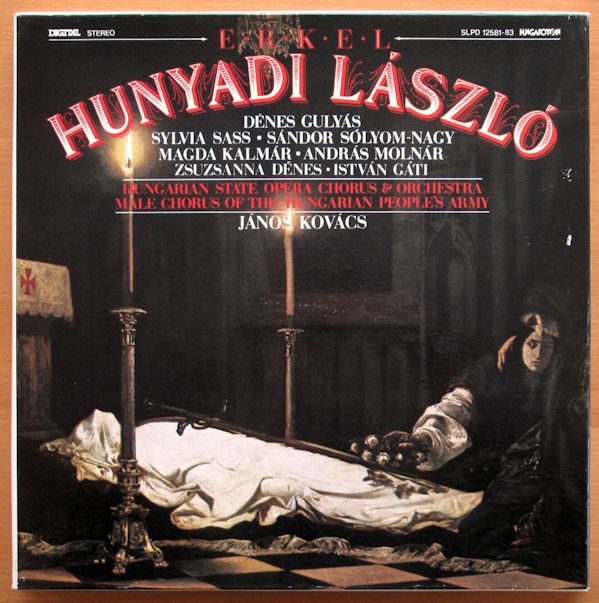
[Recordings shown above and below.] The public loves them,
and they would like to see them. They are, I think, marvelous
operas. They are very old-fashioned period pieces, but in that
period, they stand a comparison with just about anything that was written
at that time. Bluebeard’s Castle by Bartók is
a different situation because that is kind of a mythological, mystical
play. It’s like Pelléas and Mélisande.
It’s ageless, mediaeval and it lends itself to all kinds of staging.
BD: Perhaps if Erkel had been
forced, as Verdi was, to move the locale and move the time, would
they then be a little more acceptable?
GJ: Oh, they’re acceptable.
Don’t get me wrong, the public loves them. It is just politically
unwise to put too much emphasis on them. No, they’ll never go
out of style. [There is just a bit more discussion about Erkel
(as well as illustrations of his image on six Hungarian postage stamps!)
in my interview with Ádám
Fischer.] They have a few very good contemporary
operas, too. They have a few good composers
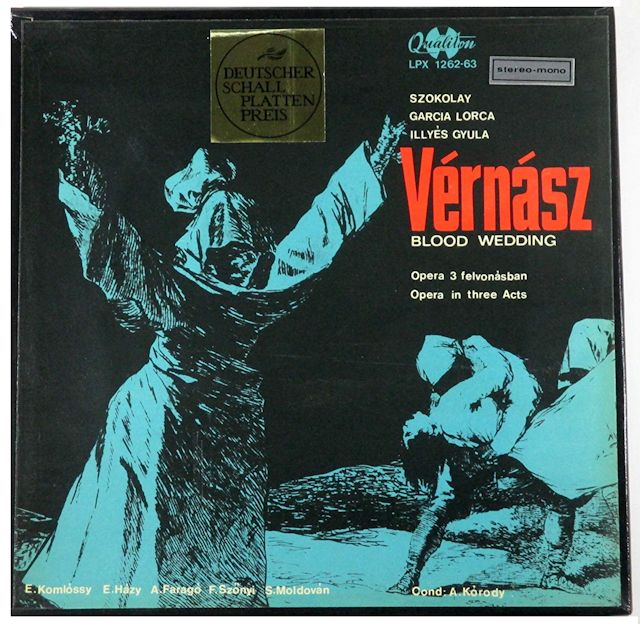
— Szokolay for one — and his
Blood Wedding was also recorded. [Image of recording
is shown below] It is an excellent opera, but the public is just
as tradition-bound as our public here. They’re not much for
experimentation. They have a problem with Háry János
because there currently is a tendency in Hungary to turn against folklore.
I don’t know why. For a number of years, while Kodaly was alive,
his teachings prevailed. Now that he’s dead, there seems to
be... I don’t want to call it a giant killing tendency, but all of a
sudden everything that was fashionable for so many years is unfashionable
today.
BD: Will it come back again?
GJ: It’ll come back. The tradition
is too rich to kill, and it is just that the Hungarian composers
of today are caught up in this scene, the international maelstrom.
They write music that is international and interchangeable.
It’s lost its national character.
* * *
* *
BD: Now we’ve just brought up
the subject of popular appeal and social fashion. Is the
public always right?
GJ: No, the public cannot always be
right, but I think history is right. We wait a few years,
and we’ll see what happens. For some of the operas that initially
failed, or did not please the public too much, eventually history
sets them into the right perspective. So, you have to wait
and see what happens. On the plane coming here, I read in today’s
New York Times Mr. Messiaen was interviewed. I hope
I’m quoting him accurately, but he said that the ancient modes were
in fashion for about ten centuries, and tonal music was in fashion for
about three centuries. Serial music was in fashion for fifty
years, and minimalist music will probably be in fashion for about a few
years. It’s too soon to judge, and I disagree with Mr. Messiaen
in one respect. He seems to write off tonal music. We
haven’t seen the end of that yet.
 BD: We’ll be coming back to that?
GJ: We are coming back to it,
but, again, this is also a passing phase. What happens today
is that we live in a very fast-moving world.
BD: Too fast?
GJ: [Laughs] Too fast for someone
of my age, yes, but not of yours! When I was a young man,
we used to think that a generation meant thirty years. That used
to be more or less what we regarded as a generation. The changes
today in five or ten years are more vast and more radical and more drastic
than the generational changes of my youth, and that is why someone in
his sixties, as I am, cannot so easily comprehend these vast changes,
not just in music. [Pauses a moment] I didn’t really mean
to get involved in all that philosophy. I don’t know if you are
a parent, but I am. I’m a grandparent. I have thirteen-year-old
granddaughter, and I listen to her in amazement. I listen to
the topics that she knows about, and the vocabulary she uses.
BD: Does she go to the opera?
GJ: She goes to the opera when
her grandparents take her. [Laughs] Her parents have
other interests. They live in San Francisco, and they do go to
the opera, but they don’t share my one-sided enthusiasm.
BD: I’m just wondering what is
the right age to bring children into the operatic world.
GJ: Gradually and gingerly, and without
forcing them. I would say around ten. Never to make
it a chore, never over-sell, but let them go to something light
— preferably now that we have surtitles
— such as Rossini, Bizet’s Carmen, Aïda,
something that offers more than just pretty music. It should
be a spectacle or fun. Not Don Giovanni, not Rosenkavalier.
I was exposed to Rosenkavalier at fourteen or fifteen, and
it made no sense to me. Because everybody knows the big waltz,
I thought that’s all the opera was going to be. Everybody would
be dancing around. Subtleties I didn’t have the mind for. But
the important thing is not to force anything. No generation would
stand for that — not just today,
but even in my time. When it was an obligation, I didn’t like
it. Opera should sell itself.
BD: Is it succeeding in selling
itself enough to ensure its future?
GJ: [With slight consternation] I
detect a concern in your voice about opera’s future. [Both
laugh] I believe in opera’s future. It’s always been a
tough fight, and it will be a tough fight, and, yes, the audiences
are growing. They’re not growing in the proportions I would
like them to grow because I’m an old-time record man, and I talk to
record merchandisers. I’m told about the figures, and I don’t
like the figures. In this overall huge recording industry, classical
music represents five or six per cent of records sold. In Europe
it’s about ten per cent. It should be ten per cent here in our
country, too, and I hope that this rebirth of the record industry now
with compact discs will inject a fresh new phenomenon. It will increase
sales once the hardware cost is absorbed, and, hoping for a continued reasonable
economy, we’ll find rebirth of the classical recording industry also.
But the proportions I’m not too happy about.
BD: You’ve brought up the whole
subject of recordings, so let’s talk about opera on record.
Being such a dramatic art form, how well do you think it translates
to a purely aural medium?
GJ: It translates extremely well because,
first of all, this is a brave new world, and now we have video opera,
which has grown beyond my expectations. I am not an avid fan
of video opera, but I recognize its necessity. You asked me a few
minutes ago if I thought that televised opera would lead to an increase
of the viewing audience and opera-lovers, and when I said yes so quickly,
I would include video cassettes. They’re helping immensely, and
the repertoire is really quite considerable. Much is being imported
from Europe, not just legitimate items, but quite a bit of what we call
‘pirated editions’ have appeared. Let’s leave legalistics aside,
but they’re also helpful, and suddenly opera is a wonderful medium on
records. You can use your imagination, and if you don’t care,
you just sit back and enjoy the voices, and not just the voices, but the
total music.
BD: You’ve experienced much opera
in the theater. Are the voices captured on the records really
truthfully as they’re heard in theater?
 GJ: Very often better than truthfully! You
know what I mean... [Both laugh] Very flatteringly very
often, yes. The audio engineer has his or her power to modulate
the balance between singing and orchestra. Many of our conductors
today have a tendency to dwarf the singers. Sometimes it’s almost
essential or necessary, because singers sometimes let them down, and being
buried by a very considerate conductor when a singer is in distress is
a thoughtful act. But that isn’t always the case. There
are exceptions, but I would say that yes, generally speaking the balances
are good. The singers are caught to their advantage. The
problem there is that if the singer is a great dramatic artist, but
a somewhat flawed vocalist, the dramatic art will not be fully conveyed
to you through records, and the vocal flaws will be magnified.
I don’t want to name names but quite a few really captivating singers,
especially women, really can hold you enthralled. Then, when you
hear that same interpretation and the visual magic has gone, the vocal
imperfections are what you must consider because that’s
all that’s communicated to you. These
are not necessarily bad singers, but this is what happens.
GJ: Very often better than truthfully! You
know what I mean... [Both laugh] Very flatteringly very
often, yes. The audio engineer has his or her power to modulate
the balance between singing and orchestra. Many of our conductors
today have a tendency to dwarf the singers. Sometimes it’s almost
essential or necessary, because singers sometimes let them down, and being
buried by a very considerate conductor when a singer is in distress is
a thoughtful act. But that isn’t always the case. There
are exceptions, but I would say that yes, generally speaking the balances
are good. The singers are caught to their advantage. The
problem there is that if the singer is a great dramatic artist, but
a somewhat flawed vocalist, the dramatic art will not be fully conveyed
to you through records, and the vocal flaws will be magnified.
I don’t want to name names but quite a few really captivating singers,
especially women, really can hold you enthralled. Then, when you
hear that same interpretation and the visual magic has gone, the vocal
imperfections are what you must consider because that’s
all that’s communicated to you. These
are not necessarily bad singers, but this is what happens.
BD: At one point does the manipulation
on the audio track become a fraud?
GJ: I’m reluctant to even use that
word, because recordings impose different standards. Many
years ago, there was a remarkable and very significant producer
in England named John Culshaw, who was very vocal on this issue.
His view was to forget about the theatrical illusion. Recordings
represent a new art form, a different art form. It has its own
standards, and the record producer has many options at his disposal,
so let him exercise those options. I think he went a bit far
in some of his productions. Possibly he was enticed by such a
dynamic conductor as Sir
Georg Solti, and in some of those Wagner operas the orchestra
was just too overpowering, too powerful. Culshaw applied the
same technique to some of the early Puccini operas, such as La Bohème
on London records, and those early stereo records created an imbalance
which was not at all judicious for vocal music. But still, I would
not call that fraud.
BD: Do you feel that the perfection
of recordings sets up an impossible standard that cannot be hoped
for in the theater?
GJ: Perfection is always unobtainable.
BD: I know, but the records can be
put together, spliced up, and fixed.
GJ: That I don’t believe in.
No, that comes close to a fraud. In other words, it’s the
same as a pianist who cannot master a certain passage. He would
break down in the middle, and would have to start from the middle to
complete it, and then you fuse it together. That is fraud.
I don’t believe in that. It should be long takes.
BD: [Gently protesting] But
every record will have these imperfections removed, so that you
really have something that is reasonably close to accuracy, and you
never get this same accuracy in the live theater. Do you ever
feel that the public is expecting the same kind of thing they hear at
home when they go to the theater?
GJ: Frequently, yes, because for a record
you have a producer. You are dealing with human beings, and
when something breaks down you have to think if you want to be ‘honest’
and carry that imperfection — which
is sometimes severe — onto a record,
because you want to be honest in representing whatever happened in
the studio. The prospective buyer will have to live with that
imperfection forever. [In my interview with Margaret Hillis, who
founded the Chicago Symphony Chorus, she remarked, “A
concert hasn’t yet happened. With a recording everything happens
exactly the same way every time through. If you have ever heard
any of the old recordings of Toscanini broadcasts, when they took place,
they were enormously exciting. You play the recording through
once and it’s just great. You play it through again and you find
that this tempo changed or the orchestra is scrambling over here and
the intonation is a little out, and you become a little disenchanted
with it. Then you play it a third time and you become annoyed.
So there is a certain kind of technical perfection that a recording
requires that would be nice if you could get it in a performance.
If I’ve got my choice between technical perfection and musical excellence,
I’ll take the musical excellence any day.”]
BD: But even if it’s not an imperfection,
every singer will get all the details right over a number of performances.
We’re just stringing all the right parts together, and yet no
performance will have the right parts on one performance.
GJ: There have been some electrifying
performances where everything just works right, and don’t forget
you’re much less critical in the theater than you are with records.
You don’t mind if a singer occasionally gets a fly in her throat,
and produces a tone that does not immediately arrive on pitch. But
the singer makes an adjustment, and you end up with the right note and
you go away happy. But on records, that would be kind of silly
to preserve such a mistake. I realize that we’re dealing with
an amplitude of possibilities, and it is really foolish to go into the
studio with a singer who has a history of break-downs, and an inability
to carry through a performance. But if you go in with a professional
and successful cast, and the occasional imperfections develop, which
you can easily correct, by all means correct them.
* * *
* *
BD: Let me ask about contemporary operas.
Are you pleased at all with any of the directions that new works
are going?
GJ: [Thinks a moment] I really
am not that familiar. For instance, I am not familiar with
the Philip Glass operas.
I’ve not seen them staged, but I am pleased by the variety of ways
into which operas are going — ranging
from Menotti,
who, incidentally got a horrible press for his last opera, to Mr.
Adams with his very successful Nixon in China, which I also
have not seen. Yes, I would say I’m pleased by the variety,
but I’m still waiting for that great talent. Incidentally,
I did see Casanova’s
Homecoming by Dominick Argento,
and I thought it was marvelous. It’s coming back to the City
Opera this year. It’s traditional, which tells you a lot about
my taste, but it’s got a wonderful thought-out libretto, and was extremely
well staged. No company will have any difficulty with the staging
part of it. Though it requires good acting, I don’t believe it requires
anything extraordinary in terms of vocal demands. This man knows
how to write for the voice. He writes for the natural registers
of the voice, so he is one of hopes of opera.
 BD: Do you feel that this idea of composer-in-residence
is this a good one?
BD: Do you feel that this idea of composer-in-residence
is this a good one?
GJ: I think it’s a very good
idea because neither composer, nor opera, or orchestral organization
work in any kind of a vacuum. There is an interaction. A
conductor and the composer will benefit from the performer’s viewpoint.
[At this point, a phone call from a friend of his interrupted
our conversation]
GJ: [Upon returning] We are very
old friends, [laughing] part of the Hungarian Mafia!
BD: [Thinking of other Hungarians]
I had an interview with [cellist] Janos Starker a few weeks
ago, and Victor Aitay
[long-time concertmaster of the Chicago Symphony] was there. I
also had just done a phone-interview with Lazlo Halasz...
GJ: [Interjecting] I meet
him occasionally.
BD: ...and Halasz said be sure
to say hello to Victor when I saw him.
GJ: Does he come to Chicago?
BD: Halasz?
GJ: Yes.
BD: No, he doesn’t. We
did the interview on the telephone.
GJ: He’s getting on... he is
in his 80s.
[We then chatted briefly about birth dates, and calendars
which list musicians. I said that I relied on Nicolas Slonimsky’s
book, since it was the most accurate volume.]
GJ: I saw him two weeks ago. Incredible
man.
BD: Wonderful man. I did
an interview with him on the phone, also.
GJ: He’s
irreplaceable!
BD: I’m trying very hard to find
a lot of the older singers and conductors, and get a hold of
them before they leave this world. I’ve managed to speak with
quite a number of them. If there are some others, I will ask
your advice...
GJ: I don’t know if you’ve done
her, but if you want to give yourself an enchanting time, speak with
Jarmila Novotná.
[As you can see from the link, we did meet eventually!]
BD: I’ve tried for a long time.
She and I went back and forth several times, and she didn’t want
to do it on the phone. If I had been in New York, I probably
could have done it... I was waiting now for her book to get
published, and hoped then she’d be coming around.
GJ: I don’t know if she’s going
to be coming around. She’s in excellent health. She’s
taking very good care of herself and she’s a beautiful woman, a wonderful
woman. And, of course, Bidu Sayão. I’m
sure you have met her?
BD: Yes, I’ve talked with her.
GJ: That’s an experience, too.
BD: Absolutely, yes. I
managed to get her in an upbeat mood, and asked her questions that
she could answer in a positive way. I’ve seen several interviews
where she’s been down on this and down on that, and hates this or
that. I try to get my guests to be upbeat as much as possible.
GJ: Well, you cut what doesn’t
please you...
BD: But, I don’t want to use
the scissors too injudiciously.
GJ: Good.
 BD: I’m glad we’re talking about this. I
don’t want to ask you if singers are better today than they were before,
but I do want to ask if the singers who are acknowledged to be great
today are on a level with the singers who were acknowledged to be great
in the previous generation or two.
BD: I’m glad we’re talking about this. I
don’t want to ask you if singers are better today than they were before,
but I do want to ask if the singers who are acknowledged to be great
today are on a level with the singers who were acknowledged to be great
in the previous generation or two.
GJ: Absolutely, absolutely. What
I note with regret is the brevity of singers’ careers, and for that
you need a more scientific person to explain it than myself.
But it does relate to the tempo of modern life, and possibly the air we
breathe. Careers of stars in the old days lasted longer.
Again, I don’t want to mention names, but there have been many, many very
promising artists who came and went. I will cite Anita Cerquetti...
BD: ...and Elena Souliotis?
GJ: Souliotis, yes. Right now
in Hungary we have Silvia Sass [featured in the recording shown
at right]. She’s still singing, and she will probably continue
singing for a several years, but the bloom is gone. We have
quite a few in our midst who seem to feel that a five- or ten-year career
is not mandatory, but seems to be the pattern. I always feel
that the real magic occurs when the youthful voice is retained, and
enough artistic maturity is combined with it to make a marvelous combination.
In my various programs, more than once I have celebrated that youthful
voice — the young Pinza, the young
Rethberg, the young Gigli. These people all had long careers
but the legacy that they have left us lives most thrillingly in their
youthful recordings. Certainly, there is a lot of stage wisdom,
a lot of shading and color, and intellect in later recordings, but the
voice no longer obeys the mandates of the intellect. I will give
you a classic example — Fischer-Dieskau.
Frankly, he should stop recording.
BD: [With a playful nudge] But
the world needs his twelfth Winterreise! [Both laugh]
GJ: You said it! The world
is still in his debt for revealing so much German literature, music
that if it hadn’t been for him, nobody else would have recorded. This
constant search for material leaves us his legacy which is really
interesting, and so much to be admired. But the voice is a shadow
of what it was, and it’s doing his art no justice.
BD: Is there any way that managements
can get out of a contract they made a couple of years ago with
a singer that is no longer singing as well as should be on their stage?
GJ: It’s happening all the time,
but it’s costly.
BD: [Somewhat surprised] The
houses have to buy them off???
GJ: Yes. That’s only fair. Will
Crutchfield had an interesting article on that a few weeks ago
in The New York Times. The possibility is that a star
takes off, and immediately European houses are quicker to act than
some of our American organizations. So, they sign up these stars.
Then, the Metropolitan falls in line, generally after Chicago.
Chicago gets them first, and then the singer, or the management, says
all right, fine, we’re ready for you in three years... if they can
agree on repertoire. Comes that season, and the bloom has gone.
If not off, it’s not as brilliant as it once was, and what
we get, for a great disappointing experience, is a singer past his
or her prime.
BD: And that’s happened in just
four or five years?
GJ: Yes, because there is no such thing
as an overnight sensation. These singers work for fifteen,
twenty years, and then they are discovered... maybe not fifteen or
twenty, but five or ten years. They work very hard, and the breaks
don’t always come, and suddenly they’re discovered.
BD: Despite all this, are you
optimistic about the whole future of opera?
GJ: I would like to be optimistic, and
I think I’m optimistic. Opera is something that simply cannot
go under. The richness is justly overwhelming. It
provides such a classy escape for all of us from our very mundane
lives. I know movies are there, I know TV is there, but opera
is escape with an uplift.
BD: Even when there are lots
of corpses at the end of the story?
GJ: Oh, sure! Absolutely!
First of all, every once in a while the right characters get killed.
Then there are all those beautiful teary, romantic endings
where you feel that, as they say in many texts, there is a reward in
Heaven for sacrifice in heaven. Take, for instance, La Forza
del Destino. The music is so beautiful it makes up for
all the tragedy around you.
BD: Is there a reward in Heaven
for sacrifice on Earth?
GJ: [Laughs] I hope so,
but opera makes our world worthwhile. It is one of the better
things in life.
BD: You enjoy putting together The
Vocal Scene?
GJ: I love it! That’s really
the fun part, putting it together. By the way, I’m doing
my 1,000th The Vocal Scene very soon, and you’ll probably
hearing it a few weeks later. Yes, it’s been fun. I hope I
can stay with it for a few more years.
BD: I hope so too. Thank
you for sharing your joy with me today, and for so long on the radio.
GJ: My pleasure.
-------- --------
--------
Nearly eight years later, in September of 1995, Jellinek
was back in Chicago to promote his book. We arranged to do a
special version of his Vocal Scene on WNIB the day before one
of the book-signings, and this, as I mentioned at the top, was the only
time I did an interview live on the air.
 I was the regular announcer on duty, so as the
previous programming was just about over, George joined me in the control
room. It was a tight squeeze, since it was not set up to do interviews,
but we got comfortable and enjoyed the hour.
I was the regular announcer on duty, so as the
previous programming was just about over, George joined me in the control
room. It was a tight squeeze, since it was not set up to do interviews,
but we got comfortable and enjoyed the hour.
The voice of George Jellinek was very familiar to listeners in
Chicago, since his program had been broadcast here for many years.
Perhaps the audience was surprised to hear me during the hour,
but we made the show run as a typical segment. Besides the conversation
and the recordings, he spoke of things which had aired previously, and
others which were contained in future programs.
I ran an air-check of the program, so here
is a transcript of what took place that evening.
The hour began with a recent recording . . . . . . . . .
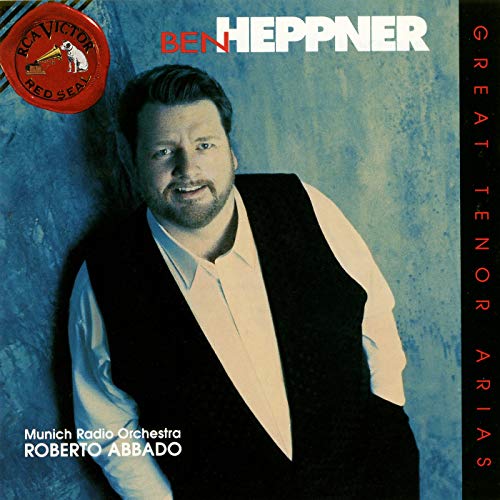
[RECORDING of Ben Heppner singing
Ch'ella mi creda from La Fanciulla del West of Puccini]
GJ: Hello, this is George Jellinek
in Chicago, and Ben Heppner may just turn out to be a tenor we’ve
all been waiting for, for all these years. Very, very talented,
and not only promising. By now that I feel Ben Heppner has
arrived.
BD: That’s from the new RCA recording,
which contains verismo arias from quite a number of roles.
As you mentioned, Ben Heppner might be a tenor we’ve been waiting
for. He’s been in Chicago, and we are glad to have him back
again. Now, George, you’ve been a student of voice, and voices,
and voice types for so many years. Is Heppner going to be one that
is going to stand up amongst all of the legendary tenors, and even the
not-so-legendary-tenors?
GJ: Certainly among the not-so-legendary-tenors.
As far his becoming a legend, maybe it is a little too soon to
tell. There have been many, many tenors who started out with
great promise, and somewhere along the line they leveled off and
did not fulfill that promise. The reason why I think that he
may have more to offer is that his career has been very carefully and
well managed. He was not pushed into anything. As a matter
of fact, I first heard about him some years ago from a gentleman called
Matthew Epstein, who’s an impresario and I believed managed him at the
time. Heppner was groomed as a Wagnerian tenor, and now as I can
see in addition to his lyric Wagnerian roles, he is extremely good in
Puccini, Verdi, and the mainstream repertory. He’s not going to be
rushed into Siegfried that Melchoir sang, and I think it will come in
time if it is what he chooses to do. But he is right now a very
good all-around tenor.
BD: Is this the advice you would
have for young singers — not to
take too much, too fast, too soon?
GJ: It isn’t I, it is a greater
authority than myself. Lauritz Melchoir was the one who advocated
that, and to quote him, because I had the pleasure of interviewing
him on his 80th birthday way back in 1970, he said that Heldentenors,
heroic tenors, are not born. They are made, and they have to
mature, and it takes time.
BD: One has to take a lot of
care to build the top to the voice?
GJ: Absolutely. Interestingly enough,
Melchoir started out as a baritone. His favorite saying was
that you have to have a foundation for everything, and he felt that
his well-placed low notes were the foundation on which he then built
the solid high notes. It may or may not work for every singer
but it worked for him.
BD: Shouldn’t every singer though
who wants any kind of local or international career have a solid
foundation?
GJ: Absolutely.
BD: Are there enough good voice
teachers around?
GJ: That’s a very, very tricky question
to answer, and, as a matter of fact, it’s a very timely one.
I just produced a program in New York, which will be coming to Chicago
very soon, called ‘Great Singers taught by Great Teachers’.
I selected twelve or thirteen famous singers who turned out to be successful
teachers, because they taught such people as Maria Callas, Renato
Tebaldi, Tito Gobbi, Nicolai
Gedda, and Martti Talvela.
I played the recordings of those singers, but it doesn’t mean that
every singer can be a good teacher. Some teachers who had virtually
no career, or certainly not international careers as singers, turn
out to be teachers of great singers, and you can’t figure out any
logic in this.
 BD: I would assume that a
singer who has a lot of natural ability might not be a good teacher,
because they really don’t know what they’re doing. It just
comes easily out of their throat.
BD: I would assume that a
singer who has a lot of natural ability might not be a good teacher,
because they really don’t know what they’re doing. It just
comes easily out of their throat.
GJ: Absolutely right,
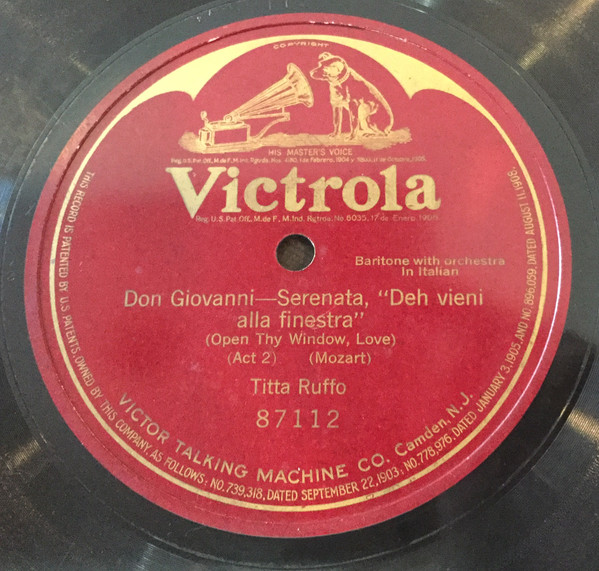
and the voice that you’re going to hear next, the legendary Titta
Ruffo, is a good case in point. He did not become a teacher.
He was a natural singer. Also, Pinza did not teach.
How can Pinza explain what he was up to? How could he teach someone
else to be a Pinza? You cannot teach them that.
BD: Next we’re going to hear
a recording by Titta Ruffo, which was made in 1920. Tell us
a little bit about this particular recording.
GJ: The reason I chose this particular
recording is that I remember that Tito Ruffo was associated for
many, many years with the great past of the Chicago Opera, and he
made some of his most appreciated and wonderful appearances here.
Back in 1913, he undertook the impersonation of Don Giovanni, and
a very esteemed local critic, Edward C Moore, in his book called Forty
Years of Opera in Chicago, mentioned that this was a role Ruffo
should not been allowed to sing! The chances are that he was
rather immature in his conception, but, as this recording indicates,
with a certain liberty he takes inserting high notes he could not resist,
you will find that you have a beautiful, really truly seductive-toned
Don Giovanni at work.
[RECORDING of Titta Ruffo singing the
Serenade, Deh vieni alla finestra from Don Giovanni
of Mozart]
BD: To those of us who know only
the modern recordings, this was a very unusual recording of the
Serenade from Don Giovanni, sung by Titta Ruffo, made in
1920.
GJ: No contemporary baritone
or bass could get away with that insertion. Conductors wouldn’t
let them, but I suppose they were freer times, and it did not happen
in the theater. It happened in the recording studio.
BD: How much freedom should the singer
be allowed, and how much control should the conductor exercise?
GJ: Difficult question.
The singer should not be allowed to depart radically from the written
word, in my opinion. Unfortunately, there are conductors who
interpret the written word very inflexibly, and they fail to allow
some singers to phrase with a certain relaxation, and the proper
breathing that music requires by adhering to a strict tempo. After
all, the metronome markings are also flexible. Many, many composers
reconsidered their original markings. They may have been found
too fast or too slow, whichever the case may be. There has to
be an understanding and an intelligent interplay with the singer and
conductor, and if singers have constructive ideas, I believe that conductors
should listen to them.
BD: Much of this, of course,
is tradition that is built up year after year, and production after
production.
GJ: Some of those traditions
are perhaps ill-founded, but you cannot just ignore tradition
that was born of experience. Some of the so-called liberties
that you find in the old recordings occurred when Verdi or Puccini
were alive. They attended rehearsals, and sometimes conducted
the performances. Frankly, whatever may have been good for
a Verdi or a Puccini in one of their operas should be allowed to
stay. I happen to know from personal experience that a gentleman
who was a student of Gigli was told that when the opera L’Arlesiana
by Cilea was new, and Gigli performed in it, the tenor came to the
composer and said, “Maestro, at a certain point
I sense this B natural is coming up, and I feel that the aria would
improve if I would do that.” Cilea replied,
“Beniamino, anything for you!”
Of course, he did it, and many, many tenors since have departed at
that junction, and created the very emotional high effect.
BD: So it’s the conductor’s job to make
sure that each person who puts in the high note is really worthy
of putting in that interpolation?
GJ: Yes, indeed. There are many
conductors, for instance, who deny the baritone the high G and
A-flat in the Prologue of Pagliacci. Many times audiences
feels let down, because even though those notes are indeed not in
the score, we expect to hear them. The baritone should be allowed
to sing those notes that the tradition has sanctified... if he can perform
them, if he can do them right. Otherwise, he should not attempt
to sing them.
BD: Let’s hear one more bit of
Titta Ruffo. This is music of Giuseppe Verdi, from Un
Ballo in Maschera.
[RECORDING by Titta Ruffo singing Alla
vita che t’arride
from Un Ballo in Maschera of Verdi]
 BD: Titta Ruffo, in a recording
made in 1912, now back out on a compact disc, so it’s been cleaned
up. This was music from Un Ballo in Maschera of Giuseppe
Verdi. You’re listening to The Vocal Scene with George
Jellinek, and my name is Bruce Duffie. George Jellinek is also,
happily, in Chicago, and he will be at Border’s Bookstore tomorrow,
Monday, beginning at 7 PM, to autograph copies of his book called History
through the Opera Glass, an entertaining and carefully researched
account of major events and personalities of more than 2,000 years,
and how the world’s leading composers have portrayed these people and events
in nearly 200 operas. [slight pause] We’ve just listened to
Titta Ruffo. Tell me a little more about him. You seem very
excited about this particular voice. [Note: Titta Ruffo was
born in 1877 as Ruffo Cafiero Titta.]
BD: Titta Ruffo, in a recording
made in 1912, now back out on a compact disc, so it’s been cleaned
up. This was music from Un Ballo in Maschera of Giuseppe
Verdi. You’re listening to The Vocal Scene with George
Jellinek, and my name is Bruce Duffie. George Jellinek is also,
happily, in Chicago, and he will be at Border’s Bookstore tomorrow,
Monday, beginning at 7 PM, to autograph copies of his book called History
through the Opera Glass, an entertaining and carefully researched
account of major events and personalities of more than 2,000 years,
and how the world’s leading composers have portrayed these people and events
in nearly 200 operas. [slight pause] We’ve just listened to
Titta Ruffo. Tell me a little more about him. You seem very
excited about this particular voice. [Note: Titta Ruffo was
born in 1877 as Ruffo Cafiero Titta.]
GJ: This particular voice started me on
record collecting almost sixty years ago, so I feel a personal debt
to it. I did not have the pleasure of meeting Titta Ruffo in person,
but when he died in in 1953, I wrote an appreciation of his art, and that
turned out to be my first article published under my by-line. That
was forty-two years ago, and it, in turn, led me to a lifelong friendship
with the son of Titta Ruffo, Dr. Ruffo Titta, who is now in his 80s and
lives in Rome. My article came to his attention, and he contacted
me in New York. Subsequently, my wife and I visited him in Rome,
and he came to New York some years later to visit us, and we became
lifelong friends. As you indicated, this artist means an awful
lot to me. I owe my beginnings to him.
BD: Now you, of course, heard him first
on 78 rpm records.
GJ: Yes, indeed.
BD: You have the sound of the
78s in your ear and in your memory. They were later transferred
to long playing records, and now have been put on compact discs.
Has the sound of the records changed appreciably
— or at all — from those
early days to now?
GJ: When I hear a Ruffo record, or a De
Luca record, or a Caruso record, regardless of how it comes to me,
part of my mind retains that original 78 rpm sound experience.
Some modifications were made, and depending on who does the mastering
at what studio, and what love and care goes into it, some of the mastering
of 78s emerged on LPs and subsequently on the CDs very insensitively, because
by eliminating the surface noise, they eliminated some of the brilliance
and the overtones of the voices. So, some of the characteristics
that we remembered from the original 78s have disappeared. I’m
happy to say that they followed a very good procedure here with this
particular Ruffo re-issue. I hear it minus the intrusive surface
noise, and yet much of that original magic is there. Some voices,
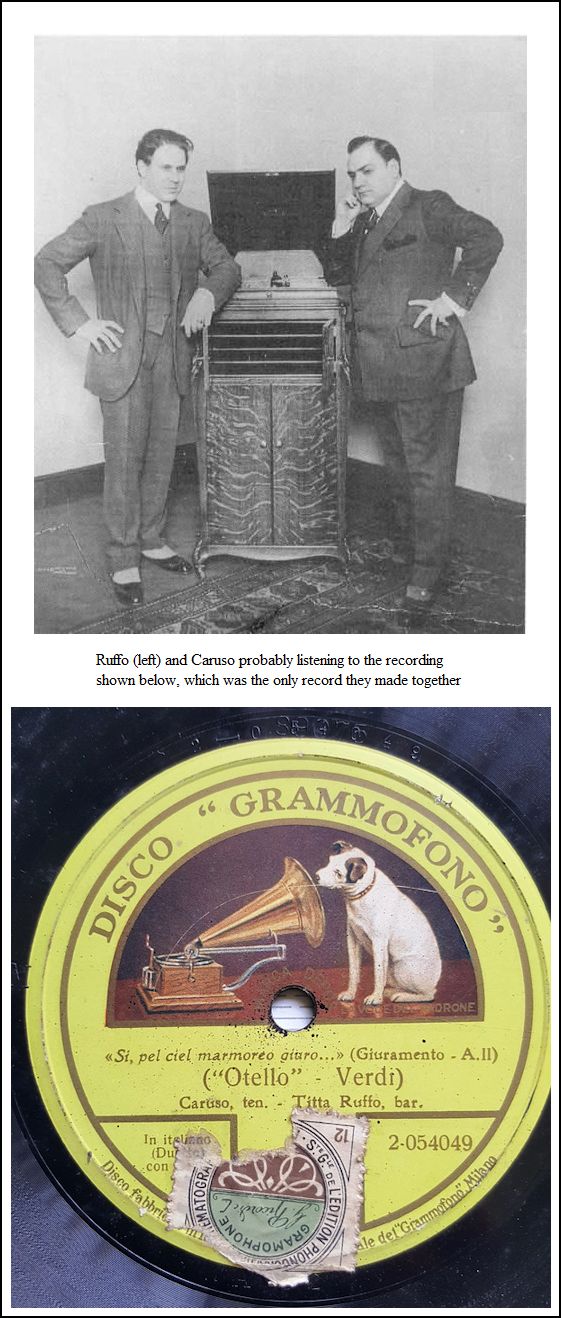
such as those of Ruffo or Caruso, recorded naturally, and they came
out. [In the photo at right, Ruffo is on the left, with Caruso
on the right.] Chaliapin, too, and Pinza. Some of the
women’s voices did not take to the original recording horn with as
much fidelity as did the men’s voices. I am not enough of a technical
person to explain why this is so, but overtones have a lot to do with
it.
BD: Even today, we have some voices which
we say ‘record well’. They sound better on the record, perhaps,
than they do in live performances... or at least they sound better on
their records than other contemporaries. Ruffo was one that
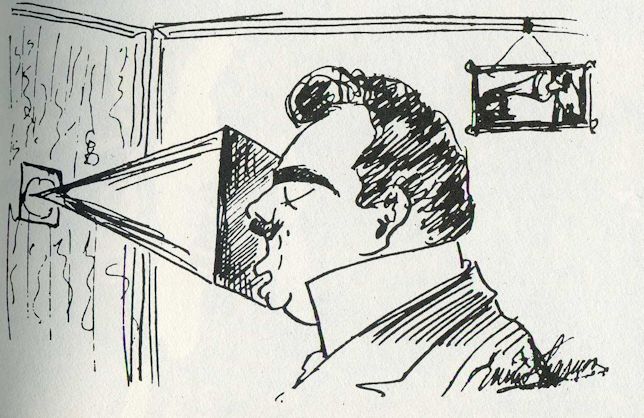
made a good impression on the wax, because these were acoustical records
— not sung into a microphone, but into the big
end of megaphone, and the sound cut directly into the wax on the original.
[Drawing by Caruso showing him making a recording is below.]
GJ: I spoke to a number of people
many, many years ago who saw Ruffo on stage, and they said that
he was just phenomenal in acting as well as singing. His was
a gigantic voice. I recently quoted Tullio Serafin, who conducted
opera for something like seventy years of his life, and, according
to him, there were three vocal phenomena — Caruso,
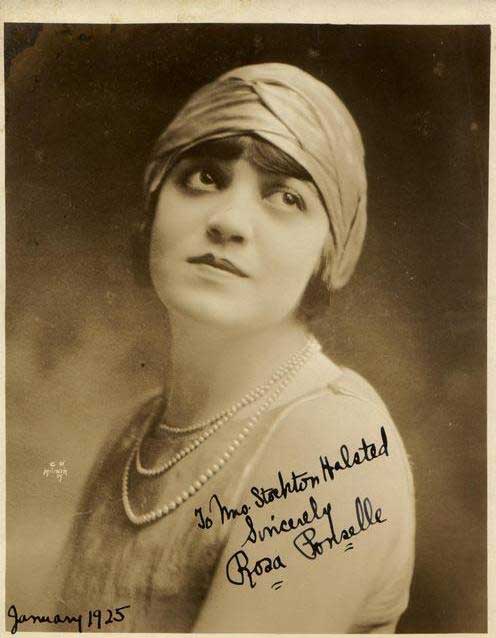
Ruffo, and Ponselle. [Autographed photo of Ponselle appears
above on this page.] The others were wonderful singers, but
these three were beyond comparison.
BD: Without mentioning names, are we getting
any vocal phenomenons today?
GJ: I would say that Marilyn
Horne comes close to that. She may be remembered as a vocal
phenomenon, but it’s too soon for us to judge.
BD: Talking about Ruffo, the sound
on the record is good, and also the sound in the theater was good.
Are we getting a continuation of a line from Ruffo through the singers
in the ’30s and ’40s,
and the singers who are the older generation today, and the younger
generation today? Again, you don’t have to mention specific
names...
GJ: I’d like to plead the fifth!
[Both laugh]
BD: One of the other singers
that you have decided to play tonight is Victoria de los Angeles.
Tell me a little bit about your special affinity for her.
GJ: She is no longer singing before the
public, but I regard her as a contemporary singer who achieved her
greatness in the ’50s, ’60s,
and part of the ’70s. No female singer
has given me so much unalloyed pleasure as did Victoria de los Angeles.
Her wonderful radiant personality manifest in her recordings, and
I was fortunate enough to interview her several times, and to share some
time with her. I found her vibrant and a lovely person, and I
suppose the personal association also enriched my involvement with her
recordings. Of all her recordings, I would say that the one you
are about to play is closest to my heart because it captures so much of
Victoria.
[RECORDING of Victoria de los Angeles singing
a zarzuela excerpt]
BD: That was Victoria de los Angeles singing
one of the Zarzuela excerpts for which she is so very famous,
from an EMI compact disc reissue. You’re listening to The
Vocal Scene with George Jellinek, a program heard each Sunday
evening during the seven o’clock hour here on Classical 97, WNIB
in Chicago, and WNIZ in Zion. Normally George Jellinek is on
tape and I can sit here in the control room and watch the tape go around.
However, at this moment I have the great privilege of looking George
Jellinek in the eye, and having a chat with him. George Jellinek
will be at Border’s Bookstore, at 830 North Michigan Avenue
— that’s at the north-west corner Michigan at Pearson
— tomorrow evening, Monday, September 18th, at
7 PM, to sign copies of his new book History Though the Opera Glass.
He has graciously decided to come and do his show live here at
WNIB this particular Sunday, and we are very grateful that he is here.
[slight pause] Since we’ve just heard a little of Victoria de los
Angeles, let’s talk a bit more about her.
GJ: She had a very unusual career, as
you probably know. She won a singing contest in Switzerland
at an early age, and she did what many singers who are trying to get
ahead in this very difficult life and career, she followed the various
leads. She even ended up in Bayreuth and did Elisabeth in Tannhäuser,
which was very well received, and made a wonderful recording of that music.
But eventually she found her niche, and became interpreter of French
and Italian opera, and a wonderful Lieder interpreter. When
I say Lieder, I mean German as well as the Italian classic repertoire,
and, of course, she was a fearless interpreter of Spanish music. She
was truly an all-around charmer.
BD: Is it the Zarzuelas for which
she is perhaps most beloved, simply because that is her native music?
GJ: Yes, but she never got around to record
a complete Zarzuela, because in her heyday, the record companies
did not think that a complete Zarzuela would be marketable internationally.
Right now, thanks to Plácido Domingo and Alfredo Kraus, we have
quite a few Zarzuelas, and they are coming to The Vocal Scene as well,
I’m happy to say.
BD: This is a little bit the
era of the Spanish singer. We’ve had the era of the Italian
singer, and the French singer, and the German singer, and now the Spanish
singer.
GJ: That’s right.
BD: You mentioned recordings.
Record companies can do a great job of recording and promoting and
preserving voices, but there’s also a flip side to this. Is
there enough of the good side to overcome the flip side?
GJ: One of the flip slides that distresses
me is how often and how quickly a major record company deletes an
otherwise worthy recording, or even make artists disappear from
the market. This is something that has to do with the curse of
bigness, because the sales department tells the A&R [Artists and
Repertoire] people that unless they sell X thousand copies in X amount
of time, then that recording should be removed from the catalogue.
The people who do the planning and the thinking are probably as distressed
by that decision as I am. But they listen to the marketing people,
and recordings go.
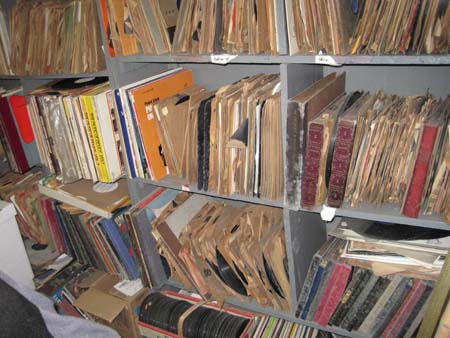 BD: [Being optimistic] But then when we
collect the recordings, we can be armchair impresarios!
BD: [Being optimistic] But then when we
collect the recordings, we can be armchair impresarios!
GJ: Well, this is what makes
collectors smart people. [Both laugh]
BD: That’s right. All record
collectors are smart people. You heard it here! [More
laughter]
GJ: Some of them are quite nice
people, too. I just completed a very entertaining hour devoted
to the Vocal Record Collectors’ Society in New York, and I had with
me two of their Board of Directors who claim that they are as mad as
the rest of the membership. We had a very entertaining hour talking
about — how shall I say?
— the eccentricity of record collecting, and the
people that this particular hobby attracts.
BD: I’ve been collecting records, as
you have, from 78s to LPs and CDs, but I don’t get involved very
much with collecting societies. So tell me, are the record collectors
happy that these are coming back on CDs, or are they keeping their
78s? What is the general thought?
GJ: I don’t think there are two
collectors alike. Some record collectors I know actually
sacrifice family life for the pleasure of collecting. They
have basements and apartments full of recordings, beginning from 78s
all the way up to the present, and there is no room for any kind of
a private life. This is a situation where a hobby can become a
mania, and I don’t endorse that at all.
BD: [With a gentle nudge] I
was going to say, there doesn’t seem to be downside to that...
[Both laugh]
GJ: It’s just that you have to know not
so much when to stop, but just how much your house and apartment can
take. I myself came to a very personal decision some time ago,
dictated by an important incident in my life, known as cardiac bypass.
I disposed of all my 78s in one major quick decision. I have
my LPs, and I certainly have my CDs, and as I find certain CDs have replaced
my LPs at a satisfactory audio level — in
other words, when I don’t feel I’m being cheated out of those overtones
that I cherish so much — then I have
donated a number of my LPs (hundreds of them actually)
to a worthy cause and to a library. I’m happy, and
I think most collectors are happy with CDs, because certain rarities
that they would spend a lot of money for on 78s and even on LPs, are
not available to them, and they’re enjoying a large variety of collectable
records on CDs.
BD: Do they miss having the twelve-inch
round flat platter?
GJ: You miss that experience as you tend
to look back on your youth, and to the extent that we miss our youth,
we miss that, too. But there is certainly a good side to modern
recordings because they give us seventy-five minutes on one CD,
and you can’t improve on that.
BD: Eventually CDs may go over
onto the other side...
GJ: Then you will improve on
that too!
BD: Records used to be round
and flat, and go around real fast, and have music on one side.
Then through all of the progress we’ve made, CDs are round and flat,
and go around real fast, and have music on one side!
GJ: I have this crazy dream that
someday they’ll invent a record that will stand still, and we’re
going to be running around them! [Both laugh]
BD: Of course, time doesn’t stand
still, and we have lots of fine singers to listen to today.
We’re going to hear next a soprano who burst onto the scene not too
long ago. Her name is Barbara Bonney, and
here she is with some music of Felix Mendelssohn.
[RECORDING of soprano Barbara Bonney singing
On wings of song by Mendelssohn]
BD: That was soprano, Barbara Bonney, singing
a song by Felix Mendelssohn – On Wings of Song. It’s
from a Teldec compact disc of Lieder. She is one who is
bringing back the idea that opera singers should also do Lieder.
Let’s wade into that just a little bit — the
idea of opera singers also singing songs.
 GJ: Opera singers should sing
songs if they know how to sing them. It’s very interesting that
you play this recording, because only last week in New York I heard
a concert for a special occasion, where a very good opera singer sang
this very song, and it was not done right. It did not have the
intimacy of what a song should have. It is possible for an opera
singer to over-emote when doing a song recital, and this is what they must
guard against. An entire different approach is needed. They
are performing different kinds of music. We have the example of Dietrich
Fisher-Dieskau and Elisabeth Schwarzkopf, certainly in the older days
there was Elisabeth Schumann and Lotte Lehmann. These were marvelous
opera singers who were song recitalists as well.
GJ: Opera singers should sing
songs if they know how to sing them. It’s very interesting that
you play this recording, because only last week in New York I heard
a concert for a special occasion, where a very good opera singer sang
this very song, and it was not done right. It did not have the
intimacy of what a song should have. It is possible for an opera
singer to over-emote when doing a song recital, and this is what they must
guard against. An entire different approach is needed. They
are performing different kinds of music. We have the example of Dietrich
Fisher-Dieskau and Elisabeth Schwarzkopf, certainly in the older days
there was Elisabeth Schumann and Lotte Lehmann. These were marvelous
opera singers who were song recitalists as well.
BD: These are the biggest names,
but was it more common then that many opera singers would give Liederabende
— song recitals — regularly,
or was it just those special few, as it is the special few now?
GJ: I would say it was always that
— a special few. There were always some
opera singers who were persuaded to do recitals, and they managed
to specialize in certain types of songs. For instance, in the
older days — certainly my time
— John Charles Thomas was a fabulous recitalist,
but he did not do German Lieder. He was a wonderful
recitalist for English, Scottish, even French song, because he had
excellent French training. As a matter of fact, he did some
Beethoven in English because he was so good at it, but you do not become
automatically a good Lieder singer because you are a good opera
singer. It’s wonderful if you can pursue these two careers in
tandem, but it doesn’t always work.
BD: How can we get more opera
audiences to enjoy song evenings? It seems to me there’s
a wide gulf between the opera audience and the song audience.
GJ: It is unfortunately so, and
some of that has to do with economics. Concert management is
somewhat distrustful of songs, as I’m sorry to say, is my own station,
WQXR in New York City. I cannot speak for your station here, but
there is a tendency not to program songs. I’ve nothing to do
with that policy, but I understand from the point of view of the way
they read the audiences, that songs and Lieder and canzone
command a smaller audience than does opera in this country.
BD: So we’re short-changing that
small audience?
GJ: I’m afraid we are. It is not true
in Germany, nor in Austria, and Italy is a special situation because
the Italian songs are something else again. The Italian songs
are very much in the province of anyone in the domain of the opera singer,
because who is to tell Franco Corelli or Luciano Pavarotti not to sing
Torna a Surriento, or O Sole Mio. That’s as much
in their blood as La Donna è mobile, so it’s a special
case. When it comes to French chansons, again an artist
like José van Dam is just as good in song as he is in opera.
Gerard Souzay was even a better singer of songs than he was of opera,
so these things vary with the traditions, I would say.
BD: You’re listening to The Vocal Scene,
a program heard each Sunday evening here on WNIB, and our special
guest, the host of The Vocal Scene, George Jellinek, who,
as I mentioned, will be at the Border’s bookstore location at 830
North Michigan Avenue. If you’d like to drop by tomorrow, Monday
evening, say hello to George Jellinek, and pat him on the back for...
how many years of The Vocal Scene?
GJ: Twenty-seven years in New
York. I don’t know how long it was heard in Chicago, but
for quite a number of those years.
BD: Probably most of that time.
GJ: This gives me an opportunity
not only to greet the Chicago audience of The Vocal Scene,
but also to express my deep appreciation to your station, and also
for the audience, because I’m getting some very nice letters from the
Chicago area, and I certainly appreciate it.
BD: We’re all very glad that you have chosen
to make vocal recordings your life’s work, and to present them and
to share them with us. Listening to your program each week, I’m
always amazed at the kinds of things you’re able to find and discover.
GJ: Thank you. It’s a labor
of love, and I think it radiates with every one of my programs.
BD: As we continue along, we
are going hear another up-and-coming singer. This is another
mezzo soprano who’ll be making her Met debut in the not-too-distant
future. Her name is Jennifer Larmore.
GJ: I am happy to say that she
has made her Met debut.
BD: Good. She, along
with Cecilia Bartoli, are perhaps going to be the Callas and Tebaldi
of the next generation.
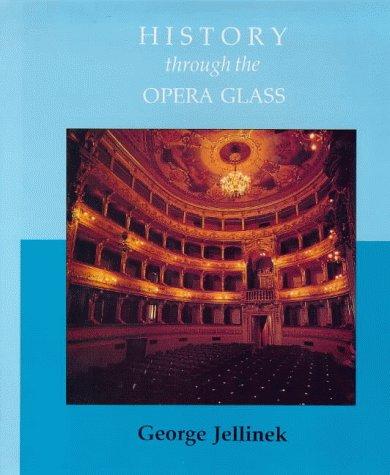 GJ: If the media will have their
way, they’re going to create a few dust-ups!
GJ: If the media will have their
way, they’re going to create a few dust-ups!
BD: That’s one of the nice things
about collecting records — we can
have both artists in ample supply. Here is Jennifer Larmore.
[RECORDING of Jennifer Larmore singing an aria
from The Barber of Seville by Rossini]
BD: Mezzo soprano, Jennifer Larmore, taken from
the complete recording of The Barber of Seville singing Rosina’s
aria. Talking a little bit about lower voices, do they record
better, or sound better, or are they just different on recordings
than higher voices?
GJ: They are just different, but with modern
technology they don’t present any kind of special problem. There
always have been singers who recorded better than others, but I would
say they record equally well.
BD: Is it a special joy that
the lower voices are getting the fioritura, and all of the
other coloration that the sopranos have been using for years?
GJ: For that you need technique,
and a very good example comes to mind, Samuel Ramey, who sings Rossini’s
fioritura with a grace and agility that many sopranos would
envy. As a result of that, on some of his recordings we hear
more notes that others bass voices in the past may have hidden from us.
But they’re there in the score, and Sam is in a position to deliver them
as written. A special agility in Italian writings for the voice
is required. You can do without it, you can simplify those lines,
but it’s wonderful when you hear them all as Rossini set them on paper.
BD: Is it the responsibility
of the management to take advantage of the voices that we have
available, and build the repertoire around them?
GJ: It’s not so much the responsibility,
but if they’re smart, they do it, and it has been the case in many
situations. There’s nothing new about that. We all remember
that Adriana Lecouvreur would have been a forgotten opera
had it not been for Magda Olivero and Renata Tebaldi. There
are many other examples with Marilyn Horne, whom I mentioned before.
Without her, certainly L’Italiana in Algeri would not have
been revived by the Met, and possibly other theaters. They
were all specialists.
BD: I was wondering which comes
first — the chicken or the egg?
If we have the repertoire, do we find singers to fill it, or if we
have singers, do we make the repertoire for them?
GJ: I think it’s easier to have
the singers, and then ask Madame So&So what she would like
to sing, because we know that we can fill the house with her.
[Much laughter]
BD: Aside from the biggest stars,
is there ever a case when the management actually asks what they
would like to sing?
GJ: I’m quite sure that there is, but it’s
a give and take situation. When you sign up a singer for two or
three years, the contract, and the price, and the purpose will have
the unwritten element there. They will do this and that if you
give them a new production of the other work. I see nothing wrong
with that, because we have very enterprising company in New York called
the Opera Orchestra of New York, which does opera in concert form.
These are rarely heard operas led by Eve Queler. She
made absolutely no bones about the fact that if she finds that commanding
singer — be it a soprano, baritone,
or tenor — who
is dying to do something that all managements have denied, she will accommodate
them. For instance, William Tell. Who is going
to stage five hours of William Tell with its murderous writing?
But Eve did it twice or three times over the last ten or fifteen years.
BD: Obviously, it makes for a
good sing.
GJ: Yes. She did it first for Nicolai
Gedda quite a number of years ago, and then for Franco Bonisolli. There
were many sopranos who excelled, and left their memorable imprint
in various roles that they could not do on stage, because the difficulties
are finding funding for very expensive operas which subsequently they’d
remove from the repertoire because they couldn’t find the right cast
for them.
BD: I know there have been cases
where the performance in concert has encouraged the opera company
to actually stage the work.
GJ: It happened time and time
again, even at the Met. For instance, Eve gave Rusalka by
Dvořák with Gabriela Beňačková in the title role. The
Met took their cue, and a couple of years later they did it. Eve
did Khovanshchina before the Met got around to reviving it.
That’s a very tough opera to do, but it was the desire of the
late Martti Talvela, and they revived Khovanshchina after many
years. It turned out to be an audience-pleaser.
BD: We’ve had it here in Chicago
a couple of times...
GJ: That’s right, you had
the fabulous Boris Shtokolov here years ago [in 1969].
BD: Something that I wish would
come back would be Der Freischütz by Carl Maria von Weber.
Here’s a little music of Der Freischütz. We’ve
heard Jennifer Larmore who’s a low female voice. This is Kurt Moll who is a low male
voice.
[RECORDING of Kurt Moll singing an aria from
Der Freischütz by Weber]
BD: An aria from Der Freischütz by
Weber, sung by bass, Kurt Moll. Unfortunately, that is all the
time we have for The Vocal Scene with George Jellinek, a weekly
program each Sunday evening. George Jellinek is in Chicago,
and has been my guest in the studio today. He will be at the Border’s
bookstore, at 830 North Michigan Avenue, at the corner of Michigan and
Pearson in Chicago, tomorrow, Monday at 7 PM to sign copies of his
book, History Through the Opera Glass. I’m sure there’ll be
lots of people who’ll want to buy the book, and say hello to George
Jellinek to congratulate him for all of the work that he has done.
GJ: Thank you very much.
I hope to meet some of you tomorrow at Border’s, and I want extend
my thanks to you, Bruce, to your colleagues, and to all of the
audience of WNIB in Chicago. It’s been my great pleasure
to be here.
BD: It’s a very special pleasure
for me. Thank you very much.
--------
--------
--------
---- ---- ----
-------- --------
--------
© 1988 & 1995 Bruce Duffie
These conversations were recorded in Chicago on January 7, 1988, and
September 17, 1995. Portions of the first conversation were broadcast
on WNIB in 1989, and the second conversation was aired live in 1995.
This transcription was made in 2019, and posted
on this website at that time. My thanks
to British soprano Una Barry for her
help in preparing this website presentation.
To see a full list (with links) of interviews which have been transcribed
and posted on this
website, click here.
To read my thoughts on editing these interviews for print, as
well as a few other interesting observations, click here.
* * * *
*
Award -
winning broadcaster
Bruce Duffie was with WNIB, Classical
97 in Chicago from 1975 until
its final moment as a classical station in
February of 2001. His interviews have also appeared
in various magazines and journals since 1980, and
he now continues his broadcast series on WNUR-FM, as
well as on Contemporary
Classical Internet Radio.
You are invited to
visit his website for
more information about his work, including
selected transcripts of other interviews, plus
a full list
of his guests. He would also like to call your attention
to the photos and information about his grandfather,
who was a pioneer in the automotive field more than a century ago.
You may also send him E-Mail with comments,
questions and suggestions.